Showing posts with label Brand-Martin Logan. Show all posts

23 November, 2011

Letter from NYC 2011 (21): Martin Logan

Letter from NYC 2011 (21): A Moveable Feast 
A Day with Old Timers

Revised December 2nd, 2011


I ask, how often are you unconditionally offered two full meals a day by your fellow hobbyists? Well, thanks to my friend AL, whose best-of-2010 system you may recall, that was exactly what I got the other day.

Aside from the royal treatment and the conviviality, what impress me the most is the undiminished enthusiasm these old timers exhibit, for audio as well as for music. AL and his friends are all my seniors, but they are all young at heart. I returned convinced that audio shall make us live longer, and more healthily. Here's a toast to you all!

Click pics to enlarge. L, the big lunch; R, the beautiful roomElectrostatic Old Timers
After a pleasant drive up the Palisades, my chauffeur AL, Lao Wu (Peter) and I were the first to arrive at the cozy home of Milty. We were soon joined by Al, Larry and Lao Tang. The hosts were effusively warm and engaging. Imagine, a shot of McCallan as greetings!

While we were feeling the sting of the mid-morning scotch, Milty's lovely wife was toiling away in the kitchen. The crowd was served a huge and delicious lunch of home-made barley soup, roast turkey and corned beef, washed down with two bottles of wine. We ate and talked for a long time, a little on audio but mostly on classical music and other sundries, during the course of which it was determined there are 4 Quad ESL users present, a majority. I must say it was the kind of long lunch that I really enjoy, and I cannot thank the host enough.

The host was proud of his sculpture in the center of the front wall, a smaller replica of the 2 century B.C. The Wrestlers (in the Uffizi). Close inspection shows excellent quality.

We had two sessions, a short one before lunch and a longer one after. We listened only to digital, mostly CDs and, unusually, a little DAD and DVD-A too. The sound produced by the unusual system, "augmented electrostatic" if you will, was wonderful.

The gears, roughly:
Analog: VPI early HW/Eminent Technology arm/Decca Gold (unfortunately not heard)
Digital multi player: Oppo 93SE
Preamp: Luxman CL-35 MkIII (restored; up to spec)
Electronic crossover: DBsystems
Amp: Parasound 2250 (old)
Speakers: Martin Logan CLS (with augmentation)

Sympathetic Vibrations Although Milty's ML is "full-range", for him, a music lover and avid concertgoer, it does not go low enough. To flesh out the sonic picture, with only minimal use of electronic crossover, Milty made elaborate use of surplus. The DBsystems crossover was used only for bass augmentation, to a Belles One amplifier for the low base, driving M &K double woofers with KLH 6 1/2 inch woofers (high base speakers). Interestingly, the small B&Ws were used to beef up the mid-bass a little. High frequency was augmented (connected passively with caps) by the Decca horns in the center (6 of them)! I am sure purists would frown upon reading this, but the great result speaks for itself!

Luxman CL-35 MkIII A word on this classic preamp, revered mostly but denigrated by some. This 70's preamp was likely designed by the great Tim de Paravicini (EAR). There is not much solid information on the net. Try this translated German website (original in German) for the spec's as well as some nice pics. Here I'd have to chime in. My previous experience with an early, and regarded, Luxman all-tube preamp (forgot model number) was not as favorable. It was just a little slow and not dynamic enough. Not so here. Perhaps it has to do with the restoration and of course the speed of the electrostatics. I'd not mind trying out this CL-35 one day.

Oppo 93SE It was great to be able to have just one player that could play everything, including DAD and DVD-A. But without a screen, we could not navigate to get some of these played. Sonically, Milty said he misses his old Meridian 508-24. The player is likely responsible for the little whiteness when the going gets rough.

Reassured Sound It would be a given that the MLs delivered utter transparency and fast transient speed. But even more impressive was the ability of the system to play loud. Integration of the large number of drivers were seamless. The DAD replay of the Classic Records issue of an old Everest classic, the exotic Corroboree of Australian composer John Antill (not to be confused for American George Antheil), was scintillating. Knowing I liked Bruckner, Milty took out his stack and we played both the new Jaarvi/Frankfurt and the old Jochum/Dresden; all preferred the latter. What an orchestra! The DVD-A of the second Kempe Ein Alepnsinfonie with the same orchestra was likewise a pleasure. Just as in the Alpine symphony, one has to make exit when daylight dwindles, so we bade farewell as it was getting dark.

DIY Paradise
Next we hit Lao Tang's house. His dedicated listening room is on the small side. Strangely, his wife decorated the room and the "hifi cabinet" and setup are unusual to say the least. For best sound, we opened the cabinet doors.

Digital Transport: Roksan ROK-DP1
DAC: Parasound D/AC 1600
Preamp: DIY 5998 with tube rectification.
Amp 1: Canary 300B SE monoblocks for high
Amp 2: Modified organ amp using 2x KT88 per monoblock, for low
Speakers: Celestion 662 inverted; tweeter replaced by Morel
Earphone amp: DIY 5998 with tube rectification (not auditioned)

Celestion 662 I was surprised by the full and balanced sound, with no booming even in the small room. The Celestion 662 surely was a quality (and expensive) speaker in its days, and is probably a tweaker's delight. It has 2x 12" bass units, one active, one passive, a 3" dome midrange and a tweeter (which most people replace). Whether it was classical or rock, the results were highly musical. The inverted placement likely helped to keep the bass clean. With classical though, it was also obvious the last degree of resolution was not there, limitation of the speakers. Even so, I was impressed by the cost-effectiveness of the setup and the quality of the DIY.

5998 According to Lao Tang, the quality of the 5998 as preamp/headphone amp tube is nonpareil. If I am not mistaken, the 5998 (made by Tungsol) is a close kin to the WE421A, and similar but not identical to the ubiquitous 6AS7/6080. Lao Tang is obviously an experienced DIYer, who concentrates on substance and not cosmetics. He eschews cathode followers and prefer direct outputs and OTL, hence his fondness for the 5998.

Home made Shanghai Cuisine As wonderful as the sound was, I have to say I was even more captivated by the host's cooking. He had apparently informally "apprenticed" himself to a chef uncle in his younger years, and it showed in his cooking. What a feast! The centerpiece was the ham and whole chicken soup 火腿燉雞湯, the stock of which were also used to braise Chinese cabbage 煨大白菜. Complementing the main dish was an immaculately prepared 四季豆, a variation on the dried string beans version (乾扁); and sauteed beef with home-made Shanghai preserved vegetable (雪菜牛肉). This was some of the best home-cooking I have had in a while! Thank you Lao Tang!

Many thanks to AL for arranging the delightful trip!
23 April, 2011

My Corner: Casual Listening in NYC

click on pic to enlarge

Letter from NYC 2011 (15): Setting Up (I)
My Corner: My Listening Stations in NYC (I) - Casual Listening

Talk Tuner: The wonderful McIntosh MR-71

Martin Logan Source redux

The Many Stations of Life
Last time I left NYC after we had just moved into our new apartment. I did the rudimentary setup of my dedicated listening room, dictated mostly by the large horns. I bought some racks and set up multiplt stations. You may ask why that many? Well, yes, I have always liked to be able to switch gears on the fly, but the reasons behind are mainly twofold: multiple stations provide better ergonomics for my various turntables; and horn speakers and panels have quite different requirements, difficult to fulfill by just a single set of equipment. As I have the number of gears required, why not?

The Casual Listening Station: Last, but not the Least
In terms of monetary value, this station comes a distant last, but in terms of use it probably comes first. In NYC I get up very early, in the wee hours, as described previously. As I drink coffee and work on my computer I listen to music at a very low volume. It's really too much of a luxury to have expensive WE tubes or the battery of the Nagra taxed for such purposes. To this end, I created my Casual Listening Station, one located right behind my listening seat and working table. The goal is to have relatively simple gears to provide what I need:

Analogue: Technics SL-1200MkII-Benz Micro Silver
Digital: Meridian 506-24 or Rega Apollo
Tuner: McIntosh MR-71
Preamp: ARC SP-9MkII
Amp: McIntosh 2200
Speakers: Martin Logan Source

Much of this I have described before. Despite the "marginal" existence of some of the gears in my cannon, this system not only excels in casual and low-level listening, it also serves as a "watchdog": the other stations have to at least equal the performance of this station to justify themselves, and it has not been easy, for a myriad of reasons! I shall make brief comments on each component in the chain.

The Source (TAS review)
I know, I have mentioned it many times: the Martin Logan Source just constantly amaze me (previous write-up's). They sound fantastic even at very low volume. The electrostatic panel and dynamic woofer are seamlessly integrated, and the latter plumbs depth that still surprises me. Unlike the Maggie 1.7, they are also small and narrow enough to stand in front of my large horns without undue negative effect.

Like the Magnepan 1.7 I had up a while ago before I fired up my horns, at first I had them placed in a relatively near field isosceles triangle of 6 ft or so. In this position, the imaging was not quite as big as the Maggies (not true when I had them much further in my old LR) and it took a little fine-tuning to achieve optimal atmosphere. With the Source relatively near field it is amazing how much the front end affects the size and height of the image.

Just 30 minutes later, I finally moved the Maggies out of the way. I was able to increase the distance between the speakers. It made a huge difference. The soundstage is now as wide as the Maggies and ambience is further improved. A trace of leaness with my vinyl playback also disappeared. I consider my setup nearly finished.

A Well-tuned Tuner Needs No "HiFi" Tuning
I acquired this McIntosh MR-71, one of the great tube tuners, a couple of years ago. Not quite true to advertisement, it was great in cosmetics but weak in performance. I had this aligned by a technician but never hooked it up until now. Wow! What a surprise! It was like having a completely different tuner, so much better the sound had become!

To tell the truth, I had not been able to tear myself away from this tuner, and to our wonderful WQXR. The announcers seem to be present in my room, in real flesh of the right size, making my speakers sound much larger than they are, equalling the image produced by the Maggies previously in the same spot. Imaging is wonderfully focused, and there is a superbly natural and palpable feel to all kind of music. And the stunning look; they don't make them like this anymore! We should give thanks that we are still able to enjoy analogue FM broadcast of high quality, and nothing does that better than a tube tuner in good alignment. Internet radio? useful but not even close in quality.

Technics Sl-1200MkII
I should put in another word to this workhorse. matched with the right cartridge, and the Benz-Micro Silver is certainly one of them, this is also another "watchdog" item in my arsenal. I am copying the use of this term from my friend AL, whose AR turntable has to be surpassed for any newcomer to be admitted. The sound from this TT is always clean and fun to listen to. It only loses to the tube tuner in body and flesh,but still outperforms the CDP handily.

Audio Research SP-9
Another word for this lovely hybrid workhorse too. Some say it has some transistor haze, but I find it just sounds neutral and transparent in the right system, and with the right tubes. It economically uses 1 6DJ8 each in the phono and line stages (I use Amperex Holland). The phono section in particular seems a great bargain. It's worth more than its low second-hand price for the phono section alone. It has enough gain and quietness for even medium output MC cartridges. An ARC preamp is also a perfect match for a McIntosh amp, be it tube or solid state.

McIntosh 2200
Under-rated musical vintage solid state amp with output transformers, stable down to 1 ohm. Perfect match for panels when used with a transparent tube preamp. Currently my only ss amp in NYC; why would I need more?

24 November, 2010

HiFi Letter from NYC 2010 (8): Rare Langevin preamp, Emergency kit, Sony DVP-SR200P, PR50P, Martin Logan Source and Linn Kan redux

HiFi Letter from NYC 2010 (8): Rare Langevin Preamp, Emergency Kit, Sony DVP-SR200P, DVP-PR50P, Martin Logan Source and Linn Kan redux

Bargain Basement Emergency kit
Actually this picture is no longer update, but that's really not important. What's important is the my continuous astonishment by the sound of my new room. Even a cursory setup of bargain basement gears necessitated by household circumstance reveals the sound to be very different from our old flat, from which we haven't yet officially moved out. Interestingly, in recent issues of TAS, Robert Harley is also chronicling the joy of the sound of his new room/house (also better).

The ML is placed a little more than 1/3 into the room, quite close to the sides (bookcases and LP storage), with some toe-in. While listing the initial setup I shall take the opportunity to expound on some of them, especially on their suitability as "emergency kit":

Analogue: Audio Technica AT-PL120/Grado Gold using its BUILT-IN phono.
Both the TT and cartridge are the greatest bargains in analogue land (as reported previously). The AT's more-than-competent built-in MM phono, which you can bypass, takes the phrase "plug and play" to a new level. No need to have a phonoamp! The TT may be discontinued soon, if not already; a new version is the same TT but adds USB facility. The Grado is supremely musical and its warmth is a good match with leaner direct-drives).

Digital: Sony DVP-SR200P
Cousin of the now discontinued and already legendary DVP-PR50P, which is sold out in HK, discontinued, but perhaps still available in Malaysia, where it was made. The PR-50P even garnered attention in Europe (Lencoheaven thread). Since the PR-50P is discontinued, some people started buying the SR-200P, which has a different look, i.e drawer vs top-loading, but the same digital parts, though now made in China. The SR-200P is available in the USA for as low as $25! I bought one in HK but only made a brief comparison between it and its more handsome predecessor. I think the PR-50P sounds more wholesome, the SR-200P leaner, but they certainly share the same sound and the SR-200P shall not be shamed by comparison with many much more expensive and "proper" CDPs, not to mention CAS. Interestingly, in the Amazon link provided above, reader Jake wrote that the SR-200P and hence by extrapolation the PR-50P are actually re-branded PHILIPS. Fascinating, no wonder the musical sound! I'd advise everyone to buy one for its infinite portability and giant-killer sound before the next model change, while still available!

Preamp: Langevin studio preamp
My dear WE friend brought this rare beauty for trial. This uses 6SJ7 (changed to 6J7) input and 6V6 output transformer-coupled, lovingly restored by 臺北的黃老闆. I shall write more later on this priceless item.

Amp: McIntosh 2200 and later the amp section of the Marantz 1120
Speakers: Martin Logan Source or Linn Kan

Roll Out the Carpets!
On my last trip I was preoccupied by the Magnepan 1.7 and did not fire up my Martin Logan Source. Hooking them up after more than 1 year of absence, and after some positioning and trials of toe-in (a must) I was floored by the sound they made in my new room. Although there were huge speakers 2 ft behind them, they carved out a cavernous soundstage that was way deeper than in my old compromised LR. The sound was also a little smoother and more luxuriant in the treble, while the bass was tuneful and well-controlled. In all aspects the sound trumped that in my previous locale. The speed, uncanny imaging and realism was a constant delight. The near full-range hybrid also provided much more realistic playback of orchestral music than what I heard from the many whimpy and even down-right odd-sounding old Quads ESL 57s and 63s in HK (except icefox's, and perhaps cpsjj's on vocals).

As I now have a pair of large speakers, I was thinking of selling them for space, but now I have changed my mind. After the renovation of the rest of our flat is over, I shall move the Maggie 1.7 in and have a comparison. It is not unlikely that I shall sell my 1.7 as I continue to prefer ML. What a bargain!

Since a lot of dust will be generated by renovation, in the next two weeks there shall not be electrostatics! I retired the ML just now and wrapped them up. In their places went my Linn Kan's on Sonus faber adjustable stands. Sound was surprisingly robust and bore a strong resemblance to what went before. There, must be the sweet spots. I ended up at about 28" height. BTW, I always think the so-called "ideal height of 24 " stands" for LS3/5As completely mistaken. No disrespect, but that height was probably determined by shorter people and are for short people. Having them higher brings our more flesh and realism. For me, I'd say anywhere 28" and 30".

My WE friend loved the PR-50P and after being impressed by my SR-200P again snatched it away from me. It shall be useful for him to take to customers' house when their systems need to be de-bugged. A customer of his was so impressed by the sound and look of his previous temporary loan of the PR-50P that he offered $200 for a $50 product, which my friend declined. I have asked him to do an A/B comparison in his small rig (Wavelength 6BQ5 SE amp and full-range speaker).

What is clear to everyone who has heard the new room is that the room is the real star! I must count myself a lucky man.

03 September, 2010

Review: MARTIN LOGAN Source

Review: MARTIN LOGAN Source

Supplements:
Further Notes: Fall 2009

Disclaimer
: If you don’t believe hybrids can work, don’t read further. If you believe Quad or Maggie or whatever looks flat rules, read no further. If you want to fight over what planars are best, get away! For those a little more objective, or less stubborn, a star is born.

A Tale of Two Drivers: An old colleague had a large hybrid ML which, because of wife factor, he placed close to the front wall, and that was a no-no. He bi-amped with Jadis Defy 7 and an Aragon. No, I’d never do that if that’s what it takes. However, even then, I heard many good things, and have kept an eye on this company. It seemed to me their products have steadily gotten better and better. Back some years ago, you could have heard quite a bit of ML hybrids in show conditions, but not any more, as ML, like other stats, is really a minority taste in HK. I remember a smaller ML floor-stander in a hotel room having one of the best sounds in the show, better integration than a lot of the Wilson’s, Dynaudio’s and quite a few of those horrid German speakers in the same show. However, labels are difficult to shake off, and “coherence” has always been an albatross on the neck of ML.

My discovery of this pair was due to Jonathan Valin’s review in the March issue of TAS. Now, I am rather neutral towards JV the writer, unlike a few others of TAS (like Steven Stone, who should just stick to desktops). What caught my eyes in this review were:

  1. Small footprint and rather nice styling.
  2. High sensitivity; 90 db.
  3. JV’s claim that the ML is the most coherent hybrid he has ever heard, with almost no discontinuity he can discern. That’s a tall statement, but from a man (and a magazine) who should know his planars and who used to own the ML CLS. He’s putting his reputation on the stake for this statement.
  4. Paper cone woofer (though you can’t tell by looking).

Searching for Godot: My friend E and I set out to find some place to hear this. Harvey’s is defunct but still maintains a “shop” in an unlikely lower Manhattan mall. They are dealer but the guy just dismissed all MLs, and none was on the floor. Sound by Singer, where we heard the Vienna Acoustics Haydn Grand and Focal Chorus 705/6Vs (all TAS editor’s choice), did not have MLs. So no luck.

By chance I saw a like-new pair on the web for sale and, after some emails, landed a brand-new pair at substantial discount! My friend E was really surprised as ML, like B&W, doesn’t usually discount at all.

Great Expectations: Two huge boxes arrived like a pair of Trojan horses, much larger than the speakers themselves. Power supply is via a small wall-mart like box not much bigger than a deck of cards, which never even gets warm, visually less threatening than Quad. There is a rear-firing port, and the woofer is located less than 1 ft from the floor (sans spikes), things that I usually avoid in my speaker selection, except this time. The manual is very well written, advising distance between the speakers and the front and side walls. I have no problem with the front wall, but have problem with one side wall, closer than recommended.

For the run-in period (manual says 72 hrs for the woofers) I had the right speaker virtually against the side barrier. The left speaker’s woofer is very close to the couch but its port is well ventilated due to the presence of a nearby corridor in the rear. And so, while the left side poses no problem, bass on the right was suboptimal at first, not helped that the classical music I listen to usually have a lot more bass to the right. Adjusting the degree of the port helps quite a bit. Although absorption supposedly does not work at low frequencies, I thought a large piece of cloth helped (maybe just psychological?). Sound in the mid-range and treble was startling good from the start, not surprising as suspense is in the bass. These are nominal 5 ohm speakers, with lowest impedance of 1.6 ohm at 20k Hz. This did not trouble my NAD 325BEE, nor the Marantz 8B, and had no trouble driving the Source to good level.

The bass gradually cleared up, becoming more and more layered. I moved the right speaker one ft more into the room and the bass cleared up further. Note that I did not install the spikes for fear of scratching my wood floor. Even then, for my loud listening level I find them satisfyingly coherent. Nor did the higher-than-normal cross-over point (470 Hz) seem to color any instrument.

After experimenting with toe-in, one can get superior dispersion (for stats), and I can sit anywhere and things still remain in the center. No, none of that tiresome move-your-head-a-little-and-hear-only-one-speaker thing. The images are tall, just like the MMG. My friend E auditioned this with me from the start and he, like I, preferred the Source to the MMGs for its realism and bass performance, even if the lean bass of the MMG is more room-friendly. Here I have to emphasize that I think whatever little problem the bass may have is due rather to the port and non-ideal placement of my right speaker. I don’t find the bass slow at all, nor do I think there is anything incoherent anymore than I may (and do) find in many conventional ported designs, or even “true” ribbon Maggies (which JV thinks are less coherent than Quasi’s). If anything, the bass performance outshines that of many conventional speakers. It goes deep and is rhythmic and walking when it should be. Even the droning bass guitar of Wilco’s A Ghost is Born cannot faze the ML.

How does the Source sound? JV said it best: “In a word, terrific. This is one very quick, very high resolution, surprisingly robust, wideband, and coherent loudspeaker, capable of making select voices and instruments sound as you-are-there ‘real’ as some multi-thousand-dollar big boys…” Sound is not as warm as Quad, but certainly warmer than Maggies. The spec’s of 42-22k Hz +/- 3 db is definitely on target, and you can still hear bass a little lower than that. I know there are people out there who think of Maggies as the most live-like thing out there. That’s simply not true. Although the imaging of Maggie is uncanny, that does not necessarily equate real presence, and in that department, good as they are, Maggies lag behind good horns, Lowther, Apogee, and Quad. Now, add ML to the list. It simply has a presence that the MMG does not.

Now, with one month on them (mine is likely equivalent to the usual person’s half a year), not only has the bass snapped into focus, the treble has also become that little bit smoother. I think they have completely broken in, and I think I can give this report with confidence. These are very revealing, yet never fatiquing as even the “true ribbon” Maggies can sometimes be. It’s like a marriage of Quad and Maggie, with the tonal purity of the former and the dispersion of the latter. Though, the soundstage has good depth but less lateral spread than Maggie, I feel the first class presence makes music sounds more like a live event, in a real hall, and not artificial “soundstage”. As I listen to to Perahia’s Mozart K453 (Sony/LP), I can clearly visualize him moving the keys with varying touch, as well as the string players leaning forward and digging in and, yes, the oboe sounds so real I recall CP’s unique ESL 57 sound. Yes, I have packed away my MMG for the moment. And even the SF EA-II is gathering dust.

Epiphany: I have saved the biggest surprise for last. I was checking out for my friend E his pair of Cary 300B Signature monoblocks. It turned out someone never bothered to adjust bias and one was run at close to 90 mA and the other at an unbelievable 125 mA, a testament to the excellent built of Shuguang 300B! Anyway, after adjusting them back to normal I hooked them up to the ML for fun. What do you know, perfect match! The presence factor was taken to the level of uncanny realism. Most amazingly, paino recordings really shone and that’s one of the highest accolades you can give a pair of speakers. Horowitz in Moscow (DG) sounds as full bodied as if it’s played on 15” JBL’s (if you don’t know it, the rendition of piano is a strength of big JBLs).

Big orchestral works posed no problem too. People who know me know that I listen at concert hall level. The ML acquits itself splendidly: Wand’s Bruckner 6th (RCA) is energized and has gravitas; Solti’s Shostakovich 9th (Decca) is all quicksilver and tongue-in-cheek. And yes, no super-tweeters nor subwoofers needed. Better leave those at your voodoo master’s place. After this, I tried the Sun Audio 2A3 (~2 watts), which did fine though the 300B amp’s inherently leaner bass and greater power provides a somewhat better match.

The other day, my friend M arrived when I was listening with E. M said, “Sonus Faber playing? Nice vocals!” That should say it all about vocals.

My daily listening now is the Source as heard through the very humble AES SE-1 300B amp, hooked up with Belden 9497. Even though it may be hard to find this lowly ML demo’ed anywhere, try to check this out if:

  1. you’re a SET amp fancier (but the dealer would surely not use a SET amp).
  2. you’re an electrostatic or other planar fancier, but not yet locked into the “XXX is best and there is simply no other choice” camp.

Keep in mind partnering is not a problem, but you need good and costly real-estate around the speakers. As with any speaker that has lowly placed woofers and rear port, clearance from front and side walls is a must. Even if your condition does not permit, these are great speakers that are worth a serious audition. At some point I also plan to audition ML’s new flagship, the all stat CLX.

Less is More: There’s an irony about the whole thing. Ever since I started listening to direct-heated triodes about 10 years ago in HK, all else have become secondary. I have always missed the sound of SET whenever I return to NY. This time I brought back my AES and planned on other SET amps to be used in my bedroom, as big efficient speakers are out of the question in the living room. The ML, with its small footprint, was bought to have a taste of electrostatics without attendant troubles. Little did I think these would prove SET-friendly. This shows the truth that there is always no harm trying, and once in a while you can be rewarded BIG. Now, SET is set (no pun intended) to be the main thing in my living room, though I have a suspicion they shall do very well at low level even in my bedroom. For me, that’s a bounty!

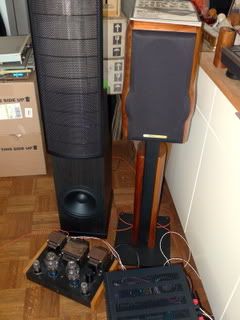
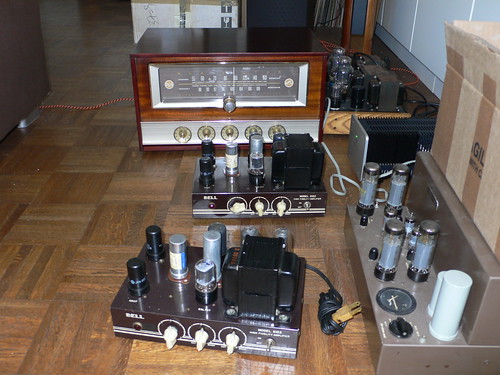
(See pic) The other day my friend E took his vintage RCA single-ended 6V6 receiver and it drove the ML Source beautifully, with no lack of power, though midrange was decidedly on the lean side. For fun I hooked up my pair of BELL 2122 integrated’s and sound was more mellifluous. Just for fun, we hooked up the Marantz 8B, which did fine too, though the sound of EL 34 PP cannot really compare with 6V6 PP in finesse and subtlety. All concluded that the ML works best with small powered amps, with SET delivering undeniable extra magic. And yes, I'd love to hear these with OTL's.

In the November issue of TAS, Robert Harley reviewed the Wilson Alexandria X-2 and mentioned its 95 db efficiency lends itself to being driven well by 50 wpc channel amps (like Naim) and outstandingly by even SET amps (he cited Lamm). In the wake of my recent experience with SET driving ML, I cannot help thinking about the mediocrity of many of the Wilson’s I have heard in HK driven by big amps. Perhaps they should try alternates, like what RH mentioned.

3 comments:

wesley said...

dj,

an excellent and informative review as usual, thanks for sharing.

it's good to have an open mind and i truly appreciate your efforts in trying out some much gears and reviewing them in an unbiased manner. it's probably because you don't do it for money.

regards,

wesley

Krishna said...

I bought Denon 3808CI. I have Martin Logan Source and Cinema in the fron. B&W 500 Watt subwoofer. I am having tought time make it better. anyhelp is greatly appreciated. I think I can make the system better by fine tuning.

doctorjohn said...

Krishna:

How are you placing the SOURCE? Placement is probably the most critical thing with this speaker. Too much against the wall can easily cause booming and that may make the addition of subwoofer even worse.

23 November, 2009

HiFi Letter from New York 2009 (3):

HiFi Letter from New York 2009 (3):

Spread them wider! Menage a Trois, ou Quatre!


If you look at the pic in my first letter you shall see the placement of the left speaker left something to be desired. With approval, a week ago I relocated the table to the middle of the front wall and the left speaker further against the sidewall. This enabled me to put the small bookshelves to the lateral side of the Martin Logan Source’s. I am still 10 ft+ from the speakers but the distance between the MLs and between the bookshelves now become a more respectable 7+ ft and 9 ft.


Needless to say, the soundstage became much wider instantly, and after adjusting the toe-in angle, there is no loss of focus. While the benefit to the ML’s are solid, the change made to the sound of the bookshelves, which shall be described in another letter, is nothing short of astonishing.


The Martin Logan Source

These continue to please me to no end. Its ability to run on good SET amps is a great bonus. The real strength is the ability to let the listener into the venue, meaning feeling like you're listening to the real musicians. In this, it is matched by few transducers that I have heard. Right now as I type I am listening to LP, Mahler’s Symphony No. 3 (LPO/Tennstedt), one of his most atmospheric. In III one distinctly feels the hushed atmosphere of the posthorn solo, and so it is the same in IV, where the singing by contralto Ortrund Wenkel is similarly atmospheric. No doubt the engagement I felt can be most appropriately attributed to ML’s exceptional portrayal of the leading edge (fast, but not too fast to stand out) allied to a full sound palette. The ML also makes most of the other speakers touted for imaging sound just that little bit manicured, even artificial. The palpability and real-life size decidedly trump the smaller Quads, which have trouble with tallness of image, not to say a realistic level of playback. I mostly play the LP pile I have just bought, but every time I slot in something familiar, like Van Morrison's Moondance, I am astonished by the experience of hearing something anew. I know it’s a cliché, but that is certainly how it is.


With its rear port and still less than ideal placement surprisingly I have very little bass problem. There isn’t significant bloating and I do not feel much standing wave effects. Perhaps I am just lucky, though I feel the 2 corridors behind the 2 speakers help a bit here.


A second station

After some toying around and running some other components for maintenance sake, the main system (for this visit) has been settled:


-Linn LP-12 (just upgraded from Valhalla to Lingo; report later) with Ittok 2 and Denon DL-304 (yes, changed from the Benz Micro Silver; report later too)

-Audio Technica 1200 turntable with Grado Gold and Denon DL-102 mono cartridges

-Linn Karik/Numerik (Linn cable)

-PS Audio GCPH phonoamp (Mogami)

-BAT VK3i preamp (thin WE interconnect)

-Almarro 6C33 SET amp (Belden 9497)

-Martin Logan Source


What’s the real reason for setting up a second system? Usually and ostensibly it is for practical reasons, like to have something in the bedroom. I suspect the true reason for some people is at least a trace of harbored ill-will for the main system. Avoiding the naked truth staring in one’s face, so as not to upset the weak psyche, one usually savors something different and usually lower in status.Just a thought.


If you believe me, my reason for a second system IS a practical one. I get up really early, like 6 am, and start to listen to music. Of course you can only listen at a very low level, though the system must excel at microdynamics. I could use the main system, but why burn up so many tubes? The second reason is to use it to test new toys. I set up a separate station close to where I sit, placing my gears on 2 coffee tables (see pic). After a bit of work, here it’s now:


-Revox 226 Signature (DIY solid core cable of thin gauge)

-Pioneer PL-10 with cheap AT cartridge (my first TT)

-High Resolution Technology Music Streamer (PC running iTunes/Wav files)(cheap Audioquest)

-Sony XDR-F1HD “digital” tuner, with HD capability (useful in the USA)

-ARC SP-9

-Almarro EL84 SE amp (Acrotec) or NAD 325BEE (used as power amp)

-Linn Kan or Focal Chorus 705V on Sonus Faber adjustable stands.


With the new positions of the bookshelves, the second system is functioning splendidly. I had a hard time with the Focal Chorus before, but they are fine now and deserve a separate report later. The Linn Kan (version I) I just got and it was plug and play. The system now achieves a very good level of transparency even at very low volume. But it is surprisingly dynamic at high volume, with images tall and fleshed out. It took a bit of work and the experience is worth also a separate report.


A bedroom system is also half finished. Stay tuned.

06 November, 2009

HiFi Letter from New York (1): Martin Logan, Jetlag

(pic taken in the wee hours)

HiFi Letters from New York (1):

Martin Logan Source redux; Jet-lag


JETLAG (and how to make the best of it)
and mental stamina
As one grows old, flying long-distance becomes more of a chore. In my case, jet-lag is more severe than in my youth. I wake up at 3 or 4 in the morning and try to kill time by catching up with my Stereophile, TAS and American Record Guide subscriptions. Then I make some coffee and have breakfast.

What does one do when one is in physical decline (and you know what I mean I presume)? One compensates by fortifying one's mental attitude, honing one's technique, to better focus on the task at hand, and to be more efficient. As it is with most things in real life, the approach to hifi and music is the same for me.

In the past, I'd just putter around doing nothing for a few days. Not now. Older people with less time left should gear up, not down. I arrived at night and after barely any sleep started building my hifi setup from the ground up early next morning. You may not know this: I dismantle my hifi every time I leave, so as to give my mother more space.

I give my gears some rotation. Last time I did not take out my Martin Logan Source. This time I did the big job, dragging the big boxes out and setting them up. Some of my gears, including my beloved BAT preamps, were on loan to my dear friend M, so I started with the following:

Digital: Linn Karik/Numerik; Rega Apollo (connected by Linn generic cables)
Vinyl: Linn LP-12/Ittok/Benz Micro Silver; Audio Technica 1200/Denon 102 (mono)
Preamp: ARC SP-9; PS Audio GCPH
Amps: Almarro 318B; NAD 325BEE (used as amp)
Speaker cables: Belden 9497 and Mogami

After hooking them up I went out and bought myself a roll with bacon and egg. Sipping strong coffee and satisfied with my hard work, I started my first serious listening session. The speakers, having been idle for a year, took some time to wake up. Ditto my other gears. Placement also had to be gradually evaluated, especially the toe-in angle of the curved panels.

For those of you who have followed my Blogs, you'd know I rate the Martin Logan Source VERY highly (see my extensive original review; now that you have the pic here you can visualize my placement limitations better), hmmm, higher than many Maggies and ESLs. By the second day, the Martin Logan Source was performing its miracles. I started my listening with CDs. Talking Heads' More Songs About Buildings and Food, which I was listening to for the first time, was so richly textured that it literally stopped me from eating breakfast. A great recording of masterfully arranged songs, if you can take a full dose of David Byrne's vocals that is. I then put on Van Morrison's Moondance and was yet again surprised by the presentation. You see, I know every song of this masterpiece inside out (but have never heard it on the ML), yet almost all instrumental touches (of which there are many in the rich arrangements) have a different presentation from what I had known before. Most of this can be attributed to the speed of the stats, which when implemented correctly give you a fast but natural leading edge that is more richly nuanced and very different from that rendered by dynamics. I say "when implemented correctly" not to praise my modest efforts ("basic" is frequently the best) but to say that quite a few people I know had ruined their panels by partnering them with highly esoteric and costly gears (notably cables) which unfortunately instantly and negatively color the sound.

While the sound was wonderful, two things began to strike me as somewhat different from before. The first is a good thing: the bass seems even more tuneful than before; the walking bass line has even more of a boogie factor and I became more aware of rhythmic subtleties, particularly with the pop albums. That was the good part.

The Source as revealed by The Source
The second thing nagged at me for a couple more days.I was diligent and had gotten out LP-shopping. I played a few on the LP-12 but the slightly rough sound just nagged at me. It was not quite on the level of the CD playback, and that wasn't the case before! I had installed the Benz Micro Silver just before I left NYC last time. It is not broken in but I remember the sound last time had more brilliance to it. This time instead of brilliance the treble just stood out a little too much and was actually grating on some LPs. I made changes which unfortunately did not ameliorate things. Perplexed, I checked the cartridge again. It was tracking at 1.5 gm. I checked the manual which says optimal weight 2 gm! So in haste at set-up I had not given it enough weight and my system did not reveal it last time! I re-set to 2 gm and played over the LPs that bothered me. BINGO! that unpleasant leading edge was gone! If you have ever listened to Francescatti you'd know what a little over-representation of the treble does to your ears!

While we're on this, don't you think most hifi systems we hear mis-represent the violin? More often than not, we hear the strings but not so much simultaneously the vibrating body. Not so with the ML. Every instrument captures your attention with its unique signature. You don't find yourself dwelling on just the upper strings in a symphony when the winds are also playing. Every solo receives its due. Despite the somewhat limited soundstage, things just seemed a lot more real than, eh, say, most dynamics and, eh again, Maggies. Should I be clearer? Well then, the ML sounds more real than the Maggie. The interesting thing is, the reality portrayed by the ML is more than a little reminiscent of the horn speaker!

One day I played the LP of Bohm's live Daphne, which I just picked up because of a superb photo of Hilde Gueden on the cover. I was stunned by her vocal portrayal, surely amongst the best Strauss vocals I have heard. This is not the greatest sounding recording, but it is clear enough. Most importantly, the ambience of the theater, and of the electifying orchestral sound emanating from the pit, was rendered in all its glory by the truthful transducer that is Martin Logan.