Showing posts with label Brand-Pass. Show all posts

26 September, 2022

Nagra VPA MSA Quad 77 909 Pass F5 Pamphonic 3000 Tektron

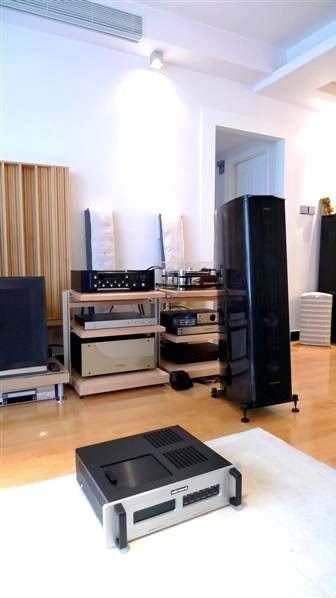
Click pics to enlarge. Top, One of the Author's many setups. Nagra PP 300B amp in center; VPA monoblocks flanking it, all driving the Tannoy Yorkminster.

Letter from Italy (22-3): M Surdi on What Make His Tannoys Tango

Editor: There is so much I agree with and want to comment on, but I want to preserve the densely textured wholesomeness of M Surdi's writing that I shall refrain and perhaps later write a companion article. Keep in mind his room is fairly big.

Previously, M Surdi wrote on his long Tannoy journey, an article not to be missed (here). The current article discusses the electronics matching during the long period.

We may take it as a given that all audiophiles are OCD afflicted. However, even terminal maniacs must balk at a blow by blow description of the decades long pairing of the four sets of Tannoys I have described in my previous post - some 25 different power amps and integrateds (and that’s keeping preamplifiers out of the mix).

Any credit accorded to my musings should also take into account the fact that musical proclivities may change with time. As an archetypal Sixties survivor, I’ve travelled the usual boomer arc from rock to baroque, Animals to Allegri, ZZ Top to Zelenka, and most alliterations in between. The Tannoys caught me in mid-journey, when punch and drive (represented by Tina Turner belting out Acid Queen, on AR-LST’s no less) were gradually giving way to midrange, proportion and all-around tone. This obviously had an impact on amplifier choice and preferences (though Biber’s Missa Salisburgensis is no chocolate box affair).

That being said, in order to cut through product clutter, I’ll be passing my judgments by amplifier categories: transistor, class AB to A; tube, push pull to SET; and class D; with some final comments on bi-amplification. With the intent of keeping things from getting even drier I’ll also be throwing in some gratuitous comments on mismatches and quirky combinations. Not, however, before raising Two Useful Signposts: best amp ever heard on Tannoy’s are the Nagra VPA monoblocs, hardly a surprise since these are the best amps I’ve ever owned (and sold off because of serious mental issues). Worst amp, and by a long chalk, is the noxious Meridian 551, a high powered sand amp which in conjunction with the equally toxic 501 all digital pre was so bad that even patriotic British reviewers could only hang their heads in shame.

Now, to Sand Amps and Current Capability. It is a well known fact that dualcons are current friendly, paper sensitivity figures notwithstanding.This is due to the unavoidably exacting 2nd order crossover, which is not the easiest of electrical loads. Trading quantity for quality however is a generally unwise gambit and dualcons are not shy about revealing grit and glare. Worst case scenario is represented by the previously denounced class AB 150+ watt Meridian (on the DMTs), which exhibited glassiness to rival the entire window surface of the Burj al Khalifa. On the other hand the most memorable sandamp pairing was obtained with the equally class AB 50 watt Nagra MSA, (on Yorks and Cants), a combo so good that it beat out my reference, 20 watt class A Pass Labs First Watt F5. It may also be noted that the Yorkminster-Quad 909 pairing was unimpeachably endearing, to the point of setting something of a record in the price-value sweepstakes. Quirkiest solid state combination (with the DMTs) was the obscure Ariston Amplifier, a Scottish OEM Nait wannabe, which substituted the cheap Naim volume pot with an even cheaper and nastier integrated chip. Not too bad really but inferior to Stan Curtis’ equally IC kneecapped Quad 77 integrated. Not recommended finally would be pairing the otherwise patient DMTs with the dependable Mission Cyrus 2. This supposedly safe combo produced bass mooing which would have done a herd of Angus cows proud. Even Tannoys get the blues sometimes.

R. Pamphonic 3000.

In my experience Tube Push Pull is the default configuration for dualcons. I’ve had this architecture in anything from giant 845 transmitting triodes to midget ECL 82s, along with pentode, beam tetrode and strapped triode combinations, with results that have consistently achieved both current delivery and tone quality - with one noteworthy exception: I really do not recommend the extremely popular Leben 300 with the Cants. I own the 300XS version, expensively retubed with Blackburn Philips EL 84s, Blackburn Mullard ECC 83 and JAN 5751 drivers. The Leben is expressly designed to accommodate both the high gain ECC 83 and lower gain 5751 twin triodes, but exhibits notable transformer induced hum with both of them. This is due to a defective layout which I would ordinarily consider a deal breaker, were it not at least partially redeemed by an excellent build and a singularly captivating sound. The mains derived hum is nonetheless unbearable using the high gain Mullards and weaker, but still obnoxious, with the 5751. A pity really, but there it is. Quirkiest tube configuration was with my father’s late Fifties Pamphonic 3000 integrated (on DMTs, Edinburghs and Yorks). Not the last word in cone control but well provided with musical as well as sentimental value. Single Ended Triode setups are where the rubber meets the road when evaluating dualcon compatibility. Somewhat contradictorily, SET amps are designed for simplicity but discussion of their performance quickly gets complicated, so I’ll give you the short version first. Can you, should you use SETs on Cants? The answer is yes, but. And it’s the but part that needs some delving into. The issue here is performance vs.power. To put it bluntly, the lower the power the more immediate the result, but what you gain in sheer musical communication you lose on dynamic swings. My SETs are custom made to my specs by Tektron of Italy (disclosure: yes, I am friendly with them). I pigheadedly favored 2A3 and 45 DHTs driven by 6J5 single triodes (look Ma, no 300Bs). This means that on a good day I can get a whole watt out of the 45s, almost, and a whopping 2 watts out of the 2A3s. Leaving aside preamplifier and tube options, which could be extensively discussed elsewhere, this means that ideal results are content dependent on music played. Turning to boomer alliterations again, both acoustic Dylan classics and De Rore quintets easily approach perfection. Janis Joplin’s Pearl on the other hand, or my favorite Alessandrini version of Monteverdi’s Vespro are tremendously enjoyable, but while Janis’ voice is truly heartrending and the baroque violin passages almost unsettlingly moving, the rhythm section behind the voice has no propulsive strength, and the violin vaulted spaces are merely alluded to. You want those, you need my 20 watt 300B push pull Nagra amp. Volume is not the issue here - I can easily fill my 50+ sqm listening room with the 45s, nor are microdynamics, but macrodynamic contrasts are muted, and tube rolling is not that helpful. And the Missa Salisburgensis is really not a thing. This also begs any technical discussion of the ever varying effects of cetacean output impedances, even with dedicated 8 ohm tap only trannies. Listening to SETs is an (educated) ear‘s first proposition, and as such gladly accepted by the Canterburys. As to quirks I fondly remember my first elephant driving flea, a Tektron ultra minimalist 6EM7s desk amp which sold me on the whole custom SET concept (reported on 6moons). 

L. Tektron 2A3 amp.

Class D, or chip, amps are easily disposed of. I’ve used Trends Audio and Amazon ordered 60 bucks SMSL thingies to excellent effect, thus faithfully replicating Dr. John’s impressions (here). As far as I’m concerned, when budget considerations intrude, go for the Cants and click the SMSL 36 Pro for an apparently lopsided but actually very well reasoned allocation of funds. Always assuming audiophiles have any familiarity with reason, of course.

About Biamping now. Dualcons are excellently suited to this and I‘ve rigged twin Quad 909s horizontally on the Yorks and tried out an extreme horizontal setup on the Cants using 45 SET monoblocs on the highs and a SET 2A3 two chassis stereo on the lows. Also quite recently, to purge myself of this excess I’ve vertically amplified the 15 inchers with two SMSL 36 matchboxes. In all instances the effects were as expected, expanded soundstage and different, though not necessarily superior, bass articulation. A possible improvement then, but to my ear not worth the hassle and the danger of 16 plus cables lying around. Also, the larger soundstage may, or may not, have been paid for with a minute loss of immediacy.

All in all, less is more to my fusty 20th century taste. Lastly and leastly, the obligatory mention of cables. Though I generally biwire lately I have fallen into the habit of single wiring my antiquarian SETs with Belden 9497 as a philological tweak, this despite my having penned a few years ago (here) some pricelessly witty, if ever so tolerant, remarks on Dr. John’s predilection for the very same cable.  Must be a lesson for us all there. (Editor: LOL. It's so wonderful that because of that we actually became friends!).

10 October, 2009

Home Visit: La Scala redux

(click on pics to enlarge)

Home Visit: La Scala redux

I should have done this much earlier, but fortunately it's never too late. Quite a long time ago I met conrad2002 and learned that he, like me, is a Klipsch La Scala user. Recently I called him up and he said his setup does not sound good. A few days ago, before a group visit to Andy L and Simon in 錦繡花園, Andy L and I paid him a visit and instantly proved that he was far too humble. Setup:

Digital: Metronome
Preamp: Pass Lab
Amp: Sun Audio 2A3 using Full Music 2A3 and GT 6SN7
Speakers: Klipsch La Scala (later non-alnico) with midrange horn replaced by EV; Tannoy "supertweeter"
Cables: All very cheap

Once again, it proves that the La Scala benefits from corner placement. The corner is part of the folded horn we should remember. The bass is excellent, full and agile. Many years ago, Leo Fung in 音响之路 advocated the use of 10 tricks to augment the "insufficient bass"of La Scala, but that was only because he had the speakers way into the room to get more "soundstaging".

The simple but effective setup has stunning clarity and presence factor. With full-bodied sound that sounds like the musicians are in the room one does not even think about artificial soundstaging. I am convinced that the Electrovoice horn contributes a lot to this great sound. The horn is unusual in that in addition to the direct front-firing central small horn, the back-firing sound is directed into the larger outer horn. driver (I should mention the same La Scala midrange compression driver is used). The "percussion" Carmen was sonorous and crystalline in clarity. The midrange is very slightly lean on vocals, possibly due to the ss preamp, but no mistake about it, the setup is marvelous and what a horn setup should sound like! With an efficiency of 104 db, I doubt the lower-efficency Tannoy tweeter is making much sound at all.

A humble system that puts many hi-end setups to shame. The Persian is just as lovely!

23 September, 2009

The Yumcha Diaries: 19-09-09


The Yumcha Diaries: 19-09-09
大而有當 系则成统

Part I: 大而有當--HiFi 精 A--First Encounter with Goto Drivers
Last week, we were glad to see two more surprise guests at yumcha and the pentagon promptly forgot about the terrorists and had a good time bonding. Afterward, three of us went to re-audition the famous setup of Alansoo (aka HiFi 精 A), which needs little introduction. It's been a while since I last visited, and now much has changed. I forgot to bring my camera, but despite some lapses I still hope my report is richer in details than what pass for hifi reports out there (almost only pics). Briefly, the gigantic setup uses 5 amps (some details may be erroneous; forgive me, given the complexity) :

Horn system: TAD 2401 + (18"?) JBL woofer + 1x GOTO (super) tweeter + 2x Pioneer (super) tweeters. No electronic crossover is used.
Digital: ARC CD-7
LP: EMT 950
Preamp: Bruce Moore tube preamp driving
(Super) tweeter amps: Russell (according to Alan precursor of Final) and something else I am blocking.
Midrange amp: A very nicely made 300B amp using 5U4 rectifier and 6SN7 drivers and Tamura trannies.
Bass amp: Parasound
(Sub) woofer amp:Professional Class-D amp; forgot name

First, let's not mince words. This is a heck of a system, as you ALWAYS expect from this man. It was so good I almost didn't go upstairs to check out his museum (listening to the top-of-the-line Kuzma shall have to wait till next time). From a whisper to a full orchestral cry, sound was much more effortless than previously, when Alan didn't use so much power. From Kogan's violin to jazz, everything has the proper scale.

I just got my Shura Cherkassky Liszt Hungarian Fantasia CD (LP heard so effectively at 珠寶梁's place; The LP may be hard to find, but the CD is not freely available either. This performance by the great pianist is buried in a 2-CD Liszt album. Click for full info).

Yes, this is not the LP, but the piano sound is rich and full-bodied, and appropriately big in size! Wonderful! I urge you to get this one.

My attention was particularly focused on the rare and VERY expensive Goto drivers, of legendary status and the dream of many horn buffs. I do not care whether they are Titanium or Beryllium, and no matter since the sound was very beautiful and smooth and I was not aware of an edge or any grain, rare in my experience with supertweeters. Info is very hard to come by on these drivers; try the following links:

6moons article on Goto
Goto USA/check out Flash pics
Great Goto horn systems; Note the metallic tweetrs
Alan told me he suspects the $300K Magico Ultimate II uses a Goto tweeter.

If you know of any good Goto websites, please let me know!

Sound was remarkably coherent given 5 amps were being driven. Each amp has its own volume, and I am sure Alan had spent a hugh amount of time adjusting the knobs! If a slight dryness remains, I shall attribute it to the speakers themselves. If there is any loss compared to previously, when I heard just the 2401 driven fullrange by a single amp (and different components) sound might have been just a tad (not punt intended) more coherent then. But given the enormous gain in dynamics I'd say the gargantuan effort has been worth it. How many times have you visited million-dollar big setups that are 大而不當? Alan's setup is not THAT expensive, but it sure is 大而有當 and Goto is surely Ichiban!

After that I went to visit yet another smaller but meritorious setup...

Part II. 系则成统--When Amati meets SME

Photo of the setup borrowed from here. Go to link for more pics. Note TT is now different.

After Alansoo I was joined by 2 more friends in a visit to simcity. This was my first visit to his beautiful new home, the interior of which was all designed by himself.

I have known simcity for quite a while. To me, he has a good ear and can instantly tell you what he thinks. One evening long ago, when he and some other friends came to my place, we were switching components and I found myself in agreement with most of his comments, all instant and on the fly. Previously, he had a rather small LR yet the sound was reasonably balanced. The current setup is as follows:

LP: SME 20/2A with SME V arm/Benz Micro Ebony
Phono preamp: Pass lab XP-15
Digital: Mark Levinson transport into Orpheus DAC
Preamp: Conrad Johnson Act2
Amp: CJ Premier 350 ss amp
Speakers: Sonus Faber Amati

Much of the setup has changed over time, but his loyalty to Conrad Johnson remains. In fact you can go to his thread in R33 (打做我的影音天地) to see detailed description of his CJ love story and previous gears.

We warmed up by listening to his digital setup. From the first instance, and unlike some of my previous encounters with Orpheus, sound was warmly musical, with good rhythmic and dynamic integrity and fine tonal balance.

Sonus Faber is a brand I have always admired and I miss the Concertino and Signum that I have sold previously. Luckily I still have a pair of Elector Amator II in NYC, still the best transducer for massed strings that I have heard. The Amati, much like Cremona, is not an easy speaker to get right. This pair of Amati is likely the most balanced higher-model SF floorstanders that I have heard. Its seamless balance and musicality is taken for granted, but what was really surprising was the deep bass, tight and qualitatively right even if the listening diatnce is quite on the short side. simcity told me he went through much trial and error, and that the sound was dreadful at first. If you have trouble with SF, you might want to chat with him, for it sounds great now! The balance was such that we enjoyed all kinds of CDs without encountering even a wink of discomfort.

Althought the SF Amati seemed to be the star of the setup, and much as I admire these speakers, for me the show was stolen by the SME turntable, which we listened to only after one hour.

In a world of rampant re-packaging, boring sameness, overkill and much ugly acrylics (your esthetics may vary), the understated SME Turntable 20/2A is a breath of fresh air and rather uniquely designed by the legendary Alistair Robertson (click for details in damping and the use of an elaborate set if industrial O-rings as suspension). For me, the no-nonsense industrial look and sensible footprint strike just the right chords. All of this would not matter if the sound were not so fine!

Against a very quiet background, from the first time the stylus touched down on the LP surface, we were served analogue playback of the highest quality. Clean, fine tonal balance and refinement, and excellent PRAT (rhythm and pace). The last is particularly of note, as SME V arm (even the SME TTs) has an undeserving reputation of being rather lacking in life. In my experience, this is true in the case of the Oracle's that I have heard, but I have also heard SME Vs work very well with Michell Orbe, Garrad 301 and, now, SME TT itself. The sound also held fast impressively; no matter how loud we played sound never broke up and there was a sense of supreme confidence. And all this with Benz-Micro, likely not the most dynamic cartridge out there! This is an impressive job.

simcity even took pride in the replay of the trains in Hugh Masekela's famous Hope album, now on Thorens LP. The myriad details were rendered with utter clarity; the trains were as breathtaking as they could be, lacking in heft only if compared to that rendered by a 15" woofer.

A great turntable! And much thanks to simcity.