Overview: WAVAC Part IWavac MD-300B and PR-X2Overview: 300B amps
As you may have known,
I am a Wavac fan, but I have never directly written on the subject. Recently, my ever-expanding SET inner circle is moving so fast that I must catch up. But it is best to start from the beginning. There is so much going on, I just hope I have the time and means to do this brand justice.
History of Direct Heated Single-Ended Triode Amplifiers (DHT, SET)Although the direct-heated triode was invented early in the twentieth century, it is a common misconception that it once saw wide usage. The limited power and inefficiency meant little commercial viability and its use as power tube vanished very soon after the development of push-pull technology.
Connoisseurs would agree with me that it was a case of an inferior topology driving out a superior counterpart, just as the solid state almost drove tubes out of existence, or, if you would, just as digital technology pushed analogue reproduction to the brink. But the superior always survives, albeit residing in a minority.
If the comeback of the vacuum tube can be termed a miracle, then the revival of the direct-heated triode as amplification device borders on a second-coming. There is little doubt the Japanese played the most pivotal role in the revival, before Frenchman like Jean Hiraga etc.
Read this Enjoy the Music article for a brief history of SET.
History of Wavac and Nobu ShishidoWhen it comes to Wavac, one must mention
Nobu Shishido, one of the pioneers in SET design. Despite a devotional following in the West, including the late Dr. Gizmo, there is surprisingly little coherent information on the man on the internet. It would be easier to find a schematic of his (especially the
Loftin-White 2A3, likely the most famous SET design ever, first published in 1970!) than even a picture of him. The man lives on in his design, as all great men do.
Shishido is an even more important figure than Kondo, and his relationship with Wavac can be glimpsed from the following passage (from Positive-Feedback,
link):
WAVAC Audio Labs come into being in 1994 when Yasuo Yoshizawa, the executive director of the former Yoshiki Industry Co., stumbled upon the book "Production of Single Amplifier" written by the late Nobu Shisido. Mr. Yoshizawa was so taken by the read that he sought out Mr. Shisido at his home, and the two rapidly developed a friendship, one that blossomed into a project to develop and produce tube amplifiers.
Though the circuit was the brainchild of Mr. Shishido and the chassis was the result of the efforts of Mr. Yoshizawa, the company eventually grew to include a development staff which included Yuzuru Ito, a stage, sound effect, and recording engineer, Yasunori Matsuki and Masakuni Kudo. One of the earliest identified goals of the company was to create a large output tube amplifier to drive today's modern, more moderate to low-efficient loudspeakers easily, not just to recreate yet another good nostalgic tube amp.
In March of 1998, when Mr. Shishido abruptly passed away, Yuzuru Ito took up the reins of the company and followed his tradition, continuing to develop fine tube based products.
In October of 1999, Sigma Co., Ltd, the large Japanese industrial firm where Mr. Ito is a Vice President, took over the development, production, and sales sections of WAVAC Audio Lab from Yoshiki Industry Co., and the sale/joint venture provided additional funds for growth and expansion. However, by 2004, as soon as was practical for WAVAC to financially stand on its own, Mr. Ito was able to make that a reality, which it is to this day.
Today, Wavac's products, especially in the use of
Interstage tranformers, are faithful to Shishido's originals. It should be said that the amplifier product line comprise triodes that Shishido had worked on, including the
805 and mammoth
833.
There is even less on the internet on
Yuzuru Ito, Shishido's successor and currently head of Wavac (an interview in Chinese,
專訪Wavac社長伊藤讓). I find it re-assuring that the man is a recording engineer and has broad experience in stage amplification. On this note, no less a recording engineer than
Steve Hoffman has great words on Wavac. I wonder if there's another example of DHT being used in a recording studio? Is there better evidence of the triode's ability to faithfully reproduce the event?
My Wavac ExperienceUnlike Audio Note and Kondo, Wavac has not had much of a presence in Hong Kong. Although I had followed the brand for a long time, aside from the occasional sighting, there was not much opportunity to hear it for oneself.
As chance would have it, a year or two back, just before I was due to return to the USA, I sighted a set of Wavac in a second-hand shop. Although the shop had no big horns, the sound was still quite good with conventional speakers. I quickly decided on the amp, but had great hesitation on the odd-looking preamp, which took me longer to decide on. Here, thanks to my friend whlee for handling the stuff for me. When I returned from NYC I began my Wavac journey.

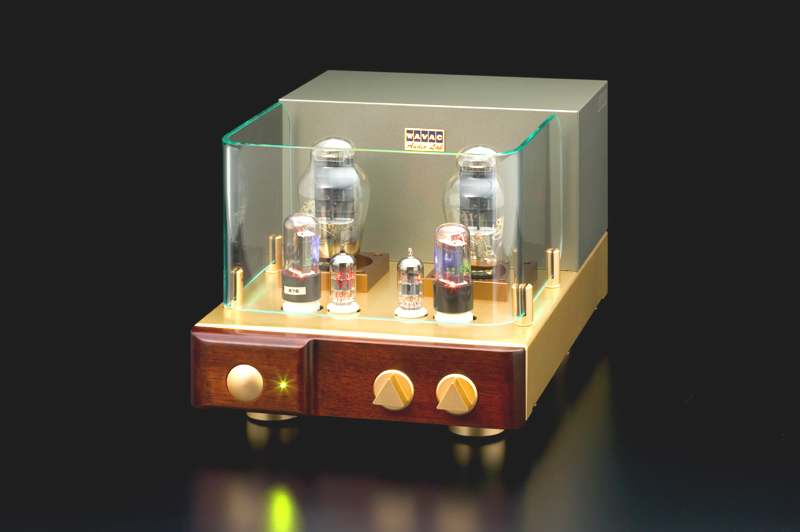
 MD-300BMD-300B Official InfoMD-300B Soundstage reviewMD-300B Enjoythemusic reviewMD-300B dagogo review
I'd refer you to the above links for details about this amplifier. Wavac makes several levels of amps. The MD-300B is really entry level. Although it is well built and well-finished, the chassis is really quite light. Underneath, however, the most important transformers are substantial, though stacked. The higher level 300B amps have much classier chassis but are largely the same amp underneath, but built with higher-grade components (like larger transformers).
Like all Wavac amps, there is no coupling capacitor. The
12AT7 is directly coupled to the 6Y6, which drives the 300B through an interstage transformer. I don't have the circuit diagram, but at the very bottom of this article there is a schematic for the very similar 811 amp (now discontinued, but more on that in Part II).
As you know, I have quite a few SET amps. For 300B, I still have a
Sun Audio (using VT-25 kit, hence the transformer is a deliberately mis-matched 5k impedance, with resultant smaller power output), the
Elekit 8300 and the
ICL Model 1-300B. Don't forget, I have had many 300B amps before, including Audio Note Kit One, Audion Silver Night and AES SE-1 and have heard even more (I refer you to my ancient
big 300B report).
 Note the interstage transformers I would not mince words, the MD-300B is the best 300B SE amp that I have heard
,
bar none. It is hard to speak of its virtues, as it is such a many-splendoured thing.
Its awesome performance is all-encompassing. It is easily the quietest amp (as one review had noticed, quieter than transistor) and the most potent of all the 300B amps I have tried, a testament to superiority of the Wavac interstage transformer.
A word on interstage transformer
Long time readers know I do not necessarily like interstage transformers. I have heard just too many DIY samples that sound deficient in one way or another, even when supposedly good trannies are used. It is not just a question of restricted bandwidth (a problem that plagues lesser ones), as much about implementation. Of course, when it is done right, as in old WE amps, it can sound superior. The MD-300B is also easily the most transparent and full bandwidth 300B amp I have heard, another testament to the superiority of their interstage. It is also a fast amp, with excellent portrayal of the leading edge and transients. Tonally, although very neutral, it is in no way aseptic, just a faithful reproducer of music.
The effect of tube-rolling is easily heard. The supplied 6Y6 is a late straight glass GE that sounds the most revealing and driven. I marginally prefer the much earlier ST RCA black glass, which gives a little more body at the expense of a little detail. I use Shuguang 300B.
In view of the sonic achievement, any reservations are reduced to quibbles. The chassis can be stronger and the volume pots can be noisy occasionally (turning it a little makes the problem disappear). And yes, the amp runs quite hot.
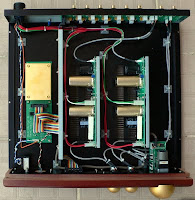
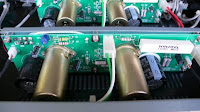
 click on pics to enlargePR-X2 PreamplifierPR-X2 Official infoSome remarks on Audiogon
Despite my amassing quite a few Japanese SET amps, I had previously never thought of buying their preamps (aside from dreaming about Kondo). One reason is I already have too many super-preamps (EAR 912, ARC SP-10, SP11, Melos 222, MFA Magus, to name a few). The other reason is these classics all have superior phono sections. During the years I spent with Sun Audio, I never tried out their preamp.
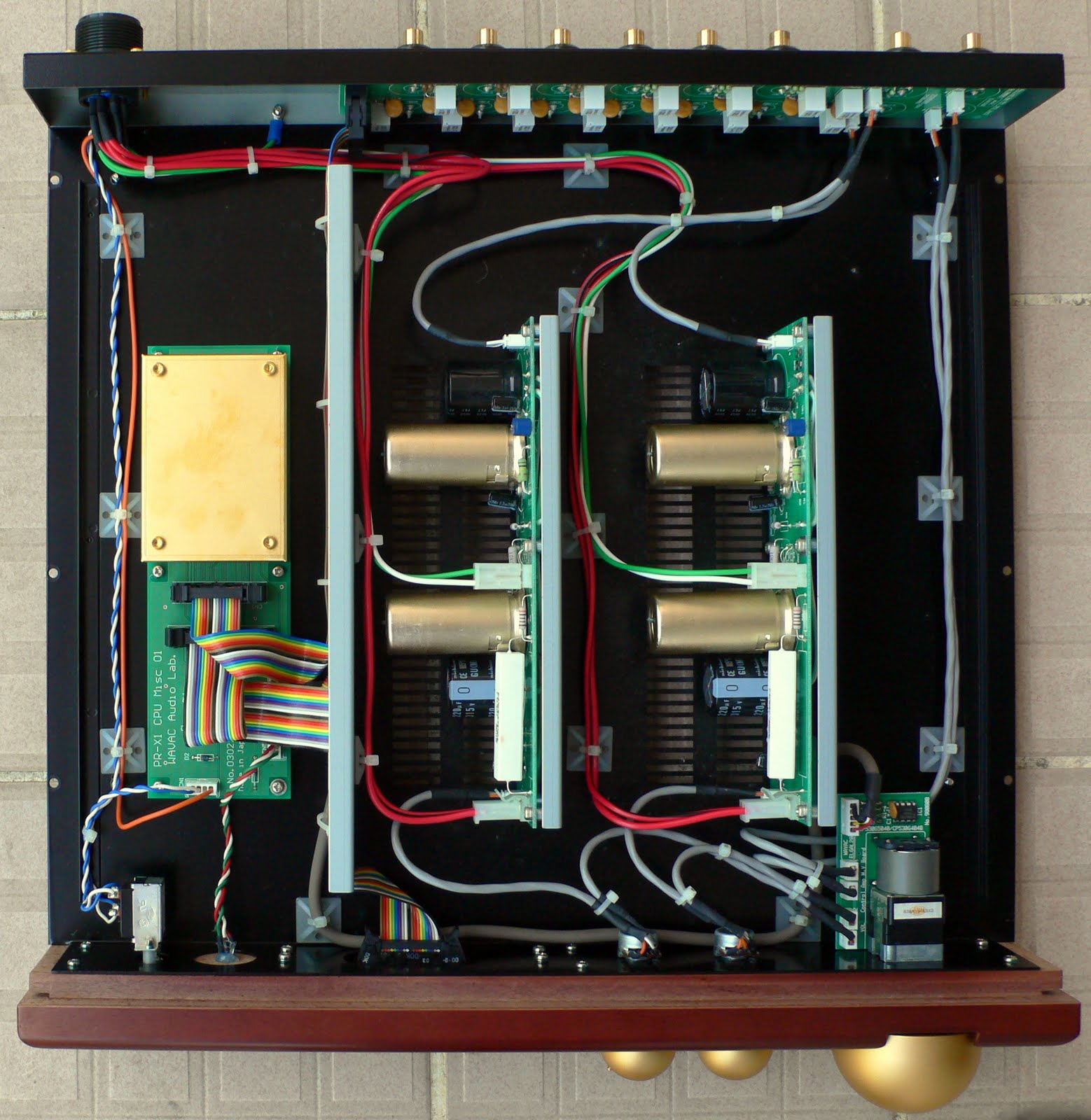
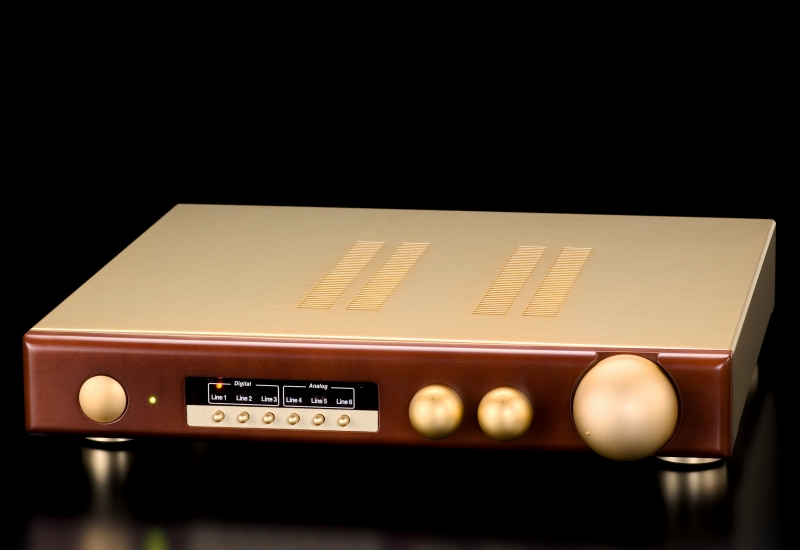
But this time, I bit the bullet and decided to get the Wavac PR-X2, and it proved an important decision. There is virtually no information on the internet about the Wavac PR-X2; and the official info lacked specs. The website does not even have a pic of the separate power supply, which is a long and heavy gold box with the same wood trim in front. As with the flagship PR-T1, it is a
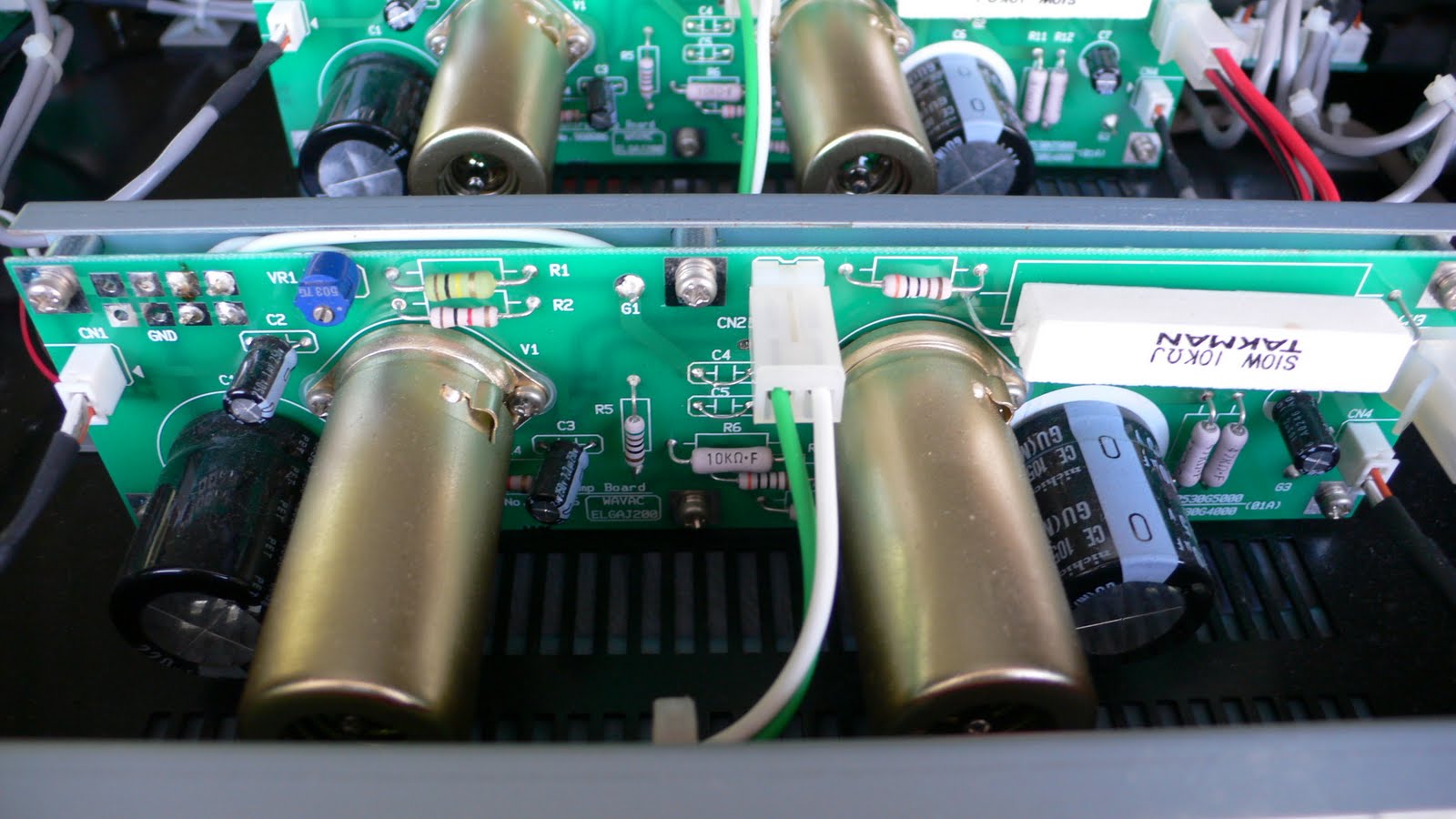
solid state supply. Inside, there are 3 substantial transformers, no wonder the weight! The main chassis is lightweight. Inside, each channel has its own circuit board and utilizes
2x 12AU7. The tube shields are awkward to remove due to the narrow gap. Curiously, this entry model sports
remote control facilities, which adjust the main volume and select channels. The remote, however, does not control the
two separate gain knobs, a useful feature (some say indispensable; found on classic preamps such as ARC and MFA) that enables you to tailor to source input level (useful when using high-output sources like my Audio Note DAC-2; I no longer have Wadia) and provides the function of balance. Curiously, there are
3 inputs marked "digital" and another 3 marked "analogue", the latter having lower input level (500mV as compared to 2V).
It took me quite some time to get used to its looks, and its quirks. The design is of
extremely high gain (I wonder if this is SRPP). In my system, the gain knobs don't go beyond 12 o'clock, and the volume knob spends most of its time between 7 and 9 o'clock. Although this is really more gain than I'd like, sonically it was a revelation from the word go. Despite the high gain, it is quite
refined and highly detailed, and with its gain control partners even high output sources with ease . Most importantly, it has
wonderful rhythm and pace, imparting a
lively presence to the proceedings, which after all is what SET is all about. In this respect, it trounces one of my reference, the EAR 912, which I had mostly used till then. The preamp drives everything I have equally well. Since I acquired this, my interest in the preamps of Japanese SET manufacturers have grown in leaps and bound. The best indication of love and bondage is the fact that I have even begun to like (but not adore) its looks!
SynergyYou'd think such a clean preamp would not necessarily be the best match for the same company's clean 300B amp. Wrong. It is a synergistic match, as one has a right to expect,
the combo delivering the highest level of detail I have heard from SET in my home, yet never at risk of lapsing into over-etched and anti-septic terrain. Two events shall illustrate the synergy.
1. One day my friend icefox (who has slowly evolved into my taskmaster and my motivator) came by and we compared the full set of Wavac against the full set of Verdier (reported
here). It is his opinion that the JCV imparts a richer and more soulful character 幸福指數高點, while the Wavac tends to be etched in more details and perhaps more alert. For myself, I prefer the Wavac combo for its higher level of lucidity (but as a firm believer of polygamy and non-absolutism, I'd like to own both). Now this is followed by an even more seminal event...
2. One day Danz came by to audition. Remember him, a fellow Canterbury user (
reported here)? My link is woefully out-of-date, as Danz had moved fast. At the time he came, he was using a full set of Verdier, Control B + 2A3. He was interested to hear the Wavac 300B amp because he just felt he needed a little more power than 2A3 could provide. He was dumbfounded by the performance of the MD-300B, which was first connected to another preamp, and we tried the Control B too. But true epiphany came when I installed the PR-X2. A puzzled look came over his face, and it took a while before he spoke. Friends, don't under-estimate a moment's import. In one moment, earths can shake, dynasties can change, we can live or die, and I could go on...
Like me, Danz preferred the Wavac combo over the Verdier combo. He astutely pointed out then that he thought the preamp even more of an achievement than the amp. Like me, he had never thought of buying another preamp before stepping foot in my house, but that moment changed him. A short while later Danz made a momentous decision. He decided to acquire a full set of Wavac, but at a higher level.
Gentlemen, in the next installment I shall detail on Danz' flagship preamp
PR-T1 and the
MD-805, only second to the 833 in hierachy.


More pics
 click on pic to enlarge
 clcik on pic to enlarge
 Odd man out: MD-811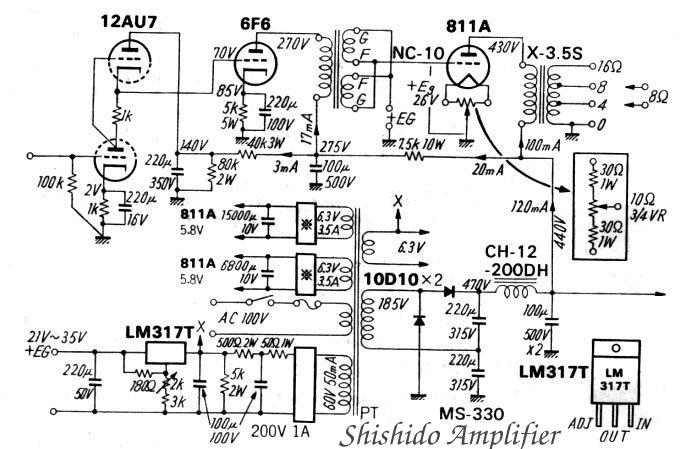
 Enter the Dragon: MD-805




 Posts
Posts