Showing posts with label Letter from NYC. Show all posts

16 September, 2023

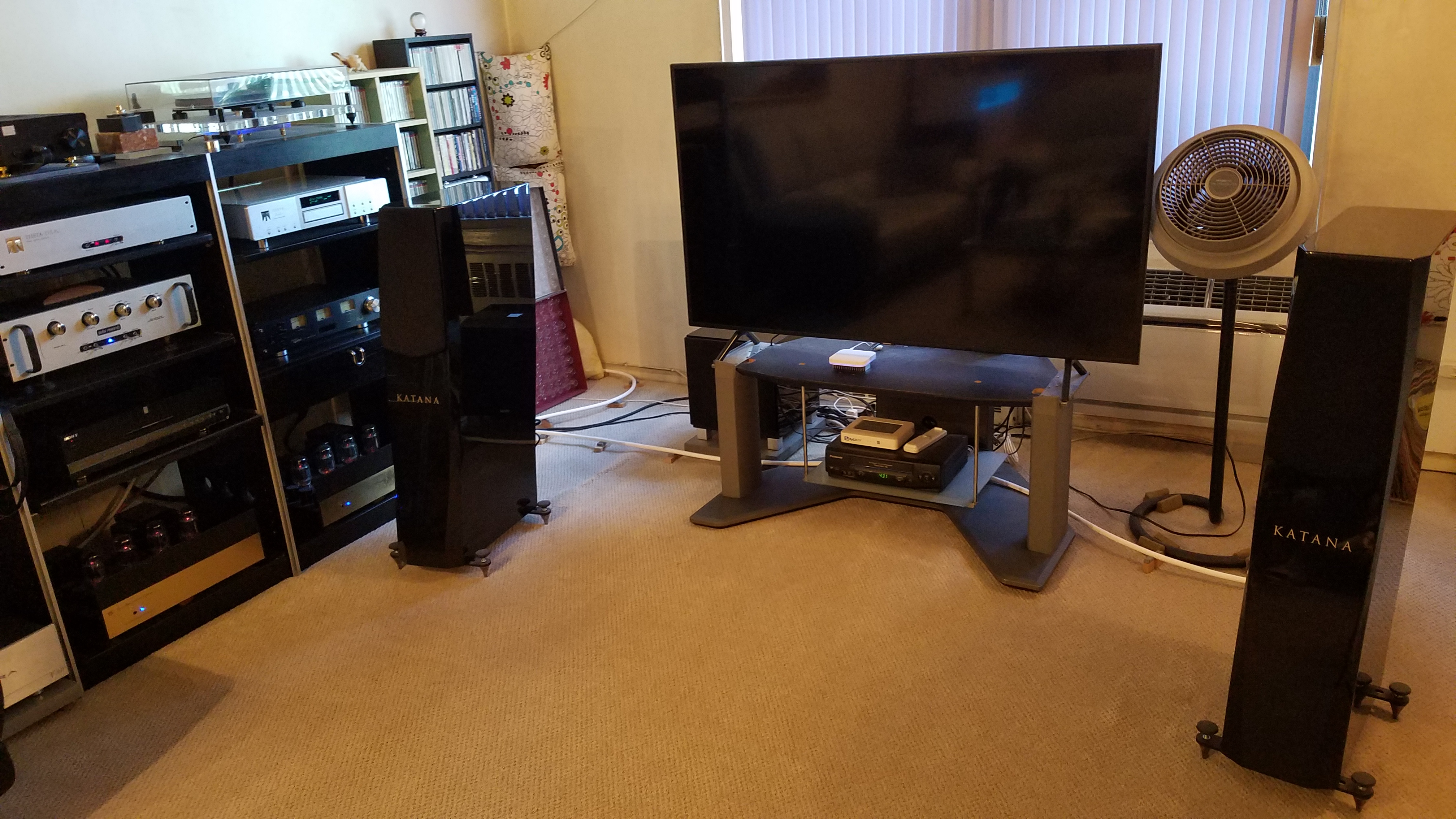
Gemme Audio Katana DS Audio E1 Tannoy

Click pics to enlarge. Tannoy 15" Gold's. Driven by Marantz 7 and (not seen) Stromberg Carlson monoblocks. Source is the legendary 2-chassis Philips 1000. Marantz 9's idle. Thorens TD-125 not heard. In left foreground is an upside down Citation II.

Letter from NYC (23-14): One Day in New Jersey, and other Loose Ends

Written in Shenzhen

One Day in New Jersey
During my stay in NYC, I made 2 trips to NJ. One was with Richard, a visit to VAS etc. But, before that, I had made a trip with Kevin., which is briefly chronicled here.

In terms of audio, the trip served 2 purposes, We went to NJ Paul's place, where Kevin picked up his CJ MV-75 (Paul installed 2 meters for him). We also met Leo there, and "my" Harbeth P3ESR SE went back to him. We spent a bit of time listening to Paul's simple but effective system. Kevin wowed at the sweetness of the vocals there. The Tannoy's sounded nice indeed!

Kevin then drove to Northern NJ to run an errand with his Auntie, an astonishingly elegant old, pedigreed lady from Shanghai and an accomplished pianist. Below are pictures of the lavishly restored old Steinway. Nearby laid piles of scores, including the complete Beethoven Sonatas. I would love to meet this lovely lady again! And to hear her play!

An Afternoon with Kane
This blog had visited Kane before. Once again, I went with Paul (NYC, not to be confused with NJ). Kane's system hasn't changed that much, but he has upgraded his loudspeakers to Gemme Audio Katana. These use Accuton Ceramic Drivers. Design is said to be quasi "horn"/Transmission Line (Soundstage review). NYC Paul and I had actually heard them several years ago, before the pandemic, when Kane just got them. They were kinda shrill at that time, but this time it was very nice. Quite an opulent sound (Kane is a cable man, particularly Siltech fan, and that's what he strives for). BTW, our NYC Andy wechat group members may not know he's in the group, as @Ren Kang.

DS Audio Optical Phono Cartridge
To this day, I don't know how good DS Audio Optical Cartridges are, but I take every opportunity to hear them. What I do know is, they are good. At the very least, There'd be many people reluctant to take up this technology, and I don't blame them, as I was perhaps once one of them! When I first heard DS Audio a decade ago at a HK show (here, a very expensive one), I was skeptical, but I also conceded the sound was not bad and deserved more careful evaluation. Fast forward to now, thanks to Andy, I got to hear the cheapest E1 (green light) at 2 venues! At Andy's place (on an SP10), with the JBL system, I can report the sound as totally "normal" and truthful and neutral to the material. Andy has changed the opamps used in the "equalizer/amplitude device and I think he now uses the Douk E6 to buffer it for a warmer sound. Whatever, I heard nothing unsavory at all. Even at R's place, where the system sounded subpar, the sound was not bad. I myself would like to try it out one day and, at least with the cheapest E1 model, you should think about it! With the insane prices of today's MC cartridges, the E1 seems reasonably priced! For a completely different experience!

Andy's Opamp Stash
NJ Paul's treasure trove!
What a beautiful vintage Steinway!

10 September, 2023

Western Electric 124 Langevin 102 LS3/5A


Click pics to enlarge. WE124B on the floor. Micromega Stage 2 CDP and Yamamoto CA-04 Preamp on the upper shelf. On top, from L, Aurora Vida with Cinemag 3440A on top, Fosgate Signature, Sparkler CDP (unused) and Elekit TU-8300 (unused).

Letter from NYC (23-12): Labor Day Weekend+, Part III (Monday), Chez Andy et Moi

Written in Shenzhen

(continued from Part II (Sunday)) I'm not sure how this came about. Western Electric must have been mentioned at some point in Andy's now much expanded (and very busy) Wechat group. In any case, I was the only one with some WE stuff, and the crowd wanted to hear them.

In Preparation and My Perspective You can imagine I had a busy morning. As it was going to be quite a few people, it had to be in the LR, where I had my LS3/5A system. The WE124 monoblocks had lied dormant for several years. It was not too much trouble getting them into the LR. I hooked them up to the Yamamoto CA-04 Preamp and they gradually came to life. Familiar and intimate sound that is very different from the 300B I had been listening to (and which Sam heard in Part II). In a small way, as the Yamamoto now has a pair of tiny WE 403A inside, it is a "full" WE system, LOL! Well, the 124s have all Sylvania tubes (6J7s and 6L6GAs) though, very importantly, the rectifiers are now WE274B! My WE friends may snicker, but I think it still delivers a reasonable fascimile of the WE sound. You may ask, what's the difference between the 300B amp and the WE124? The WE obviously has a fuller sound and is more powerful. Its air is smoother than 300B but some may like the more overt sound of the 300B. Most importantly, the WE has more of a subtle rhythmic savvy that befits all music. Also, I had actually taken out the WE106 but somehow I could find only one 274A and so had to drop it this time.

My HK taskmaster icefox (@E) again enslaved me, this time via remote! He all of a sudden mentioned the Langevin 102 in the Wechat group. He had heard it to great effect in HK apparently. So it took me quite a while to extricate this heavy beast from my dedicated horn room. It had not been used for a long time too. My unit uses no WE tubes. I swapped out the Yamamoto and the sound was a little congested at first. It opened up a bit gradually but was not as transparent as I had remembered and wrote about. I just let it run.

Chez Andy Just before noon, I walked all the way to Andy's place in Auburndale. This had actually been planned the previous week, before all the recent madness descended upon us. As usual, we casually listened to some records on Andy's mellow Altec A5 (if you search the blog [upper left corner] for "Andy + A5" you shall find lots of piecemeal bits I wrote. To sample, perhaps this and this to start? Andy prepared Beef Noodle Soup, his specialty, and we drank and ate. One funny thing is Andy opined that no wine ever can pair with the noodle soup. I'm rather less picky. I particularly enjoyed a Nono/Berio record; somehow the European Avant-garde (old guard by now), whom I favor, deliver a narrative (unlike much modern music) that sounds particularly good on horns.


About 2 hours later, the crowd descended upon Andy's. Philip, who had dim sum before, came with Johnny. MJ arrived around the same time, separately. They much enjoyed the A5 for a while. Somehow, we found out Johnny had not eaten lunch yet and Andy's Beef Noodle Soup saved the day for him. One recurrent theme during our meets is Bossa Nova. The laid back style is particularly suitable for horns. So a bit of Gilberto was played wherever we went.  Then we all squeezed into into MJ's car and headed for my place.

Chez Moi I had bagged up all Andy's wines, which we continued to enjoy at my place. Kevin joined us later. I used my Micromega Stage 2 almost exclusively. We played a lot of CDs. The system sounded good but something was missing. I swapped out the Langevin and back went the Yamamoto. All the air and soundstage came back. I reckon I need to re-run in the Langevin for quite a while. Next time maybe. I also demo'ed the el-cheapo but excellent 16 bit TDA1543 Magnavox, which is so different from the 1-bit Micromega. As Phil's CDP had gone south, I lent it to him to play CDs. Meanwhile, the horn room was active. A couple of people went in and I played a couple of tracks. I could not man 2 rooms and it was under-utilized. I also took out and played my Sonus faber Electa Amator II, which is more powerful and quite different from the LS3/5A.

The big question is: did they get what is the fuss about WE? I'm not sure at all. The small system was certainly not at the rarified level of my 133 in HK (also a different pair of 124 here), all utilizing big Tannoys (like our friends' GRF's). Even in HK, I had friends who failed to grasp what it's all about. The LS3/5A is a small loudspeaker that should be appreciated within its own envelope. But, I maintain, if you listen hard, it can still reflect what the equipment is largely about, in a subtle manner that big loudspeaker users may not be used to (or unable to mentally switch over in an instant). To me, the real distinction of WE is very subtle, an extra tug here or there, an accent that one never notices before, and a breathing whole. I'd think on the day I ended up likely demonstrating what an LS3/5A system can achieve more than what WE sounds like. It's like the effect of the WE274 rectifier (the real one, like what I used, not replica), which does not shout at you but instead persuades. I'd say the air and refinement of the system was excellent. It was also a demonstration of what near-field placement can achieve. I note that few of our friends employ near-field placement, and that is an important divide. For myself, I try my best not to have the loudspeakers against the front wall, as in-room confers a much wider soundstage and ambience (or venue and hall sound). Music is not just about texture and impact, though these are important. Next time, whenever that is, I shall try to have a larger pair of loudspeakers in my LR (maybe my Martin Logan Source). Or maybe I shall take my WE to their large systems!

Nice Coasters from Taiwan! Chez Andy

JBL C60 Altec A5 A7 604E Tannoy GRF Memory Electrovice B&W Matrix 801


Click pics to enlarge. JBL C60 against the wall. Citation IV atop the center pile driving McIntosh MC240, next to which was the Citation I.Note the huge Kronzilla to the right.

Letter from NYC (23-11): Labor Day Weekend+, Part II (Sunday), The Longest Day

Written in Shenzhen

(Continued from Part I (Saturday)) MJ came by in the morning and listened to my systems a bit. He was particularly taken by the deep airy soundstage produced by the LS3/5A in my LR (Yamamoto; Elekit, here). I packed some of the food I cooked on Saturday and we went over to Kevin's place, where he in short succession demonstrated his Altec 604E, B and W  Matrix 801, Infinity RS-1 and Altec A7 (I have profiled him extensively in many articles; will have an updated article somewhere down the line). We had lunch there with the stuff I brought over, supplemented with some nice Chinese chives (grown in the backyard) sauteed with bean sprouts. Andy was waiting for Godot in the morning. By 1 pm, Godot had not turned up and we were very happy to have our group leader join us. We picked him up and headed to Roslyn Heights.

Chez MJ We first hit his basement, and were immediately overwhelmed by the sheer number of large vintage loudspeakers and gear. It is an L-shaped basement (see diagram). We enter first into the long-stroked arm. At the Tip of the Letter were the Altec 604E and a pair of EV, driven by very simple disc player and an old Sansui Receiver. The Altec cabinet is a little larger than Kevin's and I thought it also sounded a little richer. Not bad at all for the very difficult to get right 604E (like the bigger A series, most suffer from crossover woes). The EV Fullrange was also surprisingly organic.

Like soldiers going through landmines, we advanced inch by inch and sat down on the sofa and listened to the JBL C60. Wow! It's like the big brother of the 4320 the day before! Significantly larger with an extra passive 15" woofer. Driven by Citation IV and McIntosh MC240 the sound was utterly engrossing! And the LP was played on a humble Technics SL-1200 with a Denon DL-103 (rare variant D), Denon Step-Up but a cheap "professional" DJ phonoamp! Streaming through a Marantz, much like Sam. As you can see in the pic, the C60 is propped up on a dolly. Andy raised the question of listening to them in the original state, on the floor (though the tweeter would be quite a bit below ear level. And then there is the question of taking the mid driver and tweeter out and putting them on top - something many JBL users do to improve the sound.

How good is the C60? Near the top, for my taste. Incidentally, I had written a brief JBL Overview before, so you know where I stand. Looks like I have to update it! As I mentioned in Part I of this series, my hitherto favorite has always been the L300. But the C60 has mighty attributes of its own, like an extra, albeit passive 15" woofer. The sound of the C60 (as of now) tilts towards the bass, whereas the L300 likely has a more evenly sorted sound. It hardly matters - we are smitten! Kevin is already on the lookout. Andy and I have no more space.

And then we turned the corner to the short leg of the L. At the end was a pair of Altec A5, with Wood Horns! It was being driven by a pair of Acrosound EL34 monoblocks to good effect. Of course, this wing of the L shaped room is just too confining for the A5. Source was classic half-size Esoteric VRDS Transport and DAC. Preamp was a DIY by one of their friends. Beneath are some Stromberg Carlson integrated amps. I asked to substitute the Oliver Sayes 43 SE amp (this one had 1x 6SL7 and a 5Y3). I heard much the same mellifluous sound as the 71A amp I had at home (although the 43 is indirectly heated pentode and 71A DHT).

One thing I learned recently is, much to my surprise, Altec's can be less efficient than I thought. With my YL horns (YL drivers and Altec 416A woofer) the Oliver Sayes 71A (0.7 watts) was more potent than here with the 43 driving the A5. Similarly, at Kevin's my Conar SE EL84, though tonally excellent, was not that powerful with the 604E (article to come).


Flanking the Tannoys are the Klipsch Forte's used in HT. Pair of Chartwell LS3/5A on stands. Pair of Spendor SP-100 idle on left.

Chez Philip Phil lives across the Street and came over to MJ's for a while and we all followed him back to his VERY large basement. Aside from the speaker change, the room looked much as before. Unlike Sam and MJ, Phil maintains a more minimalist outlook. The Tannoy GRF Memory is earlier than Sam's, with Cork face. We're not sure if they are TW's, Alnico or Ferrite. Phil still uses the McIntosh MX110 tuner-preamp (hidden in cabinet), a great bargain in my book, which drives a pair of McIntosh MC-60 (atop cabinet). Streaming was through a Gold Note two-box (in open cabinet). Sound was decent and much like at Sam's, though here due to the wide separation and heavily carpeted and large space less focused and softer. But it was still very musical. However, with old Jazz, say a Trio, it's ridiculous - there is too much of a ping pong effect with one player far away on the right and another on the left. Many of these old stereos have weak centers to start with, so this is a problem. After giving it thought, I recently told Phil mono jazz small combo albums will likely play better in this system, though we didn't try it that day. With classicals and orchestrals, the wide span was not so much a problem. We also tried out his humble analog setup of Pioneer PL-12 TT and AT95 Cartridge. Through the MX110's excellent phono section. sound was decent. There was however significant imbalance between the levels of the 2 channels, which I balanced by using the MX110's convenient Level Controls (tubes need to be checked). The tone of Michael Rabin (Seraphim LP) was surprisingly opulent, but the orchestral part was kinda grey. We tried to play CDs but the player was unresponsive.

This room is really too large. If I had known years ago, I'd not have recommended the SP-100 for him. In the plan below I show my idea of how to improve placement, but of course I understand everybody has constraints. I know some upgrades and a rack are in the works but re-positioning will have even more decisive impact. just brainstorming.

The highlight of the evening was an outdoor BBQ. What's a Labor Day Weekend without one? The food was simple but high quality, washed down with good wine. We were joined by the two wives (delightful) and another audio friend Johnny, a seasoned vintage veteran whom the mosquitos zoomed in on. Andy and I were completely unscathed. The only regret of the day was that Sam could not have joined us, as he was having too much fun laboring in Las Vegas.

Below a clip of Phil's, all from a cheap cheap TT! 

 L, Phil's room now. R, my suggestion of subdividing by 2-3 ft. This allows for the Tannoys
to be closer together and have more soundstage behind. It'd also make connectivity better.
The TV being closer would be more impressive too.
L, Room Plan of MJ as of now. R, my suggestions
  
Preview: MJ's latest! Too bad I can't be there! Boy, these guys move fast!

09 September, 2023

Tannoy GRF Memory JBL 4320


Click pics to enlarge. JBL 4320 in front of Tannoy GRF Memory. Japanese (100V) 2A3 amp in foreground. Dared 300B PSE monoblocks in cabinet, atop of which are the Harmon Kardon Citation I and Lafayette Preamps. Cary 300B SEI atop a McIntosh Preamp. The shelf above shows McIntosh MR71 tuner, atop of which a Cary preamp and to the left a WE421A amp. More vintage on the shelf above, including Eico.

Letter from NYC (23-10): Labor Day Weekend+, Part I (Saturday), Labor of Love

Written in Shenzhen. Updated 9/10/23: Some corrections, re-writes and expansion (shaded boxes). Latest Video of  JBL 4320 added.

The weekdays before the Labor Day Weekend were unusually peaceful. Andy was having his contractors cleaning up his yard, and I was busy tidying up things before my departure. Things then happened so quickly all of a sudden that the older ones among us had great trouble keeping up! These new characters are much younger than Kevin and I, not to mention Andy. I certainly had a hard time sorting out the events for this article (especially since a lot of drinking was involved)!

The ball actually started to roll long before, when we visited R. As mentioned, I met Simon's friend Sam (in Whitestone - we all live close by) for the first time there, and it proved pivotal, indeed catalytic. Sam mentioned that we have a common acquaintance, Philip (in Roslyn Heights). Indeed, said Philip many years ago asked me some questions about Spendor SP-100, and I actually met up with him several times then (even with Andy!) Apparently, Philip had more recently taken after Sam in acquiring the Tannoy GRF Memory. I was delighted as I thought Philip had called it quits (his children were very young then). Sam had to fly away on Sunday, and Philip and family were coming back from the Carribean Saturday night, so Sam and I arranged to meet on Saturday with the wild hope of hopping over to Philip later (it was not to be).

Saturday was a long day! Sam had to go to New Jersey in the morning to pick up a pair of JBL 4320. I knew it was going to be a long day, so in the morning I prepared rice, a large pot of Beef Shank (金钱腱) Stew, and Chinese Cabbage with Bean Pockets (油豆腐). Richard came in from Manhattan, picked me up and drove to Sam's place around 2 o'clock. The timing was perfect, not a minute too soon, as Sam's return home was delayed because his pick-up truck had developed problems during the trip. We met Sam's friend MJ (Michael, also from Roslyn Heights, friend and neighbor of Phil, who was with him on the NJ trip. Later, Kevin joined us.

First, we listened to the Tannoy GRF Memory. This is the later one with Wood front baffle. Sam mentioned later it had upgraded German paper cones. Sound was excellent. TT was VPI HW-19 with early Graham arm sporting a VdH cartridge. Forgot the step-up. Preamp was the Citation I (also tried the Lafayette) and Amp was a Dared PSE 300B monoblock. Digital duties were served by a modern Marantz CDP/Streamer.

A word on these Tannoy GRF Memory. There were many generations (confusing) and they are basically predecessors of the Canterbury HE (which itself spawned SE etc). The earliest ones were Cork faced and there were designations of HW, TW, TWW etc.  Sam's later version is bi-wired (just like the later Canterburys). Only the very early ones were Alnico. Sam's is Ferrite. For the Prestige Canterbury HE that I have (and subsequent iterations) Tannoy had reverted back to Alnico. The sound is much more balanced and dynamic than older Silvers and Reds. This blog wrote profusely on the modern Canterbury's, which I believe are the best! These GRFs are very impressive. Indeed, Sam's pair sounded just like my Canterburys, and count among the very few best Tannoys setups (in HK heard too many horrible Silver and Red setups) that I have heard. Do not confuse these with the earlier corner GRF, nor the later Prestige GRF (alnico but 12").

Of course, we could not resist and asked for the JBL 4320. As with old JBLs (and TADs), only spring clip terminals in the back. Sam, an experienced DIY person, made some cables and adaptors on the spot. Sound was of course much more neutral than the Tannoy. Even though they had not been used in a long time and were suboptimally placed in this room, both Richard and I nodded enthusiastically in approval. We just loved the realism. We switched to a Japanese 2A3 amp that sports full Tango transformers (including interstages) and old stock double plates. Sound was sweeter but lacking a little heft. Now, I'd love to hear a stacked pair (my experience with stacked 4312A was stunning)!

A word on the 4320. My first time hearing these and was I impressed! These have superior alnico drivers. Although it bears JBL's "43" professional designation, it has a sturdy wood enclosure. In terms of drivers, the "home use" equivalent (subject to variations over time) is the L200 (just as the L100 is the home use version of 4312). I think these have a lot of potential. My absolute favorite JBL loudspeaker is the formidable L300, but these are no slouch!

We even listened a little to the DIY RCA 829 Preamp and Harmon Kardon Citation II driving the legendary but notoriously difficult to drive ATC SCM10. Not bad at all!

Then, MJ had to go pick up Philip and family from the airport and Kevin returned home. Richard and Sam and I went to my home, had dinner and listened to my LR system of LS3/5A driven by Yamamoto preamp and Elekit 300B amp (here). Afterwards, they spent a little time listening in my dedicated room with my YL horns driven by Shindo Monbrison and Oliver Sayes 71A amp. I had only set it up in the morning and I believe it was very good. The 0.7 Watts of the 71A was amazingly high quality.

A lot of wine (offered by Sam, a Cab drinker) and a day well spent! Sam's place is a treasure trove that I intend to visit again and again! Thx so much! Thx Richard too for being the driver! Incidentally, Richard was very happy as it was not so easy for him to hear big horns, not to mention 2 pairs in one day, no less. I predict a horny future for him!

Preview: Just received this Video from Sam. Swapping in the McIntosh C22
resulted in a fuller sound for the JBL 4320. Wish I were there! 

ATC SCM10 flanked by Philips fullrange in cabinets made by Simon. DIY 829 preamp
atop Citation IV. Citation II. Background various Stromberg Carlsons and Dynaco.
Chartwell LS3/5A atop Philips

Better view of the Dared 300B monoblocks.
Below: Video of GRF

26 August, 2023

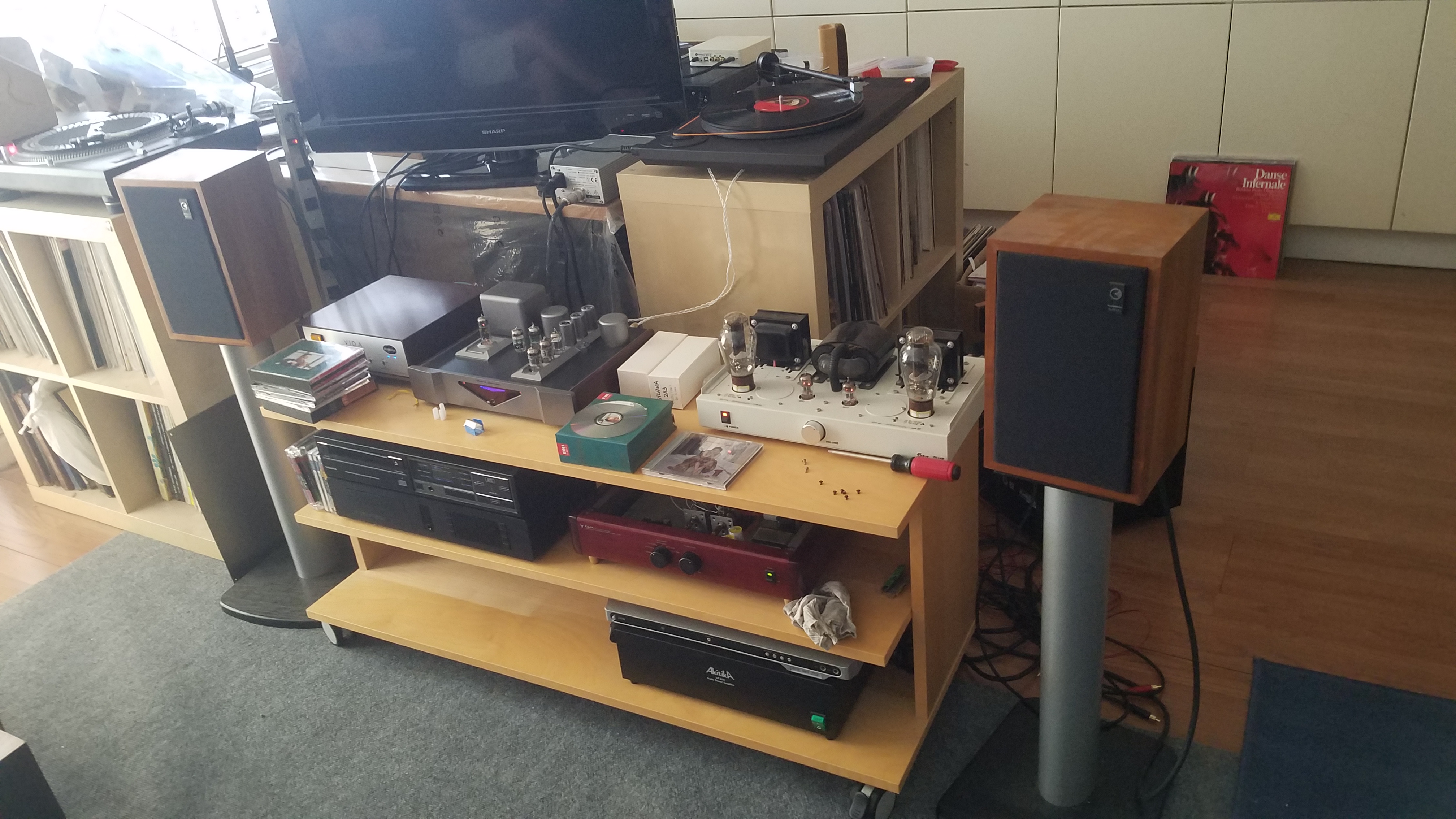
LS3/5A Chartwell Audiomaster Rogers Yamamoto CA-04 Douk E6


Click pics to enlarge. Chartwell LS3/5A. On top of rack, Fosgate Signature Phonoamp and Elekit TU-8300 amp. Beneath, Micromega Stage 2 and Magnavox CDB-262, Yamamoto CA-04. Incidentally, the LP Danse Infernale in the background is one of my references. The Boston Pops/Fiedler Night on Bald Mountain is my favorite, bar none in performance and sonics, more exciting than the venerated LSO/Solti (Decca), which seems plain vanilla in comparison. It can often be found in dollar bins.

Letter from NYC (23-8): Small but Beautiful

Update 8/30/23: A few edits, including important clarification on the LS3/5A shootout - the Audiomaster won all hearts.

It has been a little over 2 months since I left China for NYC, where I spent all my time except for 2 weeks in July in Chester, UK. In the one and a half month here, I really haven't done very much except lately I have upped my written output for sure (I think around 10,000 words in the last few days). I have mostly sorted out my accounts. Sometimes it's exasperating dealing with financial institutions, including the IRS. Everything takes so long.

Given that I am by myself, I wake up even earlier than usual, around 4:30 am! I go to sleep around 9 pm. Maybe 2 or 3 times a week, I'd meet up with friends for a lunch gathering. I don't spend much time preparing food, and 2-3 times a week I'd just take out from the local Senior Citizen Center. Otherwise, aside from running errands and shopping for essentials, it's all time at home, much of it spent listening to music, sometimes while writing. I like moving about in my large LR more than being cooped up in my dedicated listening room (even if it has my reference gear it is more of a sanctuary when there are others around), so up to now I have only listened to the small LR system. Whether for review purposes or not, I rotate things in and out, and here are some brief notes:

Harbeth P3 ESR SE vs LS3/5A In my recent posts, including reviews, I have used pics of the Harbeth and LS3/5A. I acquired the Harbeth not long before I left NYC in 2020 (review). Fact is, a few weeks ago the original owner Leo would like to buy it back, and I obliged. I slotted in the Rogers LS3/5A (black badge, serial # 5,xxx). Haven't used the Rogers in quite a while, but in an instant I knew it's a worthwhile change. By now I'm in an even better position to talk about the differences between the two. Although both classic English loudspeakers with shared heritage, differences are obvious: 1) the Harbeth is smoother and reaches deeper; 2) despite a somewhat slower transient, the LS3/5A nonetheless is livelier and more dramatic; 3) despite many reviewers' talk (most often wrong, even downright stupid) on neutrality, as a whole the LS3/5A is more truthful. Sometimes it will show a little more the warts and fraying edges of recordings, but that is what a monitor is supposed to do, and a monitor it is. Still, I had much enjoyed my time with the Harbeth, and recommends it.

Preamp Rotation First I used my Shindo Monbrison. But as soon as I started to try out different phonoamps I switched to Yamamoto CA-04. The reason is very simple: the stock vintage RCA connectors of these Shindo's lose connectivity often (AD mentioned this in one of his Shindo reviews). If one has to plug and unplug often, a switch is mandatory. Yamamoto vs Shindo These have very different design and sound. I wrote about the difference in 2020, and things haven't changed. This time in the Yamamoto I have been using exclusively the WE 403A.

Douk E6 This belongs to the above section but due to the epic nature of this comparison I give the Douk E6 its own subheading. I borrowed one of Andy's many units. It has the stock Chinese tubes, with O-Rings for damping. The caps had been changed to red Audiophiler MKP 250V 1.0 uF (marked 105J). These look similar to the ones I used. PS was a small 5V USB Charger. vs Yamamoto As well as I know the E6, I was still astonished by the sound. The most significant change is a larger sound field with fleshier images (befitting a DHT) and even more air. This is consistent with my experience but now the comparison is with a preamp whose second-hand price is 20 times the cost. One interesting observation is that the clicks and pops and LP artifacts are particularly highlighted. I think this is a result of the incredible high frequency extension, the high gain and transient speed. The Yamamoto is perhaps more controlled with large scaled music and its midrange (with the WE tubes) and rhythm a little more layered. But the E6 held its own for sure and I only continue to use the Yamamoto for the better connectivity. Note that this is the first time I have compared an E6 to estimable preamps (though my HK and NYC circles have, all to the same remarkable conclusion of equality, if not superiority). Remarkable!

Analog Rotations I have been logging this. In case you have missed them, more substantial articles are on Sun Valley SV-EQ1616D and Fosgate Signature Phonoamps, and MoFi Studiodeck. Since the arrival of the Studiodeck I have been using it mostly, with the Fosgate Phonoamp. Very contented, but I hope I can stir in something a little more exotic before I leave NYC in early September. In recent days, I have gone through 3 symphony cycles: invigorating Beethoven by Munich/Kempe (Seraphim, sound good despite being quadraphonic); magisterial Dvorak by BPO/Kubelik (DG; stupendous sound); flawed but worthwhile first Sibelius cycle by Boston SO/Davis (Philips, good but not top sound). You shall be amazed how time flies when one listens to the greatest music.

Digital Duties As here. I actually listen to quite a bit of CD, especially Jazz. Like Miles and Coltrane. Particularly fine sounding Rachmaninov Symphonic Works from Concertgebouw/Ashkenazy (Decca). Ever heard Patricia Barber's Companion (Blue Note)? Fabulous sound and one of her best. Have you noticed one thing? I haven't streamed the whole time! I actually miss it, but the very weak data handling of my phone is not up to it.

SE Amps I started with the small and  convenient Almarro A205A (EL84), then two 300B amps, the AES SE-1 and Elekit TU-8300 (first review and review after mods and updates). The Almarro does a fine job driving the LS3/5A but the 300B amps open things further up. AES has fixed bias adjusted through a single 1/4" TRS phone jack in the back (I use a connector with my multimeter). As the bias is for both tubes, and tubes may not be balanced, it's better not to bias high. Mine (Shuguang) was set pretty low, at 90 mA total (for both channels). This time, I operated the Elekit as an amp (Yamamoto  AES vs Elekit Using the same 300B tubes, despite being biased lower (the Elekit is autobias), the AES sounds more powerful. The circuit may have something to do with it (traditional vs constant current source, respectively) but I'd say the AES has the better transformers. Tonally the Elekit is airier, more resolved and on the neutral side, and the SE-1 is a little more centered on the midrange. Both are very good. Andy and Kevin have heard them both and voiced no serious preference. With my guests I also rolled in the Philips JAN 6L6WGC (which I liked) but it seems both of them preferred the 300B. I think the Elekit is sounding the best as it ever has. I actually wonder if it has finally starting to break in. You see, I don't think I have had more than 300 hours on it altogether, a significant fraction from this time around! And now being summer, I may not bring in the 6C33C Almarro 318B. Instead, if I have time I shall try some more powerful Push-Pull Amps on the LS3/5A!

Subwoofer After a while, I brought in my very modest Pioneer SW-8 subwoofer.  Finding the setting took a little more time than when I used it with the Kilpsch Heresy. I estimate the final Crossover Frequency to be around 80 Hz (I remember in HK it was even higher, but it was a different sub) and Volume was just a touch (less than 1-hour on the dial). With even the little bit added, the music is more dynamic. When Kevin and Andy visited I demonstrated to them and Kevin correctly said with the sub on the soundstage expanded. There are very few albums on which the presence of the sub can be suspected. A success, but I know all about it from my experience in HK.

Rogers vs Chartwell vs Audiomaster As both Kevin and Andy liked the pair of Beydas clone I brought to Andy, I invited them to my place for an in-depth session with 3 pairs of the real thing, all 15 ohm versions at that! First, we listened to the Rogers (black badge; serial # 5xxx), which had been resident in the system for a while before they came, and it was very nice. When the Chartwell (serial # 3xxx) was substituted, we all heard more treble and a leaner balance. Andy remarked it had less bass. Part of this could have been because the Rogers was in use before they auditioned, whereas the Chartwell had been in the closet for years. After their visit I just continued using the Chartwell, and really do not feel now that they lack bass in any way, though it is true the treble is a little more prominent (mirrors my experience in HK). As a whole, I enjoy its tighter grip on material as well as better dynamics; its sound is likely closer to modern variants. Finally, it was the turn of the Audiomaster (serial number not obvious). More than Rogers and certainly Chartwell, I have used this pair on and off over the years, always with great satisfaction. It is a little darker but, oh, how relaxed it is! Both Kevin and Andy were thoroughly charmed by the Audiomaster. Too bad we did not have on hand the Beydas to compare! It should be noted that Chartwell and Audiomaster are much rarer than Rogers, especially so in America.

Xinshi 新时 597 Passive Horns In many of my more recent articles, these appear atop the loudspeakers. They enhance the sense of air. After the pair was handed to Kevin, I immediately noted a diminution of air in the system. This incredible thing is now a necessity in any system. Next time I come back to NYC, I shall bring a pair along.

The TV Long time readers with eagle eyes will have noticed that in 2020 the TV was on the rack, whereas now it had been moved to the large work table behind. It cleared much space for gear, but that was not the point. Experienced audiophiles know that a large center object, aka the TV, messes up the soundstage (can be better if a thick cloth is draped over it). By doing that, the soundstage immediately deepened, significantly. I usually never sit in the center, close to the right speaker when I'm on the sofa reading or computing, and further right on the dining table when working or eating. No matter, the soundstage is much improved, and quite impressive. Advantage of being alone.

TV Sound My Sharp, circa 2010, is certainly not shap in picture and a lousy one when it comes to sound. As I watch quite a bit of TV, be it old TV series or B movies, I struggle with the sound as well as clarity. The older movies and series are definitely lower in sound volume and often muffled. Perhaps they are playing bad (low res) copies. I borrowed a couple of DVDs (Unberable Lightness of Being and Two for the Road) from Andy and found the sound of the replay (through my Sharp TV), even from my top-tier Sony BDP-S5000ES, better than TV but still totally underwhelming. I finally could not stand it any longer and fed the optical out of my TV into my Micromega MyDac DAC and then into my regular system. Much better, but still not enough. You simply do not watch a modern movie (Unbearable) with a SET amp! LOL! I know I can probably do better by configuring my Blu-Ray player and, yes, more wattage will be a different story, but so much for now.

 Audiomaster Crossover

Innards of the modified Elekit TU-8300

Douk E6 in action

24 August, 2023

Bad Habits

Click pics to enlarge. No, can't pull the Wilson Grand Slamm's further in. Yes, better sound if the piano lid is down.

HiFi Basics (XVII): Mentors, Gluttony, Overreach, Connectivity and Cost-Effectiveness
Letter from NYC (23-7): A Day in the Country

Yesterday, some of us got together again at our friend R's mansion on Long Island. For me, this was the first time in 3 years! Understandably, there had been limited activity due to the pandemic. Since I have gotten back, I have met with our group leader Andy quite often. Kevin too since he had come back from Atlanta. Despite their arriving very late, I was happy to see Simon again, especially since he brought a new friend Sam, a vintage aficionado too (Tannoy GRF, Philips Full Range etc; I'm sure you shall hear more of him). I am glad I met up with subwoofer fanatic Richard and his wife. It's so funny, the first welcome-back SMS I received when I landed back in NYC was from Richard, who knew from the blog that I was back! Most amazingly I met Alex again (last time I saw him was probably in the late 80's, at Princeton Record Exchange no less). Years ago, Alex was president of the NY Audio Club and knew everyone. I have always admired him greatly for his tireless effort to try to get the many Chinatown audiophiles (through whom I met him) to listen to good classical music, a tough task indeed. We talked a lot about concert halls, the NYC and HK concert experience (like where is the best seat), anything but audio, as he is totally toned down now in terms of equipment - contented with being a music lover but not an audiophile. This is such a colorful assembly of characters from various trade that, if I were a composer of Elgar's caliber, I'd compose my version of the Enigma Variations, for, despite my knowing them, they remain enigmas to me. It was also a rare occasion because R's wife M could join us. As usual, R made a sumptuous lunch for us which was held on the patio (a first). The special wood smoked BBQ chicken was excellent (we would demand no less of R) and the two salads (cucumber and apple) were just perfect for summer. For my taste, the wines on this occasion were a particular fit for me. I loved most the 2012 South African Cabernet Franc. The fruitier Austrian wine was also interesting. The Costiere de Nimes was a little too subtle for me. And then there is Richard's Long Island wine from his friend's brewery, which I didn't taste. I was told it is young but promising (sounds like our youth, which didn't always pan out). I Thank R for hosting us.

Before and after lunch of course we listened to the audio in both the spacious LR and the smaller horn room. I only did the LR, where I spent most of my time talking to Richard and wife, and M. After 3 years, it seems there are quite a bit more gear here! But sound was regrettably no better from what I remembered, so it got me thinking hard. I think all the new stuff brought too many new variables that the system as a whole got sidetracked, even neglected. As this is a common audiophile issue, I'll take this opportunity to dissect some of the audiophile's habits. I use R as an example but aspects can also be applied to almost everyone present, including myself.

Gluttony

First question: Should we take on everything we have our eyes on? Not if you can't do it justice. This goes for people as much as audio - you need time and sensitivity to truly appreciate strengths and weaknesses, to learn that perceived deficiencies and strengths are sometimes just two sides of the same coin, and to build up stable relationships. This is NOT a question just of desire and drive, nor money - rather, of time and patience. Just like people we neglect or don't do well by, our systems tell us in no uncertain terms that things are not right (if we are truly good listeners). Today we start with examining the Gluttony of which we are all guilty. Incidentally, one reason why this blog covers some visits is because of the excess, photos of which are eye candy for many readers. What they may not realize is the detrimental effect excess has on achieving the best sound, which should be everyone's goal. The cruel reality is, in the quest for better sound (or for different experience) by acquiring more equipment, we frequently make things worse - a regression. This is not the same as loving different kinds of food. One can enjoy Chinese on Monday, Thai on Tuesday, Arabic on Wednesday etc, but one cannot quite do that with one's audio systems - one will almost inevitably end up with fusion, and the worst kind. There is only so much "breakthrough" one can achieve in audio, and there is plenty more ground to lose. Oh yes, there are audio buddies who tell you their system is XX% better every time you talk to them (and who tirelessly urge you to go listen), and there are magazines that tell you constantly about "progress". Don't you believe them! One of the biggest lies in audio is the Wilson Watt/Puppy, an unfortunate, incoherent amalgamation that persisted through 8 generations, each proclaimed to be a breakthrough by the press. A big grain of salt is in order when the reality is, with the exception of certain areas, there has not been much progress in audio, especially in terms of "absolute" sound; and the sonic up's and down's of the systems of most audiophiles is no smoother than the stock market at its most volatile.

Believe me, I know of Gluttony, as I used to be guilty of it, not just in terms of audio equipment (including tubes) but also in terms of LPs and CDs. Not so much now, though I still suffer from the aftermath. I actually regret my past. Too much stuff, too many hassles. many in our circle are gluttons.

The evolving systems of R actually comprise the longest running thread of this blog. As I reflected on its evolution, I was aided by all the articles I had written - one benefit of the blog is to set down things for later (if sometimes just for myself), as memory is so often unreliable (even if I remember equipment better than most people). It took quite an effort to tally up all the scattered articles - including this one there are 10! Amazing!

Chronology of Previous Home Visits to R

2016 here; early on in my acquaintanceship. Wilson Grand Slamm in smaller entertainment room. Equipment evaluated included Jadis JPS2, Lamm LP2. Rockport Sirius II, Versa Dynamics 2.0/Jan Allaerts MC2, Walker Proscenium/Kondo IO-J

2017 here Wilson moved into large LR; here, Tom Tutay, CJ P3

2018 here, Arrival of Altec A5, evaluation of Jadis JPS2/JA80, Marantz 8B McIntosh Verdin P153, Harmon Kardon Citation I; here, SMSL challenge, CJ P2 vs P3, Cary CAD-211, arrival of ARC Ref 2; here, re-positioning of horns, Bell 2122;

2019 here Bell 2122; here, Nottingham Space 294, Decca Super Gold; also here.

Mentors

I. As you can see, I have known R for quite some time, but Andy predated me by quite a long while. I hope my history of R is correct here. The previous mentor of R is A, a veteran of the industry who had retired to Florida a few years ago. Much of the oldest gear that R owns and still uses, and those of modern brands: the Wilson, the hopelessly gargantuan Tube Research stuff, Tom Tutay, and newer Jadis, Lamm, Jan Allaerts, Kondo, etc, likely all stem from that network.

II. The next period of R saw the growing influence of Andy as Mentor. Andy probably doesn't think of it this way, but to us he is. Vintage equipment proliferated. When I first met R he already owned several iconic, but notoriously finicky gear that without encouragement could not have come from his own imagination. The massive Rockport Sirius TT and Versa Dynamics were surely Andy's influence (Andy has them still). That influence only grew stronger during the time span I outlined above.

Consulting often with a mentor or friend with trusted ears is a good and natural thing, but to populate one's shopping list in wholesale fashion with only their recommendation is a big mistake. Since this happens very often and everywhere, in Hong Kong and even within our NYC circle I have consistently observed that most of the people who do this more often than not fail to achieve the next step up. It's not hard to duplicate and make the same equipment choice; what's much harder to duplicate, even truly understand, is what's behind the choice, which concerns listening sensitivity and perhaps a bit of the Midas' touch or even "wisdom", if anything in audio deserves that lofty term.

One interesting aspect of the relationship between R and Andy is that most of the exchanges happen over the phone. R professes himself to be just a music lover (a gross denial) and perhaps regard many audiophile activities as unnecessary, but broadening one's horizon is a must when growing up. I learned a lot by visiting other people's systems in my early years in HK. R would often call up Andy, asks what's he been up to, and Andy would tell him about his newest adventures, and R would follow suit on quite a few. Most recently, this is how R also got the Douk E6 into his system (not from reading my Blog), but it's my opinion that he has really misunderstood and misused the thing. R would likely benefit more from visiting others than having people visit him.

Let's proceed to look at what equipment are linked to Andy (and are also at Andy's home right now):

Before the pandemic: at least, Rockport Sirius and Versa Dynamics TTs, Nottingham Space 294 TT, Decca Super Gold, Bell 2122, Harmon Kardon Citation I, Conrad Johnson Premier 2(3), ARC Reference 2, Altec A5.

Since the pandemic: I was shocked by some of these latest additions. Not one but TWO Thorens TD-124 (one in each room; both with Decca arms), Decca cartridge (in horn room), Goldmund Studio TT, Sun Valley EQ1616D, DS Audio E1 optical cartridge system, many Douk E6s (both rooms), many cheap new cables from China (including "Cardas", note that Andy and Kevin have a variety of these). Yet another Citation I is in the works.

That's a HELL of a lot! As importantly, aside from one item (EAR G88, from A), I didn't see anything that has nothing to do with Andy. Below, in the section that analyses the sound of the day, I will say more on some of these.

The Mentor's "Duty" As with any relationship, feedback is important. In audio terms, that means the mentor better listens to how the stuff he recommends is doing in his charge's system and "grade" him. If it's not working, say "you screwed up!". But you will be surprised how many don't do that, as we are not really teachers and students, and "friendship" often obscures "truth" and gag candidness. I belong to those who shoot straight, even with friends, and though likely in the minority I'm not alone. Yes, perhaps I too have "mentored" a few, but I would always tell them in no uncertain terms whether things were working or not. Chinese saying "养不教,父之过,教不严,师之过" ("To bring up without educating, the father's fault; to fail to instill discipline while educating, the teacher's fault"). The last few days the real world here saw consecutive shootings during youth parties, and the saying came to me while watching the news. Maybe it is a bit true too in audiophilia, though I am positive not everyone shall agree with me.

Connectivity

From my perspective, aside from gluttony, another aspect of R's audio practice makes me tear my hair out even just to watch, and that is Connectivity. In his case, there are several aspects to this. When I first knew him, he had few extra cables and helping him re-configure things was quite exasperating. R is a very strong man, who can lift up or move very heavy items. But somehow he cannot really kneel down and poke around. This makes him really reluctant to change connections in the LR. As you can see in the top pic, all of the source and control equipment are hidden from sight (low down in the dress table behind the sofa. I can totally understand and sympathize with physical limitations, house rules and aesthetics, but then why squeeze 4 TTs, 3 SUTs, 2 Phonoamps (one bigger than 2 amps) and a Preamp, with their many associated cables into hard-to-reach hidden space? Why not just simplify?  Mind you, his many newly acquired cables had enabled him to make more connections, but that too exacts a cost (below).

Mind you, R is not at all the only one who has connectivity issues. Here in NYC, some of Andy's cables are nearly impossible to access and swap out too. But the problem is by far much more prevalent in space-strapped HK where for many the allowable space for audio is miserably small.

To be a Glutton one has to improve Connectivity. To accommodate the many extra cables is not that hard, but to use the cables wisely is the much bigger problem, especially if they are of various makes, from various sources and from different eras. R may now have the cables he needs in numbers, but it is unlikely that he knows the character of each at all.  I looked at his China clone Cardas and I had no idea what to expect - I surely hope he does. For me it's easier, as my cable stash comprise mostly of professional cables of few types and brands, all of which I know very well and have used for years on end. More often than not, my whole system is strapped with Gotham.

Audiophiles should make it easier on themselves. For those with a lot of gear, especially with a mix of vintage gear, there is no place for short cables, stiff cables, fat cables, big connectors etc. An example is the Citation I, which like many vintage gear has tightly cramped RCA terminals. The most suitable cables would be terminated with Switchcraft; my Cheap REANS will also do, but barely. R has one, which he has someone modify by adding a cable terminal strip.  Of course, the best would be to cut down on gear and cable tangles.

Overreach

Personally I'd prefer not to own gear that would need constant servicing. Case in point, TTs with vacuum hold downs, especially vintage ones. Long before I even met Andy I had heard many of them. I knew even then pumps are not for me. Design merits are always overblown, and none of those I heard convinced me that that is the only way to go. Even in Andy's place. If vacuum hold-down is the ne plus ultra of TT design, nobody would know better than Andy, and Andy would not be so into other TTs also (especially the idler wheels in recent years). But Andy's case is different, as he has the know-how to trouble shoot and fix most of his problems himself. And he is a good friend of Simon, who happens to be a Dental Equipment service technician (yes, a lot of pumps there). With R it's different: aside from having a basement to hide the pumps, he completely lacks the know how and on multiple occasions had to call in Andy and Simon (Mark too) for help. It would help my understanding if the vacuum TTs (Versa and Goldmund and Walker make 3) sound superior to the others, but they don't (more later).

Horns is another aspect. I worship Altec but know how hard it is to get them to work really well. There is perhaps no perfection. There is no way I'd constantly try to improve the crossover. There will always be problems and temptations to modify. R's A5 is one of the best ones as it came with crossover done by our friend Paul. He's lucky. Here in NYC I have my treasured YL horns, and no room for more. In HK I know many people with all kinds of horns and components strewn all over the place. Even if sound is not always commensurate with the investment, they make my mouth water. But at least these days I follow my own advice below and have no desire to own them:

Know your own limitations and try not to rely on others too much. There is always a limit on how many favors one can ask of others. There is no free lunch either, one way or another we end up paying.

Cost Effectiveness

One factor that fuels buying vintage gear is perceived Cost Effectiveness. Andy and friends are vintage aficionados, and so am I (mostly). If you look at the Andy/R gear, many will only go up in price. Cash depreciates fast. The right gear holds the value, even appreciates. In hogging things and buying duplicates of things R is nothing compared to a lot of people I know in HK (also some in the NYC circle).

But when it comes to electrical things, particularly vintage gear, such perceived value is often a delusion. Things break down, caps need to be changed, and leaving things idle for a long time is the best way to ruin them (believe me, I know). So, one has to go through the trouble of repairs. A fraction of the extreme collectors can do at least some rudimentary restoration themselves but the rest will have to pay for service or cull favors from friends.

And what about selling them? The problem is, selling things is a big effort. Here, Andy, Kevin and I don't sell things just because it's so much trouble. We are not used to it. In HK, it's much easier (and I bought and sold for years due to space limitation), as everyone is within reach and things are bought and sold after inspection. Not here in the US.

In practical terms, Cost Effectiveness when it comes to vintage gear is often as much delusion as reality. It comes with hidden trappings.

Sound in the LR I only did some listening in the LR. Before lunch we didn't pay much attention due to insufficient warm up. Some brief notes:

  • The Heart of the System hasn't changed since my last pre-pandemic visit, but the sound took an obvious turn for the worse: ARC Reference 2 Preamp driving monster tube amps remain the same. What I think is too many new gear took things down the wrong path. IMHO things happened too quickly for R's own good. In fact, even the last time was not the best I have heard in his LR. Before he got really crazy with new acquisitions, things were better with the more limited stuff at hand. I am not a fan of CJ or Jadis, but in his earlier system these were better at delivering the musical message. For me, in his system the ARC Ref 2 took it a notch down. This is ironic, as it sounds good in Andy's upstairs main system (and I've heard it many times in HK to good effect), and in my own system I'd likely choose ARC over CJ and Jadis (currently I don't own anything of the latter two). I hope that means I hold on to some objectivity, as opposed to subjectivity. I'm not about to re-read all my wordy posts and give you the exact timeline, but some past moments in R's system were memorable: Ansermet's Espana; Handel's Messiah (which he played on this occasion but it was not good). These all occurred years ago. In fact, one of our best experience was with his old 1-bit Altis flagship digitals: it was subtractive but musical, with none of the problems of his current analog rigs (Andy can corroborate this). As for the analog rigs, all four failed to inspire.
  • Thorens TD-124/Decca arm/Kondo IO-J. They make kinda odd bedfellows, as one would usually more likely see the low compliance Kondo on a high mass 12" arm. It goes into the Kondo SUT, which is its mate (no matching issue there) and then into the monster Tube Research phonoamp. Sound on this TT was perhaps the better of the bunch, but with things as they were, it was hard to say with certainty. 
  • Nottingham Spacedeck 294/DS Audio E1 with own "equalizer". Seemed a little paler than the above rig.
  • Goldmund Studio/T3F/Benz Micro LPS goes into an old Ortofon SUT; and Rockport Sirius II/Jan Allaerts MC2 into a smaller Kondo SUT. Both into Sun Valley EQ1616D. The Rockport sounded way way off, heavily rolled off at both ends. The Sun Valley is tubed exactly as Andy's, which was what I reviewed (except for the psvane 274B). I think of the Sun Valley as a very vivid device and was quite flabbergasted by what I heard. Since the Jan Allaerts likely has a Denon DL-103 heart, I wondered how good a match the Kondo SUT is. In HK when I owned the Kondo SUT it wasn't impressive at all with the high impedance Denon. As for the Goldmund TT I heard too little to make a comment. Benz cartridges are usually high impedance too and I don't know what exact Ortofon SUT R has but vintage ones are usually for low impedance cartridges. With the Rockport I actually tried out bypassing the SUT and used Sun Valley's own FET headamp section (even if it's loaded low) - to me that sounded significantly better, but R was not interested.
  • Douk E6 I only use the E6 as Preamp whereas some in our circle use it between source and preamp, but R had the Douk between the Preamp and amp. In brief A/B comparisons, the use of E6 did bring forth a bit more solidity and air but at the tremendous cost of noise, which was just too much. Not sure what's the rationale using the Preamp's Pre-Out instead of Tape Out. Andy reminded us that the Ref 2 has a Defeat switch which would bypass the Gain. Using these would make the Ref 2 just a switch box and volume can be adjusted on the Douk.

Thoughts

  • More most often means LESS, Less can be More All audiophiles are susceptible to the upgrade bug. It can be upgrade within the same ecosystem (exploited by the manufacturers and inevitably underwhelming), or a bold attempt to move to something different (like from Wilson to Altec that R did, at least in the horn room - the best thing he had done). All that is healthy if taken gradually. But if too many things are happening at the same time, and the time devoted to each acquisition is not enough, regression is often the case. Of course, we all hear things differently. Tell you something about myself. About a year after I just returned to HK in the early 90's, I had a modest system of Spendor 11 ohm LS3/5A, DIY Marantz 7 and Dynaco ST70. It inspired many, including a lady friend of mine who is an accomplished pianist. She has heard some of my subsequent (and much bigger) endeavors and yet she insists, to this day and to my chagrin, that the oldest one is the best. Of course there may have been extraneous circumstances that had influenced the perception (I'm not about to chronicle), but I respect that actually. She knew and knows what she likes. Much cannot be said about audiophiles. A large number of audiophiles take things to the extreme, and the rest is noise. Whether one tackles a smaller or larger system, one should try to get the best out of it, enjoy it, know it inside out. Since I have come back to NYC, in my LR I have listened to my LS3/5A mainly (another report coming) but I tried things to get the system to sound its best. I'm enjoying the music so much that I have yet to fire up the big system! In passing, I should also note that in my long experience in Hong Kong, many people, even if they have the proper space, fail to transition to a larger system. It's relatively easy to do well by the LS3/5A, which is one reason why they remain popular, but the larger the loudspeaker the more the problems with setup - frequency anomalies, room interaction (many simply do not have the freedom to place them properly), etc. But I think one main problem is actually a narrow musical taste, which simply cannot do a bigger system well. One can probably get away with setting up the LS3/5A using only vocals or jazz, but with larger loudspeakers that approach will likely fail to deliver the proper balance. Most audiophiles try to advance at too quick a pace, and many just vacillated in the same place despite much equipment turnover.
  • Attention to Details One should take time to know everything in the arsenal. E.g., the character of each cable matters, and it takes time to know. TT users are at even greater peril.  By this I mean one should have at least a modicum knowledge of the technical aspects of things. With many cartridges, due to impedance issues, especially high-end ones, just using the nearest SUT and cable would not bring about the best (and some, like the Jan Allaerts, are likely dismissable, at least from what we have heard at R's over the years). While one can possibly arrive at an empirical solution, it's best to have the technical aspect in mind. When it comes to me, a good example would be the Denon DL-103. I use it extensively on medium mass arms (sometimes with added weights) but I know well the objections to this although to me cables can ameliorate some of the said deficiencies. I know very well I'd prefer a DL-103 to, say, a more even tempered Hana any day, and that's good for me to ignore the naysayers. One has to develop one's own views, by which I mean long term ones. Let it not be misunderstood, by these I don't mean technical aspects mean everything - not at all! In audio it's not unoften that empiricism trumps "science" but it pays to study the fundamentals. I'm NOT a big SUT fan for a reason - matching them to cartridges is a cumbersome task. As I mentioned above, on the Rockport/Allaerts when I dropped the Kondo SUT for the built in FET section, I got improved sound (God forbid, many would say). To me, a mismatch is definitely possible. I told R he has to work on his TTs one by one, throw everything at them, swap SUTs and cables and phonoamps and evaluate carefully. Hard work, but necessary.
  • Analog Woes In my experience, alarmingly, many people take the analog experience too far. Although an analog fan, I'm also a constant digital listener and gauge the proper sound by both digital and analog. They should sound broadly similar and the analog should have the edge in aspects of reproduction. But with many analog users this becomes quite crooked. In chasing too zealously after the tactile factors (like force and touch, as often used) that analog delivers in spades, many throw the baby out with the water, achieving what is more appropriately described as noise and cacophony. Yes, today, what is often heard in "high-end" analog is worse than digital - the tweakability and adjustability have turned into liability for far too many. IMHO, many of the current analog users now would be better off with a good digital setup, at at least have one on the side (for diagnostics of analog woes and even wake-up call). Our "honorary correspondent" icefox in HK has taken his highly secretive super BT device and E6 around and he reports that they have put many expensive "super" Analog Rigs to shame. The Altis digital setup of R is too heavy and big to move into the LR for a casual A/B (before he got all these extra, and extraneous, TTs it used to reside there) but if it were to happen as of this moment I have full confidence I'd prefer it over the 4 TTs he has in there. Then there is the story below.  
  • Detours/Affairs I never tire of relating one story: In HK, one day we visited our friend W, who is very experienced with analog, and heard several of his nice TTs. To me, while all of them sounded pretty good everyone was a bit off. He said this was to exploit the different virtues of each. Finally I summoned up the courage and had him play CDs through his Studer A730. Guess what? Everything sounded normal and to me better! But there is a clear difference between R and W - from what I heard on the day R has a long road to travel to get his analog rigs to be just even-tempered; whereas our friend W just needs to tone down his tendency to exploit characteristic traits (or eccentricities). This is to say while I totally understand the allure of playing with things of very different designs, and bringing out the specific characters of each, with each and every new toy, especially analog rigs, one has to get a handle on it. It's too easy to be totally wowed by what the new toy brings, but inevitably downsides will show up and one cannot ignore them. It cannot be TT-A is for Jazz, TT-B for Rock, and TT-C for Classicals; rather, maybe this, all TTs will play everything well, but A perhaps a little better in jazz, B a little better in Rock and C a little better in Classicals. Many analog fanatics take "analog" where it should not go. Andy, despite all his rigs, is one of the few who does not. If I may say so, I don't either, but then perhaps my much more humble rigs with many limitations don't allow me to either, and that may be a blessing in disguise! Meanwhile there are many lost souls on the highway, just driving with nowhere to go. My advice is, while we may enjoy Shrews sometimes, Tame them to be Ladies, or Wives, for the long term! Is this politically correct?

OK, now. This may be one of the less coherent pieces I have delivered, but I reckon it contains much heartfelt sentiment, and frustration. Lest you think my standards are too high, I should tell you that I'd be very happy to listen to the Technics SL-1200 with a good MM cartridge (even the AT-VM95C) into the NAD 3020 driving the LS3/5A. The Denon DL-103 with the NAD 3020B version would be even better of course for the MC capability. Yes, it frustrates me when I hear potentials not realized, or things veering way off. It really has not been easy writing this article.

As a parting message, I quote Master Engineer Bob Ludwig: "A lot of audiophiles say you have to really live with (a piece of equipment) for a while before you can discern the differences, then it becomes rather obvious. That is true in my opinion. It's just amazing how the brain goes."

From the piano to foreground: Thorens, Goldmund, Rockport.
Far right, Nottingham

Top, Goldmund and Thorens;
Bottom: Sun Valley and ARC
The small room, too many things to cover
Fabulous Lunch
Th Legendary EAR G88