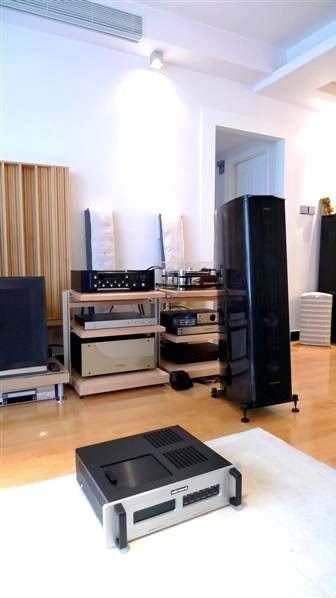
Click all pics to enlarge. Top, what a place! Fantastic! this must be one of the "simplest" systems I have ever seen in the high-end.
Virtual Home Visits (1): Two Systems in Mumbai!
Overview: JBL
Amended 7/24/20: audiopro's listening experience on the first system added.
Editor: Readers, it is terrible that during this Lockdown we cannot hang out with friends, whether it is having a pint at a bar or sharing a meal. Home Visits are even more of a no-no. Hence, this is the first in a new series. Today, we visit two audiophiles in Mumbai (Bombay), India. For quite a while, I have been in occasional email communication with one of them (Vivek) and got to email too with his friend Prem recently. I hope to meet up with them some day! It is too bad they are too humble to write, despite their perfect English! I tried to entice them to be the Blog's Indian Correspondents but did not succeed. Both use loudspeakers that were Monitors.
For today's Home Visit, some of the equipment are close to my heart (or experience), so I shall ramble quite a bit. So that you can skip, some of my rambles are in italics. At the end of the article I shall write a concise Overview of JBL.
Big Loudspeakers, Simple Setup
First we meet Prem, an engineer. The equipment he has now and the stuff he had before add up to a mightily impressive list, even by my standards! And his curiosity knows no bound.
Prem is one of the few audiophiles I know who only listens to vinyl (at least at home). His main diet is Bollywood Classics, Indian Classical Music, Classic Rock and a bit of Fusion.
This is analogous to many HK audiophiles, who enjoy Canto-pop and Cantonese Operas. For myself, as one who knows Chinese Opera, I relate to Indian (the region's) classical music. In fact, I really admire a lot of their classical music, so sophisticated (when I was younger, like many Westerners, including prominent musicians, I loved to listen to raga's as well as sufi music - I should dig out those CDs!)
 EMT 950 with the 929 arm, TSD 15 cartridge and the built-in EMT phono with their step up transformers. I am green with envy! Prem's unit had been completely serviced and restored to original specs by ex EMT engineers in Germany. At the time of purchase he had the option of opting for the original tube phono supplied with the 927 and 930 instead of 950's Soild State Modules. But both the ex EMT engineers and Stefano Passini, who’s written a book on EMT, suggested he stuck to the SS one supplied with the 950 since it mates best. They said if EMT engineers thought the tube sounded better, they would have supplied the tube phono and not the SS phono, and Prem went with their advice. The 950 was a statement product, used by most prestigious radio stations, including the BBC. On this complete unit, one can adjust the output voltage gain anywhere from 0.77 v to 10v (!). It has 2 gain controls, one each for left and right. Since it has a built in pre, Prem just uses it to drive the power amp directly.
Having encountered many EMT's in Hong Kong, I know this is the Centerpiece of Prem's System, something he will never change. And why should he? Few can afford it and it goes up in value steadily (better than volatile stocks). The EMT's I heard in HK varied in condition; all had EMT arms and cartridges, and they always sounded musical. Ditto the 930's of my friends Andy and Mark in NYC. I used to wonder why I never owned an EMT; I guess that is because my smaller abodes in crowded HK and NYC made me adverse to over-sized TT's. I can only take solace in the fact that my Thorens TD-125 is basically an EMT 928. Now, if I have a whole basement (and the dough)...
JBL 4343 This needs no introduction. It was actually the Centerpiece of a 2009 Home Visit in Shenzhen, China, a rare early entry that I wrote in Chinese (English here). In 2017 we also heard it briefly in NJ, but it was too casual a visit to record much (here). I am glad this iconic loudspeaker makes a formal return in this blog! Prem's are the more coveted earlier alnico version.
JBL's, because of their easy load, generally work as well with tubes as solid state, so the HK users are kind of split down the middle in terms of what they use. Though a benign load, despite the spec's, like latter day TAD's, db for db, JBL's are not as easy to drive as, say, Klipsch, Altec and Tannoy. Generally, you don't find SET and low power amp lovers using JBL. It should be noted, HK has close ties to Japan, and is heavily Japanese influenced. The Japanese revel JBL and the subset of HK Japanese gear aficionados (I am one foot in) also are JBL fans.
In HK, I have listened to a lot of 4343's (both alnico and ferrite), as well as quite a few pairs of its sibling 4344 (largely for the Japanese market), and I prefer the 4343 for its greater versatility. See, JBL, because of its rich sounding midbass, are often favored by jazz, pop and rock listeners. In many setups that I have heard, classical music was not reproduced as well. This tendency is worse in 4344, which I personally think sounds better with ss amps. I have more to say in my JBL Overview at the bottom.
 Quicksilver Integrated This is a current QS product (official site). The stereo amp uses 4 x EL84/6BQ5 and 1 x 12DW7/7247 (remember Dynaco ST35, which also uses the same EL84?). The topology is not that dissimilar to the now legendary VTL Tiny Triode's, which differ in that they are monoblocks and run in triode mode.
I have always loved the EL84 tube. Prem's words "...I like the EL 84 sound. It’s got good tone, it’s pretty quick, immediate and lithe..." are completely in sync with mine.
Although Prem has had all kinds of brand name cables before, he now prefers Radio Shack speaker cables and generic interconnects with connectors upgraded to Rean (a Neutrik sunsidiary). This kind of preference may be anathema to the average audiophile, but it is not at all uncommon among horn users (my friend Andy uses lamp cords for his Altec A5's).
What are Prem's priorities and where does he want to go? He said: "...I am looking for an honest, natural sound. Focus is on tone, presence and dynamics. The Quicksilver is very decent. In fact the designer Mike Sanders too has a vintage JBL which helped. While the Quicksilver is very musical, I am looking at a bit more resolution and transparency but not at the cost of tone, immediacy and dynamics." He is constantly moving his loudspeakers little by little to maximize their performance. Some of these exercises are discussed in HiFiVision Forum, an Indian high end forum, where everybody posts in English. Judging by some of the posts, that's a pretty high end crowd! Audio seems thriving in India!
Sound? Well here is a description by audiopro!
I cannot resist to list some of the stuff Prem had used before. He had owned a variety of speakers from Tannoy 15 inch Gold's to B and W 801 Matrix Series 3 to Audio Artistry Beethoven to Martin Logan’s to Rethms (Lowther-like loudspeakers). For amps he had used Mark Levinson ML2, Parasound JC1 monoblocs, DeHavilland 845 monoblocs, Dave Slagle customised 2a3 amp and a few others. He had also tried an Audio Note amp but it was too warm and rich for his taste (I agree). As if that's not enough, here is one more for you (mrgoodsound will take note), in his own words:
"...Prior to Quicksilver I had a David Berning customised class A zero feedback amp using 6b4g triode tubes in a push pull configuration. It was a 10 watter but could easily drive my JBL. It’s the same amp that David uses for his personal listening. I found this amp made it a bit lean in mid bass but otherwise it was excellent. Probably not a good match. This amp according to Berning is probably the best he’s designed..." FYI, he preferred that amp to LTA's current Ultralinear amp.

Graham LS5/9 on stands. Norma IPA140 on bottom shelf.
BBC Bent, Small System and Big Music
Now we meet Vivek. How time flies! I was sifting through my emails with him and was shocked that it has been 8 years! As one who is soon to be eligible for Medicare, moments like these are kind of frightening.
Like me, Vivek is a big classical music fan. By big, I mean he doesn't just listen to the usual suspects; instead he is adventurous (aside from me, I have never heard anyone mention Martinu!) Just like me in the HK and even the US audio communities, he is among the minority. Vivek enjoys live music and frequently attends concerts. Given that India has its own (and very sophisticated) classical music, it surprises me some of the names that appear in Mumbai with the Symphony Orchestra of India, including conductor Alexander Lazarev, one of my favorites. Western music seems to be thriving there.
Graham Audio LS5/9 Given his classical bent, and given that the space available to him is modest, Vivek is wise in preferring loudspeakers with a BBC heritage. Graham Audio specializes in reproducing classic BBC loudspeakers, and from a humble beginning has evolved quite astonishing a range (not surprising, as Spendor is behind them). Their products are generally well received, including the LS5/9 (TAS review by fellow BBC enthusiast Robert Greene).
I'll weigh in here. I have previously used the second generation Rogers LS5/9 (also called Mk II, bi-wired; now, please don't confuse this with the current reproduction Rogers LS5/9 - it must be lucrative that everyone wants a piece of the pie). The sound of the old Rogers was quite mesmerizing but I did have one issue with it: during that time I only used tube amps and the bass was too loose for my taste. I am sure solid state will do better. I have also heard several times the original (Mk I) and I think it is better than Mk II. When we listened to the larger and excellent Graham LS5/8 (here), I didn't write about it but we actually briefly listened to the Graham LS5/9 (not a fair comparison to its much more voluminous sibling) and I did think the bass was more tightly controlled than both Rogers Mk I and II. BTW, there is a Chinese company called Bestvox that also reproduces BBC LS loudspeakers (not BBC sanctioned, but at a fraction of the price). They are pretty popular in Taiwan, especially the LS3/5A. There is a U-Audio review of Bestvox LS5/9 (translated to English; original) . This review is actually thorough and went into details about the design and it talked about the bass issue. For this article, I read some other netzine Graham reviews (LS5/9 reviews as well as some LS5/8 reviews that came after mine) and I think they are mediocre. These lousy reviewers write the same thing about everything and are boring; you wonder whether they use the same template and just change the brand name. Of course, they know little about the BBC sound and design philosophy. I'd personally avoid those sites for any review.
Norma Revo IPA 140 As of this writing, Vivek is testing out this amp, which is on loan to him. This is a new name to me, designed by yet another Rossi (no relation to Vinnie). It has been well reviewed in HiFi+ but, interestingly, Vivek said he was even more swayed by a review in Taiwan's U-audio (in Translation; in Chinese). Obviously, the Translators have gotten so much better to allow English speakers to comfortably read Chinese articles and, as in this blog, for Russians to read English!. That has not always been the case, and does represent progress.
I asked Vivek what he thinks about the Norma and he said: "...I have the perfect description for the NORMA...Take the LFD that you reviewed (here). Strip away some excess warmth and add some more resolution, mid-range solidity/palpability, more bass control and less sweetness (a pinch) in the treble and voila!" That sounds pretty good to me! FYI, Vivek had previously used LFD Mk III.
Analog - Rega P3-24
Digital - Cambridge audio CD player and SOtM player (Pi with JRiver as server) feeding into RATOC RAL 24192DM1 (link).
Vivek also has the TEAC PD-H600 CDP, Elekit TU-8500 preamp and a Clones (gainclone) amp. Previously I recall he had used the Harbeth C7ES and Leben integrated amp.
************

Graham LS5/9 on stands. Norma IPA140 on bottom shelf.
BBC Bent, Small System and Big Music
Now we meet Vivek. How time flies! I was sifting through my emails with him and was shocked that it has been 8 years! As one who is soon to be eligible for Medicare, moments like these are kind of frightening.
Like me, Vivek is a big classical music fan. By big, I mean he doesn't just listen to the usual suspects; instead he is adventurous (aside from me, I have never heard anyone mention Martinu!) Just like me in the HK and even the US audio communities, he is among the minority. Vivek enjoys live music and frequently attends concerts. Given that India has its own (and very sophisticated) classical music, it surprises me some of the names that appear in Mumbai with the Symphony Orchestra of India, including conductor Alexander Lazarev, one of my favorites. Western music seems to be thriving there.
Graham Audio LS5/9 Given his classical bent, and given that the space available to him is modest, Vivek is wise in preferring loudspeakers with a BBC heritage. Graham Audio specializes in reproducing classic BBC loudspeakers, and from a humble beginning has evolved quite astonishing a range (not surprising, as Spendor is behind them). Their products are generally well received, including the LS5/9 (TAS review by fellow BBC enthusiast Robert Greene).
I'll weigh in here. I have previously used the second generation Rogers LS5/9 (also called Mk II, bi-wired; now, please don't confuse this with the current reproduction Rogers LS5/9 - it must be lucrative that everyone wants a piece of the pie). The sound of the old Rogers was quite mesmerizing but I did have one issue with it: during that time I only used tube amps and the bass was too loose for my taste. I am sure solid state will do better. I have also heard several times the original (Mk I) and I think it is better than Mk II. When we listened to the larger and excellent Graham LS5/8 (here), I didn't write about it but we actually briefly listened to the Graham LS5/9 (not a fair comparison to its much more voluminous sibling) and I did think the bass was more tightly controlled than both Rogers Mk I and II. BTW, there is a Chinese company called Bestvox that also reproduces BBC LS loudspeakers (not BBC sanctioned, but at a fraction of the price). They are pretty popular in Taiwan, especially the LS3/5A. There is a U-Audio review of Bestvox LS5/9 (translated to English; original) . This review is actually thorough and went into details about the design and it talked about the bass issue. For this article, I read some other netzine Graham reviews (LS5/9 reviews as well as some LS5/8 reviews that came after mine) and I think they are mediocre. These lousy reviewers write the same thing about everything and are boring; you wonder whether they use the same template and just change the brand name. Of course, they know little about the BBC sound and design philosophy. I'd personally avoid those sites for any review.
Norma Revo IPA 140 As of this writing, Vivek is testing out this amp, which is on loan to him. This is a new name to me, designed by yet another Rossi (no relation to Vinnie). It has been well reviewed in HiFi+ but, interestingly, Vivek said he was even more swayed by a review in Taiwan's U-audio (in Translation; in Chinese). Obviously, the Translators have gotten so much better to allow English speakers to comfortably read Chinese articles and, as in this blog, for Russians to read English!. That has not always been the case, and does represent progress.
I asked Vivek what he thinks about the Norma and he said: "...I have the perfect description for the NORMA...Take the LFD that you reviewed (here). Strip away some excess warmth and add some more resolution, mid-range solidity/palpability, more bass control and less sweetness (a pinch) in the treble and voila!" That sounds pretty good to me! FYI, Vivek had previously used LFD Mk III.
Analog - Rega P3-24
Digital - Cambridge audio CD player and SOtM player (Pi with JRiver as server) feeding into RATOC RAL 24192DM1 (link).
Vivek also has the TEAC PD-H600 CDP, Elekit TU-8500 preamp and a Clones (gainclone) amp. Previously I recall he had used the Harbeth C7ES and Leben integrated amp.
I am very grateful to my two Indian friends for entertaining us! A round of Applause!
Brief Overview: JBL
Although in HK I have likely heard more JBL's than any other loudspeaker brand, this Overview is brief. Why? Because on the internet there is so much information already. JBL's own pages are not worth anything; Rather Lansing Heritage is a good place to start. Here I shall only briefly chronicle my own impressions, experience and assessment.
General Character Because of its popularity in home use, people tend to forget that JBL is a company with a professional monitor heart. As with other monitors, they usually have a flat response and are easy loads. Because of that, they generally work as well with tubes as solid state, so the HK users are kind of split down the middle in terms of what they use. Despite the spec's, like latter day TAD's, db for db, JBL's are not as easy to drive as, say, Klipsch, Altec and Tannoy. Generally, you don't find SET and low power amp lovers using JBL. It should be noted, HK has close ties to Japan, and is heavily Japanese influenced. The Japanese revel JBL and the subset of HK Japanese gear aficionados (I am one foot in) also are JBL fans. Mid-bass and Bass When JBL lovers tell of their love for the bass, they are really talking about the full sounding midbass. This is not to say there is a midbass bump, rather the bass rolls off very cleanly. Inch for Inch, JBL (and TAD) actually has less bass extension than many other loudspeakers (like Tannoy). For classical replay this is a disadvantage. Electronic Crossovers Perhaps influenced by Japanese, in HK, there are a number of people who insist on using electronic crossovers. My view is simple: it can do good but it always do some wrong too. Basically it is a more hifi kind of sound if done well, and subpar when not. It is also more demanding of power. Not my cup of tea.
Now this is something: I have almost never heard a really bad JBL setup. An easy choice for audiophiles. Also, despite the time span and evolution of drivers, the basic JBL sound is pretty consistent. Now, I don't know the current products, but I doubt they are better than the vintage classics.
4343/4344: adapted from above. The 4343 needs no introduction. It was actually the Centerpiece of a 2009 Home Visit in Shenzhen, China, a rare early entry that I wrote in Chinese (English here). In 2017 we also heard it briefly in NJ, but it was too casual a visit to record much (here).
In HK, I have listened to a lot of 4343's (both alnico and ferrite), as well as quite a few pairs of its sibling 4344 (largely for the Japanese market), and I prefer the 4343 for its greater versatility. See, JBL, because of its rich sounding midbass, are often favored by jazz, pop and rock listeners. In many setups that I have heard, classical music was not reproduced as well. This tendency is worse in 4344, which I personally think sounds better with ss amps.
L300 For me, if I have the chance and dough, I'd grab the now very expensive L-300, which is time aligned, more home oriented and I have heard that perform very well with classical music. One of my dream loudspeakers.
4310-L100/4311/4312 Because of the large number of units out there, these are the most commonly encountered, particularly the long running 4312 series. I have heard a lot of these. My own experience with 4312A included stacking two pairs 4312A (here). That was a high point of my audio journey and I remember it with fondness. I have also heard some 441x, of similar sound.
4430 This Bi-Radial model is also frequently seen. I have heard it several times (even its larger sibling), and they do a good job, but personally I think the 431x and 441x sound better.
K2 Series In my opinion, these are very suitable for home and they sound wonderful. They are truly home-friendly horns. I have heard the 9500 but I prefer the later 9800 (with a supertweeter). I still remember my 25 wpc Fisher X-101-C driving the latter to perfection in a 200 sq ft room (outperforming the very expensive and artificial sounding Swiss FM Acoustics). Too bad I never got to hear the Everest.
Everest DD66000 I got to hear this several times! In HK, at an audio show and at an audiophile's big house; in NYC, in a small house(!), and in Guangzhou, China, in a warehouse. They all sound "good" but I was never impressed. The experience in the HK audiophile's house was seminal. This fellow has always been a JBL man, "upgrading" all the time. He "upgraded" from the K2-9500 to the DD66000, and we all thought it was for the worse (I heard he later went for the current 67000). The most incredible thing is, bass was seriously lacking, despite the double 15" woofers. It should be noted that he used electronic crossover. He later added 2 Wilson Thor subwoofers I heard. I shake my head. If you ask me, I have never heard good bass from this .5 way of dividing the bass duties between 2 drivers (a lot of loudspeakers do that). Maybe on paper, but not in action.
Hartsfield Although my experience here was not perfect (placement in particular) I could tell these could be superb. But any corner horn is difficult to implement.
Paragon Yes, I have heard it. This odd duck can make OK background music but there is no way it is serious audio!
L101 My experience here.
L20T/4406 Excellent. My experience here and here.
Century Gold Excellent. My experience here. The sound is tighter and more modern than the 43/441x series.
Studio 5 Series mrgoodsound reports on Studio 590.
Professional By this I mean older professional products. I am not familiar with the model numbers of the drivers but I have heard them to good effect in DIY horn systems in HK, as well as in NYC, with my friend Simon and Andy (here and here).
Subwoofer In HK I loved my vintage JBL subwoofer (mine is Digital 12). It has a paper woofer, and I prefer the sound to the more famous and upmarket REL Strata III (rubber). Look up craiglist and you may get a pair for next to nothing.




 Posts
Posts