Showing posts with label Brand-AES. Show all posts

31 October, 2020

AES SE-1


Brief Review: AES SE-1, revisited, vs Elekit TU-8300

AES SE-1 Review (2010)
Elekit TU-8300 review

Ten years ago I wrote the above article on AES SE-1, and till now it is still one of the most read in this blog. Recently, after the arrival of the easy-to-drive Harbeth P3ESR SE, I began to run again some of the SE amps that I have. After the 5 wpc Almarro A205A (EL84), I ran the SE-1. 300B's were Shuguang; old stock Ken-Rad 6SL7's.

Driven by the Shindo Monbrison, the sound was quite nice. Compared to EL84 the image was larger, surprisingly life sized and midrange was warmer. The bass was well contoured, as is usual for 300B. I was able to play quite loud with classical orchestral pieces.

vs Elekit TU-8300 I swapped the same 300B's onto the Elekit (used with or without preamp). In comparison with the SE-1, the sound is similar, perhaps a little more resolving but also a little leaner. Most revealingly, the sound of the Elekit is more 2-dimensional, the SE-1 more corporeal. It is obvious which one I prefer.

Both amps are solid state rectified. The SE-1 is a very simple circuit, Zero NFB with (Cathode Resistor) Fixed Bias. The Elekit on the other hand is a more complicated design. There is a small amount of NFB. The B+ has FET ripple filter. Although auto-biasing, it is actually Fixed Bias controlled by a Constant Current Circuit, with protection for current overdraw. I cannot help but think the solid state components, although "not in the signal path", likely could be a reason for the somewhat lean sound of this amp.

The AES amp is a good buy. It is a basic amp, conservatively designed, with good parts and iron. Aside from changing some caps and upgrading some parts, there is not that much room for upgrade (my first unit was modded and it did not sound that much different.) It is not the most resolving, nor the most subtle in expression, but plain speaking is often preferable to over-voiced in the long run. To surpass it, at the least one needs even better iron (like Sun Audio). For a larger leap, one needs to consider much more expensive amps like the Wavac MD-300B ( 2 tube input + driving stage + interstage) or Verdier (a unique circuit).

Q and A I'll take the opportunity to answer a reader's questions by email. In general, I prefer to have the questions in the blog (as comments) so as more people can read about it. Here it is:

Q1. Might you still have a copy of the owners manual for the AES SE-1 power amp you could email me?

A1. I do have a manual in NYC, but I have posted the relevant pages in the link above. The rest is construction notes, not important. I am away now, and for the foreseeable future have no access to it.

Q2. Since this is my first 300b power amp I'm simultaneously happy and anxious and curious. I love the sound but wonder where how this old thing stacks up against some of the more contemporary options out there. For example, the Bottlehead kit. Or some of the amplifiers available at a low price from China.

A2. Please read carefully. In the link cited above and in this article I have laid it out, though not exhaustively. For the cheaper Chinese amps, I think you can forget about them (since you have the AES already). Remember, many of those people touting some of these products are no more experienced than you in SE amps. Bottlehead is not bad, but they are over-priced now.

Q3. How long did you keep your SE-1 in your system? What did you move on to?

A3. This is an odd question. I know many people do a quick A/B and sell off what they deem is inferior. I do it a little differently. I sell things sometimes to acquaintances or by chance. Sometimes, one regrets what one has sold and other times things actually appreciate in value. If you seriously peruse this blog, you will find many 300B amps that I have used and commented upon, albeit briefly.

Q4. What cables are you preferring?

A4. Similarly, you can find many posts on that. Mostly Gotham, sometimes Mogami and others.

Mail: "...Here's a little about my system and history - for many years I was in the Naim camp. I ran LP12/Ittok/dynavector 17D3/Linto, CD 3.5/hicap into 82/hicap/135s into Apogee centaurus minors. I used this system for 15+ years. 7 years ago I picked up a pair of ESL 63s. Switched from the 135s to an Innersounds Electrostatic amplifer (great amp). When I retired I bought a Supratek Cortese preamp. Now I'm using a Quad 909 and am using 2805s. I also have a pair of JBL 4430 monitors. I'm using the SE-1 with the JBLs and it sounds very nice. Power cords, speaker wires and interconnects are still evolving..."

Reply: Judging from what you have had, all good stuff, you know what you are doing and can make your own decisions. The 4430 is excellent. Since I had the 4312 (which I wrote about extensively) I know the house sound. And I can surmise that you don't listen to banging music. The 300B (any SE) is just enough to get a good sound with the JBLs, but it would help to add a subwoofer (an old and cheap model will do), and that would reap more benefits than switching amps. The subject of adding a sub has been extensively treated in this blog.

Good luck!

26 March, 2011

Q and A:AES, Sonus faber, Clearaudio, VPI, Chinese made products

Q and A: AES, Sonus faber, Clearaudio, VPI, Chinese made products

Periodically I receive emails from readers on various topics. A few I answer right away because the questions are simple and easy. A few requests, like the circuit diagram on the extinct AES SE-1, took some time to satisfy. But there are many on which I procratinate; I hesitate not because I don't want to, but because I don't know the readers well. Many ask whether I'd prefer A to B, and these are not too easy to answer without knowing a lot about the reader. For myself, I simultaneouly enjoy many different things, though in the bottom of my heart I know my ultimate preferences. After some thought I have decided to periodically publish Q and A, of which this is the first. This is to let you know I hate to not answer mail, but sometimes it is not easy to give a conscientious answer based on the little I know of you. Now, from the newest first.

Q. on AES SE-1 (gwoods100) "...have you, by any chance, heard the standard SE-1 against the 'Signature' version? I'm contemplating doing the upgrade...do you know where I might locate a schematic for the Signature version? If there's not much involved, I might consider the upgrade and take a chance that it'll sound better.Incidentally, I have tried to contact Cary about this, but so far they've failed to respond to my emails (three so far, across ten days). Again, many thanks for the SE-1 schematic - and for other fascinating reading..."

A. No, I have never seen, let alone heard the 'Signature' version. What I have heard though, is the difference between the stock version I have now and the decked-out one (Kimber caps; upmarket diodes; better wiring etc) I previously owned. I'd say heavily modified the sound is clearer, but not necessarily musically better all-around. From my perspective, one's money would be better spent in another amp that has a completely different design, say the wonderful Elekit 2300 or 3200. Boutique parts are expensive and don't always pay dividends. YMMV. Some people build a tube recitified power supply for the thing, and I think THAT would be worthwhile, though drastic surgery.

Q. Sonus faber EAII (gysbertwillem)
"...I have had my Sonus Faber: Electa Amator 2 for years, very happy. Nad 330 to "feed" them...
I was not going to use the Nad that long anyway, however here I am now ( years later) and one speaker stopped in the low frequency! I have worked out that it is not my amp , could it be the xover, or is it the woofer it self. I have tried all the sonus faber people to advise me in this one ,simply no reply of none of them. Desperate as i am got me on to you when I found out about your web site. I know that you don't want to get back to the people who approach you, but could you please make an exception in this case of mine so I can listen to my music again. It is nearly 2months since this shit happened! Also I would like to hear your opinion about the Almarro 318 b in combo with Electa amator 2..."

I am really sorry that the second question is a lot easier to answer than the first. It depends on the music played. I think classical solo and chamber music and jazz would be OK for the Almarro 318, but big works or rock would not do for lack of power.

I have actually tried to contact also the SF HK dealer but got little. You have to make sure it's the woofer that's bad. In HK we have repairmen who can make it work, though how much up to spec's is not clear. It's too bad SF does not back up.

Q. Clearaudio and VPI (Babar)
"...I noticed your commentary on Clearaudio Concept. I just listened to this today and it sounded great even with the stock cartridge. I am considering to purchase this table, maybe with a better cartridge like Virtuoso or Maestro. I guess you still own this table so you must like it! I see you are very particular about your tables and the musicality is important to you as it is to me. I also considered Clearaudio Emotion CMB table which I have a line on for a very good price, with the Virtuoso cart. I was wondering what you thought of this table in comparison to Concept. Personally, I found it to be very present with great soundstage, but also overly bright and fatiguing (maybe was setup?). Also many people recommend me to stay away this table and instead consider Concept or others. There was something appealing about the sound but also maybe it was analytical or something bothered me as well which stopped me from buying this, as dealer was pushing me, insisting it was best value for the price ($2000.00 approx) The last one I think about is VPI Classic and would be interested to hear more what you think about this table. It is a little bit outside of my budget for purchase, however, so I am leaning towards Clearaudio (Concept most likely). How would you compare these two tables - i.e., will I be satisfied with the Concept!..."

A. Probably too little too late. Yes, I love the Concept and consider it one of Clearaudio's better efforts. To be fair, they do put effort in their lower end products, though the upgrade path is more of a pandora's box. As I alluded to in answer to another question, many times I'd prefer just playing with something else rather than upgrade. I suspect the Emotion itself, without the CMB, is probably a lesser turntable than the Concept. I am curious about the CMB myself, but the magnetic arm on the Concept is probably just as good as the one on the Emotion, and rare to boot. As for cartridges, Clearaudio would not be my first picks. Denon, Benz-Micro, not to say Ortofon, would be hard competitors. In any case I think all of them are OK. As for the VPI Classic, I think it is a bigger sounding beast, quite different and worth an audition. It too has too many upgrade paths. Too much temptation. Do let me know what you finally settled on and whether you liked it.

One thing though on the Concept: the price in HK is a bargain!

Q. China Made (Dana)
"...since you have strong Asia connections, how come you don't review more China components. It's my understanding that China high end audio components have improved dramatically in both audio and build quality. It would be most helpful to review some of these products like the DOGE 8, and maybe identify those vendors who turn out really good stuff..."

I thank reader Dana for his kind words elsewhere. As to why I don't review too many China gears, it's actually a complex question that merits an article on its own, and I am way behind. While I agree the audio and built quality have improved greatly, based on what I hear I still often have serious reservations about most of the stuff. As a rule, I generally frown on copy-cat stuff (especially cloning), and that eliminates many products (well western products too). The looks too of many of the gears put me off, neither here nor there. Most importantly, I think in general it can safely be said the Chinese designer is likely not quite mature in his MUSICAL TASTE, which makes or breaks a product. Many products do reasonably well on vocals but fail when it comes to full-bandwidth music. This is especially true of Chinese (including HK) tube audio products, of which I am not a fan. Despite claims, many of the transformers and designs just sacrifice both ends of the spectrum, to list just one of their sins. In contrast, I do think the Chinese solid state products are better than the tubes ones. As for speakers, well, they are few good ones, and most are just clones of existing big-names.

There are good manufacturers. Like YS-Audio from HK, which I plan to report more on. I also would like to write a full length reply, but no time yet.

03 September, 2010

Review: AES SE-1

Review: AUDIO ELECTRONICS SUPPLY (AES) SE-1
Even though they make reasonable products, I am not a great fan of CARY. What most people don’t know is that, early on, Cary made kits, named AES (they still have that branch, but finished products only). They at the very least were great values and frequently gave their finished products (of higher gloss) a run for their money. Sounds familiar? Think Audio Note. Think of the AN Kit-1 vs Conqueror.
And the best product of that time was the 300B SET amp SE-1. My first one was about 10 years ago, thoroughly tweaked out, sold to me by a nice fellow from Slovenia! It had good power, able to drive my Klipsch and Tannoy Lancaster to thundering levels. But I had too many amps and marginally preferred the Sun Audio and ICL, so I sold it, even if I preferred it to the AN Kit 1 (which I sold too). They have discontinued this model long ago. I doubt it was making much money for them.
Recently I bought this amp again, in stock form. At its current ridiculous second-hand price, it’s a true bargain. The sound, without upgrades, is still much like what I remember. It is musical. Parts are really superb. High quality diodes, resistors and caps, including Kimber caps. As a matter of fact, recently E lent me the flagship Cary 300B Signature monoblocks, and the parts are similar!
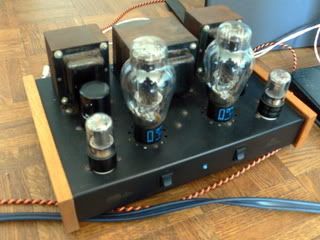
The SE-1 features beefy trannies, likely from Magnequest given that this is from Cary. Solid state rectification. DC filament. 1x 6SL7 (cascaded) driving 1x 300B per channel. This is a fixed bias design. In the back there is a phono jacket in which you can plug in a phono pin and measure (with a multimeter) the combined plate currents of the 2x 300B tubes, which should be in the vicinity of 130 ma. The current is adjusted by the pot next to the phono jacket. Of course, you can bias it lower or higher as you like. I prefer lower.
One cautionary tale. Some people buy it used and just plug their 300B’s in without bothering with the bias procedure. This is not good, even dangerous. The sample I bought this time sounded weak at the seller. When I got home, I measured the bias, and it was in the low 80’s, no wonder. After proper biasing, the amp sounded a lot more powerful. Another caution: The bias measures the COMBINED currents of the 2x 300B tubes, not individual bias. If you’re sure your tubes are a matched pair, there’s no problem. But, if the pair is not matched, it’s better to have lower bias current, as one tube may draw too much current and the other too little.
Aside from using ss rectification, the design is not much different form the flagships. And a good feature is separate switches for on/off and operate/standby. This allows for pre-heating of filaments to ensure better life for the 300B.
This amp can be easily converted to use other tubes, like 2A3. If you change the sockets, tubes like 6B4 can be easily accommodated with minor changes.
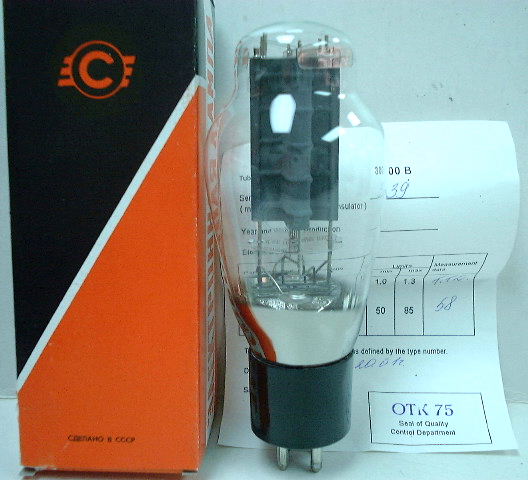
The sound? It’s as good as the 300B SEI and perhaps even the Signature monoblocks (not as powerful in this case). For best result, use Ken-Rad VT-229 silver plate.
Addendum (April 20, 2010)
Finally, I have loaded the Schematic and some pertinent info. Thanks for your patience and I hope the info helps.


12 comments:

Humayun said...
Thanks for the review. I've just bought one, and I need a manual. How can I get one? I'd like to try 2a3 tubes. Thank you.
doctorjohn said...
Humayun:

Where are you? My manual is in the USA and I shall not have access to it until the fall. I can send you a copy then. Can you leave me your email address?

If that's too long to wait, please contact Cary. They may be able to help you.
cruzd2 said...
I am considering this amp, I would also like to run 2a3's (for more bass, any truth to that)? Also when installing 2a3's should they be re-biased, what should my setting be? How about their signaure version, worth the price? I have B&C M15 speakers(98db)that house a large horn and a 15' woofer, I need to move that air for personal bass satisfaction would this amp be a good match? Thanks for your time and insight!
doctorjohn said...
cruzd2: 2A3 is surely more bassy than the bass-lean 300B. You cannot just plug it in. You need to change to the lower filament current of 2A3 and re-bias is absolutely needed (lower total current). As my previous reply says, I don't have my manual with me right now but shall have access sometime in the fall when I return to the US.
tubeornot2b said...
To use the 2a3 tube you do not really have to change the filament voltage circuit. The SE1 was set up to accept either via a voltage dropping resistor. You will have to rebias.

Cary/AES recommends using the settings of a range of 138-150mA for all 300B tubes and 110mA for 2A3 tubes. I found that I preferred the sound of lower settings. Particularly with the 2A3's 110 ma is pushing them a bit.
Tac said...
Thank you for valuable information on your web pages. And I bought SE-1 also and enjoyed its excellent sound with 2A3s as biased 100 mA as your suggestion. I would like to try different tube type such as 6B4G with adaptor or even 183 tube, but had no access to the manual. If you have the access, could you send me a copy?
Best,
fedup said...
Could you send me a manual? Or possibly provide some details on using a dropping resistor to lower filament voltage for a 2a3?

Thanks,

sardeenz@gmail.com
doctorjohn said...
This post generates more interest than I thought. I am going to see if I can put a copy of the manual on the net as pdf file or something. Please bear with me
fedup said...
Thanks doctorjohn. I appreciate taking the time to upload the schematic, etc.

I'm still a bit confused on 2a3 compatibility. Tubeornot2b's comment mentions either 300b or 2a3 will work without changing the filament circuit, but he says it's designed to accept either via dropping resistor. Does this mean you need to add a dropping resistor after the .75ohm 25W resistor to bring down the voltage or it does it automatically. I put Sovtek 2a3's in and they measure 2.5v filament but when I put in 300b's they measure 5v filament. It's as if the tube itself is changing the provided voltage needed. When I measure without output tubes in, the voltage is 4.2 volts. So basically I'm a confused newbie. Any thoughts or advice are appreciated. btw, the 2a3's sound fantastic, and I've been leaving them in. I'm just unclear on their operating points in the base (unmodded) configuration. My 2a3 grid measures -69v and get 354v via blue wire gong to the plate. filament is around 2.4v or 2.5v with no mods.
doctorjohn said...
"Fedup": I am glad it was of use. The Blog interface is not the best for chatting though. I found the "auto-adjustment" strange too. To my layman's view, it shouldn't be. But it's true in the manual it does not mention changing dropping resistor for different tubes anywhere, so I'd trus your voltmeter.

I may be getting some articles on modding the SE-1 to auto-bias and tube rectification!!!!! Of course this would necessitate a separate power supply box, but I'm sure this would take the amp to a different level. It's in Chinese but I'll see what I can do. Check back in a few months...

Meanwhile, enjoy!
carla said...
Very cool. I am very interested in a separate tube rectified ps. I just replaced the rectifier diodes with hexfreds and I think I hear a slight difference, a little smoother, but still nice and tight. Cheers.

Review: MARTIN LOGAN Source

Review: MARTIN LOGAN Source

Supplements:
Further Notes: Fall 2009

Disclaimer
: If you don’t believe hybrids can work, don’t read further. If you believe Quad or Maggie or whatever looks flat rules, read no further. If you want to fight over what planars are best, get away! For those a little more objective, or less stubborn, a star is born.

A Tale of Two Drivers: An old colleague had a large hybrid ML which, because of wife factor, he placed close to the front wall, and that was a no-no. He bi-amped with Jadis Defy 7 and an Aragon. No, I’d never do that if that’s what it takes. However, even then, I heard many good things, and have kept an eye on this company. It seemed to me their products have steadily gotten better and better. Back some years ago, you could have heard quite a bit of ML hybrids in show conditions, but not any more, as ML, like other stats, is really a minority taste in HK. I remember a smaller ML floor-stander in a hotel room having one of the best sounds in the show, better integration than a lot of the Wilson’s, Dynaudio’s and quite a few of those horrid German speakers in the same show. However, labels are difficult to shake off, and “coherence” has always been an albatross on the neck of ML.

My discovery of this pair was due to Jonathan Valin’s review in the March issue of TAS. Now, I am rather neutral towards JV the writer, unlike a few others of TAS (like Steven Stone, who should just stick to desktops). What caught my eyes in this review were:

  1. Small footprint and rather nice styling.
  2. High sensitivity; 90 db.
  3. JV’s claim that the ML is the most coherent hybrid he has ever heard, with almost no discontinuity he can discern. That’s a tall statement, but from a man (and a magazine) who should know his planars and who used to own the ML CLS. He’s putting his reputation on the stake for this statement.
  4. Paper cone woofer (though you can’t tell by looking).

Searching for Godot: My friend E and I set out to find some place to hear this. Harvey’s is defunct but still maintains a “shop” in an unlikely lower Manhattan mall. They are dealer but the guy just dismissed all MLs, and none was on the floor. Sound by Singer, where we heard the Vienna Acoustics Haydn Grand and Focal Chorus 705/6Vs (all TAS editor’s choice), did not have MLs. So no luck.

By chance I saw a like-new pair on the web for sale and, after some emails, landed a brand-new pair at substantial discount! My friend E was really surprised as ML, like B&W, doesn’t usually discount at all.

Great Expectations: Two huge boxes arrived like a pair of Trojan horses, much larger than the speakers themselves. Power supply is via a small wall-mart like box not much bigger than a deck of cards, which never even gets warm, visually less threatening than Quad. There is a rear-firing port, and the woofer is located less than 1 ft from the floor (sans spikes), things that I usually avoid in my speaker selection, except this time. The manual is very well written, advising distance between the speakers and the front and side walls. I have no problem with the front wall, but have problem with one side wall, closer than recommended.

For the run-in period (manual says 72 hrs for the woofers) I had the right speaker virtually against the side barrier. The left speaker’s woofer is very close to the couch but its port is well ventilated due to the presence of a nearby corridor in the rear. And so, while the left side poses no problem, bass on the right was suboptimal at first, not helped that the classical music I listen to usually have a lot more bass to the right. Adjusting the degree of the port helps quite a bit. Although absorption supposedly does not work at low frequencies, I thought a large piece of cloth helped (maybe just psychological?). Sound in the mid-range and treble was startling good from the start, not surprising as suspense is in the bass. These are nominal 5 ohm speakers, with lowest impedance of 1.6 ohm at 20k Hz. This did not trouble my NAD 325BEE, nor the Marantz 8B, and had no trouble driving the Source to good level.

The bass gradually cleared up, becoming more and more layered. I moved the right speaker one ft more into the room and the bass cleared up further. Note that I did not install the spikes for fear of scratching my wood floor. Even then, for my loud listening level I find them satisfyingly coherent. Nor did the higher-than-normal cross-over point (470 Hz) seem to color any instrument.

After experimenting with toe-in, one can get superior dispersion (for stats), and I can sit anywhere and things still remain in the center. No, none of that tiresome move-your-head-a-little-and-hear-only-one-speaker thing. The images are tall, just like the MMG. My friend E auditioned this with me from the start and he, like I, preferred the Source to the MMGs for its realism and bass performance, even if the lean bass of the MMG is more room-friendly. Here I have to emphasize that I think whatever little problem the bass may have is due rather to the port and non-ideal placement of my right speaker. I don’t find the bass slow at all, nor do I think there is anything incoherent anymore than I may (and do) find in many conventional ported designs, or even “true” ribbon Maggies (which JV thinks are less coherent than Quasi’s). If anything, the bass performance outshines that of many conventional speakers. It goes deep and is rhythmic and walking when it should be. Even the droning bass guitar of Wilco’s A Ghost is Born cannot faze the ML.

How does the Source sound? JV said it best: “In a word, terrific. This is one very quick, very high resolution, surprisingly robust, wideband, and coherent loudspeaker, capable of making select voices and instruments sound as you-are-there ‘real’ as some multi-thousand-dollar big boys…” Sound is not as warm as Quad, but certainly warmer than Maggies. The spec’s of 42-22k Hz +/- 3 db is definitely on target, and you can still hear bass a little lower than that. I know there are people out there who think of Maggies as the most live-like thing out there. That’s simply not true. Although the imaging of Maggie is uncanny, that does not necessarily equate real presence, and in that department, good as they are, Maggies lag behind good horns, Lowther, Apogee, and Quad. Now, add ML to the list. It simply has a presence that the MMG does not.

Now, with one month on them (mine is likely equivalent to the usual person’s half a year), not only has the bass snapped into focus, the treble has also become that little bit smoother. I think they have completely broken in, and I think I can give this report with confidence. These are very revealing, yet never fatiquing as even the “true ribbon” Maggies can sometimes be. It’s like a marriage of Quad and Maggie, with the tonal purity of the former and the dispersion of the latter. Though, the soundstage has good depth but less lateral spread than Maggie, I feel the first class presence makes music sounds more like a live event, in a real hall, and not artificial “soundstage”. As I listen to to Perahia’s Mozart K453 (Sony/LP), I can clearly visualize him moving the keys with varying touch, as well as the string players leaning forward and digging in and, yes, the oboe sounds so real I recall CP’s unique ESL 57 sound. Yes, I have packed away my MMG for the moment. And even the SF EA-II is gathering dust.

Epiphany: I have saved the biggest surprise for last. I was checking out for my friend E his pair of Cary 300B Signature monoblocks. It turned out someone never bothered to adjust bias and one was run at close to 90 mA and the other at an unbelievable 125 mA, a testament to the excellent built of Shuguang 300B! Anyway, after adjusting them back to normal I hooked them up to the ML for fun. What do you know, perfect match! The presence factor was taken to the level of uncanny realism. Most amazingly, paino recordings really shone and that’s one of the highest accolades you can give a pair of speakers. Horowitz in Moscow (DG) sounds as full bodied as if it’s played on 15” JBL’s (if you don’t know it, the rendition of piano is a strength of big JBLs).

Big orchestral works posed no problem too. People who know me know that I listen at concert hall level. The ML acquits itself splendidly: Wand’s Bruckner 6th (RCA) is energized and has gravitas; Solti’s Shostakovich 9th (Decca) is all quicksilver and tongue-in-cheek. And yes, no super-tweeters nor subwoofers needed. Better leave those at your voodoo master’s place. After this, I tried the Sun Audio 2A3 (~2 watts), which did fine though the 300B amp’s inherently leaner bass and greater power provides a somewhat better match.

The other day, my friend M arrived when I was listening with E. M said, “Sonus Faber playing? Nice vocals!” That should say it all about vocals.

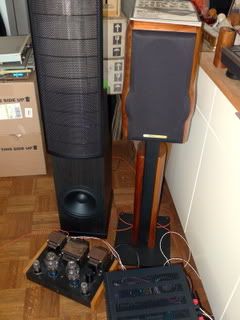
My daily listening now is the Source as heard through the very humble AES SE-1 300B amp, hooked up with Belden 9497. Even though it may be hard to find this lowly ML demo’ed anywhere, try to check this out if:

  1. you’re a SET amp fancier (but the dealer would surely not use a SET amp).
  2. you’re an electrostatic or other planar fancier, but not yet locked into the “XXX is best and there is simply no other choice” camp.

Keep in mind partnering is not a problem, but you need good and costly real-estate around the speakers. As with any speaker that has lowly placed woofers and rear port, clearance from front and side walls is a must. Even if your condition does not permit, these are great speakers that are worth a serious audition. At some point I also plan to audition ML’s new flagship, the all stat CLX.

Less is More: There’s an irony about the whole thing. Ever since I started listening to direct-heated triodes about 10 years ago in HK, all else have become secondary. I have always missed the sound of SET whenever I return to NY. This time I brought back my AES and planned on other SET amps to be used in my bedroom, as big efficient speakers are out of the question in the living room. The ML, with its small footprint, was bought to have a taste of electrostatics without attendant troubles. Little did I think these would prove SET-friendly. This shows the truth that there is always no harm trying, and once in a while you can be rewarded BIG. Now, SET is set (no pun intended) to be the main thing in my living room, though I have a suspicion they shall do very well at low level even in my bedroom. For me, that’s a bounty!

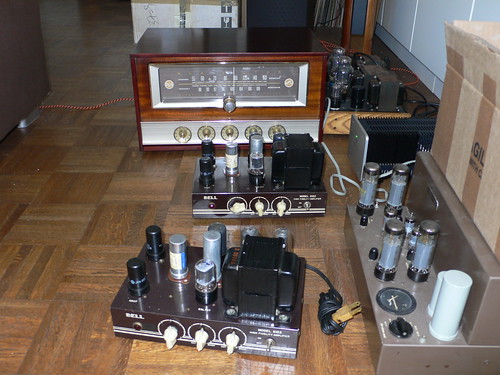
(See pic) The other day my friend E took his vintage RCA single-ended 6V6 receiver and it drove the ML Source beautifully, with no lack of power, though midrange was decidedly on the lean side. For fun I hooked up my pair of BELL 2122 integrated’s and sound was more mellifluous. Just for fun, we hooked up the Marantz 8B, which did fine too, though the sound of EL 34 PP cannot really compare with 6V6 PP in finesse and subtlety. All concluded that the ML works best with small powered amps, with SET delivering undeniable extra magic. And yes, I'd love to hear these with OTL's.

In the November issue of TAS, Robert Harley reviewed the Wilson Alexandria X-2 and mentioned its 95 db efficiency lends itself to being driven well by 50 wpc channel amps (like Naim) and outstandingly by even SET amps (he cited Lamm). In the wake of my recent experience with SET driving ML, I cannot help thinking about the mediocrity of many of the Wilson’s I have heard in HK driven by big amps. Perhaps they should try alternates, like what RH mentioned.

3 comments:

wesley said...

dj,

an excellent and informative review as usual, thanks for sharing.

it's good to have an open mind and i truly appreciate your efforts in trying out some much gears and reviewing them in an unbiased manner. it's probably because you don't do it for money.

regards,

wesley

Krishna said...

I bought Denon 3808CI. I have Martin Logan Source and Cinema in the fron. B&W 500 Watt subwoofer. I am having tought time make it better. anyhelp is greatly appreciated. I think I can make the system better by fine tuning.

doctorjohn said...

Krishna:

How are you placing the SOURCE? Placement is probably the most critical thing with this speaker. Too much against the wall can easily cause booming and that may make the addition of subwoofer even worse.

20 April, 2010

AES SE-1: Schematic and Info


Click on pics to enlarge


AES SE-1: Schematic and Info


After I published my articles on the AES SE-1 300B amp, over time I have received a surprising number of inquiries on it. Most ask for the manual. I have finally dug it out. Since I don't have a scanner, it is cumbersome to take photos and load them. Most of it is assembly instruction, so I just took pics of the schematic and pertinent operating info. I hope you shall be satisfied.

28 August, 2009

Extended Audition: The BIG 300B Tube and Amp Report

Overview: The BIG 300B Tube and Amp Report

First, an overview, and then a 7-part listening chronicle. My listening preference has shifted slightly over time with regards to certain tubes, but these articles written in 2001 still ring mostly true. Later I shall post my current feelings about even more 300B tubes. Almost 10 years later, I'm still listening to 300B, but things have changed a little.

Comparison of 300B tubes: 2001 Overview
(Revised from thread posted here, on 05/07/01)

The current production 300B tubes illustrate one basic point: that competition by manufacturers fuels progress. Let's hope the competition does not proceed to cut-throat level which will surely provoke a decline in quality, reversing the trend of product improvement we have enjoyed.

When I started with the 300B tube several years ago, Chinese and Cetron were almost the exclusive game. Then we got Sovtek, Svetlana, Tesla, re-issue WE, VV (defunct), KR, AVVT, and now Tianjin. Not only that, manufacturers, particularly Chinese ones, have come up with
commendable variations and, more importantly, improvements. The current state is an embarassment of riches.

No 300B test can have ALL 300Bs. I believe our several articles have the LARGEST variety of tubes available in any test, and we have tested the tubes in more amplifiers and configurations. Most of us, especially me and Andy have lived with a variety of tubes for many years and have intimate knowledge of our own, as well as each others' systems. I have not tested the Sovtek this round as a friend recently destroyed 2 filaments of one of mine and the other is orphaned (had NEVER happened to me; just don't pull on those things when hot) but that is an excellent tube for the price. I also had run a pair of Cetron for a long time many years ago. It was smooth but
lacked some resolution and air and I preferred the Sovtek in the AN kit one, at that time my only 300B amp.

No test can seriously A/B all tubes in one setup. Indeed it is my personal belief such A/B test is non-optimal and ultimately not helpful. I do believe there are no best tubes, and those serious about sound know things are system dependent. Our tests offer an interesting variety of amps and operating conditions, and carefully readers will even note that I repudiated myself from time to time. Such is the nature of things.

We should be humble in scrutinizing our own opinions. We should be proud that we enjoy the music so much and that we lsiten to such a large variety of serious music. Indeed it was a joy to have a teenager bringing his so-so recording (sound-wise) of Shostakovich largo to test out tube gears! And yes it was sometimes a chore to have to wait for the violin to emerge from Beethoven's long lead-in. But all was ultimately joy. Yes, the joy was in the music and 300B is the great messenger, better than most over-rated tubes.

I enjoyed most of the tubes. There's plenty of room for "error" in the views, but I do believe NO ONE is immune. If I am forced to make a summary, here it is:

Original WE, Tianjin meshplate, Svetlana
These are my absolute favorites. The TJ mesh is surprisingly similar to the WE. I do not agree with those saying it has a different sound. As a matter of fact the TJ is closer sounding to NOS WE than the re-issue WE. The Svetlana has a different sound, with some of the characters of other tubes, but it is a good boogie tube that keeps the refinement. I would keep it in this august company and do not regard it as inferior to TJ mesh, at the same price point too.

Sovtek, Valve Art (both versions), non-mesh Tianjin (ST and globe)
These are basic tubes with balanced virtues but a somewhat over-excited top, but used correctly would give a lot of pleasure. The best starter tubes for the budget minded.

Tesla, KR, AVVT, re-issue WE
These share some interesting characteristics that have NOTHING to do with the original WE 300B. Our listening favors KR which may be the best sounding tube in this group, with Tesla last. I have heard good performance of re-issue WE300B in 1 system, so care is needed. And it
cannot be emphasized enough that run-in is perhaps most important for this group and evaluation likely to be most erroneous. Problem is, people will only run in very expensive tubes like re-issue WE...

Cetron
Very warm and suitable to lean and over-revealing systems.

Evaluation is not meant to be inflammatory. Your mileage may vary, even greatly. With due respect, reading Thorsten's and the old TNT and Stereophile reviews, I agree with many points and disagree with as many. Your inputs are MOST welcome.

Lastly, we have no ties with ANY company, though some testing was done at Opera.

Listening Log
1. Part 1.
(Revised from thread posted here, on 22/06/01)

I was lucky that I got hold of a pair of Tianjin (Fullmusic) meshplate 300B to play for a while. Preliminary listening is very encouraging. As personally I always thought 3-note shootouts to be not desirable, I decided, what the hell, I'm going to seriously evaluate these, and in the process, test again all my 300B amps and 300B tubes. This is going to take many parts.

As summer has fully pressed upon us, I have gone into my small room for daily listening. This 80 ft room has the quieter and smaller (energy-saving) air conditioner. Following is the stuff I used for testing, which may change as test progresses, as the aim is to bring out the best in each.

FRONT END
-Micromega Drive 1/VdH Optocoupler/Micromega DAC.

PREAMP
-None used for amps with volume knob (Advance and AN kit one)(CD direct in, passive attenuation).
-For pure amps (AES-1) I use either the Audio Synthesis Passion V passive preamp, or if necessary, the Fisher 400C.

INTERCONNECT
-Taiwan military teflon silver cables into amp.
-When preamp is used, VdH Second from CD to preamp


AMPS

-AES-1 (Cary) 300B kit, original version, but upgraded with a load of boutique parts like Hexfreds, Cardas and Tiffany posts, Kimber caps and a pair of AN copper-in-foil caps. ss rectification. Fixed bias, with one adjustment for total of both channels. 1x 6SL7 and 1x 300B
per channel. Ken Rad silver plate 6SL7 used. This amp is highly revealing but a bit lean and un-involving, so a challenge. More details here.

-Advance 300B kit. This Japanese kit is one of my favorites. 1x 6AN8 (don't tell that to Joe Rosen) and 1x 300B per channel. Sylvania 6AN8 used. Stock except for Black Cat couplings caps. Meter and 2 pots bias the 2 tubes individually. Fine, warm sound, no doubt partly attributable to some NFB (no-no in some people's book, but not mine). Not as powerful, but nice.

-Audio Note kit one. On loan to a friend but soon to be back. Stock. 5U4 rectification. 1x 300B per channel, together driven by 1x 6SN7 and 2x 5687 (in SRPP). Will use RCA smoke glass VT231, Sylvania JAN 5687WB. This IMHO is THE most powerful 300B amp.

SPEAKERS
-TAD 300 used mainly, placed close to wall.
-Spendor original SP1 for comparison.

SPEAKER CABLES
-For TAD, original simple twisted stranded copper.
-Goertz cheapest copper for comparison.

SOFTWARE AND APPROACH
I'm going to spend a lot of time listening to various CDs, but for each combination I'll listen to a few fixed CDs:

-Brahms piano concerto #2, Katchen/LSO/Ferenscik (Decca)(Superb sound in bargain 2fer, sounding like Kingsway/Wilkinson type of thing, but uncredited, a recent favorite)
-Burmester CD II, various tracks, Ricky Lee Jones, Inbal/Weiner Symphoniler/Shostakovich #9, Von Otter sings Handel.
-Bach partita #2, chaconne, Menuhin (EMI), mono (sound good but difficult to make appealing due to Meunuin's style; a challenge)
-Teresa Tang (Polydor)


First 2 nights I played with both the AES and the Advance. With 2 amps one has the advantage that one can insert tubes in the idle amp (it is NOT advisable to change tubes hot, sure to kill weak filaments). I started with the Advance amp. For 300B I started with the long familiar Valve Art (VA), then Tianjin (TJ).

I quickly determined that using the preamp was not beneficial to the Advance, which already has volume knobs. With CD direct in. Sound into TAD was a good match. The TAD has ultra-analytical power. You hear SO much it is almost annoying sometimes. Fingers striking on the board, pages turning. The Advance smooths this out a bit. Without the preamp the Advance had the more natural flow. With loud passages the congestion was still a little annoying with the VA. This disappeared almost completely with the TJ. One immediately noticed that things are
a bit rounder at the leading edges. But importantly the scale was preserved (no mean feat to improve smoothness of attack and preserve scale), and the energy and presence of the Valve Art was not lost either. At this point I listened to several hours of CDs and I had absolutely no fatigue and enjoyed all the discs. No doubt the TJ is great for long term listening.

The TJ also needed a slightly longer warm-up to reach steady state. Within one minute it will clip. One tube has slightly dimmer outer filaments, but sound was unaffected.

Moving on to the AES proved a lot more troublesome. To be honest when I got this amp, with original Sovtek 6SL7 and Sovtek 300B I played it with the TAD. I was astonished by the brutally revealing nature of it, but I was not happy as it did not have the boogie factor. Perhaps it was "upgraded" too much that musicality vaporized. Recently I returned from the USA and brought back some Ken Rad silver plate 6SL7, the best in the business (yes, those UK "equivalents" are very bad). OK, with the KR 6SL7 on board and VA 300B the sound was quite a bit more refined, indeed almost musical. I started using the Audio Synthesis passive, and had to advance the volume to 3 o'clock to have good sound pressure, so the input sensitivity is lowish. But there still was considerably more grittiness than using the Advance amp. The lean nature had some advantage. Piano was better rendered, with the resonances clear, like the piano top had been opened. Clearly there were some good things but the AES must have particular attention paid
to matching. The Goertz fleshed out things a bit but lost the improvement in the piano. Switching to the SP1 mellowed out the sound quite a bit. Really more musical but the slight veiling and loss of details were palpable and difficult to accept after TAD. Switching to the Fisher preamp, volume around 12 o'clock, the effect was similar to the change to SP1. I decided to stick to the AD, original cables, and Audio Synthesis for the AES.

And then I changed to TJ in the AES. Predictably the leanness was ameliorated, not completely but by half. Things were still sharper than the Advance but the pro's and con's now became more even, and listenable too. Things were really quite fine except massed strings which still were a bit too thin, but this may be the TAD's Archilles' heel anyway. The Burmester CD, Teresa, all beautifully rendered. The only area in which the VA was not bettered was piano tone, with the TJ a bit fat and muddy there. Playing Menuhin again just confirmed that the playing was still not appealing. TJ could not do that, so was not over-decorating the music (IMHO Menuhin needed that).

One thing I need to mention. This used pair of TJ 300B biased quite a bit differently than my other 300Bs. I had to turn the bias pot quite a bit more clockwise (a few hours) on BOTH Advance and AES. The difference is greater than any of the 300Bs, usually within 1-2h. That
probably indicated the conductance characteristic is possibly quite different, or possibly aging effect. The 2 tubes also did not bias quite the same in my Advance, indicating not quite a matched pair. This has implication. As the AES can only bias 2 tubes together, that means for unmatched tubes it was wise to bias low for safety. I adjusted the AES to be 100-105 mA. Ideally it should be 130 mA for a matched pair, meaning 65 mA each tube. In this
situation who knows I may still be getting 60 mA in 1 tube and 40 mA in the other, with the total 100mA (though I doubt the difference is that much). So I played safe. The bias held rock steady in both amps though, with no nasty fluctuation, and that was nice.

2. Part 2.
(Revised from thread posted here, on 26/06/01)

Over this weekend I finally had a bit of time, and the weather was not THAT hot. So I took the AES amp out to the living room and hooked it up to the La Scala. Totally different setup:

SOURCE
-either the Quad 67 cdp or PS Audio Lambda/Illuminati/Monarchy 18B. The former is very musical but the latter is more hifi, with excellent resolution.

PREAMP
-Wai Lee. 1/2 6SN7 transformer output. Using generic GE 6SN7. I used an old RCA 5Y3 rectifier.

AMP
-AES-1, with KR silver plate 6SL7 and TJ meshplate 300B.

CABLES
-MIT Terminator 3 interconnect throughout. Cloth WE (thin red) for speaker cables.

ADDITIONAL SOFTWARE
-Beethoven Symphony #9. Krips/LSO (Vanguard)
-ditto. Zinman/Zurich Tonhalle (Arte Nova)
-ditto. Wand/NDR orchestra (RCA)
-Chevalier de Saint Georges, violin concerti, Nishizaki/Cologne chamber orchestra/Muller-Bruhl (Naxos)
-Bruckner Symphony #3. Bohm/VPO (Decca)


This marked the first time I listened to the La Scala in months. Ever since I got the lowther I concentrated on the lowther to make it sound better and better. That was NOT because I preferred the Lowther. On the contrary, I prefer the La Scala, but it was interesting working on
the Lowther.

I was literally floored listening to the La Scala again. Unparalleled presence and rhythm and timing, and just a big wallop of sound. How delightful.

With the admittedly milder cabling in the living room, sound was eminently musical. As a matter of fact, The AES with TJ mesh sounded great! I now have the additional query of whether I had under-estimated the AES, or if the TJ made things much more musical, or both. But that is for later.

There is no doubt that the qualities observed of this TJ meshplate before (vs VA) shone even more in the large room. The smooth leading edge is very much in evidence. I put on the Vanguard Beethoven (have never listened before, excellent performance) and was very pleased by the excellent scale and smoothness. What REALLY astounded me was the very defined vocal image. This was much sharper than I remembered with the La Scala. To confirm I played the other 2 versions of the 9th that I have played many times before. No question, the sense of scale and definition had better subtle gradation than before. A delight in the last movement of the 9th because of its large and varied forces. Similarly, the Vienna brass in Bruckner (LOTS of them) howled with fabulous full tone, surely a reason why we use horns.

After the Beethoven and Bruckner, I changed the source from Quad to my just-returned PS Audio/Monarchy combo, and played the violin concerti. This front end can sound a trifle hard with the violins but not this time. Beautifully clear and involving violin.

I would think all this due to the TJ mesh, but I shall change tubes later in the AES to confirm. But so far so good.

3. Part 3.
(Revised from thread posted here, on 27/06/01)

Thanks to the seemingly non-ending rainstorms I got to spend a surprising amount of time at home. So last night, after a pint or 2 (none for the road, :-)), and after cooking myself a vegetarian dinner, I continued the 300B test. Setup exactly the same as Part 2. I refreshed myself with the sound of TJ meshplate. Then I tried to change to Tesla.

What a bummer! The base of the Tesla was a little too big for the depressed socket, so this tube CANNOT be used in the AES. Will have to do this with another amp.

What then? OK, my favorite Svetlana then! So I installed them. This is a matched pair but I decided to bias them at the same point used for the TJ mesh (105 mA for 2 channels). Fair?

What do you know! Sound is really quite different from the TJ meshplate. There is no doubt that, despite the smooth leading edge and excellent scale of the TJ mesh, these are surpassed by the Svetlana. The Svet has the denser texture and better control. And though the leading edge is a tad wirier than the TJ mesh it does not detract from the overall dynamic superiority. The boogie factor is in full force. But most of all, the Svet plays louder passages more composed. With the TJ mesh I haven't previously mentioned that with large volume the sound still whites out and flattens out a bit (though already superior to VA). This does not happen with the Svet. The Svet/AES kept its composure with loud passages, with excellent instrumental separation
and bass texture. There is something else difficult to describe. The Svet simply has superior 3D feel, imparting the feeling of greater texture.

The performance of the AES is more than a little unexpected. As a matter of fact, it is on full par with my other amps. I should retract some of my less kind words on AES before. As used here, it has excellent timbre rendition and instrumental outline. Imaging is superior.

I suspect the results will vary with the bias. At 105 mA this is lowish for 300B, but I think I like it very much, and shall continue testing the other tubes in AES at this bias point. Perhaps a little
lowish but there may be something to gain too. If I do get another pair of matched TJ mesh I shall try a higher bias on both of these tubes again.

4. Part 4.
(Revised from thread posted here, on 28/06/01)

Thanks again to the cool weather I was able to continue testing in my big room.

I substituted the Audio Note Kit One for the AES, and inserted the Sevtlana ("autobias"). Contrary to my usual practice of direct in, I kept the preamp to make a comparison with the AES. Sylvania 5U4GB, NU black glass 6SN7, Tungsol 5687.

Additional music played: Buena Vista Social club's Ibrahim Ferrer and Ruben Gonzalez CDs (World), and Sibelius symphonies #4, 2, and 3, Babirolli/Halle (EMI) (yes, 3 in one evening).

The difference of the 2 amps are clear enough. The kit one remains the more powerful amp, handling any climaxes with more headroom. It brings even further smoothness and refinement to the Svetlana, removing the (very) little bit of sizzle in the top (when in the AES). It is
noticeably slower than the AES though. The separation of instruments is a tad (but just) not as crisp as the AES, but dynamic gradations and turns are even more graceful. Only when the quavers get really complicated, as in symphony #3, did I miss a little more separation and a faster speed.

So another splendid outing. I would like to try next the Tesla, Sovek and KR. And if I get another pair of TJ meshplate I would love to test it in the 450V operation of kit one.

5. Part 5;
(Revised from thread posted here, on 29/06/01)

Last night I took the big plunge. And what a pleasant surprise!

Eager to hear more of the TJ mesh, I threw caution out of the window and inserted them in my autobias AN Kit One. This is having them work at considerably higher disspation than the AES SE-1. And HOW beautiful they sounded!

I had to listen really hard to compare the performance with the Svetlana. Execept ONE thing, which is soon noticeable. The TJ mesh sounded faster than the Svetlana in the Kit One. This is without sacrificing ANY of the smooth leading edge.

And unlike in the AES, the TJ mesh yielded little to the Svetlana. If anything it was a wee bit smoother in the upper midrange. It was fully dynamic, with none of the whitening-out noted in the AES. The Svetlana still have the upper hand in density of texture. The TJ meshplate was a shade lightweight in comparison, but that, together with the faster speed, had the occasional advantage of sounding more buoyant and airy, especially with jazz cymbals and percussion, though this was by no means always evident with other music. As I said you have to listen real hard to tell. With bopping music it was also apparent that the boogie factor is a bit below Svetlana.

Additional software: City of Sadness, soundtrack (Flying Saucer). Shostakovich Preludes and Fugues, Scherbakov (Naxos).

With this superior performance, it appeared that TJ mesh preferred to be run at higher dissipation. It would be interesting to run it in the AES at 130-140 mA if I have a real matched pair. We shall find out more about it when I take it to Andy's rig this weekend. His DIY 300B
amp runs at only 300V or so!!!!

6. Part 6.
(Revised from thread posted here, on 03/07/01)

Thanks to the bad weather and the successive long weekends, I managed to get a lot of work done this past weekend (due to rain, no laundry though, :-()! System stayed the same.

Additional music played: Mozart symphony #40. Wagner, Celibidache/Munich (EMI).

I need to clarify one fact. I just confirmed the AN kit one actually works at ~380V and not 450V. So nothing unusual.

I inserted the Valve Art into the kit one. One immediately noticed coarsening of the treble. With warm up this improved but was never on the same level of TJ. Indeed the whole texture was slightly coarser than both the Svet and TJ. The ability to play loud as well as the scale were both slightly restricted. It was faster than the Svetlana but did not have quite the same boogie factor. But it was an even performer that had no overly weak areas. Unlike...

Then I tried out the Tesla, which was my least run-in pair, with probably <80 style="font-weight: bold; color: rgb(255, 0, 0);">7. Part 7.
(Revised from thread posted here, on 05/07/01)

OK, write this part before the impending typhoon reaches me...Has anyone read "Man in the holocene"?

Sunday night and Monday I took the TJ mesh to 2 persons' homes and tested it out. This is possibly the most important part of this mammoth series.

First system (Andy's):

Marantz CD7/Michell Orbe/SMEV/Benz Ruby/Benz phonoamp/DIY 6SN7 transformer oputput preamp (using RCA 5692)/DIY amp using 5U4 rectification, 1x 12AX7 (Forgot which expensive one) and 1x 300B per channel [Note: these have unusual operating conditions as it was really an 2A3 amp with changed filament; Opearting at 240V and 70 mA]. Into Tannoy Canterbury HE (so this can approximate Thorsten's setup a bit more than mine). Tara labs Decade and Air cabling.

CDs used: Burmester CDII; Mozart piano concerto #23, Bilson/Gardner (DG). LP used: Paganini violin concerto #1, Rabin (Classics re-issue).

First up was REAL NOS WE, 1951 matched pair. These have been used maybe 50 hrs? For those with long memories, initial sounding was good (better than new re-issue WE when new) but not quite beautiful nor relaxing as my very old pair. Sound now was excellent, indeed best
sound Andy had obtained with this amp (yes, better than this amp with RCA 2A3 which we found ultimately inadequate for Tannoy). It sounded rich, with no artificial forcing of any passages, and indeed remarkable with LP (yes, better than CD of course). Looked like TJ would be in trouble.

So we swapped the TJ in. Surprise!!! Excellent and on a par! Much of the smoothness was comparable. Indeed the TJ was smoother in some passages though violin had a wee bit of edge that yielded slightly to the WE. The TJ sounded a bit faster and more involving and you could
listen at a lower volume. The TJ was a wee bit muted at top compared to the WE. But the astonishing thing was that they sounded mostly ALIKE! How about that! For Andy, as TJ was not really better, he would continue using the WE (lucky him), and for me I see no reason not to
go with TJ. Everyone was happy.

Then we tried out the KR 300B. We expected maybe some disappointment? But surprise, it performed rather well! It had the denser texture mentioned about Tesla and re-issue WE (NOT present in the NOS WE300B) but it was more balanced, with reasonable rendering of harmonics and less shut-in quality. Bass was tight but good. Scale and rhythm and pace were good. A very clean sound. Indeed of this type of more uptight sound we both have found KR better. With some more playing (these were 30 hrs?) maybe a bright future ahead? Not quite as
beautiful as WE and TJ, but a dignified performance.

And thanks Andy and his wife for an excellent dinner. Much appreciated.

Second system:
Sony ?B940 SACD/CD player (this is the cheap but top-rated one by UK mags)/Audion Silver Night (Amperex Holland 6DJ8, Tungsol 5687) into Lowther Acousta (Opera Audio's version). Mostly DIY cabling.

SACD software: Vivaldi, Four seasons, Stern/Israel chamber (Sony); Kunzel/Cincinati pops DSD. Supplemented by CDs: Beethoven, violin concerto, Perlman (EMI); Shostakovich symphony #5 and Tchaikovsky symphony #6. Mravinsky (Victor); miscellaneous vocal recordings.

Paradoxically we (friend of host and his classical music fanaftic teenage son [who brought the Mravinsky's], and I) found the SACD player to be quite shrill with SACD, and the on deck DAC was not as good the digital out connected to a Musical Fidelity X24k DAC, which we ended up using except for the SACDs.

First up was the host's newly bought WE re-issue 300B. These are brand new and <15 hrs run-in, so take these with a grain of salt. The sound was a bit like the Tesla sound described last time. At small volume, good and dense mid-range texture which is however somewhat shut-in,
with shortchanging of harmonics and short decay (not a good thing for Lowther), thus accentuating the upper treble. Scale was somewhat compressed and bass was one-note and so-so. With louder volume there was shouting. As I know the Audion quite well, I estimate the rhythm and timing to be a bit better than Tesla though. These WE need much run in but some of the sonic characteristics is just as I remembered.

The TJ mesh were substituted and, BINGO, all problems were gone. Music smoothed out, regained scale and dynamics, with better and elastic bass. Air and harmonics returned. What more could we say! Unanimous decision.

Then the crowd drove to Andy's place and enjoyed his system (with 1951 WE 300B) and he played a few LPs. Viva analogue: Beethoven, piano concerto #5 Bishop/Davis (Philips); Rimsky-Korsakov, Scheherazade, Reiner/Chicago (Classics); Wagner, ride of the Valkyries, Boult/LPO (EMI).

With this part I think I shall draw a line and finish the 300B series. Indeed I had tried my best to try out various tubes in various amps and places. Not all combinations were possible (nor deserving). Together with the 300B tube and amps summaries, which I shall write soon, these will form the inaugural 300B issue for the magazine, and hopefully people will find it useful. No meaningless 3-note shootouts here.

I shall continue experimenting with other combo's, especially the tubes that did not do well (this is what I really like rather than proclaiming something as the best). E.g., I had put in the Tesla in my Advance and the results were promising, and I will run the Tesla in some more (and the re-issue WE 300B owner will too for sure), so more fun are coming.