Click pics to enlarge. David and Goliath? In the US, David is priced at 1/50 the price of Goliath.
Talk Vinyl: Mono Button, Headshell, Cartridge Wires, Viennese Waltz
New York Diary (19-24):
Air Tight PC-1 Re-visited vs Koetsu Black Goldline vs Midas Denon DL-103
Aurorasound Vida vs AQVOX CI Mk II vs Fosgate Signature
$5 Ebay Headshell vs $240 Premium Headshell
Review: AQVOX 2CI Mk II, Part III
Calibration of Analog Sources in System II
Revised 12/28: AQVOX tested with Midas Denon DL-103
Revised 12/26: Addition of Fosgate Signature Phonoamp
Mega Article on AQVOX, Parasound and Aurorasound (this older article features all the phonamps and cartridges in this present article, which can be regarded as a Part II of the older article).
Fosgate Signature Phonoamp as last heard
After I finished my long and gratifying session with the VAS Ebony Mono, and after brief flings with the Denon DL-102 and Shure SC35C (here), I reinstalled my Midas Denon DL-103 on the Thorens TD-124/Schick 12". This was all into the Parasound JC3 phonoamp, which has a Mono Button, which is fed directly into the LTA MicroZOTL.
One thing led to another, and this article snowballed.
Mono Button with Mono Cartridge
Whether with the VAS Ebony Mono or Denon DL-102, engaging the Mono Button produced no discernible effect. This is also true in my System I, where the Mono Button of the Aurorasound Vida phonoamp produced no effect with these two cartridges. This shows the cartridges are not picking up anything from the vertical plane, and are hence true mono cartridges. Nonetheless, I usually habitually engage the mono button anyway when I play mono records.
Mono Button with Stereo Cartridge
I really wasn't doing any critical listening and was typing away on my computer but, after listening to two stereo LPs, it disturbed me a little that the sound of the Denon DL-103, while good, was not open enough. I looked around a bit and suddenly saw the Mono Button of the JC3 was still engaged!! Pressing the button again immediately opened up the soundstage and distributed the instruments. That is to be expected but what was not was a smoothening of the treble and small loss of bass impact. I then went back and forth with the button and confirmed that with stereo records the Mono Button firms up the bass but also paradoxically makes the treble a little sharper (?focused). Of course, the Mono Button is designed to let one cancel out the vertical modulations of the stereo cartridge when playing a mono record. But judging from the above, it may benefit the playback of some sub-optimally recorded or non-RIAA stereo recordings (which a mono cartridge does too).
 Headshell and Cartridge Wires
After a while, I got itchy again in trying to improve the replay with the Midas Denon DL-103. This cartridge was permanently installed on the only expensive headshell I have, the heavy magnesium-carbon fiber Ortofon LH-9000 (here) which was an impulse buy (always a wrong thing) in HK when I acquired the Schick arm in 2012 (in the pic in the original post). Somehow, despite its hefty price, or because of it, from the first sounding I have always been suspicious that it may not be the headshell for me.
See, for a start, I don't like the cartridge wires that come with this headshell (left pic); I frown upon the relatively thick strands. The wires are the LW-7N that Ortofon sells separately at an outrageous price. They are much thicker (lower in AWG) than the generic ones that usually come with my generic headshells. Ortofon actually sells all sorts of cables but they have never caught on with anyone, certainly not in HK and US. Almost all their cables are LC-OFC, 6N/7N copper, and all made in Japan, just like most of their tonearms and tonearm cables (basically Jelco). In my experience, these Japanese cables are smooth but lacking in dynamic expression.
It has always been my belief that thick cables sound worse than thin ones (as stated in this HiFi Basics article). So, 7 long years later, I swapped out the Ortofon for a generic Korean made perforated metal one that costs around $5 on Ebay, roughly 1/50 the price of the LH-9000 at established US retailers (cheaper on Ebay, at maybe half the price, which was around the price I paid for mine in HK)! In the case of the cartridge, the output signal is so small that a very small-gauged wire (high AWG) is enough to carry it; the larger the diameter (lower AWG) of the wire the more the delicate signal is going to be altered.
It has always been my audio belief too that one flat surface should not be placed upon another. This is true of smaller loudspeakers and their stands. For small loudspeakers like LS3/5A, one may get away with a little blue tac at the corners, which serves the dual purpose of securing the loudspeakers as well as decoupling. For larger loudspeakers, stands with flat tops are more often than not suboptimal. Two examples: The original Epos stand for their medium sized ES-11 and ES14 (great loudspeakers btw!) has an open-frame top, and they sound best that way; ditto the magnificent but voluptuous Spendor SP-100, which also sounds best on an open-frame stand. This is likely true of the cartridge/headshell interface too, particularly if both headshell and cartridge body are metal. I happen to like the look of these generic headshells, cool and retro. I also like the perforations, which should help resonances - witness Rega derived tonearms that have so many holes punched into them that they look like they are bullet ridden from an ambush! There is a reason why the open-framed Orsonic headshells fetch good sums on Ebay. For my cheaper plastic body cartridges I fuss less, but in my mind I don't like having the top of a metal-bodied cartridge right against a metal headshell (of course the metal screws unavoidably do bind them together at two points), and if the sound is not entirely satisfactory I'd insert a shim of cut expired credit card between them. I did that in this case (you can see in the pic; it helps with the VTA too). Note too that the Ortofon LH-9000 also has a thin strip of anti-vibration material taped onto its underside, so someone there was thinking along the same line.
Guess what, my worst premonitions all came true! The cheaper headshell was more to my taste - more air around instruments, a larger soundstage and a livelier and more subtle presentation. Whether it is due to the wires or headshell or a combination of the two I won't say. Of course I could swap the wires and try out all combinations, but I am not about to do that - one is just as unlikely to use an expensive headshell with generic wire than to use expensive wire with a generic headshell. Somehow, I just love the cheap package!
Which brings us to: how complicated vinyl playback can be! Aside from the turntable and the arm and the cartridge, even the littlest things, the headshell and cartridge wires, influence the sound greatly. In my experience, people who constantly tinker get bad sound (how can they not if they only concentrate on a few records for A/B); people who don't tinker can go either way; the best is to tinker less and concentrate on the music more - improvement comes with experience and in due time - there is no expressway to "heaven".
Unwanted Noise/Resonance/Vibration Control in audio has always fascinated me. In my experience, most of the time, the "solution" is worse than the "problem". Most, if not all, AC Line "Conditioners", Spikes and Cones, ridiculously expensive racks like Finite Element are just some examples that kill the liveliness of music, perhaps only suitable for those who use hot solid state amps and "state-of-the-art" loudspeakers. Those of us sympathetic to tubes seldom need these paraphernalia's.

Air Tight PC-1 redux
I then rearranged the positions of the 3 turntables in System II for some easy testing. For the first time in at least 2 years I played my Linn LP-12/Ittok/Air Tight PC-1 (here). I had looked forward to this moment ever since I got my Koetsu Black re-tipped by VAS. A comparison is in order.
For this part, as usual everything in System II went through the Shindo Monbrisson preamp, which drove the same LTA MicroZOTL 2.0 amp. Aurorasound Vida was the phonoamp for the Linn. I played 3 LP's that I had played using the gears in the above section, and the result was both spellbinding as well as instructional.
with Aurorasound Vida Henry Krips is almost forgotten today. He previously amazed me with his Suppe Overtures (here). This time, I got his Johann Strauss Favourites (HMV Concert Classics). Before, I thought it was well played but not quite inspiring. Not so with the PC-1: all of a sudden, the orchestra swinged and swayed, and Krips deftly applied to the English orchestra a Viennese lilt. The all-important upbeats acquired more emphasis, subtle retards became evident. Most delightful were the percussions, which felt purposeful, a sine qua non of good reproduction. In the Thunder and Lightning Polka, the rapid bass notes depicting the thunder were superbly resolved, no easy task. This LP is so telling that it is going to be my go-to test LP for cartridges. As amazing was Swarowsky's Saint Saens Symphony No. 3 (Urania). Despite excellent sonics, it was a straightforward account that bordered on boring, and the pickup Viennese orchestra had some weak playing. Again, not so with the PC-1: orchestral texture became more refined and colorful, and dynamics improved to the extent that it was actually not bad at all! Similarly, on Beecham's Ein Heldenleben (HMV Concert Classics) the Royal Philharmonic seemed like a much better orchestra with the PC-1, and combined with the subtle conducting (no bombast) of Beecham it deserves its reputation as a great interpretation.
vs Koetsu Black Goldline AQVOX As the Aurorasound Vida's MC input is now occupied by the PC-1, I first connected my Koetsu (on my Thorens TD-309 turntable, here heard with the Vida) to my AQVOX 2CI Mk II, and then played the same 3 LP's. Although better than previously with the Midas Denon DL-103, compared with the PC-1, it was evident the music was rendered with a broader stroke. I fiddled with cables, which did not help too much. Aurorasound A little piqued, I did the hard work of disconnecting the Linn/PC-1 so as to connect the TD-309/Koetsu rig into the MC input of the Aurorasound, which was how I played the Koetsu last time (here). Ah, the playback became more focused, and the Koetsu found more of what the PC-1 did (like the Viennese lilt). However, ultimately, the PC-1 was just more detailed and dynamic. The Koetsu Black is already a top-notch cartridge, but the PC-1 belongs in even more rarified company. From this, I concluded that I wanted to use the Koetsu on the Aurorasound, so I recruited my Bob's Device SUT (here) for input to the MM input and the result was largely the same, perhaps with just an extra touch of force, which I didn't really need. Based on the Koetsu Black alone, it would seem safe to conclude that the Aurorasound Vida is better than AQVOX CI Mk II. Although there is no question the Aurorasound is formidable, but, as audio, particularly analog playback, is all about matching, I was not ready yet to draw this conclusion... Fosgate Signature The next day I connected the Linn/Koetsu rig to the Fosgate and, as they say, the rest is history. In this system, the Koetsu did even better than on the AQVOX, and perhaps even better than on the Aurorasound. The Koetsu did everything the PC-1 did, but at a somewhat smaller scale, but I feel it has been optimized. What amazes me is that the all-tube Fosgate yields not one iota to either the AQVOX or Aurorasound in the transient portrayal of the leading edge; every emphasis is microdynamically portrayed, no mean feat, with the additional benefit of a smoother sound.
with AQVOX I then connected the Linn/PC-1 rig to the AQVOX. The PC-1 was instantly everything it was on the Aurorasound, but with a little more grain. Remembering that I had bypassed the capacitors before (here), I switched them back in and now there was more warmth needed in this very high resolution system. I also adjusted the gain (front knobs; not = volume knobs) and experimented with cables (Gotham DGS-1 and GAC-2111 in lieu of the previous GAC-2) and got closer and closer to what I was hearing before. There were several thing that were amazing: 1) as some have commented, the current amplification phonoamps thrive on low-impedance or low-output cartridges, and the PC-1 vs Koetsu is 2.5 vs 5 ohm; 2) even with the gain turned way low, the AQVOX was even more dynamic and even faster than the Aurorasound, with either cartridge. Make no mistake, for my taste, because of its more refined nature the more expensive Aurorasound is still the better phonoamp, but the AQVOX would not be easily dismissed and I am going to explore more around the findings of today. For now, given that I had found a home for my Koetsu (i.e., the Fosgate), the PC-1 going back to the Aurorasound (the MM used for the Denon DL-102).
AQVOX with Midas Denon DL-103 With all of this, it is also apparent the TD-124/Schick/Midas Denon DL-103 needs some rejuvenation or upgrade. I went back to the rig and replaced the Parasound JC3 with the AQVOX. Surprise! With those 3 LPs I got back much of the quality missing before. In Johann Strauss Favourites, much of the Viennese lilt was back, and the bass notes in Thunder & Lightning Polka was surprisingly very well resolved. In Saint Saens, the brooding atmosphere was highly satisfying and the strings and winds had surprisingly sheen. And the Ein Heldenleben was positively luxurious, if a little lighter. How good it was can be judged thus: I was getting more than a little sick listening to the 3 LPs, but this round I wanted to hear entire sides and never lifted the needle mid-way, so pleased I was. What is a little surprising is that the end result rivals the playback by the Koetsu Black Goldline - in terms of tactility, the Denon was at least an equal, but perhaps the Koetsu was slightly richer from the mid-bass down. Again a great performance by this humble evergreen. However, it is also clear the PC-1 remains in a league of its own.
All of this is a bit exhaustive and exhausting - audiophile behavior. This article represents the biggest analog testing session lazy me have done in a long while, since the last big one linked above. But it is undeniably rewarding as I have achieved as much parity as I could have mustered. More rehabilitation of cartridges and phonoamps are in order.
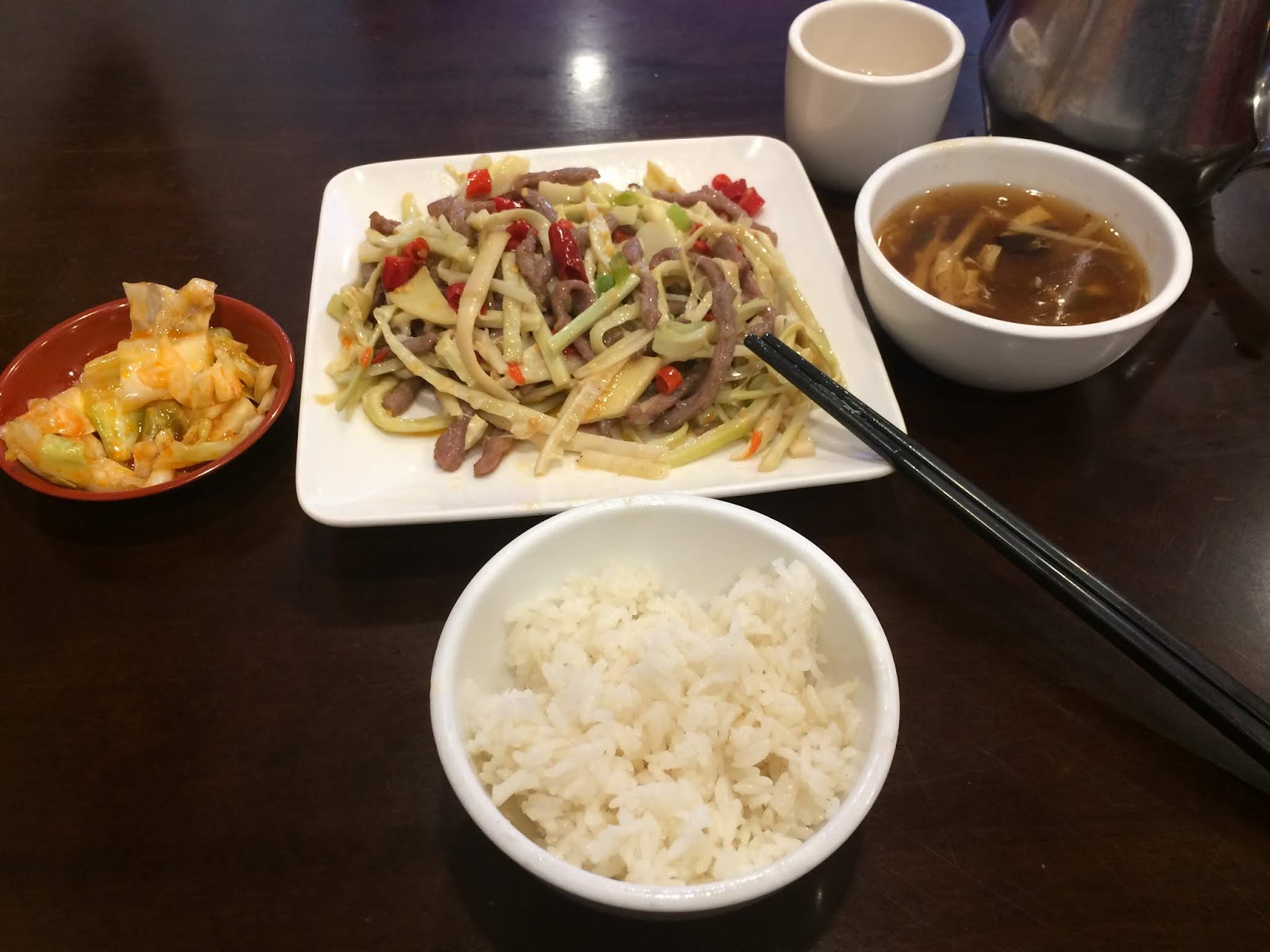
Simple Lunch, Spicy Beef with Dried Bamboo Shoots
Lightly Pickled Cabbage as Condiment


:format(jpeg):mode_rgb():quality(40)/discogs-images/R-910083-1171837921.jpeg.jpg)
:format(jpeg):mode_rgb():quality(40)/discogs-images/R-8388806-1460655584-5381.jpeg.jpg)
:format(jpeg):mode_rgb():quality(40)/discogs-images/R-3238975-1506047439-6062.jpeg.jpg)
:format(jpeg):mode_rgb():quality(40)/discogs-images/R-7052573-1526140180-6070.jpeg.jpg)
:format(jpeg):mode_rgb():quality(40)/discogs-images/R-4527054-1367413051-4654.jpeg.jpg)


 Posts
Posts