Showing posts with label Brand-Revox. Show all posts

27 January, 2023

Revox 720 722 Aiyima A07 A07 Pro Fosi TB10D Tidal


Click pics to enlarge. Note DG Karajan box on top. Bottom L is part of the DVP; to the right, the Gophert SMPS.

Letter from Shenzhen (23-3): Home Alone with Revox 720 722 Loose Ends
Streaming Classical (23-1): Karajan Haydn Mozart
Book: John Berger


Early on I decided not to go to Guangzhou and rather spend CNY by myself. Aside from the usual daily chores, I did a few things (not all audio related) which I shall record here. As during this time I had the Living Room (LR) all to myself, the first thing I did (on New Year’s Eve) was...
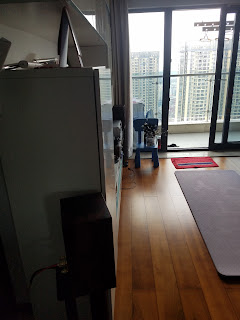
Reconfiguration of the LR System Before I was using various Aiyima products (mostly T9) to drive the Anubis LS3/5A (here). Since my main listening room, the study, now has transitioned to all-tube (here), I moved my trusted Revox 720/722 combo out to the LR and installed it. Chinese Bubugao DV-997 serves as CDP. Bubugao was maker of now-defunct Oppo, which were once widely popular (and perennial recommendations in trade mags) for their universal players. Mine is just an old DV Player, but a top one that is sonically superior (modified a little by someone in HK, then HKD 1K). General Sound Despite its relatively compact size, the Revox 722 has plenty of power to spare. Compared to the Aiyima T9 (run at 24V), sound is much more authoritative in my big LR (speakers are 2.6m apart, and I listen from the sofa, 3.4m away). This portion of the LR is 3.6m by 4.2m, but it is an artificial mental line, as the space extends much more to the left (the dining room and open kitchen) more than doubling the area. It is a joy to listen to the Revox pumping out juice, and the Anubis sounds significantly better than usual too. I mentioned to jules last night that a lesser system in a big room can be even more satisfying than a better system in a smaller room, and that may be the case here. No, it doesn’t quite have the details and refinement of the main system, but having music resounding in a large space is something else. Revox 720 Preamp As I needed at least 2 inputs, the preamp comes in handy. It also has balance adjustment (a slider rather than a knob, as is the volume), which is very useful for me, as I like to sit near the window rather than in the center. Which is also why I toed in the left speaker quite a bit. With the help of the balance feature, I can get the music filling out the center. This is also the reason why I don’t use the Aiyima T9 as Preamp, though I may re-evaluate it next round. I don't have much use for tone controls but would like a balance knob (unfortunately not present either on T9 nor my tube preamp in the study). The 720 actually has a decent tuner, but there are no classical stations here (HK has RTHK4). Aux vs Tape In I had the DVP hooked up to the AUX and the Aiyima T9 Pre Out to the Tape 1, and found that the DVP was much louder. Reversing the inputs brought the opposite. So the Gain of Aux is much higher. I only just now recall that the Revox Preamp has small screws below each input to adjust the gain. Next round I shall look into this to equalize. Aiyima T9 Now I had the Aiyima T9 connected to the AUX primarily to use it via its Pre Out for its Bluetooth (which benefits from higher gain). In Pre Out mode, the power meter cannot be relied upon for adjusting correct level. So it was empirical and more precise tuning shall have to wait till next round. I also did test the Aiyima as DAC. I connected the Coaxial Out (using XLR 0.4) and Optical Out (generic) of the DVP. Sound was initially comparable, but after some to and fro I came to realize that the DVP analog out is better with the swells of massed strings - just more real. And so I removed the digital connections. I may test out my other BT devices later, as it’s kind of clumsy to use the T9 only as BT via pre out. So much for this setup for now.

I get up early, usually around 6:30. The sky is still dark. After boiling water, I’d have some instant coffee, just for the jolt. Still considering a coffee maker (one more item on the cramped kitchen counter). Usually, I’d just read till the sun comes up. But in the past few days, I’d turn on the lamp by the sofa, turn on the system and start listening to CD, something I haven’t done for almost 2 years!...

KARAJAN Symphony Edition (DG), Haydn, Mozart This 2008 38-CD megabox is a great bargain, and solid basic repertoire. Amazingly, unlike many other boxes that come and go, it’s still in print, 15 years later, still at bargain basement price (Amazon is $53). I don’t have that many CDs here, though I have 4 boxes of Bruckner and 2 of Shostakovich (that shows you where my sympathies lie). What better music to play during the new year than Mozart and Haydn? I started with Mozart on New Year’s Day. It is not an exaggeration to say the music infused my soul and was uplifting. I soon went through all 3 CD’s. Karajan made some very good Mozart recordings before on EMI (overly reverberant acoustics) but these 70’s recordings have better sound. The execution is just perfect - one hears everything when one should, and nothing when one shouldn’t - artless indeed. There is little question that the BPO of old was much better than its impersonal counterpart today (imho, Abbado and Rattle ruined the orchestra’s classy sound). Down to the last piece, they are coherent and meticulously balanced - classical indeed. Then I moved on to Haydn, and it was an even greater joy. The Paris and London Symphonies total 7 discs, and I’m one short of the finish line. Not having re-visited these in decades (I have these on vinyl) I am highly impressed by the discipline and verve of the team - everything moves forward, nothing sticks out, and there are moments of humor and even Brucknerian grandeur. I grew up on the Bernstein, Ansermet and Szell recordings, but these are even better in overall execution (and sound). The only other one worth noting is Kurt Sanderling’s Berlin RSO set of the Paris (Eurodisc), absolutely proper and sonically superior (oop; but probably can be streamed). Of course, I’m not talking about HIP Haydn that is prevalent now. Mind you, I’m a fan of, say, the ongoing cycle of Il Giardino Armonico/Antonini (Alpha) but I think there’s more than a place for these grand old performances with big orchestras. Where the small HIP ensembles can deliver a shock, the bigger BPO can deliver grandeur, and that’s a completely different thing. To use an audio comparison, it’s almost like a small room compared to a big one. Karajan is not “known” for his Mozart and Haydn, but here I think he is owned his due. This box set is a contender in every composer and can form a keystone in one’s library. If you still prefer CDs, get it. You can stream almost all of it too.

Sometimes though it’s better to have no music at all. In the wee hours or first thing in the morning with coffee, a good book is bliss...

JOHN BERGER A Fortunate Man Despite the limited resources (in English), I’ve read more books here in SZ than most time in the past. I actually have a little personal thing relating to Berger. Many years ago, an artist friend of mine recommended Berger’s Ways of Seeing, but I forgot about it. A few years later, a Taiwanese friend was translating the book, and asked me to go over the proof. I did, and made many suggestions that she might not have liked. Truth is, as a sometime translator (erstwhile and amateur; I have done poems, art catalogs and exhibits etc), I realized the big divide between the very precise English of Berger and the inherently imprecise Chinese language. Then, I realized what a masterpiece the book is. Fast forward to recently, when I borrowed this book from the very limited English book selection of the local library. Like Ways of Seeing, it is one of the most engrossing books I have ever read.

Berger calls it an essay. It follows the practice of country physician John Sassall, and probes in depth the relation between the healer and his subject. It surveys the landscape of a less affluent sector of society. Importantly, it emphasizes the devastation of cultural deprivation - spiritual poverty. The work is prescient of our current society, urgently in the UK but just as true in the US. A social commentary and condemnation that is even more relevant today. Should you be interested, there is a huge amount on this book on the internet. I started it sometime ago, but finished it this CNY. Everyday I still think of the book - that’s how good it is. Of course, as a trained person in the field, I can easily relate to the subject, and indeed find the hero, practicing solo, highly skillful and, well, positively heroic.The only problem is, I have trouble thinking of what to read next. I may also write another short article on this book, as I’d like to share some of the texts with you.
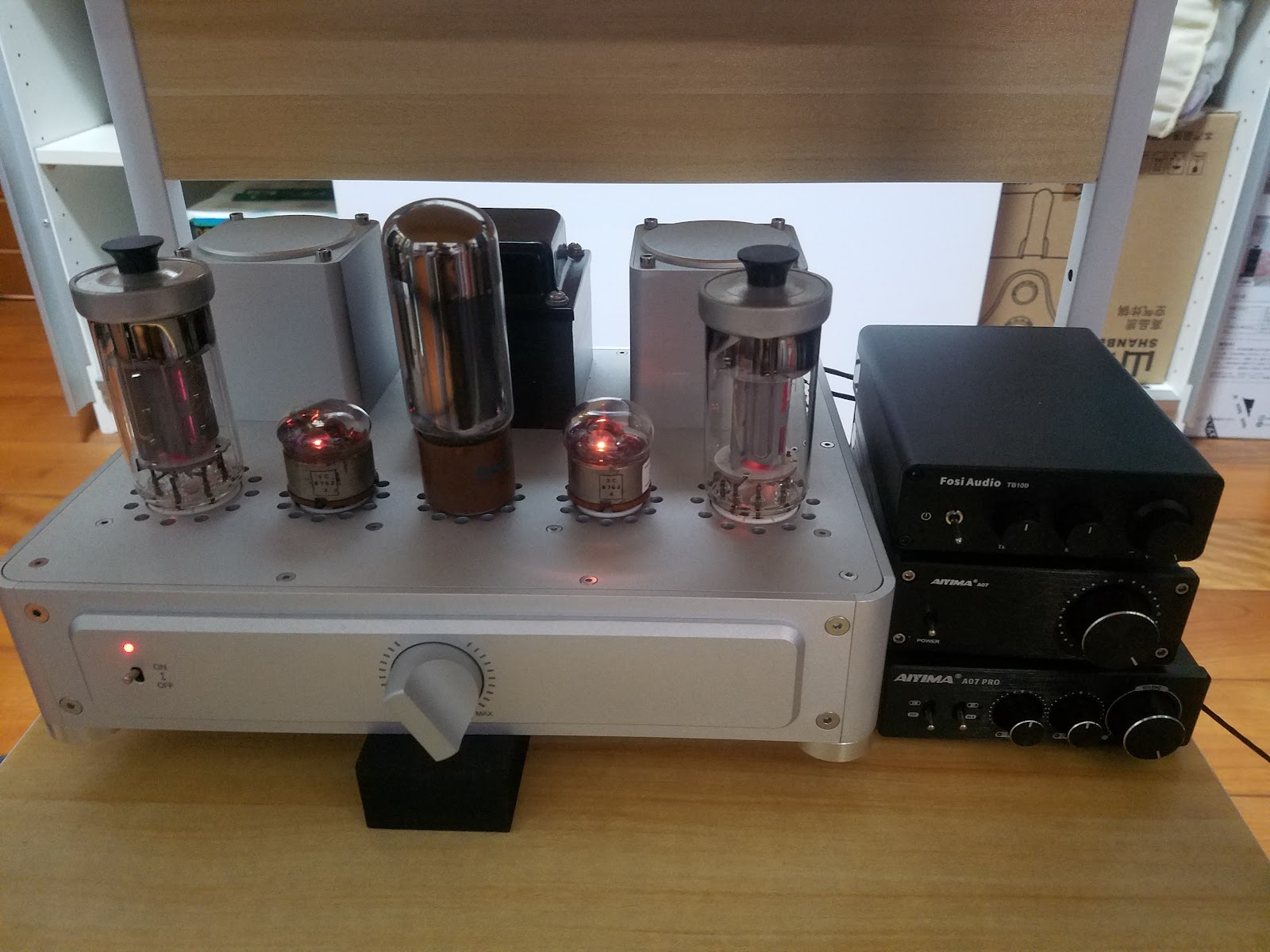
More Aiyima Previously, I had tested out the Aiyima A07 (for many, a perennial fav) and its latest incarnation, A07 Pro (with the Fosi TB10D thrown in too). In preparation for writing a short article on the trio, I have re-listened to them in my main setup as well as the LR. Watch this space.

Tidal Some time before the CNY, my HK friend Sang/Seng, whom I had featured (as Home Visits) many times in the blog, surprised me by including me in his new Family Plan of Tidal. This had not come out of nowhere. Seng has always been an avid classical listener and loved to browse and buy CDs. For the longest time, I had been persuading him to start streaming seriously (he had Spotify, but the LOUD ads are basically intolerable), to start with Bluetooth for nothing. About half a year ago he finally capitulated and bought the FX Audio BL-MUSE-01 I had previously recommended in this blog (here). He was using its digital out into his own DAC and deemed it satisfactory. Not long after he established his footing, he took the leap and subscribed to Tidal! And so, I have Tidal here, and I love it for the pop and jazz on offering. I shall be penning a Tidal article, likely in conjunction with some of our other authors in HK.

27 March, 2021

Low Fi Sansui Kyoeon H-9A


Click Pics to enlarge. This is an old pic of System 1.

Letter from Shenzhen (21-7): High on Low Fi?
Kyoeon H-9A Bluetooth: A Reckoning


Here I am. I am here. Am I here!

After almost 3 months, I feel I am beginning to "settle in". I have been trying to rebuild some routines into a schedule, meanwhile to get to know the city better than before (as I have to be here for longer). The most obvious casualty of a less rigorous routine is Writing, but it is coming back a little. Several articles are in the pipeline; aside from a long one on "HiFi Basics" (even I smirk here, as many articles in this series can really be viewed as Anti-Fi, or rather, Anti-Hi, and I am proud of that), there shall be an equally long one on my take on living in this city. I also have quite a few pieces of equipment from my soujourn in HK that demand write-up's (not least the Ruark Crusader III). All due, but in due time...

What has been disturbed the least is Listening to Music. I still use the piecemeal time snippets to stream music through NML (yes, the hunger is very much there). A piece of sad news: since a recent router change by the service provider I lost my previously easy access to Spotify. But I am reasonably up to date on new issues.

Readers are likely curious about what equipment I use here, so this report.

System 1
Long ago I appropriated the second largest bedroom as my main listening room (though it is also a storage room), and it has been reported on before (here). The Sansui F-55 (Audioquest CV-8) loudspeakers are approximately 7-8 ft apart and the listening seat is a little further away, an isosceles triangle that is close enough to equilateral, my favorite geometry. The loudspeakers are narrow in baffle but quite deep, so the front baffle is a little more than 2 ft from the front wall.

The system is simpler than before, using whatever is around. The Revox A720/A722 (French Filotex RG-58 cable) combo is still the center of the system. CDP is the trusted Sony DVP-PR50P (cheap AV MIT). Streaming is via my Laptops hooked up (HK Unitek USB cable) to Meridian Explorer I (Line out via minijack adaptor to cheap AV MIT). Occasionally, I also use the Meridian as headphone amp with my Grado SR-80E.

As reported before, the sound of the system is decent enough; I get thrilled with big orchestrals, yet still enjoy good details at low levels. There are no spec's, but the Sansui F55 Loudpseakers by ear go down at least to a solid 40-45 Hz. The woofer is 8" but I neglected before to mention it is complemented by a passive 8" radiator.

With Jazz and Vocals, the presence is quite stunning. With orchestrals, since they cannot be further in-room, the soundstage is a little shallow, but not at all flat, and still atmospheric and provides a semblance of the venue (the IKEA beehive-like shelf helps). Imaging is very good. Overall, I am quite satisfied. I don't need a sub yet, but I'll not rule out one in the future.

System 2
This is in the Living Room and here I encountered several challenges (detailed below). It currently makes use of the rest of the original Sansui AV system. The 2-way Sansui S60 bookshelves were designed to be rear speakers that complement the Front F55. These have 5" woofers and are 6 ohm 65-20k Hz. The tweeter has a broad but shallow circular waveguide. To minimize contact with the low cabinet below and to raise the image, I use a pair of disposable chopsticks to prop up the baffle front a little.

The Amp is Sansui UX-800 (here, now in its Mk II iteration). This 6.1 AV amp has Digital as well as Analog Inputs. I don't know whether the latter are first digitized. Cables are Mogami 3082. Researching, I saw a second-hand ad for CNY 350! :-( That shows the cruel depreciation of AV equipment. The ad has more pics should you be interested.

The electricity from the busy outlet on the front wall, where the router, TV Box and TV are also plugged in, is shockingly dirty, certainly the worst I have encountered. I first actually tried to setup another smaller AV setup (Changhong) but the noise proved too much. The Sansui was much better at noise suppression.

Streaming is via the Bluetooth Kyoeon H-9A (Thanks Eric again!) hooked up to the "analog" AUX input via its earphone output (built in Line-Out is too low in level) with a minijack adaptor connected to old and cheap Monster RCAs lent to me by old friend Hon Wo, who also lives nearby in Longgang.

CD is played through the Bubugao DV-997 DVD player. BBG was the Chinese arm of Oppo, and you can think of it as an equivalence of the Oppo 9xx series. This old DVP was touted by the HK DVD-A crowd in its time and was modded a little by one of them. I wanted to use its analog out, which is quite decent but, lacking in cables, I was forced to connect digitally. First, I tried my ancient XLO 0.4 Digital Coaxial but the noise proved annoying. I then dug out a generic Optical Cable and that vanquished the noise. The sound is quite acceptable, so I am thinking of purchasing another FX Audio BT device and use its Digital Out.

Having established the sound of the CD playback was quite satisfying, I returned to streaming and soon had some doubts about the sound of the orchestra.

Now, the loudspeakers are about 7ft apart, but the listening position is far away, almost double that, so a very narrow isoceles triangle. I know this does not favor a stereo spread but was still puzzled that the lower strings seemed to be in the center (some orchestras are fanned out like this, but not the majority). In fact, even the violins seemed to hover close to the center. I switched to the lower-level RCA outputs and the result was the same. I then streamed one of my test tracks, the Allegretto of Concertgebouw/Haitink's Shostakovich 5th (Decca), which has clearly delineated lower strings to the right. My worst fears were confirmed when I heard them hover near the center! I then switched to my Meridian Explorer and, voila! The stereo spread was clear. So this was not a problem with the loudspeakers or the setup.

The diagnosis is clear: the Kyoeon H-9A has poor channel separation; in fact it is almost mono in sound!!! I failed to notice this before as I had only used it sparingly, briefly in HK and on the desktop in the quarantine hotel. Eric had used it for longer but his system too seems to be almost desktop in its limited embrace. Also, my sample may not be representative. I don't recall my Dayton Audio (FX Audio) BT (or even the lowly HK008) to be like this (my NYC small speakers have a vast soundstage), but I wonder. Actually I may get another FX here to compare, as its digital output will fit my current amp. In fact, this re-ignites the mono-stereo debate - there is something musical about mono, as some insist. Mind you too, with a lot of a stuff I don't mind the mono, and could even prefer it (I thnk my friend Andy and our very discriminating mrgoosound would agree), but with large orchestrals, I need my spread.

In this system I am usually seated too far away on the sofa. If I sit on the high chairs, which are closer (I love to use my laptop here as it affords me a good view from the balcony), the sound improves despite the seat being high-up and skewed all the way to the right. Also, even with some propping up and tilting, the loudspeakers are really too low to have good dispersion. It is obvious the sound is not nearly as good as in the dedicated room (System 1 above). I have a feeling the system is not in its final state. I may try to work again with my even more humble Changhong system (or a heretic combo of the two) if I can surmount the noise problem. There shall be more on this; the challenge is to be creative and use whatever is around to deliver reasonable sound. It never surprises me when dirt-cheap stuff is made to sound good. The corollary is It never surprises me when ultra expensive stuff fail to deliver (indeed it is almost a rule, and a curse for many).

Everybody would be happier if music, not -fi, is the focus. Am I a happy audiophile and music lover? Yes. From this angle, with my horns and Western Electric inaccessible for the moment, am I happy? A resounding yes too. So, you, friends and readers, should be happy for me. More importantly, YOU should be happy! Cheers.

System 2
High Chairs 

10 June, 2016

Direct Drive Turntables

Brief Overview: Direct Drive Turntables (with budget emphasis)

UNDESERVED BAD REPUTATION Audiophile Aversions Among audiophiles, direct drive turntables as a genre has a reputation of being hard-hitting, lean sounding, even crude or only for DJ's. Some of this is because the average audiophile only knows the cheaper Direct Drives or the ones intended for DJ use. Fact is, there were many esoteric hi-end turntables (except for EMT, majority Japanese) that are classics and coveted by connoisseurs. Another factor is due to the Linn-led suspended table, belt drive crusade (for it was really that) - any other methodology (including my favorite, Idler Wheel Drives) were deemed heretical and adherents burned at the stakes (spectacles even now staged on the internet). Motor Noise One of the important turntable design parameters is how to isolate the motor noise for a supposedly clear midband. Belt drives do this with relative ease (though a lot depends on how you mount the motor), but all the great direct drives have Herculean engineering to minimize this. It is all in the implementation. Why I like them While I'd not deny belt drives do have their own set of virtues, I have always liked Direct Drives for their speed, transients (much as you would for panel speakers) and slam. As noted above, I appreciate all kinds of design. Maybe a Direct Drive should not be your only turntable, but it should be one of several. The Direct Drive's Rhythm and Pace is different from the Belt Drive (or even the Idler Wheel), a little more insistent (even take-no-prisoner), less subtle, but undeniably exciting if you can tame its "undesirable" aspects. Another reason I like Direct Drives is because they are less cluttered, usually more compact and, though suspension-less, heavy for size. Also, Classic Direct-Drives are Screaming Bargains, because a High-Torque Direct Drive Motor is very expensive to develop and produce. Take the Technics SL-1200, its price (then and even now) is so reasonable only because it sold in huge numbers. By comparison, a second-hand Linn LP-12, with a cheap low-torque motor, is NOT innovative, and NOT a good buy!

Current Revival Fashion recycles; styles that have gone out of fashion all of a sudden make a comeback. This is no less true for audio. While belt drive still rules the analog hi-end (albeit in suspensionless designs mostly), tides are certainly turning for the Direct Drive, as in recent years quite a few new direct drive designs have emerged (Read the informative article by Roy Gregory in theaudiobeat). Many of those mentioned in the article have reviews on the net, and it is fun reading them, just google the manufacturer's name and direct drive. No doubt more is to come. Also, in Stereophile, Herb Reichert gave a rave review of the Pioneer PLX-1000, a clone of the Technics SL-1200.

 Drive Turntables - My Experience
  • Price/Performance Ratio Current vs Classics I'd be interested in comparing the current crop (pretty expensive, understandably) against the classics, say the cheapest and ubiquitous Technics SL-1200! Someday I hope... Classics vs Classics This gets more interesting. Disclamer: I don't own the most expensive ones, but since EMT's and classic Japanese turntables are popular in HK, I have heard a lot. If you stick to Technics, It is definitely true the more expensive SP-10 is better than the SL-1200. BUT, imho they are the bargains among quality Direct-Drives, maybe even "giant-killers". Some classic Direct Drives, like Micro Seiki, Pioneer P3(a), not to mention EMT's, command a very high price, but should you spend so much? Here is an anecdote: my friend Edward once asked Walt Bender, godfather of vintage gears, about EMT, and he said he thought the Technics SL-1200 is just as good, and totally under-valued. Well, take it with a grain of salt - aside from mechanics, they do sound quite different. Point is, for a modest outlay, one can get a very good direct drive design.
  • Technics SL-1200 General The most famous of direct drives is without a doubt the Technics SL-1200 and variants, in constant production for decades and a DJ staple. I need not further elaborate as there is a huge amount of info on the internet. Literally, millions have been sold (unique among "hifi" gears), and as a result, obtaining one is not difficult (though still escalating in value). Also, many parts are available, so refurbication is not a problem. Mods Given the underground cult (deserving imho) there are many hifi mods dedicated to them, chief among them KAB. But I think the most significant mod would be to replace the tonearm, a somewhat laborious project (guides available on the net). Re-Birth! The SL-1200 has been discontinued for a few years, but a completely updated anniversary edition, and maybe more, are coming the summer of 2016. It has just received a rave review from HiFi News (not yet on the net). This one is immortal! My Experience This is the one of two turntables that I have in both NYC and HK (the other is Thorens TD-124). For my own general experience see here, also here for matching with the incomparable Decca cartridge. Currently, in NYC I use it with my mono Denon DL-102 (here). All those combo's - how's that for versatility? The Technics SL-1200 is not as good as the SP-10, but it is mighty good! I have never heard a modified one, but I'd be curious. One day, I'd hope to go that route too, although I have to say, given my variety of experience, I don't think the stock arm is that bad!
  • SL-120 This is a curiosity, more for home use than DJ purposes. Unlike the SL-1200, it is not quartz-locked and the motor is an enclosed type (which some say is better). It has an armboard, which allows mating with any tonearm, an advantage over the SL-1200. If you see one with a suitable arm board for you, buy it! An after-market armboard costs a bit, and if you subtract that sum from your cost, the turntable really costs very little. I just acquired one in HK (SME board) and you shall hear more from me.
  • Technics SP-10 (top pic; info here) This is Technics at its pinnacle, and my personal favorite. The sound has bite, but is smoother than the SL-1200 - everything is just a little better. For my experience, see here and here (which includes a link to the Revox direct-drive). It is commonly said that the plinth is undesirable, but I personally have never heard feedback or unwanted noises emanating from that. That said, recently at my friend seng's place, putting Vibrapods under the feet dramatically improved the fluency of the sound. In HK, a noted audiophile, limage, has stuck with this TT for decades, and he gets good sound from it. This is worth all you can throw at it (if you are convinced your measures will work). Unfortunately, it is getting more expensive.
  • Audio-Technica AT-PL120/AT-LP120USB These are basically the same thing, with the current version sporting USB ADC for digitizing purposes (and reversing PL for LP). This is a blatant clone of Technics SL-1200. Although still massive at 27 lbs, it is made in China and not as sturdy as the Technics (one knock at the plinth's surface and you'd know; a hollow sound vs the Technics' dull thud - plastic vs metal). Perhaps it is too cheap (in street price) for its own good. For some reason, I have never formally "reviewed it", but my satisfaction can be gleamed from my experience with the Empire Cartridges (here) and Shure SC35C (here). Note here that for the last month, partly fueled on by Andy, I had been playing with MM's using this turntable. I cannot say things were as refined as my other more expensive turntables sporting MC's, but I can say I really did not feel much was wanting. I'd think there's no better testament to its value. Also, its built in phonoamp (MM) is not bad at all, making it a screaming bargain.
  • Taiwanese "Super OEM" Hanpin While researching, I read this: "...As vinyl began to wane as a mainstream format, Chinese (editor: Taiwan) company Hanpin produced the ‘Super OEM’ turntable, the most well-known model of which is the Stanton STR8-150, but which has been adapted and re-badged by numerous companies. What the Super OEM had in it’s favour, besides good build quality, was that it was the first deck to take advantage of the expiration of the Technics motor patent. So, finally, there was a Technics ‘clone’ on the market with truly similar performance.
    The beauty of the Hanpin design is that, working from a solid base with that motor, manufacturers are free to then innovate around that. So bell & whistle features like line-level output, reverse play, pitch correction, and digital pitch readouts have all appeared on Super OEM decks, reaching a zenith with the Reloop RP-8000 and it’s built in midi controls..."
    So, there it is. The Audio Technica AT-LP120(USB) is made by Hanpin. The aforementioned Pioneer PLX-1000 too (see Stereophile link above). Somehow, I doubt the more than twice as expensive Pioneer is built much better. I'd be most curious to hear the Pioneer though. I also would love to hear Hanpin's own copy (official link here). I wonder if Hanpin is one of the reasons why Technics ceased production of the 1200? If so, that is a bad thing!
  • EMT (950/948/938) I have never owned one, but they are popular among Asian vintage collectors. Hence, in both NYC and HK I have heard many (including the non-direct-drive ones, like the 927 and 930). EMT is well documented on the internet (try the wiki entry; stefanopassini, emt-profi.de and febtech.de). Most of the EMT's are not direct-drives and imho they are now way over-priced. However, the direct-drive 950 does have a fair claim to be the best direct-drive turntable. Although the price is sky-high one should keep in mind it was very expensive originally. As for the sound, it is hard to assess the turntable individually, as they are usually used with their own 12" arms and EMT cartridges, which like Ortofon's SPU's, have a full midrange sound that is noticeably not modern (which is what many prefer, but I have my reservations). In NYC, my friend Andy has a good 950 setup, and in HK I have heard the related 948 (here) to good effect. I have never heard the 938.
  • Goldmund Studio As mentioned in theaudiobeat, this is a classic, and a curiosity. The most interesting thing about it is that it is built by Audiomeca, with a suspended direct drive! I have heard one in my friend Andy's place to good effect.
  • Revox (790/791/795) These look very elegant. I owe the 791 (with a Shure cartridge) and the sound was lean and certainly take-no-prisoner! Unfortunately, it broke down (an often occurence) and I have yet to service it.
  • Micro Seiki Here is a very interesting article, with valuable links. Again, the brand is very popular in Asia. Micro Seiki made all sorts of turntables but the ones I have heard tend to be hi-end models, including direct drives. Somehow, most of them sound kind of mechanical to me. Not one of my favorite brand.
  • Pioneer I have heard several times (like here) the expensive and iconic P3, usually to good effect. However, I never got the feeling that it is much better than its much cheaper Technics brethens. That said, I have never used one myself.
  • Rockport Sirius III This is yet another all-out effort. I have heard it previously in HK to good effect. Anyone interested in direct drives should read this huge article in IAR. Note that Rockport is notorious for not supporting their old products. Thumbs down.
p.s. This article is not meant to be exhaustive, concentrating on my own experience mostly.

01 September, 2011

Review: 3 Superb CD players Revox C221, Pioneer PD-T07A, Primare D20 and the AKM4324

Review: 3 Superb CD players
Talk Digital: Older, but better

I am in the process of setting up multiple stations in my room, and take the opportunity to run my large collection of idling CD players a little, or else they will go bust in the humidity here (I learned from mistakes!). For my last LFD exercise I tried out these three and found none wanting.

Revox/Studer C221 (1991)
This has been a long-term reference, not necessarily because it has the "best" sound (what does!) but because of its neutral balance, as befits a studio quality product that carries the Revox name! The Swiss counterpart of Revox has the exact same player as Studer C221. Unlike earlier Revox, and like Studer, the C221 has fully balanced circuitry and output. Digital out is RCA only.

Unlike the legendary Revox 225 and various iterations of the 226 (Studer 725, 727), the later Revox/Studer C221, circa 1991, is much less known. There is surprisingly little info on the net (this Polish site with internal views). Laser is CDM4, DAC is supposedly Philips Bitstream, probably the SAA7321 or 7323 (but various sites also mention SAA7310, 7320 or 7350). On my unit, I cannot see the chip on the circuit board; perhaps it is underneath, so I cannot confirm.

According to the info I gleamed from this Taiwanese Blog in Chinese 音響白痴小痞, supposedly some Revox C221 were made in Germany and some in Switzerland. Aside from minor differences in the circuit boards, one can tell it is from Germany (most of them I think) by the following: 1) the Revox logo has a slightly protruding 3-dimensional tactility; 2) there is a transport lock underneath; 3) the transport motor is brushless and mechanism is CDM4-Pro. As my unit is made in Germany, I can attest that points 1) and 2) are true in my case, but when it comes to 3) my unit is fitted with a generic CDM4. Mine came from a TV studio, and was defunct when I received it. It was determined the laser had died, and I sourced a used CDM-4/(19 I think) as replacement. It was resurrected and had operated flawlessly ever since.

The C221 is a wonder to look at. If you ask me, it is even better looking than the C225 and C226, and approaches the coolness of the superb EMT 981. Using this studio player is a little inconvenient. One has to turn on a switch in the back and turn off the bottom-row buttons (otherwise it will only play 1 track). I was told that the laser in this kind of professional player is always on, and I suspect that is the truth as it plays a disc instantly. And so, as a caution, I always turn it off after use, which means it will take some time to warm up next round (note: see reader's comment below on how to circumvent this). Of course, there is no remote.

The sound is wonderful. It is quite detailed, smoother and just slightly on the light side if compared to better true multi-bit players, a refreshing change and improvement from the usual bloat (mostly due to unresolved bass) of Bitstream player. Its even-handedness is such that it gives pleasure when inserted into any system. If you ask me, sound through the XLR is a little better than through the RCA.

Personally, I think this player is even better than the LHH statement products of Philips that used the supposedly more advanced one-bit chip TDA1547, a little more musical than DPA (also using TDA1547), and on par with the best from Micromega. In sum, one of the best Bitstream players.

Pioneer PD-T07A/PD-77 (1992)
The original T07 was second-from-top in a series (others are T05 and T06; top model is the magnificent T09, the US version being PD-95). It looks almost identical to its descendants, but used Philips bitstream conversion.

The PD-T07A (and its even rarer variants S, U, and HS) sports the same legendary Stable Platter mechanism as the previous series, but the DAC section was designed in-house from scratch and a full assault on state-of-the-art. Pioneers developed their own DAC (I think it was 20-bit). The unit features balanced analogue outputs. There is precious little info on the internet on the PD-T07A per se (an English "translation" of a Japanese site here). Web info has it that the alleged US equivalent PD-77 is the same machine, but if you browse the pics available (few) the PD-77 seems to have a flat back and no balanced output, whereas the PD-T07A has the balanced output coming out of a sizable protrusion in the center of the back (as do the other variants and the earlier T07 and T09; see link above).

The sound through either RCA or XLR out is excellent. The player is highly resolving, but everything is delivered in a warm, bold and rich manner. Sound is a little more upfront than most players, and soundstage is perhaps not as deep as the best, but there is nothing unbalanced, as evidenced by the fact that its replay of classicals is every bit as sophisticated as jazz.

As a transport, to be frank, it is superior to most of today's megabucks stuff. The same warm, big and bold sound lends gravitas to even the thinnest sounding DACS.

This is a masterpiece. In my house, it has received praise as much as the Revox.

click pics to enlarge

Primare
D20 (MkI; 1999)
And now for the dark horse. Not to mince words, I feel exactly like what the reviewer said in Soundstage: "I feel like I have discovered a rare jewel of a player."

The funny thing is, I didn't even buy this CDP. Captain Lo, my old friend took it to me unannounced when he last visited. The unit belonged to a friend of his who was not in a hurry to sell. Well, as if my place needs more stuff...

While the player was superbly built and above average in physical stability, there was not much inside. It bothered me that the transport mechanism used is the notorious Philips CDM 12.4, which received no special reinforcement here. On the other hand, I was much captivated and intriqued by the very small DAC and output board (the small board with the close-up). Amid the SM components I was excited to see the AKM4324 DAC chip.

While AKM is a reputable chip maker, in audiophile equipment their DAC chips are only rarely sighted (Rotel, Gryphon). This is because they are much more often seen in things like soundcards and Pro Audio (think Behringer).

Although the D20 is just a red-book CD player, the AKM4324 chip is 24/96 capable. Later, AKM would become more known for their so-called
Miracle DAC, the AK4396, a true 192kHz 24-bit 2-channel DSD-capable DAC used in the SlimDevices/Logitech Transporter. Current Primare CDPs though do not use AKM chips, instead the more ubiquitous Burr Brown's.

All it took was just one cut and I was hooked. The incredible air and purity of the treble have to be heard to be believed. I believe in terms of treble this is the best player I have heard, true transparency without any stridency, the Kondo of CDP if you will. The midrange is see-through and the bass well delineated. Dynamically, it is no slouch, able to scale above average, though not perhaps equal to the best here. This entry-level Primare IMHO beats out many much costlier rivals.
There is some confusion on the internet regarding this player. I think the unit I have, with Philips CDM 12.4 transport (and obviously Philips servo, including display, as in this pic)), is the so-called MkI. Very soon, Primare changed to a Sony mechanism (note the official manual pdf file shows the Sony, as well as Sony style display), and that became the so-called MkII. The DAC remained the AKM4324. It is likely Primare ran into the same problems with CDM12.4 as Micromega did with their Stage series, which in effect bankrupted one of the best digital companies in my book.

Conclusions
Excellence does not get out-dated. Things become different, but not always (if ever) better. Witness these 3 players. Each still sound thoroughly enticing, and should beat the hell out of many modern players, not to mention over-rated CAS.

18 December, 2009

Home Visit: JBL 4343


家访: JBL 4343 胆石皆宜?

经唐吉訶德的安排,周一待他下班后就直奔龙岗。 与他朋友亦同事余先生等在肥仔烧鹅吃了便饭。这家连锁店听说很有名,烧鹅还可以,但没能令我忘了锦田聚富轩的味道(可惜已成绝唱); 倒是油鸡和鹅肠都还不错。

这是我第二次到访。JBL 4343 是钢磁的,先前经唐吉訶德的调教由 Marantz 7+9 推得有板有眼,加上余先生令人羡慕的聆听环境,效果比很多香港的 JBL 都好。 留意由于地方大中置用上了一对 L100。当然这一切没能令余先生止痒, 最近又买了一套 Cello。 器材如下:

CD: Revox 126 (有时直出;有时做转盘); Meridian 588, 562
前后级: Cello Suite + Performance, 还是有 phono 的

刚进去的时候, 声音有点薄,且左右不均, 有点飘忽。 唐吉訶德发力调教了一番; 我在旁喝啤酒,偶然添添乱;声音也就慢慢好起来。还是很好听的声音,平衡得来稍嫌淡抹了一点

我看余先生跟我一样,骨子里是个胆客。 个人认为, JBL 确是胆石皆宜, 但胆是走在前面的, 就是好那么一点。尤其以 JBL 来说,再贵的石机就算在一套中低价的胆机身上也讨不了便宜。其实胆前石后也会很好, 值得尝试 (我就是这样推 4312A 及 Century Gold 的)。

18 February, 2009

Home Visit: Studer/Revox/JBL

Home Visit: Studer/Revox/JBL

Often it's not easy to enjoy hifi in a small living room. But I have always managed to do so with ease at Rick33's place. That's not only because of his gears, it's also because he's a real music lover.

My last visit must have been more than a year or two ago. This time tubediyer and I went in the afternoon. A bottle of French red was already airing and we lost no time in enjoying ourselves.

Rick's system has undergone a near-complete makeover. With the baby around, rick's place is bursting at the seams. I doubt he can upgrade much further, though he's thinking about a tube preamp. Here's the equipment list:

--STUDER D732 CDP (replacing D226)
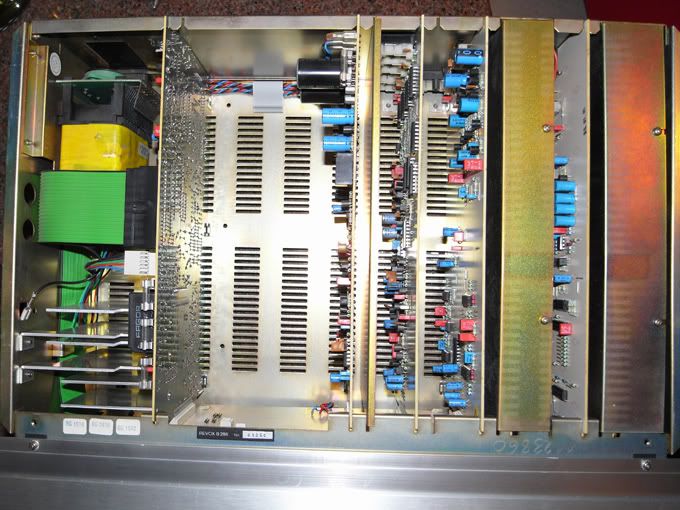
--REVOX B286 tuner-preamp (internals in last pic below; classy heh?)
--UREI professional electronic crossover
--2x STUDER A68
--JBL L101 (LE175DLH + LE14A) plus passively connected HEIL 斩崩刀 (replacing 4311)

The sound was a significant step forward from the last setup. I was mightily impressed by the live presence and horny character. JBL 小蜂巢有料到! Sound was quite balanced and after two hours of high-level near-field listening I was still fine. The good P.R.A.T. contributed to the Happy Hour Atmosphere. Most importantly, Rick always plays good songs and balances his playlist between jazz/R&R classics and more esoteric stuff. Nina Simone and 陈升 I recognized instantly, but Jonny Cash (as senior citizen) surprised me a little. Before we left, we listened to a little RTHK4 on the 286's tuner. Excellent, full sound! Finally, Rick unwrapped his Miles Davis Kind of Blue LP and played it on his friend's cheap Project Debut TT (stock cheap Ortophon). Sound was magnificent, the place was bopping! Many expensive TT setups may not sound as good! I have always have high esteem for Project.

Since 唐吉柯德 放了飞机 (are you reading???), rick33 took me to the Outback bar, where he's a regular. More pints there and I barely made it home. I think I forgot to pay. Thanks Rick, I had a grand time! Next time you go to that bar, please call me and the drinks are on me.

19 August, 2008

BEST BUY: Integrated Amplifier and Receivers

BEST BUY: Integrated Amplifier and Receivers

Last revised August 20, 2012

This is the first in a series of "Buying Guides", which shall cover all components in replay. Of course, these do not aim at total coverage as they largely reflect my own experience of gears that I have used myself.

BEST BUY Integrated amplifi
ers/Receivers
No matter my ultimate preference, the budget integrated is an area I have always retained an interest in. These days in HK and NYC I listen to my second systems more than my main systems! While an integrated amplifier, especially a budget one, is ostensibly a compromise, it takes real judgment and art to achieve a good design, something surprisingly few manufacturers (especially non-UK ones) have managed to do. Provided your speakers are not too difficult for the limited power on hand, a good design can even outperform the same companies' separates in coherence and musicality, if not in power.

I have observed that a lot of audiophiles, including many who think of themselves as old-hands, really cannot handle the variables in matching, and do not even know when the system veers alarmingly from the norm. I'd say even if you don't "need" one, it is essential to have one on hand for testing of musical balance, a sort of reality test for audiophiles who love to delude themselves. This article covers mostly old models. As mentioned, few makers achieve a good design, not to say one that is a bargain (an abused term these days). Many manufacturers today, especially non-UK European ones, make rather expensive integrated and promote the notion that the short signal path brings benefits. While that is not false, with few exceptions, their implementation is usually quite bland, compared to their UK counterparts.

The older integrate
d's all have surprisingly strong phono sections that surpass many outboard phono amps that you can buy these days. That's good news for the TT user!
 
SOLID STATE (UK): 
The best integrateds are overwhelmingly British, and mostly older ones. One really miss the stereotype of the old UK/European audiophile: stingy, cheap, calculating every penny AND very demanding! UK gears are not quite the same now. I miss the old days, don't you?
 
The mod
ern and updated versions of these classics may have a "little" more power but they are largely the same (or inferior). They all claim continual refinement but looking at the circuit board makes you realize many are largely the same; sometimes the good is even refined out with the bad! So even evaluation of an old model can serve to illuminate newer ones.

Musical Fidelity A1 and A100-X and variantsFrom a pure sonic viewpoint, personally I think the A1 (and its closely related siblings A1-x, A1-S, A2 etc) as well as the higher powered A-100-X are the best integrated amps ever. Their unique look is entrancing. But they run alarmingly hot. One must have adequate ventilation. They are musically so wholesome that one wonders why a tube amp is needed. They even have better bass! Power is limited but if your space is not too big it's enough. In this respect the A-100-X is superior, with enough power to drive a good speaker even in a larger LR (info here). If the A1 were not so good, they would not be introducing a new version so many years later (though its power rating is closer to the A-100-X)! I haven't heard the new one. I am using an A1-S in my bedroom, which is air-conditioned in the summer, but it's in winter that the amp is comforting!!! It's a great match with my Audio Physic Step. Here is a must-read site. MF is NOT a brand that I like too much but, hey, the A1 was designed by none other than the great Tim Paravicini, now founder of EAR. If you know the excellence of EAR gears, you'd like this one. The MC/MM phonostage is excellent.

Linn Majik
(2010) Finally I got hold of one and this jumps now to head of the queue.
It is superbly bold sounding, with outstanding PRAT. It merits a separate review!

Cyrus I, II (III)
The II adds the option of adding a separate power supply (which now commands a higher price than the amp itself). Even at the current inflated second-hand price, thes
e are bargains. It sounds without grain, quite neutral (even a little hifi-ish) and has surprisingly enough power to drive the best of the cheap to moderately priced speakers (people have even used it to drive Magneplans, not that I advise that!). The organic whole, the integrity of the sound simply is first-class, and it outperforms in coherence many gears a hundred time its price. It drives the B&W M805 and LS3/5A very very well, and that's no mean achievement. Its MC/MM stage is even better than most "class A or B" components, and it works via the TAPE OUT with just the power cord plugged in (and the power switch NOT turned on; that is, in the long British tradiiton of "standby" mode). Even used just as a phono stage it is a sure bargain, and some say it comes close to a ML phonostage. Click for further Info.

Nait Nait I, II, III
The III is completely different cosmetically. These are excellent but not as neutral as the Cyrus. The sound is bolder and Naim's famed "Rhythm and Pace" is very much in evidence (more than its modern counterparts),
but there are things to watch out for: (1) the vital vocal midrange is a little recessed; (2) Lower midrange to upper bass is a little emphasized; (3) Treble is just that little bit reticent. Its primary strength is in its portrayal of the leading edge, an area I have not heard its equal. It is best partnered with its own CD players, which shall yield a sound that is uniquely rhythmic and pacey, not neutral but a paradigm in what it excels in. In a complete set, it can lay claim to a unique sound not heard with other brands, and here I tip my hat. An example is my Nait II and CD2 (TDA1541A) combo. With it, the ATTACK of a single plugged string (like guitar), or drumming, are phenomenally live. Even more surprisingly, the "rhythm and pace" benefits tremendously a slow instrument like the organ. With Bach's organ work, you can literally feel the different degree of attack that the organists applied on the keyboard, and it's a revelation. Click for a good read. Note that the phostage are either MM or MC, and they are excellent.

NAD (revised Aug 20, 2012)I originally wrote: "...For once I agree with Ken Kessler that the "venerable" 3020 is flaccid-sounding and hopelessly over-rated. I got a 3020i as a close-out from Ming Fat and till I sold it some years later I never realized what the hell was it all about!. I much prefer the current remote-equipped 315BEE, which garnered rave reviews everywhere. After reading the detailed review by Ken Kessler in Hi-Fi News I bought one, and that's a first for me with this reviewer! Now it's the 316BEE. I also have a 325BEE in NYC. Buy any of their BEE series with confidence..." Now, while the BEE's are great buys, I have to make a revision here: (revised Aug 20, 2012) I finally got to hear the original NAD 3020, which was a revelation (review here). It deserves the term "legendary", and was certainly much better than the underwhelming 3020i I had before. Its all-rounded nature and musicality puts it into the top eschelon of integrated amplifiers.

LFD My experience with the Zero Mk III was enlightening. The phono section is superb, and driving power is awesome. The internals look very much like the much earlier Mistral, which if available is probably even more of a bargain. 

Quad
Quad 77 was the first and only integrated
amp Quad made. It is a much under-rated amp with sound distinct from the old Quads of 303, 405, 306, edging very very close to the sound of the current 99 series, which curiously has no integrated amp (as it has volume built into its CDP). This is a crisper sound than Cyrus/Naim and it can drive even ATC very well. A classic. The only problem is that most of the remotes have broken down, so use the front buttons. At its current price (likely less than a Nait), grab one if you see one. No phonostage. I am keeping mine.
 
Arcam, Meridian, Exposure, Audiolab, AVI, Rega, Creek, Rotel 
Unless otherwise noted, phono is an option with these, which means the units in HK are largely without. The Arcam 290 (excellent optional phono) was the only Arcam integrated that I liked very much. A little dim, grainy and earthy, but powerful and able to drive the LS3/5A. The Meridian 501 looked great and sounded fine but was seriously underpowered, and that stupid remote! If you can find it, the old 100 series is a lot more fun. Yawn, the famed Exposure XX is very powerful but tonally shut-in and not attractive. Audiolab 8000B (line only) is better than the dull 8000A (MM/MC) and the lean 8000S (line only), but with this brand you have to go to the 8000C(MC,MM)/8000P to get better sound. AVI is an even performer but rare in HK. The old Rega Brio (MM phono) is too light sounding; I reckon you have to go to higher models to get more. But the old look is fabulous, much better than the new ones. I have never owned a Creek but have always liked the sound of the old black boxes with green letters (which have phono); the new aluminum fascia of the Destiny and Evo series look hideous. Rotels are always good value for money, and the old models (MM/MC phono) can be had for very little money, though one may wish to investigate their separates instead (like the 870BX amp I have).
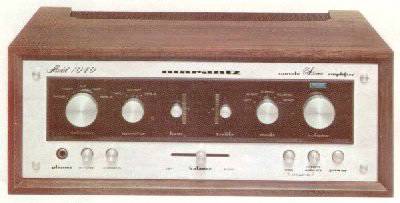
Linn Classik (old version)This is a very good complete system. The integrated is fine, the tuner is outrageously excellent and the CD player is competent (but a far cry from their excellent CDPs. I am not familiar with the newer version. The integrated amp part is good but not as good as the older Majik.

SOLID STATE (non-UK):The problem with many non-UK integrateds is that they are just too bulky or expensive for me. Why not go separates for the size! So my experience is limited, but there are some gems.

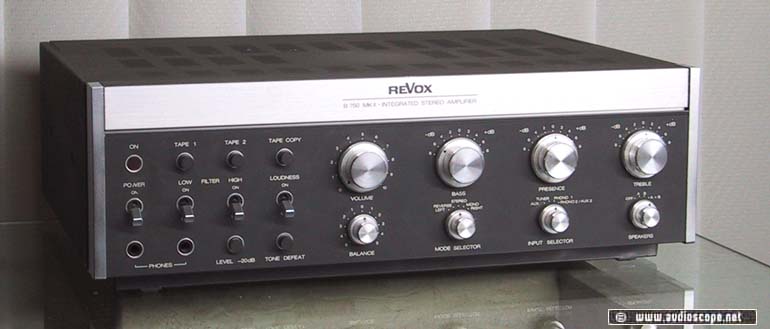
Revox/StuderImpeccably built and neutral sounding, a good one will shame most modern "high-end" solid state gears! I was very surprised by the performance of BOTH the preamp and the amp sections of my B-750 MkII. The former is as good as a solid state preamp can get, and the latter has enough real world power to drive my ATC20 to very satisfying level! If you can handle the bulk, try one!

Copland
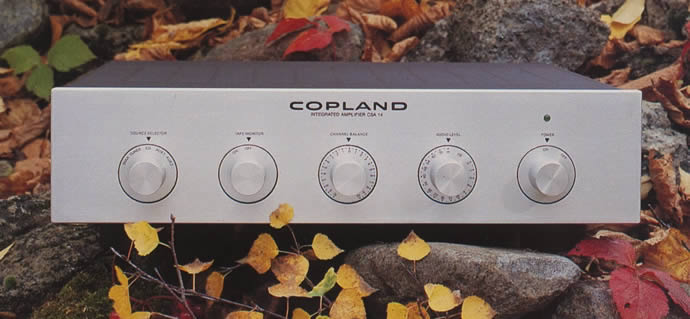
Ever since I saw and heard the CSA-14 driving LS3/5A at Golden String I wanted o
ne. This is a bulky but very well built 120 wpc integrated amp with 2x 6DJ8 in the input stage, and therefore it has a warm sound and fluidity. In contrast to the next incarnation CSA-28, which is almost exactly the same inside and out, this model even has an ss MM phonostage!!! That makes it a ridiculous bargain at current second-hand price, which is not much more than a Nait! Copland also makes good tube amplifiers (superior output transformers).

Pathos
I have never owned any Pathos, but my good friends did. It was many years ago that I encountered the fascinating, mammoth and now classic Twin Towers, which established
Pathos' name. However, although the sound was excellent, its driving power left something to be desired with speakers like Sonus Faber Electa Amator or even LS3/5A. It was not until another friend used the smaller but more powerful Classic One (pictured) with his B&W Nautilus 804 that I took note of the very fine all rounded performance. Yes, the preamp tubes helped greatly in delivering the mellifluous sound!


Densen
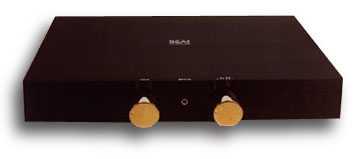
The Beat B-100 is a fabulous chunk of aluminum. I think it really is just an amp with a volume pot, but it is highly resolving, surprisingly dynamic and rhythmically enticing. This brand never caught on in HK. I sold it because it's just too chunky but sometimes I regret it. If this were available in a UK shoebox I'd get one...

Accuphase
Big but excellent products. Mine was an E-204 I think. It ran pretty hot but gave excellent sound with hard-to-drive speakers like ATC
20. The MC/MM phono is also exceptional. Mine was black, and I was told that meant hong goods for the old models. I miss mine.


McIntosh 
More than an integrated amp, this is a receiver. Now, this is a curiosity. The integrated amp portion is solid state, and an excellent one at that, more powerful than the UK stuff, and it looks fabulous too. What makes it unique is the tuner, a fully tubed section!!! IMHO, the tuner section rivals that of the finest McIntosh tuners! And so it is a great bargain. My review has more details. If interested in its siblings and other priceless gears from this company, click here for a great site.


Marantz
Early USA Marantz are excellent, and surprisingly powerful too. In an era where horrid sounding ss amps were being made, it was a comfort to many. I picked up the 1040 for US$10 by the sidewalk, though I spent $70 fixing it up later! It's worth it, as it can even drive my Magnepan MMG to excellent level. I am using this in my bedroom in the USA. Visit this excellent Marantz site.

There is too much to cover, but so much for now. Note that I do not really include true tube integrated amps (not amp with volume knob) for the reason that they are cumbersome and the vintage ones are difficult to service.

Perhaps I shall add to this article in the future
---to be continued.