Showing posts with label Brand-YS Audio. Show all posts

08 July, 2020

Tannoy Canterbury Spendor SP100 EAR 912 509 YS Thorens Zorin


Click Pics to Enlarge. Tannoy Canterbury HE behind Spendor SP-100.

Virtual Home Visit (5):  Tannoy Canterbury HE and Spendor SP100

The name of my HK yumcha friend trazom used to come up quite often in after yumcha activities (dealer or home visits), yet I haven't really written an update for quite a while. Trazom is Mozart backwards, what a moniker! Maybe I should call myself Renkcurb or Hcivokatsohs, Bruckner and Shostakovich in reverse. Almost unique among HK audiophiles, although trazom listens to all kinds of music, his heart belongs to opera.

Early in our acquaintanceship, I wrote in detail about him in 2009 (here and here). He gradually fell under our influence and became a very different kind of audiophile (tube oriented) and took up vinyl again. Two years later, I sold him my Spendor SP-100 and he acquired tubed preamp and monoblocks from  YS Audio (here). Although 2015 was the last time I wrote about him, up till the time I left HK, I have actually listened to his setup several times. In the interim, he had upgraded his YS amps. I then lent him the Leben RS-28CX Preamp, then sold him the EAR 912 Preamp. Before I left HK, I lent him both my Tannoy Canterbury HE's and EAR 509 monoblocks. His current setup:

CDP: Lyngdorf CD-2; Esoteric K-03
Analog: Thorens TD-125/SME 3009; Zorin Setup

Phonoamp: YS Audio Concerto Plus MC
Preamp: EAR 912; Leben RX-28CX
Amp: YS Audio KT-120 monoblocks; EAR 509 monoblocks


From Right, from Top to bottom; Zorin TT, YS Phono; EAR 912, 509; Esoteric, EAR 509; Thorens, Leben, Lyngdorf. 

A word about the analogue setup. Around the time trazom updraded his YS Audio Amps, he bought the Zorin Turntable (YS is distributor in HK). Zorin is a Taiwanese company that now only maintains a Facebook Page. Its products are very beautiful and competitive in price. I was not really enamored of the sound. While very good, it seemed to lack something, soul perhaps. One day, out of the blue, trazom called me and said there was a used Thorens TD-125 with SME 3009 arm for sale for around USD500 and I told him to jump on it without delay, which he did. I heard it later and, yes, that was the kind of sound I like!

Every audiophile is different in his preference and his ways. The Spendor SP-100 and Tannoy Canterbury always sounded a little tighter at trazom's than at my place.

He also put together something in his study. I sold him my pair of the famed Pioneer S-A4SPT-VP (evaluated here), and I see he has paired them with an old Pioneer receiver!

trazom's other hobby is to build toy models (mostly Japanese designs, OEM'ed in China). During the Lockdown, he built many kits, See below:


08 March, 2015

Review: Elekit TU-8500 Full-Function Preamp, Part II

Review: Elekit TU-8500 Full-Function Preamp, Part II
Brief Review: Sparkler S303 CDP, Part II
Talk Vinyl: Fidelity Research MC-202 MC Cartridge, Part II
Brief Review: Lyngdorf CD-2
Yumcha Diary 07-03-2015

Revised 9/2016

See Elekit TU-8500, Part I for Basic Info and First Impressions, and Part III, Part IV, Part V, Part VI for more.

For initial impression of Sparkler S303, see Part I. For my definitive view after run-in, see Part III.

Day 2 In my Reference System
On Day 2 I took the Elekit to my old house, and hooked it up in lieu of my trusted Leben RS28-CX. I mainly wanted a first glimpse into the phono section.

Equipment Used

Digital: Sparkler S303 CDP (120V; but using my 100V line)(Best Buy 2014; see here and here)
Analog 1: Thorens TD-124 MkI/SME 3009 series 2/Denon DL-103 (briefly mentioned here)
Analog 2: Garrard 301 (grease bearing)/Thomas Schick 12"/Denon DL-103 (Midas)
Comparison Phonoamp: Micromega MyGroov (Best Buy 2014; see here)
Preamp: Elekit TU-8500 (Gain 3x)
Amp: Wavac MD-300B
Loudspeakers: TAD TD-3401

Oh MercyLine Section With the CD (well recorded, as is usual with Daniel Lanois production) of Dylan's Oh Mercy, the Elekit capably served up the requisite jump factor, albeit at this point with a broad stroke. With music that I know this well, even from memory I am fairly certain the Leben resolves just a little more (it better, costing so many times more!). Also, there is a little smearing of the bass which I had not noticed on Day 1 - this could be due to the microphonics or a character of the GE 5965.

MC Phono Section Again, through the Thorens turntable, I played the vinyl (original) of Oh Mercy, which is one of my trusted Test LPs. First, I played it through the Micromega MyGroov (which had received some run-in as I had lent it to my shidi and also trazom), then through the Elekit. The two solid state phonoamps are more alike than different. The Micromega MyGroov might just be a tad sweeter and the Elekit a little lean, but I do think the Elekit resolves a little more detail and has a somewhat larger scale. Promising, considering that the Elekit phono section had not seen a signal before.

I left the Elekit in the house, to be used the next day.

Image result for solti brucknerDay 3 In my Reference System 
On this day, shidi came to my place, and we listened for 2 hours. I wanted to get a glimpse into tube rolling and understand the 5965.

5965 vs 6189 I dug out a pair GE 6189 (green letter), a 12AU7 variant. These are humble tubes, not at all the best of 12AU7, but still much better than current productions, and likely a real-world choice for Elekit owners. Actually I think this pair came with my TU-875 long ago, and I had not used them much. The difference is immediately felt.

The 6189 instantly provided a little more air, more fine details and in general a more sophisticated presentation. With the 5965 tube, through the razor-sharp Sparkler S303, CD replay with certain material was a just a trifle overbearing. For instance, the brass of Bruckner 9th (Solti/Chicago/Decca), which shidi requested because we had both recently attended a live performance of Dresden/Theielemann, sounded borderline strident with the 5965 tube, but swapping in the 6189 ameliorated that to a large extent. But there is the other side of the coin: shidi astutely pointed out that the 5965, although rawer, had a faster transient and, despite the lower-mu, more oomph factor. This surprised me a little, but it also shows tube rolling should be fun with the TU-8500. You will hear more about the 5965 later, but I will acquaint myself with the 6189 a little more for now.

MC Phono Section Suddenly I got only intermittent signal from my Thorens right channel, so I switched to the Garrard setup, As before, the Oh Mercy LP sounded distinctly better than the CD, more dynamic gradation and rhythmic finesse. We actually compared it to another more famous phonoamp (won't reveal it at present) and shidi thought the Elekit was better, a little less refined but more wholesome.

Short Note on Sparkler S303
Through the Sparkler S303, Dylan's band simply pulsates, full of electricity. The live atmosphere of the excellent Sarah Vaughn album was also well conveyed. This is a CDP that excels in Rhythm and Pace, hence a good choice for jazz and rock aficionados.

As mentioned above, when the going gets heavy, the CDP can be a little lean with classical and big orchestral stuff. Part of this may be due to the non-oversampling and minimalism. So partner with care.

Note 9/2016: after run-in, the Sparkler gained much ground! See Sparkler S303, Part III.

Yumcha - Audio Takeout
After the session, shidi drove me to Central, where I joined yumcha. After yumcha, I took the Elekit to match with the Spendor SP-100 (more description and previous visits here), but the attempt was not entirely successful. System:

CD-2 Front_angleCDP: Lyngdorf  CD-2 (official link)
Analog: Thorens TD-321/SME 3009S3/Fidelity Research MC-202
Preamp: YS Audio Balanced A2
Phonoamp: YS Audio Concerto Plus MC
Amp: YS Audio KT-120 monoblocks


Lyngdorf CD2 Playing the CD of Kondrashin's Scheherazade, although a little less resolving, imho the Elekit was more musical than the more matter-of-fact YS Audio Balanced A2 preamp. Here, I must mention that I have heard the CD2 before at the host's, and also the previous CD1. I think it is a very fine CDP, resolving, dynamic, yet relaxed (for analog lovers, the midrange is a little less rich, yet never wanting).

Fidleity Research MC-202 The resident LP system proved a foil for the Elekit. The Fidelity Research MC-202 had previously belonged to me (see my experience here). With the LP version of the same Scheherazade the sound was slow and lacking in spirit. Surely, the cartridge's low output of 0.17V was too low for the Elekit MC section (nominal 63 db gain; keep in mind the gain of the line section (9.8 db at 3x gain) is not very high either). Somehow, although the total gain is almost 73 db, it sounded like less. The hosts preamp/amp obviously had higher gain and brought the music to live. In fact, I think he got better sound from the MS-202 than I.

At this point, it seems to me the TU-8500's gain structure tends to be more suitable for higher efficiency loudspeakers (like my TAD 3401.)

Watch for Part III, coming very soon.

21 August, 2012

The Yumcha Diaries: Tannoy Canterbury, YS Audio


The Yumcha Diaries 飲茶後記 : 18-08-2012
Tannoy Canterbury, YS Audio

On this day, our friend Charles brought over three friends. I was happy to recognize 2 friends from the PRC, 喜見稀客,三水的黎先生和錢先生。

I hardly write about home auditions these days. The main reason is because I am severely backlogged; the other is, frankly, not much interest me these days. But when a fellow Canterbury user extends an invitation, it would be impolite not to pay a visit!

You may remember SG, whom we visited last year. He has just moved to a beautiful new home. His equipment also underwent significant changes. He is now bi-amping Tannoy with two tube amps, and he has added another tonearm and upgraded his phono amp too:

Digital: Cary 306
Analogue 1 (stereo): SME 20/12A with SMEV-12 arm-Kondo IoM to Kondo KSL SF-Z
Analogue 2 (2 arms): TW Acustic Raven One-SME M2-12-Audio Technica AT33 mono; SME M2-12R-Ortofon 2M Black
Phono preamp: YS Audio The Real 4-piece flagship
Preamp: Audio Note M8 (phono  no longer used)
Amps: YS Audio 300B SE and KT120 PP bi-amp
Speakers: Tannoy Canterbury SE (spikes used)
Rack: Symposium


When we got there, the sound was kind of "phasey", and the image was weighted down by rather slow bass. Puzzled, I surmised that the volume of the KT120 amp used to drive the bass should be trimmed a bit. After a bit of experimentation, turning down the volume by 3 notches, sound regained some speed and clarity. The bass too, was cleaned up and no longer one-note. This illustrates that for bi-amping it is very critical to arrive at the correct volume. Personally I am not a fan of bi-amping - no amp is completely linear at all volumes and all frequencies.

Overall, the sound was still somewhat subdued for my taste. I noticed his main rack is Symposium, which I am weary of. IMHO, Symposium subdues and limits dynamics, and is usually not too suitable for tube users. Still, the sound was better than before (using Goldmund).

The apartment is new and the audiophile power supply rail may not be run-in yet. I also think the speakers would benefit from being further apart. As before, I don't think the supplied spikes should be used at all - it damps the sound.


01 July, 2011

Overview: YS Audio aka Audio Experience

pic: YS Audio's humble showroom; Solo2

Overview: YS Audio (aka Audio Experience)
Review: YS Audio Balanced A2 + Sonata KT88
The Yumcha Diaries 飲茶後記: 25-06-11 Spendor SP100

History of YS Audio (official website)
YS Audio took its name from its founder YS Chui, a known tube designer in HK. In the heydays of the early 90's, they had a store in a Kowloon shopping mall 聯合廣場, near Prince Edward MTR. Although this area of HK had a large number of hifi stores then and the building is next to the largest second-hand store in HK, its location nonetheless was a little odd, since the mall largely catered to teenagers. At that time I visited the store many times but came away with nothing. The products always looked beautiful and there were many interesting designs (you should visit the history page), but the prices were above average. I don't know why, the sound then was always a little too soft and euphonic for me.

(官方網頁) YS-Audio 始創人徐日生是香港有名的真空管放大器設計師, 九十年代十年間曾在發燒音响音响天地等雜誌撰文1988年起生產高級真空管放大器, 由1998年全部 YS-Audio 的產品都以Audio Experience 品牌發售。公司產品全部由徐日生先生和徐志偉先生在香港廠房親手制造自從由1998年起本公司的產品以銷售到海外為主, 多年來得到很多外國音响愛好者的讚賞

Later, YS Audio closed its shop in 1998 and operated out of a unit in an industrial building, its current location, which is to say the least a little out of the way for most of us. By necessity YS turned to other methods of selling, via Ebay and the internet. It must have been hard for them to have build up their reputation bit by bit, largely by feedback and word of mouth. For more than a decade, until recently, I rarely heard about, or had a chance to hear their newer products. But I am glad they have come back with a vengeance!

Fast forward to now, although the father is still very much involved, I'd think the son, Nelson Chui, has a large input in the designs. I say that because, from what I hear, the sound of YS Audio has changed dramatically and, for my taste and no disrespect to the founder, for the better.

YS Audio Solo 2
Purely by accident, I became reacquainted with YS Audio. First, a friend bought one of their amps (report below). Then, in close succession, a friend in the US asked me to buy their Solo 2 phono pre-preamplifier for him. As almost no one makes an active pre-pre these days, I became intrigued, called up and went for the pick-up. Back home, I tested it out and was very pleased by its performance (reported here). I called my friend and told him the good news and soon another friend in NYC also wanted one, and thus I met Nelson.

Showroom Audition
My friend icefox has been trying out and considering phonoamps for quite a while, and was interested in some of YS's products from the good words-of-mouth he heard. When we first talked on this topic I had never heard any YS phono products. Later, after I heard the Solo 2 we talked on this again and decided to pay a showroom visit. icefox is also fond of my ICL Model 4 phonoamp (imho a great product on par with EAR834, but that is for a later article) and would like a comparison. So I called up Nelson and asked if we could do that and he agreed without hesitation. Thumbs up!

Sound in the YS showroom was excellent. Click on the pic to enlarge, as I don't really remember the equipment used too much (should have written this up much earlier), but roughly:

Turntable: An old Sota with a humble arm and an AT cartridge
Preamp and Amp: Reference one/Sonata Reference KT88
Speakers: KEF LS3/5A
Phonoamps used : Solo2 step-up amp, Concerto plus and Concero Plus MC-TSE phono preamp.

We heard several of the YS phonoamps, including using the Solo 2 in lieu of the built-in stepup. There were differences but they uniformly made music; even the cheapest one was very good. As for the ICL, perhaps it showed a subtly greater rhythmic finesse but not everyone is sensitive to that. The preamp used was a balanced one, and the amp a Sonata Reference KT88. Although we listened mostly to the LS3/5A, Nelson actually has several pairs of speakers around, and a brief listen to a pair of Maggies revealed their KT120 amp to be a good match.

Nelson was very relaxed and we wasted a lot of his time! But we came away with great admiration for the products.

Concerto Plus
The next time I heard a YS equipment in depth was at SG's place (report here). Judging by the very good mono playback, the Concerto Plus is a winner.

Balanced A2 + Sonata KT88
Back to my HK friend, you have met this classical music and opera lover before in this blog (previous visits). For the longest time, we tried to persuade him to convert to tube gears, at least a tubed preamp. Recently, to make space I made the painful decision of selling the Spendor SP100 to him.

At first, even after some re-run-in (absolutely necessary after long-term disuse), the SP100 was not really making a sound that I thought was appropriate. Imagine our surprise when one day he bought the Sonata KT88 (most basic version with Chinese c-core power transformer) out of the blue. Apparently he liked the demo and the very reasonable asking price. We heard the amp driven by a digital preamp and the sound was definitely an improvement over the digital amp before, although a little lean. A tube amp takes forever to run-in.

Not much later he surprised us again by acquiring also the Balanced A2 preamp. And on this day we went after yumcha for an audition. I am happy to report the YS combo made the best sound I have heard at his house. The SP100 sound came back like magic! A smooth and refined top, beautifully transparent mid-range, and extended bass (although the host likes it rather lean)! I should add that that the host had done quite a bit of small-tube rolling to have arrived at the present ones used, nothing too expensive, but effective. heroic length is not needed (nor recommended).

As expected, the YS made a sound that has the bloom of tube, but not at all euphonic, a modern and neutral tube sound. Although that may not appeal to many of HK's misguided vintage tube aficionados, who mistake euphonics for musicality, they certainly appealed to me.

02 June, 2011

Group Review: 8 Phonoamps (ARC, AQVOX, PS Audio, Musical Surroundings, YS Audio, Linn, Elekit)

Group Review: 8 Phonoamps
ARC PH-1 and SP-9, AQVOX 2CI mkII, PS Audio GCPH, Musical Surroundings Phonomena II, YS Audio Solo 2, Linn Kairn, Elekit TU-875
Vinyl Talk: Phono pre-preamplifiers
Vinyl Talk: How good are outboard phonoamps?

In this age of the line preamplifier, many people actually prefer outboard phono units. For people like me though, who have held on to vinyl through the birth, middle age and old age of CD, full-function preamplifiers with built-in phono stages are still de rigeur.

It can be said many of my reference (tube) preamplifiers (Nagra PL-P, EAR 912, Verdier Control B, Shindo Monbrison, not to mention older units like ARC SP-10/11, Melos 222, Counterpoint SA-3000 nor truly classics like Marantz 7C) have built-in phono sections of exemplary quality that cannot easily be outclassed by even expensive outboard units. That said, occasionally I do play with some, and recently I tried or (re-) tested quite a few while setting up my various setups in NYC.

For the record, I prefer at least some tubes in the phono section (even with my efficient 100 db horns). I used mainly 3 turntables with my SET setup (see also sidebar) and this rambling review is in no particular order:

--Thorens TD-124/SME 3009 S2 imp/Denon DL-304
--Clearaudio Concept/Koetsu Black
--Audio Technica AT-PL120/Denon DL-102 (mono)

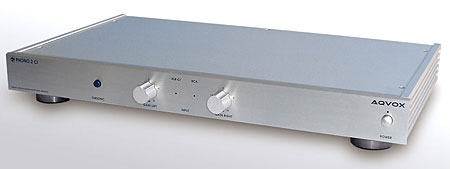
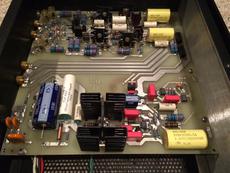
AQVOX 2CI MkII
This one intrigued me the most. Ever since I read Fremer's review in Stereophile I have wanted one, not because of Fremer, but because of the design. Not because of its fully balanced nature, but because of its innovation. My experience with this phonoamp tuned out to be exactly in line with the very thorough report in Stereophile, as well as reviews in tnt-audio and 6moonspositive feedback and particularly from 10 AudioSalute!

The seller of my unit had balanced tonearm cables whereas I do not, and was not about to re-terminate. So I started with the RCA inputs. It performed well but not quite distinctively. So I moved onto the XLR input. Not about to buy their own adapters, I decided to use my cheap Chinese XLR to RCA adapters. I knew this would not work as is, and certainly no sound was obtained by plugging them in directly.

I opened up the adaptors and saw that pin 3 is tied to pin 1, and that is the connection you have to break (pin 1 should not be used). Some quick de-soldering action later, voila! And what great sound! One play of Kondrashin's Philips LP of Shostakovich Symphony No. 15 and I decided it is going to be a long-term relationship. If you know this symphony, you will know that the equipment's main job is to (1) portray accurately the battery of percussion; (2) to convey a certain quality of life ticking away, an enigmatic quality. You may think (1) is not so difficult, and certainly the AQVOX performed miraculously in this aspect. Certainly, I tried the same LP on various phono setups, including tubed ones, and AQVOX's performance remained unrivalled. Even more importantly, it conveyed (2), proving it is not just merely an analytical machine, but a master communicator! A winner!

Audio Research PH-1(PH1)
It is interesting to study how ARC makes phono equipment. Indeed ARC played the most important role in keeping tube preamps and tube phono equipment alive during the transistor years. All the older tubed SP series (which they in recent years revived a little) preamps have built-in phono sections (seriously speaking, they are only MM stage) of superb quality. I have owned and am quite familiar with the SP-3, 6, 8, 9, 10 and 11. In HK, until a few years ago I used the SP-11 MkII as my reference (still with me). With my sensitive horns, the lowish phono gain of the SP-11 (higher than the others) was enough even with my MC, the Denon 103. During these years, ARC made the mostly solid-state MCP series of phono pre-preamplifiers to satisfy the requirements of increasingly low output MC cartridges.

In 1989, ARC abandoned the SP series and introduced the LS series linestages. Of course, they needed to make outboard phonoamps to go with these, and the PH series was born with the introduction of the solid-state PH-1. Since I have always had ARC SP preamps around and they have superb phonostages I did not really need to try these out.

When ARC introduced the tubed (actually hybrid) PH-3 I did try it out. The sound was not quite like the phonostages of the SP series: less full bodied even after tube-rolling, a lighter sound. But its Achilles heel was a lack of dynamics. The nominal 54 db gain was a bit over-rated IMHO. I sold it after a while.

Fast forward to now. Recently I got a PH-1 (full info here) in excellent condition, and I was surprised by its performance. At 48 db, the gain was low and I could not use it with my MC's even with my horns. But partnered with step-up transformers the sound was crisp and full, dynamic and lively, in the best of the ARC tradition.

There is an interesting review of PH-1 by Stereophile-Robert Harley. There is also an interesting comparison of PH-1 vs PH-3 in Audiogon. For me, the PH-1 is a keeper, a better phonoamp than the later, popular and rave-reviewed PH-3. For one as dedicated to tubed phonostages as I, that says a lot. YMMV.

Musical Surroundings Phonomena II can be quickly dismissed. Although it has enough gain for my MC cartridges, and loaded with features, I found the sound curiously lacking in finesse. It has good bass and reasonable dynamics but, most annoyingly, strings lacked sheen. I played several Heifetz mono LPs through the Denon DL-102 mono cartridge and the violin sound was so lackluster it was not better than the AT's built-in phono!!) A switch to the ARC PH-1 immediately restored normalcy. So much for all the rave reviews; it turns out the small prints are much more important than the rest of the reviews.

PS Audio GCPH (Stereophile, What HiFi?) fared much better (see also my previous experience). You can frequently find this phonoamp discounted and so it costs just a little more than the Phonomena, but its performance is in another league. There is just more music, and it performed evenhandedly with all set-ups. MM and MC alike. Heifetz? Yes, I recognize the sound, though I still give the edge to the PH-1. For a cheap full-function phonoamp, the GCPH is well worth considering.

YS Audio Solo 2 Phono pre-preamplifier
And now for something different, but what exactly is a pre-pre? Well, if a phono preamp is like foreplay (which is after all something before amplification), a pre-pre must be what happens before, I guess perhaps seduction, or whatever it takes to get to foreplay.

The active phono pre-pre is now a rare bird and no longer fashionable. In this high-noise age, it is no wonder stressed out audiophiles demand low-noise, and for additional gain when using low to ultra-low MC's usually opt for the even older but quieter technology of Step-Up transformers. An additional powered unit and an extra set of cables certainly can be cumbersome. But I have always thought the active pre-preamplifier has a valid reason for existence, as transformers can be colored and bandwidth-limited, and I still own the wonderful Klyne SK-1 as well as the Mark Levinson JC-1DC (one day I hope to acquire a Counterpoint SA-2). For myself, and perhaps I belong to a minority, if gain, noise or tonality are not issues, I prefer the potentially greater dynamics of fully active amplification rather than having a transformer in the signal path, but as always experimentation is the key here.

YS Audio Solo 2 is that rare bird. As a matter of fact, I cannot think of another CURRENTLY produced phono pre-preamplifier!! And it is one with a twist too. It is basically a solid-state device, but with a tube regulator (solid state rectification >> solid state regulator >> 6N3 regulator >> to gain stage)! I got it in HK but took it to NYC, where I proceeded to try it out in august company. Using the Chinese stock tube it proved immediately a winner. I set all my MC/MM full function preamps to MM and connected the Solo 2 with Kimber KCAG. As expected, it immediately proved its superiority over the JFET section of the Elekit TU-875. More importantly, it was not shamed by the step-up transformers inside the Verdier Control B as well as the EAR 912. Noise is acceptable for use with my Tannoy Canterbury HE, Gain is very good and sounds like more than its spec of 20 db. In NYC, it proved quiet enough to use with my 100 db YL horns. I also tube rolled a bit. The WE 396a proved superior, though a little noisier than the stock 6N3. Unfortunately, my Bendix 2C51 on hand proved too noisy in this circuit. But it is amazing the tube regulator has such effect on sound.

Why not get a free line preamp with your phonoamp?
Outboard phonoamps come in all sizes and prices, but I can tell you one thing: it will take quite an expensive phonoamp to outperform the phono section of (usually older) full-function preamp. And so it makes sense to buy an older full function preamp and just use its phono section via the tape loop. In such case, you would not want a bulky or hot tubed unit, but there are ample choices.

An example is Linn Kairn with Brilliant power supply. Used in MC mode, it has high gain, is quiet enough, and tolerant of loading (works equally well with my Denon DL-304, Koetsu Black and Ortofon MC-5000). Some say it is as good as the Linn Linto. I don't think so, but the performance is certainly very good. For the same price as an outboard phonoamp, you get a full preamp and remote facilities (the preamp ain't bad, but I am a tube man)!

Of course, it would be even better to go tube. Here, you'd want a unit that is not too bulky or hot. I highly recommend the hybrid ARC SP-9's phono section, which offers 46 db of gain. The vinyl replay is pristine, quiet and nuanced, and if I am forced I'd think perhaps even better than the PH-1 . The whole preamp uses only 2 tubes and is only warm to touch. I bet its line section will outperform almost all solid-state preamps in overall strength. Considering its price is only a little more than the PH-1, I think the SP-9 is as good a place to start with tube phono as any. As a matter of fact, the SP-9 is really hard to beat in overall performance, even with much more expensive equipment. It serves as a benchmark for me (see here).

If you're willing to build it yourself, the Elekit TU-875 full-function preamp is a no-brainer. Its MM stage is fully tube, liquid and airy, the MC is more than useable and quiet (though as noted not as good as the YS Audio Solo 2). It is small and simply wonderful as a phono unit, and you get an excellent line section. More on this preamp later.