Showing posts with label HiFi Basics. Show all posts

24 August, 2023

Bad Habits

Click pics to enlarge. No, can't pull the Wilson Grand Slamm's further in. Yes, better sound if the piano lid is down.

HiFi Basics (XVII): Mentors, Gluttony, Overreach, Connectivity and Cost-Effectiveness
Letter from NYC (23-7): A Day in the Country

Yesterday, some of us got together again at our friend R's mansion on Long Island. For me, this was the first time in 3 years! Understandably, there had been limited activity due to the pandemic. Since I have gotten back, I have met with our group leader Andy quite often. Kevin too since he had come back from Atlanta. Despite their arriving very late, I was happy to see Simon again, especially since he brought a new friend Sam, a vintage aficionado too (Tannoy GRF, Philips Full Range etc; I'm sure you shall hear more of him). I am glad I met up with subwoofer fanatic Richard and his wife. It's so funny, the first welcome-back SMS I received when I landed back in NYC was from Richard, who knew from the blog that I was back! Most amazingly I met Alex again (last time I saw him was probably in the late 80's, at Princeton Record Exchange no less). Years ago, Alex was president of the NY Audio Club and knew everyone. I have always admired him greatly for his tireless effort to try to get the many Chinatown audiophiles (through whom I met him) to listen to good classical music, a tough task indeed. We talked a lot about concert halls, the NYC and HK concert experience (like where is the best seat), anything but audio, as he is totally toned down now in terms of equipment - contented with being a music lover but not an audiophile. This is such a colorful assembly of characters from various trade that, if I were a composer of Elgar's caliber, I'd compose my version of the Enigma Variations, for, despite my knowing them, they remain enigmas to me. It was also a rare occasion because R's wife M could join us. As usual, R made a sumptuous lunch for us which was held on the patio (a first). The special wood smoked BBQ chicken was excellent (we would demand no less of R) and the two salads (cucumber and apple) were just perfect for summer. For my taste, the wines on this occasion were a particular fit for me. I loved most the 2012 South African Cabernet Franc. The fruitier Austrian wine was also interesting. The Costiere de Nimes was a little too subtle for me. And then there is Richard's Long Island wine from his friend's brewery, which I didn't taste. I was told it is young but promising (sounds like our youth, which didn't always pan out). I Thank R for hosting us.

Before and after lunch of course we listened to the audio in both the spacious LR and the smaller horn room. I only did the LR, where I spent most of my time talking to Richard and wife, and M. After 3 years, it seems there are quite a bit more gear here! But sound was regrettably no better from what I remembered, so it got me thinking hard. I think all the new stuff brought too many new variables that the system as a whole got sidetracked, even neglected. As this is a common audiophile issue, I'll take this opportunity to dissect some of the audiophile's habits. I use R as an example but aspects can also be applied to almost everyone present, including myself.

Gluttony

First question: Should we take on everything we have our eyes on? Not if you can't do it justice. This goes for people as much as audio - you need time and sensitivity to truly appreciate strengths and weaknesses, to learn that perceived deficiencies and strengths are sometimes just two sides of the same coin, and to build up stable relationships. This is NOT a question just of desire and drive, nor money - rather, of time and patience. Just like people we neglect or don't do well by, our systems tell us in no uncertain terms that things are not right (if we are truly good listeners). Today we start with examining the Gluttony of which we are all guilty. Incidentally, one reason why this blog covers some visits is because of the excess, photos of which are eye candy for many readers. What they may not realize is the detrimental effect excess has on achieving the best sound, which should be everyone's goal. The cruel reality is, in the quest for better sound (or for different experience) by acquiring more equipment, we frequently make things worse - a regression. This is not the same as loving different kinds of food. One can enjoy Chinese on Monday, Thai on Tuesday, Arabic on Wednesday etc, but one cannot quite do that with one's audio systems - one will almost inevitably end up with fusion, and the worst kind. There is only so much "breakthrough" one can achieve in audio, and there is plenty more ground to lose. Oh yes, there are audio buddies who tell you their system is XX% better every time you talk to them (and who tirelessly urge you to go listen), and there are magazines that tell you constantly about "progress". Don't you believe them! One of the biggest lies in audio is the Wilson Watt/Puppy, an unfortunate, incoherent amalgamation that persisted through 8 generations, each proclaimed to be a breakthrough by the press. A big grain of salt is in order when the reality is, with the exception of certain areas, there has not been much progress in audio, especially in terms of "absolute" sound; and the sonic up's and down's of the systems of most audiophiles is no smoother than the stock market at its most volatile.

Believe me, I know of Gluttony, as I used to be guilty of it, not just in terms of audio equipment (including tubes) but also in terms of LPs and CDs. Not so much now, though I still suffer from the aftermath. I actually regret my past. Too much stuff, too many hassles. many in our circle are gluttons.

The evolving systems of R actually comprise the longest running thread of this blog. As I reflected on its evolution, I was aided by all the articles I had written - one benefit of the blog is to set down things for later (if sometimes just for myself), as memory is so often unreliable (even if I remember equipment better than most people). It took quite an effort to tally up all the scattered articles - including this one there are 10! Amazing!

Chronology of Previous Home Visits to R

2016 here; early on in my acquaintanceship. Wilson Grand Slamm in smaller entertainment room. Equipment evaluated included Jadis JPS2, Lamm LP2. Rockport Sirius II, Versa Dynamics 2.0/Jan Allaerts MC2, Walker Proscenium/Kondo IO-J

2017 here Wilson moved into large LR; here, Tom Tutay, CJ P3

2018 here, Arrival of Altec A5, evaluation of Jadis JPS2/JA80, Marantz 8B McIntosh Verdin P153, Harmon Kardon Citation I; here, SMSL challenge, CJ P2 vs P3, Cary CAD-211, arrival of ARC Ref 2; here, re-positioning of horns, Bell 2122;

2019 here Bell 2122; here, Nottingham Space 294, Decca Super Gold; also here.

Mentors

I. As you can see, I have known R for quite some time, but Andy predated me by quite a long while. I hope my history of R is correct here. The previous mentor of R is A, a veteran of the industry who had retired to Florida a few years ago. Much of the oldest gear that R owns and still uses, and those of modern brands: the Wilson, the hopelessly gargantuan Tube Research stuff, Tom Tutay, and newer Jadis, Lamm, Jan Allaerts, Kondo, etc, likely all stem from that network.

II. The next period of R saw the growing influence of Andy as Mentor. Andy probably doesn't think of it this way, but to us he is. Vintage equipment proliferated. When I first met R he already owned several iconic, but notoriously finicky gear that without encouragement could not have come from his own imagination. The massive Rockport Sirius TT and Versa Dynamics were surely Andy's influence (Andy has them still). That influence only grew stronger during the time span I outlined above.

Consulting often with a mentor or friend with trusted ears is a good and natural thing, but to populate one's shopping list in wholesale fashion with only their recommendation is a big mistake. Since this happens very often and everywhere, in Hong Kong and even within our NYC circle I have consistently observed that most of the people who do this more often than not fail to achieve the next step up. It's not hard to duplicate and make the same equipment choice; what's much harder to duplicate, even truly understand, is what's behind the choice, which concerns listening sensitivity and perhaps a bit of the Midas' touch or even "wisdom", if anything in audio deserves that lofty term.

One interesting aspect of the relationship between R and Andy is that most of the exchanges happen over the phone. R professes himself to be just a music lover (a gross denial) and perhaps regard many audiophile activities as unnecessary, but broadening one's horizon is a must when growing up. I learned a lot by visiting other people's systems in my early years in HK. R would often call up Andy, asks what's he been up to, and Andy would tell him about his newest adventures, and R would follow suit on quite a few. Most recently, this is how R also got the Douk E6 into his system (not from reading my Blog), but it's my opinion that he has really misunderstood and misused the thing. R would likely benefit more from visiting others than having people visit him.

Let's proceed to look at what equipment are linked to Andy (and are also at Andy's home right now):

Before the pandemic: at least, Rockport Sirius and Versa Dynamics TTs, Nottingham Space 294 TT, Decca Super Gold, Bell 2122, Harmon Kardon Citation I, Conrad Johnson Premier 2(3), ARC Reference 2, Altec A5.

Since the pandemic: I was shocked by some of these latest additions. Not one but TWO Thorens TD-124 (one in each room; both with Decca arms), Decca cartridge (in horn room), Goldmund Studio TT, Sun Valley EQ1616D, DS Audio E1 optical cartridge system, many Douk E6s (both rooms), many cheap new cables from China (including "Cardas", note that Andy and Kevin have a variety of these). Yet another Citation I is in the works.

That's a HELL of a lot! As importantly, aside from one item (EAR G88, from A), I didn't see anything that has nothing to do with Andy. Below, in the section that analyses the sound of the day, I will say more on some of these.

The Mentor's "Duty" As with any relationship, feedback is important. In audio terms, that means the mentor better listens to how the stuff he recommends is doing in his charge's system and "grade" him. If it's not working, say "you screwed up!". But you will be surprised how many don't do that, as we are not really teachers and students, and "friendship" often obscures "truth" and gag candidness. I belong to those who shoot straight, even with friends, and though likely in the minority I'm not alone. Yes, perhaps I too have "mentored" a few, but I would always tell them in no uncertain terms whether things were working or not. Chinese saying "养不教,父之过,教不严,师之过" ("To bring up without educating, the father's fault; to fail to instill discipline while educating, the teacher's fault"). The last few days the real world here saw consecutive shootings during youth parties, and the saying came to me while watching the news. Maybe it is a bit true too in audiophilia, though I am positive not everyone shall agree with me.

Connectivity

From my perspective, aside from gluttony, another aspect of R's audio practice makes me tear my hair out even just to watch, and that is Connectivity. In his case, there are several aspects to this. When I first knew him, he had few extra cables and helping him re-configure things was quite exasperating. R is a very strong man, who can lift up or move very heavy items. But somehow he cannot really kneel down and poke around. This makes him really reluctant to change connections in the LR. As you can see in the top pic, all of the source and control equipment are hidden from sight (low down in the dress table behind the sofa. I can totally understand and sympathize with physical limitations, house rules and aesthetics, but then why squeeze 4 TTs, 3 SUTs, 2 Phonoamps (one bigger than 2 amps) and a Preamp, with their many associated cables into hard-to-reach hidden space? Why not just simplify?  Mind you, his many newly acquired cables had enabled him to make more connections, but that too exacts a cost (below).

Mind you, R is not at all the only one who has connectivity issues. Here in NYC, some of Andy's cables are nearly impossible to access and swap out too. But the problem is by far much more prevalent in space-strapped HK where for many the allowable space for audio is miserably small.

To be a Glutton one has to improve Connectivity. To accommodate the many extra cables is not that hard, but to use the cables wisely is the much bigger problem, especially if they are of various makes, from various sources and from different eras. R may now have the cables he needs in numbers, but it is unlikely that he knows the character of each at all.  I looked at his China clone Cardas and I had no idea what to expect - I surely hope he does. For me it's easier, as my cable stash comprise mostly of professional cables of few types and brands, all of which I know very well and have used for years on end. More often than not, my whole system is strapped with Gotham.

Audiophiles should make it easier on themselves. For those with a lot of gear, especially with a mix of vintage gear, there is no place for short cables, stiff cables, fat cables, big connectors etc. An example is the Citation I, which like many vintage gear has tightly cramped RCA terminals. The most suitable cables would be terminated with Switchcraft; my Cheap REANS will also do, but barely. R has one, which he has someone modify by adding a cable terminal strip.  Of course, the best would be to cut down on gear and cable tangles.

Overreach

Personally I'd prefer not to own gear that would need constant servicing. Case in point, TTs with vacuum hold downs, especially vintage ones. Long before I even met Andy I had heard many of them. I knew even then pumps are not for me. Design merits are always overblown, and none of those I heard convinced me that that is the only way to go. Even in Andy's place. If vacuum hold-down is the ne plus ultra of TT design, nobody would know better than Andy, and Andy would not be so into other TTs also (especially the idler wheels in recent years). But Andy's case is different, as he has the know-how to trouble shoot and fix most of his problems himself. And he is a good friend of Simon, who happens to be a Dental Equipment service technician (yes, a lot of pumps there). With R it's different: aside from having a basement to hide the pumps, he completely lacks the know how and on multiple occasions had to call in Andy and Simon (Mark too) for help. It would help my understanding if the vacuum TTs (Versa and Goldmund and Walker make 3) sound superior to the others, but they don't (more later).

Horns is another aspect. I worship Altec but know how hard it is to get them to work really well. There is perhaps no perfection. There is no way I'd constantly try to improve the crossover. There will always be problems and temptations to modify. R's A5 is one of the best ones as it came with crossover done by our friend Paul. He's lucky. Here in NYC I have my treasured YL horns, and no room for more. In HK I know many people with all kinds of horns and components strewn all over the place. Even if sound is not always commensurate with the investment, they make my mouth water. But at least these days I follow my own advice below and have no desire to own them:

Know your own limitations and try not to rely on others too much. There is always a limit on how many favors one can ask of others. There is no free lunch either, one way or another we end up paying.

Cost Effectiveness

One factor that fuels buying vintage gear is perceived Cost Effectiveness. Andy and friends are vintage aficionados, and so am I (mostly). If you look at the Andy/R gear, many will only go up in price. Cash depreciates fast. The right gear holds the value, even appreciates. In hogging things and buying duplicates of things R is nothing compared to a lot of people I know in HK (also some in the NYC circle).

But when it comes to electrical things, particularly vintage gear, such perceived value is often a delusion. Things break down, caps need to be changed, and leaving things idle for a long time is the best way to ruin them (believe me, I know). So, one has to go through the trouble of repairs. A fraction of the extreme collectors can do at least some rudimentary restoration themselves but the rest will have to pay for service or cull favors from friends.

And what about selling them? The problem is, selling things is a big effort. Here, Andy, Kevin and I don't sell things just because it's so much trouble. We are not used to it. In HK, it's much easier (and I bought and sold for years due to space limitation), as everyone is within reach and things are bought and sold after inspection. Not here in the US.

In practical terms, Cost Effectiveness when it comes to vintage gear is often as much delusion as reality. It comes with hidden trappings.

Sound in the LR I only did some listening in the LR. Before lunch we didn't pay much attention due to insufficient warm up. Some brief notes:

  • The Heart of the System hasn't changed since my last pre-pandemic visit, but the sound took an obvious turn for the worse: ARC Reference 2 Preamp driving monster tube amps remain the same. What I think is too many new gear took things down the wrong path. IMHO things happened too quickly for R's own good. In fact, even the last time was not the best I have heard in his LR. Before he got really crazy with new acquisitions, things were better with the more limited stuff at hand. I am not a fan of CJ or Jadis, but in his earlier system these were better at delivering the musical message. For me, in his system the ARC Ref 2 took it a notch down. This is ironic, as it sounds good in Andy's upstairs main system (and I've heard it many times in HK to good effect), and in my own system I'd likely choose ARC over CJ and Jadis (currently I don't own anything of the latter two). I hope that means I hold on to some objectivity, as opposed to subjectivity. I'm not about to re-read all my wordy posts and give you the exact timeline, but some past moments in R's system were memorable: Ansermet's Espana; Handel's Messiah (which he played on this occasion but it was not good). These all occurred years ago. In fact, one of our best experience was with his old 1-bit Altis flagship digitals: it was subtractive but musical, with none of the problems of his current analog rigs (Andy can corroborate this). As for the analog rigs, all four failed to inspire.
  • Thorens TD-124/Decca arm/Kondo IO-J. They make kinda odd bedfellows, as one would usually more likely see the low compliance Kondo on a high mass 12" arm. It goes into the Kondo SUT, which is its mate (no matching issue there) and then into the monster Tube Research phonoamp. Sound on this TT was perhaps the better of the bunch, but with things as they were, it was hard to say with certainty. 
  • Nottingham Spacedeck 294/DS Audio E1 with own "equalizer". Seemed a little paler than the above rig.
  • Goldmund Studio/T3F/Benz Micro LPS goes into an old Ortofon SUT; and Rockport Sirius II/Jan Allaerts MC2 into a smaller Kondo SUT. Both into Sun Valley EQ1616D. The Rockport sounded way way off, heavily rolled off at both ends. The Sun Valley is tubed exactly as Andy's, which was what I reviewed (except for the psvane 274B). I think of the Sun Valley as a very vivid device and was quite flabbergasted by what I heard. Since the Jan Allaerts likely has a Denon DL-103 heart, I wondered how good a match the Kondo SUT is. In HK when I owned the Kondo SUT it wasn't impressive at all with the high impedance Denon. As for the Goldmund TT I heard too little to make a comment. Benz cartridges are usually high impedance too and I don't know what exact Ortofon SUT R has but vintage ones are usually for low impedance cartridges. With the Rockport I actually tried out bypassing the SUT and used Sun Valley's own FET headamp section (even if it's loaded low) - to me that sounded significantly better, but R was not interested.
  • Douk E6 I only use the E6 as Preamp whereas some in our circle use it between source and preamp, but R had the Douk between the Preamp and amp. In brief A/B comparisons, the use of E6 did bring forth a bit more solidity and air but at the tremendous cost of noise, which was just too much. Not sure what's the rationale using the Preamp's Pre-Out instead of Tape Out. Andy reminded us that the Ref 2 has a Defeat switch which would bypass the Gain. Using these would make the Ref 2 just a switch box and volume can be adjusted on the Douk.

Thoughts

  • More most often means LESS, Less can be More All audiophiles are susceptible to the upgrade bug. It can be upgrade within the same ecosystem (exploited by the manufacturers and inevitably underwhelming), or a bold attempt to move to something different (like from Wilson to Altec that R did, at least in the horn room - the best thing he had done). All that is healthy if taken gradually. But if too many things are happening at the same time, and the time devoted to each acquisition is not enough, regression is often the case. Of course, we all hear things differently. Tell you something about myself. About a year after I just returned to HK in the early 90's, I had a modest system of Spendor 11 ohm LS3/5A, DIY Marantz 7 and Dynaco ST70. It inspired many, including a lady friend of mine who is an accomplished pianist. She has heard some of my subsequent (and much bigger) endeavors and yet she insists, to this day and to my chagrin, that the oldest one is the best. Of course there may have been extraneous circumstances that had influenced the perception (I'm not about to chronicle), but I respect that actually. She knew and knows what she likes. Much cannot be said about audiophiles. A large number of audiophiles take things to the extreme, and the rest is noise. Whether one tackles a smaller or larger system, one should try to get the best out of it, enjoy it, know it inside out. Since I have come back to NYC, in my LR I have listened to my LS3/5A mainly (another report coming) but I tried things to get the system to sound its best. I'm enjoying the music so much that I have yet to fire up the big system! In passing, I should also note that in my long experience in Hong Kong, many people, even if they have the proper space, fail to transition to a larger system. It's relatively easy to do well by the LS3/5A, which is one reason why they remain popular, but the larger the loudspeaker the more the problems with setup - frequency anomalies, room interaction (many simply do not have the freedom to place them properly), etc. But I think one main problem is actually a narrow musical taste, which simply cannot do a bigger system well. One can probably get away with setting up the LS3/5A using only vocals or jazz, but with larger loudspeakers that approach will likely fail to deliver the proper balance. Most audiophiles try to advance at too quick a pace, and many just vacillated in the same place despite much equipment turnover.
  • Attention to Details One should take time to know everything in the arsenal. E.g., the character of each cable matters, and it takes time to know. TT users are at even greater peril.  By this I mean one should have at least a modicum knowledge of the technical aspects of things. With many cartridges, due to impedance issues, especially high-end ones, just using the nearest SUT and cable would not bring about the best (and some, like the Jan Allaerts, are likely dismissable, at least from what we have heard at R's over the years). While one can possibly arrive at an empirical solution, it's best to have the technical aspect in mind. When it comes to me, a good example would be the Denon DL-103. I use it extensively on medium mass arms (sometimes with added weights) but I know well the objections to this although to me cables can ameliorate some of the said deficiencies. I know very well I'd prefer a DL-103 to, say, a more even tempered Hana any day, and that's good for me to ignore the naysayers. One has to develop one's own views, by which I mean long term ones. Let it not be misunderstood, by these I don't mean technical aspects mean everything - not at all! In audio it's not unoften that empiricism trumps "science" but it pays to study the fundamentals. I'm NOT a big SUT fan for a reason - matching them to cartridges is a cumbersome task. As I mentioned above, on the Rockport/Allaerts when I dropped the Kondo SUT for the built in FET section, I got improved sound (God forbid, many would say). To me, a mismatch is definitely possible. I told R he has to work on his TTs one by one, throw everything at them, swap SUTs and cables and phonoamps and evaluate carefully. Hard work, but necessary.
  • Analog Woes In my experience, alarmingly, many people take the analog experience too far. Although an analog fan, I'm also a constant digital listener and gauge the proper sound by both digital and analog. They should sound broadly similar and the analog should have the edge in aspects of reproduction. But with many analog users this becomes quite crooked. In chasing too zealously after the tactile factors (like force and touch, as often used) that analog delivers in spades, many throw the baby out with the water, achieving what is more appropriately described as noise and cacophony. Yes, today, what is often heard in "high-end" analog is worse than digital - the tweakability and adjustability have turned into liability for far too many. IMHO, many of the current analog users now would be better off with a good digital setup, at at least have one on the side (for diagnostics of analog woes and even wake-up call). Our "honorary correspondent" icefox in HK has taken his highly secretive super BT device and E6 around and he reports that they have put many expensive "super" Analog Rigs to shame. The Altis digital setup of R is too heavy and big to move into the LR for a casual A/B (before he got all these extra, and extraneous, TTs it used to reside there) but if it were to happen as of this moment I have full confidence I'd prefer it over the 4 TTs he has in there. Then there is the story below.  
  • Detours/Affairs I never tire of relating one story: In HK, one day we visited our friend W, who is very experienced with analog, and heard several of his nice TTs. To me, while all of them sounded pretty good everyone was a bit off. He said this was to exploit the different virtues of each. Finally I summoned up the courage and had him play CDs through his Studer A730. Guess what? Everything sounded normal and to me better! But there is a clear difference between R and W - from what I heard on the day R has a long road to travel to get his analog rigs to be just even-tempered; whereas our friend W just needs to tone down his tendency to exploit characteristic traits (or eccentricities). This is to say while I totally understand the allure of playing with things of very different designs, and bringing out the specific characters of each, with each and every new toy, especially analog rigs, one has to get a handle on it. It's too easy to be totally wowed by what the new toy brings, but inevitably downsides will show up and one cannot ignore them. It cannot be TT-A is for Jazz, TT-B for Rock, and TT-C for Classicals; rather, maybe this, all TTs will play everything well, but A perhaps a little better in jazz, B a little better in Rock and C a little better in Classicals. Many analog fanatics take "analog" where it should not go. Andy, despite all his rigs, is one of the few who does not. If I may say so, I don't either, but then perhaps my much more humble rigs with many limitations don't allow me to either, and that may be a blessing in disguise! Meanwhile there are many lost souls on the highway, just driving with nowhere to go. My advice is, while we may enjoy Shrews sometimes, Tame them to be Ladies, or Wives, for the long term! Is this politically correct?

OK, now. This may be one of the less coherent pieces I have delivered, but I reckon it contains much heartfelt sentiment, and frustration. Lest you think my standards are too high, I should tell you that I'd be very happy to listen to the Technics SL-1200 with a good MM cartridge (even the AT-VM95C) into the NAD 3020 driving the LS3/5A. The Denon DL-103 with the NAD 3020B version would be even better of course for the MC capability. Yes, it frustrates me when I hear potentials not realized, or things veering way off. It really has not been easy writing this article.

As a parting message, I quote Master Engineer Bob Ludwig: "A lot of audiophiles say you have to really live with (a piece of equipment) for a while before you can discern the differences, then it becomes rather obvious. That is true in my opinion. It's just amazing how the brain goes."

From the piano to foreground: Thorens, Goldmund, Rockport.
Far right, Nottingham

Top, Goldmund and Thorens;
Bottom: Sun Valley and ARC
The small room, too many things to cover
Fabulous Lunch
Th Legendary EAR G88

14 July, 2023

Room Factor Floor Material


Click pics to enlarge. Above, Station B. Center, Philips AK601 CDP and Melos 222 Preamp below Sun Audio VT25 and DIY 45 amps. Left, from top, Micromega Duo transport, Micromega Solo, Elekit 8230 2A3 amp, Philips el cheapo CDP, Micromega Duo Pro DAC, PS of Melos 222 and Bryston 4B. To the right, note the Ruark Crusader II in front of the B&W Matrix 801 Mk II. Note the "wall" on the right side was a partition using steel cabinets. Note the Tile Floor.

Letter from Hong Kong (23-7): Room Filling Sound
HiFi Basics (XVI): Floor Material, Dead vs Live Room, Three-Phase Electricity

Written in the UK.

It was only in June that I made it back to my Hong Kong (HK). After running errands, I had little free time. When I finally returned to my old house, where all my residual equipment are housed, I discovered that, while the ceiling lights and fridge etc still worked, all the lower outlets off the floor were dead. It took another week for the electrician to come and solve the problem. Like all "Village Houses" in HK, the Electricity is Three-Phase  (much coveted by audiophiles). After a new fuse box was installed, all was restored. I did not get to listen for very long, but what I heard took me back in time and made me think hard.

In August 2018 I left HK for NYC. Two years later, in October 2020 I was in HK for almost 2 months before crossing over to Shenzhen (SZ). I had the opportunity of firing up some of my stuff but didn't really write about it. In an article then I casually mentioned: "...I returned to my old house, which housed a lot of equipment. In 2018, before we returned to NYC, I moved some of the furniture and stuff from the new place there, so it was packed to the rafters. Due to the humidity in HK, the house was moldy too. So it took a lot of getting used to. Over the weeks I spent a huge amount of time cleaning up, unpacking, sorting and throwing things out...Of course there had to be music. The NAD 3020 is still tethered to the B and W Matrix 801 Mk II (reported here) and they still make beautiful music. I stream through a Meridian Explorer (my downstairs neighbor generously let me use his wifi). Later I also fired up the Ruark Crusader II (same link above) and it makes fantastic music with my ICL 300B. You shall hear more about these..." What happened just a bit later was that I turned the volume up just a little too much and the NAD gave up the ghost. I substituted the Rotel mentioned below. So! for practical purpose it has been three years since I last fired them up!
 
From top, Left rack: Technics SP-1200, ARC SP-11 Mk II, Marantz CD-60, Marantz CD 94 Limited DAC, PS for SP-11. Right rack: ARC CD2, Revox CD-221, Pioneer T-07A, MFA Magus B, Rotel, RB-870BX, Marantz 9 (reissue). B&W 801 to the left. Note the Tile Floor.
 
Station A (by the Entrance)
I first turned on the Counterpoint SA-3000 but it'd not come out of Muting. Sticky Relays perhaps after three long years of inaction, but I shall also check the tubes next time. I substituted the MFA Magus B, which drove the Rotel RB-870BX (Gotham GAC-4) and B&W Matrix 801 Mk II (Belden 1810A). Digital source was at first what's on the (Jap) 100V line: Marantz CD-60 as transport into Marantz CD94 Limited DAC (Belden 1694A); then, miraculously, the Pioneer T-07A, which was not working 3 years ago, worked flawlessly! Sound was just fabulous! I slotted in Eagles' Hell Freezes Over and wallowed in it. YES! The sound is back! After a few tracks, I played Miles Davis' Tutu, and it was just as great. No matter what I played, it was utterly musical.

Difference from SZ While the sound was utterly familiar, it immediately dawned on me that there is a fundamental difference from the sound I get in SZ. The HK setup is by far more room filling. As you shall see later, it's not because of the large B&W loudspeaker. It's a sound that "richochets" around - not reverberant, just nourishing and big, and it conveys the excitement of the crowd in the venue of the Eagle's live concert very very well indeed. In contrast, as impressive as it could be, the SZ setup is very much scaled down in feeling and visceral impact, indeed nearfield and monitor-like.

Station B (near Balcony)
I then fired up my trusted Melos 222 Preamp and a variety of SET amps (Gotham GAC-2 and Mogami 2543/9), which drove the Ruark Crusader II (here and here; with Gotham 50025) . Source was the el cheapo but excellent Philips AK601 (1543 chip). Both the ICL/Softone 300B and 2A3 as well as Sun Audio 300B (mine is "mismatched", using the VT-25 kit with its 5K output tap) delivered excellent all around performance with the Ruark. In many ways, the even more flea-powered SET amps delighted even more: the DIY 45 amp (WE 412A driver, Tango trannies)) was just pristine, with intimations of WE sound (as much due to the driver as the great 45 tube); ditto the Sun Audio VT25 amp (GE ST tubes), somewhat darker but possibly even more mesmerizing and sinuous. I didn't listen to any of them for very long (the point is to run them a bit), but I loved everyone of them. I also got the Micromega Solo to work. The 1-bit sound is less resolving than the 16-bit Philips but it is richer and musical.

What's Behind the Sound The most interesting aspect of the sound to me is how much the low powered setup and much smaller system mimic the larger one. We are talking about much the same room filling soundIf I don't tell you which system and loudspeaker are playing, you would not know. Amazingly, even with around 1-2 watts (the VT25 and 45), and despite clipping on louder material, the scale is still large! This leads me to conclude the the bigness of the sound is mostly due to the room, not the loudspeaker nor equipment. My friends in NYC, none of whom stream, half-seriously suggest that the result shows the superiority of CD playback over streaming, but they are highly mistaken, as at the end of 2020, as quoted above, the same sound was obtained with streaming. Indeed, it aligns with my past experience in this place, where almost everything sounds good. No near-field monitor room, this!

The Room Factor
All this leads me to ponder what makes the sound different, and how my rooms differ. I gave it much thought.
  • Room Dimension Much has been made about the ideal room dimension. Indeed, it does matter. And many a serious audiophile with the space and means has gone through extreme trouble to expressly create a dedicated listening room of "ideal dimension", which is usually reckoned to be somewhat (but not overly) rectangular, with high-ish ceiling, and with no two axis of similar dimension. Thus examined, I have to tell you that none of my spaces approach this ideal. The HK old house room is somewhat low in ceiling, closer to cubical, and was actually carved out of an L-shaped living-dining room with a partition made out of two heavy duty steel bookcase-cabinets. My NYC LR is also a large square, though I use only half of it in my usual near-field listening (most recent pic below), with the whole room used only with augmented horn systems (below, like here). My SZ room is smaller, and also closer too to a cube than a rectangular box (pic below).
  • The Larger the Space, the Better? Sound treatment? While it's definitely true that small spaces don't yield the best sound (at best, near-field), larger spaces bring about other factors. Reverberation Usually severely frowned upon, most audiophiles try their best to veer closer to  a more absorbed sound. Before I moved into my HK old house, I surveyed the vacant LR (prior to partition), lots of glass on two sides, clapped my hands and determined that it was somewhat reverberant. Aside from the partition, I did not do anything to treat the room. I just had too much stuff and basically tall racks lined the periphery and lower racks filled the center. After stuffing everything in, sound was excellent! No reverberation upon clapping! My own thinking is, some reverberation is better than a dead room! The former you can work with, but the latter is a dead start, and dead end. Dedicated Audio Room The conventional audiophile wisdom is to have a (large) room with only the gear and one prime spot for listening. It's silly to me. What you want is room filling sound which you can enjoy as you move around, like what I have in HK, and not just "perfect sound" at one spot! After all, concert halls and live music venues have all-enveloping sound that don't just cater to one spot. And all the expensive treatment can be avoided if the area is more "lived in". It's my observation that stuffed rooms and lived-in rooms usually sound way better than "meticulously crafted" audiophile ones. Stupid Tweaks One main reason for the puny sound that is often heard in an audiophile's room can be attributed to all sorts of stupid tweaks that unnaturally slim down the sound  for the sake of of "clean bass" and "imaging" (to name a few audiophile "virtues"). The more spikes, platforms and tweaking devices one uses, the higher the risk of a threadbare sound. Judicious is not a word that the majority of audiophiles understand. While everything may have value if well applied, more is often less. Context Yes, the HK old house space is considerably larger, and the B&W is definitely much larger in bass cone area, so better sound should be expected. However, the smaller Ruark is not much bigger than my SZ Sansui, though its huge sound in the space is confounding. It's not just the equipment, it's safe to conclude.
  • Three Phase Electricity It'd be reasonable to think the 3-phase electricity is partly to be credited. There may be something in this, as my former rented "village house" residence had equally great sound. There are city dwellers who go through draconian measures to obtain 3-phase. Somehow though, I don't think that's the whole story. In my NYC main listening room, sound is just as splendid but it surely is not 3-phase (big horns though).
  • Floor Material I cannot help but notice that my HK old house has Tile Floors, which I think is helpful to the sound, more reflecting and reverberant perhaps, but a plus in scaling. It should be noted that my "newer space" in HK also has tile floors, and despite the non-optimal dimensions, the Yamaha NS-1000 still functioned very well there (with a hefty feeling)! In contrast, my SZ room and NYC LR are all wooden floored (the latter partially thinly carpeted), and provide more of a "monitor sound".
Conclusions As I have outlined above, there are many factors governing whether a room sounds good. It's not easy to collate them into dogmas, and I'm highly sceptical of "conventional wisdom". But I think I'm willing to say a few things, YMMV:
  • For sure, the room determines the sound as much as the equipment. Just like a concert hall heavily governs what you hear.
  • I believe a room should have a lot of things in it, "lived in" that is.
  • I believe Tile Floors are better than Wood Floors.
 
NYC LR. Half used. Note Wood Floor with Thin Area Carpeting
NYC LR. Full Room Use.
SZ Room, Wood Floor.
HK Newer Place. Small, with Yamaha NS-1000. Tile Floor not visualized.

21 January, 2023

Cheap and Good DC Power Supplies


Pic shows LPS, but even in SM, smoothing ripples and regulation is basically the same.
Letter from Shenzhen (23-1): Cheap DC Power Supplies from Taobao
HiFi Bascis (XV):
Power Supply - The Hope, The Fuss, The Expense, The Futility
Happy Year of the Rabbit!

Editor: Not long ago, around the time of 11.11, I wrote my first Taobao article in Chinese mostly for my HK readers, because the stuff are not available outside of the region. I liked the response and comments and resolved to write about more of my purchases. Most shall be in English for other readers in the West to consider, as some of the items may be found on Aliexpress, Ebay etc. I shall not search myself, as it’s hard work enough writing the article. I shall provide a Taobao link, which will have many pictures of the item. You’re on your own from there.

It's Lunar New Year, and I wish everyone well! In a few hours it shall be Year of the Rabbit. All the Best. I have buried a few risque pics worthwhile of Hugh Heffner at the very bottom.

This article nominally is to introduce the 3 DC Power Supplies (PS) I bought from Taobao (TB), but I shall take this opportunity to write about my beliefs in PS in general (and hence this is a HiFi Basics article), though they are likely to fly in the face of many “objectivists” (especially DIYers and those obsessed with measurements).

I shall start with my “Basics”, that is my Beliefs. It’d be a little long. Those who just want to browse the 3 PSs I use now can just skip this section.

HIFI BASICS: Power Supply
  • How much does the PS influence the sound? More than most people think. There are many aspects to the PS, and every one influences the sound. Component Quality Take the most simplistic scenario, vintage tube electronics have simple PS, but seasoned aficionados know that the tube rectifier has huge, even profound, influences on the sound, more than the driver and output tubes. If you have ever heard the WE 274 (B or A), you would know what I mean (Currently, a humble Tung-Sol 80 tube rectifier, a tube derived from the formidable WE 274A; ST, engraved) is producing astonishing result in my APPLause 300B amp). But we would not want to over-state this. The rest of the PS circuit and the audio section of the gear the PS is used for are important too. Mind you, the rectifier is important in solid state too. That’s just a single component. And then there are Diodes, Chokes and various Capacitors and others. These components can range from a few cents to hundreds of dollars. Each has its own sound and pricier doesn’t always equate to better. I have heard too many expensive DIY PSs stuffed with deluxe components do a terrible job. Design and Regulation Over 20 years ago, I participated in several DIY Meets where the auteurs compared their works. There were many based on the simple Marantz 7 circuit, which is solid state (selenium) rectified without much regulation. Some would add a lot of regulation. Others changed it to tube rectification. Despite the additional components and circuitry, almost all of them did not sound balanced and not as good to my ears as my simple M7 replica. Mind you, M7, even the real thing, is by no means a perfect preamp; it simply cannot deliver big dynamics. Preamps with iron control and impressive dynamics were not to arrive till the era of ARC, CJ and the likes. Take ARC, their earlier preamps can be regarded as highly tweaked M7-like circuits, with much beefier and regulated PSs. As with the rest of the circuit, a good ear helps, but the PS happens to be usually the section the builder/user pays the least time evaluating the sound. Bigger and Better Current Delivery This usually happens in Solid State gear. Naim and Cyrus were among the earlier brands who actually sell PSs as an upgrade path, and the PS can cost just as much or even more than the amp. The addition of the PS increases the power delivery. But is bigger always better? Not always. Of course, if your loudspeaker is current hungry, it will help greatly. But if yours happen to be quite efficient, pushing the amplifying device harder may actually be counter productive. The harder the device is used, the more distortion arises. With a Digital Amp, like Aiyima T9, one can use 18-30V. In my case, I I thought the 19V generic computer PS sounds better than another generic 24V one (to use it as preamp, one can supply just 12V). Also, imho the bigger the power supply, the more likely the deader the sound. Monoblocks and Dual-Mono High End manufacturers have ingrained the audiophile into thinking that monoblocks are better than stereo. This is not true in many instances, let alone being gospel, and has never been. A vintage example is McIntosh - the MC40 monoblocks and the stereo MC240 are basically the same, but the stereo MC240 sounds significantly better. For the 47 Lab Gaincard, using just 1 Power Humpty sounds better than using 2. One wonders if the single PS in these cases enable more synchronicity in the 2 channels.
  • What’s the limit of what the PS can do? Simple, my dear Watson. Whatever the gear, if it’s just ordinary stuff, there is only very little a better PS can do. And by ordinary stuff, I mean the majority of so-called hifi offerings out there, including megabucks stuff. The problem is, the majority of people who want to upgrade their PSs believe too unduly in their gear, usually at the urging of netizens who promise nirvana (and transforming things into “giant killers’). Most would be disappointed in the long run, and would sell the gear while throwing in the “upgraded” PS.
  • What benefits the most from a better PS? I’d say, first, the cheap (but good) stuff, like a digital amp with a wall-wart. At the highest end, this likely holds true too. A WE PS is definitely going to be better than a DIY effort, no matter how expensive the modern components used. The BIG problem is the middle 90%, where you can perhaps hear some changes, but in most cases they won’t change the overall assessment of the gear. Expensive upgraded PS is now a commonly offered path for “upgrade” for many audio brands, but usually after you fork out the dollars you still cannot escape the confines of the product and the greatest flaws of the design will not be improved. In most cases, it would be better for you to forge a new path and change gear. There is only so much the PS can do.
  • Linear PS (LPS) vs Switch-Mode or Switching PS (SMPS) For the longest time, there were only LPS. With the advent of digital, SMPS came to the fore. At first, it was regarded as just noisy and nothing but interference, used only in computing and the likes but, as technology matured and geek gear started to shrink in favor of smaller ones, audio people (at least the low end) started to take notice. At first, only the digital DAC and Amp people (like the Chinese) use SMPS. But then, SMPS started to make it big, even in high-end manufacturers. Time flies, and it has been 25 years since Nagra unveiled their first home-use audio product, the iconic PL-P (which I still have and have high regards for). It sports a separate SMPS! Today, many European high end manufacturers use SMPS. Witness Swiss Soulution (their GBP 20K “entry level” 325/311 pre/power combo uses SMPS, and I’m pretty sure SMPS are also liberally used in their upper echelon products). It’s interesting to note that many European hi-end (witness another Swiss one, Goldmund) embrace digital technology and SMPS, much more than the US hi-end. Witness the advent of the T-amps and later ICE modules to hi-end gear. Perhaps it has to do with the more pan-European conviction of their green responsibility to the environment (US is despicable in this regard, as in many aspects of their world-view). Talking about skepticism of new technology, Surface Mount components have been ridiculed for a long time but I actually think they are very good. Again, Linn in the UK was among the first to use SM components in their products and they sounded quite decent and those were what converted me, decades ago. There is MUCH BS about short signal path in audio - what can be shorter than SM components? If you look at the tiny PCB of a Linn Linto or a humble Kolector, you will get the point. BTW, Linn also embraced SMPS, even in its phonoamps. As with SMPS, in the US, pretty much no hi-end pretenders would do this. If being green environmentally is left or progressive, US audio industry mostly remains in the far-right.
  • Aftermarket Audiophile LPS Supplies are a dime a dozen. They range from very reasonably priced (as in the offerings below) to the ridiculous. Usually, the more expensive it is, the greater the hyperbole. As I implied above, no amount of PS upgrade can elevate a pedestrian offering (which is most stuff) to the transformative level, despite claims on the net to the opposite. There are probably more PS for flat-earth Naim people than anything else. It is reasonable to expect subtle but meaningful differences. Please don’t believe in a sustained Night and Day difference; in most cases you are likely in Scandanavia, where sunshine breakthroughs are possible but rare.
  • SMPS Upgrade The 2 featured below are very cheap and yet surprisingly effective. These most definitely outperform the wall wart type SMPS that comes with your digital gear, be it DAC or Amp. These are not originally meant for audio applications, instead for industrial use, for repairmen and surveillance cameras etc. The difference between these and the wall-warts is that these are much better built and can deliver much more current. They are good for amps, but the difference made with a DAC is perhaps even more surprising (see below).
TAOBAO Offerings

https://m.tb.cn/h.UPPaQjS?tk=kSg0d5HlRWA

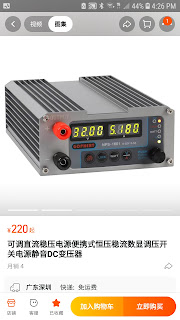
The first one I bought (branded Gophert) was an SMPS. There are many options and I picked 32V 5A max. Price now is RMB 231 (around USD 35). Tactile buttons are used for selection of voltage and current (as well as lock), which are adjusted (fine and coarse) with a knob. The build is excellent; the TB page claims excellent regulation and smoothing close to an LPS. Mind you, I picked it only because it is compact and looks better than its rivals. I had no idea whether the innumerable other ones are better or worse. The only thing I’m certain of is that it made a difference with my Aiyima T9, whether as an amp or as a preamp (written up here). For this article, I moved it into my reference tube system in my study, and used it with my DAC (see section below)

Then came 11.11 and I bought 2 more. Prices now are actually about the same!

 https://m.tb.cn/h.UOY51zT?tk=7jjZd5Hlw2s

This one is another SMPS (branded Wanptek), with somewhat different features but similar spec’s as the previous one. This is also a regulated unit. The back has a 110/220V selector so I’m pretty sure this one sells in the US. You can see from the pic that the innards are quite a bit more stuffed than the Gophert. There are many options and I again picked the cheapest 30V 5A max (GPS305D). Right now the price for my unit is RMB 148 (around USD 23). Its simple rotary dials are easier to use, but it doesn’t have voltage and current caps, nor lock (I have turned it on and off and it always stayed at the last setting - just don’t accidentally bump it up and down while it’s on, not a likely thing without a child around). Unlike the Gophert, the shell is perforated and there is a fan at the back. I used this for a long time in the main system in my study, where I used it to power my DC 5V 1-bit TDA-1305 DAC. Compared to the stock PS, the sound is immediately more graceful, transparent and subtle. This is amazing because the display indicates it is drawing a mere 0.11 A in use and less than half of that idle (so the fan never turned on). The front also sports a useful 5V USB DC output. You can use it to connect your 5V devices (say BT) or charge your phone. As my DAC is 5V, I did try this output (you’d need a USB B to correct-size DC plug cable, which I happened to have) but it doesn’t sound as good as the main output.

Gophert vs Wanptek For this article, the main recording I used is a recently re-issued old MHS recording of Haydn Piano trios (Musical Concept-Orpheus). The difference is subtle and they are more alike than different. The Gophert may be just very slightly smoother with the violin and a tiny bit more rhythmical; whereas the Wanptek seems to be a just little airier and relaxed, though possibly slightly grainy with the violin. I could use either in either of my 2 locations. They have different form factors - the Gophert is a horizontal slab (but you can easily have it vertical too) whereas the Wanptek is a vertical one, so aside from looks, I’d pick the one more suitable for your space. Also keep in mind that, at least locally, the Wanptek is “significantly” cheaper than the Gophert.

https://m.tb.cn/h.UPPZmbY?tk=icscd5HO51F

This one is an LPS, said to be modeled on Studer, offered by BRZ or Weiliang Audio (they are the same). Right now, 173 RMB (about USD 26). Unlike the SMPS ones, it has fixed output with limited current capacity. There is a cheaper 15W option and a slightly beefier 25W option. There is also a Talema Transformer option for a small premium. You have to specify the DC Voltage you need. Think of it as tailor made. I ordered a 12V one for a device, and it made an improvement but then, all of a sudden, I lost interest in the device and regretted my purchase. I then thought of converting my unit to 5V for my DAC. I noticed (see pics) on the PCB there are Hi, Med, and Low settings. I asked the seller, told them that I can solder and would not hold them responsible, and they very helpfully told me how to convert it (see pics). It is a very cramped space down there and the low setting through-holes are close to a resistor. First, I sucked out whatever solder there was, then I had a hard time bridging the 2 LO through holes though I achieved my goal finally. After connecting the through holes in proper fashion, one then has to adjust the adjustable resistor to get to the correct DCV output (measured by a multimeter; for Aiyima and the vast majority of modern devices, the center is +, so insert the red probe of the multimeter into the female DC plug and put the black probe on the outer shell). Note that the adjustable resistor has only a small and finite range. When mine was still 12V, I did try and I could only go down to around 7V, which was why I had to perform the jumper modification. I also bought a 7V one for ELO, and that one cannot go down to 5V either! The price is more than reasonable for an LPS and you may as well buy another one if the need should arise.

Click pic to enlarge. Upper L near the power inlet, notice the Hi Med Lo through holes. The LO are bridged for my 5V application. Notice the sand colored adjustable resistor at the upper left corner of the power trans.

Through the same DAC TDA-1305 DAC, the sound was different enough from the SMPS. Amazingly different. Both SMPS, when first connected to the gear (Aiyima T9 and DAC, respectively) gave a more spacious, relaxed and refined sound, with a little more details. Not quite so with the LPS. Replacing the Wanptek on the DAC, I instantly noticed a tightening of the proceedings. Certain instruments came to the fore, others became more indistinct; rhythm seemed more upfront, even insistent at times. This recently re-issued long oop print album is just fascinating. Huyette Drefus’s fortepiano to me is more correct in timber with the SMPS - the LPS sounding a little too much like the modern piano. Yet Eduard Melkus’ violin, although a little subdued, had more texture whereas in comparison the Wanptek SMPS was a little grainy, even if airier (the Gophert is a little closer to the LPS in a way). The cello is rather subdued in this recording anyway to be a factor. So, this reinforces my impression that the SMPS has more air, likely due to high frequency performance, and the LPS likely has more solid mids and bass. I have gone back and forth, with my fixed reference system, and I’m still not sure which I prefer. The only thing I’m sure is that each likely offers something that the other doesn’t quite.

A word about this particular LPS. It is NOT for an amp, or high-powered devices. It’s output is only 15 or 25 watts. One can calculate one’s need. Watt (P) = IV where I is current (in A) and V voltage. Say, your device is DC 7V (ELO’s Elekit TU-875), the 15 watt option will give about 2A, the 25 watt version closer to 4A. But, if your amp works on 24V, even if you get the 25 watt version, you won’t have much more than 1 A of current. Not enough headroom to play safely at a decent volume, so only for front-end devices. But for those looking to power DAC’s, many headphone amps, BT devices and digital preamps, this looks like a cheap and excellent option for an LPS.

Conclusions and Thoughts
  • Adjustable and Regulated SMPS These units that can deliver higher currents that are seriously good, much better than the stock wall wart PS that come with your gear. This is as much true for a bigger 24V (or 30V) slab for your digital amp as the tiny 12V one for your preamp or BT, or the 5V one for your DAC. If you own such devices, just get one, for very little money - guaranteed satisfaction. IMHO SMPS has entered maturity, used often in high-end and does not deserve its previous “bad rep”. In fact, when a manufacturer says, “we believe in tradition, shortest signal path, highest quality component, attention to details...” (sounds familiar?) start to worry, especially if their stuff is expensive!
  • Regulated LPS The LPS I recommend here is ridiculously cheap for what it offers. If you have a front-end device, DAC, BT, preamp or a headphone amp, seriously consider this. Keep in mind it only has a fixed DCV and has limited current ability. Not flexible, so only consider it for a FAVORITE device that is likely to be around as you go along. At this kind of price, there is no reason not to try. Personally, for high priced aftermarket LPS, I’d refrain for reason mentioned earlier.
  • SMPS vs LPS I see strength in both. At the price of the offerings here, there is no reason not to try both if just to get a feeling. Personally, I lean towards SMPS - no fuss, flexible. I shall continue to use the LPS for my DAC (there’s no other use for it now, at 5V), and the Wanptek is free to do other duties. In the LR, the Gophert shall serve the Aiyima T9 on the low shelf. But if I have to shuffle them, I’d not have any reservations.
  • Connectivity After all this writing, I’m in no mood to write in detail (or provide links) on this. Suffice to say, you NEED to know the spec of the DC Plug of your gear. The most common is the 5.5*2.5 where 5.5 and 2.5 mean the outer and inner diameter of the plug in mm. The next most common is 5.5*2.1, and these 2 are sometimes interchangeable (but not always; Aiyima use 5.5*2.5 and will NOT take 5.5*2.1, but my DAC takes both), Most of these PSs come with some kind of cable, but they are often not what you think. The LPS above is made for audiophiles and therefore comes with a proper DC cable, 5.5*2.1 at either end, as is the convention. If you need a 5.5*2.5 or whatever other sizes, you’ll need to buy a set of DC Plug ADAPTORS, which by convention takes in a 5.5*2.1 plug (most will also take in 5.5*2.5) and outputs whatever other size. In case you need to measure the plug, I’ll suggest an accurate caliper. For the SMPS, they are not primarily intended for audiophiles and hence come with cables for testing purposes: the bare wire (or banana) end is for connection to the PS, the other end is usually crocodile clips. You’d need to buy an extra cable that is bare wire at one end and DC plug (5.5*2.1 to be universally used with an adaptor kit, as stated above) at the other. Of course, you can also DIY a cable, as DC plugs of all spec’s are available. Study the pics below carefully. WARNING: Study this yourself. As I have provided the basic info I’ll NOT entertain any further question on this subject. U have to source what you need yourself.
L. for SMPS, bare wire to DC Plug (5.5*2.1, here connecting with a 5.5*2.5)
Center, bank of adaptors.
Right, the cables that often come with SMPS, with crocodile tips for testing purposes.
Bottom, Cable that came with LPS, DC plug (5.5*2.1) at either end) 
My System. Beneath the PSs,black DAC and Reisong transformers;
beneath, Preamp; to the right, Schumann generator.
Innards of the Gophert.
Innards of the Wanptek
Taiwanese JKF Girls' Rabbit Year Greetings

21 August, 2022

Aosibao APPLauseAudio Union Audio Anubis LS3/5A Xinyi Sini

Click all pics to enlarge. Above, from National Geographic, a man living on the receding shoreline of Java, Indonesia, has his house flooded with water as a permanent and worsening state. I doubt he still listens to his audio, but it's obvious they are his worthy possessions. 

Editor’s Note: A New Trajectory, Previewed
Letter from Shenzhen (22-11): My Lowest Fi - but a High
HiFi Basics: What’s the Correct Audio Value (and Why Bluetooth can Help You)

Editor: Subsequent events prove that I was not entirely on the money with the Anubis. Its place in the living room means less critical listening. Simply put, the clone ("Stirling 史特灵") just completely killed it. I have opened up the Anubis and a post-mortem is coming. 

I shall start with myself (and it’s lengthy), but this Note is not just about myself. Collectively, this Blog has some new and surprising articles coming from its authors. This is kind of a Preview.

This letter first traces an Inner Journey of mine that led to the start of a new phase here in China. Shenzhen is literally a stone-throw away from Hong Kong (where I still have quite a bit of treasured audio equipment). Yet, with the complicated requirements of border crossing, and consideration for family, one cannot easily move around, and so for now I don’t have access - neither to equipment nor the large number of exceptionally endowed fellow audiophiles (only in terms of equipment).

The past 10 years For most of this period, although I had drastically (by my standards) scaled down my activities, whether in NYC or HK. I still had access to my stuff and would buy something now and then, not to mention I still had all my audio friends around - and so I still had things to write about.

Pandemic and Watershed Moments The pandemic changed everyone’s life, as it did mine, in more ways than I would want to relate here. In NYC From the Fall of 2018, when I repatriated to NYC, till March of 2020, when Covid hit NYC in full stride, I had not acquired much, nor did I feel the need to. Then, finding myself alone and in isolation, for the next few months (before I exited NYC for HK) I did what many audiophiles did (I’d think): I perused listings and actually acquired a few things (the most notable being my Yamamoto preamp). But by far the most significant event during this period was getting into Streaming and Bluetooth. Reviewing the small and inexpensive gadgets in many ways re-affirmed this blog’s cheaptubeaudio roots. Even more importantly, it portended a way of listening which has extended into my current life here without my humongous collection of LPs and CDs. Mind you, many of my friends in HK, at least those around Icefox, had long been pioneers and influencers in this respect, and I was a latecomer. Now, they are emphatically not novices, but seasoned audiophiles (many use complicated and ultra-expensive horn systems and WE) who play LPs and CDs, but who employ BT a lot for casual listening. I know there are skeptics, but I’d say (and I think my predecessors would agree) that if you can make your BT (or low-res files) sound satisfying to you, your system is right on the money. Yes, given the right circumstances (like in my NYC home) for the greatest pleasure I’d simply play LP, but the portability and comprehensiveness of Streaming is just indispensable, and not partaking in that can only be your loss. In Shenzhen The Past Year and A Half In terms of audio, this period had been the most atypical in my audio journey, indeed an anomaly. I just streamed music and didn’t buy a thing. People like ELO repeatedly reminded me that Taobao is audio heaven (and it’s true), but I never perused it. Indeed, I had gone into Retreat. In terms of exploration of music, if you read my Streaming articles, you’d know it has been the most fruitful. Before streaming it’d have been impossible to think of living here. Without diddling in audio, I had time to expand my musical horizons. Let’s not forget: Audio Hibernation is not Inaction; Music Appreciation continues unabated, or even heightened in sensation. As Alex, once prominent in tri-state audio activities, said in our wechat group, it forces one to listen harder to the music. And that has its considerable rewards (not that my setups sound so bad).

Hitting the Play Button Again
As I mentioned in my recent article on the wildly popular Aiyima T9, the audio aspect of my life here (as opposed to musical appreciation) had started to change after its arrival. Like the advent of Spring, or a single digital switch from 0 to 1, it woke me from an audio hibernation. The last was no exaggeration, for during the preceding year and a half I had not harbored any thought of new acquisitions. It’s not that the Aiyima, competent as it is, is an earth-shattering event in my long audio life; it was just the right timing.

More Personal History
It was not the first time I had taken a hiatus. For the longest time in NYC, as chronicled here, I just used a modest system as a means to listening to music. Thirty years ago I repatriated to Hong Kong. For more than a year before that, having rented out my apartment (and sold or given away my stereo, but not my LP collection) I was kind of nomadic. I then spent some time living with my mother (and saddled her with my LPs) before leaving for HK, and did not really keep a steady system, though by this time I did start to acquire some vintage electronics. When I arrived in HK, as an expat, the University paid for my stay in a hotel. I had in advance shipped about a hundred CDs and listened to them on a Discman I bought, through generic earphones. After 4 months, I was given a cavernous University apartment but I still felt impermanent and did not really install a decent stereo system. Another 8 months later, given a different contractual arrangement, I moved out of the campus into a local “village” type apartment. And gradually there I started to build a meaningful system. I bought a second-hand pair of Spendor LS3/5A (plentiful and cheap in those days) and brought back from the US one of my Dynaco ST70s (with the more desirable earlier trannies). My student DIYed a “Marantz 7” for me and I was all set with a cheap Philips CDP - the rest is history, albeit a very long one which I may write about some day (I am inspired by Signore Surdi’s recent Tannoy article, very much down his memory lane)

Quitting vs Hibernation
I have met many audiophiles who, for various reasons, often rather abruptly, called it quits. Many reasons were offered, ranging from WAF factor, interest in another hobby to lack of money. It’s not my place to question anyone’s choice, but my observation is most of these individuals lost interest in music. If you look into what they listen to, you’ll find a lot of audiophile picks (much mediocrity) but few selections of their own liking. Mind you, the reverse is not necessarily true, as quite a few who are only obsessed with audiophile tracks soldier fearlessly on (but usually the longer they go, the more they begin to like some real music - the power of music is such that few remain incorrigible to the end). Suffice to say, the more one really likes music for the holistic aspect, the more one stays an audiophile (who wants to get more out of music).

Audiophiles are Very Lucky Today
Cheap equipment has improved to such a degree that, if one loves music and develops a strong personal value system, one does not need to spend much to really enjoy music. Even more than that, streaming has put an end to having to own all that physical media (and in cases like my generation, moving them around wherever we go, which btw showcases our dedication to software). Of course, ultimately, vinyl and tapes sonically reign supreme, but those are only for stable (and discriminating) folks to enjoy, and who today will count himself as destined to stay in one place?

Chinese Audio Products, Then and Now
For the last twenty years, perhaps more, many people, including older yahoo cheaptubeaudio group readers, have asked me why I don’t “review” more Chinese products. Well, there had been many reasons, and I must say that my early exposures in the mid 90’s were not encouraging, which stopped me from buying Chinese products (with few exceptions, I only review what I buy), or even from looking at them as bargains. Over the next decade, things started to change as I heard some very competent stuff. Much of it was DIY oriented, but things by then started moving in the right direction.

It was not until the Digital and T-amps arrived that I started to consider the cheap and cheerful stuff. It was really a revolution, as it made good sound available in a small and green package (even an old Class A veteran like Ray of Rayaudio recognizes the development as such). There is no question the Chinese manufacturers saw an opportunity and they surely wedged themselves into the preeminent positions in the bargain market - deservedly so (and here, especially as one who champions efficient loudspeakers, I shall re-emphasize that all the “high-end” digital amps are mostly nonsense).

Bluetooth, and Why it is a Good Audio Tool
As mentioned in detail above, during the pandemic, I finally took up Streaming and BT and never looked back. In terms of Streaming, I use free sources (mostly NML through the NYPL, and sometimes others,) which are not hi-res. I use mostly USB, but sometimes resort to BT, and I don't find the divide so big. Mind you, I’m aware that I’m likely a laughing-stock in some circles. Like everyone, I know BT is lossy, but BT today can be surprisingly listenable (I have been streaming for 2 years, sometimes eschewing USB for BT). What most people forget is that BT is kinda like Radio Wave which is analog in its transmission, and that could be a strength. Talking about the latter, remember the many audiophiles who sneer at FM, who (just like with LP playback) decry its limited bandwidth and dynamics? It’s likely these people have never heard a great tuner. The superb sound of Analog Sources serves as the best proof that there is something seriously wrong with over reliance on measurements.

In audio, I maintain that it matters very little if your system can play audiophile tracks well; whereas it matters a lot more if you can stream over USB or BT well. The former usually means there are many “unlistenable” stuff in your encounters; the latter however conveys pleasure even in musical but not sonically impeccable material. Many years ago, my friend Hoi (a horn user and a classical fan) said to me that it’s most important to be able to playback mono well. Time only makes me agree with him more. There’s a treasure trove of mono stuff that are heritage material (especially jazz) that should be listened to (I spend at least a few hours per month exploring the latest jazz, but I’m sorry to say most of the stuff sound tepid next to a mono Ellington or Miles). One my friend Andy likes is Ellington Uptown. It will likely sound execrable in a “high end” system, but I can enjoy its music with my humble setups, and that is what I advise you to strive for too. This kind of album mercilessly exposes the over-inflated audiophile “values” that often in the name of resolution creep into the system: wiry treble, lean midrange, un-natural bass. When a system is right (especially with horns), this kind of album can be listenable and enjoyable, and our sonically vastly superior audiophile albums that we enjoy for the physical thrills (make no mistake, I love them too) will not be worse for it. In passing, I cannot help to mention that this album, even in a latter day “mono” Columbia pressing (ubiquitous, as it was likely a best-seller in its days) really comes to life with a true mono cartridge (even the ridiculously well built and cheap Denon DL-102)! We often say there has been no progress in audio, which I agree with in sonic terms, though I make an allowance that compact and green and ridiculously cheap modern digital amps have changed the landscape (including mine) forever.

Value, that is what it is. NOT audio value, but musical value - more often than not, you cannot have “all” of both (but you can have most of it if you listen and work hard), and it is YOUR CHOICE. But audiophiles are a masochistic bunch: we mess up ourselves as much as we make improvements, meanwhile murmuring to ourselves that it must be our fault!

A New Budget and Acquisitions
Now, what’s happening to me. After the Aiyima T9, I have decided to spend not much more than USD 1k on Chinese products, and I finally went for some tube equipment (just to remind myself)! This is a much harder decision than you think. Given that I have tons of gear and good tubes in NYC and HK, I’m not about to spend a lot on swapping tubes here. But there is little doubt in my mind that Chinese transformers have gotten a lot better (indeed likely the best in the world now in general), so bring forth the tube amps!

I also got some cheap cables and I’m getting some tools and a soldering station, all to make my life here a little easier and more interesting. I chose equipment that are cheap and good-looking. Some previews:

AOSIBAO 6P1 PSE The 6P1 is not so far away from the 6AQ5/6V6 and EL84. This is a hard-wired, tube rectified, all-tube amp with 2 meters for about USD120. As expected, sweet sound from the 6P1, and it’s a great pleasure to look at! I may do a little tube swapping but it sounds pretty good as it is.

APPLauseAudio 300B amp Finished in hammer tone, in pseudo-WE fashion, this is at least several rungs lower in price from the better known Chinese WE imitators (and miles from that newly launched garbage “WE”). At USD 350, it is hard-wired, double tube-rectified. I also chose it because it uses a 2-stage triode-pentode 6F3 (similar to 6BM8) in front, ensuring good driving power. It is solid sounding and I think will put many competitors to shame.

My preliminary evaluation is that both of these sport decent transformers. I hear good bandwidth and tight bass, signs of quality. They also do not unduly overheat. At this price, especially if you are handy to upgrade parts (which are not bad), they are ridiculous bargains.

Union Audio Anubis LS3/5A (Update 11/27/22: I have kept the original text here, but reservations have emerged - see Editor's Note at top) I wanted another pair of loudspeakers but would not like to spend time auditioning. So I picked this “clone” of the venerable BBC monitor. It freely admits of following the sound but with some updates (and is 8 ohm, though a 15 ohm version is coming). At USD 300, this is an excellent choice. I don’t have my LS3/5As (or Harbeth P3 ESR) with me, but, given my long-term familiarity, I can safely attest that the sound is in the same vein. I’d think it is slightly more polite and less forward in the midrange, smoother and more efficient in the bass. Most of all, it does not suffer from the slower transient of the LS3/5A. It has completely transformed the sound of my System 2 (less used living room). In fact, unlike before, whenever I get the chance now, I happily listen to and tweak this system. I’m struggling over whether to get a pair of cheap stands to use them occasionally in the Study (which houses my main system). See, in audio one thing begets another, and I have to exercise restraint.

XINYI Sini Audio amp Now, this is a real surprise (from here in Shenzhen no less). I bought it with another function in mind, but it came up with such a good effort that I was charmed off my pants. It’s a bluetooth amp with auxillary input and output. The input chip is a Chinese JL bluetooth chip (different from the Aiyima one) but the output chip is the familiar TDA3116 (same as the SMSL I own). There are 4 versions: single 3116 vs double, and audiophile upgrades for both (I guess only caps for USD 2 premium). Given my efficient loudspeakers I opted for the single chip one. The result is so good that I’m contemplating also buying the double-chip one. At USD 6 for the whole amp it is absolutely the LOWEST Fi in my entire life - but that is referencing the price, not the quality! I’d not be surprised if Goldmund takes this, puts it in a nicer case, calls it JOB Mk X, and sells it for Euro 2000. But they won’t as it’ll sound much better than their lousy and crazily expensive digital amps.

I’m just too excited to report all this to you, and there are more, but not too much more. All of these will be duly reviewed in depth soon, so watch this space.

Finally, even more exciting stuff are coming from some of the other Authors! In no particular order:

--For those interested in Tannoy, Michele Surdi has more on amps that he has used and a few loose ends that are quite interesting. Plus, I don’t know where he gets all these nice brochures! His contribution makes sure this site shall contain the most comprehensive useful information on the Tannoy Prestige series. He shall likely contribute on some other surprises too! Maybe the heat in Europe is cooking him to our advantage!

--ELO was abroad and had just returned to HK. His soul searching continues. He has a couple of articles left with me and one audition (albeit brief) is a surprise, on something that I had been interested in a long time. Soon.

--Some of our occasional contributors have things up their sleeves, but they are just too busy. Let’s hope they find a moment to pen something.

--Last, but absolutely not the least, my dear colleague mrgoodosund is boiling soup in a BIG cauldron. I may have inklings, but true to our understanding, I’m not to divulge. I love his surprises, even when his views are not quite in agreement with mine (such as on LTA; but I can totally understand his view). In fact, with like-minded individuals I look at different views as healthy, and contribute to our understanding. No less a mind than the great Kierkegaard argued with himself in Either/Or.

I am thankful for the contributions of all. This blog is not a corporation, does not monetize (even if it can), nor adhere to a schedule or fixed agenda. All in due time. Check back often. Salut!