The Yumcha Diaries 飲茶後記: 18-09-10 (Wilson, Continuum Caliburn)Part IThe Prodigal Son, His Friend 你既老友, and a Go-Between
On this day
JCR33 came back from a business trip and resumed his place at the table. You should have seen how the waitresses congregated around him! It was happily coincidental that we had planned a visit to his friend ML afterward, and it turned out to be a very fine time.
Sometime ago, shortly after our
last visit, we got wind that the system of
盧華煇,
aka ML, had undergone some major changes:
(1) The Focal Grand Utopia EMs are gone and in their place now are the
Wilson WAMMs (moved from home);
(2) The
Continuum Caliburn turntable is back from an upgrade.
Of course, we would not miss for the world the chance to hear the legendary WAMM and to pitch the Continuum against the Clearaudio. Again, we relied on
鄔 Sir Sir to arrange things, and made our second visit after yumcha. Apology to the host that the crowd was a little larger than anticipated.
 How an Ugly Duckling Turned Into a Swan.
A little background on the WAMM is in order. A good place to start would be the
History page in the official
Wilson Audio site (just don't read the baloney about the Wiener Musikverein inspiring his newest thinking!). The next piece of mandatory reading is
JA's 1990 Wilson interview in Stereophile, in which Wilson offers much insight into the WAMM.
In the pic on the right, you shall note that the
Dahlquist DQ-10's, on which the WAMM prototype was initially based. The look of the DQ10's look is a dead-ringer for Quad ESL57. They were famous during their long reign and contemporaneous with the Yamaha NS-1000 (info
here,
here and
here; even
J Gordon Holt wrote a preview on a pre-production unit). It's a bit like Vandersteen, all drivers except the enclosed woofer in an open-baffle and time-aligned. Readers with good memory would remember I had a pair of these marvelous speakers and mentioned them in
a previous article. On top of the DQ10 sat what looks like a large
RTR ESR electrostatic tweeter and at the very top a small
Braun (/ads) 2-way mini-monitor (not sure what model; earlier WAMMs used Braun's). Info on both RTR and Braun are difficult to find now. If you have more info on Braun or RTR, let me know.
 What has Paul Klipsch got to do with it?
Here is a pic of Wilson's home during the last days of the WAMM , from a
Soundstage Factory Tour. Here we have a set of
late-production WAMMs. The report took place just before the WAMM was discontinued (article mentioned 53 WAMMs in existence; according to ML, only 55 were ever produced).
This set looks very similar to ML's set (serial #49). In between the 2 2-way mini-monitors (not Braun anymore) is sandwiched an electrostatic panel made up of 9x
Janszen (not to be confused with Jensen) units, the whole sort of an augmented D'Appolito Array.
The (sub) bass column has a single 15" woofer mounted rather high, and a small front-firing port. What most interested me in the pic was where Dave Wilson (I think purposefully) placed it,
right against the corner, kind of like the
Klipschorn (which differs in having a true bass horn that utilizes the corner by design). Many people simply do not know
Dave Wilson has very high regards for Paul Klipsch and Klipschorn. I suspect most Wilson users, "modern" hi-end'ers, would instantly dismiss horns as a genre. They should read this article indeed. Another thing of note is what Wilson used himself, including an ARC preamp (he talked about ARC later in the JA interview). Wilson Audio has always used
ARC tube products (and vice versa) in their own rooms (
here), but for some reasons it's not so common to see HK Wilson users doing the same. Keep in mind Wilson's recordings (one example below) were made with tubes in the signal path too.


Even more interesting are the bass units, the iconic
KEF radiators (aka
大球場; I'd guess active versions here). People have derided the WAMM as being LS3/5A + ESL + KEF; in actuality there is nothing LS3/5A about it, except for the presence of the small mini-monitors. If anything, the implementation is more like the pioneering KEF 104AB pictured, very fine monitors that are seriously under-rated (see
here). Come to think of it, for a multi-box idea, KEF's 105 was a pioneer too. To digress further, the KEF (and TDL) radiators of course can be seen in many other iconic speakers of the era, such as the Sonus Faber Electa Amator (I own the MkII) and the
Extrema, one of my dream speakers.
I note that aside from an infinite number of permutations on aligning the drivers, the equalizer was not flat at all. You can spend a life time dialing in the settings...I am sure that's not the last we have heard of the WAMM. A tweaker's delight!
----------------------------------------------------------------------------------------------
Part II It's Lonely on Top
Before I begin to "report", I'd refer you to the picture I drew. Driving the four columns were 2 pairs of
Spectral monoblock amps connected by MIT
Oracle cables. Here's the current equipment list, including
Hong Kong's sole sample of Continuum Caliburn (now with the latest updates):
Vinyl 1 -
Clearaudio Statement-Goldfinger
Vinyl 2 -
Continuum Caliburn-Cobra arm-
Airtight PC-1 on dedicated standPhonopreamp -
FM Acoustics 222Digital Transport-
Metronome Kalista Reference SE on standsDAC -
Wadia 931 Controller + 922 monoblock DACPreamp -
Audio Note M10Amp -
Spectral DMA360 monoblocks bi-amping
Speakers -
Wilson WAMM (serial #49)
Cables -
Oracle bi-amping;
Gotham for preamp-amp I believe.
Wilson WAMM = Focal Grand Utopia EM?In the high-end design world,
Form Follows Function is almost an imperturbable dictum. But in the hifi world, where both form and function are not as well delineated, such is almost always not the case. As in live performances, the "form" of the music/sound in any particular setup is contingent upon interactive personal and room factors, and most audiophiles would not hesitate to subjugate the functions of the hard wares in his pursuit. As a result, most systems bear the sonic signature of the owner, and ML is perhaps no exception.
All this only to preface what I observed, that is
in this particular room the Wilson WAMM did not sound all that different from the Focal Grande Utopia EM. Of course, as the Focal's were gone we did not do an A/B comparison and I am relying on my aural memory.
 Similar as they may be, they are not quite identical
. Mostly the same LPs were played to facilitate comparison.
Overall, the Wilson's sounded a trifle lighter, looser, and perhaps more extended; the Focal's had more midbass gravitas.
Just 2 examples: on the
Manger Test LP, Gelber's Beethoven on
Track 3 was more solid on the Focal but the Wilson's had more of the leading edge as the fingers hit the keys, though some of it had me confused for a Bosendorfer for a while (it's Steinway). On
Track 2 though the Focal built up the steadily eerie atmosphere quite a bit better.
We also heard some different items. I personally found
We Are The World nicely rendered. While it was not quite the usual rowdy rendition, the subtle delineation of the various different voices was quite mesmerizing, if just a little light on the male vocals.
Digital replay is quite different from analogue, indeed more upright and upfront, in other words livelier. Some may well prefer one format over the other. More comments on the sound are reserved for Part III.
As everybody may have his own explanations for perceived sameness, my statement is sure to stir controversy. Before my statement is deliberately hijacked by others to suit their own ill intentions, let me expound further on my own thinking...
Q1. Should 2 loudspeakers sound alike?I believe this is not a question of "Should", but rather "Can". Yes, I believe two very different systems, not just loudspeakers in isolation,
can sound similar. And keep in mind the more subjective "alike" does not equal the more objective "the same". In our hifi world, I believe the accumulation of at least over 80 years of growth and experience, wisdom and follies has greatly enriched us, particularly in the understanding of neutrality and the means to get it. By this I mean for the dedicated there are many paths, using new or old equipment, home or pro gears, to similar results.
Should the Wilsons and Focals sound alike? Who knows! But why not? If you look carefully at the designs, even shapes, you shall start to find more than coincident similarities between the two. In particular, variations on the D'Appolito Array and care paid to time alignment.
Can they sound alike? Not if I had to guess from previous impressions of Wilson and Focal speakers. But yes, judging by this audition.
Now, the corollary.
Q2. What's the "real" sound of a good transducer?Aside from its duty to provide good presence to the music, I believe a good transducer should be responsive to whatever changes in the signal. Unfortunately, this also means two people (designers and audiophiles alike) can get completely different sound out of the same transducer. If this were not true, we would not have the frequent misfortune of hearing anomalies such as ear-bleeding "neutrality", airless panels, narcotizing vintage gears, lugubrious ESLs, bass-shy big JBLs, to name just a few oddities perpetuated by some audiophiles.
In the most exalted realm, it is often said the loudspeakers (and other gears) should have no real sound of their own, their only duty to get out of the way. Do the Wilsons and Focals belong to this exalted category? I believe they do.Q3. What Factors are Conducive to Likeness?In short, a higher control, beyond equipment, akin to the supratentorial influence on reflexes.
Electrical gears interact like reflexes, but they are susceptible to other controls. Here are some candidates:
The Room: No matter how much care we take in speaker placement and system implementation, we all know the room plays the biggest role in how the system will sound. Here, as discussed in the
last visit, ML's unique room is even more of a factor than most, its almost stealthy silence (particularly the stage portion) more of an iron grip than any equipment can be. Incidentally, before I forget, I still think images, like last time, are just a shade elevated even at our listening volume. This could well be alignment or preference, or simply room effect. The bottom line is I think
the room is a major player here, as I am sure is ML's intention.
Another reason why some people listen at low volume is a Hong Kong syndrome:
the speakers are too large for the room.
Power Conditioning: The best power conditioning is supposed to remove interferences without removing music. Here I must declare a bias. Unlike ML, I'm usually quite strongly against conditioning
. Personally, I'd rather have a little more roughness than too much smoothness. But not everyone is the same. My guess would be that in ML's place a little of the sort of liveliness (presence) I treasure has been deliberately removed during conditioning, but
I do appreciate the silent background and refinement. There was a huge amount of tiny ambient details on offer, more than in almost any other system I have heard, though presented in an ultra-calm fashion that perhaps betrays a synthetic origin. You can listen to this system for days without fatigue, but wouldn't just a bit of fatigue be more real?
Listening Volume: I have consistently observed this is a pervasive trait among well-known older HK audiophiles (
often over-solicitously referred to as "Master" this and that; 各大師,大佬,大大,大_...). Almost down to the last person they guard the volume knob zealously. Let me be frank, for my taste most of them play at unrealistically low volume. It is relatively OK to play chamber music at a low volume, but to play a big symphony at low volume just does not work for me, someone who goes to concert regularly. When we listen by ourselves, we can choose any volume we like, but when there is a gathering it is then a showcase where more realistic volume level is a requisite for demonstration of high fidelity, for what fidelity can there be if the volume is much lower than in real life? I'd venture that too low a listening level easily leads to a feeling of sameness washing over even audible differences. It's like asking which of two girls is prettier and getting an answer of "...the same."
That said, if I have to, I can adjust myself to low listening level and, well, interpolate the rest. In the case of ML, although the listening level is below my norm, it is still thankfully significantly higher than many of his cohorts. Careful listening revealed that, within his own chosen envelope of calmness, nothing serious was lacking. The sound was layered and nuanced, of exceptional refinement. Commendably too, transients were quick when the dynamics changed, and the scale of bigger canvas faithfully preserved, though somewhat scaled down. Within this low-listening-level species, I personally would rate ML a master, and downgrade some of well-known "masters" and "
大_" to journeymen, if not apprentices.Neutrality: Finally it's my firm belief that only in a highly neutral system can two highly neutral speakers achieve semblance.

 Silent Presence 無聲勝有聲?
As quoted from
JA's 1990 Stereophile interview:
Atkinson: What range does the electrostatic unit cover?
Wilson: It operates above 5kHz. And it operates at a very low level. It functions primarily to provide part of the leading edge of high-frequency transients.
ML asked us to participate in a test. Some of his friends has queried whether the electrostatic panels are functional at all since one can hear almost nothing even standing directly in front of them. We listened to just one cut,
Milstein's Meditation twice, with the power on and off. There is little question they did make a subtle contribution to the leading edge of the violin, exactly as Dave Wilson intended.
To me this little demonstration was the singular most interesting thing about the afternoon. A designer took great pains to add just a little information to the leading edge of the notes which he missed from the tweeters. No doubt skeptics will think of this as patching, but I think it showcased Wilson's acute hearing. Thumbs up! Now, where have I placed the telephone number of 教父高, anathematic to some but a hero to me? It'd be time to pay him a visit! I wonder how many drivers he now employs...
Pictured also above is an original
Janszen unit. You may want to read the little link at
Martin Logan's site, especially if you have been seriously misled into thinking Quads as the only worthy electrostatics on earth.
---------------------------------------------------------------------------------------------
Part IIIVinyl Talk: Clearaudio Statement vs Continuum Caliburn
 Shootout Fantastique 擧(手)與不擧(手)
Gulp...after a drink of water we have finally arrived at the real
raison d'etre of this article, to
compare the Continuum Caliburn and Clearaudio Statement, 2 of the most expensive turntables in the world. For such famous turntables, there are really very few reviews. Whatever there are mostly report on the technical aspects and much less so on the sonic aspects, even severely lacking in thoroughness.
Continuum Caliburn/Cobra:
Stereophile ;
HiFi ChoiceAirtight PC-1:
Ken Kessler;
TAS
Clearaudio Statement: The reviews need further scrutiny. The
TAS review is a thorough one, but IMHO failed to pick up on the Archilles' heel of the Statement (on which more later); Ken Kessler's review in
HiFi News was more a site visit than a proper review and said little on the sound;
Australian HiFi was downright negligent and ill-informed. Claiming one cut was enough to establish the supremacy of the Statement, the reviewer said: "...I can assure you that listening longer did not tell me anything more about the sound quality than drinking a glass of wine tells you any more about the taste than you knew after the first sip..." Wow, what a "connoiseur" who most likely has had too much Australian wine and not enough of French vintages! And this on the soil of the Continuum! :-)
Clearaudio Goldfinger v2:
TASHere I must again thank ML for playing various tracks on both TTs even without our prompting. Both cartridges were fed into the same FM222, with the same
loading of 30o ohms. The specs of the 2 cartridges differ significantly:
(A) Air Tight PC-1 vs (B) Clearaudio Goldfinger v2:
Output Voltage: 0.6 (A); 0.9 (B)
Internal Impedance: 2.5 ohms (A); 35 ohms (B)
As is frequent with expensive cartridges, there is little information on loading recommendation, not even from the manufacturers. ML believes the Goldfinger should be loaded at 300 ohms. He thinks the PC-1 should be 400 ohms. Curiously, I found at one of the vendors the "Recommended Loading" for the PC-1 is 30-100 ohms, but that may be the vendor's own opinion. But we listened to 300 ohms for both.
As the Audio Note M10 preamp has a stepped volume, precise volume matching was not entirely possible, but the different temperaments of the 2 contenders were instantly revealed.
Unlike the case with the loudspeakers, I believe you can easily tell them apart in a blind test and with disparate volume settings. This is important, especially in light of the discussion in Part II. It is also a
testament to the neutrality of the system and to the effacing act of the speakers.
The Clearaudio setup sounded rock-solid as usual, with pitch-black background, uncanny imaging detail retrieval and seismic bass. In these departments one is in agreement with the reviews. But what of its weakness? None of the review mentioned a single weakness. I regard this as serious malpractice by the audio critics.
The Archilles' heel of the Clearaudio Statement is a (profound) lack of rhythmic savvy, or (poor) Pace, Rhythm and Timing (PRaT), should you wish. I have said this on numerous occasions, and I have heard 3 Statements so far, and they all sounded the same, so it's not an afterthought after comparison with the Continuum. I quote myself:
July-10
First Visit to ML: "
...在背景寧靜和細節重播上,Clearaudio Statement 肯定是優秀的,可是我認爲這個唱盤似乎有點遺漏了音樂重生最重要之一的一環, 那就是節奏感。 這是我聼過 Statement , 甚至於 Master Reference (乃至於大部份 Clearaudio 唱盘) 後都沒能揮去的感覺。..."(addendum: many months ago at another place we actually got to listen to a newly delivered Statement. Comparison with the old Master Reference revealed the newcomer to be rhythmically inferior)
August-10 in a
report on the Clearaudio Concept: "...Most importantly, it has a
lively rhythm and pace, something unusual for this company. In
this aspect, without A/B comparison, I instantly know it is superior to my
Champion, and many of this company's expensive offerings..."
September-10
listening to another Clearaudio TT (model unnamed): "...The TT has recently been upgraded. Sound is very dynamic, with black background, but I am still bothered by its lack of rhythmic elan. I remain unmoved by this Clearaudio..."
More than round earth vs flat earth,
PRaT is an absolutely integral part of music replay. Without it, music becomes boring. Would you tolerate your favorite drummer, say Art Blakey, sounding four-square like the boy next door? Whatever their individual merits and demerits, this would never happen on a humble Garrad 301, Thorens TD150, Systemdek, to name just a few. For a manufacturer with tall claims to building the world's finest turntable, it is serious negligence.

How does the Continuum setup better the Clearaudio setup in this regard?
The Wilson LP violin and piano (Abel/Steinberg) illustrated it for us. At the same sound level, the violin sounded more sinuous, simply more fluent. It was as if bar lines had suddenly disappeared. Even more significantly, the piano sounded louder and livelier as a result of better transients and microdynamics. The leading edge of the Continuum setup was faster and had more presence. I think part of this may be attributable to the difference in cartridges. In the
TAS review of the Goldfinger cited above, JV made a similar observation.
Overall, as heard in this setup, most of us voted for the Continuum.
To be fair, the Statement triumphed in almost every other department. I also think the newly upgraded Continuum setup was not yet fully optimized. Aside from obvious superiority in PRaT and better transients, it sounded a little constricted compared to the Statement. Perhaps more experiments in loading options shall bring rewards.
What I'd like to hear one day is a different arm and cartridge on the Statement. I wonder who's going to be the first one bold enough to do it? Well, if that's too much to hope for, how about a different cartridge on it? That would be fascinating. It would be boring if everyone uses the same arm and cartridge, same sound. Otherwise, I'd personally prefer to hear more of the Continuum and less of the Statement.

 Red and Blue
ML played for us the
RR LP of
Berlioz, and since JCR33 was there we reminisced about the
Everest version heard so unforgettably (the bell!) on his Westminster. ML managed to dig out that recording too, and we had a good time comparing the two. Myself? I prefer the Everest.
Despite some differences in opinions, all was jolly and no one got red and blue.
Acknowledgement: Differences pale next to gratitude. I must give my biggest and most sincere thanks to ML for treating us to so many rarities in one day.

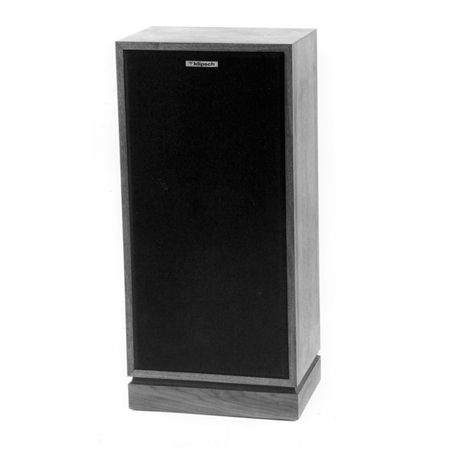 Klipsch Forte Then I went to Philip's new house on Long Island where I heard and tweaked things a little. The setup is very simple, McIntosh MX-110/MC-225, a dependable combo. His basement is a vast and bare space, really too large for audio comfort. The Forte still sounded very good and much like the Quartet I have heard before (interestingly, both setups were a little lean). Philip just got a pair of Spendor SP-100, which I look forward to auditioning. Incidentally, as the Forte's sometimes dip low in impedance (Stereo Review, Pg 1, Pg 2), one should try all the output taps, including the 4-ohm. Which one will sound the best will likely be system dependent.
 Focal/JM Lab Nova Utopia (Stereophile Review) Last Sunday I went with Paul to visit 台山華 . He had just moved to a smaller house. Equipment has not changed: Jadis CDP, Audio Note M6 preamp and Pass Lab X-250 amp. The current space for audio is small, about 200 ft, but has some sidewall reinforcement. Sound, including the bass, was surprisingly much improved over his old cavernous space, which lacked wall reenforcement. Once again, this shows the effect of the room is of paramount importance. This experience makes me ponder on Philip's setup above...





 Posts
Posts