Showing posts with label Brand-Line Magnetic. Show all posts

27 February, 2023

Shenzhen Audio Show I

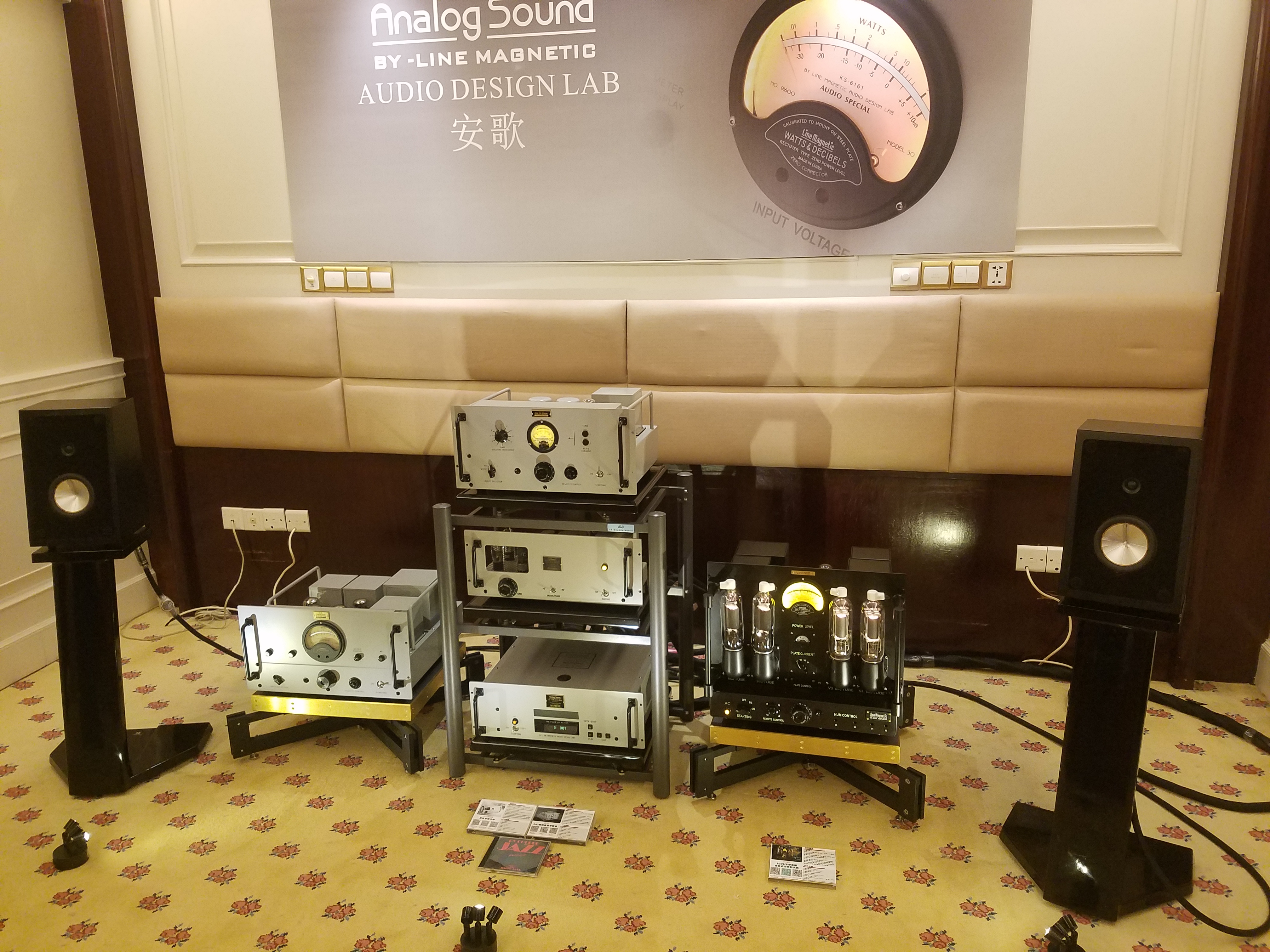
Click Pics to enlarge. Top, Analog Sound, Foshan division of Line Magnetic. Text below.

Letter from Shenzhen (23-4): SIAV Audio Show, Part I

Part II and Part III have been published. Roll up or click link.

In terms of audio, Shenzhen is in an awkward position. Being one of the world’s tech cities, SZ has long been an IT and manufacturing base (and heavily influenced by HK; but due to cost constraints, manufacturing bases have moved inland, and north, steadily). But, as an echt immigrant city and erstwhile sleepy town, SZ has lacked cultural identity, though the local government has done a lot to promote it in this aspect over the years. But there is no denying that the power centers in audio in China remain in nearby Guangzhou and faraway Shanghai and Beijing, all cities with stronger cultural heritage. The density of audiophiles in SZ is far behind Guangzhou and HK.

I reckon this is one of the few SZ audio shows, and the first organized by the Shanghai group SIAV. It is an ambitious organization that hosts shows in several cities, one after another - Shenzhen is just one stop. The hotel is a a large one, but not the largest. There were 3 floors of audio stuff, and one floor of dismissible AV stuff, which I did not cover.

It is free. And imho (in a way) better than the HK shows I’ve previously attended, for the simple reason that there were not so many attendees, and I could wallow in the sound if I like. I have previously reported on annual HK shows, and they were basically hit and run. So crowded, and I hate that! HK shows charge you a small admission, but you get a CD/SACD in return. Confession: since shows are imho great for exposure but not so good for us demanding audiophiles in terms of sound, I’m not a devotee. So, I have never attended a US show (very expensive too, unless you are VIP)! One reason is that, after I have been in HK and elsewhere, the US offerings seem rather limited and, sorry to say, mostly not interesting (MAGA notwithstanding).

Chinese readers can scan the UR code at the lower left of the poster for more info. For those who can read Chinese, here are Part I and Part II of the Report of Chinese Magazine New Audiophile. They have a lot more pics than I do, so perhaps you may just want to browse the pics even if you can't read it. So why read my report? Well, I'm critical, and they are not - that's elementary, my dear Watson!

A lot of audio companies are from nearby Guangzhou. And several HK distributors are there, as they handle China too. I was impressed by the average level of the sound, better than in HK (can the power be cleaner?) I was impressed too by the professionalism (and eagerness) of the sales forces. As there were not many people (by show standards) I could discuss certain aspects of the sound (or trade) with ease, and have them honor specific requests, be it a choice cut or moving to another loudspeaker. Good! I enjoyed the show. I went around noon on Friday, not many people. The next day I went back to meet my friend Humphrey from HK (he was featured in Virtual Home Visits before).

One thing you need to know when reading this report: CD is VERY MUCH ALIVE in China. Most exhibitors use CDPs, not files nor streamers (though some are present). Analog too is everywhere of course. There are almost ten rooms selling second-hand LPs and CDs (a high proportion for this relatively small show)! And they are priced quite high because of import difficulties.

Coverage of the show follows no particular logic. As before, I’m going to grade the sound. Best is simply Bold Black, in a category by themselves. Others are shaded: Very good is Green; Good is Yellow; and Average is Red. Believe me, I'm very lenient! More so towards others than myself!

***

Analog Source 安歌 (Line Magnetic Foshan Division) See Top Pic. This is going to be confusing for many people. Most have heard of LM. For whatever reason, Line Magnetic has split into two, The Zhuhai Division (covered below) is what most of you think of as LM. On the other hand, now named Analog Source, products of the Foshan Division look very different, as you can see from the top pic. Vintage Hammertone looks, almost military, and quasi-Western Electric. Products are a bit more daring, and priced a little higher. On both days I heard the system and it was great. The 2A3 Preamp (top of rack) has many tubes. The CDP (bottom of rack) is also tubed. The 212 amp is the black one (2x power, for about 25 watts; 2x for full-wave rectification.) Yes, we only heard the Chinese 212, as the WE D or E versions are just astronomically priced, much pricier than the amp itself. On Saturday, when I went again to meet Humphrey and friends, we listened for quite a while! The sound was really very good, smooth and analog, with tube sheen. IMHO, much credit must be granted to the Ensemble Reference, one of the greatest "bookshelves" of all time! Ah Fung (Choice, HK) was the host, and we were treated to single-plated RCA 2A3; sure, the sound improved further. Incidentally, in this blog you have met one of this company's previous amps before (here). For top to bottom coherence, on the whole, this room had the best sound of the show


Line Magnetic 丽磁 (Zhuhai Division) Above Pic This is what most of the readers will know as LM and it has retained the logo. It still has the aluminum dominated looks. It still makes many amps with various tubes. Readers know the 845 amps that HR and others reviewed in Stereophile. But my heart belongs to the first LM amp that I have heard, the mammoth (and spine-breaking) LM-219IA, which has a new PLUS edition. The tube complement: 12AX7, 310A, 300B driving 845. But what I heard was the Cary-like 805 amp. Sound was quite good with Eggleston (not among my favorites).  But it lacks the magic that its Foshan sibling is producing with the great Ensemble reference.

Somehow, I forgot to take a photo of the Hanowa. Above is from New Audiophile/

Hanowa Eizz 艺致 The expensive German Hanowa Mercury 4-piece System (said to be dipole) comprise AMT and Ribbon arrays on Panels and separate double 12” woofer modules (in the back). As with most of this kind of thing, the bass just seemed a bit discordant, though the highs and mid’s were quite smooth and listenable as driven by Greek Pilium electronics. More interesting was the SZ local Eizz Analog rig. The designer was there, and I spoke with him. Definitely a dedicated guy, he was a likeable fellow and totally unassuming (not a given designer trait). This TT, with its Pneumatic equipped stands, sells for the princely sum of RMB 190k, and the double chassis (with meters) phonoamp, which employs 6x ECC802S, sells for RMB 250K. The Gary Karr album playing was not the best, but then I don’t like Karr (I don’t even think they were the best recorded)! No musicality. Then, I went through the pile and asked to play the Jennifer Warnes Blue Raincoat and it was very good! The phonoamp was silent as a lamb. I consider it a good job! It’s too bad I didn’t even notice the hot Moon II supertweeter was on silent display!

Pocket King 薄小强 This is an amazing product. My 淫媒 source icefox had long alerted me of it. Indeed, it was eye- (or ear-) opening. The sales asked me first to experience it as “earphone”. So, I sat down on the comfortable chair and was, no kidding, mesmerized by the sound-field created by the pair that flanked me - No shit, on top of, and right behind, my head there were so much info it was thoroughly entrancing. Who needs open back earphones? Of course, I ain’t no headphone fan, but it merits a place if you consider open back (or closed, for that matter), in terms of ultimate comfort. What's more comfortable than not having to wear anything on your head? Then, they were shifted to in front of me, and sound was good too. I’d like to test it out more, if I can. Simply put, this is much better than wearing cans!


XinShi 新时 From Guangzhou, sifu Xin 辛 is now the premier WE replica artisan of China. He has long employed WE-derived transformer metal cores to re-wind trannies. His products are much hyped by a HK magazine. Models include the 106, 141 and 129 Preamps, the 86, 91, 124, 212 amps as well as many others (including Leak 12.1). At the show, a Studer A730 was employed. Loudspeaker was mostly the "WE 22", using vintage drivers. In front are his "WE LS3/5A" using "WE" replica trannies. I heard only the horns and they were very good, but not perfect. Also, it was better to sit at the right, where the sound was more balanced than at the left, near the door. I asked Sifu Xin whether he prefers 300B in SE or PP mode, and he says the PP, which I agree with (in my auditions, 86 is better than 91). Notice the passive "597" horn tweeters on top of the horn loudspeaker cabinets. Sifu Xin and his wife demonstrated for me - they were well choreographed, removing them instantly dulled the sound a little. I have known about this gadget from my friends, and I capitulated and got a pair. Report to follow.


Totaldac So far, despite my friend having the 4-block version, I’ve totally failed in my effort to appreciate Totaldac (Yes, TotalFail). For R2R I’d rather have old Philips TDA chips. Sound with Nuprime transport and Audiovector loudspeaker was just average. I was surprised that the amp used was Korean heavyweight Allnic (T-1800 Mk II, EL34x4). Looks like a Chinese amp. Colorless. 


Liangge 靓歌 Not good, even bad, with audible distortion, driving the ATC100.

21 September, 2017

BBC LS5/1A, Line Magnetic LM-126, EAR 519, Koda K-10, Studer A807, Tape Project, Analogue Productions


Click pics to enlarge. Top: Chez Jules I, with LM amp in front; R: Chez Jules II. Note the Studer A807 above the Koda K-10. On the small stand in front is the Thorens TD-125, beneath which is the Line Magnetic LM-123 buffer. In front, on the floor, is the challenger DIY preamp.

Review: BBC LS5/1A, Sheer Brilliance
Kondo disciple Preamp vs DIY Kondo clone
Review: Robert Koda Takumi K-10 Preamplifier
Review: Studer A807 Reel-to-Reel
Review: Line Magnetic LM-126 Integrated Amplifier
Talk R2R: Re-issue Tapes from Tape Project and Analogue Productions


Revised Sept 30, 2017 (Forsell taken into account)

Note: This article took forever to write! Some time ago I nearly finished but someone accidentally erased much of it. After the deflating process of re-writing, I found out Jules had made some momentous acquisitions and we just had to pay him another visit. As a result, this article has snowballed into gargantuan proportion. While there is a real line up of stars here, make no mistake that the LS5/1A remains the central attraction.


Introduction
The BBC monitors that we regularly encounter are the ubiquitous LS3/5A and the larger LS5/9. This is because these are relatively small, as large boxes with large footprints are out of fashion anywhere where real estate prices are high. Recently, Graham Audio has also "re-issued/replicated" a much larger LS5/8, bigger brother of the more home friendly LS5/9 (reviewed in this blog here) and descendant of the even larger LS5/1A. Aside from these, earlier BBC monitors are seldom seen or heard, although their influence can still be felt in various Spendor (e.g. SP1/2, SP100) and Harbeth loudspeakers (e.g. HL5, M40).

So I was ecstatic when my friend jules called me to audition with him a pair of LS5/1A. I first heard it when I went with him to the shop, then some time later at his place. What a find! But first some basic info...

From KEF website: "...Soon after the formation of KEF, Raymond Cooke re-established his previous relationship with the BBC and KEF took on the exclusive manufacture of the LS5/1A monitor system, a system to which KEF’s meticulous approach to production engineering was well suited. The monitor utilised a Goodmans C129/15pr 15” woofer and two Celestion HF1300 tweeters and was designed for studio broadcast monitoring. The system stayed in production for more than ten years and was a useful benchmark for KEF’s own designs.

KEF also supplied the LS5/5 (including manufacturing the bextrene coned 12” bass and 8” midrange units) the LS3, LS5/2A, LS3/4 and LS5/6. In 1973, the KEF designed Reference Series Model 5/1AC, an active version of the LS5/1A, went into production and found application in many of the new independent radio stations of the time..."

Below I include even more info, but shaded it so you can bypass the section.

pic from internet.


From Elsewhere, likely original BBC info (typo's unedited; LS5/1AC is the active version of the LS5/1A):

"LS5/1, and LS5/1A
The studio versions of the LS3/1 and A, designed to replace the LSU/10. The cabinets were larger than the LS3/1 and the tweeters were mounted above the woofer, rather than in front of it.
The following units were used: Plessey (LS5/1) or Goodmans C129/15pr (LS5/1A), 15-inch paper cone woofer 2 x Rola-Celestion HF1300 tweeters.

KEF /BBC DESCRIPTION FOR LS 5/1AC: 
BBC MONITOR SPEAKERS 

DESCRIPTION 
The speaker system employs three units, which together cover the audio range available from present day records and broadcast programmes. The enclosure is constructed from high-grade veneered chipboard of a quality, which has been found by experiment to possess the smallest degree of self resonance of all suitable construction materials. The structure is reinforced by internal partitions which restrict the vibration of the back and sides and also by a metal strut between the front and the back panels. Mudocel damping is applied to the top panel. 
The internal volume of the enclosure is 4.7 cubic feet and a small vent resonating with the volume of about 50c/s is used to give a slight boost to the low frequency output. Standing wave effects are damped by internal pads of absorbent material. 

LF UNITS 
The lowest frequency unit is a 15 inch paper cone type with a 3 inch diameter voice coil and PVC roll surround. Its axial frequency response extends smoothly up to about 2 Kc/s and it is relatively free of colouration effects. The sound output for this unit radiates through a vertical slot 7 and a half inches wide to ensure good horizontal dispersion up to the crossover point with the high frequency unit s at 1750 c/s.


HF UNITS 
Two identical HF units are fitted each having a phenolic impregnated diaphragm. The frequency response extends smoothly up until 13kc/s above, which it dies away in a regular manner. Tests have shown that the output to be free from prominent low damped resonances. The two HF units are mounted in a vertical line above the LF unit in such a way that the separation between high and low frequency sound sources is not noticeable to listeners located over four feet away. Both units are operated in parallel at middle frequencies to increase power-handling capacity in the region close to the crossover point.


Above 3Kc/s the input to the upper HF unit is reduced to induce dispersion in the vertical plane and the phase is retarded as to direct the combined radiation pattern upwards 

CROSSOVER NETWORK 
A thirteen element printed circuit crossover network incorporates facilities for equalising minor irregularities in the LF unit as well as providing for adjustment for relative levels of LF and HF units in 1 DB steps. An additional network corrects the diffraction effect at low frequencies due to the finite size of the cabinet, as well as the low frequency loss due to the motional impedance. 

ALTERNATIVE CABINETS 
There are two versions, one a floor standing cabinet for studio and control room work and a suspended model for use in television control rooms.


The floor standing speaker model LS5/ 1A is intended to be operated on a 15 inch plinth above the floor which positions the HF unit at optimum listening height. The plinth is designed to accommodate the equalised power amplifier conveniently beneath the speaker enclosure. 


The suspended model is equipped with metal suspension gear, which enables the entire speaker to be tilted downwards at the required angle The LS5/2A requires additional equalisation at low frequencies to compensate for the loss of floor reflections. A suitable equaliser is available which can be incorporated with the power amplifier if required. 


Both cabinets are available in a choice of oiled teak veneer or hammer grey lacquer. 

SPECIFICATION 

SIZE: LS5/1AC 33 X 19x 17 inches 
Weight: 82 Lbs 
Nominal Impedance 25 Ohms 
Maximum input: 35 watts R.M.S 
Frequency response : 40 –13 K/cs +_ 5db 
Directivity index: Better than 54 db up to 3 Kc/s reaching 7db at 10 Kc/s 
Calibration Accuracy: The axial frequency response checked against a BBC approved standard sample is adjusted so that the curve of the loudspeaker under test does not differ from that of the reference loudspeaker by more than the following amounts: 
50 c/s - 200 c/s +_ 1.5 db 
200 c/s – 400 c/s 0db 
400 c/s – 13000 c/s +_ 1.5 db 
13000 c/s- 15000 c/s +_ 2 db - infinity 
The reproduction of the Loudspeaker under test is also compared with that from the reference speaker using high quality programme sources and white noise. 

LF Unit: 15 inch Heavy paper cone with plasticised P.V.C. Roll surround. 
Fundamental resonance: 25 c/s 
Flux density: 9000 oersted on a 3 inch dia centre pole 
Total Flux : 16000 maxwells 

HF Unit: 1.5 inch diameter direct radiator with Phenotic impregnated - fabric diaphram 
Flux density : 10,000 oersted 
Total Flux : 25,500 maxwells 

Crossover Network 13 Element printed circuit network employing Radiometal - - cored inductors and closed terminal metallised foil capacitors. - Completely enclosed and shielded in a steel case.

Other Useful Links:


Wireless World Article on developing replacement for LS5/1A
BBC Paper on Design of LS5/1's successor's LS5/5 and LS5/6
Japanese Site with Great pics of the Active LS5/1AC

Sonic Impressions
  • At the Shop The shop sells clone-Dartzeel's and has only a solid state preamp. Even with their solid state amp or a cheap Chinese amp, the LS5/1A sounded good enough. But with my pair of Western Electric 124 that jules had been auditioning and which we brought with us, it became a revelation. Needless to say, since this is a BBC design, the midband was immaculate, rendering vocals perfectly. The treble was just a bit grainy with the ss amp, but this was largely ameliorated by the WE amp. Most impressively, there was great presence, creating the illusion of a live event; indeed, the palpability bore an uncanny resemblance to the Graham LS5/8 (here). My one reservation then centered on the quality of the bass, quite slow, one-note and somewhat truncated. I was weary of possible driver deterioration and urged caution, but jules bit the bullet anyway. As we find out later, that was due to the partnering electronics. Read on...
  • Chez Jules I - pre Koda Jules' place is very familiar to me (last reported: the Dahlquist DQ20 here). Equipment Orpheus Zero SE cd transport; Totaldac d1 twelve dac; Van Alstine Pat 5 Preamp (solid state, fully modded dynaco); Line Magnetic LM 126 power amp or EAR 519 power amp. Sound With this setup I heard the LS5/1A twice, once as pictured, the other time with the loudspeakers more or less in the same positions but turned around firing towards the couch (as I heard the Dahlquist DQ20). The sound had improved since last reported (no wonder as the tube amps replaced the ss amps). Now, the LS5/1A really shone! Needless to say, there was just more of everything good. The bit of grain in the treble heard at the shop was gone - one only heard the surprising energy of the dual Celestion tweeters, which worked seamlessly with the 15" Goodmans woofers in the midband. The bass anomaly heard at the shop basically vanished - perhaps it was still a trifle slower than ideal and not the lowest reaching, but it was tuneful and tactile. Old loudspeakers sometimes need to be re-run-in (again, why all the difference from the shop? Read on...) vs Dahlquist DQ20 I wished Jules still had the DQ20's for me to compare. Alas, the small space had necessitated their removal. If my recollection serves me, both had a lively presentation, and excellent midrange presence. To my mind, the Dahlquist DQ20 (at least the treble) suffered a little from being partnered by ss electronics. Let me just say, the Dahlquist DQ20 costs a lot less than the LS5/1A and I miss it.
  • Line Magnetic LM 126 Among the Chinese manufacturers I have always regarded Line Magnetic (official site) to be among the best. I have heard their amplifiers, particularly the SET behemoth LM-219IA, perform well at the HK AV Show. I have also heard at friends their WE Horn Replicas and Field Coil Amps and they look decent (hard to individually assess the sound in a horn system, but I know there is a European fan base). They make a bewilderingly huge range of products and in the West it seems only certain products (higher-priced; manageable size) are offered. The LM 126 at hand seems to have limited distribution. One can understand why - it is a another imposing behemoth, not expensive and hard to ship! Design wise, it is a potpourri - said to be based on WE circuit, with inclusion of a clone WE 618C input transformer (definitely not a necessity), but upping the power by using KT66 instead of 6L6. I understand this is a move to accommodate modern "real-world" loudspeakers but, if you ask me, there is no way one can duplicate 6L6 based WE amps with higher power - just not the same things (even for WE, the more powerful 142 is not as good as the 124), not to mention the sheer impossibility of cloning the WE transformers! The LM 126 performed well enough but, even though Jules had installed the best NOS tubes, I still had my doubts - a powerful sound, yes; but not quite an even response, especially when... vs EAR 519 There is no if's and's or but's: disregarding the substantial price differential, the EAR 519 completely outclassed the LM 126. Even with generic tubes, the EAR is much more even across the frequency spectrum and controlled the bass with an iron grip. That said, the LM 126 is quite good for the money and probably more than satisfactory for those who do not need full-range amplification. However, if you are patient and discerning, I'd wait for a good second-hand pair of the 509/519 and you will be settled for life (see also my most recent appraisal of the equivalent EAR 509 MkII) - until you get to know WE, that is...:-)...vs WE Jules did not hook up the WE this time (I never asked for it), but my take by memory is that some of the magic we heard at the shop with the WE is still missing.

  • Chez Jules II, post Koda Just as this article was about to be finished, a few days ago, I called Jules and was flabbergasted that he had acquired the Robert Koda Takumi K-10 Preamp and a Studer R2R. Of course this article would have to be extended to incorporate these important new acquisition. So, after yumcha, Trazom, KC, Pluto and I all went to visit. We tested a lot in a few hours, so read on...
  • Robert Koda Takumi K-10 (and Forsell Air Reference II Transport) There were two significant changes in the system from Jules I (listed above): the Forsell Air Reference CD Transport substituted for the previous Orpheus; and of course the Robert Koda K-10 Preamp. As a Kondo man, I was of course very interested in this very expensive solid state preamp from a Kondo cohort/disciple (a man who has gone on records saying he has never preferred a solid state preamp), which has won some accolades (see official link, which has review links; avoid the garbage HK magazine). Sound I have to say that what I heard might have been a combined effect of the Forsell and the Koda. The sound actually quite fascinated me. It sounded a tad slower than before, was more upfront, but quite warm, utterly devoid of the nastiness of lesser solid state components. Images were taller and larger than usual, with a fleshiness that I liked. Perhaps because of the warmth, I felt it to be a little less airy than the usual tube preamp in soundstage (not something of utmost importance to me) and depth, The reviews mentioned ultra low noise and distortion, which I agree with, but as usual with designs that place utmost importance in these parameters, a little liveliness may have been sacrificed (I dealt with this important topic in my lengthy review of iFi's iPhono). Although some of this (like reduction in speed, warmth and larger image) might also be properties of the Forsell, much as I appreciated the K-10, I was thinking I'd prefer a tube preamp (like my EAR 912, now relegated to the rear; but more to come, read on...).
  • Surprise! David vs Goliath? As it happened, our yumcha friend davewong had been building a Kondo-clone preamp based on the very simply laid out boards by thomasfw. Since it is said to be a Kondo-clone, I expressed an interest to hear it (a very rare occurrence). Suffice to say, davewong geared up and had the prototype ready that day (click on right pic to enlarge), so we took it along to Jules. The DIY preamp employed 6X4 rectification and MOSFET regulation. For the line section, the two triodes of the 12AX7 were coupled and output was cathode follower. No exotic components were used - Dale resistors and Wima red caps for the line section; Philips caps for the power section. Sound The Kondo clone actually sounded quite decent. It seemed to be modern sounding, with a surprisingly fast leading edge (methinks faster than the Koda). Immediately, there were more air and a deeper soundstage, and the front corners were better illuminated. With the jazz CD, virtues were more split: the percussion had better rhythmic expression and exactitude with the Kondo clone; the saxophone and guitar sounded much fuller with the Koda - a surprise as usually one would expect the reverse. A Little Tube Rolling As there were Europhiles present, Valvo long plate's were swapped in for the RCA (D getter, grey plates). Immediately, the saxophone and guitar sounded much fleshier and much closer to the Koda, but at a cost - the percussion lost almost all of the snap (a price I personally would not pay). The Votes Though still a flawed prototype, some of us preferred the DIY tube preamp, but pluto, a DIY man, admired the Koda. As you see, it was not quite a David vs Goliath scenario. Suffice to say, both the DIY kit and the solid state Koda met with our approval, and (except for pluto and maybe jules) this is a rather hard-core tube crowd! After this, we reconnected the Koda and listened to analogue playback.
  • Detour: Kondo Clone vs Kondo/Audio Note Japan M7 After I got home, I actually briefly compared it to my own Audio Note Japan M7 (the one in the pic). Both are quite neutral sounding so it is hard to say whether they sound alike, but the challenger was obviously a little on the lean side and rhythmically a little too insistent, without the M7's subtle and articulate nature. Still, a respectable showing!
  • Analog Rig I This consists of the Thorens TD-125 with the Linn Ittok arm fitted with an EMT TD-15 cartridge, fed into EAR MC4 and a ss phonoamp (can't remember brand, but it was of some vintage). We listened only to a few cuts. Sound during the visit was a little on the sharp side. I was told after we left a swap to Gotham DGS-1 ameliorated the problem.
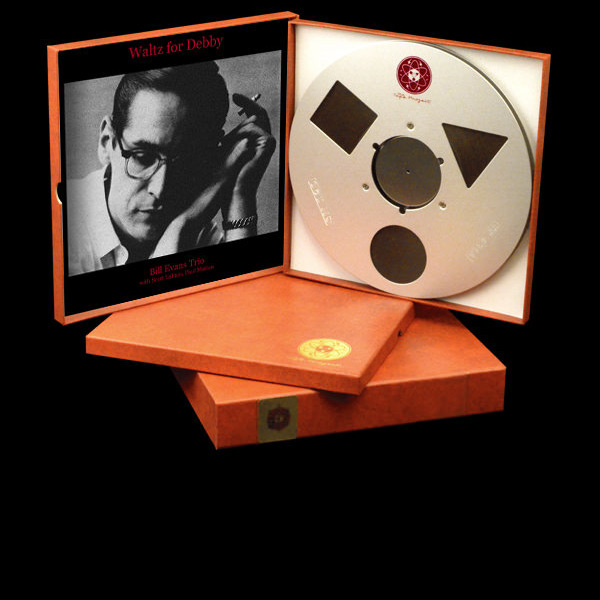
  • Analog Rig II The big surprise! After my dear friend Robin left for Taiwan, I thought I'd never hear another R2R, but here it is in the form of the Studer A807 (info on this classic here)! And we heard two new tapes, one from Tape Project (Bill Evans Waltz for Derby, link) and one from Analogue Productions (Rickie Lee Jones It's Like This, link). These are both USD 450 a pop. Is it expensive, yes; is it worth it, even I have to say yes! Yes, the R2R playback absolutely trumped the vinyl, according to jules. We didn't really compare but the playback of the two tapes via the Studer was simply breathtaking. Of course I had long known this to be true. This time I shall not waste words, but instead re-direct you to my previous impressions of R2R (under the Label: Talk R2R) - everything said about Robin's R2R applies to jules. That is how good it is! The A807 is a professional two-track only machine, and cannot play four-track tapes. I predict there will be a second R2R deck chez jules soon.
Conclusions
  • LS5/1A The LS5/1A is simply magnificent, the best BBC (or BBC-derived) loudspeaker that I have ever heard. How is that for direct utterance? And I know my BBC and BBC derived loudspeakers! Epitome of 2-Way I have always preferred 3-way's to 2-way's, but the LS5/1A is an exception that challenged my views. It is the best large 2-way I have ever heard. Indeed, I don't think the best BBC-derived 3-way's, like the Spendor SP-100 or the earlier BC-3 can match it. That is TALL accolade. Also, once again, a 15" paper cone woofer proves hard to beat; and it is very rare to have a two way that employs a 15" woofer! This is basically one of a kind.
  • Robert Koda Takumi K-10 Since we heard also the Kondo clone vs Koda, I am confident I can separate the effect of the Forsell and come to the right conclusions. This is likely the best solid-state preamp I have heard (It sounds better to me than the Cello Suite [a bit too electronic], Mark Levinson ML-6 [not enough resolution], to name two, and jules had owned these before too I think). I think the K-10 would be a godsend with solid state or even hybrid amplifiers, like Koda's own K-70. But while I admire its rock solid steadiness and imperturbable nature, I am too hardcore a tube man and in general prefer a more lit up, livelier presentation, but then, as we witnessed, others may not think so. In the end, no question, it plays everything well! I'd like to listen to it more next time to get more impressions. So, there may yet be a Part II!
  • Forsell Air Reference II CD Transport This is a classic that I have heard before on multiple occasions. In spite of, or because of its "deficiencies" indeed it makes CD's sound more musical, more analogue if you will. Since I know jules' system quite well, I have to say I like this transport a lot better than the expensive Orpheus (which makes things sound like digits). It is still amazing to me that transports make such a difference (some of my other favorites are the Audiomeca Kreatura, Roksan DP1 and Theta Data)!
  • Reel-to-Reel Although I don't plan to own one, I am very happy the R2R Renaissance shows no sign of waning; rather, it is going from strength to strength. Price of new tapes are expensive, but not really overpriced, if you ask me. You may want to read this interesting interview of Tape Project's Dan (also known as Bottlehead's Doc B, whose cheap products I admire and have had some experience with) to gain some perspective. How does Vinyl Compare? Well, even the most expensive vinyl rigs I have heard have to yield to R2R, in every parameter. The tape advantage is decisive. And Digital? This year is the 35th year of digital, yet sonically it is still inferior to a good vinyl setup, not to mention R2R. Think, 35 years of continual "advances" and it is still a distant third. Don't you think all those data people and critics are laughable?
  • DIY Advice The success of the DIY challenger reminds me once again that simple is best. Using simple, cheap and reliable components (like the Dale resistors) more often than not bring better results than stuffing it with expensive boutique components (like expensive caps).
Image result for manger cdPostlude: What Went Wrong at the Shop?I actually hesitated about writing up this part of the experience. I knew next to nothing about the shop and don't want to make enemies, but I am truly astonished by the sheer ineptitude of what the shop offered.

When I arrived, the resident DIY Transport/DAC combo, of which the owner was proud of (and I think he sold quite a few), was playing some jazz/percussion stuff, and it was OK and offered no premonition of things to come. A while later, I asked to play the Manger Test CD I spotted, my favorite all-in-one, if there is such a thing. The owner immediately jumped to the last track (Track 15), the percussion track everyone knows. But that was not my intention - I asked him to start with Track 1. As soon as the bells tolled, I knew something was seriously wrong. The whole thing was utterly flat, with virtually no microdynamics to speak of. Ditto every subsequent track of this CD that was played. I was flabbergasted - I have never heard this CD sound so bad. Desperate, I spotted a 47 Labs Transport and asked to switch to it. Despite having to use adaptors, the 47 Labs immediately and unequivocally demonstrated what was wrong with the resident DIY Transport - almost all the microdynamics and nuance missing came back.

And then, there was the poor bass quality, which can be attributed to the resident DIY DAC, which can hammer it out, but in a one-note, monochromatic fashion. If it were me, based on the demo I'd not have taken the chance with the loudspeaker. Fortunately, chez Jules the bass problems basically vanished.

I cannot even briefly tolerate this kind of front-end, but obviously some people do! In my years of hifi wandering, I have heard plenty of way-off stuff, but this experience belongs in the top ten. It made me feel I must write this article:

HiFi Basics VI: Know Your Source(s) and Digital Front-End Buying Guide (coming soon)

13 April, 2016

Letter from NYC (52) 2016 (8): More Rare Birds

Tannoy Westminster Thanks to arrangement by Paul, and dedicated driver Philip, two Sundays ago we got to visit again Jimmy's system. Look at this pair!


The host's listening room is one of the most luxurious I have seen; I love the decoration, and all that wood! Even the equipment racks are beautiful solid wood (from Ebay).

Sources are an Oracle CDP fed into an MBL DAC for CD and a Lumin for digital files (we much preferred the CDP to CAS). Preamp is Conrad-Johnson GAT. Mono amps (one just glimpsed behind right speaker) are massive so-called "WE" (like these that our friend Simon has), each of which employs a bank of 8x 300B tubes. Sound was a lot better than a previous visit 3-4 years ago. We attributed the marked improvement to his new CJ preamp (old one was Audio Space 300 preamp) and also the Field Coil Line-Magnetic Supertweeters (power supplies seen to the left of the Oracle CDP and right of the CJ preamp).

The Westminster (older version, foam surround) used with the Line-Magnetic has a very different sound than on its own. Treble is airier and bass is more controlled. A very sculptured sound that we liked, though perhaps not for the Tannoy traditionalist.

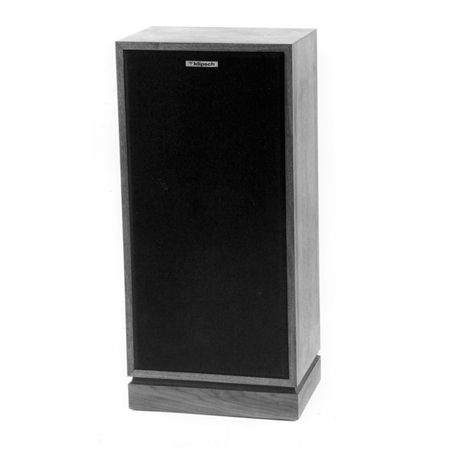
Klipsch Forte Then I went to Philip's new house on Long Island where I heard and tweaked things a little. The setup is very simple, McIntosh MX-110/MC-225, a dependable combo. His basement is a vast and bare space, really too large for audio comfort. The Forte still sounded very good and much like the Quartet I have heard before (interestingly, both setups were a little lean). Philip just got a pair of Spendor SP-100, which I look forward to auditioning. Incidentally, as the Forte's sometimes dip low in impedance (Stereo Review, Pg 1, Pg 2), one should try all the output taps, including the 4-ohm. Which one will sound the best will likely be system dependent.

Focal/JM Lab Nova Utopia (Stereophile Review) Last Sunday I went with Paul to visit 台山華 . He had just moved to a smaller house. Equipment has not changed: Jadis CDP, Audio Note M6 preamp and Pass Lab X-250 amp. The current space for audio is small, about 200 ft, but has some sidewall reinforcement. Sound, including the bass, was surprisingly much improved over his old cavernous space, which lacked wall reenforcement. Once again, this shows the effect of the room is of paramount importance. This experience makes me ponder on Philip's setup above...

It was among the best JM Lab sound I have heard, and I have heard a lot, including the current flagship. Fast and crisp, and with good control, we played many CD's while sipping tea and chatting. It was gratifying to hear that the host has gotten totally bored with audiophile discs and now listens to more and more classicals, all on his own.

Happy Listening to you all!

05 August, 2011

Show Report: 2011 Hong Kong High End Audio Visual Show 香港高級視聽展

Sometimes it's better to remain silent.

Show Report: 2011 Hong Kong High End Audio Visual Show 香港高級視
聽展 (August 5, 2011)
 
Attention: -click all pics to enlarge 點擊照片就會放大 -Revision 1 (Aug 6): This is mostly it. I shall make a few additions in the next revision.

General Observations As usual, I could almost reprint last year's show report (click here for 2010 my show report) for this year's. Year after year, the show is much as usual, with the exhibitors occupying their usual rooms on the upper floors. More interesting were the smaller rooms in the foyer, where there were more new stuff than usual. Overall, sound was less good than last year (I wonder if widespread use of CAS was to blame). The cue for tickets was longer than last year. However, as before, inside the venue it was not particularly crowded (by show standard), leading one to suspect some people just bought the ticket for the CD and never attended the show.
 
As usual, for me and my friends, we hit the software counters first. As usual, this year there were no bargains. For the regular stuff, discount was small, the most generous being perhaps Ming Da.

CAS was widely used by exhibitors. However, with few exceptions, the sound was pallid. As usual, the best sounds came from LP sources, followed by CD replay. Despite use of Weiss etc, CAS had the poorest sound. BTW, do you believe all the hype about CAS? Weiss? I say, no.

The coverage below is in no particular order, divided into categories and by merit only:
******************************************************************
Good Try (Large Room)
In terms of large speaker demo, three setups stood out for their room-filling sound, no easy task in these big convention rooms. It should be noted that I visited early on the first of three days, when many setups likely have not achieved status quo. Your mileage may vary.

(Distributor Jadis Electronics) usually did reasonably by show standard. But, in their big room, more than the big MBL and Westlake they showed in the last 2 years, and more than the other Wilson's they had in the past, the Wilson Alexandria X2, this round provided a satisfying room-filling sound with the help of Wadia and Boulder electronics and of course Thor's Hammer (wise to use a sub-woofer in this setting). Could the improved sound be attributable to old-hand 余師傅 who had joined the staff recently? Although not perfect, this is much better Wilson sound than the many pairs of Alexandria and Maxx and whatever Wilson's that I have heard in many HK home visits. Once again, this proves that the speaker must match the room. Unfortunately, in HK, more often than not we see Wilson's housed in rooms that are too small; as a result, sometimes these are played at very low volume in order not to lose control. The resulting sound is anemic, even somnambulating - that illustrates the sad state of HK hifi. Yawn.


Miraculously, despite partnership with over-priced and usually under-performing Burmester (which year after year delivered artificial and colored sound at the show), the flagship Ascendo gave a very good room-filling piano sound (Distributor Richcoln, not to be confused with Richcom). Many years ago I heard a much earlier iteration of this Ascendo; then driven by Audionet the sound was awful.
Our friend trazom thought it best of show. In this room I ran into gentlemanly Leo Fung; it's nice to see him in great shape. I wish him well.


Distributor Dah Cheong year after year mostly played their lackluster Chario in their big room. Last year they bravely had the flagship Cabasse, which was not a complete success. But they really ought to be playing their Tannoy a lot more. This time, the Kingdom Royal sounded great as driven by Esoteric, a lot better than the same speakers we heard at a previous home visit.
I missed our friend Richard Cheong, who has left the company.

Good Try (Small Room)
On a less epic scale, for once (Distributor Hit Audio) had a hit (as you shall see later, they failed spectacularly too in another room). Zu speakers did great justice to the electronics of Chinese Line Magnetic, the field-coil specialist. I heard the beautifully finished LM219IA integrated amp, a SET 845 amp driven by 12AX7 followed by re-issue "WE310A" (website; does not work too well in English). The sound was excellent, proving simple is best. And the meter is definitely a plus!

******************************************************************
Could have been Better Two brand new speakers, Kondo and Rockport flagship, should sound better than they did.
L: Darth Vader; R: Feminine Field-Coil
(Distributor Tara Labs) traditionally had consistently excellent sound on offer in a big room. But this year the Darth Vader Rockport Arrakis (which Robert Harley raved about) had just arrived, and was definitely not even close to run-in. These are the largest speakers the company has ever handled, and they are much bigger than pictures make them. These were driven bi-amp'ed (a must, said manager 阿明) by VTL TL7.5 pre/MB450 monoblocks. My friend whlee, who visited a few hours later, praised the sound of the room. I had perhaps visited too early. Note the beautiful Spiral Groove turntable with the latest arm.
(Distributor Avantgarde) usually did pretty well in shows. But this year, without their flagship Avantgarde Trio the sound did not measure up. When I visited, the sound delivered by the just arrived and intriguingly styled Kondo BiYura field-coil loudspeakers definitely showed they were not run-in. This may still be a prototype; the only reference I found was a negative comment for its appearance in CES 2011 (here), but note that the writer sells Audio Note, rival to Kondo, so... An unverified source told me the tweeter is similar to the one in Kiso HB-1. The Ongaku used was probably also too little power for the room. Later, friends reported the Avantgarde Uno G2 did not cohere either, as one would expect of hybrid design in such a big room. Perhaps their YG would have done better? The excellent AMR 777 was used as source.
****************************************************************
Not Too Bad
EAR this year finally got better speakers (at least they look so, even if they look like clones). They did not crank it up, but sound was good.

Over-priced MBL, unlike Burmester, at least put on a reasonable showing every time. This time, a smaller room and decent sound.


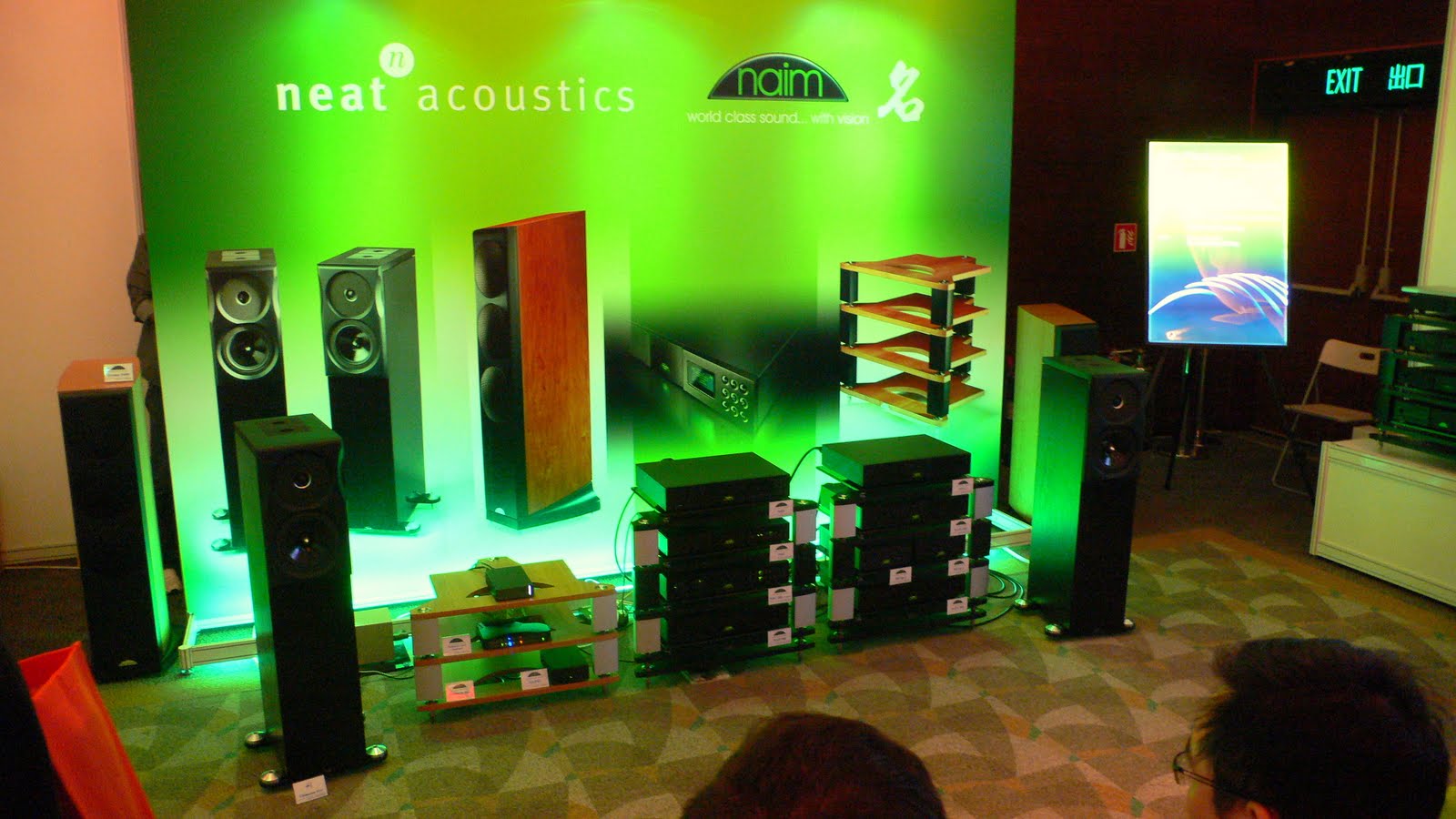
Naim sounded good with hi-res file, a notable exception from the majority of poor CAS sound at the show (partnered most often with Weiss to no effect). This is the only brand I heard from the large stable of (Distributor Radar).
Audio Physic, as driven by Simaudio, delivered not the most neutral sound, but it at least had good rhythm and pace, no easy task in shows!


Neither Eggleston nor Krell are personal favorites, but they delivered at least acceptable sound at (Distributor Excel). It is just too bad that I did not get to hear again the wonderful Vivid Giya or Dartzeel, surely superior products. And, why never Magnepan?
Dali matched with Lyngdorf was passable
. Surely, room correction was used?
(Distributor Wellwick) always did better than usual (considering what they have). This year it was Elac as driven by over-priced and over-rated Accustic Arts. I'd prefer the same company's more humble Densen.

********************************************************************
Not too Good

The Tannoy-like flagship 5-way Wharfedale Airedale was only so-so with Luxman. Although missing over-hyped Eventus is nothing to me, I wished I had gotten to hear Soulution (Distributor Wise Sound).
German Physiks this year used a smaller pair and sound was not as good as last year's bigger brother, as driven by Brinkmann.


Similarly, TAD and Marten did not achieve their best.
The TADs were driven by Esoteric monoblocks but without preamp, using computer and the Weiss DAC's volume knob. No wonder the pale sound. I asked the sale person why no preamp. He said, "Esoteric preamp not out yet." Hey, man, why not use your company's Quad preamp?
Zellaton driven by Ayre was lackluster.
***************************************************************
Bad

I was excited by the appearance of the Devialet, but sound through CAS/Weiss was pallid.

Adam driven by Modright had one-note bass.
What happened to YBA? So ugly! Together with Atohm they failed to make music.


Melody (big 845 monoblocks) tried to show off its strength with ATC, but failed miserably. So, one hit, one miss for (Distributor Hit Audio).

The Crystal loudspeakers gave a terrible showing. Why not play Franco Serblin's products?

(Distributor First Impesssion) continued to disappoint. What happened to the tried-and-true combination of Avalon + Rowland? Is there nothing certain in this world anymore? It seems Italian Audia electronics is not a good match. Watch the first impression you give!

(Distributor Matisse Asia) is usually nothing but gimmicks. This year when I visited they were showing a black and white jazz video! Sound through Verity Audio in surround was simply awful, without a trace of presence that is necessary for jazz reproduction.


(Distributor Premiere HiFi) sadly failed to live up to its name. I am not familiar with newcomer Trennel and Friedel, but the sound was awful as driven by Viva. It's too bad all the JC Verdier stuff were lying idle on the side! Sacrilege!

Elephant Holdings seem to be hibernating these days. Remember the old shows at the Regal Kowloon Hotel? They used to have great sound.

JBL 4365 should not have done so poorly. I venture the Harman electronics are not up to it.

***************************************************************

Unusual Looks
My vote for the best looking loudspeaker goes to retro-cool Danish Davone. You can easily mistake them for furniture from the likes of Kartell and Driade, or whatever. here it was seen with Japanese Leben tube products.

I was taken by the funky looks of the strangely named Everything But The Box. I hope it would not turn out to be "everything but the sound".

***********************************************************
Chinese Products (and those that pretend they are not)
The usual Chinese products (mostly tube) are there. Beside established (and well finished) Shanling, Raysonic, Line Magnetic etc, we have a few newcomers, though not nearly as many as in the Quangzhou show.

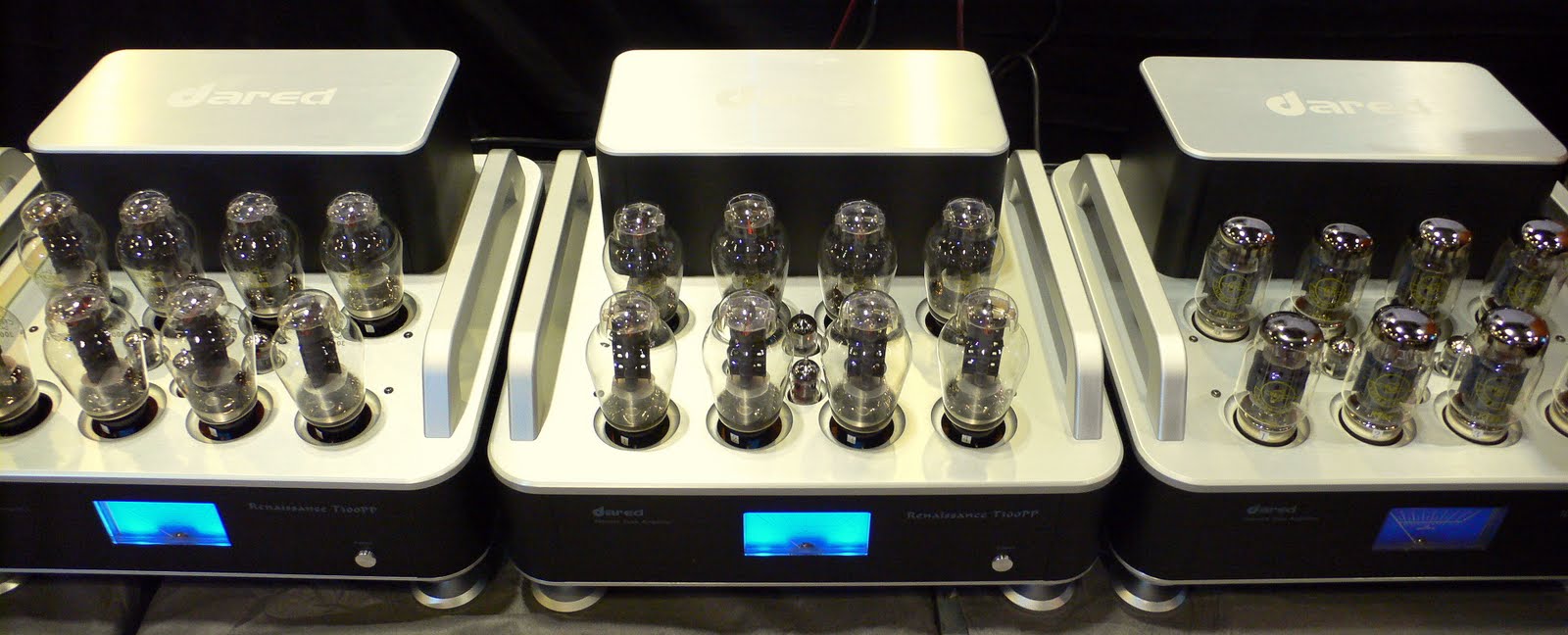
What is also apparent is that even old budget manufacturers are moving upmarket. One of the most striking example is Dared. These massive 300B amps look pretty good!

Here, I'd like to divert a little. It is now fashionable for Chinese designers (especially from HK) and companies to disguise themselves as non-Chinese (Canadian, US, Australian, whatever) in order to charge you more. How sad! I often see products that look suspiciously like barely dressed up (in some cases down) Chinese stuff, but commanding a much higher price.

In the world of tube products, if you see something that looks suspiciously like a Chinese product, but is said not to be, and the website has poor English, is either devoid of content or has little information on the company or designer, then it is likely a disguised Chinese product. I frown upon this practice and would avoid these companies like the plague. In contrast, I support Chinese companies that are Chinese from Day One (like the aforementioned Line Magnetic, Shanling, Raysonic etc).


**********************************************************************

Lifestyle products

As is the world trend, there seems to be an explosion of compact devices of T-amps and USB capable DAC's that cater to earphones and the lifestyle crowd. These companies often have unusual names, like Briks, Trends etc, and why not?
Loudspeakers that target the desk-top crowd are everywhere too. One of the more interesting one is Taiwanese JohnBlue, which uses full-range drivers. I'd love to hear the company's desktop JB3 and floor-stander JB8 (pictured).
But have you noticed a phenomenon? The established lifestyle products get more expensive quickly, whereas newcomers appear everyday and fight for the lower priced territory? Personally I think this is not healthy, and the market is saturated. Lifestyle products have a large me-too component and is not the future of hifi. When you see mass-market TEAC trying to emulate Meridian (seen above, used at a counter that sold CD), you know the end cannot be far away.
**************************************************************

Other Show Reports

As you know, much on the internet is BS, pics with few words, and certainly no criticism. I don't know why people bother to read them.

A rare exception is the report by Francis Leung in computeraudiophile. Candid and concise.

**************************************************************
The "Not For Sale" CD Every year the show produces a CD that is free with admission (HKD 60). The gimmicky part is the CD comes in 2 versions.
The SACD/CD dual layer version is always available. But the so-called "LPCD" version (favored by some local audiophiles) are limited to a much smaller quantity and available 1) only in a dual-pack of 2 admissions in tandem with 1 SACD/CD; 2) on a first-come, first-served basis. This means the majority of the people will not get the LPCD, thus enhancing its value, and a great promotion for the "format".
This CD is supposedly not for sale, but you can easily buy it on the net (click here; still 97 copies available at time of writing). Can someone tell me why??

香港高級視聽展 的 SACD 不是 [非賣品] 嗎? 那爲什麽網上大把有得賣? 此刻,這個網頁 還有 96 張 SACD (隨便填寫一個大數目,然後投入購物車,就可得知餘數),港元 150 一張。往年的 LPCD 也有少量。

**********************************************************
As for the content of the CD, let me add something in the next revision.