Showing posts with label Review. Show all posts

04 October, 2013

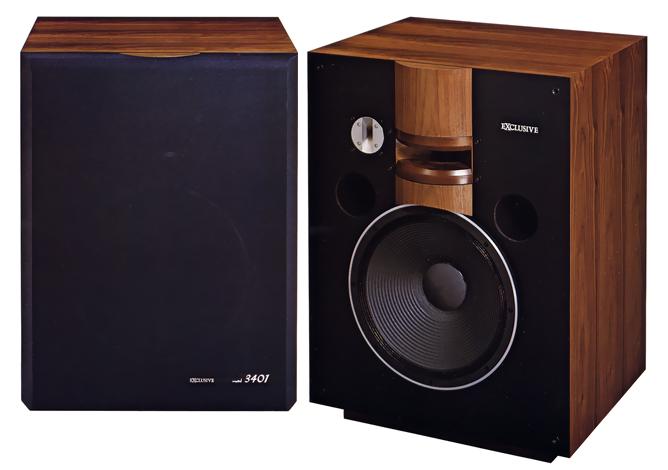
Review: Pioneer/Exclusive/TAD TD-3401, Part I

model3401-Wの画像Review: Pioneer/Exclusive/TAD TD-3401, Part I

Part II details how my pair performed in another space.

Previous Encounters with various Pioneer/Exclusive/TADs
I have to confess I have always had mixed feelings about most of my previous encounters with Pioneer/Exclusive/TAD. The 2-way 2402 and even the bigger 2401 seem to be not efficient, not SET friendly and not even very "horn" sounding. I have also previously heard the TD-2301 (see the pdf cited below), and neither did that do much to me. Part of this I am sure is my general reservation about wooden horns. Those who want to read more about my previous experiences can read more here.

But then came my encounter with TD-3401. My impression was, for once, very positive. Now, despite its smaller size, and a small wooden horn (compared to the more popular 2401/2402), it makes a hornier sound! The reason for that is what I mentioned previously: "...although the wooden horn of 3401's midrange driver is very small, with the help of the tweeter the 3401 achieves an excellent dispersion, feeling of air and presence that to my ears OUTCLASSES its succesor 2401. Here lies one of my strong beliefs: A very good 3-way is better than an excellent 2-way. The 3401 is 3-way, the 2401 2 only. Enough said for me; YMMV...". Now, that is the one for me! First some useful info:

audio-heritage.jp has a lot of info on Pioneer/Exclusive/TAD loudspeakers:

Comprehensive catalog of individual components (Page on 3401)

Woofer 15" (EL-403)
Mid-range driver + horn (ED-915EH-351S
Super-tweeter(ET-703 Crossover Unit (EN-907)

And here is a useful Chinese pdf on various Exclusive/TAD models.

TD-3401 Redux
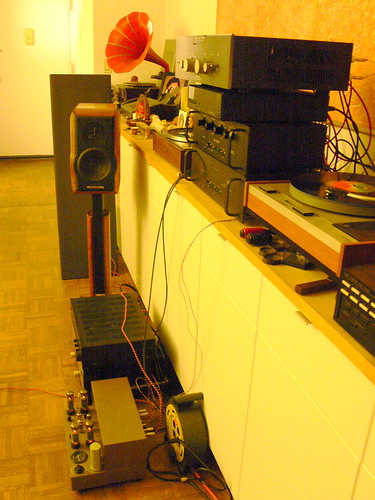
I am happy to report that thanks to some recent development I recently got a pair of TD-3401 to play in my reference system. I took some help and effort to get them into the house. They were casually placed in front of the Tannoy's, rather near-field and really too low in placement, but that will have to do until I elevate them. I briefly tested them with all Japanese electronics:

Digital: Sony CDP/DAC R1
Preamp: Leben RS28CX
Amp: Wavac MD-300B

Before hooking things up, based on previous encounters we had doubts about the viability of using 300B for the 3401. But after things warmed up it was not bad at all! Sound was tremendously detailed, if just a tad cool. The 300B did not plumb the greatest depths, but the bass was developed and the general sound was balanced, fast and lively, hardly betraying the limited power on demand. Considering that the speakers had been idle for more than 2 years, and the electronics had not been fired up recently too, that is remarkable! The rated 97 db of the TD-3401 surely is much closer to the truth than the 95 db of the TD-2402! This also attests to the great driving power of the Wavac MD-300B.

You will hear a lot more about the 3401 in the coming future.

01 January, 2011

Review: Elekit TU-8300 amplifier

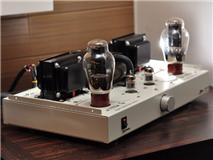
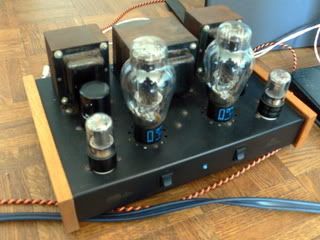
(L) 2 Verdier amps (R) Elekit TU-8300

Review: Elekit TU-8300 amplifier
(reviewed by Danz, with minor edits by DJ)

Revised Sept 8, 2017: A bit of update from my Elekit Overview added at bottom.

Editor's Note:At the end of September, 2010 I wrote briefly about my visit to cna music, HK dealer of Elekit. What I didn't tell you then was that I actually bought a TU-8300 300B amp!

In early November I lent my virtually new Elekit 8300 amp to my friend Danz (and let him do all the run-in! :-)). He did a thorough evaluation and wrote this excellent review, which mirrors my own feelings about this amp. Danz and I share many things in common, including a foam-surround version of the Tannoy Canterbury (last visit here). Danz' system has been changing fast.
What Danz wrote:
As my JC Verdier 2A3 SET amp sounds a bit inadequate to drive my Tannoy Canterbury for some large scaled symphonic works due to its meager 3W output, I think it’s time to upscale the power section of my system. Even though the JCV 6550 push-pull power amp I’ve acquired about 2 years back is powerful enough for most of my listening, I prefer the additive characters of SET, hooked by the intimacy & immediacy of the SET beauty. It may be a personal preference, but, I think whoever has the chance to live with SET should understand what I mean, providing that he has the right speakers.

My impressions on this 300B amp started with disappointment, but later turned the opposite.

I’m no critic, who can describe equipment in many technical terms. I only know a few jargons. So, how can I differentiate the good gears from the bad? I simply sit there and listen. IMHO, a good system will let you sit there for hours without the desire to change CD unless the CDP stops. A good system can unveil the music behind the CD(s) on which you’ve long given up and declared as poorly recorded or performed. (well, some really bad CDs are beyond salvation). A good system should not be good only for one or two types of music only.

Danz' Day 1:
I simply replaced my JCV power amp with the Elekit TU-8300 without changing anything else. My source was Sonic Frontier CDT1/SFD2; the preamp was JC Verdier Control B. Cables used were Sommer Epilogue interconnects and Gotham speaker cables.

My first impression of the amp was its power. It was like an honest and strong man who can give you all the power you need and all the details in the CD's, except music! I thought, it may need more warm-up time.

I was expecting the warm-up period time to pass soon, so I could listen to some real music. But I literally gave up after about 3 hours, as I couldn't hear real music. It was simply giving out a non-attractive sound which will urge any music lover to turn off the system. I tried to remain patient, since I believed DJ wouldn’t pull my leg. You know, getting this amp all the way from NT to KLN was a lot of work! I even once said to myself, “How dare you, DJ!”

Danz' Day 2:
Whenever my brain was not occupied by work, I kept on thinking about the listening experience the night before. I was certain that there must have been something wrong!

Unlike my previous experience with other local made 300B amps, the character of the Elekit was not fat, nor slow nor bass-shy (yes, I did live with one for about 2 years and the kind of music I could listen to was limited to only female vocals and chamber music). In fact, it was so powerful, analytical and clean (I’m sure someone is laughing at me about the word “analytical” I’m using here to describe a 300B amp! Mind you, all I have done was comparing with my current gears.) It was simply the opposite of my JCV 2A3! I’m not saying that my 2A3 is not powerful. Believe me, it is very powerful in its own class, but not quite powerful enough to drive the Canterbury for particular types of music. My JCV 2A3 is a seductive amp which has a dash of its French designer’s romantic genes. It plays music so well; however, sometimes it shows its inadequacy in its portrayal of complicated symphonic works. All these thoughts reminded me of the time I’ve spent on searching for the right interconnect to raise the system’s analytical ability.

Harboring the above thought, I did think 300B is the right way to go for my Canterbury in terms of the right power envelope it provides. However, in order to play real music, I needed to do something to suppress the analytical character of the Elekit.

After a long day of work, once back home, I changed the interconnect between pre and power amps from Sommer to Gotham. Well, as hinted in the beginning, music came out so well that I started to retrieve some of the CDs I had given up on before, to unveil their true beauty.

That night, I forgot about HiFi. It was simply music.

Danz' Conclusions:
The Elekit TU-8300 has completely changed my impression of 300B amp. It is a strong and analytical amp which can also play music well. Compared to my JCV 2A3, this Elekit tends towards the honest side, while the JCV is a bit colored towards romance.

This amp is also highly sensitive to interconnects, but I’m not sure about power cables though, as I’ve not tried others.

Apart from the 300B, this amp is also fun to play with as it can accommodate other pentode tubes for taste changing/tube rolling. However, I’ve not tried any other tubes since, the original setup can play music so well already. I’m only a lazy music lover!

After this experience, I’ll definitely get a 300B amp for my system. Well, will it be this Elekit? I don’t know yet & let’s see what will come up later. But, I’m sure that this amp is a real bargain at its price range.

Editor's Postlude:
In my system, while the Elekit was not quite as emotive as my other SET amps (Sun Audio, ICL, Wavac, etc), it was musical enough, and its power and control are rather unparalled. That said, there is a touch of the hybrid in its sound, probably due to the use of ss in constant current source.

Before I left for NYC, I did try SE EL34. While predictably it did not have quite the presence and live music feeling of SET, it was surprisingly robust in sound. I'd easily rate its EL34 sound better than that of the Audion Sterling.


TU-8300 Update

Official Info (hit 外觀.仕樣>> for more pics)
Japanese website with good pics
Japanese website that chronicles the assembly
Japanese website showing details of the parts

If you're reading this, you may remember that I have previously published a review (by my friend Danz) of this 300B amp (click here). This is a limited edition product, but may still be bought (as kit) from various places on the internet.

I took this amp to NYC, where it is driving my YL speakers ably. The amp is certainly run in by now, and my impressions have not changed much. It has a trace of leanness about it, but its driving power is quite exceptional. Not for the romantically inclined, but a strong contender.

The input sensitivity is way too high for my 104 db YL horns. I lowered it by adding resistors, but some background hum persists. Also, I changed the coupling caps to NOS Russian Military, which increased warmth.


Elekit TU-8300 Official Page

26 September, 2010

Review: Muiscal Fidelity A100-X Quad 99 CDP

Review: Muiscal Fidelity A100-X (and Revel Ultima Gem I), Part I
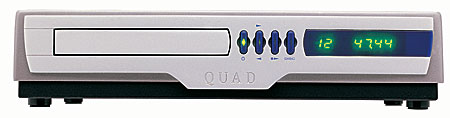
Review: Quad 99 CDP

The MF A100-X is a close cousin of my favorite integrated amp, the iconic A1 designed by Tim Paravicini (EAR). I quote myself:

Musical Fidelity A1 and A100-X and variants
From a pure sonic viewpoint, personally I think the A1 (and its closely related siblings A1-x, A1-S, A2 etc) as well as the higher powered A-100-X are the best integrated amps ever. Their unique look is entrancing. But they run alarmingly hot. One must have adequate ventilation. They are musically so wholesome that one wonders why a tube amp is needed. They even have better bass! Power is limited but if your space is not too big it's enough. In this respect the A-100-X is superior, with enough power to drive a good speaker even in a larger LR (info here). If the A1 were not so good, they would not be introducing a new version so many years later (though its power rating is closer to the A-100-X)! I haven't heard the new one. I am using an A1-S in my bedroom, which is air-conditioned in the summer, but it's in winter that the amp is comforting!!! It's a great match with my Audio Physic Step. Here is a must-read site. MF is NOT a brand that I like too much but, hey, the A1 was designed by none other than the great Tim Paravicini, now founder of EAR. If you know the excellence of EAR gears, you'd like this one. The MC/MM phonostage is excellent. (click for full overview).

The web does not have much info on the A100-X. This little bit is interesting:

Product Info
(from cached file) The Musical Fidelity A100 is a strongly biased into Class A (roughly 93% of music is in Class A), the A100 benefits from the sonic advantages of Class A operation, without the drawbacks of immense heat and vast power consumption of pure Class A. It is a low feedback design with passive preamp, phono and RIAA stages, and a sophisticated power supply.

Info on Italian site


Serendipity, A Gem!
A few weeks ago after yumcha I went into 影音寄賣 (Central) and immediately spotted a mint-condition A 100-X quietly sitting in a corner. My heart literally fluttered. As the price was reasonable and condition excellent, I bought it without hesitation. For testing, 榮哥 hooked it up to a pair of old Revel Ultima Gem I. Before hooking up, he was worried the sound may not be too good, as the 50 wpc on hand, though twice that of A1, is really quite limited. But we were testing only for function.

When the music played we were quite pleasantly surprised by the absolute rightness of it. The 2010 AV Show CD was rendered as well as I have heard anywhere. Most impressive was the quiet background, from which pristine sound emerged. It was so good that for twenty minutes it literally stopped everyone in his track.

I have always liked Revel loudspeakers, particularly the Ultima's and Salon's. I'd refer you to JA's review in Stereophile. I'd buy this pair downright if it were not for the dark wood finish, which is not to my taste for this particular styling.

Back Home
I tested the A100-X in my living room with the following gears:

Digital: Quad 99 CD-P
Analogue: Clearaudio Concept/Ortofon MC3000
Speakers: Usher X-708; KEF LS3/5A; ATC SCM7

A note on the CD player which I just brought back from SZ. This is a wonderfully natural player that is woefully under-rated. And I don't usually like oversampling technology. This shows with every kind of technology, some people do it right, and some don't. Mine is the original version with Philips CDM-Pro 2 laser (as reviewed by KK).The later version CD-P2 is basically the same player with a different laser mechanism (as reviewed by Stereophile).

While not quite matching the refinement of the Revel heard at the shop, it partnered the Usher X-708 extremely well, delivering a lively and dynamic sound. With the less efficient ATC SCM7 sound turned a little stressful at high volume. My KEF LS3/5A did surprisingly well, even with a Bruckner symphony. With simpler material, like RR's Rameau, sound is truly sophisticated. Although 50 wpc is only nominally more powerful than the A1's 25 wpc, subjectively it seemed to have significantly more power.

Just to satisfy my curiosity I gave the MC phono section the ultimate challenge by using my Clearaudio Concept setup. The Ortofon MC-3000 has a very low output of 0.13, but the A100-X handled it with aplomb. It was quiet and good sounding and, although lacking a little necessarily in ultimate dynamics, everything moved with good PRaT. A marvelous phonstage!

At the start of the article, the "Product Info" was from a previous MF website page used by some seller. MF doesn't have info on the A100 anymore. I was much intrigued by the statement "... It is a low feedback design with passive preamp..." and shall test this out by using a preamp in Part II. Perhaps there's really no preamp section, as the usual volume pot noise prevalent on the A1, which some attribute to DC (see must-read site cited previously), is completely absent.

21 September, 2010

Review: Pro-Ject Headbox II

Review: Pro-Ject Headbox II

And now for something much easier to write than the last post!

Pursuant to my last post on the Sennheiser HD-600, I decided to get a cheap headphone amplifier to go with it. That is because I have decided to take my HD-600 to SZ, where I'm materializing a small headphone setup.

Pro-Ject is an interesting company that I have always watched. Although they have grown more ambitious, I firmly believe their heart are in the right places when it comes to budget gears.

Long before they have branched into other electronics, I heard the original version of the cheap RPM 4 through a much more expensive setup consisting of Verdier Control B preamp, Unison Research Smart 845 and Spendor SP-100. icefox's setup not withstanding, it's still one of the best analogue playback I have heard. On the internet, you read a lot of negatives about Pro-ject's, about their arms or whatever. But since that experience nothing can shake me from an admiration for Pro-ject.

The Headbox II can be had for around HK$ 800. In view of my positive experience with this company, its diminutive size as well as look made that a no-brainer for me.

After I got it home, I hooked it up to the tape loop of the Nagra PLP. No, it was not as mellifluous as the Nagra, but it was close. What surprised me the most was that it drove the inefficient HD-600 easily. With most music I seldom had to venture beyond 11-12 o'clock for satisfactory sound level. With earphones off, the mix was tonally closely related to what came through the main speakers. Later, back in the PRC, the Pro-ject delivered highly satisfactory result with the humble Sony DVP-PR50P. Music had a natural breath, even tonal balance and never a shrill moment. One also felt enough power on hand, enabling one to hear deep into the mix with full bass.

The combination of the Senneheiser 600 and Pro-Ject Headbox II is a clear winner.

10 September, 2010

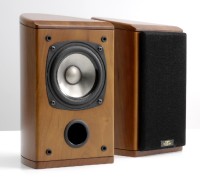
Review: Airtight MSM-1 Bonsai loudspeakers

Review: Airtight MSM-1 Bonsai loudspeakers

阻抗:4 歐姆
頻率響應:70Hz~20kHz(-10dB)
承受功率:30W(最高50W)
效率:89dB重量:2kg(每聲道)
尺寸:165×140×245 mm


Info on U-Audio (Chinese)
hifihivi 高傳真視聽 group test (Chinese)

Thanks to
Danz' loan I was able to enjoy this tiny pair of speakers. Suffice to say, its performance quite surprised me.

A true high-efficiency speaker
I am not really a fan of
Airtight. While I think they make decent products that are very well finished, I have heard many of their products, including the 211 amp, and the sound for my taste usually veers a little too much towards the overly warm. Their push-pull products are not too accomplished, and their SET products are definitely better. This MSM-1 Bonsai was definitely developed to partner their low-powered SET amps. The 4" driver is claimed to be an original design.

While I have always liked full-range speakers, I have grave reservations on small drivers (like ALR Jordan) in small cabinets. Physics dictates that these have very lean bass, if usable at all. You have to have at least the cabinet volume of
Loth-X BS-1/Amaze or Reference 3A to have a meaningful balance between transparency and weight.

At first I frowned upon its small size and ultra-light weight. 2 kg, is this a joke? the packaging is quite luxurious, the finish good, but the speaker terminal is not of high quality.

I placed them high up, on top of my big Tannoys. Equipment used:

Digital:
Sony R1 combo or Revox C-221
Preamp
: Nagra PL-P or EAR 912
Amp:
ICL 300B

As a good full-range should, the sound immediately enthralled me by its
speed and coherence. At least, this is for once a real pair of efficient speakers suitable for SET use, more so than its 89 db rating suggests. On jazz and chamber music, detail retrieval in the treble and mid-range is first-rate, actually yielding to none. Thanks to its full-range nature, instrumental timber always ring true. Image size is quite reasonable, not tiny.

Commendably, playing it real loud did not cause it undue stress, and I was able to play my big classical pieces. of course, for big orchestrals the bottom is found wanting, which also makes the high a little over-etched. I'd say its 70 Hz rating is reasonably true.

Enters the subwoofer
This is where the
subwoofer comes in. I mated it with an old JBL paper-cone, and the result literally floored me. The cheap sub did not allow for precise crossover; I estimate I used around 100 Hz. The marriage was highly successful. I was able to play my Mahler to my satisfaction. And I detected no incoherence. I doubt one shall have trouble with most subwoofers.

My conclusion is that this is a pair of very worthwhile full-range speaker. Personally I'd definitely mate it with a subwoofer. For a SET lover with space constraints, it's truly a blessing.

p.s. How does it compare to the Pioneer 酒桶仔? I think it's better, in almost all departments, and certainly friendlier to SET.

03 September, 2010

Reivew: Nagra PL-P Tube Preamplifier


pic from Dagogo.

Reivew: Nagra PL-P Tube Preamplifier


Note: I now own one.

First, a million thanks to feikeung's generosity. Not many people would lend out so expensive an item.

For background, click here for an excellent pdf file from Nagra.

For a detailed review of both sound and features, this Stereophile article by Jonathan Scull is quite good, though some of my conclusions may be slightly different.

Basically, I agree with much of Stereophile's review. However, as I use at the end SET tube amp and Tannoy speakers, my conclusions in a couple of important aspects are quite different, and even more in Nagra's favor. What I used:

  • Clearaudio Champion turntable/Origin Live RB250/Ortophon MC15 super II
  • Revox C221 CD player
  • ICL 300B amp or AES 300B amp
  • Tannoy Canterbury HE
  • All Gotham cables and also AN AN-V
  • Counterpoint SA-3000 preamp for comparison
First, let me state my firm view on preamps: (1) No solid state preamp, no matter how expensive, can come close to a good tube preamp (not necessarily expensive) in conveying the full scale of music; (2) Only a few modern tube preamps (like Nagra, Verdier, EAR) match or surpass the level of classic preamps from the likes of Counterpoint, MFA and ARC; (3) Really old preamps from the likes of Marantz, McIntosh, Fisher etc, while possibly tonally alluring, just cannot compete with more modern tube preamps with serious attention paid to power regulation. These vintage preamps are only for people who want to play some songs, not for people into serious musical playback, like full-scale classicals.

That said, I find Nagra's PLP one of the very few modern products worth its price (the other for me would be EAR 912). This doesn't mean at all it's necessarily superior in all aspects to a reasonably priced older Counterpoint or ARC (not expensive new ARC), but aside from its smashing looks it has some qualities that are very special:

1. Remarkable "presence". The sense of a "live" occasion is rare. This is perhaps partly due to the somewhat forward stage it projects (which also means it has a less wide and deep soundstage than even the cheap Counterpoint). There is plenty of air though, and I'd opt for real presence (which is always tied to the music) over fake soundstage (which is almost never really related to the venue) every single time.

2. A subtle rhythmic savvy. This is usually difficult to appreciate when there are a lot of people. But in a small gathering one night, everyone heard a very different Mozart/Szigeti from that portrayed by Counterpoint. Tonal difference aside, the Nagra just makes you acutely aware of Szigeti's sinuous phrasing; the flow of the music being just more mellifluous. This quality is usually tied to excellence in microdynamics and truthful portrayal of the leading edge (like Naim). Here it's only partially true, as generally on some other musics the Counterpoint is at least as revealing of low-level dynamics and details (and possibly slightly more tonally balanced; it was preferred by some listeners in piano music). However, when it comes to portrayal of the leading edge, Nagra is superior. As an example, Nagra has some of the best portrayals of bow attacks I have heard anywhere. You "see" and feel the attack, and this helps in making something like 哮天犬 (or the harp and bass track 2 of AV show) less boring than it can be.

3. Phenomenal bass quality. This is a mighty plus for proper classical music replay. Deep and fast, you just hear more and feel you're getting at least a few more Hz of bass extension from your speakers (no mean feat in Tannoy 15")! The double basses are just delights, rather than background rumble as with lesser preamps!

4. Superb phono section with comprehensive loading options which, unlike many lesser phono sections and (mis-matched) MC input transformers, is able to render my Ortophon with natural timber and warmth (I used the 33 ohm jumper).

5. Superb dynamics. It plays even the largest scale music with ease, and make the flea-powered amps sound a little more powerful than they are.

With most of my NOS tubes stacked away in boxes, I managed to find 4x Holland Amperex 12AX7 and 2x Mullard 12AT7 for a little tube rolling (originals are Sovtek 12AX7WXT and GE 6201). There is a little difference, but I can assure you all of Nagra's strongest points mentioned, which (besides an even balance) have little to do with tonal quality, are just as easily audible with stock tubes and hence inherent. Those who only concentrate on rolling tubes and not music would do better with a vintage preamp perhaps.

Overall, the PL-P is a solid and surpisingly "NON-hifi" preamp. I find it quite balanced and not at all "soul-less" People into exaggerated and artificial soundstaging and more brightly lit vista may well find other preamps (like the Counterpoint) more enticing. For me, its subtle strengths are the more important and I like it a lot more than many tube preamps of more recent vintage, including ARC. If money is not an issue and you're an LP user, it's a good buy. If not, something like a much cheaper Counterpoint can be equally satisfying, if without a certain je-ne-sais-quoi quality, not to say prestige.

Review: KLIPSCH Heresy

Review: KLIPSCH Heresy I
Much as I like planar speakers and electrostatics, there is something adamant, even belligerent, about the beliefs their followers have in their superiority in transparency. Is that true?

Let's not talk about those people who, for their own idiosyncratic tastes far removed from musical norms, get really (unduly) mediocre results out of their ESL's or Maggies. That's more than half of the users. Let's compare with the better ones.

Recently, in my living room, I put my Heresy I on 24" stands and in the same position as my MMG (see previous article). I drove it with MX-110 and SUN SV-2A3 and the result stunned my Western Electric friend (call him E).

My pair of Heresy I has at least an alnico midrange, and most likely is all-alnico. There are some all-alnico units out there and there are many variations. Note several things about the various Heresy's:

--The tweeter and midrange drivers of the Heresy I and II are different from the other models in the Classic series, ie, La Scala, Belle Klipsch, Klipschorn, Cornwall. They can be alnico or not.

--The earlier Heresy's, alnico or not, here called I, surely have sturdy real wood cabinets. The later versions, II's and the current III's are made of MDF.

--The drivers of II are still substantially the same as later I's, but III's have different tweeter (titanium) and bass drivers. Specs-wise, each version is superior to the earlier one, but sound is another matter.

Driven by the 2-3 wpc 2A3 amp, sound of the treble and midband are more transparent than even the very fine MMG. The transparency is also allied to a most palpable presence that the Maggies cannot emulate. My very spoiled WE friend, who happens to be a dealer of used equipment who has heard much of hi-end, paid the Heresy the highest possible compliment: "marvelous speakers! Sounds like the WE 755!" Now, that's the most famous full-range on earth (though often really ruined in sound by the incorrect treatment they get from HK people). In terms of soundstaging and presence and transparency, it gave the MMG a run for its money, only losing a little in bass extension and clarity.

The biggest challenge the Heresy user has is how to get more bass out of them. In the living room bass is decidedly lean, but not bad. In the small study problem is as great. A lower placement helps. Read the Klipsch site. The Heresy started out as a third channel speaker that compliments the gargantuan Klipschorn. For much of its life, it was meant to be placed on a small wedge-shaped stand that time-aligns it on the floor as well as uses the floor for bass reinforcement. It is obviously the bass issue in modern home use that necessitates the re-design of III, with its more prodigious bass output. Nevertheless, if you are not a bass freak, with some patience, a reasonable balance can be obtained. e.g., the bass strong 2A3 is a better match than the leaner 300B.

Nonetheless, a superior pair of speakers that emulate fullrange, easy to drive and loads of fun. What a bargain! E is looking for a good pair...:-)

More pics of actual units in my home shall be added later.

Review: SONUS FABER Electa Amator II

Review: SONUS FABER Electa Amator II

I have long been familiar with this speaker, and with most other models in the family. A good colleague and later a friend both had the EA I, which some preferred as it sported the Esotar tweeter. However, although the I mated better with solid states the more open nature of II can be even more of an asset with II.

My journey with SF started with the Concertino, a marvelous entry model. Later, I had the rather unique Signum, which I regret selling up to this date. Recently I came across this immaculate pair of EA II with original stands, and bit. Not cheap, but worth every penny.

These are even better than I thought. Previously I heard them with ARC LS5/VT70 (very good) and Pathos. Now I mated them with ARC SP9 (or BAT VK5i on loan) and Marantz 8B. Hooked up with no-nonsense cables (which makes all the difference, believe me) the sound is astonishing. Detailed, big, bold, yet refined. Even more impressive than a single violin's tone is the peerless conveyance of massed strings, which most expensive speakers fail to deliver. Even if I switched to an NAD it remains mesmerizing. Overall dynamics and power is awesome, though always delivered naturally. You can put this up next to a stat and not fear.

The best “bookshelf” I have yet heard. This is really a more manageable version of Extrema, quite similar in design.

p.s. I know a lot of people use SF with ss amps. That’s a mistake. SF can do a lot better. As for those who say these are difficult to drive, you just laugh!

Review: AES SE-1

Review: AUDIO ELECTRONICS SUPPLY (AES) SE-1
Even though they make reasonable products, I am not a great fan of CARY. What most people don’t know is that, early on, Cary made kits, named AES (they still have that branch, but finished products only). They at the very least were great values and frequently gave their finished products (of higher gloss) a run for their money. Sounds familiar? Think Audio Note. Think of the AN Kit-1 vs Conqueror.
And the best product of that time was the 300B SET amp SE-1. My first one was about 10 years ago, thoroughly tweaked out, sold to me by a nice fellow from Slovenia! It had good power, able to drive my Klipsch and Tannoy Lancaster to thundering levels. But I had too many amps and marginally preferred the Sun Audio and ICL, so I sold it, even if I preferred it to the AN Kit 1 (which I sold too). They have discontinued this model long ago. I doubt it was making much money for them.
Recently I bought this amp again, in stock form. At its current ridiculous second-hand price, it’s a true bargain. The sound, without upgrades, is still much like what I remember. It is musical. Parts are really superb. High quality diodes, resistors and caps, including Kimber caps. As a matter of fact, recently E lent me the flagship Cary 300B Signature monoblocks, and the parts are similar!
The SE-1 features beefy trannies, likely from Magnequest given that this is from Cary. Solid state rectification. DC filament. 1x 6SL7 (cascaded) driving 1x 300B per channel. This is a fixed bias design. In the back there is a phono jacket in which you can plug in a phono pin and measure (with a multimeter) the combined plate currents of the 2x 300B tubes, which should be in the vicinity of 130 ma. The current is adjusted by the pot next to the phono jacket. Of course, you can bias it lower or higher as you like. I prefer lower.
One cautionary tale. Some people buy it used and just plug their 300B’s in without bothering with the bias procedure. This is not good, even dangerous. The sample I bought this time sounded weak at the seller. When I got home, I measured the bias, and it was in the low 80’s, no wonder. After proper biasing, the amp sounded a lot more powerful. Another caution: The bias measures the COMBINED currents of the 2x 300B tubes, not individual bias. If you’re sure your tubes are a matched pair, there’s no problem. But, if the pair is not matched, it’s better to have lower bias current, as one tube may draw too much current and the other too little.
Aside from using ss rectification, the design is not much different form the flagships. And a good feature is separate switches for on/off and operate/standby. This allows for pre-heating of filaments to ensure better life for the 300B.
This amp can be easily converted to use other tubes, like 2A3. If you change the sockets, tubes like 6B4 can be easily accommodated with minor changes.
The sound? It’s as good as the 300B SEI and perhaps even the Signature monoblocks (not as powerful in this case). For best result, use Ken-Rad VT-229 silver plate.
Addendum (April 20, 2010)
Finally, I have loaded the Schematic and some pertinent info. Thanks for your patience and I hope the info helps.


12 comments:

Humayun said...
Thanks for the review. I've just bought one, and I need a manual. How can I get one? I'd like to try 2a3 tubes. Thank you.
doctorjohn said...
Humayun:

Where are you? My manual is in the USA and I shall not have access to it until the fall. I can send you a copy then. Can you leave me your email address?

If that's too long to wait, please contact Cary. They may be able to help you.
cruzd2 said...
I am considering this amp, I would also like to run 2a3's (for more bass, any truth to that)? Also when installing 2a3's should they be re-biased, what should my setting be? How about their signaure version, worth the price? I have B&C M15 speakers(98db)that house a large horn and a 15' woofer, I need to move that air for personal bass satisfaction would this amp be a good match? Thanks for your time and insight!
doctorjohn said...
cruzd2: 2A3 is surely more bassy than the bass-lean 300B. You cannot just plug it in. You need to change to the lower filament current of 2A3 and re-bias is absolutely needed (lower total current). As my previous reply says, I don't have my manual with me right now but shall have access sometime in the fall when I return to the US.
tubeornot2b said...
To use the 2a3 tube you do not really have to change the filament voltage circuit. The SE1 was set up to accept either via a voltage dropping resistor. You will have to rebias.

Cary/AES recommends using the settings of a range of 138-150mA for all 300B tubes and 110mA for 2A3 tubes. I found that I preferred the sound of lower settings. Particularly with the 2A3's 110 ma is pushing them a bit.
Tac said...
Thank you for valuable information on your web pages. And I bought SE-1 also and enjoyed its excellent sound with 2A3s as biased 100 mA as your suggestion. I would like to try different tube type such as 6B4G with adaptor or even 183 tube, but had no access to the manual. If you have the access, could you send me a copy?
Best,
fedup said...
Could you send me a manual? Or possibly provide some details on using a dropping resistor to lower filament voltage for a 2a3?

Thanks,

sardeenz@gmail.com
doctorjohn said...
This post generates more interest than I thought. I am going to see if I can put a copy of the manual on the net as pdf file or something. Please bear with me
fedup said...
Thanks doctorjohn. I appreciate taking the time to upload the schematic, etc.

I'm still a bit confused on 2a3 compatibility. Tubeornot2b's comment mentions either 300b or 2a3 will work without changing the filament circuit, but he says it's designed to accept either via dropping resistor. Does this mean you need to add a dropping resistor after the .75ohm 25W resistor to bring down the voltage or it does it automatically. I put Sovtek 2a3's in and they measure 2.5v filament but when I put in 300b's they measure 5v filament. It's as if the tube itself is changing the provided voltage needed. When I measure without output tubes in, the voltage is 4.2 volts. So basically I'm a confused newbie. Any thoughts or advice are appreciated. btw, the 2a3's sound fantastic, and I've been leaving them in. I'm just unclear on their operating points in the base (unmodded) configuration. My 2a3 grid measures -69v and get 354v via blue wire gong to the plate. filament is around 2.4v or 2.5v with no mods.
doctorjohn said...
"Fedup": I am glad it was of use. The Blog interface is not the best for chatting though. I found the "auto-adjustment" strange too. To my layman's view, it shouldn't be. But it's true in the manual it does not mention changing dropping resistor for different tubes anywhere, so I'd trus your voltmeter.

I may be getting some articles on modding the SE-1 to auto-bias and tube rectification!!!!! Of course this would necessitate a separate power supply box, but I'm sure this would take the amp to a different level. It's in Chinese but I'll see what I can do. Check back in a few months...

Meanwhile, enjoy!
carla said...
Very cool. I am very interested in a separate tube rectified ps. I just replaced the rectifier diodes with hexfreds and I think I hear a slight difference, a little smoother, but still nice and tight. Cheers.

Review: MARTIN LOGAN Source

Review: MARTIN LOGAN Source

Supplements:
Further Notes: Fall 2009

Disclaimer
: If you don’t believe hybrids can work, don’t read further. If you believe Quad or Maggie or whatever looks flat rules, read no further. If you want to fight over what planars are best, get away! For those a little more objective, or less stubborn, a star is born.

A Tale of Two Drivers: An old colleague had a large hybrid ML which, because of wife factor, he placed close to the front wall, and that was a no-no. He bi-amped with Jadis Defy 7 and an Aragon. No, I’d never do that if that’s what it takes. However, even then, I heard many good things, and have kept an eye on this company. It seemed to me their products have steadily gotten better and better. Back some years ago, you could have heard quite a bit of ML hybrids in show conditions, but not any more, as ML, like other stats, is really a minority taste in HK. I remember a smaller ML floor-stander in a hotel room having one of the best sounds in the show, better integration than a lot of the Wilson’s, Dynaudio’s and quite a few of those horrid German speakers in the same show. However, labels are difficult to shake off, and “coherence” has always been an albatross on the neck of ML.

My discovery of this pair was due to Jonathan Valin’s review in the March issue of TAS. Now, I am rather neutral towards JV the writer, unlike a few others of TAS (like Steven Stone, who should just stick to desktops). What caught my eyes in this review were:

  1. Small footprint and rather nice styling.
  2. High sensitivity; 90 db.
  3. JV’s claim that the ML is the most coherent hybrid he has ever heard, with almost no discontinuity he can discern. That’s a tall statement, but from a man (and a magazine) who should know his planars and who used to own the ML CLS. He’s putting his reputation on the stake for this statement.
  4. Paper cone woofer (though you can’t tell by looking).

Searching for Godot: My friend E and I set out to find some place to hear this. Harvey’s is defunct but still maintains a “shop” in an unlikely lower Manhattan mall. They are dealer but the guy just dismissed all MLs, and none was on the floor. Sound by Singer, where we heard the Vienna Acoustics Haydn Grand and Focal Chorus 705/6Vs (all TAS editor’s choice), did not have MLs. So no luck.

By chance I saw a like-new pair on the web for sale and, after some emails, landed a brand-new pair at substantial discount! My friend E was really surprised as ML, like B&W, doesn’t usually discount at all.

Great Expectations: Two huge boxes arrived like a pair of Trojan horses, much larger than the speakers themselves. Power supply is via a small wall-mart like box not much bigger than a deck of cards, which never even gets warm, visually less threatening than Quad. There is a rear-firing port, and the woofer is located less than 1 ft from the floor (sans spikes), things that I usually avoid in my speaker selection, except this time. The manual is very well written, advising distance between the speakers and the front and side walls. I have no problem with the front wall, but have problem with one side wall, closer than recommended.

For the run-in period (manual says 72 hrs for the woofers) I had the right speaker virtually against the side barrier. The left speaker’s woofer is very close to the couch but its port is well ventilated due to the presence of a nearby corridor in the rear. And so, while the left side poses no problem, bass on the right was suboptimal at first, not helped that the classical music I listen to usually have a lot more bass to the right. Adjusting the degree of the port helps quite a bit. Although absorption supposedly does not work at low frequencies, I thought a large piece of cloth helped (maybe just psychological?). Sound in the mid-range and treble was startling good from the start, not surprising as suspense is in the bass. These are nominal 5 ohm speakers, with lowest impedance of 1.6 ohm at 20k Hz. This did not trouble my NAD 325BEE, nor the Marantz 8B, and had no trouble driving the Source to good level.

The bass gradually cleared up, becoming more and more layered. I moved the right speaker one ft more into the room and the bass cleared up further. Note that I did not install the spikes for fear of scratching my wood floor. Even then, for my loud listening level I find them satisfyingly coherent. Nor did the higher-than-normal cross-over point (470 Hz) seem to color any instrument.

After experimenting with toe-in, one can get superior dispersion (for stats), and I can sit anywhere and things still remain in the center. No, none of that tiresome move-your-head-a-little-and-hear-only-one-speaker thing. The images are tall, just like the MMG. My friend E auditioned this with me from the start and he, like I, preferred the Source to the MMGs for its realism and bass performance, even if the lean bass of the MMG is more room-friendly. Here I have to emphasize that I think whatever little problem the bass may have is due rather to the port and non-ideal placement of my right speaker. I don’t find the bass slow at all, nor do I think there is anything incoherent anymore than I may (and do) find in many conventional ported designs, or even “true” ribbon Maggies (which JV thinks are less coherent than Quasi’s). If anything, the bass performance outshines that of many conventional speakers. It goes deep and is rhythmic and walking when it should be. Even the droning bass guitar of Wilco’s A Ghost is Born cannot faze the ML.

How does the Source sound? JV said it best: “In a word, terrific. This is one very quick, very high resolution, surprisingly robust, wideband, and coherent loudspeaker, capable of making select voices and instruments sound as you-are-there ‘real’ as some multi-thousand-dollar big boys…” Sound is not as warm as Quad, but certainly warmer than Maggies. The spec’s of 42-22k Hz +/- 3 db is definitely on target, and you can still hear bass a little lower than that. I know there are people out there who think of Maggies as the most live-like thing out there. That’s simply not true. Although the imaging of Maggie is uncanny, that does not necessarily equate real presence, and in that department, good as they are, Maggies lag behind good horns, Lowther, Apogee, and Quad. Now, add ML to the list. It simply has a presence that the MMG does not.

Now, with one month on them (mine is likely equivalent to the usual person’s half a year), not only has the bass snapped into focus, the treble has also become that little bit smoother. I think they have completely broken in, and I think I can give this report with confidence. These are very revealing, yet never fatiquing as even the “true ribbon” Maggies can sometimes be. It’s like a marriage of Quad and Maggie, with the tonal purity of the former and the dispersion of the latter. Though, the soundstage has good depth but less lateral spread than Maggie, I feel the first class presence makes music sounds more like a live event, in a real hall, and not artificial “soundstage”. As I listen to to Perahia’s Mozart K453 (Sony/LP), I can clearly visualize him moving the keys with varying touch, as well as the string players leaning forward and digging in and, yes, the oboe sounds so real I recall CP’s unique ESL 57 sound. Yes, I have packed away my MMG for the moment. And even the SF EA-II is gathering dust.

Epiphany: I have saved the biggest surprise for last. I was checking out for my friend E his pair of Cary 300B Signature monoblocks. It turned out someone never bothered to adjust bias and one was run at close to 90 mA and the other at an unbelievable 125 mA, a testament to the excellent built of Shuguang 300B! Anyway, after adjusting them back to normal I hooked them up to the ML for fun. What do you know, perfect match! The presence factor was taken to the level of uncanny realism. Most amazingly, paino recordings really shone and that’s one of the highest accolades you can give a pair of speakers. Horowitz in Moscow (DG) sounds as full bodied as if it’s played on 15” JBL’s (if you don’t know it, the rendition of piano is a strength of big JBLs).

Big orchestral works posed no problem too. People who know me know that I listen at concert hall level. The ML acquits itself splendidly: Wand’s Bruckner 6th (RCA) is energized and has gravitas; Solti’s Shostakovich 9th (Decca) is all quicksilver and tongue-in-cheek. And yes, no super-tweeters nor subwoofers needed. Better leave those at your voodoo master’s place. After this, I tried the Sun Audio 2A3 (~2 watts), which did fine though the 300B amp’s inherently leaner bass and greater power provides a somewhat better match.

The other day, my friend M arrived when I was listening with E. M said, “Sonus Faber playing? Nice vocals!” That should say it all about vocals.

My daily listening now is the Source as heard through the very humble AES SE-1 300B amp, hooked up with Belden 9497. Even though it may be hard to find this lowly ML demo’ed anywhere, try to check this out if:

  1. you’re a SET amp fancier (but the dealer would surely not use a SET amp).
  2. you’re an electrostatic or other planar fancier, but not yet locked into the “XXX is best and there is simply no other choice” camp.

Keep in mind partnering is not a problem, but you need good and costly real-estate around the speakers. As with any speaker that has lowly placed woofers and rear port, clearance from front and side walls is a must. Even if your condition does not permit, these are great speakers that are worth a serious audition. At some point I also plan to audition ML’s new flagship, the all stat CLX.

Less is More: There’s an irony about the whole thing. Ever since I started listening to direct-heated triodes about 10 years ago in HK, all else have become secondary. I have always missed the sound of SET whenever I return to NY. This time I brought back my AES and planned on other SET amps to be used in my bedroom, as big efficient speakers are out of the question in the living room. The ML, with its small footprint, was bought to have a taste of electrostatics without attendant troubles. Little did I think these would prove SET-friendly. This shows the truth that there is always no harm trying, and once in a while you can be rewarded BIG. Now, SET is set (no pun intended) to be the main thing in my living room, though I have a suspicion they shall do very well at low level even in my bedroom. For me, that’s a bounty!

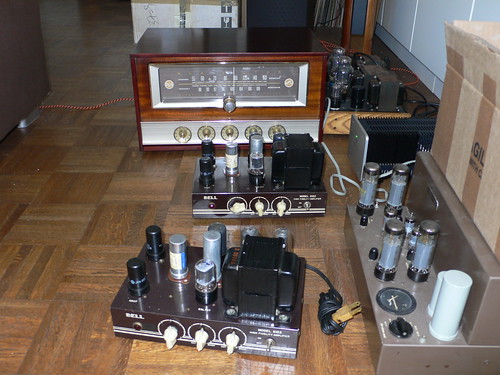
(See pic) The other day my friend E took his vintage RCA single-ended 6V6 receiver and it drove the ML Source beautifully, with no lack of power, though midrange was decidedly on the lean side. For fun I hooked up my pair of BELL 2122 integrated’s and sound was more mellifluous. Just for fun, we hooked up the Marantz 8B, which did fine too, though the sound of EL 34 PP cannot really compare with 6V6 PP in finesse and subtlety. All concluded that the ML works best with small powered amps, with SET delivering undeniable extra magic. And yes, I'd love to hear these with OTL's.

In the November issue of TAS, Robert Harley reviewed the Wilson Alexandria X-2 and mentioned its 95 db efficiency lends itself to being driven well by 50 wpc channel amps (like Naim) and outstandingly by even SET amps (he cited Lamm). In the wake of my recent experience with SET driving ML, I cannot help thinking about the mediocrity of many of the Wilson’s I have heard in HK driven by big amps. Perhaps they should try alternates, like what RH mentioned.

3 comments:
wesley said...

dj,

an excellent and informative review as usual, thanks for sharing.

it's good to have an open mind and i truly appreciate your efforts in trying out some much gears and reviewing them in an unbiased manner. it's probably because you don't do it for money.

regards,

wesley

Krishna said...

I bought Denon 3808CI. I have Martin Logan Source and Cinema in the fron. B&W 500 Watt subwoofer. I am having tought time make it better. anyhelp is greatly appreciated. I think I can make the system better by fine tuning.

doctorjohn said...

Krishna:

How are you placing the SOURCE? Placement is probably the most critical thing with this speaker. Too much against the wall can easily cause booming and that may make the addition of subwoofer even worse.