Showing posts with label Brand-Aiyima. Show all posts

25 January, 2024

Aiyima A07 Max vs A08 Pro

Letter from Hong Kong (24-2): ELO asks: Aiyima A07 Max, better than my A08 Pro?

Readers know that I'm a big fan of the Aiyima A08 Pro (here). Lately my system has reached an equilibrium that I spend much time listening to music everyday instead of worrying about what I have missed on this and that. Is it perfect? Not really, but I believe my current setup can compare nicely against many setups which are many times more expensive than mine. (Every HiFi lover has this objectivity implanted in their heart~)

I have been toying with a decent LPS for my Wattson Emerson. Or upgrading a cable or two (maybe Viard? A French name with products that are amazing for their price, not cheap but really good value). Of course, the "Studer" cables that I am using now are no slouch at all (here)! 

Or perhaps I should replace my A08 with a Hypex, Purifi or GaN Fet Class D? 

While I am constantly looking for my next upgrade, I have also noticed that Fosi has released some interesting products like ZA3. Also the latest Aiyima release of A07 Max had really caught my attention. By cutting down all the bells and whistles and using higher grade parts by Wima, Elna etc, has Aiyima produced a pure amp that can compete with the elite names and claim itself as a legitimate giant killer?

When it comes to budget amps, a lot of Youtubers have reviewed them, but only to match them with inferior equipment which do not do justice to some excellent products. They seldom assess these budget products in a serious manner be examining all hifi attributes. Often, I hear  "it does has a lot of power...clean and can be the best desktop amp and for this price...it serves nicely as an entry product of hifi beginners!". Very few people are as crazy as DJ and I trying to feed all the goodies to budget equipment to get amazing results. Most reviewers always miss the point and treat them as cheap amps and often biased with "cheap amp expectation" embedded into their minds, with which I do not agree at all.

Before I have drifted too far with my conundrum, I pressed the button and ordered the A07 Max and it arrived at my door in less than a week's time. All I was worrying about was that A07 Max does not have bluetooth and I cannot connect it to my TV and WEA at the same time. I was quite convinced by the brilliant specs of A07 Max, and even hoped it can dethrone my A08 Pro. I did not buy the power supply and instead used the one that came with A08 Pro, so I could compare apple to apple.

After listening to the A07 Max for 5 days, I unhooked it and put my A08 Pro back again to hear the difference. I also realized that I needed to max out the A07 Max in order to match the A08 Pro at 11am position.

Put it this way, unlike many reviewers' view, my conclusion is that all budget Class D amp are NOT EQUAL, even under the same brand name! They do sound different and the difference is not small at all!!!

When I first hooked up the A07 Max, I sensed an improvement in the coherence and musicality of piano notes. However, the bass was so subtle that I could follow the bass line, which is not a good sign. The highs were simply missing the air surrounding and decay of instruments. This separates a high end gear from the average off the rack stuff. Yes, the A08 Pro is a special product, indeed.

I came to realize that A08 Pro is a little gem that A07 Max is not able to match! High end parts simply fail to give A07 Max the edge. With the A07 Max, highs are missing like a head being truncated, and bass is light footed. A08 Pro also does have way better separation of images. Also, harmonics are much better heard in the A08 Pro.

I have to give the A07 Max a pass this time. Or simply put, the A08 Pro far exceeded my expectation and is firmly embedded in my setup at this moment. If the A08 comes out with a Max version, I would be very curious. 

There are a lot of interesting Class D amps in the market which I am interested in, but some are out of my budget like the AGT, SPEC, AAVIK. One can buy a cheap amp to review even if it fails expectations, but one cannot do that with much more expensive stuff.  It is important to hear something and to evaluate. This is part of the reasons that my A08 Pro is still firmly embedded in my system.

Well, I have full confidence that the engineers at Aiyima will straighten things out given I already know they can design a great product like A08 Pro! 

Editor's Note: Some months ago I actually briefly heard at Aiyima headquarters a comparison of 3 amps, the original A07, the A07 Max and a Fosi amp (don't remember the model). The original A07 was coherent, warm sounding but not the last word in details. The A07 Max sounded completely different. My feelings then mirrored what ELO wrote above. Not much air in the treble. What bothered me about the bass was less the quantity than the timing; in fact, I thought rhythm and pace as a whole were suspect. On that occasion, I thought the Fosi, though as usual on the hifi side, to be the better performer. Based on my impressions then, I decided not to take home the A07 Max for further audition. But do note that the listening session was short, with rather bare bone ancillary gear (same as before, see here), much unlike what ELO used the amp with. Also, I'd like to remind readers that I've actually heard the A08 Pro in my own home; see Editor's Postscript in ELO's review (link at top).

Before I edited this article, I actually read the audioscience "review".  As usual, aside from the measurements, the "review" and "sonic assessment" are a joke. YMMV.

I don't knock all these technology. More and more very big names have embraced digital amp technology. I have heard at shows some of the amps ELO lusts after, and they can sound decent (have heard at least SPEC and Aavik). Indeed many very expensive gear now use SMPS too. Each has his own way to improve things. But in the end proof is not in the measurement, it's in the listening. The better the ear, the more discriminating. Not everything that measures well sounds good, but like ELO alluded to, there are just too many bad listeners passing as critics out there.

31 January, 2023

Making of Aiyima T9 Pro

Video: The Making of Aiyima T9 Pro

Update 3/29/23: The Video is now available on Youtube and also embedded here.

It's very entertaining, and I learned a lot about the manufacturing process. I helped a little with the translation of the subtitles.

What truly impressed me is that the care shown over the manufacturing and Quality Control. This kind of testing and quality control is likely as good as, or even better than, many so-called high-end manufacturers. Come to think of it, in many cases the latter cannot really be easily returned (the more expensive the more so), whereas a cheap Aiyima can be returned to Amazon even after an unreasonably long time, so it's in the interest of Aiyima to make sure there are no small incidences.

Enjoy!

27 January, 2023

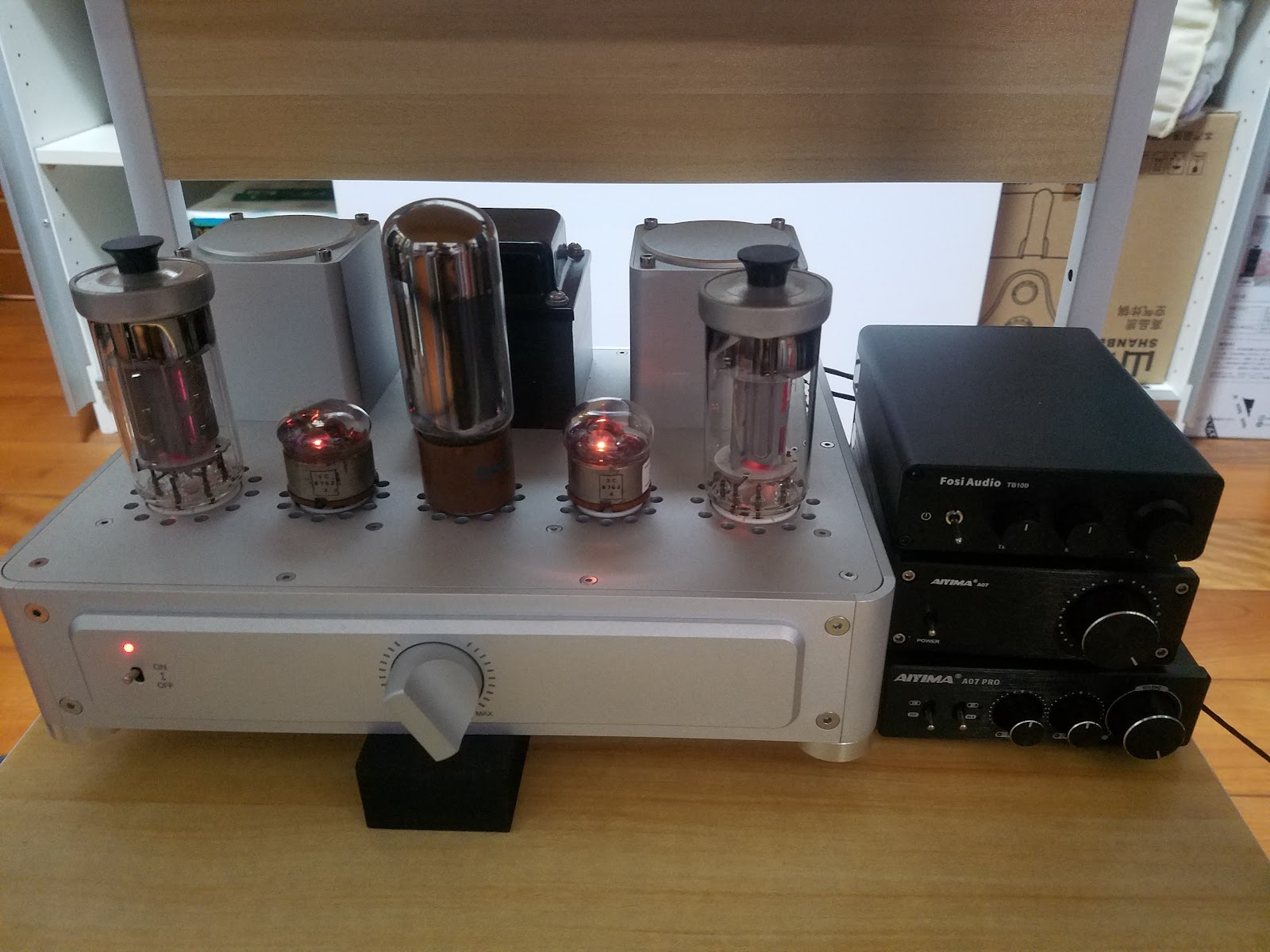
Revox 720 722 Aiyima A07 A07 Pro Fosi TB10D Tidal


Click pics to enlarge. Note DG Karajan box on top. Bottom L is part of the DVP; to the right, the Gophert SMPS.

Letter from Shenzhen (23-3): Home Alone with Revox 720 722 Loose Ends
Streaming Classical (23-1): Karajan Haydn Mozart
Book: John Berger


Early on I decided not to go to Guangzhou and rather spend CNY by myself. Aside from the usual daily chores, I did a few things (not all audio related) which I shall record here. As during this time I had the Living Room (LR) all to myself, the first thing I did (on New Year’s Eve) was...

Reconfiguration of the LR System Before I was using various Aiyima products (mostly T9) to drive the Anubis LS3/5A (here). Since my main listening room, the study, now has transitioned to all-tube (here), I moved my trusted Revox 720/722 combo out to the LR and installed it. Chinese Bubugao DV-997 serves as CDP. Bubugao was maker of now-defunct Oppo, which were once widely popular (and perennial recommendations in trade mags) for their universal players. Mine is just an old DV Player, but a top one that is sonically superior (modified a little by someone in HK, then HKD 1K). General Sound Despite its relatively compact size, the Revox 722 has plenty of power to spare. Compared to the Aiyima T9 (run at 24V), sound is much more authoritative in my big LR (speakers are 2.6m apart, and I listen from the sofa, 3.4m away). This portion of the LR is 3.6m by 4.2m, but it is an artificial mental line, as the space extends much more to the left (the dining room and open kitchen) more than doubling the area. It is a joy to listen to the Revox pumping out juice, and the Anubis sounds significantly better than usual too. I mentioned to jules last night that a lesser system in a big room can be even more satisfying than a better system in a smaller room, and that may be the case here. No, it doesn’t quite have the details and refinement of the main system, but having music resounding in a large space is something else. Revox 720 Preamp As I needed at least 2 inputs, the preamp comes in handy. It also has balance adjustment (a slider rather than a knob, as is the volume), which is very useful for me, as I like to sit near the window rather than in the center. Which is also why I toed in the left speaker quite a bit. With the help of the balance feature, I can get the music filling out the center. This is also the reason why I don’t use the Aiyima T9 as Preamp, though I may re-evaluate it next round. I don't have much use for tone controls but would like a balance knob (unfortunately not present either on T9 nor my tube preamp in the study). The 720 actually has a decent tuner, but there are no classical stations here (HK has RTHK4). Aux vs Tape In I had the DVP hooked up to the AUX and the Aiyima T9 Pre Out to the Tape 1, and found that the DVP was much louder. Reversing the inputs brought the opposite. So the Gain of Aux is much higher. I only just now recall that the Revox Preamp has small screws below each input to adjust the gain. Next round I shall look into this to equalize. Aiyima T9 Now I had the Aiyima T9 connected to the AUX primarily to use it via its Pre Out for its Bluetooth (which benefits from higher gain). In Pre Out mode, the power meter cannot be relied upon for adjusting correct level. So it was empirical and more precise tuning shall have to wait till next round. I also did test the Aiyima as DAC. I connected the Coaxial Out (using XLR 0.4) and Optical Out (generic) of the DVP. Sound was initially comparable, but after some to and fro I came to realize that the DVP analog out is better with the swells of massed strings - just more real. And so I removed the digital connections. I may test out my other BT devices later, as it’s kind of clumsy to use the T9 only as BT via pre out. So much for this setup for now.

I get up early, usually around 6:30. The sky is still dark. After boiling water, I’d have some instant coffee, just for the jolt. Still considering a coffee maker (one more item on the cramped kitchen counter). Usually, I’d just read till the sun comes up. But in the past few days, I’d turn on the lamp by the sofa, turn on the system and start listening to CD, something I haven’t done for almost 2 years!...

KARAJAN Symphony Edition (DG), Haydn, Mozart This 2008 38-CD megabox is a great bargain, and solid basic repertoire. Amazingly, unlike many other boxes that come and go, it’s still in print, 15 years later, still at bargain basement price (Amazon is $53). I don’t have that many CDs here, though I have 4 boxes of Bruckner and 2 of Shostakovich (that shows you where my sympathies lie). What better music to play during the new year than Mozart and Haydn? I started with Mozart on New Year’s Day. It is not an exaggeration to say the music infused my soul and was uplifting. I soon went through all 3 CD’s. Karajan made some very good Mozart recordings before on EMI (overly reverberant acoustics) but these 70’s recordings have better sound. The execution is just perfect - one hears everything when one should, and nothing when one shouldn’t - artless indeed. There is little question that the BPO of old was much better than its impersonal counterpart today (imho, Abbado and Rattle ruined the orchestra’s classy sound). Down to the last piece, they are coherent and meticulously balanced - classical indeed. Then I moved on to Haydn, and it was an even greater joy. The Paris and London Symphonies total 7 discs, and I’m one short of the finish line. Not having re-visited these in decades (I have these on vinyl) I am highly impressed by the discipline and verve of the team - everything moves forward, nothing sticks out, and there are moments of humor and even Brucknerian grandeur. I grew up on the Bernstein, Ansermet and Szell recordings, but these are even better in overall execution (and sound). The only other one worth noting is Kurt Sanderling’s Berlin RSO set of the Paris (Eurodisc), absolutely proper and sonically superior (oop; but probably can be streamed). Of course, I’m not talking about HIP Haydn that is prevalent now. Mind you, I’m a fan of, say, the ongoing cycle of Il Giardino Armonico/Antonini (Alpha) but I think there’s more than a place for these grand old performances with big orchestras. Where the small HIP ensembles can deliver a shock, the bigger BPO can deliver grandeur, and that’s a completely different thing. To use an audio comparison, it’s almost like a small room compared to a big one. Karajan is not “known” for his Mozart and Haydn, but here I think he is owned his due. This box set is a contender in every composer and can form a keystone in one’s library. If you still prefer CDs, get it. You can stream almost all of it too.

Sometimes though it’s better to have no music at all. In the wee hours or first thing in the morning with coffee, a good book is bliss...

JOHN BERGER A Fortunate Man Despite the limited resources (in English), I’ve read more books here in SZ than most time in the past. I actually have a little personal thing relating to Berger. Many years ago, an artist friend of mine recommended Berger’s Ways of Seeing, but I forgot about it. A few years later, a Taiwanese friend was translating the book, and asked me to go over the proof. I did, and made many suggestions that she might not have liked. Truth is, as a sometime translator (erstwhile and amateur; I have done poems, art catalogs and exhibits etc), I realized the big divide between the very precise English of Berger and the inherently imprecise Chinese language. Then, I realized what a masterpiece the book is. Fast forward to recently, when I borrowed this book from the very limited English book selection of the local library. Like Ways of Seeing, it is one of the most engrossing books I have ever read.

Berger calls it an essay. It follows the practice of country physician John Sassall, and probes in depth the relation between the healer and his subject. It surveys the landscape of a less affluent sector of society. Importantly, it emphasizes the devastation of cultural deprivation - spiritual poverty. The work is prescient of our current society, urgently in the UK but just as true in the US. A social commentary and condemnation that is even more relevant today. Should you be interested, there is a huge amount on this book on the internet. I started it sometime ago, but finished it this CNY. Everyday I still think of the book - that’s how good it is. Of course, as a trained person in the field, I can easily relate to the subject, and indeed find the hero, practicing solo, highly skillful and, well, positively heroic.The only problem is, I have trouble thinking of what to read next. I may also write another short article on this book, as I’d like to share some of the texts with you.

More Aiyima Previously, I had tested out the Aiyima A07 (for many, a perennial fav) and its latest incarnation, A07 Pro (with the Fosi TB10D thrown in too). In preparation for writing a short article on the trio, I have re-listened to them in my main setup as well as the LR. Watch this space.

Tidal Some time before the CNY, my HK friend Sang/Seng, whom I had featured (as Home Visits) many times in the blog, surprised me by including me in his new Family Plan of Tidal. This had not come out of nowhere. Seng has always been an avid classical listener and loved to browse and buy CDs. For the longest time, I had been persuading him to start streaming seriously (he had Spotify, but the LOUD ads are basically intolerable), to start with Bluetooth for nothing. About half a year ago he finally capitulated and bought the FX Audio BL-MUSE-01 I had previously recommended in this blog (here). He was using its digital out into his own DAC and deemed it satisfactory. Not long after he established his footing, he took the leap and subscribed to Tidal! And so, I have Tidal here, and I love it for the pop and jazz on offering. I shall be penning a Tidal article, likely in conjunction with some of our other authors in HK.

18 December, 2022

Elekit TU-875 Aiyima A08 Pro

Letter from Hong Kong (22-14): ELO finds his Preamp, Elekit TU-875

Who would be interested in a review of a long-discontinued preamp which was sold mostly as a kit? But I think the point is, sometimes you need to look high and low for the right equation and missing link to complete your journey of searching for the perfect system. Therefore, I'm always open to new "old" ideas to improve my overall setup. While my icOn4 passive AVC preamp is very good, I somehow feel it does not have synergy with the Aiyima A08 Pro. Like I said before, this time I'm looking for a tube amp to smooth the edges of A08 Pro. Of the four preamps in consideration, TU-875 is the cheapest of the four (remaining three are the Nagra PLP, Shindo Claret and Lab12 Pre). So, if it works out, I would have picked up a sonic bargain!

"Can I get both Fish and Bear's Paw at the same time?" Let's go find out!!!

Elekit TU-875 Prelude - Benchmarking its Performance
Apart from listening to live performances, home and shop visits are also very important experiences that HiFi and music lovers must gain in order to gauge how your system stands among other great setups! See my latest visit report.

So, I have been to some home visits and showrooms with really great sound, and that is excellent to benchmark the system that I have at home. Otherwise, I will be non-objectively indulging myself and bluffing on how good the sound quality of my own setup is, like a frog at the bottom of the well LOL.

After a few weeks of listening and continuous tweaking, the sound of my TU-875 had improved leaps and bounds. When I first hooked it up, the sound already instantly gained some smoothness and analytical power. However, there was still a layer of haze masking the music. I suspected that the Gotham GAC4 may be the culprit (and it would soon be replaced by the "Studer" interconnects; see below; I had my fingers crossed that it could clear out the mist).

However, before the cable arrived, several things, though small tweaks, that I have implemented over the last few weeks proved highly effective and had unexpectedly huge impact in improving the overall sound quality!
  • 1) I hooked up the Subwoofer!! I had thought I had hooked it up with my 47 lab flimsy cable, but IT WAS NOT!!! I immediately replaced it with my Grimm TPR and voila, the image solidified, haze lifted and noise floor was lowered too, with addition of an extra layer of refinement along the way (which is exactly what the addition of subwoofer will offer).
  • 2) I hooked up my DIY ground box with similar magnitude of improvement! (P.S. I took my ground box to my friend CW's place to try out and the results was positive. Overall music involvement and PRAT had improved markedly. CW ended up later adding a KOJO Crystal ground box that also resulted in marked sound improvement. I just wonder how my DIY will fare with his KOJO~)
  • 3) I pulled out the 2 tubes for the phono circuit as recommended by DJ, then I turned up the volume and immediately I thought there's difference but was not really sure what that was - another Snake oil? After turning on the unit cold with only one tube plugged in for the line stage, sound did not change much and I mumbled to myself whether I should tell DJ that there's no change at all. However, after half an hour, the sound seemed to have transformed. Voices became more pronounced, emotionally involving and different shades of singing was beautifully portrayed in front of me. Imaging was now more nailed to the center as well.
  • 4) I replaced all I.C. to "Studer" IC, which I'll talk about later.
  • 5) enter the Luna power cable along with the Studer cable. It was hooked up to the 220/110V transformer powering the TU-875.
Preview/TBA:
  • 6) To use a better 220V SMPS to replace the stock unit (TBA)
  • 7) Upgrade my Luna Gris speaker cable to Orange, a step up from Gris (TBA)
  • 8) A network switch with a proper LPS (TBA but initial experience is rather mixed)
  • 9) UMI transformer signal isolation device (will directly compare it with Rayaudio's) (TBA)
Overall Sound of Elekit BEFORE including one extra pair of Studer cable into the mix
How would I describe the sound of this little unit? Sound is very refined and smooth. Instruments has body and shimmer; bass is good but has slightly less slam compared with using BT on Aiyima A08 Pro standalone. It has great analytical power, yet not cool and sterile. It's musical, with microdynamics which paints a colourful picture of instruments; in particular, vocals have lots of decay and attenuation. It's not lean at all, yet not bloated, just the right perfect body instead of needle-like imaging. Soundstage is very open, natural and extended to both sides to the wall as well as to ceiling. Music is slightly set backward compare with A08 pro standalone.

Timbre is accurate, better than A08 Pro standalone.

Strings are delicate with nice portrayal of hairpin turns. Acoustic Guitar plucking is solid, with good body, quickness, tenacity and roundness, as well as attack. Bass guitar with attack, authority and sufficient body that is life size. Drums are quick, decisive, with good timing and body, bass slam and PRAT is tad behind A08 Pro alone but still very respectable.

Vocal is where this preamp really excels. It is top notch, capable of capturing all the shadings, techniques and tonal colours delivered by the singer. I am not talking about the breathing or swallowing of saliva (which are just by-products), rather the singer's skills and emotions that is being conveyed to the listener. The rise and fall of singer's voice is parabolic instead of straight-line; starts and stops and change of tone and speed are far more pronounced, such that the whole thing is more emotionally involved. You can actually hear the performers directly sing deep into your heart. Some apparently sing less emotionally or more technically than the others, and it is easier to pick this up with TU-875. I always use this analogy: great equipment will give you Celine Dion's voice while lesser equipment will give you a bar singer's or an ailing Celine's performance. With due respect, some bar singers are still very good, but it's still just not Celine Dion at her best! just found out about the sad news of her "Stiff person disease". Just wish she can overcome it and keep singing for us and for herself!

During the course of replay, you feel the ebb and flow of it, and there's also a synergy among the musicians as if they are playing for and against each other and trying to feed off the energy from each other. That makes you want to keep listening without fatigue as you hear unity in performance.

I have been comparing the music playback through Bluetooth from A08 Pro to A08 Pro /TU-875/ WEA. I must say nowadays music reproduction quality from Bluetooth has improved leaps and bounds and it is not trailing too far behind WiFi streaming! Without intensive and careful auditioning between the two, I could, and I swear that I can live happily with the standalone A08 Pro playing BT music from my LGTV as well as BT from my laptop playing Tidal music - and this is after intensely comparing both options.

Enter the extra pair of Studer IC
Alas, I finally received the Studer IC. I ordered a total of 7m in bulk, and that converts to 3 pairs of 1m IC, 2 pair of 0.25m pairs IC (for use with Rayaudio's signal Tx isolation). I had already been using a pair of Studer IC between my WEA and TU-875. The extra pair was used between TU-875 and A-08 Pro.

The sound has literally further transformed and has reached another whole new level, no shxt!!! At the same time Kwong has also made a pair of the Studer IC for himself and hooked it between his Audionet ART CDP and Amp and has experienced the same Audio Nirvana (slightly LOL?)

What has actually happened? As soon as I hooked up the cable, I was immediately drawn into the music. The wholeness, coherence and sheer musicality just forced me into the world of the musicians, and that makes you forget to analyse the virtues of the cable. "This is MUSIC", the cable is trying to tell me - enjoy and stop criticising.

When I finally came back to Earth, I started to analyse what has happened (I'm a damn engineer anyway). First of all, this cable completely trounced my GAC4 in every way.

It's smooth, organic, musical; notes seem to connect seamlessly as a whole; body fleshes up without being bloated, and with finesse. You pick up the subtle changes from fff to ff to f, or ppp to pp to p; treble notes seem to sustain in the air and feel ethereal. Harmonics is so rich and in abundance; extension on both ends is great; bass has plumpness, and pluckiness; especially with double bass, the sappiness, speed and transients are there and approaching that of the A08 Pro standalone performance. Sound is exciting, yet not even a bit fatiguing when playing music at a respectable level; engaging and involving with PRAT with no signs of digital glare and edges! Imaging and detail retrieval are top class; you can pick up so many instrumental details even at ppp that was never heard before.

Addition of the Luna Gris power cord has further improved everything, though not as dramatic as the Studer.

Up to this point, I really think I am very close to getting both fish and bear's paw...

Sparkler Audio S503 CDP vs WEA
Well, there was one more thing I could try. I wanted to see how my Sparkler Audio CDP will fare through my Elekit with my newly acquired Luna Gris Cable and Studer cables.

Unfortunately, with all the better cables and Elekit TU-875, WEA still sounds much better than the Sparkler S503. With due respect, S503 ia a very nice CD player already. But I think it's about time to consider converting all my CDs into NAS... Been talking to Dom Tu of iAngel, who carries Innous/Plixir/47 Lab/Sparkler Audio in HK; he is trying to get me a old Zen Mini MkII streamer/CD ripper to try out~

Two modes of listening : A-08 Pro vs A-08 Pro/TU-875
Now, the PRAT of A08 Pro/TU-875 is 80% of the A08 Pro standalone. The A08 Pro standalone provides the extra slam and fun that is so thrilling and exciting to listen. So, if I ever want that last bit of slam and fun, I will switch to Bluetooth mode and play music through my TV or Tidal and Youtube through my Laptop!

When I want ultimate hifi mode, I would stick with the combo instead of A08 Pro standalone. I ended up listening with the A08 Pro/TU-875 combo 90% of the time!

I can now play both music that requires huge dynamic, slam and directness as well as music that is more delicate and demanding of delicate emotions with the A08 Pro/TU-875 combo!

For readers with a budget, you can play Tidal through Bluetooth from standalone A08 Pro and it is of really respectable quality. But if you want ultimate music Nirvana, acquire the A08 Pro/TU-875 combo! It's still dirt cheap anyway. (Editor: this is not practical for most people, as the Elekit TU-875 is likely only available in Japan second hand. HK readers are more fortunate in that they can use third party companies to bid/buy from Japan)

Final Thoughts
Ultimately, A08 Pro/TU875 is the definite winner in terms of sheer musicality, genuine vocal portrayal and deep emotional involvement (as with details, soundstaging, background darkness and quickness). But, that said, I can still easily live with with A08 Pro alone should I not have come across the TU-875 ! A08 Pro does have a slight edge of PRAT and slam in music, plus a bit of coarseness and edge to music which I think is FUN sometimes.

But I do treasure highly the finesse, refinement and musical involvement that A08 Pro/TU875 provides. There is no listening fatigue, and with this combo and I can listen for hours and not get tired of the lovely music it can produce.

The miniscule combo of Elekit TU-875/ Aiyima A08 Pro / Wattson Emerson Analog, all roughly palm-size, with total weight of less than 5 lbs, pumps out volume and quality of music that is unheard of in my years of experience! Cost wise, the amp/pre costs at $450USD and represents a colossal bargain in today HiFi world that demands thousands, if not tens of thousands, of dollars for a decent system.

How does my current system stand against the sounds of previous home and shop visits? I can comfortably say that it does not shy away from any of these systems at all. In my early days when I started the HiFi journey, I always felt depressed and lacked motivation to hear my system at home after showroom visits that sounded so spectacular. But not with my current setup, which can stand up against these multi-thousand dollar setups comfortably without feeling inferior in terms of music performance!

Currently, I feel that any further improvement will be icing on the cake instead of a complete upgrade. Having said that, I always welcome surprises but, for now, I will revert to my most treasured and ultimate mode, that is, music enjoying mode!

Of course, I still having high expectations from the Luna Orange, UMI unit, dedicated PS and Bonn N8 network switch that can impact to my current setup! Stay tuned!!

Music used for assessing the system
Numerous Youtube videos from Blue Note Tokyo, Bob James and Tiny Desk Concerts etc

Tidal Music
Far too good - John Smith - uncanny voice with foot tapping solo guitar. Great lyrics.
Rainbow - Kacey Musgraves - uplifting. Hope and positivity through her voice, lyrics and songs.
Blue Orchids - Bill Charlap - amazing attack on piano notes and soothing jazz tunes.
Two Lonely People - Susana Wong - duo sing with one heart; not a usual fan of hers but this one is exception.
Welchester Lady - Bob James - as usual so tuneful and fun.
So What (Live) - Michel Petrucciani - High energy and piano attacks that shockingly knocks on my head!
Where Breathing Starts - Tord Gustavsen - slow ballad that emotionally feels like gently adrift on a slow boat.
The Sky - Allan Taylor - great effect, soundstage; crisp guitar and uncanny voice.
My Favorite Things - Youn Sun Nah - amazing and realistic voice with single, cymbal-like percussion instrument.
When I think of Angels - Eivor - such touching and genuine voice that caresses your heart
One Wish (Trio Version) - Hiroshima - slow version which is preferred to original one; and the Koto plucking is so realistic and beautiful!
My Foolish Heart/ Spain - Chick Corea Trio - scintillating performance. They play together as one, with fire and passion (both A-08 Pro/TU-875 and A-08 Pro standalone options are good)
Bali Run - Fourplay - A-08 Pro standalone has slight edge, but with TU-875, you hear more details.
Bei Shan Wang Hai Li Bu Kai (Live) - Kay Tse - Guitars, sax and drums and dreamy vocals - highly recommended.
Elephant on Ice Skates - Brian Bromberg - showcasing the tenacity of the lightning-fast bass guitar, which has great body!
Volver, volver - Buika -showcasing the dynamic range of her vocals; so much emotions!
Paris - Cy Leo - World champion harmonica artist has such everchanging shades and tones to get you emotionally involved. A must.
The ship is at the Landing - Krut Reiersrud - Twanging of guitars is so fun to hear (both versions are worth listening)

30 October, 2022

AIYIMA A08 PRO

Click pics to enlarge.

Letter from Hong Kong (22-11): ELO on Aiyima A08 Pro (1kg vs 20 kg)
Sidenote on Belden 9497

Editor's Notes: Readers may be interested in: 1) this Video of the Making of Aiyima T9 Pro. It shows in detail how an Aiyima product is made; 2) My Visit to AIyima.

Editor's Preface: 1) For regular readers, this article is somewhat unusual for a reason. For the longest time, this blog "reviews" things that the authors have bought on their own and want to write about (mrgoodsound and I bought T9 on our own). As a Stereophile writer remarked to me, we basically shoot from the hip. Although we can (not to the extent of youtube), we do not monetize and harbor no outside influence whatsoever (and, yes, sometimes we may even shoot a good guy, LOL). The only time I can remember otherwise was when VKmusic sent me an Elekit amp to review (which I sent back afterwards). So, declaration: Aiyima sent the amp to ELO for review, and he's buying the review sample. I have more to say in the Postscript, but I'd like to emphasize that I personally feel uncomfortable about getting freebies, no matter how cheap, either for review or measurement, and I ask our writers to do the same. It's fine to get shipped a sample for review, but to keep it for free is troubling for me, though that may be a widespread practice at the low end of Fi.

Aiyima A08 Pro Official Info

I have listened to many setups costing well above $1M HKD, but these days I am even more interested in what something selling for around $100USD can bring to the table. That was why some months ago I got interested in the Aiyima T9. This blog's journey with Aiyima started when I casually informed doctorjohn of it. (Not) Surprisingly, he bought one in Shenzhen and then wrote a long review (here). 4 months later, that review is still the most-read post of the blog, attesting to the interest Aiyima is stirring up. Ironically, as much as I have been intrigued by the company, I have yet to try out T9. Just when I was about to get one for fun, opportunity knocked, and I was given the chance to audition the A08 Pro, one of their recent amps! Doctorjohn had heard it (there is a brief video clip of the A08 Pro in his Aiyima Visit article, which is replicated at the bottom) and thought it'd be suitable for me, and I immediately jumped at the opportunity to test drive it! 

Aiyima A08 Pro Claiming 300Wx2, it is housed in a compact metal case which is quite cool and sturdy. The central depression can serve as an air duct if you stack something on top, but is designed to seat the vertically deployed "companion" T8 Preamp. It is even smaller than my reference amp, the iconic 47 Lab Gaincard. The front is simple, just knobs for volume and tone controls. And I like that SPL meter, kind of reminding me of Nagra and HiFi Rose (Ed: SPL, the expensive headphone amp brand, is another that comes to mind). Aside from the speaker binding posts, the back only sports the BT Antenna and RCA in (as there is no selector, BT has priority). The matching SM power supply is rated at 36V, which converts to 170Wx2 at 4ohms. I wondered if it would be powerful enough, or would I need 48V instead? But for the time being, I was going to stick with what I had.

Weighing barely 1 kg, will the Aiyima A08 Pro cohabitate with my more expensive peripherals and integrate into the system? Can this featherweight amp compete with other chunky amps weighing more than 20kg?? Well, let's find out.

After weeks of intense listening, my hitherto understanding of these cheapo Class D Amp had undergone significant changes. Mind you, most current NAD all-in-one integrated amps are running in Class D mode and they sound very decent too and people are buying them at much more expensive prices!

Before I even listened to this little amp, I had this typical review already well drafted in my mind (call me a biased bastard) and it would go like this:

😉My Predetermined script: “...As a class D amp, the unit does pump out copious amount of power, can go loud and clean and when paired with a $400USD speakers and a good entry level Streamer/Dac like Bluesound Node etc, you would get a great system that is off the charts in PQR! Sure, the sound may harden a bit when driven to its limit, but one must realise that we are looking at an amp costing only $120, give or take a few notes. So, what can one expect, right?”...and how wrong was I..."

I WAS COMPLETELY WRONG!! Those who follow my posts will know that these days I’m kinda "go small, go cheap" type of guy and I have been confident that my acquired knowhow can translate to the ability to spot bargain equipment. Certainly, A08 Pro gave me great pleasure and off the chart PQR, but I have to admit I was completely caught off-guard, even having expected it would be good given the favorable review from DJ on Aiyima T9. There were many revelations during this review process, which are eye opening to say the least. Let me come clean to start with:
  • Discovery 1 Upon receiving this little amp, I had totally prepared myself to write something like my hypothetical review. How wrong was I! In many ways, this amp overturned my belief in HiFi equipment. With the A08 Pro, I was forced to use my best setup to squeeze out its maximum potential and I felt that it would go from strength to strength if paired with good associated equipment.
  • Discovery 2 I would have never imagined that the A08 Pro has the potential to take away the spot of my 47 Lab Gaincard! As of now, I have no intention to switch back to my beloved Gaincard, nor hook up to my TVC icOn4 (I will soon I promise).
  • Discovery 3 This amp has the guts and ability to drive my inefficient Dynaudio Crafft to a level which is simply FUN to listen with. Now I think I have finally released the full potential of my speakers. Sorry that it took so long, my Craffties...The Aiyima is much like an ant that is able to lift up objects that are easily 10 times its own weight.
Now, more details on the process.  

Setup and General Sound
When I received the A08 Pro, I hooked it up immediately, with source from my Streamer Wattson Emerson Analog (WEA) connected by my newly acquired “Dubious Studer” cable (which is indispensable to me by now), then Rayaudio’s magic little box. Speaker cables Gotham, and subwoofer from Audio Physic. I tested the BT with my phone and noticed there’s a gap when compared to playing Tidal music through WEA, so for most initial listening I used WEA as my source.

Once run in a little, the unit already sounded very good, with ample power driving my Dynaudio Crafft, to a level which I seldom was able to get to with my 47 Lab Gaincard, an issue that has been love and hate to me. Question is, will A08 Pro just play loud and lose all the nuance and musicality for which I treasure my 47 Lab? The answer is a big NO! This little guy got rhythm and PRAT and is also very musical as well. It also has great soundstaging; despite not being the deepest, it’s wide enough to fill my whole living room! I also hear nuances of musical instruments and details. Vocals are natural, uncanny and realistic, not at all without emotion. Highs are a tad on the dark side, but while they don’t sparkle there's no lack, smooth and soothing (perhaps it's also the signature of the Watt Emerson). Bass is solid, with body and authority, tuneful and with a tactility that is lifelike! Overall picture is very musical. On some music I detect some hardness on the edges, which may or may not be limitations or characteristics of Class D amp; I may want to use some softer cables to pair with it. My friend Dr Lo brought in his secret interconnect for me to try out, but while the midrange seemed fleshier and rounder, suddenly transients felt like the brake was applied and also missing were the previous foot tapping elements. Mystery IC turned out to be the VdH Carbon; there was just no synergy with the T08 Pro.

During the course of listening, I bought myself some LINN Skeet's on which to rest my speakers’ spikes. The result was that the music became more coherent, but with a slight shrinkage in width of soundstage, but I consider it a beneficial tradeoff. After listening to this combo for 2 weeks or more, I noticed that the amp had started to break-in, and the rough edges had mostly rounded off and the overall sound had become very balanced! Bravo, patience paid off!

Bluetooth with Youtube on TV
After a few weeks, I suddenly came to realize that I could hook it up to my TV, which has Bluetooth. The sound coming out from playing Youtube was such a joy that I kept searching for my familiar music video clips one after another and the sound had completely transformed. How to characterize? To describe it simply, it is fun to listen, very good organic sound; bass has kicks; vocals are natural - overall extremely enjoyable with the 55inch OLED screen playing pictures along with music.

Bluetooth vs Ethernet Connection
How is that different from my WEA? I would say the soundstage shrinks a bit, but not by much. Outline of instruments is a bit smudged compared to WEA but very close indeed. I have been utterly enjoying on Youtube all my favorite clips like Free National, Monsieur Perin, Alicia Keys, Masego from Tiny Desk, plus many others. I say it with confidence that I can live with listening to music using Bluetooth connection only. However, it seems like the BT from my TV sounds better than BT from my phone though. This is a huge advantage over my 47 Lab which does not have BT.

Wait, I’m comparing A08 Pro + BT with my 47 Lab + WEA even without considering the gulf in price!? I realize that while I was reviewing this unit, I did not take into account at all the price differentials! Without realising it, I have been treating this unit as a "proper" hifi gear, regardless of the price! And I have been surrounding it with all the excellent equipment I have, when more than 90% of the people who bought it will be pairing it with a pair of budget speakers costing probably at most a few hundred USD. However, the Aiyima has not been shy, not even one bit in front of these wonderful gear. Instead, it flourishes and passes the tests with flying colours. I likely do not need the 20kg transformer of a high-end Class A or AB amp when just a 1kg unit of Aiyima A08-Pro achieves this kind of result. Kudos to the engineers at Aiyima! It’s kinda like David and Goliath.

Con's of A-08 Pro - it's not perfect, but it does not need to be perfect
Are there any con's in it? This is not a perfect unit of course and, if I tell you so, I will be lying to you! But if I were to nitpick, it does not provide the pinpoint focus which a lot of audiophiles crave for, nor does it give you the ultra-smoothness and shimmer which a selected few (and very expensive) are capable of producing. Perhaps it’s not as good in portraying a whole orchestra with ease, and violins may not possess the ultimate satiny feel on the strings. Perhaps a tad more smoothness will not be remiss but, man, so much fun and excitement come from this tiny box, and that makes it really easy to forget about these shortcomings.

Emancipation of my Dynaudio Crafft
Astonishingly, the amp not only drives my power-hungry Dynaudio Crafft with ease, it does the job with joviality, musicality and strengths in soundstage, tonal accuracy, punchy bass lines, natural vocals and relatively open highs (despite being a tad dark). Without looking at the size, it is already a fine piece of serious hifi equipment. If you factor in the price as well, this is one heck of a music bargain. I do believe that, if you pair it properly with decent equipment, it will give you a truly amazing musical experience at a dirt-cheap price, priceless by today’s inflated standards.

Next step, I will hook it up with my icOn4 preamp and see if there’s any improvement. Also, I’m still waiting for my Luna Cable Gris for my speakers and Gris RCA for trial and see if the sound can further improve.

So far there is not even one moment that I miss my 47 Lab, which speaks volumes on how good the A08 Pro is, since I do treasure the sound of my 47 Lab a lot and once regarded it as endgame gear for me. A08 Pro changed my mind and I’m buying the Review Sample, period.

iCon4 atop Rayaudio preamp. 

What if I hook up a preamp in front of the A08-Pro?
The above referred to using the A08 Pro as an integrated amp, meaning using its volume knob. The other day, Dr Lo and another old classmate of us came to my place to listen to this amp. We were all delighted by the dynamic, clean and exciting sound that came out from this little gem. Then I hooked up to Ray's tube preamp and played it against my iCon4. With Ray's preamp the music took on more flesh and smoothness, and that is a positive direction. My iCon4 seemed to have narrower soundstage due to restraints in highs, with more emphasis on midrange accordingly.

Conclusion is that this little unit will definitely benefit from pairing with a nice preamp, probably a tubed one. So next step will likely to be either Nagra PLP or Shindo Claret to go with it~~ (so far, just fantasy!)

Interlude: Gotham 54240 vs Belden 9497 小插曲
I have always heard good things about the renowned Belden 9497 and always suspect the Gotham is the weaker link, hence I ordered the Luna Gris Speaker Cable to try out. It just happened that my friend wanted to get a pair of decent speaker wires, and so I recommended the 9497, and ordered an extra pair for myself. Took 3 days and, upon receiving them, I tried it out without hesitation.

My oh my, fresh start with cold feet, the 9497 beats the Gotham 54240 by a very wide margin.

In a nutshell, 30%+ increase in PRAT, more solid bass, wider soundstage, better definition and microdynamics, better attenuation and decay of instruments. Seems like the better the equipment or accessory you insert into the system, the A08 Pro will benefit from it directly. Feet tapping ratio is now sky high and I faintly recall my Linn LP12 Naim pre/power combo some 39 years ago! Having gone around in circles for so many years, now I'm back to square one, LMAO, but definitely in a good way. Will run it in 24/7 to see how much it would improve!

Verdict
Am I overly enthusiastic, or have I lost my cool by this amp (DJ asked this question)? Well, when something that costs less than 120USD can make such an impact on my system, this is almost unthinkable before for me. Previously, I was ignorant about what Class D can bring to the table, but now I know.  That is to say, when designed properly, like Aiyima. I'm sure their engineers have put in loads of effort, and not a little love, in getting the sound.

Do I recommend it? A thousand yes is not enough to express my mind! Wholeheartedly recommended!

--------------------------------------------------------------------------------------------------------------------------
Editor's Postscript: I'm actually somewhat astonished by the positively huge response from ELO. Not because of any doubt about the A08 Pro, not at all, just a question of magnitude. And I'm really pleased, as ELO has done what I'd have done for worthwhile cheap gear - that is, not comparing it to similarly priced stuff, but trying our best to get the most out of it. That shows again his commitment and integrity. Not to forget, many people likely have not run in the gear before commenting, and this review took well over a month!
  • Something about Dynaudio This is strictly my opinion (though icefox would likely agree with me). This company's tech savvy is beyond doubt, but does tech always ensure a good product? No. ELO's Crafft sports likely the most iconic tweeter ever: the ESOTAR. I kid you not, there are many people who embrace this tweeter to the grave. My treasured Sonus faber Electa Amator II is always less valued than Mk I because it does not employ the Esotar. I don't agree with this, but that shows you the fierce devotion to the Esotar. There is little question the Esotar is a little "darker" than modern tweeters, but then we also know many modern wannabees are simply too bright. No matter, the Esotar is a great tweeter for many, legendary for its texture. I provide this info just to put things in context. The thornier issue concerns Dyna's woofers, which I personally have always had a problem with, the more modern ones the more so (the best deployment to me was the BBC LS5/12; it's not just my opinion that other manufacturers use Dyna drivers better than they do themselves - witness the classic Sonus faber's and Ruark's). They are the antithesis of what I like, paper woofers and surrounds. To me, most Dyna speakers are not quite coherent in the integration between tweeter and woofer. The more modern, mostly the worse. Now, the vinatge Crafft is likely one of the best Dyna's in our opinion. It can sound deadly dull in the wrong hand, for sure, and I have experienced that eons ago. All this is to tell you, it's not that easy to get a lively and tactile sound out of high end Dyna's. That was why I thought the powerful and spritely A08 Pro would be a good fit for ELO's Crafft, and I'm happy that it turned out that way. As an owner of the Gaincard, I understand totally ELO's conundrum; with my efficient loudspeakers, the Gaincard would sail smoothly, 
  • My experience with the A08 Pro I haven't written it up, and my fellow writers don't even know about it, but maybe it's time to leak some info (a brief survey is underway). After my latest visit, I took home a bunch of Aiyima gear, and I immersed myself in them for quite a while. You'd be surprised, every outwardly similar model has its own personality, and there is no hands down best! I really enjoyed the A08 Pro with my reference system. Although my speakers are the total antithesis of ELO's, being very high efficiency, they threw up, just as ELO mentioned, such a huge soundstage that I was mesmerized. What I also noticed was the disarming rhythmic fortitude, seemingly a character of the brand. In terms of refinement, it was trumped by the older, and much less powerful, A8 (Infineon chip) but, again, the latter lacks some excitement. You can't have everything (true for the lowest to the highest end) but the A08 Pro held its own. Very youthful, engaging sound.
  • This has nothing to do with this article, but while I was researching Infineon I came across their How a chip is made article - fun!
Boy, where's the amp?
A08 Pro in action at Aiyima

16 October, 2022

Aiyima T9 GE 5654 5725 PS Upgrade

Click pics to enlarge.

Review: Aiyima T9, Part II

T9, Part I

Part II picks up loose ends, and took place in my less used Living Room, which had nonetheless been transformed by some recent arrivals, as detailed in my “New Trajectory” article. Since I published that, I have tweaked the system here and there, and it is increasingly satisfying, if not quite on the level of my primary system in the study but qualifying for somewhat more casual listening.

All Listening with the Anubris "LS3/5A"
It should be noted that the “LS3/5A” is less efficient than the Floorstanding Sansui in the study. In the latter, after significant revamping (here), I can get utter tube bliss with my APPLause 300B amp - no apologies, no if’s, and’s or but’s. Not quite so in the larger LR. As to whether this loudspeaker really replicates the legendary BBC sound, the answer is more complicated and shall have to wait for a later article.

As Integrated Amp with Anubis LS3/5A
The T9 did a very competent job, just as it did with my main loudspeakers in the study (see Part I). 

As Preamp with Aosibao 6P1 PSE Amp
The T9 did, and still does, a good job as a Preamp, driving the 6P1 amp, which is likely a watt or two less powerful than the 300B amp now residing in the study. Compared to the T9, the 6P1 amp is audibly less powerful and on the soft side, but it is tonally opulent and graceful even when pushed to its limits (you hear it as a flattening of dynamics rather than outright clipping). This is a big room, but this tube man still chooses it despite its limitations (the 300B amp does even better but it is reserved now for the study). In this scenario, as with all low powered amps (SET or not) the contribution of the preamp becomes very critical. I shall have more coming in due time in this regard. In case you wonder how competent the T9 is as a preamp, let me inform you I also tested the tiny Xinyi (Sini) (here, and also in bottom pic) and, while it is a very competent amp, it fails utterly with its Aux Out as preamp. This shows you the Pre-Out of T9 is solid and not just a value-added thing.

Tube Rolling
Here we have some widely available cheap (latter day green letters) GE tubes that we can use. Mind you, the green lettered ones are abundant and the cheapest, but older variants are inevitably better sounding. The 5654 is not an exact 6K4 equivalent, rather that of the Chinese 6J1/Russian 6Ж1П /EF95/6AK5 (the latter available in much more expensive WE version, including even earlier 403A; should you really want to splurge a little, you may want to read about my considerable previous experience in the well-chronicled Yamamoto CA-04 Preamp, and, more briefly with the FX-TUBE-01). The 5654 confers a more textured sound, though the stock 6K4 is likely a little more open. Just recently, I was loaned the 5725 (in spec’s more akin to Chinese 6J2/Russian 6Ж2П; also WE 409A) and it is a different sound: more extended at either end, a little louder and seemingly more dynamic, though sometimes showing a slightly rough edge, which nonetheless seems to benefit some material; ultimately, I’d think the 5654 is more balanced and closer to the more neutral sound of 6K4, but do try the 5725 as it is ultra-cheap and fun (yes, I'm going to get my own pair too). For a very small outlay, tube rolling is fun. I’d not bother getting the Riverstone stuff - the premium can be better spent getting other older NOS or used variants.

USB vs BT
By this round I had received a length of my favorite Unitek cable, this time USB A to B rather than the A to Mini I had long used with my Meridian Explorer. It took rather long to open up; in the end it sounds rather close to, but not quite the same as the A to Mini with adaptors (as detailed in Part I). Nonetheless, after running in, it’s obviously superior to the BT.

Power Supply
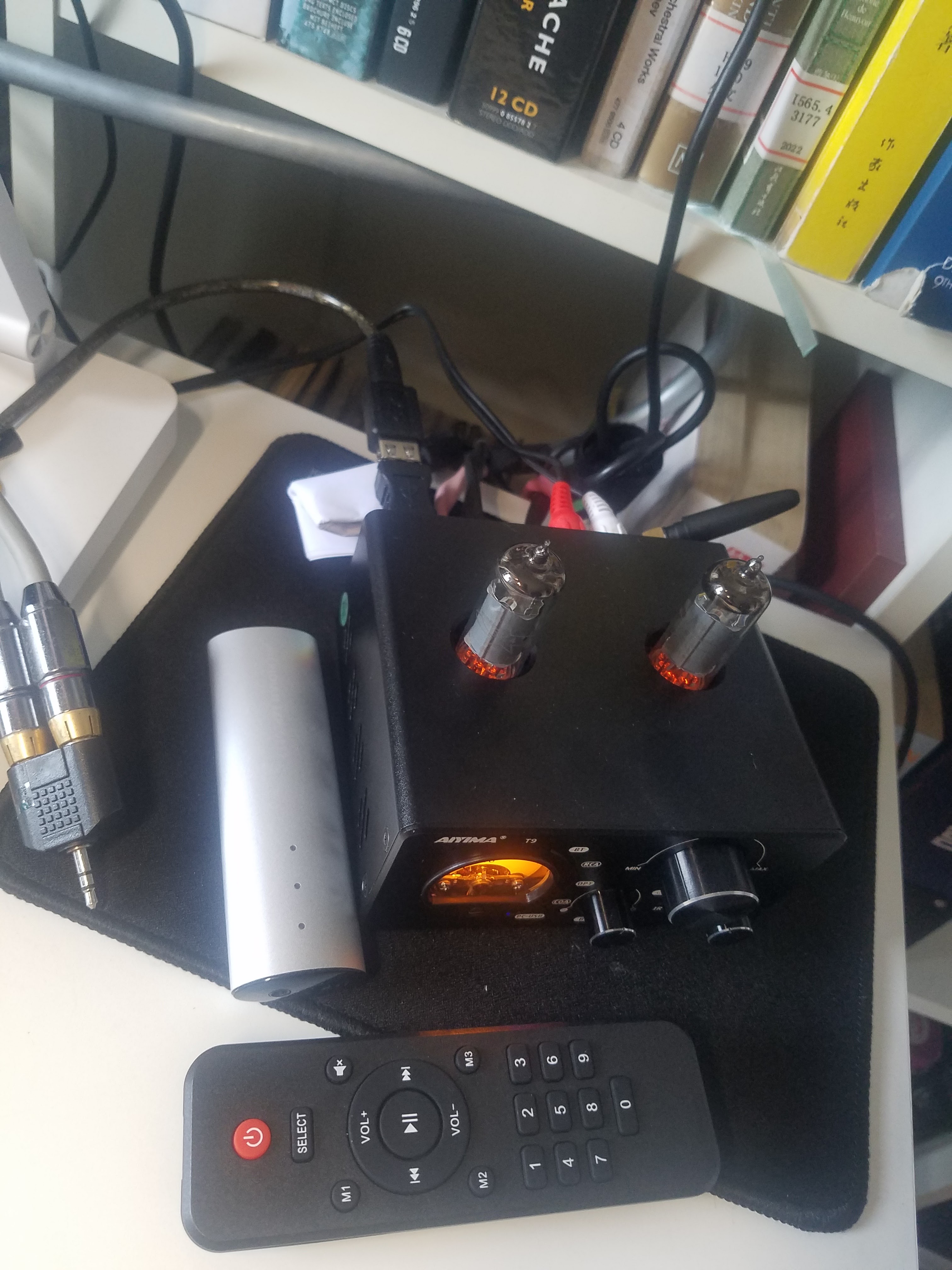
I only tested this with T9 as Preamp, but it makes a big difference. With a humble and cheap adjustable SMPS (around USD 4; rated 3A, lower left corner, on upper shelf, in top pic) I experimented with different voltages. The T9 specifies 18-30V, and the stock PS is 24V. I tried all voltages, but preferred the lower ones for more refinement, and I settled on 19V. As preamp, the T9 is warm to touch, and draws a steady 0.38 A only. Things took a significant leap when I switched to a somewhat more expensive, albeit still SM, PS (lower shelf in top pic and also bottom pic; around USD 30). More easeful and further refinement. My unit can go up to 30V and 5A, enough for more applications. Reassuringly, it also can cap voltages and currents, a good safety feature. IMHO, if you take home one message here, it’s that a good and still very cheap SMPS is a considerable improvement on wall warts. Don’t get hung up on expensive custom LPS. I have not tested its effect on the amp as a whole, but as a believer that the front-end is the most critical, I'm confident in my recommendation. Mind you, there are many to pick from; I just picked one that looks appealing to me.

There’s a lot more to say on the other stuff, but here’s not the place.

05 October, 2022

Aiyima Visit T9 T5 A08 Pro


Click pics to enlarge. Top, the factory.
Letter from Shenzhen (22-14): Visit to Aiyima, Part I

Editor's Note 2/2/23: Readers may be interested in this newly published Video of the Making of Aiyima T9 Pro. It shows in detail how an Aiyima product is made.

Addendum 10/31/22: Aiyima A08 Pro Review published.

Revised 10/6/22: some more design process, including meters, added. Even if you have read it, you may want to re-read.

When I first came back to SZ (early 2021) my NYC friend Andy suggested I sought out some of the local manufacturers to highlight. Good idea, but then I had no impetus. As I had mentioned in my recent Aiyima T9 article, I was basically dormant until earlier this year, when I bought the T9, and it triggered my recent activities (detailed here).

The Aiyima website has a local SZ number, which I then called to ask some questions. The fellow, Ben, quickly added me to his Wechat. When I expressed my interest in the company, they quickly formed a Wechat group and the discussions took off from there.

For two months I just asked some technical questions, and they also informed me of some new projects, like the T5 which they have just rolled out. I kept track of the Stats on the blog, and it astonishes me how the T9 article has maintained its position ever since its publishing at the top (at one point I was shocked there were 600+ hits in a 7 day period). That’s not a credit to me, but it gives you an idea about the general interest in the product.

A week ago I finally felt comfortable enough to initiate a visit. It was about an hour from my home by public transportation and I was there by mid-morning. I was met by the Boss, Mr. Liu (center); Sales, Mr, Deng (right); and Engineer, Mr. Guo (left). The latter I had become familiar with on our Wechat group as he answers most of my questions. They are all much younger than I.

Now, I was quite surprised by how young this company is across the board. Where I visited was the headquarters, not the factory. The meeting room is not very large, where the 4 of us sat and drank some tea. Outside was a larger office, where there were a surprisingly large number of workers in Sales and Service (as they do worldwide), and they were moving around, not just sitting mannequin-like. See the photo for the Ping Pong and Soccer Tables! After I talked to them in the meeting room, we went for a short session in the smallish Listening Room, where testing takes place. It is also where photo shoots take place. When we entered, a photographer was doing his work but he yielded to us. It was getting close to lunch, and we didn’t spend that much time in the Listening Room (at my insistence). I didn’t need to spend that much time because what I heard was quite satisfying (see videos below) and I used my own music folders on the Chinese Netease (网易云) App streamed through Bluetooth.

I like this Company Culture! Staff is obviously relaxed. In case you don’t know, SZ is the foremost tech city in China (in terms of IT), and talents are grabbed up and well treated. Not at all the older model (like China of old and Japan), with endless overtime and almost no time off. Young people today just don’t take to that.

Now, to some of the stuff we talked about and tested.

How long has the Company been Around It shocks me that it has been around only since 2016, a very young company.

How was the Company Founded Founder Mr Liu loves music but is not at all an audiophile. He was in other businesses before as Yima, so when he decided to enter this business he just added Ai, love in Chinese, to the name. You can see that in the photos. But he obviously had found the right people to assist him.

Where is the Factory The factory (in Guangming, 光明) is operated by Mr Liu’s friend, about an hour away in SZ from the headquarter. Mr Liu forwarded a few pics of the factory, but I hope to visit it personally soon.

A Completely Different Business Model Why is the same product sold under many different names? Mr Liu’s friend’s factory OEM’s for a lot of people. Perhaps, and I’m not sure, some of them have small design changes, but...More importantly, from what I understand, these brands, Aiyima, Suca, Douk, Nobosound etc, compete as well as cooperate. Some would re-brand something without hesitation (same factory) and use their own sales base. This is pretty unthinkable in the West. Grant you, the products are similar (a testament to the very high level achieved with cheap digitals now) and, if you ask me, there is not much room for breakthrough.

How to Go Forth? Engineer Guo told me, if you design something successful, and license it to others, then you have to immediately start to design an improvement! Absolutely! One can possibly make more money with a new design (but not always), and profit margins are VERY thin. Aiyima has some new products on the horizon, and they are planning a slightly more upmarket line.

Optimizing the Sound Anyone with a rudimentary knowledge of circuits know that the circuit does not define everything. Take the simplest of tube design, where the coupling capacitors (different values and brands) change the sound so significantly that one is sometimes shocked. A good sounding gear is not just a coincidence - the designer listens and tweaks constantly. It doesn't matter if it is a USD 100K Swiss amp or a USD 100 Chinese digital amp, some painstaking listening is behind the successful products. Early on, Mr Guo told me of the then evolving T5. A little later, I asked him how it was going. He said the bass was not quite to his satisfaction, so he was tuning it. Yes, these little digital things may look faceless in a crowded field, but there are human faces behind them.

That Delightful Meter Very early on I had told Mr. Guo on wechat that part of the appeal of the T9 comes from the pretty little meter - we are unrepenting suckers for surface beauty (you shall notice that both tube amps I bought have meters). This time he told me that meters, due to their analog nature, are very difficult to source now. They were mostly made by Taiwanese manufacturers, which had stopped making them. I was also told that it takes effort to calibrate the meters properly. A lot of work for non-sonic reasons! :-)

Hardship of Selling on Amazon, and logistical Nightmares Consumer protection is a good thing, but carried too far it is a very bad thing. Amazon is basically totally customer based and make harsh demands on sellers. Its 2 month return policy harms small manufacturers like Aiyima. I asked what’s the percentage of returns, and Mr Deng told me it could be as high as 10% - what makes it unpalatable is that most returns are not because of “problems” (like relay clicks) but simply “it doesn’t sound like I imagined” or “it’s not what I’m looking for”. I personally have long abhorred the US return policy. 1 week, good; 1 month, stretching it; 2 months, ridiculous. I have bought untold number of items on Amazon, but all after careful consideration and research - and I have never returned even one item. I’m proud of that, and I think that makes the planet greener. I can understand a return because of defect, but look down on casting a wide net, ordering a lot and returning a lot. These people are not thoughtful people, and the back and forth courier pollute the planet immensely. No wonder America is the world’s No. 1 Polluter, but it’s poor countries in Africa and, say, Pakistan, that suffer the direst consequences of Climate Change, despite producing negligible pollutants. Now, for a US company, returns can be sent back to the factory, and easily sold as Open Box perhaps. But small Chinese companies have no US division, so they have to improvise and find someone to accept returns. That someone would charge a re-stocking fee, and Aiyima still has not found a way to sell their returns. I suggested going the Open Box route, but that too has its logistical difficulties. And the fees that Amazon charge is increasingly difficult to bear, more than the profit margin actually.

Despite considerable difficulties, I hope all these Chinese companies soldier on. I shall no doubt re-visit and I hope to get to the factory soon. This visit to an audio company is My First, and I hope there are more to come despite my laziness.

The demonstrations below employ two Nobsound loudspeakers. The upper one with the horn loaded tweeter is the one seen on Aiyima's website. The one below is much larger and an astonishing bargain. At around USD 300, it's absurd that one gets a ribbon tweeter, and dome midrange! All listening through BT. I heard the new T5, also a prototype of the extensively re-designed "T9" (the front will sport not only the analog meter, but also an additional digital display; a new model number will be assigned; because of parts costs, there shall be a proportionally significant price increase; the original T9 will stay in production). Also, the A08 Pro, which has already temporarily sold out. I hope this blog will provide reviews of some of these items in the not so distant future.

T5 through BT. Phono not tested (will arrange later). Samara Joy.
T9. Van Morrison of course.
A08 Pro
More photos of the Factory
The Factory's Sound Room seems more completely furnished. 

24 June, 2022

Aiyima T9

Click all pics to enlarge. The subject of this review, Aiyima T9, stands out just as the Beautiful Lady stands out in the photo above. If anyone knows more about this photo, please let me know. I found it in a Chinese news magazine here, but there's nothing on it.

Review: Aiyima T9, Part I, Swiss Army Knife


Editor's Note 2/2/23: Readers may be interested in this Video of the Making of Aiyima T9 Pro. It shows in detail how an Aiyima product is made.

Addendum 10/16/22: Part II (including Tube Rolling and PS Upgrade) published.

Addendum 10/5/22: Visit to Aiyima Headquarters published.

Aiyima Official English Website (T9 Specs)
Aiyima Official Amazon Website (some useful user comments)

Editor: Regarding Length This article is very long (Covid Revenge Review?), as per my usual style when testing things I am interested in, especially things that can be used in multiple ways. Regular readers and experienced audiophiles will more likely find the many details along the way interesting. However, the vast majority of readers, usually referred here by a Google search, may want to skip here and there, or even just go to the end for Impressions, Comments and Thoughts. Regarding Organization In contrast to my usual ways, Music Used and my descriptions of the rights and wrongs will have a shaded box near the end, and there shall also be a little Technical Info near the end.

Preface Boys shall always be Boys (though better not be "Proud"), and we need toys. We are always itchy. But in my 1.5 years here in China, I had not bought a single item. Amazing, no? It's not surprising: I have so much good stuff both in NYC and HK that I simply could not use here, and I have always viewed my stay here as transitional. So whatever tempts me better be (relatively) cheap and cheerful.

Finally I have broken my abstinence, and I don't regret it. This review however turns out to be more difficult (in execution) than I thought (but highly worthwhile), primarily due to lack of arsenal here (I don't even have extra cables here). This is perversely interesting too, and some audiophiles may empathize ("I wish I had kept that..."; "damn, I need that gadget in my old house!"...). In fact, this review shall likely change my audio trajectory here a little. More on that later.

The Informant Although in China, I'm always in wechat contact with a few of my audio friends. Regular readers know of Icefox and ELO, our HK contributors. Unlike me, they are avid youtubers; ELO told me of this little gadget which rose to fame after a rave review on youtube (please google for yourself; I still haven't watched it, perhaps deliberately so; see also official youtube at the end of the article). There is otherwise little on the net, except on Amazon (link above), where some useful and surprisingly detailed user comments are available.

The Decision Yes, call me superficial. I immediately fell in love with the SEXY (VU) meter! But, unlike some of you, I'd not easily give in! :-) Certainly I have no need for another amp (or so I thought). While the almost universal digital connectivity appeals, what seals the deal for me was the AUX OUT. I wasn't sure whether it is Fixed or Variable, but as some users used it for subwoofer it should be a Variable out. It is, and more on this later.

The Order The company is actually in my "backyard", about an hour away by public transportation. I managed to email and call them (in Chinese), and the salesperson (I think named Ben) was very helpful. I inquired whether the units sold on Taobao here in China are the same as the ones exported (through Allied Express and their own Amazon store). Yes, they are. Mind you, in the case of Chinese products, sometimes those sold through distributors or dealers (especially in the West) can be different from those sold direct (of course in price too) even in parts (like in my case with Dared) and what's included (PS etc). But Aiyima, no matter where you buy it, is in its original form; just check whether there is a PS. The price here in Taobao China, especially around 618 (one of lesser Chinese Black Friday's) is cheaper than in HK, so I hit the button a week ago! Just shy of 24 hours, the thing was in my hand (though substantial, it is small enough so one would do). Great, typical Shenzhen efficiency! BTW, being a fan of Ridley Scott's cinematic masterpiece Blade Runner, I’d say if the upcoming sequel does not include an army of delivery people on electric vehicles running through town then it has failed in its futuristic vision.

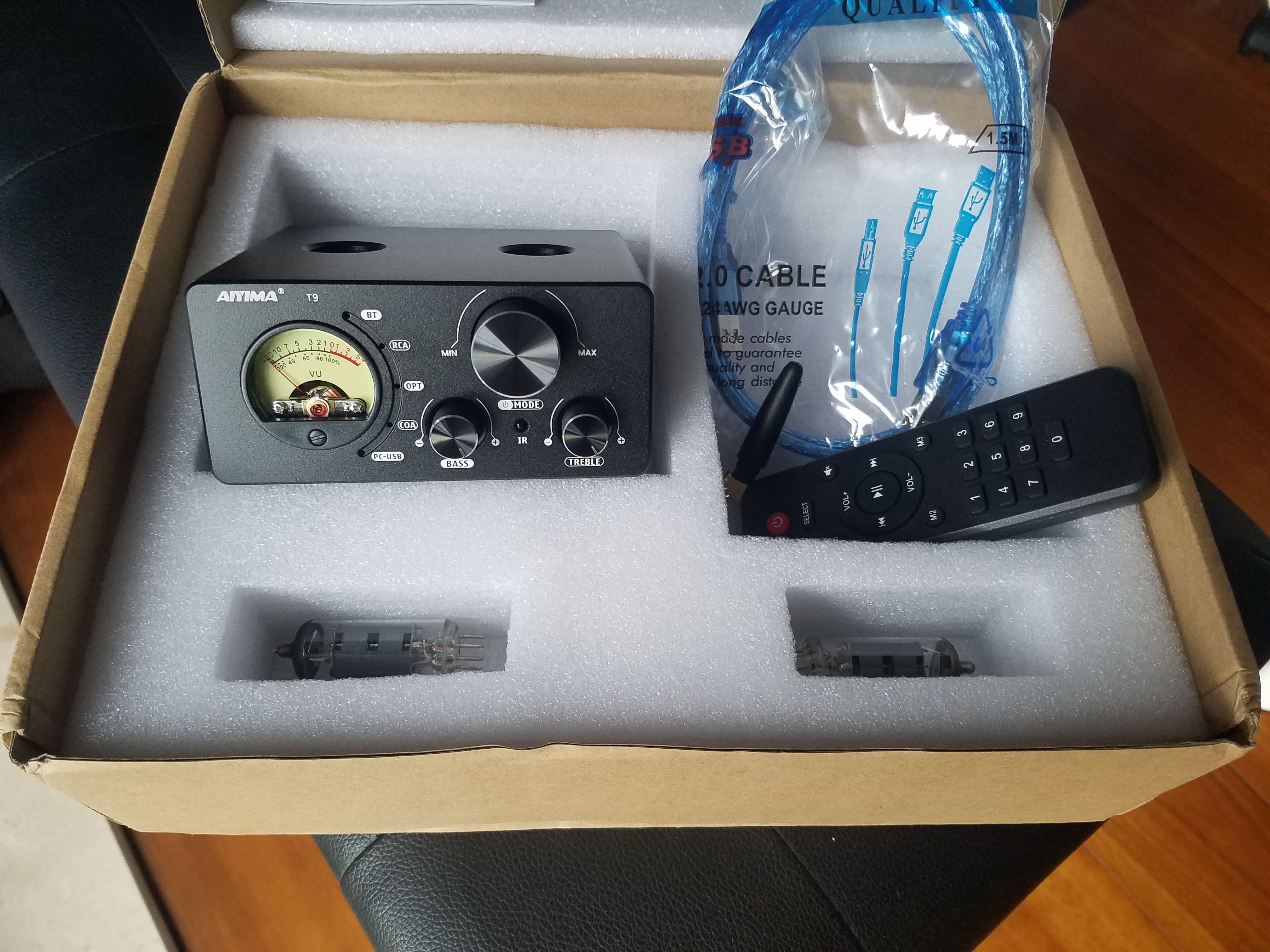
The Package It came in a utilitarian box that is well cushioned, which should survive long distance shipping (but the tubes are just naked in slots that are too big; for long-distance I think they should be bubble-wrapped as any tube filament is delicate and prone to damage if knocked around).

The Hiccup Foolish me! Well, I was so smart as to not order the PS. Who needs another Switching PS? The official one is 24V, but I saw from the pic of the back that Power input says 18-30V, so I was sure that my 19V laptop supply would work. I asked and they said yes. But I forgot about the connector! I have 3 Laptop PS, and 2 simply would not insert. The 3rd (Dell, 19V 3.5A) would, but was loose, so I had to angle it and weigh it down to ensure it does not fall out (see pic; not exactly ideal and I don't advise you to do so). I have Linear PSs (with connector kits) in both NYC and HK, just not here in China! A bummer. Am thinking of one, though!

On-Off But hey, how do u turn this thing on? I finally remembered the remote (batteries AAA x 2, not included, but that may be a good thing as many Chinese gadgets come with lousy batteries that are short-lived and leaky) and turned it on. Actually the Volume Knob (digital; continuous 360 degrees, an anathema to us old timers) has many functions: a short push turns the unit on; more short pushes cycle through the Inputs (it remembers the last Input you used); a longer push turns the unit off. I didn't find that out until later; it's in the manual but I didn't read it - the print was painfully small. Right after Turn On, there is a Relay Kick; a little later, a second one, with a small bump in the meter (the second one is for the amp section, which has to wait for the tube to warm up to ensure there is no DC Offset)

The Supporting Players Now, this is important. What I have here in China are very humble (by my standards), based on a set of more than 15 years old Chinese Sansui AV system (yes, the Japanese sold the name to the Chinese company, which is now a home appliance company) which I parceled out for 2 systems (main one, System 1, in my study, where I write for you; and the much less used auxiliary System 2 in the LR) There are a few extras that I had brought over from HK long ago, the most important being Revox and Sony. The stuff I use are detailed in my previous articles (Current iteration here, with links to earlier config). After some work they sounded pretty good. After listening to the systems for years I thought I knew them well, but what happened told me it was not quite so.

Source As I'm a classical fan I mainly use my low-end Chromebook to stream Naxos Music Library (courtesy of NYPL; described here). Here in China, especially with Jazz and Pop, I augment with Kuwo (here) and sometimes Spotify (which requires VPN), streamed using my HP laptop running Windows (now 11). I never use my smartphones to stream. Let me remind you that I mostly stream now, but I do have some good CDs and a very good CDP (Sony), but that will not feature in Part I.

I had really thought the review will be quick and to-the-point, so I didn't really want to uproot my systems unduly. Events proved me wrong. And so, I have decided to tell you my journey in a compulsively chronological manner (I do this only with the best gears). I hope you don't lose patience.

ROUND 1 As Integrated Amp into Sansui Bookshelves (actually Rear AV loudspeakers)

I poached these from my System 2. This short session is basically just to check functions and wellness. Due to several comments about the relay kicking in and even strange noise etc, I played safe and hooked up the Aiyima to these expendables. No catastrophe. Aside from the 2 Safety Relay Kicks at Turn ON, cycling through the Inputs you'll hear 1 kick for each Input. Another when signal plays through the selected Input. This seems quite normal to me. To clarify, the relay kicks are soft, and within the device, not through the speakers. For me, it's nothing; mind you, when I use my laptops on my desk (hours a day) I actually sit between the loudspeakers and listen to them like large earphones and the T9 is right at my elbow. More on the Relay later.

For connection (see right pic), as I didn't want to break my main system connections, the only loudspeaker spare cable I had was the Mogami 3082. As the strands are too thick for the tiny binding posts, I had to build adapters using short and thin strips of generic loudspeaker cable and screw them and the Mogami's onto terminal blocks (see my article on this here). BTW, please note the satiny finish of the chassis - very classy!

Out of the box, everything was well. Sound was pretty good. I was impressed. I briefly determined that everything worked properly. As there seemed to be no issues, I was eager to move on from this ad hoc solution.

ROUND 2 As DAC/Preamp Out Through my Regular Floorstander System (System 1) 

THIS is a BIG JUMP. I used the exact same 3.5mm to RCA adaptor and MIT cable I use for my Meridian Explorer, through T9's AUX OUT. Of course, I removed the loudspeaker cables from T9's binding posts.

  • The VU Meter The regular System goes through the Revox Preamp, which has its own volume control. What I usually do is set the Revox Preamp to a ballpark area, and set the laptop volume to around 70-80%. For classical music I usually don't have to do much adjustments. If I need to I just do it on the laptop. Now, how do I adjust the volume pot of the T9? Well, I am not sure what's the "right" way, but I did it this way. I maxed out the output on my laptops and used the T9 volume pot. I made sure the loudest passage did not go beyond +3 in the red. For classical albums, this is easily established. But if you listen to podcasts of songs with widely different recording levels you'd be busier. Note that this meter is like a McIntosh power amp's meter, as it assesses the amp's output as a whole. It is different from that on a professional preamp (or mixing console), such as the incomparable EAR 912 that I had previously (here). With the EAR, the meter gauges the incoming signal and would go into the red on those horrible over-hot CDs even when the volume knob is at zero. Not so here. You may be curious why I don't just connect the T9 to the Revox amp directly. Well, two reasons: this way, I can match it against the Meridian; and the Revox amp is harder to get to (may do that in Part II or even III).
  • vs Meridian Explorer Now I am a great fan of Meridian and think highly of this musical little device (here). The difference is instantly audible. The Meridian seemed a little livelier and airier. The T9 seemed (the italics are deliberate because of a later finding; hang on) slightly darker and slightly slower, especially on pop material. It was highly listenable and I began listening to many familiar recordings. It became clear that the T9 is better in one respect. The T9 somehow brings out more of the background players. Whether it is the double bass or violins or amplified electronic keyboard, there is more texture and harmonics - the instrumental envelope just seems larger and better defined. I find myself repeatedly caught up by these little “background” details and sometimes they seem to steal the limelight from the soloist (vocalist or pianist or violinist). For an experienced audiophile, this is something that cannot necessarily be bought by money (too much garbage high end out there - the majority I’d say).
  • USB vs Bluetooth For the USB connection, I used the supplied USB A to B cable. The difference is also instantly audible. They sounded more similar than different, but the BT seemed to have a little more air. I started to wonder about the supplied USB A-to-B cable (in Chinese they also call it the Printer Cable, as USB B is what many Printers employ) but, hey, the thing is not burned-in (more later). BTW, the T9 Bluetooth only pairs when you select it, which imho is a good thing (I usually turn off BT on all my devices and only turn on when I need to use it - there's already too much interference in our environment), but that means you have to select it before you pair with the device. Once selected it seems to be memorized - if you switch to another input and then switch back to BT, it will automatically reconnect (provided you haven't turned off the BT at the source).
  • Tone Control In this configuration, particularly with the USB input, I dialed up the treble a couple of notches (it is indented and the feel is good) to give a little more air on top. It is very effective. No need for bass adjustment as my Floorstander has excellent bass (in both extension, weight and definition). Remember the tone controls are in the digital domain and are “in circuit”, so there is no reason not to use them. Think of them as kind of like dithering, but this is more effective imho (I don't usually like the Filter manipulations and actually harbor at least a little contempt for high end digital products that offer a few to choose from).

I got the feeling that this configuration sounds a bit like a tube system (including the feeling of being slighty slower), and I am a tube man! I was satisfied.

ROUND 3 Back to Integrated amp and Bookshelf (as in Round 1) 

In contrast to Round 1, this time I listened seriously for much longer, in the hope to find out more about the amp section.

  • Bookshelf vs Floorstander As they are part of the same AV system with the same tweeter, you would expect them to sound similar, and I thought they did (see also Round 4). Of course, the bookshelf is not as extended on either end of the frequency spectrum.
  • vs Round 2 There are at least two major differences. The First is that the feeling of mild darkness or slowness or a tube-like aura completely vanished. Yes, the T9 has normal dynamics and Rhythmic Finesse. Those perceptions are therefore at least partly attributable to the Revox system, but also partly possibly due to the complicated Gain Structure of Round 2 (more on Impressions, Comments and Thoughts). The Second nagged at me a little: as I played more tracks, some albums just did not meet my requirements (like the Piazzolla described in Music Used near the end), especially with the USB, even if the difference between USB and BT had narrowed a little. The gain in speed and sharpness was not enough to compensate for the loss in musicality. So, again, I had some doubts about the USB cable, and so I ordered two adapters (more below).
  • Chromebook vs Windows I started to play some Jazz and Pop music, using the Kuwo App on my Windows laptop (many Apps do not have Chromebook versions; I am probably the only person in China using one; most Chinese don't even know about Chromebook). The sound was often a little disappointing, and not quite as good as the Chromebook (I confirmed this by playing some classical tracks that I had played before on the Chromebook). I thought I had noted this and remarked on it before, but I cannot find it.

Suffice to say the results were not perfect but using the whole amp was encouraging enough for me to push on to the next and important step. I could say more in this section but the thoughts are better spelled out in the next round below.

Note the "Triple Threat" Unitek USB cable (brown). Below it is an improvised folded paper spring clip to secure the loose fitting PS plug. To the right generic cable for hooking up to the electronic keyboard. To the left of the T9, the diminutive Meridian Explorer. Far left is the MIT cable and 3.5mm adaptor used in Round 2.

ROUND 4 As Integrated amp with Floorstander 

Finally I capitulated and connected the amp to the larger loudspeakers (still with the Mogami cables).

  • vs Bookshelf Unlike in Round 3, I was shocked by how different they were! The Floorstander of course has more extension at both ends and dynamics, but I only then realized that the balance of the Bookshelf (AV Rear) is darker. In fact the system sounded just too sharp now and even gritty in the treble. After a few tracks, I decided something had to change.
  • Loudspeaker Cable Swap (Sansui vs Mogami) I know from previous use that the Mogami 6802 can be lean in certain systems (as when it was tested in my System 2 in the Living Room; this is why it is a spare cable). My Revox amp is still wired to the Audioquest CV8 but I didn't want to dismantle it yet if other ways could be found. In desperation, I appropriated for use the generic Sansui Loudspeaker Cables from System 2, as I know they are warmer sounding. These have bananas which can insert into the T9. No more Terminal Block. YES! A success but not quite a Bull's Eye. It took a little time to settle in (haven't been used in a long time) and now at least I could sit down and enjoy music.
  • vs Revox System Although the tonal balance was now restored to near normal, music played still lacked that last once of magic that the Revox system had provided in Round 2. I knew the Piazzolla could sound better still, but I was at least pretty satisfied. I went to the library to continue to write this article. Home is too distracting (ELO and I went back and forth on wechat with each finding). And the library has free air-conditioning). :-) I periodically checked my smartphone. Goodness, the USB adaptors had arrived in less than 24 hours! I couldn't wait to test my theory.
  • Menage a Trois Unitek vs Stock I have long used Unitek USB cables (in China 优越者) and had written about them (here they beat the well regarded Belkin Gold and others). I still have a Unitek USB A-to-B in NYC, but here I only have the Unitek A-to-Mini (for the Meridian). Here on Taobao there are almost 20 kinds of USB adaptors, but not Mini Female-to B Male. So I ordered 2 hemaphrodites to make one: Mini Female-to-A Male, and A Female-to-B Male. The copulation is positively pornographic. But as soon as I switched to the Triple Threat Unitek, I knew my work was done! Yes, it's that incredible. Things just opened up and background instruments re-acquired their larger envelopes. More sweetness and subtle inflections. And yes, Piazzolla is back too! Now, it sounds very close to the Revox system in Round 2, but with faster transients and just a tad less "tubiness". Later, I found out the B version of my particular cable can be found on Tabao but in undesirable longer lengths (for printer use); I'm sure with more work I can find a 1 m one, but, unlike many of you, I hate scrolling on my Cell. I'm not even sure that's needed. Despite the Menage a Trois, the musicality seems intact. USB vs BT Finally, with the cable change, USB performance surpasses the BT (a little more detailed and textured), but it's commendable that the BT is very good. All of you probably have your own favorite USB cable, so I'm not worried here. Next round maybe I'll match it against ELO's Kyoeon H-9 (I have a feeling the Aiyima is better). In fact, I feel the Aiyima is worth the price even if it just has the BT.
  • Line (RCA) In I tested this briefly with the Electronic Keyboard on my desk. Sound is good, but quite different than through the Revox system (cabling are different), more like a Bosendorfer to Revox's Steinway. Shall test it more usefully with my CDP in Part II or III (which can also test the Coaxial and Optical Digital Inputs with Red Book CD 16/44.1).

I am now completely satisfied with the Aiyima in my modified System 1 and am streaming with a smile. Everything is good and that little bit of tube sheen is highly desirable. I shall conclude Part I. In Part II I shall likely be using the T9 as Preamp in my Living Room System 2 (which is why I bought the T9 in the first place). For that I shall restore my original System 1, which would be a real test. The last A in ABA is always more important than the AB. Now for some tidying up:

Comments, Impressions and Thoughts

  • Relays IMHO this issue is way over-blown. I stopped and restarted tracks (even counting to 10) to test this and the Relay never kicked. But, after a longer period, yes, the Relay will kick in periodically. Why is that a problem, I don't understand. Also, when the laptop (or your cell) crashes or needs to restart, the relay may kick in a few times as the USB or BT outputs stop and start. That's fair enough. For the great sound on offer, don't let this be a deal breaker. It's your loss.
  • Tube (and Noise?) The tube is actually part of the good sound, as is most often the case. My own feeling is, this 6K4 tube, a new one to me, seems like a great sounding tube on its own (likely sweeter than the Chinese 6J1, 6N1 and 6N3). I may get some JAN 5654 for fun later (too bad my NOS 6AK5, including WE 403, are in NYC!) Mind you, none of these are exact equivalents, just pin compatible and similar. Electrically, they are a little different but used as a buffer the differences are likely unimportant. Think of tube swapping as potential fun, but with something like the T9, even the stock tube sounds mighty good, and quiet. Noise? There are worries about so-called noise. My unit is quiet as a mouse. From the description, I am pretty sure these were caused by faulty tubes. Most of the people who buy the T9 are not really seasoned audiophiles, and many probably encounter tubes for the first time. Now, one must make sure the pins are straight and orientation perfect before attempting insertion (2 of the pins are farther from each other on both the tube and tube socket, and perfect alignment and smooth insertion are a must. Even a little forcing can harm the pins (and crack the vacuum). Also, for these tubes that are small in diameter, the pins are more slender than usual, and they may rock a little even in socket. One of mine is a little looser. That's par for the course. Now, there are probably at least hundreds of T9s around (lots of them in inexperienced hands), and only occasional tube failures - that's a rate that is likely better than astronomically priced hi-end gears. If you read Stereophile (or TAS etc) you would have encountered quite a few reviews of hi-end stuff delayed or even marred by tube failures (and they don't sell that many). See, even with a tube tester (lower voltage than actual operation) and normal results, faults can still develop in use. Happened to every serious tube user. Don't let this deter you.
  • Volume Control I must say I am not a fan of this kind of continuous rotation digital controls but they are part of the norm today. You never know where you are. The unit at first starts at rather low volume and sometimes you cannot even hear the music initially, but it then remembers your last volume choice if you are using the same Input.
  • Comparisons with Similar Gears If I were in NYC, I'd have even more fun comparing the T9 to both my FX TUBE-01 (here) and SMSL Amp (here). And I'd have more tubes to play with. But, based on what I hear here, I am more than confident the Aiyima is at least comparable (if not better). I actually think the Aiyima is sweeter than both, especially the Preamp Out compared to the FX (even with better tubes).
  • Comparisons with Other Integrated Amps Actually, this is in response to ELO's question. He asked me how does the T9 measure up to bigger and more expensive higher end products. A good question, as it can put the casual reader into perspective. Well, first, I am not impressed with the modern "hi-end" integrated amps. Those I have personally heard were from before the digital input age, before digital amps. I have heard plenty then, including Audionet, Burmester, Copland etc, and there was NONE that would make me trade in my NAD 3030 and Nait I or II (or 47 Labs; or MF A1, not that I still have most of them). In fact one of this blog's perennially most-read article is my integrated amp survey (here). And now, many hi-end makers are taking the digital route. Yes, I have unfortunately heard not so long ago the Goldmund digital amps and I think they are awful. My own feeling is, for a T-amp, Class D, digital whatever, I'd NEVER consider an expensive product. Cheap and cheerful is where I'd stay. Now, would I replace my NAD 3020 (large number of entries in this blog) with the T9? No, but I'd gladly use the T9 in lieu of the later 315BEE (here) or Micromega IA-60 (here) etc. Would I use the T9 instead of Nait I/II? No, but I'd gladly use it in lieu of Nait III (here) and beyond, and probably Cyrus I/II (I have not experienced the earliest plastic I). For many readers not into buying second-hand equipment, the ridiculously cheap T9 with its full connectivity is a no-brainer. Mind you, for the last 2 days (since the USB cable change) I have streamed many albums and I have no complaints at all - everything is in its right place.
  • Comparisons with DACs and Preamps I think this is actually an even more relevant question. All these digital amps (including so-called high-end ones) probably sound more similar than different in their amp section (the more expensive deliver more and perhaps "cleaner" power, but that certainly does not necessarily mean better sound, especially if you are using more efficient loudspeakers). In truth, digital input probably also has advanced so much (on a broad basis) that it's likely equally difficult to tell the difference between high and low end. A single chip can do so much now it's really astonishing, and I think the T9 proves the case. In this Part I, I have basically assessed the Digital Performance against the humble but excellent (and more expensive) Meridian Explorer and mostly I think the digital decoding in T9 outperforms it. But I hesitate, because I shall later revert back to the original system, and that is often the truest test. Mind you, I hold my Revox combo high in esteem. Regardless, the T9 is astonishingly fine in its digital abilities.
  • LoFi? Files Yes, I am streaming low-res files here through laptops. How does that justify the high end pretense (I have none; just in case that's your feeling)? Regarding low-res files I tell you: everyone is using it on their cellphones, including all reviewers, especially when they visit setups of others. And if the user has the same files in high-res at home, he would develop a correlation between the two and adjust mentally. In my case I have listened to many albums that I have on LP and CD through NML. In most cases, with a good system (such as my regular streaming systems in NYC and here in China) I don't feel short-changed and often hear things I have never heard before. The Gulda album is a case in point. I knew immediately if something didn't sound right (see below) and its beauties never stops to astound me. Devices Whether you stream on Smartphones or Laptops, the device has a sound and each is different. You should try them all and see which ones you like better. More below.
  • The Gain Structure Most devices don't give out spec's on the sound output, or at least I have no idea what they are on my 2 laptops. Add to this that the Apps have their own Volumes (and EQ), and it's kind of complicated. You should always experiment with the Device Volume, App Volume and the Volume Control(s) of your equipment. This is why in Round 2 I'd not entirely attribute what I heard to the difference between the Revox and Aiyima. There are too many Gain Controls that one should be cautious. This is akin to some older preamps or integrated amps that have separate Gain and Volume Controls (ARC and MFA come to mind), and many experienced audiophile swear by using both. I assure you, for any final volume, the sonic difference between 1) maxing out the source and attenuating the amp; and 2) maxing out the amp and attenuating the source; is HUGE and beyond pale! Sonic advantages can be had by paying attention to these parameters. In Part I, I am not doing that.
  • Power Input Aside from the less than snug fit, by using my 19V PS instead of the stock 24V, the Power Output is less. I asked Aiyima and they said maybe 10 Watts less. It is fine as is, but I think I'll get their 24V PS (or an LPS) in due time to bring it up to spec to complete the picture. As it is, the unit is quite warm to touch, but not very hot. Effect on the digital sections and tube should be small to minimal.
  • Chips, Parts and Build Quality As an Amazon customer remarked, the Chassis is positively luxurious. The surface has a satiny and textured feel - classy! Parts used are good. The Chips are common and ubiquitous. A little on the heart of the machine, the Chinese 杰理 JL AC6926C chip - I suspect it's a great sounding chip (despite its relay quirks). On this, let me remind you that some of us think the big (and more complicated) brands (audio or chips) are not necessarily better sounding (remember ELO preferred his cheap Chinese device to iFi; rereading it I still want to salute him for his reporting integrity!). In any case, we only care about the result (mind you, we care about the sound and whether it is involving, as opposed to sites that basically just tests equipment on the bench and claim scientific ground, forgetting that the best science serves human needs, not vice versa). The T9 is simply damn good.
  • HiFi Basics - Keep Trying, Keep Learning I think my journey illustrates that one should try out everything one has. In my case, I didn't have much choice. I probably think the Mogami 6802 is a better loudspeaker cable than the Sansui, but it is not suitable here. And if I were one of those "objectivists" I'd certainly frown upon using 2 USB adapters. But proof is in the pudding. We have too many preconceptions in audio and would do well to be more flexible. The experience also let me learn more about my equipment: I learned more about the difference between the 2 Sansui Loudspeaker siblings; I confirmed again my impressions of my Chromebook vs Windows Laptop; I likely have learned more about my Meridian and Revox (to be investigated further in the next round). The Transparency and versatility of the T9 enables all of that - for that it is a Swiss Army Knife of audio.

Music Used There were a lot. Some are old favorites, like La Spagna (BIS), La Folia (Harmonia Mundi). Some are albums that I have recently listened repeatedly to, like Bach Brandenburg Concertos by Il Gusto Barocco/Halubek (Berlin Classics), Beethoven Symphony No. 6 by Pittsburgh/Honeck (Reference Recordings). But for this round several other staples are particularly used by me for testing purposes.

  • Astor Piazzolla The American Clave Recordings (Nonesuch) I used the first 2 tracks of this 3 disc set, where the Master's incomparable Quintet play. Tanguedia III has a sonically flawed and forceful opening that can easily sound congested and heavy footed. Only when the system is at its best (as with the original System I or the final setup of the Aiyima) does it sound more open and lighter on its feet. The Milonga del Angel is a slower piece that should sound sinuous.
  • Mozart Piano Concerto No. 20 and 21 by Gulda and VPO/Abbado (DG). Now, NML has both: the one with the original cover and a a later twofer re-issue. Its shocking how much better the former sounds. The VPO should of course sound splendid with sweet strings. Gulda too is at his finest and the piano playing tests well a systems microdynamics. Tonally the piano should sound more like a Bosendorfer than Steinway.
  • Ruth Slenczynska My Life in Music (Decca) Amazingly beautiful music making by a 97 year-old. Track 2, Rachmaninov's Prelude, Op 32/5 is full of very subtle color shading. The track should sound mellow but not too mellow (lack of microdynamics). And then Track 5, Chopin Grand Valse Brilliante, is even more revealing. The slower tempo brings out much more color and rhythmic felicities - a tutorial on how to play and not rush the piano.
  • In For One to Love, Cecile McClorin .Salvant sings an absolutely ravishing Le Mal de Vivre (original Barbara). She gives a completely new dimension to the song. The subtle use of inflections in her perfect French tests microdynamics.
  • 中文歌我用几个专辑 陈慧娴 秋色千千阙歌罗大佑 爱人同志陈永淘 阿淘的歌。都耳熟能详,差一点都不收货的。

Aiyima T9 Design At the heart of the T9 is the AC6926C Bluetooth chip, which besides BT conversion performs all control functions (volume, tone controls, selector and relay). Digital Inputs go through the MS8412. The 6K4 tube is basically a buffer (the Aux Out does go through it). Amplification functions are carried out by first the NE5532 and, of course TPA3221 chips.

Specs:
Replaceable tubes: 6J1, 6J2, GE5654, 6J3, 6J4, 6J5, 6Ж1п, 6AK5, etc.
Support: MP3/WMA/APE/FLAC/WAV
pc-usb sampling rate: 24bit96khz
Optical fiber/coaxial sampling rate: 24bit 192khz
Bluetooth sampling rate: 24bit 48khz
pc-usb support system: XP/W7/W8/W10/MAC/Linux (add my W11)
Total harmonic distortion: 0.07%
Signal to noise ratio: ≥98db
Frequency response: 20-20Khz (±1db)
Treble/bass adjustment range: ±6db
Speaker impedance: 3-8Ω
Output power: 100W*2 4Ω load

Official Aiyima Youtube