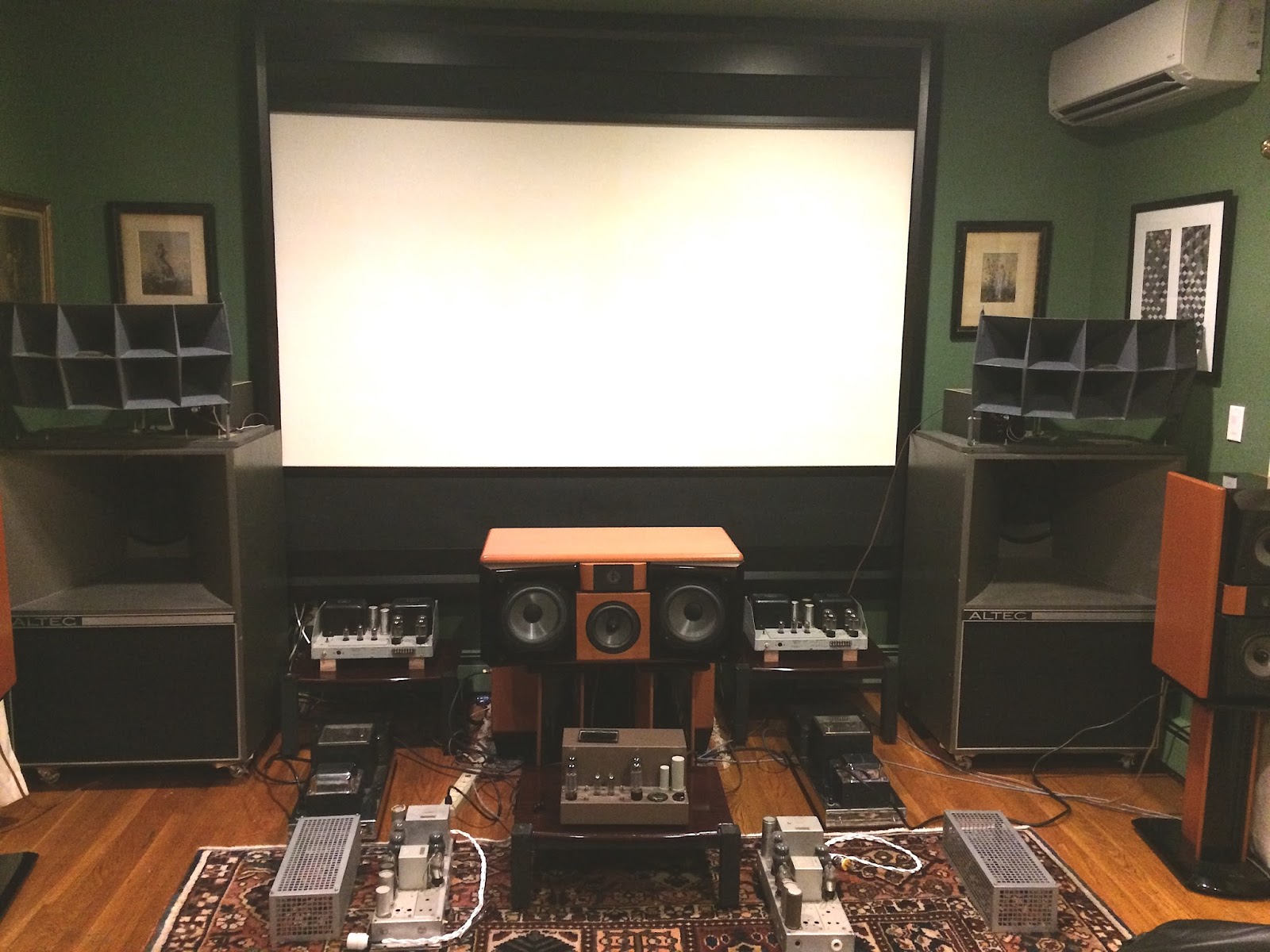
Click pic to enlarge. System is so simple it is self-explanatory.
Caveman
by Audiopro
Editor: If you look at this simple system, it may escape and surprise you that the author had gone through a lot before, including something as different as a fully tubed Audio Note Level 2 System! Sometimes we get more ambitious, sometimes we scale down, sometimes we change trajectory, but whatever we do our ears (and our hearts), not those of others, must guide us. This makes his points even more worthy of heeding. This is also Virtual Home Visits (11).
My quest for a setup began almost 25 years ago. At that time I owned a Sony FH series mini compo and I listened to music that I loved. My foot tapped, my head bobbed. My body swayed. I yelled in joy on some tracks. I clapped my hands on others. My body wanted to dance! I was going by primal instinct, I was a caveman! Then I turned into an audiophile locked lifeless in a chair and began to listen to music that sounded good only on my setup. So what happened?
I moved from the simple Sony system to a set of floorstanders driven by an integrated amplifier and CD player. Suddenly music no longer sounded fun.
I tried cable swaps, power filtering, speaker changes etc. Swapped speakers, swapped amplifiers, CD players, etc. I began buying audiophile CD’s because I firmly believed the garbage in garbage out fallacy. Sounds familiar? Read on!
I call this a fallacy because very often we are told that a high end system will expose a poor recording. It will expose the warts on it but it shouldn’t take away the primal quality of music. The body is sensitive to music. Walk into a store with some music playing and automatically you feel like swaying. Sitting at a pub you suddenly yell out when they play your favorite song. People faint at live concerts. I’d probably faint in fear at a Slipknot [Ed: Heavy Metal Band] concert but that’s different. Why does all this disappear when we sit in front of a multi thousand dollar setup? What happened to that primal emotion that we felt earlier?
Our expectations are set by review articles that said we should look for adjectives like silky highs, airy highs, warm balance, huge soundstage, strong harmonics, etc when judging an audio setup. Jaws should drop. Your wife should drop the cooking and come into the room and say darling what a lovely sound. Unfortunately IMHO those parameters do not matter when it comes to enjoying music.
Musicians are not trained to play a trumpet in a silky manner or to make their guitars sound warm. Imagine telling Ozzy or Freddie to sing with a silky voice. They probably would have popped you on the head for saying that. They train to time right, articulate using different parts of their head, mouth or throat, manage changes in amplitude with their breath (micro dynamics) and to get you to connect with them. Their voice changes depending on their health and age as well. Listen to an older Aretha Franklin and she can move you to tears with her big voice. A good musician connects to your primal instinct that recognizes music and moves you, be it physically or emotionally.
So what matters?
I grew up playing the piano and while I did, music was a function of three things:
1. Timing – this is what we term as PRAT. Get the timing wrong and no matter what you do the music will not engage you. Timing is everything. This is why sometimes an old mono radio (non digital) sounds good because it gets the timing right. Try clapping in tune with a song in your head. Now clap out of tune and see what happens. Music lives in the space between notes.
2. Micro dynamics – The way one hits a key or plucks a string determines the micro dynamics. We always talk about dynamics but it is micro dynamics that are more important. This is where the soul of music lies. How Louis Armstrong blows puffs of air into his trumpet is what gives him his character. Most powerful amplifiers deliver dynamics but miss out on the delicacy of the notes i.e. micro dynamics. They just shoot through them.
If I hit a key softly and then a little harder randomly, it would go ping, Ping, PING, piNG, and so on. The same is applied for singing. Listen to the song Imagine by John Lennon. When he says Imagine its not said in one amplitude IMAGINE. There is a micro dynamic to it. Listen to Goodbye Yellow Brick Road by Sara Bareilles. You should be able to pick out the micro dynamics when she plays different piano keys. This is why Keith don’t go [Ed: Nils Lofgren] sounds noisy on some systems. They just slam out his guitaring at one amplitude and fail to differentiate between the various notes.
3. Tonality – If the piano needed tuning, no matter what I played it'd sound weird. It would either sound too high or too low. A piano must be centered correctly tonally. The same is true of a system. If the system is centered too high it will sound superb on say audiophile female vocals where they swoon and tzz and whizz with the notes. Play something by Neil Diamond and it will fail to engage you. Play rock and you will run away. Play Ozzy Osbourne and…OK you get it!
These are the three parameters that any system I aspire to must have. If it fails in any of these parameters the system will not engage me at all. These are the primary characteristics. Even background music will sound good if it maintains these.
Then there are some other parameters I would add to complete the setup, especially two channel ones:
4. Image size – I have heard many people aspire for a huge image size, huge soundstage - everything must sound bigger than life. When I listen to a setup, I look at the size of the vocal image. Ideally it should emerge from a space the size of an orange or a small Cantaloupe. This prevents multiple singers and instruments from blurring into each other and creating a smeared soundstage. Smearing tends to affect micro dynamics because you cannot pickup individual instruments. It turns towards a mushy sound. We then end up turning the volume up to try and hear through the mush and it sounds noisy. This is also a function of speaker positioning but position a speaker well and use two different amps and you will pick up the differences in image size.
5. Bass – One can never have enough bass. Bass isn’t about going thump thump. Bass conveys the two things – fun and space. The mid bass adds to the PRAT factor. We enjoy mid bass; we enjoy a kick from the drum. Low bass (which is a function of your room to a great extent) shows you space. It adds a feel to the sound. The size of the recording venue, the space around the music. Bass sets the canvas on which music is painted.
I personally look for bass that is drier rather than wetter. A dry bass tends to attack and then has a short decay like a Mike Tyson punch. A wet bass tends to be soft on the attack and tends to go poooooof on the decay. Some call this a loose bass. While a wetter bass may sound nice on audiophile recordings I feel it affects music negatively overall.
6. Harmonics – Most people place this first in their list. They want a harmonically rich system. Tubes! I want tubes! When done right harmonics will move your soul. When done wrong it will get you to move out of the room. Every instrument, voice, etc has its own harmonic structure known as timbre. When you hit a 400hz key on the piano it isn’t playing just 400hz. It will deliver maximum amplitude at 400hz along with a bunch of other frequencies above and below this note at lower amplitudes.
The mistake is done when we expect the system to add a ton of harmonics, thus seriously altering timbre. The recording has to capture the harmonics while the music system must play it back. If the recording has failed to capture it you will not hear it. All systems add colour to some degree. If the system is balanced right (i.e. not too high or too low) it will sound good on a vast number of songs compared to one that is harmonically over rich modifying the timbre greatly.
7. Tube Coloration I have experienced this with tubes. The Telefunken 12AX7 tube is a neutral tube. It adds just a dash of harmonics (like Goldilocks porridge). On the other hand a Mullard tube is harmonically rich but tends to turn into mush. Alison Krauss may sound sublime on the Mullard tube but something with a little get up and go will sound boring and dull.
8. Listen for the singer. To understand this, have a look at this Beth Roars video on youtube (here, or play the video embedded on the bottom of this article). She is a voice coach and she evaluates how different famous singers sing. See if your system can reveal this. A singer is like an instrument. They all have their own set of timbre, pitch, dynamics, articulation of vowels etc. They cheat at times to hide their limitations by suddenly ending a sentence. You should be able to experience their character in your system. It is difficult to achieve this but it is possible.
How I chose my setup:
A system must sound balanced. We often try to balance a bright speaker with a warm amp etc. This is not called a balanced setup. When you do this you may end up with a reasonably listenable sound, but it almost never sounds right. This is because both products are pulling in opposite directions instead of complementing them. The point I am trying to make is try not to buy a product that is too skewed sound wise because then you are compensating for that skew with other products. The less the skew the easier it is to build a system. In theory you should be able to flavor the system with a single component, be it a wire, source, etc.
My current setup is based on my room size. I have a small 11 x 12 feet room with some basic treatment. I picked the ATC SCM19 speakers because they do not over power my room, are neutral and deliver lovey PRAT courtesy of their sealed box design. I cannot stress this enough – do not pick a speaker that is too large for your room! Or the journey will end the minute you hit play.
The ATC speaker doesn’t try and act smart. It needs current, so I recommend using an amp that delivers high current by using more than two transistors per channel. Most amps above 120W at 8 ohms will use parallel transistors and should work fine in terms of drive.
The ATC speaker delivers what it is fed. So by picking a neutral sealed box speaker that delivers adequate bass for my room I am not left compensating for the speaker's skew in sound signature, nor am I trying to compensate for the room.
My amplification chain consists of the ATC P1 power amplifier, which again to a large extent is neutral with a tad of MOSFET warmth in the bass and upper highs. It has enough drive for this speaker. It times well and is dynamic.
My DAC is from Schiit audio – the MB Gungnir. This dac is pretty neutral and dynamic. It is a dense DAC which means it delivers each note with a certain amount of weight. This prevents the highs or voices sounding thin. It is neither harmonically over rich nor is it lean. It doesn’t get confused by complex music and has a wholesome bass.
I use a Sony Blu Ray as a transport and stream Tidal using Chromecast. I may add an Allo transport for Tidal at a later date.
So with most of my chain being balanced neutrally I am left with the pre stage to take the system whichever way I want. This is where I have flavored it. I use a Marantz PM14S1 SE integrated amplifier as the pre. This amp is a HIDDEN gem and has flown under the radar. It’s pre stage is to die for.
It offers superb PRAT and micro dynamics are stunning; it's fluid; image size is near perfect; just the right amount of harmonic structure and a dry bass. It was as if Ken Ishiwata asked me what I wanted in an amp and voiced it that way! This doesn’t sound like the Marantz of old which was warm and tubey with poor timing. This is a perfect blend of the parameters that I look for. If I had to nitpick I’d say it has a tinge of hardness in the upper mids. This amp needs burn in. Don’t judge it on day 1 or it will sound hard. If you can get hold off a piece I strongly recommend you do so. It is able to drive the ATC speaker by itself in my small room but not as confidently as ATC’s own power amp.
Lastly cables – I use simple plain-Jane 16 guage copper speaker cables from Sommer or Supra. Interconnects are simple copper ones soldered by myself. Power cables are stock. Again the idea is to avoid products that are heavily flavoured. Do the flavouring at one level and let it flow through the rest of the setup.
I’ll sign off by sharing the following tips:
1. Try and understand the house sound of a manufacturer and if you like it and the manufacturer builds the entire chain, try and stick with it as much as possible. Example: Rega CD player with a Rega amplifier. Naim with Naim. ATC speakers with ATC amps. Sim audio amps and dacs. This removes a lot of guess work.
2. Match the speaker to your room and to the amplifier correctly. This will break a system if done wrong and no amount of tinkering can solve this.
3. Position your speakers well. Take time to find the spot in which the bass sounds right. Then focus on the image size. Image size at a macro level is primarily a function of the room though equipment, especially amplifiers, affect it greatly on a micro level as well. Complete speaker positioning is beyond the scope of this article but it is absolutely critical in achieving good sound.
4. Keep the parameters discussed in the beginning in mind. Timing, micro dynamics, well balanced sound, image size, etc.
5. Try different gauges of speaker cables. Sometimes lesser gauge wires offers better balance. Get hold of affordable 12, 14 and 16 gauge wires and try them out. High end cables DO work when you are trying to compensate for system skewness!
6. Try and listen to music at approximately 80db with 95 db peaks. This in my experience allows the singers voice to scale perfectly without hardening or bloating or loosing control. This is a personal choice though.
9. Never ever ever ever listen to an audio salesman telling you garbage in garbage out and that the setup he is demoing sounds bad because your CD’s are poor. If the system delivers on timing, dynamics and is well balanced, majority of poor recordings will get your foot tapping. Listen to a talented homeless man sing or play a cheap guitar on the street and see what happens to your foot.
10. See if your foot taps and head bobs when you listen to a system. If the system is setup well it will connect with your primal instinct and you will enjoy the setup. It will grow on you. Bass, treble soundstage, this parameter or that will no longer matter because the setup connects with your soul.
11. Pay attention to your equipment support. The material the equipment is placed on will shift the tonal balance slightly. This happens at a micro level. Place your amp on the floor, then on a stool, then on a rack and you will notice it sounds RIGHT on one of them. Avoid placing equipment one on top of the other. I consider equipment support as part of my system setup. I do not use expensive racks, but I do have different base materials like wood and granite, which I use as a final balancer for my setup.
12. Lastly, as our friend Prem says (his system the JBL4343 has been featured here too) “Don’t think of sound as warm, big, soundstage, silky treble, tight bass, etc. Think of it as tone, timbre, dynamics and presence.” The former are audiophile parameters, the later primal ones.
Welcome to the Jungle!


:format(jpeg):mode_rgb():quality(40)/discogs-images/R-2331159-1300902923.jpeg.jpg)
:format(jpeg):mode_rgb():quality(40)/discogs-images/R-4691955-1372401904-8605.jpeg.jpg)


 Posts
Posts