Reisong 1:1 Signal Transformer, Part I
Updated 4/1/24: Links repaired, UMI versions clarified.
Updated 4/1/24: Links repaired, UMI versions clarified.
First: A Re-Cap and Summary of Our Ongoing Tests of 1:1 Signal Transformers

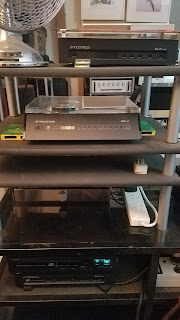
Reisong 1:1 Transformer It's about time for a formal write up! This thing (in fact, 2 of them) had been in my Shenzhen system for the longest time. One between the DAC and Preamp; the second between the Preamp and Amp.
Regular readers would have read bits and pieces of the Reisong in my various articles. Basically, this blog is kind of a journeyman's diary, where gear are in flux and subject to further evaluations, opinions not set in stone as in trade mags. For those less avid readers, or those new to the topic, here is the Timeline in this Blog for the Reisong (almost 2 years, LOL!), and you need to read very carefully to pick up all the salient points:
- 1) A long time ago my know-all friend, taskmaster and torturer icefox informed me of the UMI 1:1 Transformer (then between 1st and 2nd gen). I had always been around transformers, including Input and Interstage Transformers (which can be 1:1) and was interested. Note that icefox and his 富贵 WE friends all use the rare and formidable vintage 天花板 WE91A.
- 2) I first tested the waters with this Reisong Transformer, which is significantly cheaper than the UMI. My impressions were favorable (as quoted below).
- 3) I bought one of the 1st gen (UMI 1 or v1) UMI for our writer ELO, and tested it myself. It was hard for me to choose between the UMI 1 and Reisong (as quoted below).
- 4) In my 2022 Year in Review I expounded on this topic and the gear. Remember China was still in lockdown and Border Control was not what it's now. I wrote: "...yet to be written up, kudos to icefox (his crowd use the rare and expensive WE91A), I started playing with 1:1 transformers (the 1:2 and even 1:3 versions are for cellphone and BT users who need the extra gain, beware). Used between source and preamp, the difference is so sharply etched it’s mind boggling; used between preamp and amp, the improvement is a little less but still obvious. I’m using 2, in both positions now. I have the fortune of experiencing a new kid on the block, UMI (bought it for ELO), which has truly superior bandwidth but, at least between the DAC and preamp, my heart tilts just a little towards the older and more old-world sound of Reisong (available on Aliexpress). This is not at all the first time I have transformer coupling between stages. The excellent EAR 912 that I had has transformer coupling at every stage (input, output and interstage)..."
- 5) ELO finally got to write about it (LOL near the end of 2023! here). I was very happy that it basically transformed his journey! I editorialized a bit: "...Where should this thing be used? Well, basically it's an impedance matching device and those who use long interconnects (like I) shall reap bigger benefits. I think the greatest effect shall be between source and preamp. But, effect can also be heard between preamp and amplifier. Think about this, many HIGH-end products employ Input and/or Output Transformers (a great example would be the EAR 912)...Well, for sonic findings I must say I completely concur with ELO. I also found it astonishingly detailed and the stabilizing effect highly beneficial to the system. I also found it was a tad cool in my system. Mind you, I also had the much cheaper Reisong 1:1 counterpart, which I have mentioned now and then but never really formally reviewed. That's for a reason. In my system, I ended up using TWO, one between DAC and Preamp and another between Preamp and Amp. The Reisong saved me a lot of money and has a much smaller footprint. BUT, it's a fact that the UMI has superior bandwidth. Whereas, the Reisong is a little warmer and more musical, though some will find it a bit rolled off at both ends. I had only heard the UMI brand new (and not run in) and I still pine for it after its departure. I suspect I shall get a unit at some point (especially after ELO's opinion). It's not often that one hears a transformer that is so transparent - consider it a job very well accomplished. Would be curious to hear the Mk II also..."
- 6) I finally got an UMI 2 myself (2nd gen or v2) for testing. It went between my DAC and Preamp for the longest time. Some of my friends in NYC also got theirs. Their opinions are fascinating too (yet to be published)!
- 7) I wrote the formal first of my UMI 2 article in Chinese (here). Basically it's a review of the function of a 1:1 Signal Transformer.
- 8) Further Testing of my UMI 2 in my HK home (here)! With hyper-critical icefox and Taimonsing! Great stuff! I left the UMI in the hands of Taimonsing to circulate among his friends.
Have I lost you? This is a strange way to start a formal Reisong Review. There's reason behind the madness.
Reisong redux in Shenzhen I After I left my UMI 2 to my HK friends I hooked back in SZ my Reisong between the DAC and Preamp. What did I perceive? Perhaps, compared to UMI, the sound field has shrunken just a little or perhaps the dynamics appeared slightly more restrained, but things were still in good order. Smaller formations, solo instruments and quartets etc sounded luxuriant, likely even more so? This is a small setup in SZ and I was OK with the music, not being in the critical mode most of the time.
Reisong redux in Shenzhen I After I left my UMI 2 to my HK friends I hooked back in SZ my Reisong between the DAC and Preamp. What did I perceive? Perhaps, compared to UMI, the sound field has shrunken just a little or perhaps the dynamics appeared slightly more restrained, but things were still in good order. Smaller formations, solo instruments and quartets etc sounded luxuriant, likely even more so? This is a small setup in SZ and I was OK with the music, not being in the critical mode most of the time.
Reisong in HK I (chez moi) Lest you think I'm hopelessly laissez-faire, after I tested the UMI 2 with my ultra demanding friends (but 同气, as above, here), I took the Reisong to HK and tested it at my old house, all alone. Like the UMI, the effect was there and the same in quality, but smaller in magnitude. In Station A, between the Revox C221 CDP and MFA Magus Preamp, there was a stabilizing effect but not the expansion felt with the UMI.
Then came a pivotal event. In Station B, inserted between the Micromega Solo and the Melos 222 Preamp, the vast, airy and layered soundstage (here) disappeared and was replaced with something re-constructed, which was something more upfront and less dimensional, but more horn-like if you will (let me emphasize that I did not notice this at all in my SZ setup, which has a good soundstage even if it's smaller than the one in HK by nature of the smaller space). I was literally floored! Although supposedly a negative experience by audiophile parameters (particularly since I'm primarily a classical music person), I was still intellectually stimulated by the transformation. It was late at night and I didn't spend that much time on it (should have played some classic jazz, which is not so soundstage dependent). But, it left me with no doubt that it's an affirmation of the potent effect of the Signal Transformer. It all depends on how you use it! I'm sure, when I get the chance, I shall repeat the experiment with the Micromega connected to the UMI! I suspect the result would be similar, but I'd be glad to be proven wrong.
Lest you think I got deflated by the experience above, that was not so. The next day I took it to Taimonsing's place (the RCA vintage guru;).
Reisong in HK II (chez Taimonsing) I specifically took the Reisong to Taimonsing. We first listened to his fabulous amps, used as integrated's (here). Then, one by one amp, we tried the Reisong between the source and the amp. The effect was all positive! A firming up of tone here, a little expansion of the stage there, all without taking anything away from the inherent qualities of the amps on offer (and what qualities!) Taimonsing expressed his opinion that the Reisong is basically neutral to him and hardly alters the signal (less than the UMI he thinks; and he thinks the UMI has a slight silvery edge). My view? In his place the Reisong certainly did no harm, only good. In particular, Taimonsing was very gratified that with the LP playbacks the Reisong provided a firming up that he was looking for. As it seemed he preferred the Reisong to UMI I left it to him for further evaluation.
Reisong redux in SZ II As I left both my UMI 2 and Reisong in HK, I am only left with one Reisong in SZ, which I use between the DAC and Preamp; which is to say, there is no Reisong between Preamp and Amp, so the cabling is different too (when I had two, I used an extra Sommer SC Club II). I had been using two for the longest time! I didn't A/B but I'm pretty sure it had a small but noticeable detrimental quality to the sound (so a 1:1 between Preamp and Amp still matters!).
Thoughts
- The Benefits of Transformer I think it's very useful (my article in Chinese on general principals here; ther are more to come). Think about this, after my initial good impression I ended up with two Reisong's (after I heard the first one I bought the second), between the DAC and Preamp and between the Preamp and Amp. When I got the UMI 2 I tested it between the DAC and Preamp, but I still had the Reisong between the Preamp and Amp. In the last paragraph above, you can infer that I am a confirmed user of two (even if I'm temporarily without), even if the one between the preamp and amp has less effect than after the front end (but less does not equate none). If one's amp is a true integrated, with an active gain line stage (much rarer than amps with a passive volume knob masquerading as integrated; Taimonsing's amps featured in the last article all have an active preamp gain stage), one uses only one. But, keep in mind, many cost-no-object designers use interstage transformers within the amp, which is like inserting a transformer between preamp and amp. Wherever it's in the signal path, the trannie of course has to be of good quality; otherwise, negatives from bandwidth limitation to other anomalies will rear their heads!
- The Character of Reisong To me, the Reisong is temperate and subtle. Compared to the UMI 2, it is a less upfront in its personality, meaning it's not prone to show off. In this respect, Taimonsing's view that it's more neutral is tenable. What is fascinating is that I view the Reisong as a little more luxuriant sounding (and hence one can interpret this to mean it's less neutral). This may boil down to the difference between systems. Here, I'd like to point out that, initially, even if I possibly preferred the Reisong to the UMI Mk I, I thought the Reisong might be a little rolled off at the top. Here's a little input from my NYC friend Andy. He thought that, compared to the WE 111C, the Reisong is rolled off too (but his downstairs horn systems are rolled off to begin with). However, let it be known that in my systems (both SZ and HK) now, with the Reisong's having had hundreds of hours of play, I don't feel at all there's any significant high frequency roll-off! I suspect that the Reisong needs more run-in to sound its best. I'm still perplexed by the Micromega Solo experience mentioned above, and wonder if the loss of spatial clues is tied to some kind of frequency anomaly, even if I don't feel there's any indication of that when listening (certainly not Taimonsing either).
- The Character of UMI 2 To me, the UMI is more dramatic. It seems more extended at the frequency extremes, and the way it expands the sound field and ups the flow and excitement factor is like grabbing one by the balls. Compared with the Reisong it almost certainly has a little less midrange richness (that is not a trade everyone is willing to make). Taimonsing said he has reservation about the smidgen of silver touch (the UMI supposedly has a little silver wiring inside). BUT, to me, and our writer ELO (who has the very similar Mk I; his views here) we love the drama it provides. Here's another interesting feedback: my NYC friend Andy thinks of the UMI as somewhat beautifying, even in his upstairs full frequency system; whereas I don't feel so (likely ELO and Taimonsing too). This leads me to ponder what exactly is beautifying. I think, perhaps expanding the sound envelope itself, which the UMI certainly does (more than the Reisong) is an act of beautifying...Fascinating! Also, the UMI didn't seem to need more run-in.
- UMI 2 vs Reisong The reason why I have left these in HK for friends to test is because personal responses are inconsistent (as in audio in general). Taimonsing was initially quite impressed by the UMI 2 but later preferred the Reisong. Andy in NYC (and freiends) seem to be impressed more by the UMI 2. And I? Well, I like both! I think the result one gets is system and gear dependent. That said, I think both will bring improvement to most systems. Keep in mind that the Reisong costs just a fraction of the UMI 2 (not that the latter is unaffordable). I also heard through the grapevine that they also compare favorably with the much more expensive local 潘氏.
深圳莲花山公园外眺,可以看到弧形的市民中心和地标平安银行大夏



.png)
.png)
.png)
.png)
.png)
.png)

 Posts
Posts