Showing posts with label Brand-Elekit. Show all posts

20 May, 2023

Elekit TU-875

Review: Elekit TU-875, Part II
Letter from Hong Kong (23-6): Terrence Lau on Elekit TU-875

Editor: Reader Terrence Lau submitted this as a comment, but it's substantial enough that I took the liberty of additionally publishing it as an article, to keep the flame burning, so to speak. Many thanks for the detailed write-up!

The Elekit TU-875 is by now legendary. Many in the West look for it but finding it is very hard for them. HK people are lucky in that we could easily buy Japanese second-hand. The coverage on TU-875 is piecemeal in this blog, but I urge you to read them!

My early Elekit Overview (here) can be viewed as Review, Part I. For the sake of simplicity, I shall call this current one Part II, even if it comes after many of ELO's more recent articles on the subject, which likely triggered TL's interests.

ELO's articles are harder to classify. They were written in a Diary-like Systems Context. It pays to read
them carefully. The first one documents his Search (here); the second the full evaluation (here).

I got one in mid May 2023 in Hong Kong from a fellow on the review33 site. He was a very polite and nice guy who is similar in age as I, so we had a good chat at his home when dealing. 

It was an original Japanese domestic kit, unopened, and the seller said he had bought it in Japan himself. It had Jan Philips 5963, contrary to what I had seen previously on some YouTube videos where the kit was shown for assembly process with 12AU7EH. What a treat.

At home, it took me the best part of a day to assemble the thing. I made several mistakes in soldering one diode and several D170 triodes, rendering the unit inoperable upon “completion”. During checking I found the upstream PSU and tube boards were OK and concentrated on the lower main board. There I found my mistakes, having reversed the polarity of those parts that I mentioned. After repeated checks, it got to work finally.

It wasn’t difficult to note the “faster” sound of the TU-875 compared to my other preamps, both tubed and SS. Compared with my McIntosh C11 and C20, it sounds so airy and the background is so hiss-less that I had to turn up the volume up to max to confirm this performance. Really, Kudos to the designer of this kit working on a meagre but applaudable 7 volts 1.7 ampères little power supply case (the wall wart doesn’t even qualify to be called a box).

In stark contrast to my McIntosh and my Conrad Johnson PV-8, both the MM and the Line Sections.sound clear and quiet, without being too analytical, but giving huge level of detail and certain warmth in sound.
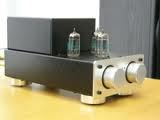
Harmonics are good therefore, and I found it easily to live with, especially for tube rolling. The front single tube is for the line amp with average amplification, while the two tubes near the taller cover on the back are for MM stage with really huge gain as I found out with my trusted OM-3 pickup. I haven’t had the chance to test out the MC stage yet but opinions have it that it should sound just as sweet as does the MM stage as it is built with two J-FET ICs. I’m not doubting.

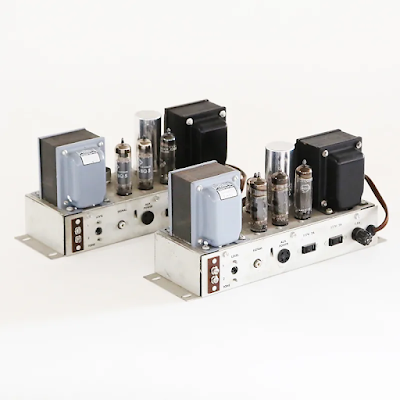
In pairing this preamp I noted it relatively prefers a power amp with lower damping, for the sound to gravitate towards the bassier side of the spectrum. So, it should be paired with a tube amp such as McIntosh MC240, or even an EL84 one. The TU-875 works spectacularly well with my Ampex 15-watt mono tube amps with 6973, often referred to as the Ampex 6973 mono amplifier. Not to be confused with the stereo version from Ampex, this mono amp was built for 16 ohm loads, the stereo version being for 8 ohm. Alternatively, I will try it with my Nakamichi PA-700.

So my take is that, nowadays, while it's difficult to source as NOS un-assembled, the TU-875 is holding up well in its performance and even at the price I paid, for US$400 in sum, it is a great value on the whole. A bargain I should say. Just the fun of assembling the kit alone is worth everything and every minute. And alas this fun is probably only for those few who will travel the extra mile to first of all get one set to begin with.

Editor's Comments:
1) It's incredible that TL can assemble the thing in 1 day; it's not an easy kit! 2) the original tubes are JAN 5693! Very nice, but of course even older old-stock 12AU7s are even nicer; 3) Ampex 6973 monoblocks, man, these are gems (pic below borrowed from reverb)! Just that 6973's are hard to find! These are fast, fluid amps that outperform even EL84s. 
18 December, 2022

Elekit TU-875 Aiyima A08 Pro

Letter from Hong Kong (22-14): ELO finds his Preamp, Elekit TU-875

Who would be interested in a review of a long-discontinued preamp which was sold mostly as a kit? But I think the point is, sometimes you need to look high and low for the right equation and missing link to complete your journey of searching for the perfect system. Therefore, I'm always open to new "old" ideas to improve my overall setup. While my icOn4 passive AVC preamp is very good, I somehow feel it does not have synergy with the Aiyima A08 Pro. Like I said before, this time I'm looking for a tube amp to smooth the edges of A08 Pro. Of the four preamps in consideration, TU-875 is the cheapest of the four (remaining three are the Nagra PLP, Shindo Claret and Lab12 Pre). So, if it works out, I would have picked up a sonic bargain!

"Can I get both Fish and Bear's Paw at the same time?" Let's go find out!!!

Elekit TU-875 Prelude - Benchmarking its Performance
Apart from listening to live performances, home and shop visits are also very important experiences that HiFi and music lovers must gain in order to gauge how your system stands among other great setups! See my latest visit report.

So, I have been to some home visits and showrooms with really great sound, and that is excellent to benchmark the system that I have at home. Otherwise, I will be non-objectively indulging myself and bluffing on how good the sound quality of my own setup is, like a frog at the bottom of the well LOL.

After a few weeks of listening and continuous tweaking, the sound of my TU-875 had improved leaps and bounds. When I first hooked it up, the sound already instantly gained some smoothness and analytical power. However, there was still a layer of haze masking the music. I suspected that the Gotham GAC4 may be the culprit (and it would soon be replaced by the "Studer" interconnects; see below; I had my fingers crossed that it could clear out the mist).

However, before the cable arrived, several things, though small tweaks, that I have implemented over the last few weeks proved highly effective and had unexpectedly huge impact in improving the overall sound quality!
  • 1) I hooked up the Subwoofer!! I had thought I had hooked it up with my 47 lab flimsy cable, but IT WAS NOT!!! I immediately replaced it with my Grimm TPR and voila, the image solidified, haze lifted and noise floor was lowered too, with addition of an extra layer of refinement along the way (which is exactly what the addition of subwoofer will offer).
  • 2) I hooked up my DIY ground box with similar magnitude of improvement! (P.S. I took my ground box to my friend CW's place to try out and the results was positive. Overall music involvement and PRAT had improved markedly. CW ended up later adding a KOJO Crystal ground box that also resulted in marked sound improvement. I just wonder how my DIY will fare with his KOJO~)
  • 3) I pulled out the 2 tubes for the phono circuit as recommended by DJ, then I turned up the volume and immediately I thought there's difference but was not really sure what that was - another Snake oil? After turning on the unit cold with only one tube plugged in for the line stage, sound did not change much and I mumbled to myself whether I should tell DJ that there's no change at all. However, after half an hour, the sound seemed to have transformed. Voices became more pronounced, emotionally involving and different shades of singing was beautifully portrayed in front of me. Imaging was now more nailed to the center as well.
  • 4) I replaced all I.C. to "Studer" IC, which I'll talk about later.
  • 5) enter the Luna power cable along with the Studer cable. It was hooked up to the 220/110V transformer powering the TU-875.
Preview/TBA:
  • 6) To use a better 220V SMPS to replace the stock unit (TBA)
  • 7) Upgrade my Luna Gris speaker cable to Orange, a step up from Gris (TBA)
  • 8) A network switch with a proper LPS (TBA but initial experience is rather mixed)
  • 9) UMI transformer signal isolation device (will directly compare it with Rayaudio's) (TBA)
Overall Sound of Elekit BEFORE including one extra pair of Studer cable into the mix
How would I describe the sound of this little unit? Sound is very refined and smooth. Instruments has body and shimmer; bass is good but has slightly less slam compared with using BT on Aiyima A08 Pro standalone. It has great analytical power, yet not cool and sterile. It's musical, with microdynamics which paints a colourful picture of instruments; in particular, vocals have lots of decay and attenuation. It's not lean at all, yet not bloated, just the right perfect body instead of needle-like imaging. Soundstage is very open, natural and extended to both sides to the wall as well as to ceiling. Music is slightly set backward compare with A08 pro standalone.

Timbre is accurate, better than A08 Pro standalone.

Strings are delicate with nice portrayal of hairpin turns. Acoustic Guitar plucking is solid, with good body, quickness, tenacity and roundness, as well as attack. Bass guitar with attack, authority and sufficient body that is life size. Drums are quick, decisive, with good timing and body, bass slam and PRAT is tad behind A08 Pro alone but still very respectable.

Vocal is where this preamp really excels. It is top notch, capable of capturing all the shadings, techniques and tonal colours delivered by the singer. I am not talking about the breathing or swallowing of saliva (which are just by-products), rather the singer's skills and emotions that is being conveyed to the listener. The rise and fall of singer's voice is parabolic instead of straight-line; starts and stops and change of tone and speed are far more pronounced, such that the whole thing is more emotionally involved. You can actually hear the performers directly sing deep into your heart. Some apparently sing less emotionally or more technically than the others, and it is easier to pick this up with TU-875. I always use this analogy: great equipment will give you Celine Dion's voice while lesser equipment will give you a bar singer's or an ailing Celine's performance. With due respect, some bar singers are still very good, but it's still just not Celine Dion at her best! just found out about the sad news of her "Stiff person disease". Just wish she can overcome it and keep singing for us and for herself!

During the course of replay, you feel the ebb and flow of it, and there's also a synergy among the musicians as if they are playing for and against each other and trying to feed off the energy from each other. That makes you want to keep listening without fatigue as you hear unity in performance.

I have been comparing the music playback through Bluetooth from A08 Pro to A08 Pro /TU-875/ WEA. I must say nowadays music reproduction quality from Bluetooth has improved leaps and bounds and it is not trailing too far behind WiFi streaming! Without intensive and careful auditioning between the two, I could, and I swear that I can live happily with the standalone A08 Pro playing BT music from my LGTV as well as BT from my laptop playing Tidal music - and this is after intensely comparing both options.

Enter the extra pair of Studer IC
Alas, I finally received the Studer IC. I ordered a total of 7m in bulk, and that converts to 3 pairs of 1m IC, 2 pair of 0.25m pairs IC (for use with Rayaudio's signal Tx isolation). I had already been using a pair of Studer IC between my WEA and TU-875. The extra pair was used between TU-875 and A-08 Pro.

The sound has literally further transformed and has reached another whole new level, no shxt!!! At the same time Kwong has also made a pair of the Studer IC for himself and hooked it between his Audionet ART CDP and Amp and has experienced the same Audio Nirvana (slightly LOL?)

What has actually happened? As soon as I hooked up the cable, I was immediately drawn into the music. The wholeness, coherence and sheer musicality just forced me into the world of the musicians, and that makes you forget to analyse the virtues of the cable. "This is MUSIC", the cable is trying to tell me - enjoy and stop criticising.

When I finally came back to Earth, I started to analyse what has happened (I'm a damn engineer anyway). First of all, this cable completely trounced my GAC4 in every way.

It's smooth, organic, musical; notes seem to connect seamlessly as a whole; body fleshes up without being bloated, and with finesse. You pick up the subtle changes from fff to ff to f, or ppp to pp to p; treble notes seem to sustain in the air and feel ethereal. Harmonics is so rich and in abundance; extension on both ends is great; bass has plumpness, and pluckiness; especially with double bass, the sappiness, speed and transients are there and approaching that of the A08 Pro standalone performance. Sound is exciting, yet not even a bit fatiguing when playing music at a respectable level; engaging and involving with PRAT with no signs of digital glare and edges! Imaging and detail retrieval are top class; you can pick up so many instrumental details even at ppp that was never heard before.

Addition of the Luna Gris power cord has further improved everything, though not as dramatic as the Studer.

Up to this point, I really think I am very close to getting both fish and bear's paw...

Sparkler Audio S503 CDP vs WEA
Well, there was one more thing I could try. I wanted to see how my Sparkler Audio CDP will fare through my Elekit with my newly acquired Luna Gris Cable and Studer cables.

Unfortunately, with all the better cables and Elekit TU-875, WEA still sounds much better than the Sparkler S503. With due respect, S503 ia a very nice CD player already. But I think it's about time to consider converting all my CDs into NAS... Been talking to Dom Tu of iAngel, who carries Innous/Plixir/47 Lab/Sparkler Audio in HK; he is trying to get me a old Zen Mini MkII streamer/CD ripper to try out~

Two modes of listening : A-08 Pro vs A-08 Pro/TU-875
Now, the PRAT of A08 Pro/TU-875 is 80% of the A08 Pro standalone. The A08 Pro standalone provides the extra slam and fun that is so thrilling and exciting to listen. So, if I ever want that last bit of slam and fun, I will switch to Bluetooth mode and play music through my TV or Tidal and Youtube through my Laptop!

When I want ultimate hifi mode, I would stick with the combo instead of A08 Pro standalone. I ended up listening with the A08 Pro/TU-875 combo 90% of the time!

I can now play both music that requires huge dynamic, slam and directness as well as music that is more delicate and demanding of delicate emotions with the A08 Pro/TU-875 combo!

For readers with a budget, you can play Tidal through Bluetooth from standalone A08 Pro and it is of really respectable quality. But if you want ultimate music Nirvana, acquire the A08 Pro/TU-875 combo! It's still dirt cheap anyway. (Editor: this is not practical for most people, as the Elekit TU-875 is likely only available in Japan second hand. HK readers are more fortunate in that they can use third party companies to bid/buy from Japan)

Final Thoughts
Ultimately, A08 Pro/TU875 is the definite winner in terms of sheer musicality, genuine vocal portrayal and deep emotional involvement (as with details, soundstaging, background darkness and quickness). But, that said, I can still easily live with with A08 Pro alone should I not have come across the TU-875 ! A08 Pro does have a slight edge of PRAT and slam in music, plus a bit of coarseness and edge to music which I think is FUN sometimes.

But I do treasure highly the finesse, refinement and musical involvement that A08 Pro/TU875 provides. There is no listening fatigue, and with this combo and I can listen for hours and not get tired of the lovely music it can produce.

The miniscule combo of Elekit TU-875/ Aiyima A08 Pro / Wattson Emerson Analog, all roughly palm-size, with total weight of less than 5 lbs, pumps out volume and quality of music that is unheard of in my years of experience! Cost wise, the amp/pre costs at $450USD and represents a colossal bargain in today HiFi world that demands thousands, if not tens of thousands, of dollars for a decent system.

How does my current system stand against the sounds of previous home and shop visits? I can comfortably say that it does not shy away from any of these systems at all. In my early days when I started the HiFi journey, I always felt depressed and lacked motivation to hear my system at home after showroom visits that sounded so spectacular. But not with my current setup, which can stand up against these multi-thousand dollar setups comfortably without feeling inferior in terms of music performance!

Currently, I feel that any further improvement will be icing on the cake instead of a complete upgrade. Having said that, I always welcome surprises but, for now, I will revert to my most treasured and ultimate mode, that is, music enjoying mode!

Of course, I still having high expectations from the Luna Orange, UMI unit, dedicated PS and Bonn N8 network switch that can impact to my current setup! Stay tuned!!

Music used for assessing the system
Numerous Youtube videos from Blue Note Tokyo, Bob James and Tiny Desk Concerts etc

Tidal Music
Far too good - John Smith - uncanny voice with foot tapping solo guitar. Great lyrics.
Rainbow - Kacey Musgraves - uplifting. Hope and positivity through her voice, lyrics and songs.
Blue Orchids - Bill Charlap - amazing attack on piano notes and soothing jazz tunes.
Two Lonely People - Susana Wong - duo sing with one heart; not a usual fan of hers but this one is exception.
Welchester Lady - Bob James - as usual so tuneful and fun.
So What (Live) - Michel Petrucciani - High energy and piano attacks that shockingly knocks on my head!
Where Breathing Starts - Tord Gustavsen - slow ballad that emotionally feels like gently adrift on a slow boat.
The Sky - Allan Taylor - great effect, soundstage; crisp guitar and uncanny voice.
My Favorite Things - Youn Sun Nah - amazing and realistic voice with single, cymbal-like percussion instrument.
When I think of Angels - Eivor - such touching and genuine voice that caresses your heart
One Wish (Trio Version) - Hiroshima - slow version which is preferred to original one; and the Koto plucking is so realistic and beautiful!
My Foolish Heart/ Spain - Chick Corea Trio - scintillating performance. They play together as one, with fire and passion (both A-08 Pro/TU-875 and A-08 Pro standalone options are good)
Bali Run - Fourplay - A-08 Pro standalone has slight edge, but with TU-875, you hear more details.
Bei Shan Wang Hai Li Bu Kai (Live) - Kay Tse - Guitars, sax and drums and dreamy vocals - highly recommended.
Elephant on Ice Skates - Brian Bromberg - showcasing the tenacity of the lightning-fast bass guitar, which has great body!
Volver, volver - Buika -showcasing the dynamic range of her vocals; so much emotions!
Paris - Cy Leo - World champion harmonica artist has such everchanging shades and tones to get you emotionally involved. A must.
The ship is at the Landing - Krut Reiersrud - Twanging of guitars is so fun to hear (both versions are worth listening)

21 November, 2022

In Search of Preamp Elekit TU-875

Click pics to enlarge. Lilliputian Conglomerate!

Letter from Hong Kong (22-12): ELO In Search of Preamp, Part I
Nagra PLP, Shindo Claret, Lab12 Pre One or Elekit TU-875?

Another fun filled journey in search of a preamp that is perfect match for my Aiyima A08-Pro, read on~

My quest for improving my overall system built around my lately acquired Aiyima A08-Pro is ongoing. I have done many little tweaks and I have always been immensely satisfied with the quickness and slam of this little machine, while my take on its shortcomings (sees previous post) still holds.

The Itch
I know I really would like to inject some finesse into the system without sacrificing the FUN and occasional rawness (also a fun part as well). My search never ceases, damn, as I realise that I have just started another holy grail chase for Audio Nirvana again. Much like the character of Tom Cruise in Edge of Tomorrow; with eternal reincarnation of the same scene, he gets to improve the situation bit by bit (like dying a little later or in a better way compared to the last episode 😂). Isn't it the same situation we hifi lovers are experiencing??

Aiyima A-08 Pro is like when you have just finished a 3 hour soccer game under 35-degree sun, and you grab a 1L Coke and poured it directly down your throat - the explosiveness of CO2 and resulting quench of thirst feels immensely satisfying. On the other hand, hifi'ers are insatiable beasts; we do enjoy sniffing and sipping a nice glass of Chambolle Musigny and appreciating the finesse and fragrance of the wine with our palates and noses. Chinese Saying goes, "Fish and Bear's paw, one can't have both". But us hifi'ers are defying this and want the best of both, hence the never-ending self-inflicted pain! We always say the journey is more fun than the results anyway...

Before you bid adieu (with four vowels, this word has been my staple word for Wordle), and without further ado, let me get to it.

Mental Games
I did start looking at tube preamps and set a "generous" budget of up to $3000 USD. My mind had been set on either Shindo or Nagra PLP or PLL. But the prices on second-hand markets are still far from my reach. Then I looked at Lab12 preamp from Greece (from reviews, it seems to focus more on music, naturalness rather than hifi terms) and got interested in a second-hand unit that was selling here for less than a grand USD. Spoke to Icefox; he seemed to be impartial to either Nagra or Lab12, as both seemed too pale for his taste. Lately, I was able to audition it and my impression is rather more favorable. A Lab12 pre/power combo through a pair of Neat IOTA Alpha speakers did yield some very satisfying sound at the showroom!

Why I chose Nagra as my target? Visiting Tokyo many years ago (15+?), I was wandering around Akihabara and chanced upon an upstairs hifi shop where they were playing music through the Nagra PLP with a pair of Ensemble Reference. The result was, as all would have guessed, totally intoxicating, and I remember it to this day. But over the years, I did not pursue this due to its high asking price - back then 7000 USD was a lot of money!

Fast forward to lately, when my friend was building a system from scratch. He was extremely interested in the McIntosh MA8900 Int Amp and, as a McIintosh SS amp user before, I told him there are also other routes. Nagra came to my mind and I told him to audition Nagra's latest Classic Int Amp to set a benchmark to himself first. He went to audition it and, naturally, was immensely impressed and poisoned by the sound. But the asking price was so high; at almost $19000 USD, it was far too much for his budget. By chance, scrolling through Review 33 secondhand forum he found this exact same amp on sale for $12000, still a handful of cash at stake. But he managed to haggle it down to less than $10000 USD. I told him if you can spend this kind of money, make sure you get the best out of it! So he took the plunge and become a happy man since. He snatched an Aurender A200 streamer/DAC and was all ready to rock and roll. Meanwhile, deep down, I have the feeling that my Wattson Emerson Analog may sound a bit more analog. He also bought a pair of Tellurium Black Ultra speaker cable which I think is too hifi sounding, so I handed him a pair Luna Orange cables, loaner from Raymond, the generous distributor (I dare not use it, I am very content with my Gris from Luna and it is way cheaper anyway). Poisoning someone else is what I can do best to get a taste of Orange's sound! His immediate impression fresh out of the box is positive and I will let him burn it in a bit longer to see how it fares with the TellQ~

I was getting sidetracked a bit...OK, while I was surfing secondhand forums all over the world, there's a Shindo Claret 343, which DJ also speaks highly of, on sale in Italy, but unfortunately the seller would not ship outside of Italy... The other seller is from Poland but is asking 30% more even though he's willing to ship to HK... Looking at 2nd hand prices of Nagra PLP/PLL and their asking prices are still well over $50K USD, I have given out any hopes for it.

A Darkhorse
I was not in a hurry though and was taking my time anyway. One day, I was chatting with Doctorjohn about my plan. We talked about the Nagra PLP which he bought many years ago (still in NY), and then he also suggested a Darkhorse which he had owned all along, the Elekit TU-875. Even back many years, I had been reading his posts, and he talked a lot about Elekit. At one point, I was almost sold on a TU-8500 preamp to pair with my 47 Lab Gaincard, but the obstacle of building the kit using a soldering gun set me back and the idea was abandoned.

As DJ said the TU-875 is a very good preamp which punches way above its price tag, it aroused my interest, especially as it is extremely reasonable priced. With this addition, and if I can keep the costs down to $500 USD, it might be a great buy and one step closer to Audio Nirvana (always have that belief, as with every Hifi lover).

TU-875 had long been discontinued, so how am I going to get a unit? DJ told me it's difficult to find a used one in HK or the US and mentioned Japanese sources. Well, since yen is cheap nowadays and I remembered I had signed up with FromJapan.com (a firm that helps people secure Japanese goods, for a commission) a while back. I was previously inactive but, when I logged onto the site and did a quick search, I immediately found out there was a Yahoo auction closing in 4 hours on a TU-875 unit. Immediately I placed a bid at 16000 yen, which is about $120USD. Then I waited until the closing hour and the price since then been propped up and I put up a few more bids (with only slight adrenaline rise as I was pretty cool actually) and finally won the bid at 30000 yen! With fees from the site, it works out to be around $250 USD, plus another $60 USD shipping. The unit arrived at my home in less than 2 weeks without hiccups!! So, if you want to look for a unit, go search Japanese sites and you can find one easily!

Power Troubles
The Wall Wart is marked 100V 7V/2A, kind of awkward voltage as in general. 5V and 12V AC Adaptors are abundant, but not 7V. I went to Apliu Street to look for a meter and perhaps a 7V AC adaptor or perhaps a step-down transformer. DJ also said even if the AC Adaptor specifies 100V, it should be an SMPS and therefore has variable input voltages (and perhaps Japan regulation restricts it to stamp on 100V only). So, by measuring the DCV a meter will definitely tell you whether it's a variable voltage or not. DJ also recommended me to buy an SMPS DC Power Supply, which may be my next step.

I was thinking of buying the meter and testing the stock adaptor on the spot. However, I was pidgeon eyed by the guy at the shop, hinting that I was too cheap and should have bought both the cheapo step-down transformer (which is my reason for hesitation) and meter together, and would not let me test my stock adaptor at the shop. After similar experience from another shop, albeit in a more polite way, I told myself I had enough and remembered Dr. Lo had offered to loan his step-down transformer to me. I called him immediately and borrowed a 300W step down transformer. I hooked it up finally with Gotham GAC4 and Gotham's power cord. I let it warm up a bit more before I listened to it critically.

..... To be continued (as in Srajan style)

Editor: As this is just Part I, and not yet the main course, I'd not like to say too much. I do want to say here what I did not say in my mammoth review of TU-8500 (here), which is that I still prefer the sound of TU-875. The reason of not saying that was that the TU-8500 was competent and has the additional virtue of possible use as an excellent buffer. Besides, the TU-875 has long been discontinued and is very difficult to find outside Japan, so no point in getting people's hopes up. HK readers are lucky that they have agents for buying Japanese goods. The TU-875 is a veritable legend by now. As I have both the TU-875 and Nagra PLP in NYC, I can say the former is not shamed at all; many would prefer its organic and mellifluous sound! I'm sure I'd comment more when the Main Course arrives!


31 October, 2020

AES SE-1


Brief Review: AES SE-1, revisited, vs Elekit TU-8300

AES SE-1 Review (2010)
Elekit TU-8300 review

Ten years ago I wrote the above article on AES SE-1, and till now it is still one of the most read in this blog. Recently, after the arrival of the easy-to-drive Harbeth P3ESR SE, I began to run again some of the SE amps that I have. After the 5 wpc Almarro A205A (EL84), I ran the SE-1. 300B's were Shuguang; old stock Ken-Rad 6SL7's.

Driven by the Shindo Monbrison, the sound was quite nice. Compared to EL84 the image was larger, surprisingly life sized and midrange was warmer. The bass was well contoured, as is usual for 300B. I was able to play quite loud with classical orchestral pieces.

vs Elekit TU-8300 I swapped the same 300B's onto the Elekit (used with or without preamp). In comparison with the SE-1, the sound is similar, perhaps a little more resolving but also a little leaner. Most revealingly, the sound of the Elekit is more 2-dimensional, the SE-1 more corporeal. It is obvious which one I prefer.

Both amps are solid state rectified. The SE-1 is a very simple circuit, Zero NFB with (Cathode Resistor) Fixed Bias. The Elekit on the other hand is a more complicated design. There is a small amount of NFB. The B+ has FET ripple filter. Although auto-biasing, it is actually Fixed Bias controlled by a Constant Current Circuit, with protection for current overdraw. I cannot help but think the solid state components, although "not in the signal path", likely could be a reason for the somewhat lean sound of this amp.

The AES amp is a good buy. It is a basic amp, conservatively designed, with good parts and iron. Aside from changing some caps and upgrading some parts, there is not that much room for upgrade (my first unit was modded and it did not sound that much different.) It is not the most resolving, nor the most subtle in expression, but plain speaking is often preferable to over-voiced in the long run. To surpass it, at the least one needs even better iron (like Sun Audio). For a larger leap, one needs to consider much more expensive amps like the Wavac MD-300B ( 2 tube input + driving stage + interstage) or Verdier (a unique circuit).

Q and A I'll take the opportunity to answer a reader's questions by email. In general, I prefer to have the questions in the blog (as comments) so as more people can read about it. Here it is:

Q1. Might you still have a copy of the owners manual for the AES SE-1 power amp you could email me?

A1. I do have a manual in NYC, but I have posted the relevant pages in the link above. The rest is construction notes, not important. I am away now, and for the foreseeable future have no access to it.

Q2. Since this is my first 300b power amp I'm simultaneously happy and anxious and curious. I love the sound but wonder where how this old thing stacks up against some of the more contemporary options out there. For example, the Bottlehead kit. Or some of the amplifiers available at a low price from China.

A2. Please read carefully. In the link cited above and in this article I have laid it out, though not exhaustively. For the cheaper Chinese amps, I think you can forget about them (since you have the AES already). Remember, many of those people touting some of these products are no more experienced than you in SE amps. Bottlehead is not bad, but they are over-priced now.

Q3. How long did you keep your SE-1 in your system? What did you move on to?

A3. This is an odd question. I know many people do a quick A/B and sell off what they deem is inferior. I do it a little differently. I sell things sometimes to acquaintances or by chance. Sometimes, one regrets what one has sold and other times things actually appreciate in value. If you seriously peruse this blog, you will find many 300B amps that I have used and commented upon, albeit briefly.

Q4. What cables are you preferring?

A4. Similarly, you can find many posts on that. Mostly Gotham, sometimes Mogami and others.

Mail: "...Here's a little about my system and history - for many years I was in the Naim camp. I ran LP12/Ittok/dynavector 17D3/Linto, CD 3.5/hicap into 82/hicap/135s into Apogee centaurus minors. I used this system for 15+ years. 7 years ago I picked up a pair of ESL 63s. Switched from the 135s to an Innersounds Electrostatic amplifer (great amp). When I retired I bought a Supratek Cortese preamp. Now I'm using a Quad 909 and am using 2805s. I also have a pair of JBL 4430 monitors. I'm using the SE-1 with the JBLs and it sounds very nice. Power cords, speaker wires and interconnects are still evolving..."

Reply: Judging from what you have had, all good stuff, you know what you are doing and can make your own decisions. The 4430 is excellent. Since I had the 4312 (which I wrote about extensively) I know the house sound. And I can surmise that you don't listen to banging music. The 300B (any SE) is just enough to get a good sound with the JBLs, but it would help to add a subwoofer (an old and cheap model will do), and that would reap more benefits than switching amps. The subject of adding a sub has been extensively treated in this blog.

Good luck!

18 May, 2020

Linear Tube Audio MicroZOTL Elekit TU-8150 Klipsch Heresy


Click pics to enlarge. Bottom, wires from RCA to TP3/4. Note the disabled resistors (under the red wire).

Review: Linear Tube Audio MicroZOTL MZ 2.0, Part III, as Preamp

Review: Elekit TU-8150, Part IV
HiFi Basics XI: Pre-amp or not to Pre-, That is the Question
Review: Klipsch Heresy I, Part IV

Linear Tube Audio, Part I (mostly as amp, with my 104 db YL horns), Part II (used as amp in the Living Room with 97 db Klipsch Heresy I).


Elekit TU-8150: Part I (Basic Info; 6AQ5 vs 6V6), Part II (Pentode vs Triode; Input 1 vs 2), Part III (tested with bookshelves).


Klipsch Heresy, Part II, Part III, Part IV (this includes the important comparison with the Elekit TU-8800VK)


Elekit TU-8800, Part II


Minor Modification of TU-8150

After rather exhaustively testing the TU-8800VK and given my fondness of the 6V6 tube, I finally summoned the energy to perform small modifications to my TU-8150.

In TU-8150, Part II, I discussed the topology of this amp. To quickly summarize, compared to the TU-8800, this is a modestly endowed amp, with a much smaller transformer (which is not necessarily a bad thing). It is a sibling of their popular TU-8200 but designed to run the low powered 6AQ5 and 6V6. It is also apparently designed for the desktop. Input 2 (RCA in the back) is routed to the minijack input in the front before going to an op-amp (for amplifying weaker sources like cellphones) and then the 50K volume pot. I removed the op-amp for purer sound. I wrote this:


1) The long signal signal path of the RCA Input 2 is certainly not ideal, but looking at the schematic one can disable R101 and R201 and solder a jumper wire between the RCA terminals and TP (Test Point) 3 and TP4, thus bypassing the Op Amp stage altogether; 2) Even if the Op Amp is removed, because of the associated circuit the signal still passes through 2 more resistors before reaching the 50K main volume pot - the 4.7K resistors (R102 and R202) before pins 6 and 2 of the Op Amp and the 22K resistors (R103 and R203) connecting pins 6 and 7 and pins 2 and 1 before the 50K main volume pot. That is 26.7K (22K + 4.7K) of resistance that can be bypassed if TP3/4 are used. If one uses the RCA Input 2, even with the Op Amp removed, there is a total of 36.7K of resistance before the 50K volume pot, making a total resistance of 86.7K if the main volume is maxed out. One notes that in SET amps the line level signal usually directly goes to the main volume pot, and 100K is the more popular value. One can use jumpers and eliminate those 4 resistors (R102/R202 and R103/R203).


As you can see in the pic above, I did (1) by disabling R101/201 (lifting one end) and wiring the RCA directly to TP3/4 (just before the potentiometer) using the conductors of Belden 8451 (just as I re-wired my TU-8300). For the moment I did not tackle the R102/202 nor R103/203, so if the minijack is used the signal will still see 26.7k of resistance before the potentiometer.


Used in Ultralinear Unlike before, given the somewhat lesser sensitivity of the Heresy I, I opted for Ultralinear Operation.


TU-8150 Used as Integrated Amp I have actually never tested the amp before like that. Suffice to say it played well but volume had to be turned way up and so it was not the most dynamic. Clearly a preamp would benefit it.


LTA MicroZOTL MZ 2.0 + Elekit TU-8150

System used is the same as testing TU-8800VK, except that now the LTA is inserted as a preamp (with Gotham and Belden as interconnect, see below). With the volume knob of the Elekit TU-8150 maxed out (something that cannot be done with the TU-8800), the volume knob of the LTA is around 1 O'Clock:

Turntable (stereo): Thorens TD-124 Mk I with Thomas Schick 12" arm and Goldbug Clement II MC Cartridge.
Turntable (mono): Technics SL-1200 Mk II with Denon DL-102 Mono Cartridge。
Phonoamp: Arcam rPhono (to Gotham GAC-2111 interconnect)
CD Player: Magnavox CDB 262 (to Gotham DGS-1 interconnect)
Preamp: LTA MicroZOTL MZ 2.0 (Gotham GAC 4/1 or Belden 8451)
Amp: Elekit TU-8800 (Belden 9497 loudspeaker cable)
Speakers: Klipsch Heresy I (alnico)
Subwoofer: Pioneer SW-8 (connected to amp with generic cable)
  • Bass As soon as I played something (it was Nick Cave's The Boatman's Call)), I was really taken aback. Surely, there was more bass! I dialed back the subwoofer volume a little and listened again. Now, the balance was about right, but it was apparent it is not just a question of loudness, as the bass is even cleaner, better delineated and a little deeper! This is likely attributable to the LTA, which has phenomenal speed and bass (read my LTA, Part I).
  • Air and Detail Also, given that I had come off the excellent upgraded Elekit TU-8800VK, I was very happy that the combo yielded little to the former here (using 6V6). As a matter of fact, there is a somewhat deeper soundstage, more air around instruments and more minute details.
  • Transient, Microdynamics and Flow The system's faster transient means enhanced microdynamics and more truthful timbers. Whether it is Nick Cave or Dvorak 9th (Detroit/Paray, Mercury), it is exciting, but never strident and always with enhanced musical flow.
  • Power Despite the somewhat more refined and sparkling manner of the LTA + TU-8150, the combo does not sound quite as powerful as the TU-8800. People with less efficient loudspeakers may have different conclusions.
  • vs TU-8800 In some ways this is a non-comparison. Elekit vs Elekit Although under the same roof, the 2 amps are quite different, especially in gain structure. The TU-8800 basically cannot be used with an active preamp (particularly if one plays vinyl) whereas an active preamp is needed to max out the TU-8150's performance. Of course, if I install the Op-amp back into the TU-8150 (as initially tested in Part I)  I'd have more gain but it is still likely not as high as the TU-8800 (or 8300 for that matter). That said, I'd think the TU-8800 is better built and more versatile, though for someone who prefer lower-powered tubes like 6V6 it is likely an overkill. LTA vs Elekit TU-8800 Let me clarify this. There are 2 facets to this: We are pitting 1) the LTA (as preamp) against the preamp section of the TU-8800. Now, I don't have the schematics of the TU-8800 so I don't know whether it has an active preamp gain stage or is just an amp with a passive volume knob (latter more likely). But the result is clear - I prefer LTA + TU-8150 to TU-8800(VK) on its own, but this is because I can get away with 6V6 (not many can), and the LTA preserves its own sterling attributes used as a preamp; 2) LTA as amp vs TU-8800 I think I prefer the more subtle sound of the LTA, but it loses out in sheer grunt. Contributing Factor of the Active Preamp To my thinking, part of this is due to the contribution of an active preamp. I have written extensively about this - unless I am faced with an amp with very high input sensitivity, I prefer to have an active preamp (especially since I am a vinyl addict). The "scientific" basis is not certain (just as "science" is used as a refutation of vinyl), but that's what my ears tell me. For more on this, read the HiFi Basics part that finishes this article.
  • Note: I do think a little more power will not be remiss. The LTA will be staying in the system as preamp. I am going to rotate some amps more powerful than the TU-8150. Next up will likely be the AES AE-1 300B amp. 
HiFi Basics XI: Pre-amp or not to Pre-, That is the Question This is excerpted from a very long previous article. Regular readers may want to skip it. I am just using this opportunity to turn this into a HiFi Basics Article for indexing purposes.

DIY, Preamp, Passive Volume Control, First Watt and Low Powered Amp

  • Is an Active Preamp necessary? Audiophiles are divided into the pragmatics and the theorists. The former will try anything if it makes the system better. The latter believes in numbers and have strong beliefs on many issues. There can be no more contentious issue than whether an active preamp is necessary. Take the standard CD player output of 2V, if you run that directly into your amp, it will be ruinously loud. So the preamp actually attenuates the signal going into the amp. The classic active preamp has gain, sometimes a lot, but in the end the signal is also attenuated before going into the amp. Many people take this to mean a passive preamp is all one needs. Why amplify and then attenuate? In theory this is correct, but in practice things are very different - the setups I have heard with passive preamps (including my own and those with source going directly into an amp with a passive volume) easily number more than a hundred, and in no more than a handful of instances did I not long for an active preamp. Let's look at this in detail.
    passion 1 audio synthesis    home audio, audio, hifi, hi-fi, stereo, highend, home sound systems, stereo sound, audio equipment, audio systems, home theater, audio system, hi-end, sound, repair, pcb design, pcb, electricity, printed circuit board, circuit board, av equipment, stereo imaging, electrical audio, good speakers, audiophile speakers, home entertainment systems, home audio speakers, home audio systems, entertainment system, stereo systems for home, hifi anlage, home theater speaker system, home cinema, lp, vinyl,
  • Passive Volume Control (PVC) Basically this is a volume pot. You can easily build one with a cheap volume pot, or you can spend thousands using boutique parts and ultra expensive resistors. My Audio Synthesis Passion V (a pic from the net to the right) costs a lot, and the cost of the parts add up to more than the second-hand price! Here are some factors influencing performance: Amplifier Sensitivity Amplifiers with high input sensitivity, such as Leak, works well with PVC, whereas those with low sensitivity, like Quad, would not. Source Output Most CDPs output a standard 2V, but there are exceptions. The vintage Muse Model 2 was supposed to be a very refined sounding DAC, but it has an unusually low 1V output. I heard it once many years ago in Opera Audio in HK. The late Stanley Chu had it in a system with 300B amp and Klipsch La Scala, but I just found the sound dull. On the other hand, Audio Note UK is known for the very high output of its DAC's. My vintage DAC-2 (here) has a monstrous 10V max. It was designed to be able to drive AN amps (those with volume knobs) directly. High Source Outputs work better with PVC. This is why imho people who play vinyl should NOT use PVC. Signal Loss and Buffer One reason why preamp with gain drives the amp better is that a PVC by nature can only use a short interconnect. Preamp with gain can drive much longer interconnects. Even more important, many active preamps actually buffer the output, which has a great advantage in impedance matching. Transformer Volume Control (TVC) This is now all the rage. Since a transformer naturally "buffers" the output, it has advantage in impedance matching with the amp. Some can even have gain, which is a plus, especially for those who use analog sources. But TVC's are not without problems: 1) expense - all are very expensive, more so than a very good active preamp; 2) non-linearity - I don't care what they claim; ALL of them cannot be linear across the range due to the compromises in winding; in fact, non-linearity can be severe. All the claims for better cores, wires etc are exaggerated. It is ironic that the DIY enthusiast can put so much faith into TVC, as they cannot easily measure the TVC's performance under dynamic condition. That said, some do sound reasonably good.
  • First Watt I am a firm believer of First Watt, which has to be: 1) of good tonal quality; and 2) of good dynamic capability. The former is not hard to achieve, but the latter is often ignored. In forums I see many DIY people using flea powered amps with PVC for "pure" sound, but most of those setups are severely lacking in dynamics. There are many people who like the "economy" of an integrated amp, but in almost all cases their "integrated" amp is just an amp with a PVC, incapable of a glorious first watt. There is a reason why a company like Audio Note, which specializes in low-powered amps, use high-gain everywhere else, be it a CDP, preamp or phonoamp (I am actually not a fan of their sound, but I know why they do what they do).
  • DIY Woes This is too big a topic for this article, so I shall be brief: I have literally come across hundreds of DIY people in my audio life and, sorry to say, much of the experience is a waste. Too much trust in science and material, too little cognitive insight, too much reliance on internet opinions, too little equipment to compare with. I don't care what you DIY, have a good source (say, an old 16-bit CDP or turntable), integrated amp (say, the cheap NAD 3020) and loudspeaker (say, the Yamaha NS-10M) on hand to compare, and be honest with your failures.

18 April, 2020

Elekit TU-8800VK Lundahl Tansformers Tube Rolling TU-8300 Klipsch Heresy


Review: Elekit TU-8800 (VK), Part II, Lundahl Transformers, Tube Rolling
Review: Elekit TU-8300, Part II
Review: Heresy I, Part IV

Elekit TU-8800, Part I (has a pic of stock output transformers; tested with LS3/5A)
Elekit TU-8300, Part I

Klipsch Heresy Part III (for system description and general characteristics)

Note: This is a very long article, particularly the section on Tube Rolling. You may want to jump to the section(s) that interest you the most.

Prologue After I wrote my Elekit TU-8800, Part I, the LTA MicroZOTL arrived and I basically just got deeply immersed for quite a long while. This article is mainly about the detailed tests I am doing now. But in the interim I did re-visit a bit. with YL Horns I did pair it up briefly with my (104 db) YL horns. With the Siemens Top O-Getter 12AT7 and current production Russian "Genalex" KT88, the sound was somewhat too sharp, especially at high volume. This was interesting to me as the same tubes worked very well with my much less efficient (87 db) LS 3/5A's. I took this to mean a little too much power/gain for my horns. 6V6 I then swapped in my RCA 6V6's. Sound audibly improved but was still not entirely satisfactory. I then got diverted by other things. Used as an amp/Gain Issue As I usually have too many sources, I almost always use these Japanese amps (just an amp with a volume knob) as amps, preceded by an active preamp. With Elekit TU-8800, as with my TU-8300, the gain is very high, so the volume knob could not be turned up too much. Even then I encountered a unique problem: occasionally, with a dirty LP, a loud click or pop was enough to trigger the protection circuit of the Elekit, which would then mute itself and the green indicator lamp would partially turn orange red. Turning it off and on again would regain normalcy. This indicated to me again the issue of gain and the amp would better be used as an integrated amp (or as an amp with a passive preamp or TVC). This has happened with my TU-8300 before too.

This unit of TU-8800 is a fully assembled loan unit from vkmusic. I was told it is bone stock except for 2 coupling caps.

With the Klipsch Heresy I System
So, now that I have set up my living room system, I set out to do more testing on it. For those not familiar with my Heresy system, please first read the Heresy link above. A brief re-cap of the system:


Turntable (stereo): Thorens TD-124 Mk I with Thomas Schick 12" arm and Goldbug Clement II MC Cartridge.
Turntable (mono): Technics SL-1200 Mk II with Denon DL-102 Mono Cartridge。
Phonoamp: Arcam rPhono (to Gotham GAC-2111 interconnect)
CD Player: Magnavox CDB 262 (to Gotham DGS-1 interconnect)
Amp: Elekit TU-8800 (Belden 9497 loudspeaker cable)
Speakers: Klipsch Heresy I (alnico)
Subwoofer: Pioneer SW-8 (connected to amp with generic cable)

I started with the same Siemens 12AT7 and Russian KT88. It was immediately apparent that the sound was better than with the YL horns. It was already enjoyable but a little more sweetness in the massed strings, particularly when they really dig in (this is very challenging for systems), would not be amiss.

Pearl
12AT7 First, I swapped in a pair of old-stock GE D-getter 12AT7, and the sound immediately and considerably sweetened. The massed strings now only had a trace of the metallic about them. The soundstage moved back quite a bit. Yes, I lost a little resolution but I got more music. This confirmed much of what I believe of Siemens tubes - many of them are forward and lean (almost transistor-like sometimes) and are best used in vintage systems that are overly warm (usually not in spec).

Output Tube Rolling It is not often that I have the time to do much tube rolling. I usually do the minimal necessary to get the sound I want. With more time on hand at the moment, I decided to do this review justice. I randomly pulled out a few types (all old stock; see pic at bottom) to test. I tested them in no particular order, and as I went along, I pulled out more and more tubes. So this is a lengthy read. I shall also talk more about these tubes after I finish the review proper, to make it yet lengthier. You have been warned.

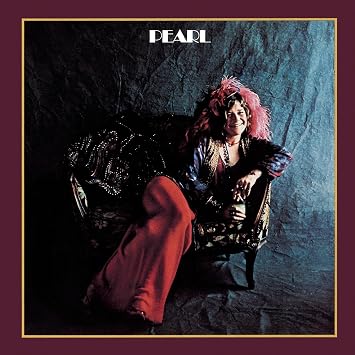
6V6GT Then, I dropped in a pair of RCA smoked glass 6V6GT (lowering the output to around 2 watts; remember to switch the Power Mode to Low) and the sound further improved. Now, I could play anything. It doesn't have the grunt of the KT88 but the power is enough for me even in this large room for Arethra Franklin's I never loved a man the way I loved you and Janis Joplin's Pearl. No pounding bass but the full impact of the music comes across loud and clear. Those 4 live bonus tracks (1970 Canadian Festival Express Tour) in the Joplin CD are even better than the album proper; the immediacy is life-affirming! Similarly, Celibidache's 1969 performance of Bruckner's 4th with the Swedish RSO (DG) is coherent and compelling. Now, all these albums mentioned, though reasonably well recorded, do not belong to the top tier in audio quality, but musically they are compelling. Triode/UL I tried both again and found the difference in sound quality as well as nominal power much less than expected (probably more apparent with higher powered tubes) and so left the amp in Ultralinear Mode. vs LTA MicroZOTL The Elekit with 6V6 is roughly in the same power envelope as the LTA. But, as expected, the LTA has a more naturally fast transient and reveal more rhythmic felicities and subtleties.

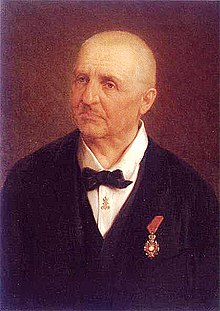
6550 I next dug out a pair of old-stock 3-getter Tung-Sol 6550 (this is a very fine tube, best of the 6550's) and installed them. By now I was listening to Rudolf Serkin playing Mozart Piano Concertos (with Abbado; DG). A repeat showed the sound to be further improved. The soundstage is larger and there is more detail compared to the 6V6GT. It is still quite smooth. Then I found out I had not changed the Power Mode before the swap (still in Low Power Mode). I turned off the power, changed to High Power Mode and turned it back on. Even more air and definition. I replayed the Janis Joplin CD. Surely it sounds more punchy, more controlled, and the vocals and instruments become clearer. An unqualified success. It got so good that I played Hugh Masekela's Hope and played a few track with relish. The attack and presence of the Heresy is highly gratifying (the non verbal expletives highly stirring), and the percussion and bass are very decent. The audiophile's favorite stimela plays with momentum, virility and satisfactory slam. Of course, again, with the 8" subwoofer, when it comes to bass it is not as good as my YL's 15" woofer, but it is satisfying enough and tightly argued. I'd not think of playing this track with 2 watts (6V6) for enjoyment (testing is a different matter). But it is not all about impact; the system brings out all the atmosphere in Nick Cave's The Boatman's Call. In this outstanding album, the mournful, the confessional and the spiritual create a groove of their own, as powerful as any uptempo material. Sparse but beautifully shaded instrumental effects punctuate the landscape established by the moody keyboard and Cave's voice (one thing I like about him is his clear vocals; you don't have to read the lyrics). Yes, horns let you feel the mood better than conventional transducers. So far so good.

Nick cave and the bad seeds-the boatman's call.jpgPower Mode I want to take the time here to emphasize the importance of checking this when one changes Power Tubes. The amps has 3 positions: LOW (6V6, 6F6); MID (6L6 family, 7591, EL34) and HIGH (KT66, KT77, KT88, 6550, KT 120/150). When I changed to the 6550 (above) I by mistake (using the 6V6 setting previously) started with the LOW, which gave it a softer sound because of the lower B+. That was OK. BUT, if I now want to swap back to the 6V6 and forgot to set it back to LOW, I would likely run into trouble as now I'd be running the 6V6 at too high a B+, even if I am sure Elekit runs the amp conservatively. Keep in mind you can safely run a power tube at a lower B+ (with a change in sound, as per my experience) for fun and experiment, but not the other way. I am not sure whether I can do this on the fly, so I didn't try. So, always check.

5881 This is a rugged 6L6WGB type that can withstand higher voltage (as per instruction, I used the Mid Position). The pair are Tung-Sol's, even if one is marked RCA. Here I got my first disappointment. It has neither the sheer brilliance and output of the Tung-Sol 6550 nor the musicality of the RCA 6V6.

EL34 Keeping the Mid Setting, I swapped in a pair of Mullard xf2 EL34 (labelled HP). The sound is very good. It sounds detailed and powerful, enough to almost rival the Tung-Sol 6550, yet is musical enough to rival the RCA 6V6G. In fact, it made the 6V6GT sound just a little veiled. It is also a little smoother than the Tung-Sol 6550, which likely means different things to different people. To the average vintage lover who crave tube warmth (usually overly so) that is great; but to someone like me the leading edge is just a little too rounded, making the sound, sweet as it is, not as life-like, and isn't that the primary goal of horn users? But one can see why this tube is popular in SE amp configuration. My first SE amp was the first generation Audion Sterling over 20 years ago, and it was a good sounding amp. Later I got into Direct-Heated Triodes, and one of my 300B amps was again the (first gen) Audion Silver Night. There is no doubt in my mind about which Audion amp is better.

6V6G Given the findings above I set my sight on testing more 6V6 types. I wasn't thinking of 6L6G but I chanced upon a pair of Zenith 6V6G and used them (Low Setting). An utter surprise! It gave a mesmerizing, flesh-and-blood performance! It is not the surprisingly detailed sound that is so impressive. Images are larger and more palpable. In the Nick Cave album, the second half is a little less somnolent than the first, and there are more instrumental flourishes, which I dig (including a violin). In Idiot Prayer, Nick Cave's voice acquires more gravitas and urgency, and the various instrumental flashes have the truest timber (nowhere is this more apparent than the pizzicati). The most impressive thing is, good as some of the other tubes are, this sets down the mood more effortlessly. You don't have to get it; it gets to you. Downside? Yes, for the first time I hear some clipping in loud passages. This is known, the G has lower power rating than the GT. But for simpler music (I count this Nick Cave album among them) it is hard to best.

6L6G Inspired by the 6V6G and, given the uninspiring performance of the related 5881, I swapped in a pair of RCA smoked glass 6L6G. Mind you, the 6L6G sounds magical in my WE 124B amp, albeit in push-pull. As expected, the sound is very good and has much of the same qualities of the 6V6G. But there are differences: it is slightly less detailed; the images are a little less fleshy and the instrumental timbers a little sweeter (not to the extent of EL34). While in terms of presence it is edged out by the 6V6G, it has the advantage of more power (doesn't clip). A very fine effort.

6V6GT/VT-107A I continued my 6V6 testing by swapping in an older pair of 6V6GT that is also marked with the military designation VT-107A (the RCA logo is also larger). In my experience, early VT- designated tubes are usually superior, and it so proved. Compared to the first pair of 6V6GT I used, it upped the game considerably. This older GT tube has a little more detail and even better presence, dynamics and flow. Like the other pair of 6V6GT, images are smaller and it is less dramatic than the 6V6G. It has the advantage of greater power and is quite effortless with most material. Overall performance is excellent.

KT66 The sound of the (old-stock) GEC KT66 proved yo be as fat as its profile. It is a rich sounding tube, even smoother than the EL34, but its transient edge is even slower. It is obvious the Nick Cave album moves at a more deliberate pace. Of course, presence is not its strong suit. When I replaced it with the VT-107A I was immediately revived by more air and pace.


KT88 Now, although this amp has 3 power modes and allows you to use all kinds of tubes, I suspect it was voiced with KT88, as it is the only tube marked in bold on the Power Mode sticker label. So I was curious about the old-stock GEC KT88., made by the UK to counter the high-powered US 6550. The US never made this tube, and in my experience all latter-day and current productions don't hold a candle to it (as evidenced here by the Russian "Genalex"). Sure enough, this excellent (and very expensive) tube performed wonderfully, very much in the vein of the 6550, though a little warmer and also a little less excitable. With all the power available (like the 6550, the chassis is notably warmer than when the 2 lower power modes are used), Chabrier's Espana (Ansermet, London) was well controlled yet crackled with excitement. With plentiful air, this tube effortlessly separated the various strands in the back-up to Cave's vocals, and the violin and pizzacati are truthful. Compared to its British cousins EL34 and KT66, it does less beautifying, and has better air, leading edge and transients. Although it is still not as neutral and doesn't convey the mood as well as the best of the 6V6/6L6 family, it is still highly musical and has more power to boot. Wonderful!

Back to 6L6G To check on myself, after the very good performance of the KT88, I re-installed the 6L6G and, sure enough, I stand by my words. Whether it is the vocals or timbers of the various instruments (like the burst of the Hammond or the wail of the violin), this tube is still more truthful than the KT88. And the music moves along even more. And, yes, the mood. I firmly know, for me, since I can get away with it, I'll stick with 6L6G, 6V6G and VT107A.

Back to VT-107A At the end of tube rolling, I re-installed the VT-107A, and the impression is the same. This is the tube I am going to use day-to-day.

Enter the TU-8300 (pics at bottom of article) At this point I swapped in my TU-8300 (see Part I). Design vs TU-8800 The two amps have a lot of similarity. The first half of the 12AT7 is capacitor coupled to the second half, which then is capacitor coupled to and drives the output tube. Both amps employ feedback from the 8 ohm output tap. Both amps have protection circuits. The biggest difference is that the TU-8300 is Triode only (for 300B as well as medium to high powered beam and pentode tubes, such as 6L6GC, EL34, 6550, KT88,  though sadly not 6V6) whereas the TU-8800 is switchable between Triode and Ultralinear and can also use low powered tubes like 6V6 (but no 300B). Of course, due to the ultralinear feature, the output transformers of the TU-8800 require extra taps and are more expensive to make. It should be noted both amps belong to Elekit's top offerings. The older 8300 does not even have an earphone output, and has only one input (a nuisance). The 8800 is much better ergonomically, has 2 RCA inputs (one wired parallel to a minijack input) and does have an earphone output connected to the transformer output. Unlike the desktop-driven design of TU-8150 (here), for someone like me who use only the RCA inputs, these extra's do not interfere with the signal path. 8300 Mods As mentioned in Part I, I did some modifications to the TU-8300 (pic at bottom). I replaced the input RCA sockets, hardwired the input with Belden 8451, changed the potentiometer to an older generic type (unlike others, I regard older designs as better, and they are really cheap) and hardwired it to the circuit board with the conductors inside the same Belden 8451. I also changed the two coupling caps on each side to Russian military PIO. Earlier, in an attempt to lower the input sensitivity, I had wired resistors to the input but I later took them out as it was not very effective. The resultant sound is a little warmer than the original. Used as Integrated Amp As discussed at the start of the article, due to high input sensitivity, both amps are better used as integrated amps. For the purpose of this article I did that for both amps. For the 8300 I had to change cables when I switched sources. I had actually never previously used the 8300 as an integrated amp. Used this way, it is actually much quieter than I thought. 300B I started with the Shuguang 300B. Initially, I was taken by surprise. Using the same albums, the vocal and instrumental placements in the soundstage were noticeably different than before, the color was darker, the bass was muddy and things fell apart with orchestral tutti. I was not happy and after some thought swapped out the Mullard 12 AT7's and swapped in the GE's I had been using in the 8800. Good Lord! Now the 8300 with the 300B sounds almost identical to the 8800! A lot of people go for Mullard, but not me. Aside from a few specific types, it has its own colored, usually fat and veiled sound. The GE sounds much more neutral and correct. Thus tubed, the 300B turned in an equivalent performance to the best of the beam/pentode tubes. I expected this, as imho the 300B is one of the few successful modern tube production stories (of course NOS true WE300B is better, but that's untouchable). Russian KT88 Satisfied, and as I was not going to do all that tube rolling again, I just tested what I started with, the Russian "Genalex", and the result was pretty good, much as it performed in the 8800. Pointers vs. 8800 Keep in mind the 8300 had been modified to yield a warmer sound, so it is right to conclude the 8800 is a little warmer than the stock 8300. Even more obvious, although the 8300 is quite quiet, the TU-8800 is dead-quiet. With some of the tubes, there is no noise whatsoever; with some others, there may be a little noise, but I am confident it is tube noise/rush. Keep in mind with 97 db loudspeakers tube noise is an issue.

The Lundahl Transformers! 
And, now gentlemen...the high point of this review. It is not every day that one gets to compare transformers! VK of vkmusic is a perfectionist who for the longest time has been offering upgrades for many of the Elekit kits he sells. These were usually capacitor and resistor upgrades (some of the resistors had to be custom made). Since the acclaimed TU-8600 300B amp, VK Music has gone further, offering upgraded transformers in cooperation with Lundahl. It is an arduous and time consuming task. VK informed me that the final version has three previous prototypes. In the top pic you can see they are even beefier and heavier than the stock ones. Installation This proved to be a bit challenging. It was not difficult to remove the stock transformers and wires, but the metal bracket they are mounted on was a problem. This is because there was not enough clearance on the right side of the chassis to allow lifting of the bracket. And because the screws of the Lundahl transformers have to be mounted from the bottom (see pic). I did not want to do the unsoldering needed to remove the circuit board. What I did was to stand the chassis on its right side. This way the bracket can be tilted 45 degrees from the chassis, allowing tight room to work (especially with the right output trans). I first got the screws in with my hand holding just the bit, then use a 90 degree screwdriver for the final tightening. The obvious message is it is much easier to have the upgraded trannies when one starts to build the kit! If not, one can upgrade with a little more effort.


Cover shows a close up of Cash's face, looking at the camera.TU-8800VK--Sonic Impressions I continued to use the GE 12AT7, the Low Power Mode and VT-107A. Brand new transformers take quite a while to run-in, but I'll cut to the chase: Now I am at around 30 hours; even without much run-in, the Lundahl Transformers are a significant Upgrade! From the first note of the Nick Cave album I noticed the difference. I replayed every album and also a few new ones. How one transformer is better than another is sometimes a subtle (but very important) thing that is hard to describe, harder than say the difference in sound between resistors or caps. Changing the transformer changes everything and it is hard to separate the impovement into components, but I shall say a few words on the sonic merits:
  • Ease of Flow Elekit, especially the 8800 (and the 8300), has a neutral and resolving sound. With the right tubes, as described in the tube rolling section, the flow can be impressive, but with the Lundahl's, it is significantly enhanced. This is as true for Nick Cave as for classical music. Paray's Dvorak 9th (Mercury CD) was as exciting as ever, yet totally non-grating. To me, better ease of flow is at least partly due to better microdynamics. As in real life, ease is a precious thing; unlike in real life in this case you can for sure buy it with money.
  • Enhanced Bandwidth This is immediately obvious and the most objective parameter. There is more air in the treble and a cleaner, more tactile, yet punchier, bass. It changes Nick Cave's vocals and the piano tone, now even clearer (sometimes even ethereal) and more resolving. All the instruments have more sheen. In classical music, it is obvious the soundstage is also significantly deeper and airier.
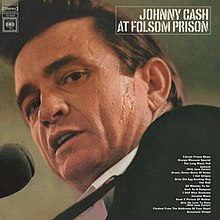
  • Sweet Presence Generally speaking, presence, or the feeling of a live performance, requires a fast transient attack (and horns) and can come at the expense of a little sweetness. Not so here. The Lundahl, even with increased bandwidth, makes everything sweeter, yet presence is enhanced. Johnny Cash At Folsom Prison (Legacy) is an excellent live recording. Here, the audience is perfectly captured, Cash's voice smoky, the guitars sweet and beautifully delineated. In Jackson, a duet, June Carter is just dynamite!
  • More Forgiving of Tubes As you have read from the Tube Rolling section, I roll tubes a bit to find out what I like (usually a neutral sound, but it has to convey presence and mood). Given the increased ease in sound, I suddenly had the idea to give some of the tubes I did not quite like before another shot. I rolled in the Russian "Genalex" KT88 and, surely, the performance is significantly better than before, less etched when the going gets rough. Keeping the output tube the same, I then tried out the 12AT7's which are so critical to the sound. The Siemens 12AT7 is still a little forward but it is now quite acceptable. The Mullard 12AT7 is still a little too dark and veiled for my taste, but it also performed very well. So, "rolling" transformers is even more effective than rolling tubes, when done right.
TU-8800VK--Earphone Tests I use earphones only on occasion, so this is brief. I first connected my Beyerdynamic DT880 (97 db, 600 ohms) and listened with satisfaction to Otto Klemperer conducting the Philharmonia in Dvorak's 9th (Angel, LP). But when I played the Nick Cave CD I realized the proceedings were a little heavy and the bass not well resolved. I was sure that is an impedance question, and so switched to the lower impedance AKG K701 (105 db, 62 ohms). Sure enough, that immediately cleaned up the sound and improved the flow, and now it resembled the sound via the loudspeakers. I see there are internal 6-position dip switches that select resistors, surely for impedance and level matching, but lacking the manual and not willing to open the chassis again I will leave it at that.
Comments on TU-8800(VK)
  • Stock Version As I'd expect from Elekit, the TU-8800 is a very capable amp. A decade on from the TU-8300, the TU-8800 is a lot more versatile and ergonomically desirable. As I'd also expect from Elekit, it is a very neutral amp that reveals every change in tubes and components. Even with current production tubes, it turns in a very good performance. Highly Recommended.
  • Lundahl (VK) Version The million dollar question is, at a premium of roughly half the cost of the stock amp, is the transformer upgrade worth it? Experienced tube users, especially vintage aficionados, know just how important, and how costly, good transformers are. Personally, I am very impressed by these Lundahl transformers. They confer abundantly that most precious Final Touch, and that elevates a very good product to an outstanding one. A lot of DIY people spend a lot of money upgrading caps and resistors but, I tell you, as reported just above, changing the transformer is even more transformative! Old stock tubes are expensive and, unless one already has a stash (like I), to me it pays to start with the better transformers. Enthusiastically Recommended. In fact, it had me thinking about upgrading the transformers of my TU-8300 (this Lundahl is not suitable). Also, if I don't already have the TU-8300 and the 6V6 based TU-8150, I'd buy the TU-8800VK without hesitation. It is also time for me to do some surgery on the TU-8150 (bypassing the earphone and mini-jack input that I don't use) to bring its performance closer to the 6V6 in TU-8800 (though unfortunately there is no transformer upgrade).
  • Tube Rolling Given the versatility of the amp, tube rolling is a temptation most cannot resist. Yet I'd like to give some guidelines here. In general, I think, even with the most humble of tubes (the current stuff) one can get a good sound. Get your system right before you go crazy rolling tubes! There are priorities. No amount of tube rolling is going to save a system that is intrinsically unbalanced. But, when you get your system to sound right, tube rolling becomes the coveted final touch. In this article, because of my stash, I can indulge in some of the best, but this is just for reference as to how far one can take the amp to. Here, I'd like to remind you upgrading to the Lundahl transformers is more essential than spending a large sum of money rolling tubes.
  • 12AT7 This is very critical, and your system and taste shall likely come into play. Experienced tube users know that the input/driver tube(s) have as much, if not more, effect as the power tubes. Unlike the many tube "gurus" out there I usually shy away from a recommendation, because I believe there is no best tube (aside from old-stock tubes are better than current ones), and context (a system approach) is just as important. That said, I do believe the old-stock GE D-getter 12AT7 (not that rare) is a very fine mate with this amp. A new pair is not that expensive and used and test good tubes much cheaper on Ebay.
  • High Power Output Tubes With higher B+, more inefficient loudspeakers can be driven adequately, as evidenced in my Part I Report with the 87 db LS 3/5A. But, even with my 97 db Heresy's, the higher power mode still performed admirably. Basically, I think the designer designed it using the KT88 as prototype. Even the Russian "Genalex" KT88 sounds pretty good (especially with the Lundahl's), and I'd wager the KT120/150 would too. I'd avoid the KT66. And the performance of the genuine old-stock GEC KT88 propelled the amp into another league altogether. But the genuine item is very expensive and off-putting to most people. The old-stock Tung-Sol 6550 is almost as good, but cheaper. Enough said.
  • Medium Power Output Tubes I'd think EL34 is worthwhile. If you already have a stash of EL34 or 6L6GC/WGB etc you would have some fun. I certainly have not tested the vast 6L6 family extensively, but for now I can recommend only 6L6G.
  • Low Power Output Tubes If your system allows the use of low powered tubes, greater power to you! For me, I just love the flea-powered 6V6. Old-stock 6V6's are very reasonably priced, but I know not many can use this kind of flea-power. But, if your loudspeakers are efficient, and your room is small, try it for not that much money! You will be surprised! For me, a horn user, it is my preference.
  • Power Mode Switch I'd like to implore you once again that it is imperative for you to check the position of the switch when you change power tubes. 
  • Integrated Amp vs. Power Amp If you want to connect more than 2 sources and if you have to use a preamp, make sure it is one without gain (passive, TVC, or even Elekit's own TU-8500 in Unity Gain mode).
There! It took forever to write this article on a Windows XP!

Top, L to R: 6V6GT, VT107A, 5881, 6V6G, 6L6G;
Bottom: L to R: EL34, 6550, KT66, KT88


 Elekit TU-8300 in action

Innards of the TU-8300