Vanatoo Transparent Zeros Part II
By mrgoodsound
In January of 2020 I wrote an article about my Vanatoo Transparent Zero desktop speakers. At the time, I had considered them to be my best audio investment to date. Over the past two years, a series of progressively sillier tweaks has elevated that opinion even further. This article will detail those tweaks for the readers entertainment.
Step 1: clubwood mpingo feet (~$350)
It has honestly been so long I don't remember where I stumbled upon the clubwood products, a South Korean firm offering wood accessories for audiophiles and espresso machine enthusiasts. Most of their products are made out of mpingo, a species of African Blackwood (in)famous in audio circles thanks to Shun Mook. Clubwood is operated by Mr. Song, who is an extremely friendly individual, and has seemingly been in the audio tweaks business for many years. His wares are sold on eBay and the clubwood website. The prices are actually reasonable, when you consider the raw material costs of real mpingo wood and the difficulties associated with working with it.
In June of 2021 I placed a large order for mpingo discs, cone feet, volume knob and cable damper; intending to test the efficacy of these products across a variety of applications. When I received them, my first instinct was to stick the cone feet and discs under my Vanatoo speakers for fun, meaning to move them to more 'serious' components later. I put three cones and three discs under each speaker, and they have been there ever since.

To say the effect was 'transformative' would be simultaneously hyperbolic and an understatement. By this point I had been living with the Transparent Zeros for many years, listening to them daily, and becoming very familiar with their sound. Vanatoo includes a pair of foam pads to place under the speakers for isolation and I had been using them on my desk since the beginning. I knew that they caused a decrease in clarity but the alternative was the uncontrolled transmission of vibration to and from my desk, which was unacceptable.
Replacing these foam pads with the mpingo cones and discs, every aspect of the sound improved for the better. Tone, timbre, intelligibility, separation, dynamics, extension, etcetera. The magnitude of the effect was actually dumbfounding, until it occurred to me that the Transparent Zeros are a self-contained system with an integral DAC and amplifier, and I had just witnessed the effect of the simple wooden feet on a single component as if it were an entire system.
I meant to write a more detailed review of the other clubwood products including the volume knob and cable damper but there is no point. They pretty much all have the same effect described above, just in varying degrees depending on the application.
Step 2: Adding a subwoofer (after all, $0)
This was actually a misstep. Even with the foam pads, which muddied the low frequencies quite a bit, I had never felt the bass of the Transparent Zeros was lacking. I still wondered if I was leaving something on the table and purchased a small subwoofer to place under my desk. The Vanatoos have a single sub out in the form of an RCA jack on the rear of the master speaker, and the manual states they automatically set the crossover point between the speakers and the subs when this output is utilized.
Unfortunately, I could never get the subwoofer to blend properly with the Vanatoos and gave up. This wasn't a big loss though as the bass of the Transparent Zeros with the mpingo feet is actually hilariously satisfying, rattling loose objects on my desk when playing modern recording with deep bass. The volume and depth of the bass is actually unbelievable for a speaker this size.
Step 3: Disabling the volume limiter and shelved DSP ($0)
From the factory the Transparent Zeros have a digital volume limiter and 'shelved' DSP mode, intended for the most common use case of desk placement near boundaries. Many owners have reported an increase in clarity and dynamics by disabling these two features, and instructions on how to do so are provided in the user manual. For several years I was too lazy to do this until I was messing around trying to get the subwoofer to work right. Indeed the 'flat' DSP mode seems to give an additional octave of LF content, and disabling the volume limiter provides slightly better dynamics. This is a 5 minute change every owner should try to get the most out of their speakers.
Step 4: USB cable (~$160)
 |
| Art USB Cable |
Recently I tried some other audiophile cables on the Vanatoos for fun. The first was the Supra Excalibur USB cable. It initially seemed like an improvement, improving clarity and dynamics substantially, but unfortunately has too much of a 'hi-fi' characteristic, lacking body and having an overly insistent sense of timing. After two weeks of usage, I returned to the generic stock cable and felt relief at how much more relaxed the sound became.
The most successful pairing thus far has been from Art Cables in Moscow. Their USB cable uses stranded Telefunken wire from the 1960s. It had all of the improvements of the Supra without the downsides, for about the same price. Highly recommended!
Step 5: Power supply (~$35)
I thought this would be the largest improvement to date but it turned out to be another misstep. The stock power supply for the Transparent Zeros comes in the form of a 24VDC @ 2.5A switch-mode brick. I decided to replace it with a cheap linear power supply as an experiment. I purchased a SOLA HD LPS off eBay for around $25. These are cheap linear supplies meant for powering lab equipment (I think), and some audiophiles have had success using them as replacements for stock SMPS of phono stages among other devices.

I carefully wired up the SOLA with a DC barrel plug and hooked it up to the Transparent Zeros (be careful, loss of power to the speaker seems to reset the volume to 100!). The results were a mixed bag. On one hand, there was more relaxed timing and ease of dynamics, rhythm. On the other hand, the sound clearly became veiled with gray overtones. In a linear supply, the voice of every capacitor, resistor and inductor is clearly heard. It turns out that the very inexpensive passive components on the SOLA PSU were not really up to snuff for audio applications. Going back to the stock SMPS took some getting used to as the sound now appeared to be lean and insistent, but the most important attributes of liveliness and color returned.
I considered modifying the SOLA PSU with some audio-grade parts, but decided it would ultimately be a waste of time and I would be better off building a new supply from scratch. Haven't gotten around to it yet.
Step 6: Schumann Resonator (~$200)
This isn't actually a modification of the Vanatoos, but I mention it here as it continues the theme of taking things too far and the funny effects of tweaks on modest desktop speakers.
People have been talking about the effects of the so-called Schumann wave, or rather its suppression, on our auditory perception for a long time. I won't really get into it, a quick internet search will find a million such discussions. Several firms including the Japanese Acoustic Revive have been engaged in producing Schumann resonators as audiophile tweaks for many years. Out of sheer curiosity, I purchased such a resonator on eBay that seemed well built from a reputable seller for a reasonable cost.
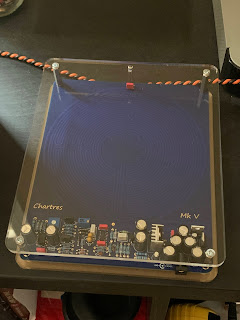
These devices promise a variety of effects ranging from a clearer audio message and less confused soundstage to improved mood stability and sleep. I can say that the device I purchased actually works, and all of these effects were noticed by me in the first few days of its operation. The problem is that the body seems to become accustomed to them, and through habituation the positive effects or at least the active perception of them seems to fade. Perhaps with more expensive devices this is less of an issue, but I cannot say I am curious enough to find out at this time.
Twenty minutes after installing the resonator in my room, I noticed the soundstage of the Vanatoos became wider, low frequencies seemed to extend a full octave lower, and the overall intelligibility of music increased significantly. The same effects were later confirmed on a different system using headphones.
Step 7: Replacing the grills with Shamwow towels ($10)
When I first got the Transparent Zeros, I tried them with and without their grills which are of very high quality and attached magnetically to the front panel of the speaker. The sound without the grills was clearer but also a bit rude and fatiguing at higher volumes. Conversely, the sound with the grills was more comfortable despite being more muffled. I left the grills on and didn't think anything further of it.
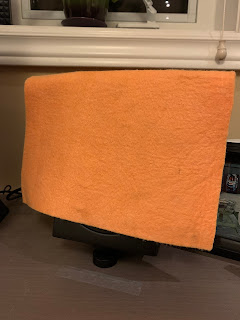
Recently I came across an old post by the Russian audio engineer Anatoly Likhnitsky who described the wonderful effect of placing orange cloth towels over his computer speakers. Realizing I had very similar cleaning towels in the closet, I took them out and draped them over the speakers in place of the grills.
 |
| Likhnitsky computer speakers |
I have long since learned to not doubt the influence of seemingly innocuous things on the sound of a system. I have especially learned to not doubt any ideas proposed by Likhnitsky, whom I consider to be something of a genius in the field of audio. I have to still admit I was skeptical of what I would hear by placing these silly orange towels over my speakers. Well, again, I was dumbfounded. If the sound without grills was too rude, and the sound with grills too comfortable, then the sound with the towels was the Goldilocks zone, that is to say just right. There was a sharp increase in the clarity and intonation of music, and yet no fatigue was experienced even at high volumes. I listened to the speakers that night for 6 hours straight with a stupid grin on my face.
If you are curious why such silly looking grills would serve such an improvement, it is because they act as an acoustic phase randomizer. In Likhnitsky's articles, he espouses that phase randomization is a necessary thing in any audio path, and especially in a short one, as an increase in sound clarity offered by a short audio path is also accompanied by an increase in what he calls musical 'garbage' or 'debris'. This 'garbage' or 'debris' are manifested non-linear distortions which are inseparable from (or glued to) the musical signal. He claims this debris is generated mainly from the decline in sound recording equipment and techniques over the last century, and it is necessary to wash the system of this 'debris' by implementing phase randomization in the sound path. The implementation of phase randomizers can be acoustic, mechanical, electrical and even digital. Grills on a speaker act as an acoustic phase randomizer.
I would also like to draw attention to the notice of the British loudspeaker manufacturer Harbeth, who advises their speakers must be used with the grills in place for appropriate response. They point to frequency response graphs which show a +/- 1dB change in the presence region when grills are employed versus not. Of course, they are correct that their speakers sound better with the grills (I think almost anyone who has experience with Harbeth's can attest to this), but their reasoning for why is absolutely silly. Studies have long shown that listeners will barely perceive, or rather rapidly adapt to, a 1-3 dB change in the frequency response employed through another means, such as digital equalization, but the effects of acoustic phase randomization from the grills is undeniable and goes beyond such simple explanations.
Conclusion
I realize I have spent more than what the Transparent Zeros cost on miscellaneous tweaks, but I emphasize it is not really a matter of linear value.
 |
| Shamwow grills in situ |
Firstly, the enjoyment I get out of the tweaked system is massive. If I were to give away or sell all of my other audio equipment, I would be perfectly content listening to music solely through the tweaked Vanatoo system.
Secondly, because the Vanatoos are a self-contained system consisting of speakers, amplifier and DAC, the effects of any tweak on them are amplified. They have become something of a test bed for experiments, and the amount of time I spend listening to them daily has made me extremely sensitive to any changes in their sound.
Lastly, it is unfortunate that the term 'tweak' has become a dirty word in the audiophile lexicon. I prefer to think of it as sound tuning. If I may be honest, the tuning of any system no matter how large or small is a difficult but important task for satisfaction. It may be true that 20% of the work (stringing together a set of speakers, an amplifier, a source) gives 80% of the result. In the field of audio however, we are often chasing the final 20%, and this is what requires 80% of our time and effort. It is simple for many to scoff at this and swear off 'tweaking' as a waste of time and money.
I don't blame anyone for doing this, we all have to draw our individual lines in the sand. However if that same individual then spends the rest of their days swapping this amplifier or that DAC for many thousands of dollars in the search of audio nirvana without being cognizant of environmental factors which can have a very real and tangible effect on the final sound, then they are simply engaging in a different but in my opinion more depraved activity.


 Posts
Posts