Showing posts with label Brand-Nobsound. Show all posts

24 April, 2024

Douk H7 Pro Nobsound

Click pics to enlarge.

Review: Douk H7 Pro, Part I

Part II (on XLR use)

Surprise! I'm actually in the middle of writing another article that shall tell the story better. But, hell, sometimes we usurp our own order, even upstage ourselves. Let it be known that I have a couple of new toys, and this one is perhaps easier to start with, even if it didn't appear so at first.

As you know, I'm not usually a solid state person but lately I've been using the Beydas 11 ohm "LS3/5A", and I know it can take to solid state amps just as well as (or even better than) tube amps. So, during a recent visit to Douk, I spotted this amp, which looks marvelously finished, and I brought it home (some kind of pet mentality, or sheer vanity?). This one is a higher powered one, a TPA-3255 amp that is able to take 48V DC. It's akin to the Aiyima A-08 Pro which ELO has reviewed before and still uses. So, I decided to give it a try, with the thought that if it passes my initial muster I'd have ELO compare it with the A08 Pro.

Built and Ergonomics Not much to comment on. The gun-metal finish is fabulous. Internals look well built with good components. This is just a simple amp. No digital input, no BT. No Op-amp sockets for swapping. Unlike its predecessor H7, this Pro version has a single volume knob, balance knob and dual meters. The meter sensitivities are adjustable via pots on the bottom. For the Inputs, there is one RCA and, unusually, one XLR.

Steup I just brought back the amp, without box or anything else. Standard PS I think is 32V, but for testing I just used my Aiyima T9's 24V SMPS supply. IMHO, the less the power the better (if your loudspeakers are reasonably efficient). The H7 Pro is barely warm even after running for the whole day.

Run-In Be patient, it took a while (at least several full days of play) for the amp to run-in (as well as for me to acclimatize again to solid state). Run-in definitely smooths out the initial rough edges, which are particularly noticeable in classical music. In case you don't know (say, you're Ken Kessler) vocals, jazz, pop are the easiest to reproduce and classicals the hardest. Many systems can pass with jazz and pop but fail miserably with classical; far too may in my experience. Mind you, I don't look at this from a classical music vantage point; rather, my system must play everything well!

Associated Equipment With the Beydas "LS3/5A" as mentioned. DAC initially was my default workhorse 1-bit  TDA-1305, later an exciting new toy (a tubed DAC/BT/Preamp) which shall for now (not for long) remain unnamed. Preamps tested were the usual Tubed suspects, ETA 6N3 SRPP, Douk T8 Pro, Douk E6 and my 6J4/6P3P Preamp.

Performance I didn't expect to review this so soon, but everything went smoothly after patient run-in. Marvelous!
  • A Word on Cables I basically used my regular cables (for interconnects, like Belden 8451), no different than when I'm using my tube amps. But, initially, for convenience, I recruited my Canare 4S10F 4-conductor bi-wire loudspeaker cable (normally hooked up to our keyboard and Sansui loudspeakers) just because I didn't want to upend my tube amps. But during the run-in, the sound proved to be too forward and a little sharp, so I reluctantly reverted back to my somewhat slower and darker (but more depth) "Belden 1309" and, voila! that smoothed out the sound significantly and they stayed.
  • As Integrated Amp This means, in my case, DAC direct in, using the unit's volume control. From my listening, this is an amp with a passive volume control (no additional gain in "preamp stage"). Sound is decent and transparent, with good air, rhythm and pace. The initial bit of tightness and treble grain smoothed out with run-in. I right now have on hand 2 DACs, and they are very different, and the H7 Pro effortlessly shows the difference. Very good!
  • With Tube Preamp Used as an amp, the volume is maxed out. Although each Preamp brings its own color, across the board a (Tube) Preamp brings additional benefits: more tonal sheen, better control and greater dynamics. Addition of preamp also makes the images a little more textured and clearer in outline. Of course, tubes make the soundstage larger and airier. The transparency of the H7 Pro means the differences between the preamps are very apparent: the 6J4/6P3P is slower in transient and less focused, which I preferred during run-in, but not afterwards; the ETA 6N3 SRPP (with JAN GE 5670) is very focused and airy but it developed problems (again); the tube-buffered op-amp based Douk T8 Pro (with 6CG7) proves to be a good match, well-tempered and with good transient speed. As for the Douk E6 , it imparts the most air and the largest soundstage.
  • XLO Facilities I haven't tested this yet, as I don't have any XLR cables or adaptors here in SZ. But next time I go to HK I shall bring both the H7 Pro and T8 Pro with me to test out the XLR connection. Not only that, I could challenge the H7 Pro with the B&W Matrix 801 Mk II - a tall one indeed.
  • vs Aiyima A08 Pro I don't have the Aiyima anymore. From my memory, I'd reckon the H7 Pro is a little smoother and more refined. But why rely on faulty memory? I shall get this to ELO, who is still using the Aiyima, for a fair comparison. Also, his Dynaudio Crafft is much harder to drive, so that's a good challenge. And, he has the larger power supply (36V). Whether he agrees with my assessment or not, I shall be happy with a large slice of truth!
I have been listening to this for days and haven't gone back to my tube amps yet. I don't miss the extra liquidity and that says a lot about the H7 Pro. Recommended without reservation!

Below are several albums played during this evaluation. Big complex works well rendered!

Stunning Varese (Vol 2 just as great) 
Muscular Elgar, This is BIG Brass galore and not for once the sound grates.
Wonderful 17th Century Spanish Music for trumpet and Organ
Wonderful scores even if you don't know the movies

07 May, 2023

Nobsound E6 III Douk Phase Microphonics


Click all pics to enlarge. Top, doctorjohn's naked E6 with Audiophiler Caps. Black Rubber O-Rings sandwiching the white Silicone ones. Kinda monochrome Saturn? Actually, they are not needed, but just for show.

Nobsound E6, Part III: Shawn P Reports on his Experience.
Doctorjohn and his NYC friends on Microphonics; Phase Reversal...etc

Editor: The Nobsound E6 wildfire is ablaze on two continents (at least), and I see no sign of ablation. I surmise there are several reasons for this: 1) Now entering cheaptubeaudio preservation stage (i know we are very small compared to the UN...), the E6 is already endangered species (no more large tube stash for continual production; how that increases its allure!); 2) although the tube in question is “flawed”, its great sound potential is worth all the wrangling (I repeat: I discourage most people who are not tinkerers or tweakers to get this thing; also not for measurement and “scientific” people - not at all); 3) a truly dedicated audiophile is a masochist who somehow perseveres, or even enjoys obstacles. In case you are in doubt, if you are someone who buys things from Amazon or Ebay or Aliexpress and compare and return most of them, you are not one! Just do the world a favor, don’t get it and then return! Try not to be a Polluter!; 4) I expect this E6 thread to go on for quite a bit longer! Gauging what my NYC friends are doing, I wouldn’t be surprised if it reaches beyond Part V...

Part I, Basic information on the Preamp and Essential Info on the Tubes.
Part II, Caps Mods and Reception by our friends in NYC.

Part IV should come soon too, on cap mods etc.

In this Part III first we’ll first hear from our HK author Shawn P. His mentioning of Schiit Vali I is extremely interesting to me. Then I’ll show you some of the things my friends in NYC and I have been discussing, and they are of import.

Shawn P
To echo with doctojohn’s Part 1, quite a while ago, we discussed the E6. I thought that was interesting as the only DHT I knew of were the 300B and 845 (and its closely related ones). Let alone, DHT preamps.

Since I like the 300B and 845 so much, I thought a DHT preamp would be nice and likely be my cup of tea. I did a bit more research and eventually I realised that I already had experience with DHT preamp with Schitt Vali (1st generation) which utilised 6088 for the preamp section and I had been quite happy with the sound of it. The realisation further reinforced my belief that I would enjoy a DHT preamp. [Editor: The 6088 is a tiny nuvistor-like Direct-Heated Pentode wired as triode in the Vali I. Like the 2J27, it's also prone to microphonics. I also have the Vali II, which did away with this tube but is not inspiring.]

I spent a bit more time on TB and found that there were not that many DHT preamps and I thought perhaps it was due to the fact that small DHT tubes had microphonic issues.

Nevertheless, the Douk E6 caught my eyes as it was nicely priced and did not seem to be a fake tube preamp with opamp. The E6 page on TB has a warning that HV rail runs at 100V and that sounded like a real tube preamp to me.

Contacted doctorjohn and told him about my new find, and he told me that he also had his eyes on this little guy for a while and perhaps my mentioning finally got him to pull the trigger and the rest was history.

Ok, how does it sound?

I had the E6 connected to my APPL 845 initially. When I first turned everything on, the E6 had serious microphonic issues and merely touching the volume would cause ringing. Needless to say, the music would cause ringing as well and I had to turn down the volume in order to mitigate the issues. Eventually, I connected the E6 to the APPL 300B which had less power and did better with the microphonics. In fact, the APPL 300B was a better match with the E6 in the sense that E6 could contribute more to the APPL 300B. The APPL 845 was doing quite ok without a preamp.

Rubber bands were introduced to the tubes and the microphonic issues were further reduced to a point that it was not too much of a problem. At least not materially disturbing my listening.

The first CD I tried out with this new setup was one of my Jazzclub CDs, “Jazz for Lovers”. on the song “Dream a Little Dream of Me” by Laura Fygi, the problematic area was usually the high E String guitar plugging towards the end of the song. With some amplifiers, the plugging could die down prematurely, and it could also sound a bit rough. With the E6, the plugging extended nicely and it was nothing edgy/rough at all. Smooth but not muffled.

Another song from “Jazz for Lovers”, “Do It Again” by Shirley Horn. I am of the view that this song is the most challenging song of this CD, not that it did not sound good but I have always felt that the music and Shirley’s singing did not match. The music reminded me of some Hong Kong black and white movies from the 60’s (粵語長片) in which, goofy guys would do some goofy acts with similar music at the background. Whereas Shirley was asking you to “Do It Again”. Kind of odd. No worries, the E6 had the ability of making sure Shirley was the “leading actress” and the music was only in a supporting role. With E6 in the chain, Shirley was speaking to me and asking me to “Do It Again” and the goofiness was gone! Shirley's singing became “3D” if you want a modern term with visual elements to relate to.

My general impressions (initial) with the E6 were very good. APPL 300B was musical but with the E6 it became more enjoyable. Music had more extension with E6 and it became more musical. Perhaps additional even order harmonic distortions or some may simply refer to it as “even order harmonics”.

Well, I still need to plug in the Russian tubes. I heard they sound even better."

Doctorjohn and Fellow NYC Friends
Now, these are very experienced people, as I have mentioned in Part II. Their actions regarding the E6 truly astonished me. But before we get to these crazies, a fact.

Phase Being an extremely simple single-stage triode (albeit strapped) amplifier, the E6 is PHASE REVERSED by nature of the design. This is a complicated question. Theoretically, with a phase reversed component in the playback chain, provided none of your other components reverses phase (the usual scenario), you should compensate by having your + and - loudspeaker cables reversed (either on amp or loudspeaker side, but not both) in both channels. Simple, right? Yes, and no. The younger among us, such as ELO and Shawn P, and mrgoodsound, likely listen to mostly recent recordings, which are mostly phase-correct. In their case, it’s advisable to do the reversal. But for older folks like Andy and friends in NYC, who hold and play tons of old vinyls, it’s not so simple. Many (say, half) of the older recordings are phase-reversed to start with (which is why many insist that a phase switch is mandatory on phonoamps and DACs). In this case, reversing the loudspeaker + and - will not be desirable in half the situations. Such may be the case with Andy who, as mentioned in Part II, uses the Citation I phono stage for RIAA. The Citation I has a Phase Switch (so no need to do adjustment with loudspeaker cables), and Andy reports no significant difference with the majority of material.

Not so for those who play mostly newer stuff. In a private communication, Shawn P reported that the image snapped into focus when compensated for phase reversal. And then there is my case. Although I love old recordings I listen mostly to newer stuff and I find compensating for the reverse phase desirable, but perhaps not absolutely mandatory. SO! You must try for yourself to see if it matters with you. It’s free!

And then there is the issue of some of the loudspeaker systems, particularly some of the older ad-hoc horn systems, where DIY (or even stock) crossover designs etc may have some of the drivers out of phase. The effect can be unpredictable. BUT, aside from a little diffusion, I maintain it’s not night and day usually. Us horn users are not pin-point imaging people, and prefer presence, and it can be a different story. YMMV.

Microphonics continue to be an issue. In Part I I have shown how the tube originally comes in a Full Metal Jacket (FMJ) for a good reason - the metal covering, and inner cardboard rings are there to damp the microphonics. In removing the FMJ for the sake of looks, Nobsound has made the E6 more prone to microphonics. Here’s the breakdown:
  • Stock Chinese tubes are naked, without FMJ. Some have very mild microphonics; others more severely affected. You can temper the microphonics by applying Tube Dampers (like one for similar sized 6SN7, which could be cheap or expensive). But I suggest you get Industrial O-Ring’s, which are dirt cheap. For those who can buy from Chinese TB, there are ones made from rubber and others made from silicone. You can use any that’s the right size, and you may find them locally too. Important to know: the diameter of the 2J27 glass tube is 29 mm. So, you need rings with inner diameter of 29mm or less. See one of the bottom pics for how to calculate. It’s likely the smaller and tighter the better the effect. Or, to start cheap, you can use some Thick Rubber Bands and wind them around the tubes (both my NYC friends and Shawn P have employed them with success). beside these more conventional approaches, you shall find many innovative tactics in the attachments at the bottom. Madtubeaudio!
  • As detailed in Part I, you can buy Russian tubes from TB here or from Ebay. The Russian ones come in FMJ. As mentioned, the diameter of the FMJ tube is slightly too large to be inserted into the E6. So, you can do as I did, and remove the FMJ. This of course makes it more prone to microphonics, but the Russian tube is inherently superior in this respect and quite manageable so far even without O-Ring dampers
  • Or, if you want to use it as is, which is definitely better for microphonics, and it saves you the hassle of removing the FMJ, you alternatively have to remove the E6 chassis (L pic: Andy's with Russian Tubes). You would need a regular Philips screwdriver for the 2 RCA socket screws and, perhaps a little trouble for some people, a small hex bit (likely from a jewelry hardware set) to unscrew the 8 chassis screws. I stick 4 small 3M sticker feet to the bottom of the circuit board and place it on a rubber slab, but any insulating material would do. Voltage is low and unlikely to cause anyone trouble. You can also choose to re-attach the front and rear (gold) plates by the RCA socket screws, but then they would be wobbling a bit and I think that’s not so good for isolation.
  • Any Downside to Damping Rings? I haven’t really done any A/B. Andy mentioned: “...two of these stop the ringing entirely but they also take away some upper harmonics in music...” This is true in my experience as well. I have used many Audio Research stuff, and in many of their later stuff they used damping rings. Invariably, I’d prefer to have a little microphonics than to have them totally damped out. The effect is just as Andy mentioned. So, use judiciously, only when necessary (which certainly varies with individuals).
  • Advice: With microphonic tubes, when changing cables etc, just turning down the E6 volume is not enough. If your amp has a volume knob, turn it all the way down, or turn it off. Give the preamp some seconds to settle down before turning the amp volume back on, and then gradually. One time, with the Chinese tubes, I was in haste and only turned down the amp volume a little. Well, I heard a loud ringing through my loudspeaker tweeters and I moved quickly to turn the amp off. After that, I have been more careful.
Kevin's Rubber Wrapped Tubes and Modified Caps, just one of many iterations
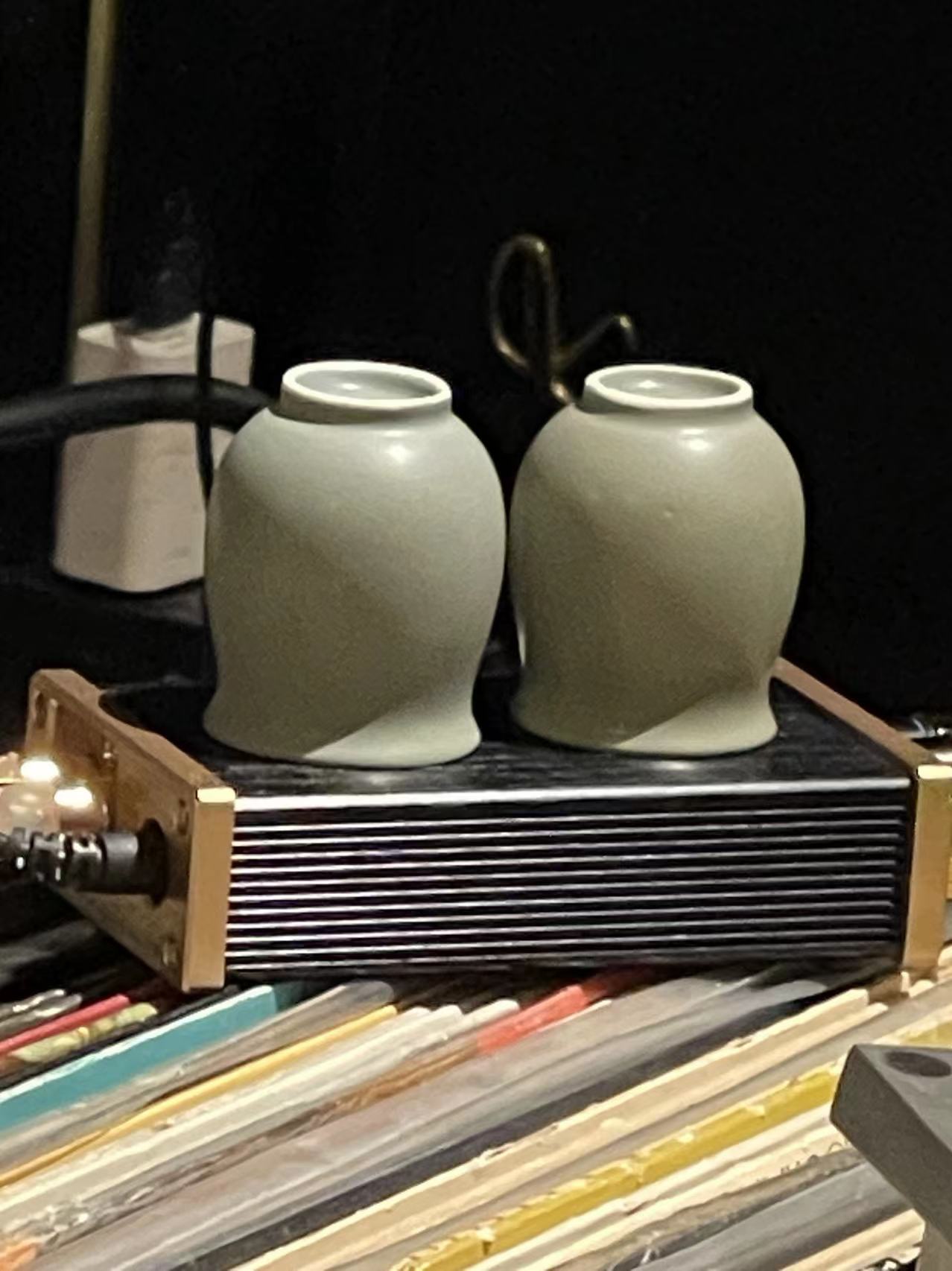
Andy's Ultra-Zen Tea Cups! Yes, they work!
Yes, Andy's Fluted Glasses Work Too!

20 April, 2023

Nobsound E6 Part II Douk

Click Pics to enlarge. Top, Andy's JBL Station. From L (top) to R (bottom), Technics SP10 w/ Dynavector DV505; Garrard 401 w/Odyssey RP1; E6 on plinth; Dared 2A3 amp.

Nobsound E6, Part II: Cap Mods, Feedback from NYC
Letter from NYC (23-1): Update on Andy’s System


Update 4/22/23: Empty circuit board photo added. Shows which cap is which. 

Note: Part I is the Main Review. For those who first encounter the E6 here in this page, please read it for main info - this is a follow up, but it’s full of useful info. Part III, on Phase Reversal and more on Microphonics, has also been published. 


The Miracle Continues 
As I mentioned in Part I, the Nobsound E6 is that miraculous product. Here we strive to make it even better!

Capacitor Mods As I mentioned in Part I, given the tiny size of the PCB that is studded with surface mount components, the only mods possible (within the ultra-compact chassis) are the 4 coupling caps. The stock is pretty standard generic MKP2. As you can see from the pics, on the side that has only one, there is no concern. BUT, on the side that has 3 jammed close together real estate is a real problem. Make sure you scale with the tube socket in mind and you shall see how little space there is.

Which Cap is What They 4 grey caps are Input and Output Coupling Caps. Value is unusually high at 1.0 uF (5% tolerance, 250V). After I un-soldered them, I noticed they are numbered C1, C2, C3, C15 on the PCB. This is highly unusual. In the usual circuits, the left and right are named with some symmetry, like 12 for R and 22 for L; 13 for R and 23 for L. Not here! The PCB tracks are sophisticated, double sided, sandwiched and copper traces are not visible except for slightly raised outlines. I could only trace C2 to the volume pot, and so it’s an input cap. I inquired and fortunately got an answer after I did my mod: C2 and C3 are Input Caps; C1 and C15 are Output Caps. Now, that is helpful for planning.

https://m.tb.cn/h.UsNmXVa?tk=bpX3dlUIHxn Capacitor Choice I cannot emphasize enough the importance of this. I don’t mean (preconceived) sonic merits, I mean size!!!! 250V caps are smaller than 400V ones, but they can still be pretty big. There is very little room. I ordered 4 types (dirt cheap), and the most “expensive” ones, so-called “Solen” that I used with success to mod my ETA Preamp (here), were just a little too big, and I finally resorted to the Audiophiler ones. I replaced all 4 with same. For US (Parts Express) and Europe readers, perhaps check out the cheap and good “German” Audyn caps which I used to modify my Dynaco PAS3 (here). The smaller the better! Dispel the thoughts of using PIO Jensen, or Beewax or whatever! Won’t fit! You have been warned.

While we are on boutique caps, most of them cost as much as, or more than this device itself. It’s your choice, but I think dollar caps today sound very good, as per my Dynaco and ETA efforts linked above. And, most of them, French Solen or German Audyn, to name just 2 mentioned here, are for sure made in China. The rest of the deduction you do yourself.
Well, here’s actually a thought. For one of the caps on the crowded menage a trois side, you can solder wires and move the cap to the other side (affix it with blu-tac or glue), which has more space. So, perhaps it’s possible to have somewhat larger caps after all...

Sound The Audiophiler Caps cost RMB 3 (for 4). One can extrapolate how much the stock one's cost. BUT, the effect is mightily impressive! Everything got significantly better. It’s not a question of better high’s or better mid’s or low’s (though it is better in all of these, but nothing predominates). No, it’s a much more organic kind of better everything, including control, integration, dynamics, noise level and, ultimately and very simply, how much one is at ease without noticing this or another deficiency. After the bar is raised, I really think this tube can do no harm whatsoever. Proceed with confidence! A rough estimate, the magnitude of improvement by cap mods is as much as moving from the Chinese tubes to the Russian ones mentioned in Part I.

Ultimate Mod Fantasies Well, one solution is to move the PCB outside its straitjacket of a chassis! Mount the PCB in a larger box, use rubber washers to isolate it and for shock absorption. Use whatever caps (even huge vintage oil caps) you like. And, yes, solder wires to the PCB and use a “better” pot is a possibility. Personally, I look down on expensive resistor ladder pots. Many of us prefer the more natural sound of carbon pots (yes, even Shindo). It’s your move. Why are we talking about this? Well! This little thing is worth it!

E6 fever in New York City
I’m really shocked how the E6 has taken my NYC friends by storm.

Lenco TT with STAX (and SME).

Andy How come I know so many Andy’s? Well, for regular readers, this Andy is not the HK one I mentioned in my recent Guangzhou Show reports. He is my NYC analog guru and leader of the gang there (we have a wechat group). Regular readers need only to search this blog and find my numerous NYC articles (here for one). Well! Andy and I know each other’s taste very, very well (yes, we have small differences, but they are highly consistent and reproducible, and we know what the other will feel). As reported before, he spends his daytime downstairs with his 2 horn systems. As purveyors of DHTs, of course we are all interested in the unusual E6. And so, Andy bought one - and really liked it:
  • He mostly uses Analog. In his Dining Room JBL Station (pics in this article, previously reported in detail here, but it is very different now), he employs three turntables with 4 tonearms: 1) Garrard 401 w/Odyssey RP1; 2) Technics SP10 w/ Dynavector DV505; 3) Lenco Double Decker w/ Stax and SME 3012 Series One. Except for the Stax Cartridge, the TT output goes into Citation I, then via Tape Out connects with E6 which then drives the Dared 2A3 amp. He hasn’t done much comparison, but his gut feeling is the E6 sounds as good as most much of his preamps.
  • The Stax setup deserves a special mention. Andy found out that the E6 almost miraculously can serve as the 10 db Booster amp (the E6 is around 16 db, with a volume knob) for his Stax ESL cartridge (reported in detail here; this cartridge is highly unusual, amplitude device, no RIAA needed; the output goes into a decoder, which must be used, and then into a Booster amp. The original Booster was FET, but Andy said the E6 is simply better!
  • In his Altec Station, he has also briefly tried out the E6 to good effect. With CD, his Sony SCD-777ES benefits from the warmth of the E6.
  • In his main mega system upstairs (reported in detail here), Andy has tried the E6 to good effect as a booster for phono going into the ARC Reference 2 Line Stage. As the noise level is low, he finds it very useful wherever signal boosting is needed. The latest is this: Quote: “...I’m testing one between the equalizer of the DS E1 optical cartridge and ARC Reference II line stage. It’s doing a good job toning down the solid-state characteristics of the IC op-amp equalizer...” Here though Andy finally detected some microphonics, which he said were largely absent downstairs.
  • Andy bought a few more to use in all his systems. And our friends have followed suit! The cohort so far has bought >10 and have depleted Ebay! I hope more reports to follow.
Mark Now, this is yet another insane friend whose big systems I have reported in detail before. Well, he bought one and then 3 more! See right screenshot for his comments.

There are more to come later from the other fellows...

2J27 Supply Woes For us, and for the foreseeable future, buying a few tubes is not a problem. But for a popular manufacturer, which likely buys 10K tubes at a time, it’s a big problem. There’s no great stash in China, nor Russia. So, in my estimation in a few months E6 shall not be available. If you are interested, now is the time to act.

Summary
  • A great product Our NYC friends have all experienced very high-end before and together we are still stunned by the performance of this little thing!
  • Serving as Booster Amp (or buffer) To sum Andy's experience, the E6 is worth trying out wherever you want a little buffering warm sound, or extra gain of up to 10+ db. It can serve well in many circumstances, particularly for analog fans, all thanks to the excellent engineering and the LOW NOISE (when the tube is good). My thinking: actually, all these fellows own several preamps and others could possibly fill the same shoes (but many of their vintage ones are noisier). But the difference with the E6 is that it's tiny and one is much more inclined to use it rather than pile up another big box into the system. A connected E6 looks smaller than the junction boxes on some interconnects (think MIT, Oracle etc).
  • Microphonics is an issue that still looms on the horizon. So far, the NYC crowd did not have much microphonics, and they haven’t even switched to the Russian tube yet. For me here, as detailed in Part I. I use Russian tubes and don’t have the problem anymore. But we're on the watch for it.
  • This is the kind of product Cheaptubeaudio exists for, and we are proud of really exploring it in depth. We have our author Shawn P to thank for it. It was after talking to him that I decided to try it out (chronicled in Part I, link on top of page). Incidentally, Shawn P has also gotten one and in due time we shall have his experience too!
Andy's Decca Cartridge through Citation I and the E6 (see setup above)!

25 March, 2023

Nobsound E6 Part I Douk Direct Heated Triode Preamp

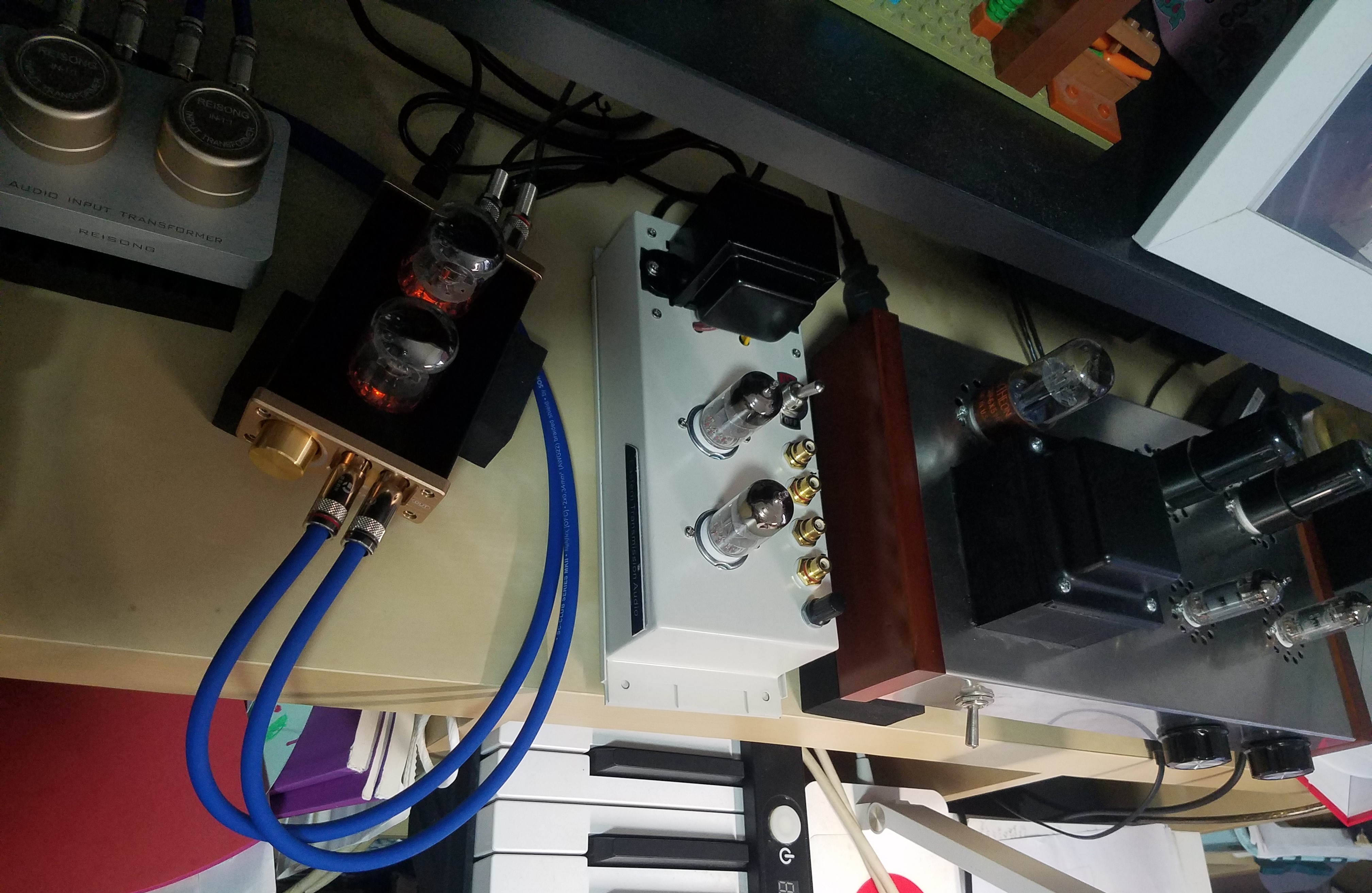
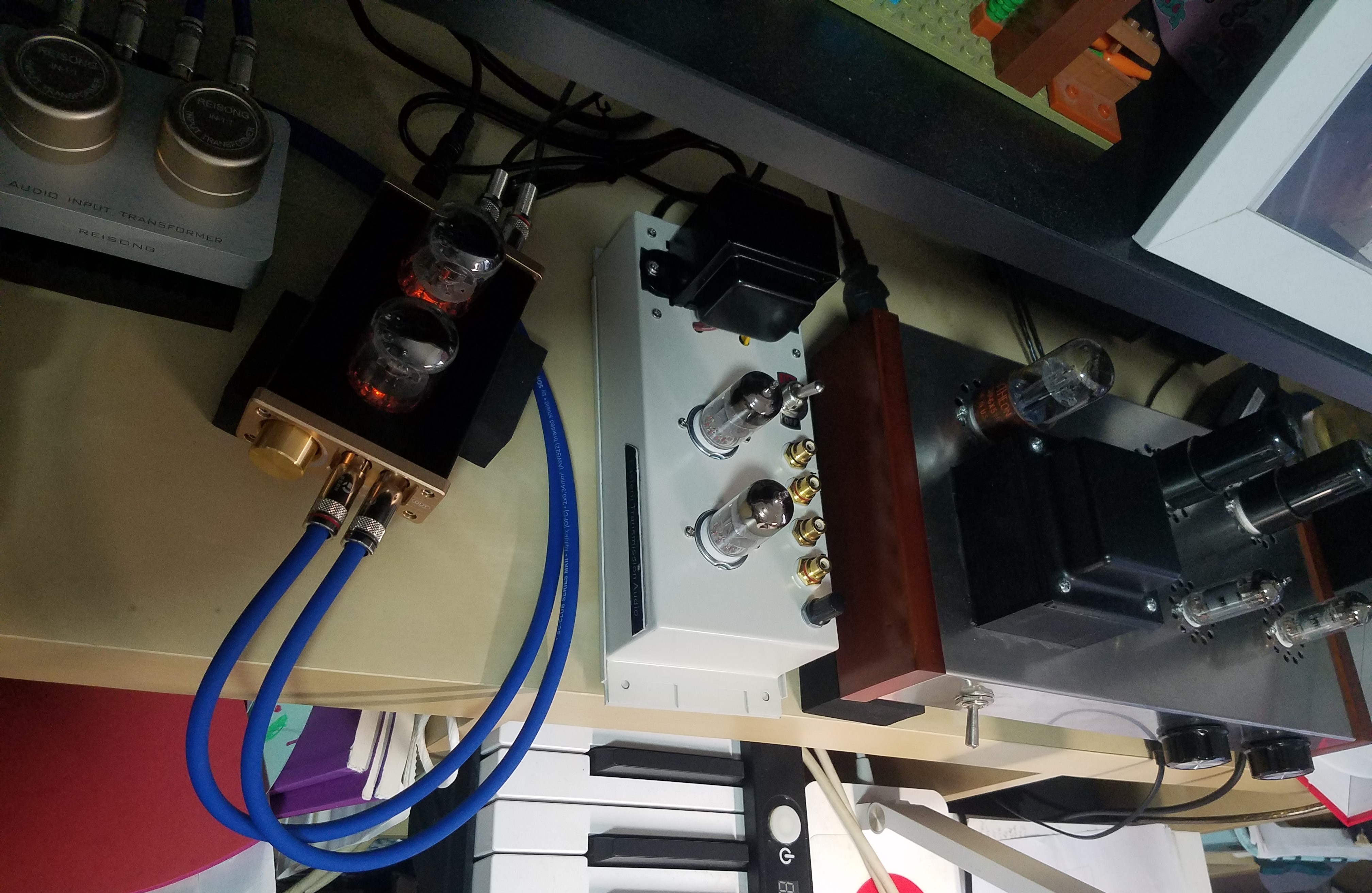
Click pics to enlarge. From L: Reisong 1:1 Transformer; E6 (note the rear power supply plug is in 2 segments, 5*52.1 supply cord with adaptor to required 5.5*2.5); ETA Preamp; 6J4/6P3P Preamp.

Review: Nobsound (Douk) E6 Direct-Heated (Triode) Preamp, Part I
Letter from Shenzhen (23-10):
Antagonistic or Complementary? vs Eastern Transmission Audio 6N3 Preamp


Part II, which details the Capacitor Mod, and feedback from my NYC friends, had been published.
Part III, which tells of Phase Reversal and more ways to combat Microphonics, also published.

Editor: 1) As detailed below, the Review Unit was a loaner; 2) Just before writing this article, I was able to confirm a few technical aspects from the company; 3) Before writing this article, I read the Amazon comments and there are misconceptions there that should be corrected.

How It Came About Not so long ago, I was on wechat with our own HK Author Shawn P, and he mentioned his interest in the Nobsound (Douk) E6. It just happened that I have also noticed this for a long time. It‘s a tiny preamp that nonetheless employs a Direct-Heated tube (DH)!!!! As a long-time purveyor of DH Triodes, of course it came under my radar! Just like our other HK author ELO’s interest in Aiyima T9 spurred me on to my Aiyima adventures, I decided to pursue this one.

I first contacted the TB Nobsound (Douk) Customer Service. Despite some delays, the fellow eventually through wechat referred me to Vivian of Administration. The lady was nice (but cautious, for good reason), and meticulously verified me as owner of this Blog. After a while, I was loaned the E6 for Review. Although I didn’t buy it through Taobao, I’m still providing the details for you.


Shipping The package was a surprise. It came in a small plain cardboard box, no logo whatsoever. The unit had the tubes installed and bubble-wrapped, with a USB cable on top and not much else. I’d imagine it could suffer damage in some circumstances.

Ergonomics There’s not much to it. It’s not much bigger than a deck of cards. The back has only the Single RCA Input and DC Input. The RCA Output is at the front, together with the Volume Knob/On-Off Switch. Having the Output at the Front is a Form Factor that takes some getting used to for most audiophiles. No 5V Power Supply included (everyone has some USB chargers). At Turn On, there is no sound until the Relay clicks a few short seconds later. For those who use solid state amps I’d wait a little longer (say, 1 minute, for safety against DC offset, in general) before turning on the amp. Ah, it’s too bad its face and rear plates are in gold - I wish a black or grey version option is available. I ain’t no fan of gold, like the Jadis and Sonic Frontiers that sell to Asian markets.

Specifications and Technical Aspects
This VERY unusual Preamp employs an obscure 2J27 DH Pentode (stock is Chinese). Wow! Direct-Heated! IT TURNED OUT THE E6 IS CONNECTED AS A TRIODE! ALL of the DH Preamps that I know of are Triodes and quite expensive. My own Manley 300B is an example (much cheaper would be the interesting Transcendent 300B Preamp Kit). And, in the recent Shenzhen Audio Show I heard the excellent Line Magnetic Foshan 安歌 2A3 Preamp (around RMB 20k), and it was great! If I were to start over serious, that would be on the top of my list! I enthusiastically applaud Douk for designing this Preamp out of the blue! At this bargain price, people don’t know the efforts that went into it. DH tube and low filament voltage mean high variability and susceptibility to Microphonics, as you shall see.

The Unit employs a 5V DC power supply, and only comes with an USB to DC Plug (5.5*2.5; the most common type) that even the manual suggest you to use with your USB charger (one that delivers above 0.34A). That’s not what I used of course! I used my Wanptek SMPS. The display shows a constant draw of 0.4 mA, no more. As some 2.5 sockets will accept 2.1 (standard for DC power supply plug) I tried without the adaptor - no go. So you need to make sure it’s 5.5*2.5 (with an adaptor in my case).


The 5V DC Power Supply goes through a switching supply to up it to 105V Rail for the HV B+. This is common in digital amps (usually 12V). In my own experience there is precedence in the ancient (and excellent sounding) Japanese Elekit TU-875 Preamp (which our ELO uses right now), which employs a 7V DC Input, which then is internally raised to higher B+. Fascinating (Douk told me it’s not easy to implement because of the very low filament voltage).


I was told by Douk that the Amplification is ALL tube (and it sounds as such, see below). As you can see from the pics at the bottom, crowded around the tube sockets are Surface Mount Components (SMC) of resistors and capacitors, which offer no route for upgrade (neither are there cables inside). But, fortunately, the 4 Grey Coffin Capacitors turn out to be for Input and Output Coupling. They are unusually high in Value, at 1.0uF 250V. This is great news for those of us who want to modify! Warning: very little room inside! Most big boutique caps would NOT fit!

Shock Absorption and Microphonics At first, I was greeted with the ringing sound of Microphonics, which died down after some seconds. The unit is very sensitive to impact. Because of its tiny size and lightweight, it can easily get knocked around even if you just want to change the volume. I put it on a solid slab of rubber shock absorber (now is different from the 2 cubes used in the top pic. Once the unit stabilizes after turn-on, there is no microphonics. This is due to lack of reinforcement in the internal tube structure. Some Amazon users though had continuous high-pitched sound, which may be a different matter, like a faulty tube. Ringing upon some form of shaking is normal for the Chinese tube. I would advise against using this on the desktop where you work, especially if your loudspeakers are also on the tabletop. Your moves (and those of your loudspeakers) may shake the table and cause trouble. Now, why bother, you may ask? Because of the Sound, of course! Also, before you move on to below, in the tube rolling section I have a very useful surprise, so make sure you read it!

Sound This is a surprise, to say the least. I’m not the only one who harbors the opinion that the larger the tube (and structure), the better the sound (hence 6SN7 > 6CG7 > 12AU7; for some too Globe > ST > GT, thought I have my reservations about that). With its big envelope (like a 6SN7 in size but housing only one triode) and large structures (the plate is about 2/3 the size of the output tubes 6V6 and EL84) I expected a bigger and sweeter sound, but I was still floored! Prior to receiving this, I have been using the modified Eastern Transmission Audio (ETA) 6N3 SRPP Preamp (Review and Mods), which is similarly priced and a formidable rival. Swapping in the Douk, the sound was instantly bolder and sweeter. Images were larger and fleshier, and so sweet that not a trace of digititis was to be had. Gain is still on the high side but not quite as much as the ETA. The amp is also very quiet, no background noise.

Does the E6 trump the ETA? It gets fascinating. A quick answer is - No. With stock tubes, great as it is, compared to the ETA, the E6 does have its weaknesses. The first is its Control, which, though not bad, does become less firm in classical big moments. The second is its Dynamic Shadings are less sophisticated. Also, the E6 is more saturated in color, but this is likely a plus rather than a minus for most people. Or, put it another way, the ETA has superior neutrality, control, microdynamics and details (or integration of the latter two). On the other hand, the Enhanced Presence of the E6 is amply evident - it puts the soloist forward and is very emotive, not something that a cheap (or even very expensive) preamp can do! 

For musical examples of ETA vs E6, in my recent Classical Streaming article I actually provided some, duplicated in the shaded box below ((if you want to read it in context, just roll down, or click here):

Either/Or: 2 Preamps
Recently, I was loaned a Nobsound (Douk) E6 Preamp, which uses the unusual 2J27S Direct Heated Tube. The chassis is very small and the tubes sticking out are big (almost size of a shorter vintage 6SN7) but the sound is big. Review to come. Before this, I have been using the modified Eastern Transmission Audio (ETA). In a nutshell, the diminutive Nobsound/Douk has a bigger, bolder sound, bigger images, but less control. The ETA has somewhat smaller images but greater depth and better dynamic gradations.

I stream mostly on NML, which has a leaner sound sometimes. I also do Tidal, which seems fuller, but colored. With some recordings, neither seem perfect. Sometimes switching from one preamp to the other brings improvement, even change of view of the performance. Let me just cite 2 examples using albums covered above.

When I streamed the Van Kuijk recordings with the ETA, I frequently feel the sound to be a little on the white side. This is a consistent observation of the Alpha label. When I switched to the E6, the strings instantly became just a little fuller sounding. Just what it needs. On the other hand, when I streamed the Schubert Trios with the E6, things are just not as woven as I’d like. Switching to the ETA firms up the piano and knit things together.

You get the gist. Which one is more accurate? I don’t look at it that way. Truth, whether in audio or politics, has many facets. In audio, unlike in reality, we can search for truth as long as we want. Nothing is forced down our throats.

Click pic to enlarge. Note the Outer Perimeter of the Sleeve is folded inward on the top plate.

Tube Rolling There is not much choice. Aside from the stock Chinese tubes, there is only the progenitor Russian version of 2J27, or in transliterated Chinese notation 227, which is how it’s designated on TB (link below). And so I bought 2 from this fellow in Hebei. Cheap. Western readers shall find plenty (and cheap) on Ebay, most shipped from Ukraine, where else!


Problem is, the Russian version is the original metal tube. They would not insert into the E6 as the diameter is just a little bigger than the holes. This is really silly - I guess Douk thinks the tube looks much better in glass form (it does) but to us old geeks, plugging in the metal tubes would make the E6 look like a Step Up Transformer (SUT), no problem. BUT, SO, you need to take off the outer armor. Douk takes them off the Chinese ones but they don’t offer the Russian (yet), so you have to DIY. In the pics at the bottom, I’ve provided what I hope are enough guidance. If you plan to do it, you MUST read everything carefully, particularly pin orientation.

There is little question that (as usual) the Russian version is superior. While just as bold and sweet, it firms up the mix and is more dynamically nuanced. It makes the E6 a more rounded preamp even in comparison with the ETA. It now wears its own attributes proudly, and there is no serious downside.

AND, importantly, a side-benefit! The Russian tubes also more sturdy, and certainly much less microphonic. Yes, a sudden jolt (or tap on the chassis) can still induce some ringing, but they are much shorter in duration and muted.

Conclusions
  • Sonically, the E6 is a miraculous product for those who can use it. It offers a glimpse into the world of DHT output tube, at crazy low cost. It’s basically unique. Being a budget product (albeit one designed with love), it has limitations, but it’s a window into another world, far away from the usual humdrum of low-end products (so is the ETA, more conventional in design but good sounding). In fact, if you get both the ETA and E6, you shall have a good glimpse into the world of Preamps - they are like Yin and Yang in a way, challenging but supporting each other rather than having you say A is better than B, and B is better than C...ad nauseum. No better musical (audio) education at this price. These two should provide a reality testing for much pricier rivals
  • Even after Tube Change, the differences remain: the E6 is "artistic", with great Presence, and paints in broader, "Live" strokes; the ETA is a more meticulous craftsman who arranges things in order, and minds every little detail.
  • If you cannot provide better isolation for the E6, DON’T get it. If you use it on your desktop or have your loudspeakers on the desktop, and you type and vibrate the desk (not to mention when you pump your fist in frustration), it’s not for you.
  • The Russian 2J27 is a definite PLUS for sonic as well as microphonic reasons. Order a couple more in case you mess up removing the shell (not likely). Believe me, It’s worth your while.
I now alternate between my ETA and Nobsound. I LOVE both for their different strengths. Now, those caps of the E6...As usual, watch this space...Obviously, I intend to purchase the Review Specimen.

Removing the Outer Metal Sleeve
Before doing anything else, The FIRST thing you do is to look at the bottom. The Center Guide Pin (which is part of the metal sleeve) has a Protruding Ridge. You MUST use a MARKER
and mark the two pins to the right and left, because after the glass tube
slides out, there is no orientation. 
After the tube is taken out, the 2 pins in question should be clearly marked.
Anatomy of the Tube. The Metal (Tin-like and soft) is folded on the top metal disc, 
beneath which are many cardboard rings(Khaki color; you can see many out-focused in the background) to adapt to the dome top of the glass tube.
First, remove the top black screw.
I use a sharp-nosed Wire-Cutter for the job. Nibble at the edge and create a defect,
 cut horizontally and roll back the metal. There's a lot of clearance
between the top metal plate and the tube, so don't be afraid.

21 March, 2023

Streaming Classical Douk Nobsound E6


Streaming Classical (23-3): Finally, Good Performances of Russian Works are Trickling In
Letter from Shenzhen (23-9): Either/Or, Tale of Two Preamps


Updated 3/24/23: Minor editing, and some more info on Liss added.

Editor: The Sub-Heading refers to my listening experience using 2 preamps that complement each other. Sometimes when I find the sound of a recording not to my liking, I make sure I listen to it on the other preamp, which may save the day. This bit of audio experience I shall briefly detail more at the end of this article. First, the recordings.

In one of the Streaming Posts last year, I lamented the dislocation of Tugan Sokhiev, one of Russia’s (and the world's) pre-eminent conductors, who resigned as director from both his French post (Toulouse) AND the highly prestigious Bolshoi Theater, thus robbing us of a potentially highly competitive Shostakovich cycle (with the Toulouse Warner had already released No. 8 and 10).

Browsing prestomusic today, to my surprise I see an imminent release by the dissolved team; it’s due in April, them being accompanists for my heroine Elizabeth Leonskaja in Beethoven 3 and 4. Warner indicates this was from 2017-8 concerts. I’m looking forward to it but can’t help wondering if this is a way for Warner to partially fulfill their contractual obligations, which are surely in limbo. My view: Toulouse forced out Sokhiev, the best director they ever had, who over a decade raised their profile and brought them a priceless Warner recording contract that other orchestras as good or better than them (truth: many out there) would kill for; Toulouse should have the decency to release Warner of any obligations. It’ll take years for Toulouse to regain the footage they have lost - not likely. When Art gets used by Politics, the only losers are the Artists.

And so a potentially excellent Shostakovich cycle by Sokhiev was violently aborted. Instead, mediocre conductors like Giancarlo Noseda soldiers on with useless UK recordings (LSO Live; NSO Washington are equally bad; only praised by UK press;). Avoid his spineless Shosty cycle. This fellow has never produced any significant stuff, in any area, but the UK press always inexplicably praise him. Ditto LSO, which, despite their high individual skills, now make one impersonal and underwhelming recording after another. No personality. Ditto over-rated conductors, like Rattle, who goes on to water down other orchestras. Emperors without clothes.

Isn’t that hypocrisy? Banish all great Russian musicians in their own music? Instead have them performed by politically “correct” yet musically pallid Westerners that soften everything? That’s really cultural appropriation, if you ask me.

Russian conductors (and musicians) are unfairly shunned like the plague by decision-wielding me-too politicians and bureaucrats (a few brave Austrian official voices notwithstanding). Have you noticed that even Russian labels (like Mariinsky’s own) have few new issues? That’s a sad void. And so it’s an obligation to promote the few recordings that trickle in.

Dimitry Liss, who heads the phenomenal Urals Philharmonic, has received coverage here before. Now, he is giving us Shostakovich 10 (Fuga Libera), a work which is close to his heart. This was not the first time Liss has recorded this. Just compare this to the previous recording he did with his other orchestra, the Phil Zuidnederland, and you shall be impressed by the superiority of the Russians. Listeners who really know Shosty will know why he MUST be continuously performed by Russian musicians, no matter who’s in charge. And then there is the excellent and substantial release of two of Prokofiev’s best works, Symphony 2 and PC 2 (pianist Korobeinikov).

While we’re on Shosty, fortunately there ARE worthy UK efforts recently, from the team of BBC Phil and Storgards. Their newest release of 12 and 15 is refreshing (Chandos), no less because of the rarity of 12, which I somehow have always loved. The enigmatic 15 is of course a masterpiece. The team’s previous 11 was good too, and this one is promising as a cycle. Not exactly heart-on-sleeve, but meticulously crafted, paced and delivered (unlike the clueless Noseda). Very good sound.

Too many unworthy recordings, but all is not lost. Occasionally we have a GREAT one. Now, Stravinsky is not even considered all-Russian really, given his long exile and sojourn in the West. But he was. And NOTHING is more Russian than his masterpiece Les Noces (Russian Wedding). This is not an easy piece to listen to, especially as it is sung in Russian. If you note the genesis of the piece, it has a convoluted history. The version most often performed is the later 4-piano version, not Stravinsky’s first choice. And so I have listened to it as such, until I recently came across this stunning original 1919 version, which the composer has only partially finished (completed in 2007 by Theo Verby)! Featuring Cimbaloms and Pianolas, no less! The performance by Ensemble Aedes and Les Siecles under Mathieu Romano is beyond reproach (Aparte). As I streamed it on NML, I was able to read the fascinating booklet notes, where the vocal coach showed how she devised ways to teach the French choir how to enunciate Russian, and indeed they sound quite authentic! A labor of love! The filler is a curiosity, Bolero arranged for choir! Sound is stunning - this is goose pimple material! This is my Album of the Year! I don’t see anything coming close. The only caveat is certainly not every reader will find it comfortable listening, though I fail to see why someone who likes Le Sacre will not like this. And audiophiles should flock to this stunning recording (as they should to Berio; see below).

As I let the tremendous colors of the performance wash over me, I was reminded of some past moments of utter joy. One from long ago, when I first listened to Berio’s epoch-making Sinfonia. The raucousness, the jaw dropping thrills on a good system (in case you want to listen, there are many good recordings out there now, say, Chailly on Decca)!

The other association was not so apparent. I thought of Gergiev, now completely ostracized by the West. I recalled his magnificent concert performance of Prokofiev’s Love of Three Oranges with the Mariinsky in 2008 that I had the fortune of attending in NYC. I still remember it vividly, so authentic and thrilling! The Russian colors of this rarely performed (or staged) Prokofiev piece is as strong as Stravinsky’s.

My words then shall serve now equally well: "...The performance makes you really ponder the empty slogans used to promote many also-run conductors and orchestras...

There is a whole contigent out there worshipping mediocrity, giving standing ovations to undeserving performances. Sign of the times. Thankfully, we still have the Russians..."

Since we mentioned LSO before, here are my concert reviews of Gergiev that include his LSO visit in NYC in 2009. Believe me, the LSO don't play like that now with most conductors.

I also thought of him as I had just recently watched a (Tidal) older video album of him conducting Prokofiev Symphonies 1 and 5, and PC 1 with a very young Trifonov. It’s fabulous stuff, magnificently played by all. You can stick with your Noseda, I’ll follow my Russians.

Another surprise is Rafael Payare. I didn’t like a previous album of his (of all composers, Shostakovich) but I was surprised to see him conduct the Montreal Symphony Orchestra in Mahler 5 (on prestigious Pentatone no less). Doing some research I was surprised that this new name to me is now director of the MSO, an orchestra I have long loved. Well, the recording is superb, with coiled tension and great playing, and in great sound! I don’t know why M5 is so popular in concert programs - most conductors fail in live performances (like the flaccid BSO/Andris Nelson and Baltimore/Marin Alsop I heard at Carnegie some years ago).

For something more angular, I’m a fan of the music of Grazyna Bacewicz and have previously recommended her String Quartets (Silesian on Chandos) and Violin Concertos (Kurkowicz on Chandos). Her string music for orchestra are somewhat more astringent, but well worth listening to, as performed by the Primuz Chamber Orchestra (Dux).

Violin
The exceptional find for me is Maria Milstein, Moscow-born and Holland based. Her Prokofiev playing are now references for me. Both the Concertos, with the Phion Orchestra under Otto Tausk (Channel), and the Two Violin Sonatas album (which includes Prokofiev)(Challenge) with husband Mathieu van Bellen, are indispensable. Van Bellen is also violinist of the excellent Busch Trio. All together, they deliver an excellent Dvroak Piano Quintets album (Alpha). Maria Milstein and her pianist sister Nathalia also shine as duo in several excellent albums (Mirare). As if that’s not enough, Maria is also part of the Van Baerle Trio, which also includes a personal fav, pianist Hannes Minaar, and they do excellent work (Challenge).

Next, two German violinists. Arabella Steinbacher is no stranger and always delivers. Also, as a major violinist, she has recorded a lot of less known works, like Milhaud. Her newest Bach album (Pentatone) refreshingly pairs the 3 concertos (I hate issues that do without the double concerto, my favorite; here it features the equally excellent Christoph Koncz) with 2 significant Arvo Part works. And then a name that I have only previously encountered in chamber music recordings, Veronika Eberle. The Beethoven VC with LSO/Rattle (LSO Live) is very good, but the new, unorthodox and long cadenzas by Jorg Widmann seriously rattled many critics. I must say I enjoyed it!

Finally a male! Daniel Rowland, formerly of the Brodsky Quartet, is very active in chamber music. (Challenge) has issued several excellent recordings with friends. The most palatable one for most listener should be Exstasis, which is mostly Piazzolla. There are also a few tunes composed by Bandoneonist Marcelo Nisinman, who grew up with the master a constant presence in his house. No wonder the authenticity of his playing and compositions! The highest honor I can pay to this group is that they are the BEST tango quintet after the master’s own (and there are quite a few others in the same stable, but none measure up to this one)! On the same label Rowland has also recorded excellent albums of the music of Vasks and, the latest, that of Ukranian Silvestrov. Of the Quintet members, Ukranian Pianist Natacha Kuritskaya and Serbian Cellist Maja Bogdanovic have recorded albums with Rowland (and on their own) and I fully intend to explore them.

Speaking of the Brodsky Quartet, their Golden Oldies album (in celebration of their existence) of encores is more fun than usual (Chandos).

Keyboard
The big find for me is Yeol Eum Son. I don’t know what’s happening, but why so many complete Mozart Sonatas cycles all of a sudden? For me, her (Naive) recording goes to the top of the list, surpassing the recent Mao Fujita and William Youn. Compared to Leonskaja, she is less sumptuous but more naturally sparkling. For those who don’t want a Mozart mega-dose, her earlier recording of PC 21 with the ASMF under Marriner is impeccable (Onyx), and it closes with several solo piano pieces, including a superbly subtle K330. Her other Onyx and Decca albums are all worth exploring.

Since we were on Prokofiev PC2, I found another older but highly worthwhile recording (with the PC1) by unknown-to-me Ukranian pianist Anna Shelest and the Janacek Phil under Niels Muus (Sorel). Great sound and playing all around.

It’s very common now for pianists to experiment with improvisations and instruments like fortepianos, old pianos, even harpsichords and clavichords etc, but few has taken things to the dimension that Anthony Romaniuk does. On Perpetuum (Alpha) he plays on many keyboards, including synthesizer! Most are short classical pieces but some are improvisations. A string of short pieces (beloved by this chic label’s producers I must say) can lose traction after a short while but somehow Romaniuk maintains interest. I shall later explore his earlier album in the same vein, Bells.

Polish jazz pianists seem to make a specialty of playing Bach (like Jacques Loussier did long ago). Marcin Masecki’s new album with the MACV (on the obscure Warsaw Chamber Opera label) has one concerto each of Bach, CPE and Mozart. NML indicates “arranged by Masecki” but I hear only some embellishments and jazzy cadenzas. He has an earlier album of Bach concertos with pianist Piotr Orzechowski (Decca), on which he plays a Wurlitzer and Orzechowski a Rhodes! The latter instrument was played at a very slow tempo (surely due to the slow response), not suitable for all listeners, but a curiosity!

Polish Organist Julian Gembalski delivers a superbly idiomatic Bach Organ Concertos (despite the name, these are solo works) album (Musicon). These can sound boring in lesser hands, but here they live and breathe. Wonderful style and sound!

Chamber Music
Heading the list is the recording of the 2 masterpieces of Mozart’s String Quintets, K515/6 by the Ebene Quartet with Antoine Tamestit (Erato). Not since the augmented Grumiaux Trio (Philips) have I heard a more competitive recording! This recording shades out the very good one by the augmented Van Kuijk Quartet (Alpha) but the latter’s Mozart Quartets are just wonderful and among the best!

I listen to every recording of the wonderful Brahms Horn Trio. Among the current crop, my favorite is Marie-Luise Neunecker, as usual coupled with the Ligeti homage. How can this recording not be good, as it features the usual partners of one of my favorite violinists, Antje Weithaas (BIS)!

Anything by Tetzlaff and associates is not to be scoffed at. The latest is Schubert’s Piano Trios with Lars Vogt (Ondine), who has passed away recently. The tempo is slow, the playing detailed yet gentler than usual, but given the circumstances (of Vogt's passing), one possibly reads a little more into it. Worth exploring. For a different way of playing, from a different era, listen to the same pieces performed by Grumiaux, Fournier and Magaloff (Philips mono, on Tidal).

Speaking of the Brodsky Quartet, their Golden Oldies album (in celebration of their existence) of encores is more fun than usual (Chandos). Very sweet!

Saxophone
The classical Saxophone has basically been usurped by jazz. But it does not need to be so. A fresh force is Huw Wiggin. His new album Rhapsody (Onyx) features more new works than the older Transcription dominated Reflections and is better for it. I enjoy his new album better than many a new jazz album!

Either/Or: 2 Preamps
Recently, I was loaned a Nobsound (Douk) E6 Preamp, which uses the unusual 2J27S Direct Heated Pentodes. The chassis is very small and the tubes sticking out are big (almost size of a shorter vintage 6SN7) but the sound is big (Review here). Before this, I have been using the modified Eastern Transmission Audio (ETA). In a nutshell, the diminutive Nobsound has a bigger, bolder sound, bigger images, but less control. The ETA has somewhat smaller images but greater depth and better dynamic gradations.

I stream mostly on NML, which has a leaner sound sometimes. I also do Tidal, which seems fuller, but colored. With some recordings, neither seem perfect. Sometimes switching from one preamp to the other brings improvement, even change of view of the performance. Let me just cite 2 examples using albums covered above.

When I streamed the Van Kuijk recordings with the ETA, I frequently feel the sound to be a little on the white side. This is a consistent observation of the Alpha label. When I switched to the Nobsound, the strings instantly became just a little fuller sounding. Just what it needs. On the other hand, when I streamed the Schubert Trios with the Nobsound, things are just not as woven as I’d like. Switching to the ETA firms up the piano and knit things together.

You get the gist. Which one is more accurate? I don’t look at it that way. Truth, whether in audio or politics, has many facets. In audio, unlike in reality, we can search for truth as long as we want. Nothing is forced down our throats.