Letter from NYC (23-13): Labor Day Weekend+, Part IV (Tuesday), Escape from NY!
11 September, 2023
Altec 604E Infinity RS-1B ARC D90B 6F8 vs 6SN7
Letter from NYC (23-13): Labor Day Weekend+, Part IV (Tuesday), Escape from NY!
10 September, 2023
JBL C60 Altec A5 A7 604E Tannoy GRF Memory Electrovice B&W Matrix 801

Click pics to enlarge. JBL C60 against the wall. Citation IV atop the center pile driving McIntosh MC240, next to which was the Citation I.Note the huge Kronzilla to the right.
Letter from NYC (23-11): Labor Day Weekend+, Part II (Sunday), The Longest Day
Written in Shenzhen
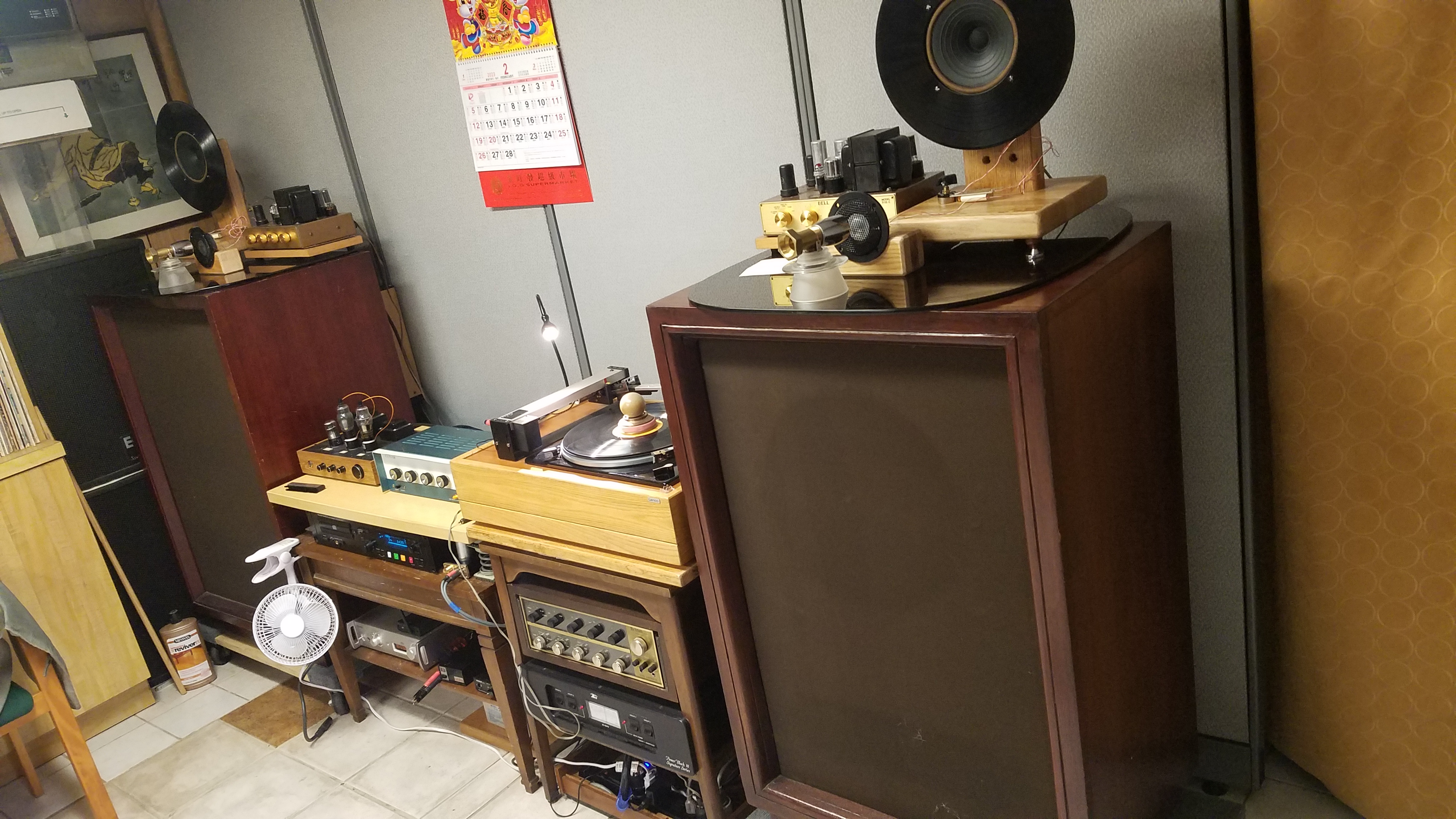
(Continued from Part I (Saturday)) MJ came by in the morning and listened to my systems a bit. He was particularly taken by the deep airy soundstage produced by the LS3/5A in my LR (Yamamoto; Elekit, here). I packed some of the food I cooked on Saturday and we went over to Kevin's place, where he in short succession demonstrated his Altec 604E, B and W Matrix 801, Infinity RS-1 and Altec A7 (I have profiled him extensively in many articles; will have an updated article somewhere down the line). We had lunch there with the stuff I brought over, supplemented with some nice Chinese chives (grown in the backyard) sauteed with bean sprouts. Andy was waiting for Godot in the morning. By 1 pm, Godot had not turned up and we were very happy to have our group leader join us. We picked him up and headed to Roslyn Heights.
Chez MJ We first hit his basement, and were immediately overwhelmed by the sheer number of large vintage loudspeakers and gear. It is an L-shaped basement (see diagram). We enter first into the long-stroked arm. At the Tip of the Letter were the Altec 604E and a pair of EV, driven by very simple disc player and an old Sansui Receiver. The Altec cabinet is a little larger than Kevin's and I thought it also sounded a little richer. Not bad at all for the very difficult to get right 604E (like the bigger A series, most suffer from crossover woes). The EV Fullrange was also surprisingly organic.
Like soldiers going through landmines, we advanced inch by inch and sat down on the sofa and listened to the JBL C60. Wow! It's like the big brother of the 4320 the day before! Significantly larger with an extra passive 15" woofer. Driven by Citation IV and McIntosh MC240 the sound was utterly engrossing! And the LP was played on a humble Technics SL-1200 with a Denon DL-103 (rare variant D), Denon Step-Up but a cheap "professional" DJ phonoamp! Streaming through a Marantz, much like Sam. As you can see in the pic, the C60 is propped up on a dolly. Andy raised the question of listening to them in the original state, on the floor (though the tweeter would be quite a bit below ear level. And then there is the question of taking the mid driver and tweeter out and putting them on top - something many JBL users do to improve the sound.
How good is the C60? Near the top, for my taste. Incidentally, I had written a brief JBL Overview before, so you know where I stand. Looks like I have to update it! As I mentioned in Part I of this series, my hitherto favorite has always been the L300. But the C60 has mighty attributes of its own, like an extra, albeit passive 15" woofer. The sound of the C60 (as of now) tilts towards the bass, whereas the L300 likely has a more evenly sorted sound. It hardly matters - we are smitten! Kevin is already on the lookout. Andy and I have no more space.
And then we turned the corner to the short leg of the L. At the end was a pair of Altec A5, with Wood Horns! It was being driven by a pair of Acrosound EL34 monoblocks to good effect. Of course, this wing of the L shaped room is just too confining for the A5. Source was classic half-size Esoteric VRDS Transport and DAC. Preamp was a DIY by one of their friends. Beneath are some Stromberg Carlson integrated amps. I asked to substitute the Oliver Sayes 43 SE amp (this one had 1x 6SL7 and a 5Y3). I heard much the same mellifluous sound as the 71A amp I had at home (although the 43 is indirectly heated pentode and 71A DHT).
One thing I learned recently is, much to my surprise, Altec's can be less efficient than I thought. With my YL horns (YL drivers and Altec 416A woofer) the Oliver Sayes 71A (0.7 watts) was more potent than here with the 43 driving the A5. Similarly, at Kevin's my Conar SE EL84, though tonally excellent, was not that powerful with the 604E (article to come).
Flanking the Tannoys are the Klipsch Forte's used in HT. Pair of Chartwell LS3/5A on stands. Pair of Spendor SP-100 idle on left.
Chez Philip Phil lives across the Street and came over to MJ's for a while and we all followed him back to his VERY large basement. Aside from the speaker change, the room looked much as before. Unlike Sam and MJ, Phil maintains a more minimalist outlook. The Tannoy GRF Memory is earlier than Sam's, with Cork face. We're not sure if they are TW's, Alnico or Ferrite. Phil still uses the McIntosh MX110 tuner-preamp (hidden in cabinet), a great bargain in my book, which drives a pair of McIntosh MC-60 (atop cabinet). Streaming was through a Gold Note two-box (in open cabinet). Sound was decent and much like at Sam's, though here due to the wide separation and heavily carpeted and large space less focused and softer. But it was still very musical. However, with old Jazz, say a Trio, it's ridiculous - there is too much of a ping pong effect with one player far away on the right and another on the left. Many of these old stereos have weak centers to start with, so this is a problem. After giving it thought, I recently told Phil mono jazz small combo albums will likely play better in this system, though we didn't try it that day. With classicals and orchestrals, the wide span was not so much a problem. We also tried out his humble analog setup of Pioneer PL-12 TT and AT95 Cartridge. Through the MX110's excellent phono section. sound was decent. There was however significant imbalance between the levels of the 2 channels, which I balanced by using the MX110's convenient Level Controls (tubes need to be checked). The tone of Michael Rabin (Seraphim LP) was surprisingly opulent, but the orchestral part was kinda grey. We tried to play CDs but the player was unresponsive.
This room is really too large. If I had known years ago, I'd not have recommended the SP-100 for him. In the plan below I show my idea of how to improve placement, but of course I understand everybody has constraints. I know some upgrades and a rack are in the works but re-positioning will have even more decisive impact. just brainstorming.
The highlight of the evening was an outdoor BBQ. What's a Labor Day Weekend without one? The food was simple but high quality, washed down with good wine. We were joined by the two wives (delightful) and another audio friend Johnny, a seasoned vintage veteran whom the mosquitos zoomed in on. Andy and I were completely unscathed. The only regret of the day was that Sam could not have joined us, as he was having too much fun laboring in Las Vegas.
Below a clip of Phil's, all from a cheap cheap TT!
04 April, 2022
Western Electric 755, TA 4189A
Regular readers know that when I was in Hong Kong, my friend icefox often acted as my taskmaster, making me work hard. This man knows virtually everyone, especially the ones worth knowing (not at all in the majority). He knows almost all the WE players in HK and the greater Guangzhou area and is a constant source of good information. He recently sent me the videos below, which I hope you will enjoy. Much of the music will be unfamiliar but I think that's not so important.
Taipei: Mr Han's WE TA-4189A 台北韩先生 He is an acquanitance of icefox. I have even less info on this. Suffice to say, this is a pair of fullrange Field Coil WE (power supply at bottom of article), driven with WE 94C amps, fed by Studer A730 directly, no preamp. This is Mr. Han's second system, his main being WE 15A (not available this time).
12 July, 2020
Horns Jensen 302 201 P15LL103 Fountek General Radio 1450TA Altec 808 Fostex T90A
Click pics to enlarge. Tri-amped Altec System. L, from top: TT, Conuterpoint, Electronic Crossover x 2, ASL. R, from top: Passive Pre, Puresound, Adcom, Raphaelite, Adcom.
Virtual Home Visit (7): Dual (Duel) Horn Systems
Editor: BenYC is one of the gentlest souls that I have had the pleasure of knowing. Always willing to lend a hand, Ben has been very kind to me. He is a very experienced audiophile; just a casual look at his equipment will tell you that. Ben also had my ferrite La Scala for a while before he evolved into the Jensen's and Altec's. Although we probably listen in different ways, there is one thing that now we share: we both listen to the low-res streamed music - Ben to his YouTube and I to NML or Spotify. We just love to explore music. For Ben, this comes in the wee hours, after a day of working and cooking (he's an excellent cook) and tending to his three kids; he then is free to listen at low volume or with his desktop system - his private hour. I am sure a lot of readers can relay. Ben plays the violin.
It was more than 10 years ago that I wrote up BenYC in a Home Visit. I had visited him several times after that but didn't report on it. Note that the equipment haven't changed that much. How does BenYC describe the sound of his systems? "...All are old gears that no one wants. They sound like a mini-hifi that can play a bit louder..." But, don't you believe him...
BenYC's Living and Dining Rooms are conjoined in an L-shape. Top pic shows the Dining Room System, which is kind of his main system.
CD transport - Puremusic MU20
DAC - Adcom 600
Turntable: Nottingham ?
Phono - Counterpoint 5.1 + Raphaelite SUT
CD Passive Pre - General Radio 1450TA (RCA 11713 Transformers in out)
Crossover and input selector - Ashly SP4.8 x 2
Treble - Raphaelite 6L6 SE to Jensen 103 + Fostex T90A
Mid - Sun Audio 45 SE to Altec 808 + 511
Bass - Antique Sound Lab 6L6 PP to Jensen P15LL
Sub - MJ Acoustics Ref 100 x 2
The system below is the second system, located in the Living Room by the Door.
Top Shelf: Ampex, Raphaelite behind amp on left, Sun Audio behind amp on right, Electronic Crossovers stacked behind Center Speaker. Middle: Parasound and Passive Pre. Lower: PS Audio. See also right pic and pic below.CD Transport - PS Audio Lambda
DAC - Parasound 1600
Passive Pre - General Radio 1450TA (RCA11713 transformers in out)
Crossover - Ashly SP4.8 x 2
Treble - Raphaelite 6V6 to Jensen 302 + Fountek NeoCD2.0
Mid - Sun Audio 6V6 SE to Jensen 201
Bass - Ampex 6L6 PP to Jensen P15LL
Sub - Sunfire HRS12
BenYC also has a lot of stuff on his desktop, but that is enough for now!
29 October, 2019
Infinity RS-1B, Altec 604H, VTL MB-450 Series I
Click pics to enlarge. My earlier Visit 1. VTL MB-450 monoblocks have replaced the previous CJ Premier 8 on the amp racks. Between the Infinity panels is my Thorens TD-124. What are the dishes? Clockwise from top: Pocket Pastry with Chives and Eggs, plus Chinese Flatbread; Fried Eels; Spicy Tripes; Mustard Green with Other Vegetables; Braised Pork.
NY Diary (19-15): Infinity RS-1B and Altec 604-H Redux
VTL MB-450 vs Conrad-Johnson Premier 8
As mentioned many times before, our friend Kevin is a dynamo. Just chronicling his quest is enough material to sustain my Blog! :-) This is the latest update.
VTL MB-450 (Series I) After my last visit (peruse for the other equipment used), Kevin bought a pair of VTL MB-450. This is the same amp that Andy (who inspired both Kevin and Mark to get into Infinity) has used for over 10 years (here). This is the series I, which has a much plainer look (that I prefer) than the later II and the current III.
Talking about product longevity, this amp actually harks back to the even earlier MB-300, which is why this Stereophile archived review link grouped all the MB-300 and MB-450 Series I and II reviews together. Quite a good read, with some caveats, as we shall see.
Each MB-450 uses a 12AT7 and a 6350 to drive 8 x 6550's, switchable from Tetrode to Triode Operation. Andy's Svetlana 6550's had lasted him for over 10 years and that is astonishing given how hard they have to work driving the Infinity panels. Kevin's amps on the other hand are now tubed with current production Gold Lion KT88's. As with VTL, fixed bias for each tube.
Visit 1 Not long after, I got to hear them. As soon as I heard the first piece, I said I preferred these to the CJ Premier 8's. Kevin laughed and said, "I predicted you are going to say that and I mentioned it to Andy last night!" Well, we know each other well indeed; I know myself well too, as I too knew even before the visit that I was to prefer the VTL.
So why my preference? I have thought of writing a CJ Overview as I have heard plenty of them and used a few, but...Well, I find CJ products too colored. To use its rival ARC as an example, if I compare their products of the same vintage, I almost always prefer ARC, for its more neutral sound. Some tube warmth is undoubtedly desirable, but CJ over-eggs it, especially as it evolved. Basically for a long time they just added more and more, and larger and larger, capacitors, particularly in the preamps. The Premier series preamps are widely used in our circle, but I personally do not favor them. As for the amps, I find them even more unacceptable. To me, CJ's use of high bias and current on the power tubes wastes power, leads to short tube life and frequent failures, produces a tight sound, but somehow does not translate into power when the going gets rough. Here, the CJ LP275, a latter day (but less well built) version of the Premier 8, was a wimp compared to the diminutive EAR 509, a neutral amp closer to the VTL in sound. That said, the popularity of CJ must owe a little to the remedial effect it has on lean systems (prevalent). It should also be said that more recent CJ products have moved towards the more neutral side.
And so it proved here. The sound of the MB-450 was surely more neutral than the CJ, more powerful too as I expected. Kevin preferred Triode Operation because of its sweeter sound. In this system, with Kevin's audio preference and the ribbon panels, there was really not much sweetness, but I left pretty satisfied. It should be noted that in one of the Stereophile's reviews, a much younger Michael Fremer favored the sound of the CJ Premier 12 (which can be thought of as a smaller version of the 8) to the MB-450. Horses for Courses.
As predicted (see link), the Altec 604-H (right pic) sounded better with the McKintosh C20/MC30 combo. Things fleshed out. On James' Lenco 78 turntable, Kevin replaced the original arm with a modified Rega 300, and the result was enormous, much better balance and bass, a tribute to the Rega arm.
Visit 2 Just yesterday we met again. In the interim, Kevin had built new power cords for the VTL's and according to both him and Andy it made a big difference. Indeed the sound was a little fuller. Kevin is now using the Tetrode Mode for its greater control and power. He said the power cord smoothed out the sound enough for him to make this choice. Kevin had switched cartrdiges. The VAS-modified Ortofon 2M Red sounded better than the Decca on his Thorens TD-125/ET arm (this arm is said to be light in bass, and so it proves). The Decca Gold (VdH stylus) also sounded better on the VPI. A good switch. On this occasion, we also heard his digital system with a Wadia 2000 transport, which sounded pretty good. It was too bad I had to leave early.
The job is not quite done. While I liked the more neutral sound of the VTL, I do think the system could use a little more warmth, but that is surely to come soon.
Note my Thorens TD-124 now has a 12" arm board made by Kevin. Lunch is Seafood Pan-fried Noodles.
09 September, 2019
Infinity RS-1B Altec 604-H VAS Re-Tip Cartridge Repair Monster Alpha Genesis 1000 Decca VdH SC4E Gold

Click pics to enlarge. A Tale of Two Positions. Top, Initial Position, rather missionary; Above, Final Position, freer. The Bass Columns are all the way in the Back Corners, barely visible below the unused horns. The Front Panels are driven by CJ Premier 3 on the rack and Premier 8 monoblocks in the center. The Bass Column is driven by a Professional Crown Amplifier on the rack below the CJ P3. The Lenco in the center is not used on this occasion. The Thorens TD-125 with Decca Gold (VdH tip) is to its right. Below the Thorens are the Yamaha DVD player, TEAC DAC and Chinese Server. A bit of the VPI turntable is visible behind the left Altec A7 horn system. McIntosh C20 + MC-30 drive the Horns. Poor B&W 801's are covered up in purple.
Background and earlier session with the Infinity RS-1B here.
Infinity RS-1B, Almighty!
To paraphrase Anna Karenina a bit: All great sounding systems are more alike than different, and easy to write up; whereas bad systems are bad in all sorts of different ways and test a writer's patience (not to mention friendships). Now, this article is super easy to write!
This man Kevin is one of the most incredible audiophiles I have encountered. Over the course of a very short 2 years, he has gone from someone who was using a small Fostex full range to Altec A7 horn system, then B&W 801 and then now Infinity RS-1B (amply chronicled in this blog, search link). If audio is a degree, then in 2 years he went from high school to post-doc! Of course, he was helped along by Andy, and benefitted from Andy's many connections. I tell you, if you have the chance to connect with older audiophiles, do so; it is likely more beneficial than hanging out day and night on the internet. One thing great about Kevin is, whatever "advice" we give him (some just guesswork from experience), he would try it out. Even if the conclusion is different, the experience is worthwhile. Yes, audiophilia is serious work.
This pair of Infinity RS-1B came on the heels of Sad News - the departure of Andy's long-time friend, Mr Ma, a notable tech wizard familiar to many in upstate New York. When he was young, in Taiwan, Mr Ma serviced the very complicated Studer components and most things are just piece of cake to him. I should have touched upon him in my last article below but somehow didn't. Suffice to say, Kevin went with Andy and bought the Infinities which were languishing in the garage and also took home a pair of Altec 604-H.
Last weekend Kevin called us and told us of the great progress he has made since my last visit (here). I of course was a bit skeptical, as this kind of call has happened often with audiophiles. Gratifyingly, it proved otherwise on this occasion.
In-Room Kevin had drastically rearranged his room. He removed his sofas (to me unnecessary) and moved the Infinities forward (just as I'd like, as chronicled with his Altec's here and at one time his B&W's here). It is my firm opinion that in-room usually sounds the best. And this time, as in the past, it is proven again. The sound was wide open and dynamic, just superb, as one would expect of Infinity (at its best). Surprisingly, the bass alignment was excellent, and I could not detect any incoherence - an achievement! Closer Together We first listened to them this way (top pic), and the sound was highly focused, super-detailed, but somewhat tight and relentless. Further Apart Then we pulled them apart (second pic from top). Aloha! The strings in Sibelius Symphony No. 4 (Karajan/BPO; DG) sweetened considerably and everything relaxed; both Andy and I nodded in approval. Dialed in, as far as I am concerned, a total success! As a matter of fact, it sounds even better than Mark's Beta, as last heard here.
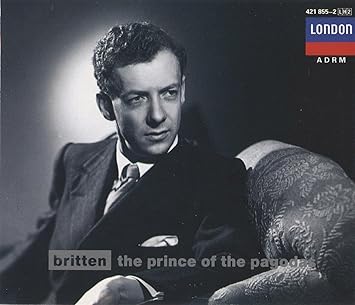
Loudspeaker Placement Again, as I have expounded many times in the past (search link), this illustrates the absolute importance of loudspeaker placement. For people who have a choice (I know many don't), it is imperative to try to find the best position. It is also true that in-room and near-field positions are freest from boundary effects.Digital vs Analog To balance the system, this time Andy brought over material in both CD and LP format . We are in total agreement that digital and analog should sound similar in tonality at least. Here. tonally the modest digital setup was definitely warmer and fuller in the bass. The Sibelius was definitely better in CD form when the speakers were in initial position. Ditto Britten's own recording of his Prince of the Pagodas (Decca). But when the speakers took up the final position, wider apart, the sound smoothed out in the treble, to make the analog sound more open and detailed, without stridency. I judge it superior but, knowing Andy, I'd think he still prefers more warmth. Nonetheless, the way analog breathes and brings out the full harmonic spectrum, and how it makes one aware of phrasing, simply can only be approximated by digital. We discussed how the ribbons have their own sound, likely not easy to fully warm up.
Two Decca Cartridges Both have the Van den Hul re-tip, and both exhibited the Decca's virtue of fast transient time and evenhandedness. Detail is probably more than the original ones due to the VdH mods. Overall the Decca SC4E on the VPI Prime was preferable; indeed this marked the best sound I had heard on the VPI (that says a lot for me, as it is not my favorite brand). Andy is very particular about the TT used with Decca's; while his current choice is Nottingham, he gave approval to the VPI. The Decca Gold on the Thorens TD-125 (with tangential arm) was not far behind. As a Decca fan, I was quite happy with both; surely with time and some cabling experiments the sound would further improve.
Altec A7 I don't know what he did, but on this occasion the A7's sounded quite good driven by McIntosh C20 + MC-30. It was the best sounding since he moved them further back. This is just a footnote, as we didn't pay too much attention being more distracted by the younger brother...
Altec 604-H
A dining table and a few chairs separate the two ends of the room. I did miss the old couch, which I think he could have kept! But now at the other end is another horn system! The Altec 604-H is the last alnico iteration of this classics, which I have heard many times in HK (read this home visit in HK). The Bell 2122-C's were not optimally tubed and lacked impact compared to the Sun Audio SV-2A3, Sound showed potential and was in keeping with many others I have heard, though bass certainly could have been fuller. I told Kevin that one time I heard a McIntosh amp worked well with the 604. Kevin followed up and called me that sound had further improved. That would have to wait till the next report.
Altec 604-H driven by Bell 2122-C's and Sun Audio SV-2A3 (behind). Preamp is Conrad Johnson PV-5 and turntable is a Lenco L-78 with original arm and ADC cartridge.
Monster Alpha Genesis 1000 (VAS Repaired)A few days later we had a lunch gathering at Andy's. He wanted us to hear his resurrected Monster Alpha Genesis 1000 Cartridge. This was a famous cartridge in its days, and Stereophile online has an article on its sibling 500 compared to the 1000.
Andy's 1000 is certainly not the first one Steve had repaired. Here is an interesting report on his job with this cartridge.
Our impressions were certainly in keeping with the Stereophile report. The Monster was made by ZYX, which still makes them more or less the same way. I am not a fan of ZYX, which I have heard many times in HK - its usual literal manner holds no fascination for me. On this occasion though, they sounded pretty good with Andy's A5's driven by a pair of vintage Bell 2122's. Andy's 1000 broke off after not much time, and he had waited all these years for a re-tip. Andy said VAS Steven's re-tip is likely better than the original. We enjoyed the music together with the sumptuous lobster noodle and seafood tofu soup.
03 October, 2018
Horn Placement, Subwoofer Supplementation
Top Pic: (Case 2) Pic of R's A5 System as of now. My Bell 6V6 amps in center front. Compare with old photo below.
Talk Horn: In-Room Placement, A Tale of Two Horn Systems
HiFi Basics VII: Loudspeaker Placement - Close-to-Wall vs In-Room
McIntosh C-20 Preamp, MC-30 A
Significant Update Oct 5, 2018: Subwoofer Supplementation added. Update shaded in Grey.
Although we are illustrating with big horn systems the size of refrigerators here, I believe the principals are universally applicable, to much smaller loudspeakers, including bookshelves.
There is little question loudspeaker placement is of the utmost importance in a system. Previously, in HiFi Basics III, I detailed my own encounters of Short vs Long Walls. This article examines Close-to-Wall vs In-room Placements.
Close-to-Wall Placement By Design FEW modern loudspeakers are designed to be placed against the wall, as this intrinsically is at odds with the modern hifi values of maximizing imaging and soundstage. But there are a few dedicated designs, like the very good Linn Kan, which needs the wall reinforcement to have useable bass for most people. More recently, there is the Wilson Audio TuneTot, which receives a lot of coverage from the audio press, but to me it is a ridiculously expensive product for what it is, and showcases the utterly hopeless nature of high-end reviewers (The TAS is a particularly serious offender; their eulogies on the passing of Wilson Sr make my flesh creep 簡直肉麻!) Corner Placement This only applies to certain vintage loudspeakers, usually larger horn systems with specifically designed corner cabinets (Klipschorn and Tannoy's) to optimize bass output. The corner has two reflecting surfaces which would cause even greater havoc with most other loudspeakers. By Choice/No Choice Sometimes one has no choice but to place loudspeakers against the wall. In my experience, most loudspeakers sound suboptimal to terrible thus placed. Most would suffer from badly delineated bass and lack of air. In this situation, one would be wise to choose infinite baffle (sealed) enclosures, preferably those with monitor pedigree, as these usually work well in near field situations and have good but never exaggerated bass. As an example, my large Yamaha NS-1000 works beautifully against the wall; there is still a good soundstage and imaging (though not as good as in-room), and my TAD TD-3401 is also good in this way. Ported loudspeakers, even front-ported, do less well. Klipsch Heresy This unusual loudspeaker is actually stipulated to be used (on its own pedestal) against the floor, not the wall, but that is not that different. Without floor reinforcement, the Heresy is lean in the bass. As such, it actually works well close-to-wall.
How should Horns be placed? No doubt the size factor predisposes their owners to put them against the back (front) wall. Also, the ungainly, industrial and utilitarian appearances of many horn systems, such as the Altec's in this article, certainly do not earn them admiration from family members and that is another incentive for relegating them to the back, even in the corners. For many, it just has to be that way, BUT for those who have the room, that is a mistake.
These horns were originally used in large theaters, perhaps hanging, but usually not against the wall; and firing down a huge space (ample space around them) minimizes any anomalies. In our much smaller spaces, one needs to take care.
In my old place in HK, I had my Tannoy Canterbury's (large loudspeakers with small horns) and TAD TD-3401 half way in-room and they sounded great that way. Visitors were always amazed by the depth of soundstage and, even more, the disappearance of the loudspeakers. In NYC, I have my YL horns the same way, with similar results. Like with a lot of more conventional loudspeakers, unless restricted by bass nodes, I like the loudspeakers in-room and with the listener form close to an equilateral triangle. Some would call this near-field, or nearly so, and it should lessen boundary effects. For me, in both HK and NYC, the sweet spot for loudspeaker placement is largely the same for all sorts of designs.
Subwoofer Supplementation What a Difference a Little makes There are many purists out there who are adamantly against subwoofers, but these are mostly people who have little concept of what live music is like. Our hearing is a complicated thing - without a bass foundation not only will the midrange and upper frequencies sound leaner, but the music will lack true sparkle, which most audiophiles mistake to lie solely in the treble. The best example is my friend WSS' Quad ESL, which came to life with just a whiffle of low bass added (here). I always tell people, a little augmentation does not really augment the bass by much, but helps the overall picture, to bring things to life. As in the case of WSS, the important thing is less to hear the difference, but to feel it. When to Use? This is purely by hearing. My modern Tannoy Canterbury, TAD TD-3401 and YL horn system (with Altec 216 woofers) do not need help, but my JBL 4312 and my NYC friends' Altec A5/A7 systems absolutely do. Another case is my Klipsch Heresy, which really is severely limited by its original design (on the floor), but rather should be used "normally positioned," together with a subwoofer (detailed here). Subwoofer vs Other Means When the bass is lean, the problem can lie with the loudspeakers, the equipment or simply the room. Audiophiles have many ways to increase bass, but these should only be used judiciously, as the "remedy" is often worse than the problem. It is one thing to try, e.g., Mogami instead of Gotham (both cheap professional cables with balances close to neutral, though they sound different), it's another to use expensive boutique cables that are basically highway robbery. Case in point: Thick and stiff cables, e.g. NBS, often increase bass, but are highly colored and smear everything. Most of the time, the loudspeaker is the real limitation - it would be wise to spend time dialing in a subwoofer rather than make the bass "fuller" via other means, as one really wants more true extension rather than bumping up the mid-bass.
The owners of these two Altec systems are good friends of mine who should be familiar to regular readers of this blog. Both share a passion for music as well as many other non-musical things, such as cooking! Both are lucky to have a dedicated room. Both had their horns in the back until I came back this time. Both had their horns on wheels so it was relatively easy to move the behemoths forward. As they say, the rest is history.

Pic shows (Case 1) Kevin's A7 System, now way out in front (compare with old photo below). The turntable on the Wall Mount is now a restored Lenco G-75 (VPI relegated to the left, a corner of which can be seen behind the B&W CM5). Below are newly acquired and restored McIntosh MC-30's. On the front stools is one of my C-20's. Click to enlarge.
L pic shows the Dumpling Dinner with side dishes of Pork stewed with Dried Bamboo Shoots, Braised Peanuts and Sliced Smoked Turkey; R pic shows the older against-the-wall Placement. Also roll down to the Blog entry before this one.
Case 1: Altec A7Since I last wrote about K (roll down to previous post) I have visited him two more times. Unbelievably efficient, over a short time he managed to move the horns forward and clear up the central clutter. All gears are now well behind and there is a clean line of sight to the plane of the loudspeakers.
The sound is totally freed up. As the man himself said, the sound now emanates from the space in front, rather than from the loudspeakers. I cannot agree more, and this also met with the approval of our captain Andy. Now, with the much cleaner and focused sound, Francescatti's tone (which could be grating in lesser systems) in his classic recording of Beethoven's Violin Concerto with Bruno Walter was just marvelously sinuous. Thumbs up! Credit is also due to K's DIY WE cable.
We also really liked the the full McIntosh combo, the Lenco/Decca/Shure M44-7 playing straight into the C-20's phono and driving the MC-30 pair. Everything sounded just right.
Case 2: Altec A5Then we visited R (last visit). I have long suggested to relegate the HT system to the periphery and bring the horns forward. I was surprised that R was game and K carried it out single-handedly (he definitely earned his lunch)! It was quite a bit of work! Everything was dismantled (the Cary amps were heavy!), the huge HT subwoofer exchanged its space with the large HT center. The result was again a cleaner path to the plane of the loudspeakers.
The effect was much as at K's place, a cleaner sound that is free of the enclosures. The Bell 6V6 amps worked very well in this system. Marvelous!
And the Food!
26 May, 2018
Western Electric Altec 604
Yumcha Diary: The Longest Day, Heat Wave, 759, Mother Tongue, and more
Home Visit: Altec 604 and More Western Electric
Revised May 28, 2018. Pic of WE 130/124 added
HK is now suffering from a protracted Heat Wave, the highest temperature ever recorded in May (SCMP report). It is over 35 degrees where I live. What better way to kill some time than yumcha with friends!
All of us are fans of 759 Store, a non-traditional food store employing an unusual business model (many stores and no warehouse), which gives the powerful supermarket chains a run for their money. 759 sells mostly imported items, otherwise unavailable, at rock bottom prices. We talked about its Spanish ham, which is certainly cheaper than in Spain. Similarly, my bottle of German Riesling cost me a mere HKD 45, likely cheaper than in most cities in Europe.
Mother Tongue Another topic concerned what recently embroiled HK, the debate on what is "Mother Tongue", which is yet another thinly disguised and distasteful onslaught on our collective Hong Kong consciousness. The whole thing is a joke - do we need other people to tell us who our mothers are? In jest, but with an element of truth, I say, whatever dialect you curse in is your mother tongue. If you say "x y z 母", your mother tongue is Cantonese; if you say "xxx xx xx xx B", yours is Mandarin (oh, excuse me, pu tong hua it should be); and if you say "xxxx you", English it is. Simple, and no politics involved.
After yumcha, I started my wandering in the desert. First stop was a home visit.
Home Visit: Altec 604-D
This is my second visit to Vincent, to his "den" right atop the flower market. I forgot to take a picture of the view from his windows, a magnificent panorama with the impressive backdrop of Lion Rock, symbol of Kowloon, even HK.
The setup here is relatively simple - CD replay only. The source is buffered through a WE transformer, then goes into a vintage Daven stereo volume pot before going into a pair of DIY Western Electric 133 employing all genuine WE parts (those interested in the WE 133 may want to read my article).
The star of the setup without doubt is the Altec 604-D. The cabinets are small but they are well nigh perfect for the relatively small space. Sonically, they are anything but small. After switching in my Gotham DGS-1, replay of jazz was well nigh perfect. This Wynton Marsalis Quartet CD is not one of Blue Note's better albums, but redeemed by the Diana Reeves cut. Even better is the enigmatic Nah Youn Sun, much better known in Europe and Asia than in North America (it seems Korean transliteration is even worse than Chinese, as there are many variations of her name on the internet; Nah is the last name; her official site). Her subdued and considered compositions on Memory Lane was intimately conveyed, with full atmosphere.Because of it space saving coaxial design, the Altec 604 has a lot of adherents. I have heard nearly all of its iterations (plus the close kin 605), in systems ranging from the simple to the very complicated (electronic crossover), but this very simple system is likely the best sounding. The whiff of treble dryness pervasive in Altec's is not much in evidence with pop and jazz, though perhaps showing just a little in classicals, although replay of my current favorites, Esther Yoo's Tchaikovsky (DG) and Currentzis' Le Sacre (Sony) (roll down for last article, or click here) were more than passable.
Thanks to the Altec 604, which because of its efficiency and horn component is arguably more suitable for WE, in general Vincent's den sounded almost as good as his home, where he had the WE 130 preamp and 124 amps, last heard using ATC SCM-100 (pic below). For sure though, the home has just a little more WE magic. If it were me, I'd take the Altec 604 home.
Then we headed for Pro Sound, where we audaciously opened a bottle of proprietor Mr. Chu's wine (a Chianti, not bad) while we shopped. I went to 759 again to procure my favorite potato chips (again from Spain) and we enjoyed the Happy Hour. The gang left for Kowloon, but I stayed behind a while longer and had a chat with Christine.
By now, the heat has subsided a little and I summoned the courage to sit and eat by the road side...
Dai Pai Dong The Dai Pai Dong is a veritable Hong Kong institution, now unfortunately threatened with extinction as the government does not issue new licenses anymore (read more here). The government, as usual, is short-sighted - this is precisely the kind of thing tourists love and what we hold dear. Perhaps, in due time, like "Mother Tongue" it will go by the way side. Sigh...
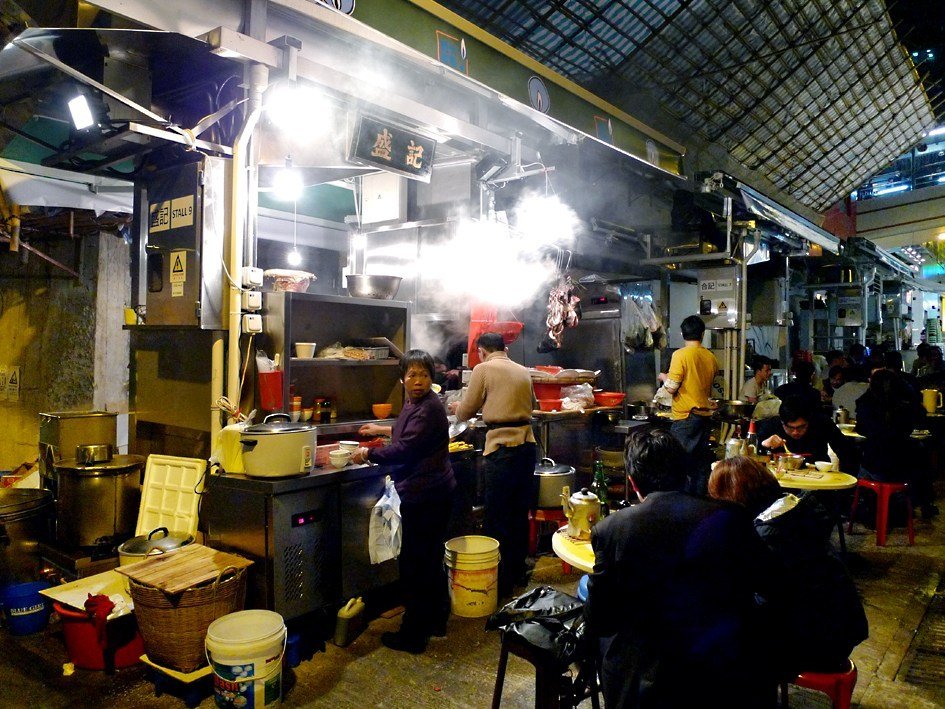
I sat down at Sing Kee (pic from Openrice), tucked into an alley in Central. This place used to have very good and cheap fish dishes but I hadn't visited it in a long time. It seems now only tourists come. I was surrounded by Mainland Chinese, all eating seafood (steamed clams and shrimps etc). Then came an Australian couple (see top pic) - the lady is stunningly beautiful, quite a sight in this environment.
I had a beer and ordered a beef dish, but the meat tasted like rubber. No matter, it was primarily a bit of nostalgia, something we people from Hong Kong indulge more and more in these days. The more we receive unsolicited and unwelcome instructions on how we should behave as adults, the more we long for our childhood. The more we are told the good old days are really "bad", the more we miss them. A person who has a memorable past to live in is a much luckier person than one who only has the politician's promise of a bright future to hold on to.
I then attended an excellent concert given by the great pianist Dang Thai Son in City Hall (see my classical blog), which looks gratifyingly exactly the same as in my childhood.Late Night Jazz After I returned home, I fired up my Kondo system and listened to Nah Youn Sun's Lento, perfectly intimate for the wee hours. And then I played The Best of Sinne Eeg (mine is the CD version). It is highly unusual for me to listen to "eurojazz", if these are jazz at all, but it was a fitting conclusion for the day.
Both beautifully recorded albums sounded significantly better than before. Perhaps it is the Gotham GAC-2111 (10550; EMT replica) I just made before going to yumcha? We'll see.