Showing posts with label Talk Mono. Show all posts

25 December, 2019

Air Tight PC-1 Koetsu Black Goldline Denon DL-103 Ortofon LH-9000 LW-7N AQVOX 2CI Mk II Aurorasound Vida Fosgate Signature Mono Button


Click pics to enlarge. David and Goliath? In the US, David is priced at 1/50 the price of Goliath.

Talk Vinyl: Mono Button, Headshell, Cartridge Wires, Viennese Waltz
New York Diary (19-24):
Air Tight PC-1 Re-visited vs Koetsu Black Goldline vs Midas Denon DL-103
Aurorasound Vida vs AQVOX CI Mk II vs Fosgate Signature
$5 Ebay Headshell vs $240 Premium Headshell 
Review: AQVOX 2CI Mk II, Part III
Calibration of Analog Sources in System II

Revised 12/28: AQVOX tested with Midas Denon DL-103
Revised 12/26: Addition of Fosgate Signature Phonoamp

Mega Article on AQVOX, Parasound and Aurorasound (this older article features all the phonamps and cartridges in this present article, which can be regarded as a Part II of the older article).
Fosgate Signature Phonoamp as last heard

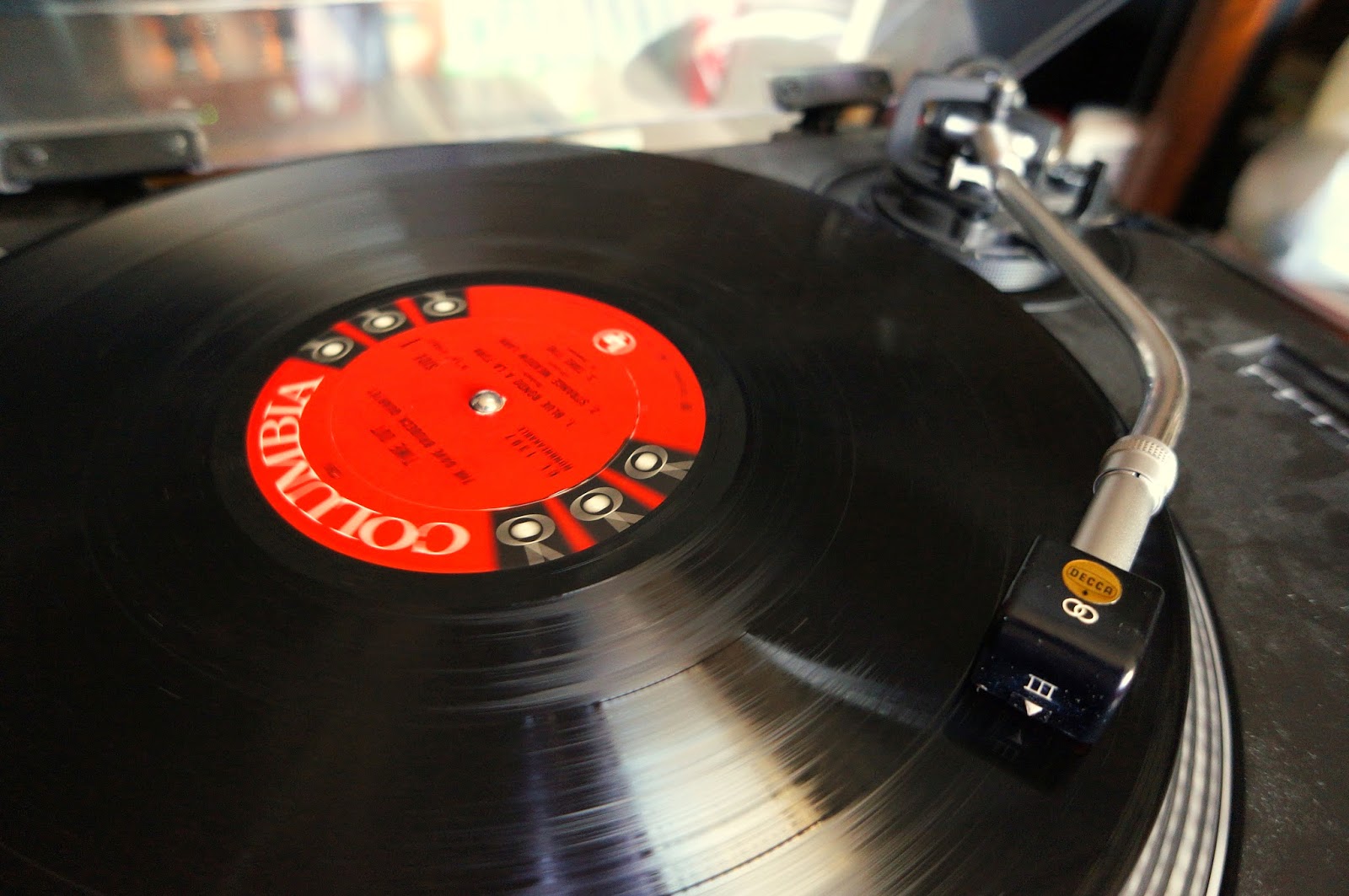
After I finished my long and gratifying session with the VAS Ebony Mono, and after brief flings with the Denon DL-102 and Shure SC35C (here), I reinstalled my Midas Denon DL-103 on the Thorens TD-124/Schick 12". This was all into the Parasound JC3 phonoamp, which has a Mono Button, which is fed directly into the LTA MicroZOTL.

One thing led to another, and this article snowballed.

Mono Button with Mono Cartridge
Whether with the VAS Ebony Mono or Denon DL-102, engaging the Mono Button produced no discernible effect. This is also true in my System I, where the Mono Button of the Aurorasound Vida phonoamp produced no effect with these two cartridges. This shows the cartridges are not picking up anything from the vertical plane, and are hence true mono cartridges. Nonetheless, I usually habitually engage the mono button anyway when I play mono records.

Mono Button with Stereo Cartridge
I really wasn't doing any critical listening and was typing away on my computer but, after listening to two stereo LPs, it disturbed me a little that the sound of the Denon DL-103, while good, was not open enough. I looked around a bit and suddenly saw the Mono Button of the JC3 was still engaged!! Pressing the button again immediately opened up the soundstage and distributed the instruments. That is to be expected but what was not was a smoothening of the treble and small loss of bass impact. I then went back and forth with the button and confirmed that with stereo records the Mono Button firms up the bass but also paradoxically makes the treble a little sharper (?focused). Of course, the Mono Button is designed to let one cancel out the vertical modulations of the stereo cartridge when playing a mono record. But judging from the above, it may benefit the playback of some sub-optimally recorded or non-RIAA stereo recordings (which a mono cartridge does too).

Headshell and Cartridge Wires
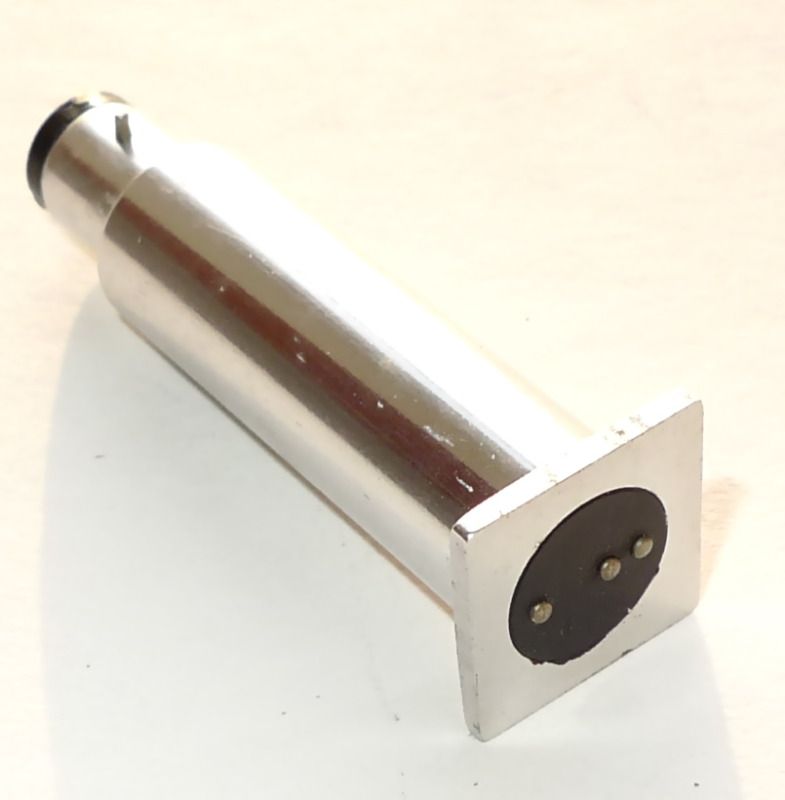
After a while, I got itchy again in trying to improve the replay with the Midas Denon DL-103. This cartridge was permanently installed on the only expensive headshell I have, the heavy magnesium-carbon fiber Ortofon LH-9000 (here) which was an impulse buy (always a wrong thing) in HK when I acquired the Schick arm in 2012 (in the pic in the original post). Somehow, despite its hefty price, or because of it, from the first sounding I have always been suspicious that it may not be the headshell for me.

See, for a start, I don't like the cartridge wires that come with this headshell (left pic); I frown upon the relatively thick strands. The wires are the LW-7N that Ortofon sells separately at an outrageous price. They are much thicker (lower in AWG) than the generic ones that usually come with my generic headshells. Ortofon actually sells all sorts of cables but they have never caught on with anyone, certainly not in HK and US. Almost all their cables are LC-OFC, 6N/7N copper, and all made in Japan, just like most of their tonearms and tonearm cables (basically Jelco). In my experience, these Japanese cables are smooth but lacking in dynamic expression.

It has always been my belief that thick cables sound worse than thin ones (as stated in this HiFi Basics article). So, 7 long years later, I swapped out the Ortofon for a generic Korean made perforated metal one that costs around $5 on Ebay, roughly 1/50 the price of the LH-9000 at established US retailers (cheaper on Ebay, at maybe half the price, which was around the price I paid for mine in HK)! In the case of the cartridge, the output signal is so small that a very small-gauged wire (high AWG) is enough to carry it; the larger the diameter (lower AWG) of the wire the more the delicate signal is going to be altered.

It has always been my audio belief too that one flat surface should not be placed upon another. This is true of smaller loudspeakers and their stands. For small loudspeakers like LS3/5A, one may get away with a little blue tac at the corners, which serves the dual purpose of securing the loudspeakers as well as decoupling. For larger loudspeakers, stands with flat tops are more often than not suboptimal. Two examples: The original Epos stand for their medium sized ES-11 and ES14 (great loudspeakers btw!) has an open-frame top, and they sound best that way; ditto the magnificent but voluptuous Spendor SP-100, which also sounds best on an open-frame stand. This is likely true of the cartridge/headshell interface too, particularly if both headshell and cartridge body are metal. I happen to like the look of these generic headshells, cool and retro. I also like the perforations, which should help resonances - witness Rega derived tonearms that have so many holes punched into them that they look like they are bullet ridden from an ambush! There is a reason why the open-framed Orsonic headshells fetch good sums on Ebay. For my cheaper plastic body cartridges I fuss less, but in my mind I don't like having the top of a metal-bodied cartridge right against a metal headshell (of course the metal screws unavoidably do bind them together at two points), and if the sound is not entirely satisfactory I'd insert a shim of cut expired credit card between them. I did that in this case (you can see in the pic; it helps with the VTA too). Note too that the Ortofon LH-9000 also has a thin strip of anti-vibration material taped onto its underside, so someone there was thinking along the same line.

Guess what, my worst premonitions all came true! The cheaper headshell was more to my taste - more air around instruments, a larger soundstage and a livelier and more subtle presentation. Whether it is due to the wires or headshell or a combination of the two I won't say. Of course I could swap the wires and try out all combinations, but I am not about to do that - one is just as unlikely to use an expensive headshell with generic wire than to use expensive wire with a generic headshell. Somehow, I just love the cheap package!

Which brings us to: how complicated vinyl playback can be! Aside from the turntable and the arm and the cartridge, even the littlest things, the headshell and cartridge wires, influence the sound greatly. In my experience, people who constantly tinker get bad sound (how can they not if they only concentrate on a few records for A/B); people who don't tinker can go either way; the best is to tinker less and concentrate on the music more - improvement comes with experience and in due time - there is no expressway to "heaven".

Unwanted Noise/Resonance/Vibration Control in audio has always fascinated me. In my experience, most of the time, the "solution" is worse than the "problem". Most, if not all, AC Line "Conditioners", Spikes and Cones, ridiculously expensive racks like Finite Element are just some examples that kill the liveliness of music, perhaps only suitable for those who use hot solid state amps and "state-of-the-art" loudspeakers. Those of us sympathetic to tubes seldom need these paraphernalia's.


Air Tight PC-1 redux

I then rearranged the positions of the 3 turntables in System II for some easy testing. For the first time in at least 2 years I played my Linn LP-12/Ittok/Air Tight PC-1 (here). I had looked forward to this moment ever since I got my Koetsu Black re-tipped by VAS. A comparison is in order.

For this part, as usual everything in System II went through the Shindo Monbrisson preamp, which drove the same LTA MicroZOTL 2.0 amp. Aurorasound Vida was the phonoamp for the Linn. I played 3 LP's that I had played using the gears in the above section, and the result was both spellbinding as well as instructional.

with Aurorasound Vida Henry Krips is almost forgotten today. He previously amazed me with his Suppe Overtures (here). This time, I got his Johann Strauss Favourites (HMV Concert Classics). Before, I thought it was well played but not quite inspiring. Not so with the PC-1: all of a sudden, the orchestra swinged and swayed, and Krips deftly applied to the English orchestra a Viennese lilt. The all-important upbeats acquired more emphasis, subtle retards became evident. Most delightful were the percussions, which felt purposeful, a sine qua non of good reproduction. In the Thunder and Lightning Polka, the rapid bass notes depicting the thunder were superbly resolved, no easy task. This LP is so telling that it is going to be my go-to test LP for cartridges. As amazing was Swarowsky's Saint Saens Symphony No. 3 (Urania). Despite excellent sonics, it was a straightforward account that bordered on boring, and the pickup Viennese orchestra had some weak playing. Again, not so with the PC-1: orchestral texture became more refined and colorful, and dynamics improved to the extent that it was actually not bad at all! Similarly, on Beecham's Ein Heldenleben (HMV Concert Classics) the Royal Philharmonic seemed like a much better orchestra with the PC-1, and combined with the subtle conducting (no bombast) of Beecham it deserves its reputation as a great interpretation.

vs Koetsu Black Goldline AQVOX As the Aurorasound Vida's MC input is now occupied by the PC-1, I first connected my Koetsu (on my Thorens TD-309 turntable, here heard with the Vida) to my AQVOX 2CI Mk II, and then played the same 3 LP's. Although better than previously with the Midas Denon DL-103, compared with the PC-1, it was evident the music was rendered with a broader stroke. I fiddled with cables, which did not help too much. Aurorasound A little piqued, I did the hard work of disconnecting the Linn/PC-1 so as to connect the TD-309/Koetsu rig into the MC input of the Aurorasound, which was how I played the Koetsu last time (here). Ah, the playback became more focused, and the Koetsu found more of what the PC-1 did (like the Viennese lilt). However, ultimately, the PC-1 was just more detailed and dynamic. The Koetsu Black is already a top-notch cartridge, but the PC-1 belongs in even  more rarified company. From this, I concluded that I wanted to use the Koetsu on the Aurorasound, so I recruited my Bob's Device SUT (here) for input to the MM input and the result was largely the same, perhaps with just an extra touch of force, which I didn't really need. Based on the Koetsu Black alone, it would seem safe to conclude that the Aurorasound Vida is better than AQVOX CI Mk II. Although there is no question the Aurorasound is formidable, but, as audio, particularly analog playback, is all about matching, I was not ready yet to draw this conclusion... Fosgate Signature The next day I connected the Linn/Koetsu rig to the Fosgate and, as they say, the rest is history. In this system, the Koetsu did even better than on the AQVOX, and perhaps even better than on the Aurorasound. The Koetsu did everything the PC-1 did, but at a somewhat smaller scale, but I feel it has been optimized. What amazes me is that the all-tube Fosgate yields not one iota to either the AQVOX or Aurorasound in the transient portrayal of the leading edge; every emphasis is microdynamically portrayed, no mean feat, with the additional benefit of a smoother sound.

with AQVOX I then connected the Linn/PC-1 rig to the AQVOX. The PC-1 was instantly everything it was on the Aurorasound, but with a little more grain. Remembering that I had bypassed the capacitors before (here), I switched them back in and now there was more warmth needed in this very high resolution system. I also adjusted the gain (front knobs; not = volume knobs) and experimented with cables (Gotham DGS-1 and GAC-2111 in lieu of the previous GAC-2) and got closer and closer to what I was hearing before. There were several thing that were amazing: 1) as some have commented, the current amplification phonoamps thrive on low-impedance or low-output cartridges, and the PC-1 vs Koetsu is 2.5 vs 5 ohm; 2) even with the gain turned way low, the AQVOX was even more dynamic and even faster than the Aurorasound, with either cartridge. Make no mistake, for my taste, because of its more refined nature the more expensive Aurorasound is still the better phonoamp, but the AQVOX would not be easily dismissed and I am going to explore more around the findings of today. For now, given that I had found a home for my Koetsu (i.e., the Fosgate), the PC-1 going back to the Aurorasound (the MM used for the Denon DL-102).

AQVOX with Midas Denon DL-103 With all of this, it is also apparent the TD-124/Schick/Midas Denon DL-103 needs some rejuvenation or upgrade. I went back to the rig and replaced the Parasound JC3 with the AQVOX. Surprise! With those 3 LPs I got back much of the quality missing before. In Johann Strauss Favourites, much of the Viennese lilt was back, and the bass notes in Thunder & Lightning Polka was surprisingly very well resolved. In Saint Saens, the brooding atmosphere was highly satisfying and the strings and winds had surprisingly sheen. And the Ein Heldenleben was positively luxurious, if a little lighter. How good it was can be judged thus: I was getting more than a little sick listening to the 3 LPs, but this round I wanted to hear entire sides and never lifted the needle mid-way, so pleased I was. What is a little surprising is that the end result rivals the playback by the Koetsu Black Goldline - in terms of tactility, the Denon was at least an equal, but perhaps the Koetsu was slightly richer from the mid-bass down. Again a great performance by this humble evergreen. However, it is also clear the PC-1 remains in a league of its own.

All of this is a bit exhaustive and exhausting - audiophile behavior. This article represents the biggest analog testing session lazy me have done in a long while, since the last big one linked above. But it is undeniably rewarding as I have achieved as much parity as I could have mustered. More rehabilitation of cartridges and phonoamps are in order.
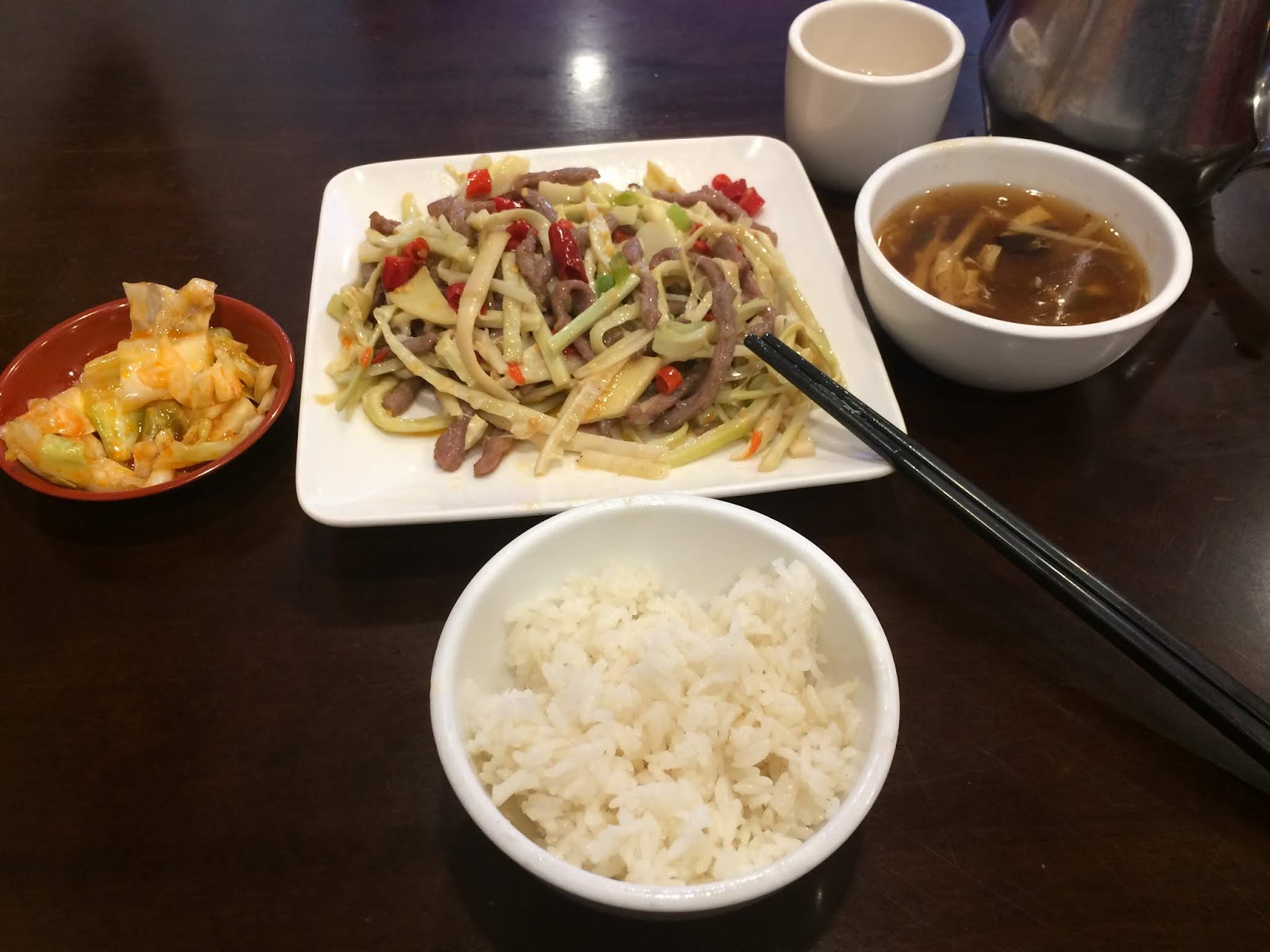

Simple Lunch, Spicy Beef with Dried Bamboo Shoots
Lightly Pickled Cabbage as Condiment

16 December, 2019

VAS Ebony Mono Denon DL-102 103 Shure SC35C Thomas Schick


NY Diary (19-22): 4 Low Compliance Cartridges
VAS Ebony 103 Mono
Shure SC35C, Part III
Denon DL-102, Part IV
Thorens TD-124 with Thomas Schick 12", Part II
Talk Vinyl - Mono Replay V
Talk Vinyl - 12" Arm vs 9" Arm, Low vs High Impedance

Shure SC35C, Part II
Denon DL-102, Part III
Thorens TD-124 with Thomas Schick 12", Part I

Evaluations in this article are largely based on a simple system (with one important detour): Thorens TD-124/Thomas Schick 12" arm into Parasound JC3 Phonoamp (mono button engaged) into Linear Tube Audio MicroZOTL 2.0 driving my YL horns. This article features 4 low compliance cartridges  that supposedly work best on heavier arms.

When I got back my Thorens TD-124 with Thomas Schick 12" arm I started to revisit the Denon DL-103 and derivatives (the VAS being one). This has been something I have been looking forward to, because the low compliance Denon DL-103 is regarded by some as only suitable for heavier arms (I happen to disagree, as I have always gotten great results on lower mass arms, Rega or even the ultra-light SME 3009i). But I suppose using a heavier arm in evaluation confers more legitimacy.

THE MONO SESSIONS

VAS Ebony 103 Mono Cartridge
I have previously written here and there about the excellent VAS cartridge rebuilds (here), including my own Koetsu Black and Denon DL-301 Mk II. I have also reviewed the excellent stereo  VAS Ebony 103 (here), which actually plays mono LPs extremely well. This time around, it is the stablemate mono version of it. It is the same exact cartridge as mentioned in the Official Info.

After briefly testing it out on my Pioneer PL-10 (light arm), to very good effect (better than my one-of-a-kind Rao's mono MC), I got sidelined by other projects and articles. But installation on the heavier 12" Thomas Schick arm was an eye opener. It simply played everything I threw at it superbly.

Concerto No.3 In C Major For Piano And Orchestra / Concerto No.3 For Piano And Orchestra (Vinyl, LP, Album, Mono) album coverJazz on a good mono cartridge is a given, and so it was with the VAS. I dug out my tattered copy of Garner Encores (Columbia 6 Eye, which I previously wrote about here) and it sounded simply fabulous, better than ever. It literally rolled on, and I played both sides. I have always not understood why Erroll Garner is not better regarded. In Johnny Hodge's Joe's Blues (Verve), the varied styles and colors of the brilliant personnel were superbly captured (more below).

Symphony No. 2 In D Major, Op. 73 (Vinyl, LP, Album, Mono) album coverThe shorter cantilever means a sharper attack and fast transient time and good PRaT, but that doesn't always benefit classical's. No need to worry, the VAS played my mono classical albums magnificently. I have always regarded late period mono records as excellent sounding. Bruno Walter's mono NYPO recordings (Columbia) belong to this camp. Brahms Symphony No. 2 was alternately lyrical (those singing strings!) and majestic, not at all inferior to his stereo Columbia Symphony remake. Similarly, Julius Katchen's Prokofiev 3rd (Decca) was crisply detailed and the piano sound was a delight (Ansermet's partnership goes without saying). If a cartridge can get the best out of both strings and piano, it is in already in the top echelon. Even Furtwangler's earlier low-fidelity Berlin recordings had more air about them than usual.

Denon DL-103 Plays Mono Given that the VAS mono cartridge is a tricked out Denon DL-103, I decided to listen to the same records using the progenitor. Well, there really was no comparison. Immediately noticeable was how much quieter the mono cartridge is. With the DL-103, instruments were not as full bodied and strings and brass had less sheen, and sometimes just a little coarseness creeps in (this is after all a solid state phonostage). I didn't listen that long.

Joe's Blues (Vinyl, LP, Album, Mono) album coverDenon DL-102 Mono cartridge
Swapping in the Denon mono cartridge proved quite illuminating. For a moment, it seemed I was listening to the VAS again. Blacker background and much steadier and full-bodied replay. But! The VAS was definitely a little faster in transient and this made for telling differences on Joe's Blues. The organist Wild Bill Davis had a distinctive style; he often made his phrases undulate wildly in dynamics; sometimes the effect strangely was almost like a portamento. VAS brought that out fully, whereas with the Denon it was less obvious. With the VAS, I think I could identify Davis in a blind test, but with the Denon I'd not be so sure (Jimmy Smith?), you see what I mean. The VAS also definitely made the colors of the horns and guitar more individualistic. This kind of superb microdynamic performance is uncommon, and it is what I really value as a listener, to feel the touch (or breathing) of the performer.

With the classical tracks, the differences were there, but minimized. In the Brahms, with the VAS the strings sounded more ethereal (important in this symphony), but the tutti were no less stirring with the Denon; as a matter of fact, I felt compelled to finish the record! On the Decca LP, it was apparent the voltage of the Denon was a notch down, but still very satisfying.

Detour: Onto the Technics SL-1200
I then wanted to get some insight into the contribution of the turntable. So I switched to System II, (see sidebar): The Technics SL-1200 Mk II is connected to the Aurorasound Vida phonoamp, then to the Shindo Monbrisson preamp, which then drives the same LTA MicroZOTL 2.0 amp and YL horns. I could have connected the phonoamp directly to the LTA but I could not be bothered as I know very well the system's sound and hi-end credentials, using the LTA or not (with LTA here).

Mozart: Concertos No. 20, 25 for Piano. Edwin Fischer, Krips. Pathe EMI OVD 4324Denon DL-102 As expected, the Direct Drive turntable upped the jump factor, but is slightly granier. The Decca disc gained traction and excitement and the piano tone was more chiseled, though here and there the scrawniness of the strings were somewhat exacerbated (they were present on the Thorens too; don't forget this is an FFSS record with a different curve from RIAA). The same increase in urgency also informed the Brahms and Joe's Blues. VAS Ebony Mono Exactly as on the Thorens TD-124, VAS immediately proved more accomplished. Just as with the Denon, there was more jump factor, but this different front-end revealed the VAS' virtues just as well as the other. Wild Bill Davis played in exactly the same inimitable way, wild indeed! In Brahms, the lyricism of the string playing was just as evident. Although the Technics was not as nuanced as the Thorens TD-124, it still managed to show to a considerable extent everything the VAS was capable of (the corollary is, the VAS played nearly as well on the Technics as the Thorens, no small achievement). I was so delighted I plowed on with other classical LPs. Edwin Fischer's Mozart's Piano Concerto No. 20 with the LPO (Pathe) is not quite as well recorded as the other two, but it was just as musically rewarding. The legendary Fischer's piano playing goes without saying, but the setup clearly revealed also his beautiful pointing of the orchestral lines as conductor - a little tug here, a little emphasis here that lifted the accompaniment out of the ordinary, even more potent than that provided by Philharmonia/Krips on the reverse side. The VAS made the musician's intent very clear, and there cannot be higher accolade. Even with much dimmer older material, the music was still engaging, as shown by Kreisler's Brahms Violin Concerto with Berlin Staatsoper/Leo Blech (from 78's; Dacapo), where Kreisler was just magnificent. This cartridge plays everything with insight.

Mono Appraisal
  • The Subject of (MC) Impedance Before I begin my appraisal, I'd like to digress a little on the subject of impedance, as it'd have some bearing on how I judge things (down below). Currently, low impedance MC cartridges, in mono even more than in stereo, are all the rage. This is because the high end has been making stereo low impedance MC cartridges for a long time, whereas their mono counterparts did not emerge until the more recent Mono Revival. This makes the offerings in this article anomalies. Indeed, the two ancient Denon's qualify as cultural relics, which makes the VAS an updated relic. :-) The lower the impedance, the lighter the coil, the fewer windings, and a more powerful magnet, but also a lower output. But lest you think this formula automatically leads to good sound, I can assure you this is not the case. Most of the high end companies produce low impedance stereo MC cartridges, but many to me are just bland (ZYX, many Lyra, Clearaudio, even many of today's Ortofon's, to name a few). I do think in general modern low impedance mono MC cartridges do better, partly due to the simpler requirements and the richer and more focused sound of mono. Impedance is not everything, as cartridge design is the art of manipulation of a limited few parts; the choice of material influences the sound just as much. Going back to high impedance MC designs, don't mistake me for favoring this approach. It just happens that some of my favorites belong to this group. The Denon DL-103 certainly (but also the DL-301 Mk II and DL-304; and the lovely Benz Micro Gold also has highish impedance). Of course, the high-output MC's by nature have high impedance and some can be good (Denon DL-102; I am also fond of the Denon DL-110; and several high output Dynavector's have serious repute); let us also not forget the inimitable Decca cartridges (not MC, in its own category), which I love. But high impedance MC can also be a disappointment too: witness my recent experience with the Hana SL (here), so you can bet I shall never consider their mono versions. As they say, the devil is in the details, and good sound is all in the implementation.
  • Mono Replay There is no question that, should you have a fair number of mono LPs, you should consider getting a mono cartridge - it makes a great difference. The much quieter experience is priceless. Contrary to the erroneous perception of most audiophiles, though mono the soundstage is wide and images are well defined and fleshy. With these modern mono cartridges you also get the additional benefit  of being able to play bad stereo records with aplomb! In these I echo the feelings of Philip Holmes cited in my Denon DL-102 link.
  • VAS vs Denon The difference between the VAS Ebony Mono and Denon DL-103 is instructive, but not unexpected. The heavier coil of the Denon (around 10x the output of the VAS) and its conical stylus (VAS is hyperelliptical and shorter) could go some way towards explaining the difference in sound. The most gratifying thing is the similar way they serve the music. The most interesting thing is that the VAS has character traits (fast transient, microdynamics) that are usually associated with low impedance MC's! I shall greatly miss the VAS when it's gone, but I could live with the Denon, as it is like a VAS with a somewhat broader stroke, but with its heart in the right place.
  • VAS in Perspective How does VAS stand in the crowded modern MC Mono field? Other than my venerable Denon DL-102, I have no modern offerings to directly compare. Although I can't tell you directly, I do have a bit of experience listening to some highly regarded ones in others' systems (Miyajima Kotetu and Zero here; Ortofon Quintet Mono here; both systems I know well and are good sounding). Let us first do some spec comparisons. Magnet I am not sure what magnets the Miyajima's or the Ortofon use, but the VAS (Denon) uses high quality Alnico, something usually found in more expensive cartridges. Impedance Miyajima's and Ortofon are all low impedance designs; in contrast Denon is high impedance. See my first bullet for more. Stylus Like Denon DL-102, both Miyajima's employ conical stylus, though interestingly more recent Kotetu's are now Elliptical (likely market demand outweighing designer's intentions, as even Ortofon SPU's now entertain all kinds of stylus profiles!). The Ortofon Quintet Mono is Elliptical and the VAS is Hyperelliptical. Sound? Well, if I have to extrapolate, I'd think the VAS Ebony Mono shall likely easily stand up to the Kotetu and Ortofon; in fact I suspect it as having more finesse and articulation. I cannot be sure about the Zero, but I'd relish a chance to find out! Some of you may object to this as an ungrounded wild guess, but I'd like to say it is an educated guess, so let me tell you my reasoning. The Miyajima's and Ortofon in question, being low impedance, of course did well in force and touch and certainly I heard that! The VAS does brilliance too, but it also does subtlety, and these two are not commonly found together even in expensive cartridges! I did not hear that aspect of excellence in the other two, but then they were not played in my system so I cannot be entirely sure. Even if based solely on what I heard in my own system, the VAS strongly merits consideration by anyone interested in a reasonably priced mono MC cartridge with truly hi-end sound. I (and a legion of others, including industry people, like the late Verdier, of Platine Verdier fame) have always thought of the unique, iconoclastic and idiosyncratic Denon DL-103 as an excellent cartridge with a sound of its own that is competitive with many more expensive cartridges, including the now-popular low impedance types. VAS, being a rebuild service, surely knows the sound of an unbelievably wide spectrum of cartridges, and, judging by its rebadged Denon offerings, certainly knows the evergreen classic Denon DL-103 inside-out. Some of its tweaks, like the shorter cantilever and hyperelliptical stylus to counter-balance the higher coil weight and impedance of the original, are, in my opinion, brilliantly applied, surely the result of many trials and errors!
STEREO SESSIONS

Shure SC35C Cartridge, Part III
Previously, I wrote about this wonderful and rather unsung cartridge (link above). What irks me, and Shure fans, is that Shure had regrettably ended their cartridge operation since then, sign of a company that does not respect its own tradition. Now, we can only pray for a resurrection, but don't get your hopes up. Meanwhile, prices for old stock and used items have risen quite a bit!

This low compliance cartridge also should (with caveats) benefit from a heavier arm, which I didn't previously have. And so, with great pleasure, I plugged it (with the stock stylus) into the Thomas Schick. The result? Very good indeed.

Chabrier Orchestral Music  (Vinyl, LP) album coverOn the Schick, it showed its mettle as a studio transcriber. Absolutely neutral and even-handed, with a full but tactile bass. So, what was the difference from my references? On Ansermet's Chabrier album (London) everything was in place, but missing just a little the swagger the humble Denon DL-103 MC can bring on. Similarly, on Persuasive Percussion's Misirlou track (Command Classics), the sinuous quality was not quite there. For us classical listeners, this has always been the case in MM vs MC, no exception, no matter what a reviewer says. But, one of the best MM cartridges, for sure. I kinda doubt my various V-15's would sound better. This round, I didn't play with the various styli I have, but perhaps I should!

Denon DL-103 Initially, on the Thomas Schick, I was using a Midas (aluminum shell) DL-103 (see link above), but for this article I shifted back to the stock version. While the heavier shell and the heavier headshell it was installed in theoretically profer an advantage, somehow I still narrowly prefer the stock one installed in a generic light shell. And for microdynamic expression, particularly at the leading edge, it proved better than the MM Shure.

Persuasive Percussion (Vinyl, LP, Album) album cover12" Arm vs 9" Arm
Previously, writing about the Thomas Schick 12" Arm (here) I made several remarks: 1) it is not "slow" as I have heard many 12" arm setups to be; 2) a good 9" arm is still faster. This round, even if I am not using a 9" arm, I still concur fully with what I wrote.

The Thomas Schick is a pretty neutral arm, and I don't hear colorations. Whether it was the Denon DL-103, Shure SC35C or the Denon DL-102, the tonal balance on the Thorens TD-124 is much the same as on my other turntables (Thorens TD-309, Technics SL-1200, Audio-Technica AT-PL120). The difference is in the background, a little cleaner and darker, not as dramatic as going from a stereo cartridge to a mono cartridge on mono replay, but is there nonetheless. Going from a 9" arm to a 12", no matter what cartridge, the music becomes a little less lively. I had a long talk with Andy, and he feels the same. Interesting, though we are in the same ballpark, he is a person who likes things a little smoother than I, but he does think there is not much advantage to the 12". Most of his arms are 9" (though heavier and of more repute than the humble ones that I have).

The biggest difference I think is found with the MM Shure SC35C. Previously I absolutely marveled at the sheer grunt of this cartridge, particularly with rock material (see link above), but on the 12" arm it kind of "grew up" into a respectable transcriber. For sure, whatever little grit it had in the treble when mounted on the direct-drive AT was now completely smoothed out, but the killer bass had also been trimmed a little, and I kinda miss a little the former excitable nature (Andy would definitely differ from me here). Part of it has to do with the turntable too, I am sure. Also, for my taste, from the previous proceedings, despite the heavy weight and high output of the MC Denon DL-102 (usually on my Technics direct-drive), it didn't gain from being on the 12" Schick.

On the other hand, the MC Denon DL-103 just may have benefited a little from the 12" arm. In stock form, or even with an aluminum shell, with lesser records it can sometimes still have a bit of coarseness in the treble. This is minimized, but not eradicated, by the 12" Schick.

All of this may lead me to install some of my other cartridges on the Schick. I suspect the 12" arm benefits MC's more than higher-output MM's. It is about time I listen to my various Ortofon's (MC-3000 Mk II, 5000; Kontrapunkt C) In due time, perhaps during the holidays?

The calming nature of the 12" arm should not be exaggerated. We are talking about quite subtle aspects of reproduction here! What I am talking here is unlike what I previously found in HK, where many 12" setups just plainly sounded slow (sometimes excruciatingly so), even staid, but I think that was because of the ancillary gear that they use. Many are vintage aficionados who use vintage equipment, which could slow down the sound if partnered improperly with a wrong front-end or loudspeaker. More, damaging is that, down to the last one, an Ortofon SPU is used. This (12" + SPU) is like a ritual in HK, probably in Asia! Certainly, in Japan, most phono setups use either the Denon DL-103 or SPU and most of the phonoamps are configured for them. I concede the SPU is rich sounding and pleasing on vocals in particular, but it is seriously colored and lacking at the leading edge, with subpar microdynamics. Used well, it could still be quite good. Setup skills is important in all cases.

In this hobby, balance is not what everyone seeks; some are addicted to having more and more of the same colorations. If we use Zero as the ideal, +/- 5-10, say, would be acceptable to me (Andy then will be +/- 2-5), but certainly not +/- 20 or more! But the holiday is coming up, and we all surely should relax our standards and enjoy more music, and the friednship of our fellow audiophiles (even if they deviated greatly from the norm)!

26 March, 2016

Review: Taiwanese Raos 臺灣 雷氏 MC Mono Cartridge (5 ohm)

Letter from NYC (46) 2016 (2): Music to My Ears
Review: Taiwanese Raos 臺灣 雷氏  MC Mono Cartridge (5 ohm), Part I
Talk Vinyl: Mono Replay IV - Filling Up the Space

Revised April 2, 2016: I had previously surmised that the humming encountered with the fully balanced Parasound and BAT phono amps may be due to the grounding of the Audio-Technica turntable, but I was proven wrong. In Part II, I swapped in the Pioneer PL-50 turntable, which has a separate ground wire, and the hum remained the same, so it is an issue of matching not particular to the turntable. Maybe balanced phonoamps are more problematic with downstream single-ended gears! This article is revised accordingly!

Note: For earlier articles on Mono Replay, click on the Label "Talk Mono" on the sidebar.

Early Bird Catches the Word As I slowly regain lucidity, I fired up all my stations, but the one I concentrate on now is my Reference Station III, because I am trying out new things and also because it is my early morning station. I get more done from 5-7 am than any time later in the day, including writing!

Diamonds in the Rough I managed a little foray into Manhattan where I chanced upon a pile of MONO records, mostly Westminster's. All were in bad condition, dirty and with many scratches. But there were several albums of Reine Gianoli that I simply could not pass up. Ever since I heard her unsurpassed Mozart sonatas (Doremi; borrowed from the library) I have wanted to hear more. Her playing is simply as regal as her name (Reine=Queen). So I grabbed the Debussy Preludes (Book I) and Mendelssohn recital, along with some badly scratched violin albums. I also managed to score a decent stereo copy of Erica Morini playing the Tchaikovsky. These I played as found with my mono setup (below).

System:
Digital: Sony XA-5400ES SACD/CDP
Turntable 1: Clearaudio Concept/Ortofon Kontrapunkt C
Turntable 2: Audio-Technica AT-PL120/Raos MC Mono
Phonoamp 1: 47 Lab Shigaraki
Phonoamp 2: Fosgate Reference
Buffer Amp: Elekit TU-8500
Preamp: Langevin 102
Amp: Lepai 2020A+ or Wavac MD-811
Loudpseakers: Almarro M1A or Dayton B652 or YL Audio 4-way horns


Raos MC Mono Cartridge Mr Lei's handmade cartridges 雷子揚的RAOS雷氏手工唱針
Now, this is a rarity, at least in the West. Info is scarce even on the Chinese internet.

Acknowledgement I thank my friend WoSirSir for the generous gift of this cartridge.

Mr Lei has long retired, but one can still find "official" sites/blogs (don't know who ran them), which however seem not to be active (last entries 2014; many new questions unanswered), and there are some other more useful links (in Chinese):

Official Blog, buried among the entries is a very useful chart with data on various models (bottom of this post)
raoslei's Wordpress Blog, a even more empty site.
wuming's review 吳鳴部落格 of the MC5B On the internet, there very few reviews, but here is a detailed review of the (stereo) MC5B (one of his most popular) by a private user.
Portrait in Chinese 台灣音響史國寶級工藝家雷子揚的RAOS雷氏手工唱針(源雜誌2008) This excellent article detailed the history of Mr Lei.

Short English Summary
  • Craftsman/Artisan, then Inventor Mr Lei was in the records business, and because of that also did some trading of audio equipment. Soon, he started to repair and re-tip cartridges for customers and built up a solid reputation. At age 60, based on experiences gained over a lifetime he started building his own MC cartridges.
  • EMT Lineage EMT cartridges served as models for Mr. Lei. At age around 80, he created the popular and reasonably priced MC5B (spec's in chart below). In the favorable blog review quoted above the author mentioned the engine is very similar to EMT TU-2, but the body is more like Supex.
Raos MC Mono
  • General From the photo above you can see that it looks almost identical to the MC5B, hence also an EMT "derivative". This was also a very reasonably priced offering. Mine did have a bottom cover, which fell out after a short while! Just as well; I like the nakedness even better.
  • Spec's A little sheet says Tracking Force 1.5g +/- 0.2 Stylus HDE Diamond (looks rather sharp; likely elliptical) Output 0.5 mV Impedance 5 ohm Weight 9g. Note: the combination of relatively low impedance (less turns) and healthy output means a strong magnet must have been used. There is no figure on compliance; the suspension seems to be on the stiff side for me, so a low compliance design
  • Setup The body's height is shorter than most, which meant that I had to use several shims (cut plastic card) to achieve the correct VTA (especially since my AT turntable is of DJ origin). Otherwise, installation and alignment went smoothly. This cartridge should benefit from a heavier arm than what I am using, but this will do for the moment.
Sonic Notes
  • Raos MC Mono By now I have about 20 hours on this cartridge. Tonality Sound still has a little of that MC peak (maybe I shall add some more shims as the cartridge still looks a little dipped down). But what a sound! Partnering Phonoamp Initially, the sound had some glare which did not sit well with Elekit's inbuilt (ss) phono section nor the 47 Lab. After some break-in the situation is getting better. At this moment, some warmth in the phono amp is still needed, and the Fosgate reference fits the bill perfectly. But I am also beginning to get good results with my 47 Lab (which is also unbroken-in).
  • Grounding Anomaly/Problems in Phonoamp Matching I encountered a few problems. Both the Parasound JC3 and BAT P5 (both balanced designs) generated a more pronounced hum than the Fosgate, Elekit or 47 Lab. Also, with the JC3, pressing the mono button drastically lowered the sound level. I first surmised the AT-PL120 may be to blame, as it does not have a ground wire, rather like Rega (ground goes to the -ve of one of the leads). This proved incorrect, as a later swap to the Pioneer PL-10 resulted in the same (this will be dealt with in the coming Part II). Therefore, a problem matching! Maybe balanced phono preamps are just more problematic with unbalanced downstream gears?
  • Mono Sound vs Stereo Sound Field Compared to my previous efforts, excitingly, more gets filled up between the speakers. There is little difference from the center fill of stereoBalance and Touch Excellent touch and conveyance of force, but not skewed towards the jump factor like some can be, keeping a even hand with all kinds of material. I didn't miss stereo, and have been listening to one mono LP after another. You will hear more about this cartridge for sure; At some point I shall compare it to the Denon DL-102.
Music to My Ears I thoroughly enjoyed listening to all the mono records and came away awed by these  artists of yore. These supreme artists make me want to write about them rather than hifi! That is how good they are. Each one plays with impeccable style and infectious personality, unlike many musicians of today. Shall we say a parallel can be drawn with vintage vs modern hifi?
catalog

08 June, 2014

Talk Vinyl: Denon DL-102 Part III


Click pics to enlarge. L: Denon DL-102 on top; note 2 cartridge leads inserted into each pin. R: Added weights at the end of the armtube and on the headshell.

Letter from NYC(32)2014(4) 
Talk Vinyl: Denon DL-102, Part III
Talk Vinyl: Mono Replay IV

Those interested may want to read the previous installments in this series: Denon DL-102 Part I; Denon DL-102/Mono Replay Part II

Technics SL-1200MkII redux
The Denon DL-102 had been on my Thorens TD-309 since the last installment of the series. This time, after enjoying a few mono records on it, I decided to tackle another project - to install the Denon DL-301 MkII onto the Thorens. The DL-102 had to come out and I installed it again on my Technics. There is a simple reason for this: each cartridge lead on my Linn/Ittok and Clearaudio Concept is dressed in the back with heat-shrink's. The true mono Denon DL-102 is not the easiest to install; it needs to have 2 cartridge leads inserted into each cartridge pin; the easiest way to accomplish this is with the usual cheap cartridge leads that have crimped-on connectors. The connector that goes in first needs a little bending for it to be pushed further in so as to make room for the one in the back (see pic). Someone had asked before how to do it, and I hope the pic explains it.

As it is, the counterweight of the arm of the Technics SL-1200 is just enough to balance the very heavy Denon DL-102. A quick alignment and I was treated to better sound than I had remembered! In fact, not far behind when it was on the Thorens. The cartridge is more open then before, with more air on top. I am sure, after a relatively long period, the cartridge is finally fully run-in. So beware, the sound of the Denon DL-102 takes a long time to come into its own, so be patient and reserve your judgement. A little further improvements resulted after I added weights (see pic: an obsolete Italian gettone in the back; a Japanese coin on top of the headshell, both affixed with blue-tac).

Now, I won't go into details, but I am quite satisfied with the setup as it is. After some playing, the Decca ffss III arrived (see last article) and the Denon DL-102 was taken out. So I was able to compare the two cartridges and here are some observations:
  • the Denon DL-102 is richer in the midband. In many ways, it is somewhat more neutral than the Decca ffss III, which has a lingering leanness.
  • the Decca ffss III has the faster and cleaner leading edge and transients, but the Denon DL-102 is quite good in these parameters too.
  • overall, the performance of the Denon DL-102 is rock solid, but the Decca ffss III is just s little special.
  • until I acquire a Decca of some sort, the Denon DL-102 shall remain my mono reference. It is now back on the Technics.
  • the exercise also renewed (again) my respect for the Technics. What a go-to turntable!

06 June, 2014

Talk Vinyl: Decca ffss MkIII


Click pics to enlarge.Note the adaptor.Time Out mono six-eye on the platter.

Letter from NYC(31)2014(3):
Talk Vinyl: Decca ffss MkIII Cartridge, Part I
Talk Vinyl: Mono Replay III
Talk Vinyl: Take Five (Time Out), do you know it?

Editor's Note: this article came about because my good friend shidi recently got the vintage Decca ffss MkIII cartridge AND the Dave Brubeck Time Out mono 6-eye LP, which he made the mistake of sending to my NYC home - well, he may not be getting them back! :-)

Background on Decca Cartridges Due to its unusual design, the history of Decca cartridges is inextricable linked to Decca tonearms and adaptors, so it is not straightforward but not unduly difficult to trace. Info can be rather piecemeal on the internet. A search reveals a lot buried in various forums, notably Lencoheaven, but if you don't have the time, start with the current manufacturer's concise history of Decca Cartridges and this somewhat rhapsodic but informative article by Philip Holmes. Also informative are two reviews of current models by enjoythemusic (Super Gold, Jubilee) and hifipig (Jubilee) that include some history and technical info.

My previous experience has been limited. Certainly, although I have always wanted one, I had never got around to it. In HK, as elsewhere, there are Decca fans and while I heard some reasonable performances, they pale next to my best experience, indeed one of the very best ever, at AL's place in NYC (Decca SC4E), chronicled here.

R. Against the correctly aligned Denon DL-102 (top) the Decca is short by at least 1 cm; L. close-up of adaptor. 

Decca ffss MkIII, make-shift setup. Never heard of Baerwald!
Warning: Perfectionists and TT setup freaks should stop here. You have been warned!

Considering its age, the Decca ffss III cartridge arrived in amazingly fine shape, together with an SME-type adaptor (3-pin connection to the cartridge, which has a common ground pin only; 4-pin out to the tonearm), so I was able to fit it on the lowest of my turntables, while it happens all my reference TTs all have fixed headshells (Garrard/SME 3009R; LP12/Ittok LVII; Clearaudio Concept, Thorens TD-309).Perfectionist will frown upon the so-so built quality of the adpator, but it comes handy.

I'd like to slip in here a word of caution: the adaptor fits very snugly onto the cartridge; you must have a firm hand when you try to detach it - otherwise one slip and you'll damage the stylus.

Note absence of cantilever.

Turntable 1 Technics SL-1200 MkII
Since I happened to have the Technics running with the Denon DL-102 mono in the reference system (shall be covered in the next article), I simply swapped it out for the Decca ffss III.

Now, as you see in the middle pic, the Decca with adaptor is short by at least 1 cm, and there is no way to move it forward. I reckon if installed on an SME arm with removable headshell one can move the entire tonearm forward and if the hole was centered well achieve alignment. Too bad my SME 3009 has fixed headshell!So, forget about Baerwald and all that for the moment!

Phonoamp: Parasound JC3 or ZPhono USB (reports to come)/iFi iPhono
Preamp: Manley Neo-classic 300B
Amp: Wavac MD-811
Speakers: YL 4-way horns

AA Little Time Out The first LP I played was the mono Time Out.It only took a few notes for me to recognize the Decca's well known qualities: Clean leading edge and fast transients. Morello was most obviously showcased - the drums were tight and tuneful; the cymbals positively shimmered, with great harmonic faithfulness. Even Brubeck's piano, which I have never found well-recorded or tonally alluring, came through clearer than usual. But the Decca is not just about speed; it effortlessly unearthed a myriad of details and rhythmic felicities.

Like many others, I have long used the Take Five track as a test (search this blog for Take Five and you will see many mentions). Morello's long drum solo serves as a most accurate means of assessing a system's transient response, microdynamics and rhythmic exactitude. But this is also one of the tracks that I morbidly fear on home visits.

Me, the long suffering audiophile Given the popularity of this track, you can imagine the uncountable number of times I had to suffer through it on home visits in HK. More often than not, particularly in the case of tube users (especially vintage types), when the saxophone cuts out and the spotlight is on the drums, the proceedings become so lethargic that each return of the bass drum just drags me further into that audiophile quicksand known as boredom. And in HK, audiophiles are in general not sensitive to rhythm and pace. They simply don't get the intricacies of the drum solo, instead patiently waiting for the saxophone's return; by then it is too late for me, all energy drained out of my body, too weak to go on and time for, yes, time out! Yes, home visits can be hell when Take Five is played.

For me, a successful replay of this track must reveal how Morello varies his beat, his touch: the varying force of each strike and the speed of withdrawal that the drummer uses to color his playing. Now, this is not the most coloristic of compositions, but whatever color there is must be revealed for the whole to have rhythmic finesse, to draw one into the music. What I previously wrote on the YBA DAC's plaback of this track also sums it up: "...All of a sudden, you can hear all the stressed beats effortlessly. This kind of replay enlivens a track like Take Five from Brubeck's Time Out. Focusing on Morello's drums, the bad CD player can make the strong beats only that little louder than the weak ones; the average CD player gives you an approximation of the playing; but the truly outstanding player, like the YBA (or an old Naim, say the CD2), makes you aware of the infinite dynamic shading and brings out the full flow. Whatever the CD, the YBA delivers the music in spades..."

Material like this is better on vinyl and well nigh tailor made for the Decca. I suspect the Decca's mono lineage also makes it uniquely suitable. You will need a very very good cartridge to match the Decca's performance: to cite an example, my Air Tight PC-1 is even better all-around, but that is a very expensive cartridge!

Turntable 2 Audio-Technica AT-PL120
You will recognize this as the TT in my Casual System, which gets as much actual use these days as the reference system - reason why I installed the Decca on it.

Preamp: Audio Research SP-9
Amp: McIntsoh MC-2200
Speakers: Linn Kan I

This turntable, clone of the above Technics, great value as it is, is the least of my TTs, yet in the latest iteration of the Casual System the performance of the Decca was astonishing.

Although limited in the bass and not full-range, the quality and refinement of replay in many ways equals that of the system 1. I played more LPs on this system, and no matter it is violin or piano or orchestral material I was very satisfied. I would guess the tubed phonostage (albeit a hybrid) proved synergistic with the somewhat lean Decca (see below)

More details on Decca ffss III Sound Quality
  • as mentioned, fast transients, clean leading edge; great rhythm and pace.
  • Excellent detail retrieval, including hall sound and air around instruments.
  • On both TTs, there is a somewhat LEAN quality. At first I thought perhaps the direct drives are partly responsible, but then just before installing the Decca on the Technics I was using the Denon DL-102, and there was no such problem. I consulted my friend AL (mentioned earlier), who owned just about every Decca's, and he told me this is indeed so. Usually we frown when we hear "lean", but this is not the case here - the sound is unfailingly musical, and cushioned by bags of air. This isn't the peaky treble that we find in many MC's, just a slight pallor in texture, so to speak. But I can imagine, with lesser electronics, the leanness and fast transient of the Decca can cause problems.
  • Now, if you have read this far you may be wondering why I haven't said more on the misalignment when used in the ordinary tonearm. That is because all else pales in the face of excellence. Yes, there is definitely mistracking, especially at the beginning. But the occasional distortion was tolerable and, even with big orchestral climaxes the needle did not jump out of the groove, as many have reported. If you ask me, I'd say the mono lineage of the cartridge makes alignment not so critical. In any case, both AL and I believe alignment requirement for cartridges in general is not as stringent as portrayed by many.
  • On the one hand, I am sure a proper arm would get even more out of the Decca; on the other, I rather think, as usual, many of the "woes" of the Decca's to be exaggerations. It is easy to get good sound if your system is balanced. The modern Decca's can be fitted with adapters ("pods") that allow mounting on any arm.
  • The sound of the Decca has nothing in common with the only other moving-iron design that I know about, the Grado. Hence, I think the absence of cantilever is the most important factor for the Decca sound. This leads me to think the modern Decca models would sound very much like the old ones, only with less headache.
  • Not surprisingly, given its lineage, the Decca is equally adept at playing mono than stereo. With the Decca, unless you are a perfectionist, you may not really need a dedicated mono cartridge. 
More later...

04 January, 2013

Editor's Note: 2012 in Retrospective, Best Buy of the Year

Nothing beats Western Electric (pictured 133 on top and 124B). Click to enlarge.

Editor's Note: 2012 in Retrospective, Best Buy of the Year
Follow Up: Sony BDP-S190, Part II
Follow Up: Sony PlayStation 1, Part II

Revised Jan 6, 2013

Once again, I have failed to write the yearly retrospective before the year's end, but this time I have more excuse than before! The year 2012 had been quite a mad year for me, and personal matters took the helm. This necessarily means fewer things to write about, but it shall not be for naught I assure you. As I look back, my 2012 in audio was idiosyncratic (I like that), and MOST meaningful for rediscovery of "old friends" (I like that even more).

Most Notable Events
  • Western Electric Without a doubt, the biggest event of the year was: Nothing New Under the Sun. Western Electric (posted here) 133A and 124 amplifiers worked their magic, and reminded me in no uncertain terms that WE remains supreme in audio achievement, bar none. People have asked me repeatedly why I had put aside my 133A for so long; I can only say: so as to explore other things, worthwhile or not....
  • Mono Analog Replay Mono Analog Replay (treated in at least 3 articles here), which some have advocated for years, is definitely not anachronistic, not a step back. It is simply something that makes one re-evaluate what one is listening to. One asks again, perhaps Less is More?
Best Sound of 2012
I am not going to be humble here. The best sound I have heard in 2012 was from my very own Western Electric gears.

Most Important Acquisitions
  • TAD TSM-2201 (reported here). This paradoxically at once boldly-styled and low-keyed design was a match made in heaven with Kondo M7 + Ongaku (result here). You are certain to hear more about this.My loudspeaker purchase of the year.
  • KEF LS50 The co-axial design is superbly coherent. You shall too hear more about this (preliminary findings here).
  • Denon DL-102 Mono Cartridge (reported here). Mono is all the rage. This studio/transcription perennial deserves its fame.This very heavy cartridge needs a robust arm to do it justice.
  • Thomas Schick Tonearm is a 12" bargain compared with others more expensive (tested here). One day I'd love to install the Denon DL-102 on the Schick.
  • Sony SCD-XA5400ES SACD player for once convinces (reported here).
Thorens TD309 reviewBest Buy of the Year

  • Thorens TD-309A turntable (here) This humble turntable delivers more than one expects. The tonearm performs way beyond expectation, and is a great match with the heavy Denon DL-102 mono cartridge. In terms of one-stop solution, this TT now displaces even formidable rivals like Clearaudio Concept (a previous Best-Buy). I'd love to try out Koetsu and stuff on this arm, but time is in short supply.
  • CineMag CMQEE-3440A made famous by Bob's Devices (here). Whether you DIY or buy from BD you are certain to be happy.
  • Denon DL-301 Mk II MC cartridge is a dark horse but its superb musicality is instantly captivating (reported here).
  • Canare L-2T2S (here) is superbly musical for a ridiculously low price.
  • Sony BDP-S190 Blue Ray Player (here) is superb. Follow Up: Since that initial evaluation, I have confirmed the transport section of this entry level Sony Blue-Ray player is as good as any previous DVD models, every bit the equal of the underground classic DVP-PR50P (a previous Best-Buy) (in fact they are indistinguishable). The analog out sound too is very clean, audibly cleaner than the DV-PR-50P but perhaps just a little less warm and emotive. I suspect any Sony BD as well as DVD player shall deliver excellent sound. Best-Buy in digital for sure.
Vintage Rediscoveries

  • Yamaha NS-10M (posted here) shows the best of yesterday is fully competitive today.
  • NAD 3020 (here) proves it is immortal. 
  • Technics SL-1200 Mk II (here) surprises yet again.
  • Sony PlayStation 1 (here) shames most current digital products. Follow Up: In one go I performed two of the modifications outlined in the dogbreath page: removing the muting transistors as well as the output blocking caps from the signal path. I am sorry to report that while more details could be had the sound lost some of its musicality - its raison d'etre and its magic. I suspect I prefer the sound with output caps, though it may take some trial and error to reach an improvement. You shall hear more about this PS1!
Suggestion for a US $1k system that will shame your friend's $10k system
This requires you to source used goods, from the likes of Ebay, but you shall be rewarded amply. Not cheaptubeaudio, but cheap audio for sure:

  • Yamaha NS-10M
  • NAD 3020 (not the i version, please read my link)
  • Sony DVD player (as the Blue Ray is more expensive, I am sure the current entry-level DVD players are likely sonically as good as their over-achieving predecessors. I see the DVP-SR210P, successor to the 200P, sells for $30! :-) Even I may buy another one to try!)
  • Technics SL-1200 Mk II. Since the NAD only has an MM section, if you use the Denon DL-301 Mk II cartridge, you will need to add a step-up transformer (suggest the cheap Denon AU-300LC or the older AU-250 (here) and that will increase the budget a little. If you stay with MM cartridge, I suggest the cheap and cheerful Shure 97xE (<$80).
  • NAD 4020A (here), the original matching tuner for the NAD 3020, if you need a tuner.