Showing posts with label Talk Tweak. Show all posts

31 December, 2022

Double Bearing Wheels 3.5mm to RCA Adaptors

Spikes, Bearings, Horizontal Dissipation's, Audio on Wheels; Anatomy of an Adaptor
Letter from Shenzhen (22-18): Year-end Leftovers and Morsels
Talk Tweak: Isolation

With this hodgepodge (or chopsuey) of an article, we bid 2022 farewell, and Happy New Year! In terms of audio, it had been a good year for the fortunate among us, but we’re not forgetting the ever-increasing masses of people all over the world suffering from Covid and, even more unfortunately, preventable horrible man-made disasters: war, climate change, famine. We certainly hope 2023 shall be better.

Audio on Wheels
For reasoning's that I simultaneously understand and abhor, spikes have gained such a prominent place in audiophilia that I shake my head. I understand because many systems and gear can sound muffled and spikes can bring out a bit more clarity; I abhor because most who think they hear an improvement do not hear the trade-off - alteration of bassline, usually less natural in decay and loss of heft. Sure, nothing is absolute, but judicious use at most (but that’s not an audiophile trait, is it?). When you see someone putting all sorts of things under everything, you know the person doesn’t have a clue.

Suggestion for DIY Spikes Should you be interested in spikes, please avoid the ridiculous claims of the rip-offs. Go to your local Chinatown (or online) and buy a set of Chinese chess. Unlike international chess, they are flat wooden discs (of reasonable quality, at least the bigger ones). And then buy some spikes for sports shoes (could be running, soccer, or others) that vary greatly in sharpness. These have screws on the other end and since they have to bear full body weight are very well made (but cheap). Drill a small hole in the center of the chess piece and screw the spike in. Simple! Sounds as good as any expensive spike. I dare say the combination of wood and metal is even better than most.

BUT, spikes should only be used sparingly and removed if your basic faulty equipment gets replaced by better ones. Also, I want you to know that I do think of shock or vibration treatment as a possible issue, but it’s one that is far behind the basic quality of the gear.

Now, what about Spherical Interfaces in lieu of spikes? Yes, we’ve experienced expensive Symposium Rollerblocks. It consists of a small solid wooden slab with a half-hollowed-out center where a spherical bearing is placed between it and the gear. Theoretically, it dissipates horizontal vibrations. Does it have an effect? Yes. Is it all good, sometimes. You can also DIY a simple version. Go to your Chinatown store (or online) and shop for the chopstick holder, many of which also allow a spoon to rest (a hollow in the ceramic). Place a bearing in the hollow and you have an el-cheapo Symposium. I can tell you it delivers most of the effects of the overpriced “real” thing. So many years ago!

Now, wheels. Whatever allows a threaded spike will allow a threaded wheel. That goes for your rack, your speaker stands etc. For wheels, I’m talking about industrial wheels, double bearing. You need to know the thread diameter - a caliper will be the best. Nomenclature is, say, M8 for 8mm, size of my rack wheels.

My rack (here) came with cheap “home” plastic wheels, which barely can roll under the weight of my equipment (not that heavy). Replacement with proper double-bearing ones (top pic) made a substantial sonic difference - things just come to life, for just a few bucks.

In HK I still have my treasured B&W 801 Mk II. Mine came with Sound Anchor stands with spikes (which I removed, letting the frames rest on my tile floors). You should know there were many kinds of stands for the venerable classic in those days, and the relative merits were hotly debated. One version was on wheels. I didn’t get to install wheels on the stands - they sound magnificent as they are. But I had wheels on the DIY wooden stands of my previous Spendor SP100, and it sounded mighty fine.

My previous experience with thrust ball double bearings was on turntables (here).

Horizontal movement is supposedly a big issue with belt-drive turntables but I think judicious tampering can bring benefit in many areas as well - more than spikes, IMHO.

As to discs underneath spikes that prevent scratching, avoid like hell! Garbage!

What’s in a stereo 3.5mm to RCA Adaptor
At some point, all audiophiles have to use adaptors for the myriad connective options (or limitations). Today, with the advent of personal, headphone, computer and desktop audio, for integration, or extension, into a full audio system, a Stereo headphone jack to RCA adaptor is a MUST.

There are many ways to do this. For those who solder, one can DIY with a 3.5 male jack, a length of cable, and a pair of RCA males. For those who don’t, they either resort to an adaptor or an adaptor cable. The pic here shows an adaptor, together with a broken one’s innards. It’s quite a revelation.

For years, I have used a similar adaptor, Radio Shack or whatever, and the results have always been satisfying. They served my various cables reliably and well and I had no complaints.

Things changed recently here in China. With my Aiyima etc, I had need for the adaptor, but I soon found out that the several I acquired here (usually about 0.5 $) were subpar in construction and durability. They sounded sonically OK, no problem. BUT, with some of my leftover cables with visor grip, like the AV MIT ones, I can insert them but when I pull them out the outer ground jacket of the RCA Females would come off too. Flabbergasting!

I set about to repairing them, and it was interesting. The molded outer casing can be pried apart with difficulty. But the innards astonished me. For such a cheap adaptor, a lot of thoughts have gone into it!

Look carefully at the photo. A plastic chassis is the foundation. The hot pins of the right and left channels (bottom of the Y harness) are insulated from each other (one channel is broken). The harness is even more ingenious - it’s made of copper. Sleeves extend into the plastic mold for the hot connection. The problem is the ground. The Y prongs of the ground look like they are just crimped to the outer RCA ground sleeve. When the visor grip of the RCA male cable pull out the outer ground metal sleeve, the thing goes caput. I have managed once to re-insert/crimp the ground (the upper one), but that’s perhaps fortuitous.

What’s the point? Plenty! The thin copper harness you may think of as flimsy, but I regard it as perfect for transmission (long been disdainful of large metal block interfaces, like Cardas). THAT is the reason for the sonic success.

If you don’t believe me, in my NYC audio wechat group, one of our members just remarked on how very BAD his Audioquest 3.5mm/RCA adaptor cable (with cable between the connectors) is, and much inferior to his Radio Shack (Chinese) adaptor of yore.

With the humble adaptor, you can use your favorite RCA cables and not have doubts. THAT’s a good adaptor. This humble adaptor shows how much BS there is in expensive audio. Think about it in 2023!

16 May, 2022

Watt Emerson Tidal Qobus Graphite Subwoofer Hi vs Low


Click pics to enlarge. The Editor thinks this marvelous photo by the author is a perfect analogy for audio - even a small shift in vantage point yields a different vista .

Letter from Hong Kong (22-5): ELO's Eternal Hell/Heaven

Editor: ELO has been compulsively tweaking his system. Basically, his system is a very simple one, and the tweaks he has been doing, elaborate or not, are like ornaments. Some of these are rather divergent in narrative, so I have taken the editorial liberty of separating the copious material into 3 articles for better organization. This is the first.

Audiophiles are a nervous bunch. Sometimes I suspect my setup, though very decent, is perhaps a little more hifi than musical, and therefore constantly look for ways to improve, which was why I had been undergoing a series of tweaks with methodologies that are all over the map. Basic Equipment:

Wattson Emerson Analog --> iCon4 --> 47 Lab Gaincard --> Dynaudio Crafft/Audiophysics Subwoofer.

To try to improve on the musicality yet maintaining the essential bite or spark is a really hard balance to achieve and is creating havoc to me recently. Here is a list of the tweaks that I have been going through:

1) DIY Earthbox , two boxes (one for digital, one for analog)
2) Power Supply to my WEA - iFi Power+ vs Rayaudio Power Supply
3) Audio Signal Isolation Transformer from Rayaudio
4) Van Den Hul MC Silver IT/ Gotham GAC4/ 47 Lab cables/ Rayaudio's IC
5) Subwoofer connection high level/low level, endless debate
6) Graphite block
7) Tidal vs Qobus
8) Wattson Emerson Analog vs Madison (newly released top streamer/DAC)
9) Schumann Device

Even with my simple system, depending on the how and where in application of tweaks, there are an infinite number of permutations. Given that you need to repeat numerous times a set of songs which you like and are familiar with to fairly compare different setups, I really got hearing fatigue big time! How was the overall result then? My current setup yields some decent sound but I feel it's not the best yet so I cannot conclude 100%!

In this article, I'll try to express my findings on individual tweaks but pardon me for the lack of  assessment on the overall improvement. Maybe one day I would go back to original mode and see if I have missed out a lot by taking away all the tweaks. But man, as my listening time is limited every day I just want to sit down and listen to music, not analysing differences!

Old Chinese saying is true, "Additional incense burner adds another ghost": whether there is gain or loss, there's no guarantee and this is the pain and yet pleasure of this hobby...

From Top to Bottom: Schumann device, Earthbox for digital, and for non-digital

1) DIY Earth Boxes Redux
Please refer to my previous post - it does works. But recently, I spoke to another guy who is intrigued by Earthboxes. He bought many different Earthboxes of different materials and discovered that each has different characters (good/bad). The choice of earth wires, earth box material, earthing material used/quantities/mix ratio all play important roles. Sound even changes if you shake the box accidentally!!! Man I got to stop somewhere and draw the line!! Verdict - Yes of course!

Editor: I have followed in ELO's footsteps, and shall write it up later...I agree, very much worth trying!

2) Power Supply by Rayaudio
Ever since I purchased my WEA (Emerson) over a year ago, another upgrade that I have always had in mind was its power supply. I had been using the iFi+ power supply with satisfactory results but deep down I knew the sound can be further improved by implementing a proper power supply. Enter Rayaudio...(sic)

3) Audio Signal Isaolation Transformer by Rayaudio
Now this little gadget really impressed me at Ray's studio, so I took it home...(sic)

Editor: 2) and 3) are actually big topics with deep implications. Both deserve more detailed treatment, and ELO had written a lot on it. So it shall be another article, second of this series. I assure you it shall be worth the wait.

4) Van den Hul MC Silver IT
I came across a pair of VdH MC Silver IT, the first generation of the most famous IC from VdH, which was selling for more than 1500USD for a meter run at the time!!! An astronomical sum for a young lad freshly graduated from college!...(sic)

Editor: Indeed an "iconic" cable, which most self-respecting hifi elders have surely used. I am usurping ELO's perceptive observations, which will serve as a jumping platform for a very small Overview on VdH. This will be the third in this series.

:5) Subwoofer Input: Low Level (Line in) vs High Level (from amplifier's Speaker terminal)
I never bothered with using low level input as high level input was recommended by Steve Guttenberg and a few hifi buddies. However, Ray opined that line out without going through high level is more direct path. In fact, he prefers low level output directly from source if it is available. Kwong swore that there are immediate improvement in speed, clarity and detail of bass and urged me to try. Since I do not have sub out in my iCon4 , I opted to use a Y- RCA jack and hook up pre-in end of my Gaincard input from iCon4. Comparison was used between using my VDH MC Silver IT and my old Mogami i.c. Turns out VDH is a bit euphonic and sweet while Mogami added some attack and bite but took some moisture away. Still comparing, but immediately, I notice that the gain level will need to be turned down quite a bit to achieve the balance (still meddling with the settings). There is a difference, but initially I tend to prefer the ripeness and easiness of bass from high level. However, after prolonged listening, I found the low level in does have a better attack , timing and bass definition and I'm really satisfied with the change! Verdict: Low level in for now....LOL. And it's a case by case. While REL designer prefers high level, PS Audio prefers low level, same as icefox had told me. Will give a follow up later.

Editor: while the Sub Low Level In seems like a more "direct" path, the impedance change introduced by the additional load is not to be neglected - direct does not equate unchanged! Of course, since subs allow for both input methods, it is a no brainer to try both out. For most systems, High Level In has less connectivity issues.

6) Graphite Blocks
While I was suffering from the tweaking hell/heaven, Kwong handed me some graphite blocks (2" in diameter and 1" in thickness). I placed them under my 47 Gaincard and, all of a sudden, there was a huge improvement in details and microdynamics - without being too dry, harsh or cold. With the smoothness and musical character of Ray's PS, the whole system now seems to balance out better. Both addition seems to compliment each other and works in good marriage. I tried to put a few blocks under the PS. It further cleansed the background noise but the effects were slight. I have ordered some more to put under my speakers. Hopefully, not too much of a good thing. Verdict: Recommended! Provides a cleaner sound that has better separation and definition.

7) Tidal vs Qobus
Another heated debate! While most audiophiles will likely prefer Qobus, both are very good! Imaging on Qobus is definitely better but Tidal, where sound is slightly smeared in comparison, has more body and roundness. Due to the hassle of obtaining Qobus account (I needed to ask my relative for help in settng up an account in Australia), I slightly prefer Tidal with more body, less details but larger music collection. Verdict: Tidal for now but surely no clear winner, depends on your preference but you actually hear more details through Qobus.

8) Wattson Emserson Analog vs Madison
I only had the loaner for a week, but I really thank the distributor for passing it on to me. Regrettably I could not find sufficient time to fully access the real potential of Madison, given the ever changing tweaks happening concurrently during the comparison of the two devices. Suffice to say, Madison, right out of the box, in stock mode, was at least 30% improvement over my WEA with iFi+ Power supply! I may put out another post based on my limited time with this nice Streamer/DAC!

Madison goes for 3199 euros. It comes with a volume control built in;  Leedh processing and dual Cirus DAC chips to improve the sound; with balanced and RCA outputs; optical and digital in; headphone input; packing a lot of great features in box that is larger than WEA yet still compact. Whether it is your cup of tea will depend on what you are ultimately looking for. It is however, designed for as a one-for-all solution with highest quality and at an affordable price (still reasonable for what it has). With Leedh volume control, one may even abandon the preamp if one plays only digital sources. But the price difference is the main factor, as it is almost double that of the Emerson Analog. For me, the big question is whether I can take out my iCon4 as a solution and use solely Madison as preamp/dac/streamer? What are the pros and cons? No answer from me yet but for those who have other digital sources ready to connect to Madison and a pair of nice cans to listen to music, it will be a no brainer!! Verdict: Not out yet~😎

9) Schumann Generator Editor: Don't hold your breath. This is quite ephemeral but we are trying to assess the effect. It shall be a future joint article between ELO, Kwong and me.

Wrap Up
How is the overall sound compare to the original? This is a million dollar question for me and I simply DO NOT have a clear answer but I feel I hear more details and quieter background and now with the low level in to subwoofer using my Mogami interconnect which is known to have speed and attack, it has more immediacy and attack definitely! And most importantly, my body starts to rock and my feet is tapping involuntarily, that is a good sign!

As I had discussed with Kwong, a good system vs an average one is like the performance by a top vs mediocre background vocalist (I admit there are a lot of brilliant background vocalists; Whitney Houston used to be one). Another analogy is that you are driving a Porsche 911 at full speed and in a hair splitting moment come to a sudden and abrupt stop at the very edge of the cliff: your heart had leaped out of the car into the air while the body is still inside. Or would you prefer the sedan car gently and safely brake to a comfortable stop at 2 feet away from the edge of the cliff ?

Another analogy, it's like when you are listening to violin performance. You are being thrown into the mid air by a violin stroke but when you finally gather your senses, the violin stroke goes completely in the opposite direction, and then you start catching up, and then, without noticing, it goes again the opposite direction and that keeps repeating! If you rather prefer a constant velocity and gentle acceleration and deceleration, it is your choice! But I prefer to be swung in mid air and experience standing at the edge of a cliff !

Hope I am one small step closer to my ultimate goal to audio Nirvana!


07 March, 2022

DIY Ground Box using Tourmaline stone chips


Click Pics to enlarge.

Letter from Hong Kong (22-2): E Lo goes Tweaking

Revision 3/13/22: E Lo has changed the box to a wood one. Boc now housed in a Cuban Cigar Box! :-) Smoky, heh?

Inspired by mrgoodsound's post, one day after work, I went to a Hifi shop selling their own brand of tube gears and a lot of gadgets.

First I bought some spikes for my speakers at 22 USD for a set of 6. While they didn't seem to change or improve the sound, the good thing is it's easier to move around and adjust (compare to my plastic pads glued under the speakers stand's base).

Then I saw a box made of 3mm solid copper that was full of stone chips. The guy told me that it is a Grounding Box and just the copper box costs almost 400usd!

There are some really polarizing views in various hifi forums on the use of the uber expensive ground boxes like those by Entreq, Audio Revive, Synergistic Research and the latest "cheaper" one from Kojo (almost 400usd still!) Some despise these as snake oil and some claim they  lead to substantial improvement in sound quality.

But it also comes to my mind that the Tourmaline stone chips sells only for less than 20 USD per kilo! So I immediately think to DIY one of my own. I bought a kilo of Tourmaline stone chip and went home and grabbed a plastic takeout box and some unused 47Lab cables that were just lying around. 

Well, if I can spend less than 20 USD to experiment, if it works, it's a bonus and if it doesn't, it won't hurt my wallet either!!

It took me less than 30 min to trim the cable and fill up the box with stone chips and I also threw in some RCA connectors and Wood Cubes that doctorjohn gave me, plus some black stones from a bracelet. I may put other stuffs in it later. The uy told me to fill it up to 80% and then cover it up and I did exactly the same. I then hooked the Box up to my 47 Lab Gaincard, which does have grounding posts for each channel.

Before I had this idea, I have always heard a pop sound through my system as soon as my wine fridge compressor stops. So I'm damn sure grounding of my system was poor. Part of the reason  for the grounding experiment is to eliminate the pops and the box seems to work on this.

OK, enough of the preparation and words, the most important question is how does it affect the system or not affect it? It does changes the sound, and also in a good way! I immediately noticed the noise floor was brought down and details from the background that was hiding before have become so clear that  ambience sound is more obvious. Music instruments definitely sound more defined. Sounds like knuckles knocking on the body of the guitar, plucking of string, and the different kits in the drum set are much easier to follow and interesting to hear/see. Without altering the sound signature, it improves the clarity of the system by a significant margin.

After I experienced the beneficial effect of Ground Box, I wondered what would it sound if I grounded my Wattson Emerson? The effect is smaller but is noticeable. Everything improves slightly in a good way! But still I don't think I 100% like what I have heard. 

Have I missed anything? Oh yes, my icOn4 AVC preamp! I use the same wire to ground my Gaincard and hooked my icOn4 in series to the ground box. There's actually another huge difference! I mean it's like hearing a different system. I guess since preamp handles small signals, any minute RF will interfere and mask the final signal to the power amp.

Now the system sounded drier and less airy but instruments were playing more convincingly and obviously clearer. Bass quantity was less than before, a tad tighter though. Separation was better as noise floor was brought down further. I kept comparing and the change is not small at all! Well, it did not seem to sound quite right yet. I then detached the earth from the Emerson DAC. Instead of earthing the amp and preamp in series, I earthed them separately and, voila, everything was back to normal. Images fleshed out; separation improved; Warmth and Air returned. Seems like this is the best combination so far! One must go through trial and error. Also on a YouTube video, a guy also advises to use a meter to test the voltage drops at different points (screws, connectors and chassis) to find the lowest voltage drop for best earthing location! And the drop can be varying in each and every screw indeed!

IMHO if one takes the snake oil view since manufacturers charge outrageous money for it, one simply loses another good opportunity to improve one's system. Next, I'll get a wooden cigar box for my ground box chassis and see how it's like😉.

P. S. I had persuaded my friend Kwong to use Earth box and he did and hooked the ground box to his Audionet SAM and Holo Spring DAC and immediately felt the improvement. He had even asked me to buy more of the Tourmaline stone chips! BTW, I bought more chips and made another ground box and hook it to my CD player and the initial impression on improvement is positive! Will conduct more listening session to confirm. 

Two of my friends has already used subwoofer based on my recommendations and both are happy with the results! And they are going to try DIY Ground Box too! It's always fun if you got hifi buddies to try different things together and gain from it.

Below shows the original plastic takeout box, now replaced by a wood one shown on top


20 February, 2022

Vanatoo Transparent Zeros Part II

Vanatoo Transparent Zeros Part II


By mrgoodsound 


In January of 2020 I wrote an article about my Vanatoo Transparent Zero desktop speakers. At the time, I had considered them to be my best audio investment to date. Over the past two years, a series of progressively sillier tweaks has elevated that opinion even further. This article will detail those tweaks for the readers entertainment. 

Step 1: clubwood mpingo feet (~$350)

It has honestly been so long I don't remember where I stumbled upon the clubwood products, a South Korean firm offering wood accessories for audiophiles and espresso machine enthusiasts. Most of their products are made out of mpingo, a species of African Blackwood (in)famous in audio circles thanks to Shun Mook. Clubwood is operated by Mr. Song, who is an extremely friendly individual, and has seemingly been in the audio tweaks business for many years. His wares are sold on eBay and the clubwood website. The prices are actually reasonable, when you consider the raw material costs of real mpingo wood and the difficulties associated with working with it.

In June of 2021 I placed a large order for mpingo discs, cone feet, volume knob and cable damper; intending to test the efficacy of these products across a variety of applications. When I received them, my first instinct was to stick the cone feet and discs under my Vanatoo speakers for fun, meaning to move them to more 'serious' components later. I put three cones and three discs under each speaker, and they have been there ever since.

To say the effect was 'transformative' would be simultaneously hyperbolic and an understatement. By this point I had been living with the Transparent Zeros for many years, listening to them daily, and becoming very familiar with their sound. Vanatoo includes a pair of foam pads to place under the speakers for isolation and I had been using them on my desk since the beginning. I knew that they caused a decrease in clarity but the alternative was the uncontrolled transmission of vibration to and from my desk, which was unacceptable. 

Replacing these foam pads with the mpingo cones and discs, every aspect of the sound improved for the better. Tone, timbre, intelligibility, separation, dynamics, extension, etcetera. The magnitude of the effect was actually dumbfounding, until it occurred to me that the Transparent Zeros are a self-contained system with an integral DAC and amplifier, and I had just witnessed the effect of the simple wooden feet on a single component as if it were an entire system. 

I meant to write a more detailed review of the other clubwood products including the volume knob and cable damper but there is no point. They pretty much all have the same effect described above, just in varying degrees depending on the application.

Step 2: Adding a subwoofer (after all, $0)

This was actually a misstep. Even with the foam pads, which muddied the low frequencies quite a bit, I had never felt the bass of the Transparent Zeros was lacking. I still wondered if I was leaving something on the table and purchased a small subwoofer to place under my desk. The Vanatoos have a single sub out in the form of an RCA jack on the rear of the master speaker, and the manual states they automatically set the crossover point between the speakers and the subs when this output is utilized.

Unfortunately, I could never get the subwoofer to blend properly with the Vanatoos and gave up. This wasn't a big loss though as the bass of the Transparent Zeros with the mpingo feet is actually hilariously satisfying, rattling loose objects on my desk when playing modern recording with deep bass. The volume and depth of the bass is actually unbelievable for a speaker this size.

Step 3: Disabling the volume limiter and shelved DSP ($0)

From the factory the Transparent Zeros have a digital volume limiter and 'shelved' DSP mode, intended for the most common use case of desk placement near boundaries. Many owners have reported an increase in clarity and dynamics by disabling these two features, and instructions on how to do so are provided in the user manual. For several years I was too lazy to do this until I was messing around trying to get the subwoofer to work right. Indeed the 'flat' DSP mode seems to give an additional octave of LF content, and disabling the volume limiter provides slightly better dynamics. This is a 5 minute change every owner should try to get the most out of their speakers.

Step 4: USB cable (~$160)

Art USB Cable
I use the Transparent Zeros with a desktop computer through the USB input. They sound best when used with their digital inputs as they are a fully active speaker, and USB is the most convenient option for computer connection. I was not a stranger to the sensitivity of the speakers to the USB cable used. Several years ago I purchased an Acoustic BBQ USB cable made using stranded Duelund wire and hooked it up to the Transparent Zeros to accelerate the break-in process. The cable sounded better than the generic black USB cable included with the speakers, but not so much so that I missed it when it was removed to be used in the 'big rig'. Ironically, swapping in a $20 Schiit PYST USB cable (OEM by Straightwire) resulted in a big decrease in sound quality over the generic stock USB cable. Side note: the PYST cable is one of the worst sounding USB cables I have encountered, for any price.

Recently I tried some other audiophile cables on the Vanatoos for fun. The first was the Supra Excalibur USB cable. It initially seemed like an improvement, improving clarity and dynamics substantially, but unfortunately has too much of a 'hi-fi' characteristic, lacking body and having an overly insistent sense of timing. After two weeks of usage, I returned to the generic stock cable and felt relief at how much more relaxed the sound became.

The most successful pairing thus far has been from Art Cables in Moscow. Their USB cable uses stranded Telefunken wire from the 1960s. It had all of the improvements of the Supra without the downsides, for about the same price. Highly recommended!

Step 5: Power supply (~$35)

I thought this would be the largest improvement to date but it turned out to be another misstep. The stock power supply for the Transparent Zeros comes in the form of a 24VDC @ 2.5A switch-mode brick. I decided to replace it with a cheap linear power supply as an experiment. I purchased a SOLA HD LPS off eBay for around $25. These are cheap linear supplies meant for powering lab equipment (I think), and some audiophiles have had success using them as replacements for stock SMPS of phono stages among other devices.

I carefully wired up the SOLA with a DC barrel plug and hooked it up to the Transparent Zeros (be careful, loss of power to the speaker seems to reset the volume to 100!). The results were a mixed bag. On one hand, there was more relaxed timing and ease of dynamics, rhythm. On the other hand, the sound clearly became veiled with gray overtones. In a linear supply, the voice of every capacitor, resistor and inductor is clearly heard. It turns out that the very inexpensive passive components on the SOLA PSU were not really up to snuff for audio applications. Going back to the stock SMPS took some getting used to as the sound now appeared to be lean and insistent, but the most important attributes of liveliness and color returned.

I considered modifying the SOLA PSU with some audio-grade parts, but decided it would ultimately be a waste of time and I would be better off building a new supply from scratch. Haven't gotten around to it yet.

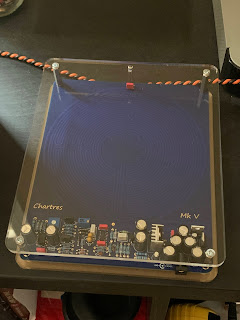
Step 6: Schumann Resonator (~$200)

This isn't actually a modification of the Vanatoos, but I mention it here as it continues the theme of taking things too far and the funny effects of tweaks on modest desktop speakers. 

People have been talking about the effects of the so-called Schumann wave, or rather its suppression, on our auditory perception for a long time. I won't really get into it, a quick internet search will find a million such discussions. Several firms including the Japanese Acoustic Revive have been engaged in producing Schumann resonators as audiophile tweaks for many years. Out of sheer curiosity, I purchased such a resonator on eBay that seemed well built from a reputable seller for a reasonable cost. 

These devices promise a variety of effects ranging from a clearer audio message and less confused soundstage to improved mood stability and sleep. I can say that the device I purchased actually works, and all of these effects were noticed by me in the first few days of its operation. The problem is that the body seems to become accustomed to them, and through habituation the positive effects or at least the active perception of them seems to fade. Perhaps with more expensive devices this is less of an issue, but I cannot say I am curious enough to find out at this time.

Twenty minutes after installing the resonator in my room, I noticed the soundstage of the Vanatoos became wider, low frequencies seemed to extend a full octave lower, and the overall intelligibility of music increased significantly. The same effects were later confirmed on a different system using headphones.

Step 7: Replacing the grills with Shamwow towels ($10)

When I first got the Transparent Zeros, I tried them with and without their grills which are of very high quality and attached magnetically to the front panel of the speaker. The sound without the grills was clearer but also a bit rude and fatiguing at higher volumes. Conversely, the sound with the grills was more comfortable despite being more muffled. I left the grills on and didn't think anything further of it.

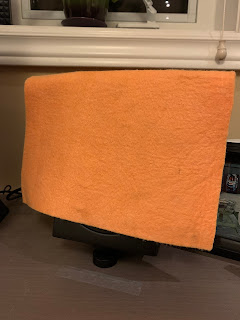
Recently I came across an old post by the Russian audio engineer Anatoly Likhnitsky who described the wonderful effect of placing orange cloth towels over his computer speakers. Realizing I had very similar cleaning towels in the closet, I took them out and draped them over the speakers in place of the grills. 
Likhnitsky computer speakers

I have long since learned to not doubt the influence of seemingly innocuous things on the sound of a system. I have especially learned to not doubt any ideas proposed by Likhnitsky, whom I consider to be something of a genius in the field of audio. I have to still admit I was skeptical of what I would hear by placing these silly orange towels over my speakers. Well, again, I was dumbfounded. If the sound without grills was too rude, and the sound with grills too comfortable, then the sound with the towels was the Goldilocks zone, that is to say just right. There was a sharp increase in the clarity and intonation of music, and yet no fatigue was experienced even at high volumes. I listened to the speakers that night for 6 hours straight with a stupid grin on my face.

If you are curious why such silly looking grills would serve such an improvement, it is because they act as an acoustic phase randomizer. In Likhnitsky's articles, he espouses that phase randomization is a necessary thing in any audio path, and especially in a short one, as an increase in sound clarity offered by a short audio path is also accompanied by an increase in what he calls musical 'garbage' or 'debris'. This 'garbage' or 'debris' are manifested non-linear distortions which are inseparable from (or glued to)  the musical signal. He claims this debris is generated mainly from the decline in sound recording equipment and techniques over the last century, and it is necessary to wash the system of this 'debris' by implementing phase randomization in the sound path. The implementation of phase randomizers can be acoustic, mechanical, electrical and even digital. Grills on a speaker act as an acoustic phase randomizer.

I would also like to draw attention to the notice of the British loudspeaker manufacturer Harbeth, who advises their speakers must be used with the grills in place for appropriate response. They point to frequency response graphs which show a +/- 1dB change in the presence region when grills are employed versus not. Of course, they are correct that their speakers sound better with the grills (I think almost anyone who has experience with Harbeth's can attest to this), but their reasoning for why is absolutely silly. Studies have long shown that listeners will barely perceive, or rather rapidly adapt to, a 1-3 dB change in the frequency response employed through another means, such as digital equalization, but the effects of acoustic phase randomization from the grills is undeniable and goes beyond such simple explanations.

Conclusion

I realize I have spent more than what the Transparent Zeros cost on miscellaneous tweaks, but I emphasize it is not really a matter of linear value. 
Shamwow grills in situ

Firstly, the enjoyment I get out of the tweaked system is massive. If I were to give away or sell all of my other audio equipment, I would be perfectly content listening to music solely through the tweaked Vanatoo system. 

Secondly, because the Vanatoos are a self-contained system consisting of speakers, amplifier and DAC, the effects of any tweak on them are amplified. They have become something of a test bed for experiments, and the amount of time I spend listening to them daily has made me extremely sensitive to any changes in their sound.

Lastly, it is unfortunate that the term 'tweak' has become a dirty word in the audiophile lexicon. I prefer to think of it as sound tuning. If I may be honest, the tuning of any system no matter how large or small is a difficult but important task for satisfaction. It may be true that 20% of the work (stringing together a set of speakers, an amplifier, a source) gives 80% of the result. In the field of audio however, we are often chasing the final 20%, and this is what requires 80% of our time and effort. It is simple for many to scoff at this and swear off 'tweaking' as a waste of time and money. 

I don't blame anyone for doing this, we all have to draw our individual lines in the sand. However if that same individual then spends the rest of their days swapping this amplifier or that DAC for many thousands of dollars in the search of audio nirvana without being cognizant of environmental factors which can have a very real and tangible effect on the final sound, then they are simply engaging in a different but in my opinion more depraved activity.

01 May, 2021

3-D Printing Potential Use in Audio?

Letter from Shenzhen (21-9) 3-D Printing: Potential Use in Audio?

I imagine 3-D Printing likely has already been used in certain aspects of high-end audio, like making unusually shaped chassis. But the following news got me thinking...

This news reported that the Dutch (among others) have already 3-D "printed" homes. What is noticeable is 1) that the technique makes the walls sound-proof; and 2) the tenant has noted great acoustics even when he is just playing music on the phone.

That is indeed something. And I trust the tenant's observations. I think this has tremendous import for audio. Not so far into the future, when construction using 3-D technology becomes more common, it will have significant impact on the dedicated listening room. For those who have dough and stamina to tackle bureaucracy for permits, I can imagine custom constructing such a room in the backyard. One can have it with a tried-and-true golden dimension and, if it were me, a sloped ceiling (which yields better sound due to its horn effect, with loudspeakers near the lower end). Or, perhaps one can custom order such walls (which can be much thinner)which will fit into an existing room. At some point, someone is going to make some sound panels out of this kind of material and sell it for a princely sum as an audio tweak.

13 January, 2021

Terminal Block Spring Clip Adaptors


Talk Tweak : Use of Terminal Block as Adaptors
Letter from Shenzhen (21-4): doctorjohn on a Tweak


Some readers may not know what a Terminal Block is. As pictured, it is a plastic sleeve with enclosed copper tube with screw terminals at both ends. It comes in various sizes and in a row (about 8-10), You can cut the plastic between the sleeves for use in singles, two's or whatever.

These are typically used in electric installations, behind light switches to connect the switch with the inlaid electrical network. The screw terminals are robust as the installation electrc cables are usually thick solid-core, which are harder to screw down than stranded. In HK, one can get this at a Hardware or Lighting supply store, In the US, as mom and pop hardware stores are rare as hen's teeth, you may have to go to Home Depot or online to get it.

I only occasionally see these in audio DIY use, but I have what I think is a good tweak for you, and it's solder-less.

For those who use certain Vintage Amps (like NAD 3020) and Loudspeakers with Spring Clip Loudspeaker Terminals (like my beloved Yamaha NS-1000 and NS-10, and old TAD's like TAD-3401) and who want to use loudspeaker cables with banana's, this is a good tweak.

Just insert your favorite short strip of loudspeaker cable at one end and screw on tight (make sure the strip is centered and with good contact). At the other end, adjust the screw so your banana can glide in easily (do it gently to minimize scratching) but would not slip out. Don't over-tighten as the screw will scratch and deform your banana. Done.

It costs cents and, believe me, the copper is of good quality, better than in many audio connectors. Some may object to no-solder, but my own experience with screw-on terminals is positive. If you use spades, you're out of luck, but personally I hate spades, cumbersome and dangerous.

Of course, the block can used in other ways, to connect 2 wires or serve as an extension in a pinch (which we all have experienced). I'd think power supply would be a good place for its use.

16 October, 2019

Full-Range Drivers, Audio Nirvana, Tonewin, Lowther, Cabinets, Mark Audio, Voxativ

Full-Range Drivers, A Guide
"Full-Range" and Hyperbole
Letter: From Russia with Love - Where is the promised Audio Nirvana?
Tonewin VT-2806

This is a sprawling article. You have been warned. But I think, should you be patient, you may be rewarded with an unusually interesting read, with an insight into how I see things that no amount of digital tracking or AI can provide...On the other hand, you can also skip certain sections to what you're interested in:

Section 1 is about my email policy and why I chose to make an exception to one. It is below in italics, which some of you may want to skip:

This article was inspired by an email I received from a Russian audiophile who knows no English but used a translator. Basically he is using a Full-Range driver with an amp from the same company. He did all the "right" things, yet the sound disappoints.

This happens to be a topic close to my heart. I appreciate full-range drivers, have experienced quite a few, still own some, and know them very well and have heard many such systems over the years, including many from my yahoo cheaptubeaudio group days. Given my preference for large scaled music, I have very firm opinions about the pro's and con's.

I did some research on what this reader used and dissected the issues. I was a bit unsettled by certain things. In audio, there are a few things I frown upon. One is hyperbole (pervasive), the other is not fully disclosing the true provenance of products (not unoften). Before getting down to business, a note about emails.

An Exception, and A First
I accept comments in this blog. Within a confined subject, dialogue is easy. But email is a different thing. Although I provide my email in this blog, I discourage directly emailing me and state clearly that I cannot and will not answer every email. Aside from time constraints, because of strong personal preferences there are just too many things out there that I am not sympathetic to. For every email I do answer there are several that I just let go. The subject has to be close to my heart. That said, even with limited engagement I have met some friends from all over, and I do hope audio makes the world a better place (certainly we can do better than politicians!).

Given their highly inequitable societies, I know many Russian audiophiles, like their Mainland Chinese counterparts, have mostly very limited budgets, and my heart goes out to them. I know well that expectation, that yearning for improvement and, most terribly, being unsure how to choose or navigate the sea of information on the internet. I am not sure how much I can help, but to my disdain not a few audio manufacturers actually pander to this sector, to lure by making usually exaggerated claims.

Section 2 starts to answer the email:

The Email So, in order to explore the subjects, I decided to make a one-time exception and actually publish this letter in an article. Here's the email in small fonts. The sender knows no English and used a translator. My editing and response in normal fonts:

Pic shows the reader's 8" full range loudspeakers. Click to enlarge. Below the A5 and 6V6 amp on a platform.

My problem is this - there is no magic)), but I really want to. The system (photo) at the moment is as follows: CD player musical fidelity A5 - connecting cable Belden 8402 (70 centimeters) - push-pull ultra-linear amplifier (lamps 6v6, 6sn7, 12akh7) - acoustic wire mono-conductor - acoustics audio nirvana alniko 8 "... power wires - normal high-quality computer cords.The equipment is on heavy maple blocks (vibration control).

What does not suit the sound? - I would like a deeper scene, greater clarity, musicality (by this I understand ... I’ll try to explain - you can hit the clay cup and the sound will be poor, or you can have a crystal glass - the sound will be colorful).


Some well-recorded discs with vocals sound pretty nice, but still there is no effect of presence. Classical music lacks hardness (there is no dryness and no brightness, namely a natural timbre - the sound is too soft).

Translation is difficult, but I think this is what you are saying: my problem is, the system has no magic. I'd like a deeper soundstage, better definition, presence and dynamics. Especially classical music, which lacks punch. (Notes: lamp = tubes; 12Akh7 is Russian for 12AX7) 

There is always not enough money and therefore the source should be digital, but I'm afraid to sell musical fidelity to A5 - most players sound even worse (up to $ 2000) ... In your blog you wrote that the figure and analogue can be very similar - you can pick up natural tone. I like this https://www.youtube.com/watch?v=5yyj-Keg3dk . Please advise me what to do ??? - replace the source? and on which? (the sparkler seems to me like a child’s toy, it has obviously poor mechanics ... + the Japanese are crazy about high frequencies and all that they are doing now is a sharp ringing sound ... I heard that many people don’t like 47 laboratories - they call their sound primitive / simplified ... it is amazing how the Japanese made Sony ES 7... in the 70-80s - but these devices were already destroyed by time). If you try the DAC, then you need transport (and this is 2 extra wires + it's difficult to synchronize the clock) ...

After evaluating your email and doing some research I think I have some thoughts which I will go into much greater detail later. Here, I agree with you that your source is not likely the main problem. Musical Fidelity made reasonable CD Players and DACs. And your cables are not the problems either. Although the Belden 8402 is not the last word in presence, it is nonetheless a neutral cable and unlikely to be chiefly responsible for your system's woes. That said, Gotham will give you a little more "jump factor".

It is also true that in some quarters Japanese gears are associated with sharpness, but personally I am an admirer of the Japanese hi-end. As for minimalist Sparkler and 47 Labs, they sure use very few parts, and not boutique parts either, but they sure sound good to me, with exactly the kind of qualities you miss in your system (like presence). Of course, the DIY people, whom you have obviously aligned yourself to, think by using better components and more complex supporting circuits things can be much better but that is likely not the case. Different philosophies, which I know quite well and will touch upon again later.

Have you heard this? http://www.chiaki.cc/Transport/sdtrans192.html

No, I have not heard it personally, but I do know using SD cards as "transport" is popular in some quarters, and there are many people, DIY or small outfits making them. A friend in HK always talk about that, but computer as server is not my cup of tea really.

P / S classical music You probably know better than me - but here are a few performers as an example ... in America they can sing like that? )) .... (verses are very deep - this is not consumer goods) . If you like it - you can always find CD or LP

The reader is obviously proud of his Russian heritage. He gratuitously included around 50(!) youtube links, mostly vocal, a few classical and the rest pop. I leave only two links here:

https://youtu.be/t2CVUOEfVKI?t=17 . Dmitry Hvorstovsky (recently died) - this is the most favorite concert of all the people ... who now can make the auditorium cry ???

https://www.youtube.com/watch?v=QHaHObdCu0Y (He was a virtuoso - stronger than Glenn Gould) (editor: Sofonitzsky)

The artists he included links for include: Владимир ВысоцкийАлександр Градский, Александр Малинин, Григорий ЛепсТамара Гвердцители, Николай Носков, Елена ВаенгаПелагея, Александр Розенбаум, Анна Герман, Полина АгурееваАлексей Архиповский, Александр Малинин 

Section 3, the most serious part of this entry, will analyze aspects of the problem/system:

Full Range Driver
  • Full-Range Drivers are ubiquitous We all listen to full-range drivers everyday. They come in all sizes. The smallest are in earphones, cellphones and other devices. They are used in TV's and cars (where some of the larger ones can be found). These drivers can usually be relied upon to faithfully deliver the vital midband so important to human speech and daily communication. We all know the voice of famous personalities, musicians or not. If that voice sounds off in your hifi, blame only yourself. The best example in my HK experience is the voice of the Cantonese opera singer 梁醒波, who is known to everyone in HK by virtue of his ubiquitous presence on TV (in old movies). His voice is favored by HK audiophiles, yet many of the poor systems that I have heard got his voice wrong - usually the more expensive, the more inaccurate. Such is the off-kilter world of the "high end".
  • My Experience I am an admirer of full-range drivers and have quite a bit of experience. For more than 20 years, I owned one of the best full range loudspeakers ever made, the original Lowther TP-1. To me, its performance is unsurpassed. Regrettably, I had to sell it before I left HK a year ago. Not having really listened to it for more than 10 years, a simple hooking up with Sun Audio 2A3 just filled the room with music (details here which you should read as it gives my view on Lowther and wannabes). You should have seen the grin of the buyer! And my grin, because I loved selling it to someone who actually appreciates it. In HK, for the last few years I have used the much smaller 47 Labs 4737 alnico full-range (here) and am also familiar with the astonishing Sparkler S301 (here,) which uses a Mark Audio driver. Many years ago, throughout the period of my Yahoo Cheaptubeaudio group, I was also very pleased with my friend jules' over-performing bookshelf Loth-X Amaze (I know, it has a whizzer cone). That was a very good company, regrettably defunct. Of course, countless DIY Fostex systems too. I have also heard very reasonably priced Goodmans and Altec full range drivers to excellent effect. Others that I have heard include Beauhorn, expensive Japanese field coils and even Voxativ (twice), but they did not make a lasting impression. Here in NYC I still own the iconic WE and Altec 755's, purportedly the best ever, which I still haven't put into use.
  • "Full-Range", Utopian or Dystopian? There are idealists, and then there are fanatics, and many full-range aficionados are a mix of the two. Their "one-driver is best" mantra can actually be agreed to even by those non-aligned. Who would not want a crossover-less driver that can do everything? But real conditions are not so simple. Over the past three decades, I have heard probably close to a hundred full-range setups (including my own), some from manufacturers of finished products (most recently, the unconscionably expensive Voxativ Ampeggio, the cabinet of which is dead-ringer for a Lowther-derivative,) but mostly in DIY cabinets. My Observation: Most DIY full-range setups are in some ways, if not woefully, inadequate, not to mention not at all full-range, and many users are unsatisfied and in a state of limbo, like our Russian friend here. That is not the kind of testimony one is likely to find in a seller's website! I know many people who have a bunch of different full-range drivers, yet is not satisfied with any. They also end up with many different cabinets, none satisfactory in the long term. And you cannot even give away the cabinets you have no need for. Mind you, I like full-ranges for what they are, but there are very good reasons why other people, including me, ultimately prefer other means of delivery, be it horns (my YL) or line source (Infinity), or planars (my Magnepan 1.7), and for smaller footprints, the LS3/5A I am using now. There are many reasons for this, and let us examine them.
  • Musical Preference Know your Advisor If someone waxes lyrics about full-range, it pays to examine what music he listens to. Audio Nirvana, which we will examine in more detail later, actually has a page on music they use; it is maybe 1/3 audiophile material, the rest pop stuff. There is not one single classical music entry. While everyone has a right to listen to whatever he wants, I personally believe without using some classical music as reference the system will never be voiced right. This is ironic because true full-range can only be found in an orchestra. It is also likely the list includes no classical music because they know their replay is more difficult. For the same reason, I dismiss the reviews of Ken Kessler in HiFi News; the man also uses no classical music. Know Yourself It is also important that the end user knows what he wants. If classical is part of the diet, like our Russian friend, full-range drivers by themselves are likely to fail the mission. Next we talk about the difficulties of implementing a full-range driver.
  • The Biggest Obstacle: The Cabinet Material Almost every seller tells you his driver works well with his cabinet plan. This is not so. The plan maybe a start, but there are too many factors. To start, the choice of material influences the sound greatly. For full-range drivers, I have rarely heard an MDF cabinet sound right, and this includes some of the "authorized" Lowther replica cabinet makers I have heard in HK. None of the reproduction Acousta, Fidelio, not to mention "TP-1" (how ambitious!) sound remotely right to me. There are people who don't think much of the original (UK) Lowther cabinets, but they are seriously mistaken - they always sound right, and I have heard them all. So use wood, which is another big topic I will not go into. Size Matters Understandably, because of space constraints and simple construction, most DIY cabinets take the form of slim line towers, but I personally have not heard many truly successful efforts. The fact that ports are almost invariably used indicates that bass always needs help. Even then, it is usually not enough, or simply not right. The lack of bass foundation makes the treble stand out too much, especially exposing the problems of "advanced" driver designs. Baffle Width If we take baffle width into the sonic equation, argument for a full-range driver housed in a slim line tower makes even less sense. The full-range has a built-in advantage of point source and soundstaging, which does not need extra help, whereas the bass does, which means a wider baffle likely helps. Even if we consider conventional dynamic loudspeakers, most of the ones that impress me with the bass are housed in wide and large cabinets (say, Spendor SP-100, B and W 801, not to mention Tannoy's). Usually loudspeakers adjust for the baffle "step" effect in the crossover, but the full-range does not have this option.  Not Everyone is an Artist By this, I mean, cabinet making is an "art". Just a simple box likely fails 99 out of 100 times, which is why people experiment with damping materials from cotton wool to bitumen. The repeated tweaks and listening evaluations can be pretty draining and disheartening. Open Baffle The people who advocate open baffle is evidence that the colorations of the box is a serious challenge. While it is true open baffle indeed works, the fact that for a full-range you'll need a very large baffle and likely corners/walls to get any bass just does not work for the majority of people. Incidentally, not a few multi-way loudspeakers mount their tweeter and midrange in an open-baffle fashion (Alon, Nola), even without baffle (Dahlquist, Vanderstein), and, more recently, super-high-end Zellaton actually even has an open-baffle bass (but with side panels; open in the back.) Back Loaded Horn It is my firm belief  that full-range drivers sound best with a back-loaded horn design (this is in contrast to Audio Nirvana). The problem is it is much more difficult to build (hence after-market services), and one still has to choose the right wood etc (witness the failures of the MDF Lowther replica cabinets I have heard in HK). A good original UK Lowther cabinet, all back loaded horns, never shouts, as US reviewers seem to suggest Lowthers always do (including Art Dudley). They simply haven't heard the real things. Bookshelves After hearing so many failures of DIY big boxes, I actually think, for full-range beginners, it is better to start with a bookshelf, and augment, as we shall see later.
  • Efficiency Let me spill the beans: No Full-Range driver is as efficient as the spec's suggest. Period. I shall start with Lowther, My fat-lady Lowther TP-1 is iconic, and it works with Sun Audio 2A3, but it would not work well with Sun Audio's even lower powered VT-25/10Y amp (estimated 1.5 wpc), with which it clips just too easily. The same VT-25/10Y amp however works much better with my Klipsch La Scala (yes, 3 horn drivers, plus crossover, but higher efficiency at 104 db). All this with a preamp with gain for the punchiest first-watt. In my experience, Fostex and Mark Audio are efficient  (as exemplified by my friend's Sparkler S301 (here,) and Kevin's Fostex (here) - both sound decent with SET tube amp. Not so the 47 Lab 4737 alnico full-range, which works better with solid-state (here). Also, read this dagogo review of the Voxativ Ampeggio, where veteran Jack Roberts states that solid state actually worked better than SET (I believe him). So not all full-range drivers prefer tubeDynamic Conditions Under dynamic conditions, the full-range driver struggles to reproduce the full frequency range and, in the process, reveals itself to be not as nearly efficient as under static (or test-bench) conditions. It is after all still a driver, susceptible to everything that any driver faces, e.g. break-up's, what have you. All you have gotten rid of is the crossover, not all evils (but you also lose room for compensation). And how that is  forgotten! Basically, the user puts all his faith in the omnipotence of the driver/designer. Mind you, I am not at all against the full-range, just questioning some people's quasi-religious attitudes.
  • Augmentation More often than not, indeed in the majority of cases, if one wants to listen to all kinds of music, some augmentation is needed. In almost all cases, bass augmentation is needed. In some cases, treble augmentation is beneficial too. But I hear battle cries: "What? Pollute the purity of the driver with others? Sacrilege!" Tweeter, or "Supertweeter" With time, as the drivers improve in bandwidth, it seems an additional tweeter is not needed. This seems so - I had no need to augment the treble of the 47 Labs or Sparkler (Mark Audio) mentioned above. Indeed, even back many years ago, the single driver Loth-X Amaze bested its predecessor BS-1, which had an additional tweeter (first-order) and which I enjoyed. With older full-range drivers, like Goodmans and Altec, even some Lowther's, adding a tweeter is often beneficial, even mandatory, opening up the soundstage and, believe it or not, tightening the bass. This is true too of many vintage loudspeakers, like vintage Tannoy (e.g. my Tannoy Gold Lancaster 12"). But, why not use a modern driver with better extension, you ask. Well, judging from what I have heard so far, many modern drivers, in an obsession to improve spec's, lose the soul. Personally, I'd pick a driver that has the best midrange rather than the best extensions, and work from there. Which is why I am still a Lowther fan, though I do like some others (like Mark Audio). Subwoofer In my opinion, the subwoofer is essential with most "full-range" systems, which under dynamic conditions become lean in the bass, especially when driven by flea-powered amps and a passive preamp fashionable in DIY circles. No-No. Nyet. Big Mistake.You need the Jump Factor, the precious First-Watt. Or else it is just a stagnant pool. Actually the suffix "sub" is a misnomer - what the subwoofer does, more than adding the missing octave(s), is supplementing the inadequacy of the woofer! And under dynamic conditions, the so-called "full-range" leaves a lot to be desired. My own 47 labs 4737 is a good example, as it benefits greatly from addition of a subwoofer (here). Crossover Point There are people who believe in spec's, so dial in the subwoofer at or below where the woofer supposedly rolls off, but that is too low in most cases, as in real-world and dynamic conditions the woofer rolls off much quicker. Let's say your loudspeaker is supposedly -3db at 50 Hz, start at 100 Hz and go down. I personally find better integration at higher crossover points but lower subwoofer volume rather than vice versa. Lastly, if you ask me, the subwoofer benefits most bookshelves and, if set up properly, is more than competitive with tower speakers of similar footprints. Keep in mind, the larger the cabinet, the more the coloration problem, particularly in the bass. Take Home Message Dial in your tweeter or sub by making sure you just cannot hear it, but can just feel it. If you can hear very clearly the contribution, it's already too much. Purists will reject all of this, because they claim the raison d'etre for using a full-range is not to have any crossover. In the idealist vacuum, I agree; in reality, more often than not, no. To have your music portrayed faithfully is the goal, not to be loyal to your/other's doctrine.
  • 2-Way Loudspeakers with First-Order Crossover Many very good loudspeakers in my experience are basically a more-or-less full-range augmented with a tweeter connected first-order. The aforementioned Loth-X BS-1 is a budget and overachieving example. Even more shining examples are the older Reference 3A's. More recent mass-market examples can be easily found, such as the B & W CM-1 (here) and Vienna Acoustics Haydn (here). At the higher-end, you may be surprised to learn that many of the classic (not now) Sonus faber loudspeakers (call me a fan) utilize first-order. Just one cap. How much sonic degradation is there, you ask? Don't forget, whatever the compromise, we only may hear it in the treble frequency, whereas the midrange driver derives much benefit from being able to concentrate on the bottom, where most 'full-range" falter. Mind you, I don't necessarily think a capacitor is bad, as it may just temper your wrong choice elsewhere. Too many factors, too many theories, too little critical listening.
  • The Best Driver? Lowther Call me conservative, but to me the best is still Lowther (preferably heard in their own UK cabinets), whose classic (PM series) offerings are evergreens. As with woofers, my preference for paper is absolute - they just sound more tactile, with greater PRaT. There are many imitators (like AER), but they almost always sound more sterile. A well done Lowther just has soul. Damn the Surrounds As much as I love Lowther's, I dissuade people from using them. The gap between the voice coil and magnet is less than 1 mm, and that is great trouble. In the less humid parts of the US, like the Northern or even Eastern states, it is better, but if you are in the humid South (say, Florida) or, even worse, in HK, Southern China, Southern Asia, I really would advice against it. The paper doesn't respond well to humidity and deform, and then you get a rubbing problem that necessitates a repair. Truing the cone is not a simple task and few can manage. The foam surrounds are problems too in humidity, necessitating periodic repairs. A little known fact is that early Lowther units have rubber surrounds, which is likely to last longer and which Lowther still repairs! Call that service! Others There are numerous Lowther imitators (like expensive AER) but, as mentioned, I usually find them sterile sounding, not worth the money. I have heard the ridiculously expensive Voxativ Ampeggio twice, but it was just good enough, not spectacular (I detest Jonathin Valin's rave review in TAS of its subwoofer'ed brethren; what does JV know about full-range, I ask) and certainly would not hold a candle for my departed Lowther TP-1 original. But I do support the budget driver sector: both Fostex and Mark Audio, to name just two, make superb value-for-money drivers. In terms of sound I'd think Fostex is very neutral and listenable, but I prefer Mark Audio for its consideration of rhythmic savvy, shown to stunning effect in the Sparkler S301 (link above). Audio Nirvana I have never heard their offerings, so I cannot comment. But the hyperboles on their website makes me feel highly uncomfortable. They say "...Are you tired of all the hype from advertising driven websites, magazines, and dealers just out for your money? Tired of '4D' speakers? Dead, dull, dark, and distant. Ready to be amazed?..." That sounds like hype to me, and our Russian reader is definitely not amazed. Mind you, Lowther, which has lasted more than half a century, and is likely to go on forever as a proverbial foil, is almost incognito, and has never said similar things. Mind you, hype can be everywhere, but it is imho actually more prevalent online than in trade magazines. Worst are the head-fi forums touting every new DAC and headphone. Avoid.
Now, problems can also be due to other system issues, which we will analyze below. But first, this...
"Manufacturer-Direct" and "Factory Built"
We all love manufacturer-direct, cutting out the middleman, but let's look at this in depth. Audio Nirvana's amplifiers all said "Factory-built", but let us look at what factory that is. Our Russian friend is using their older 6V6 amplifier.

This Polish site curiously juxtaposes Audio Nirvana with Tonewin, and one of the links included is actually the manufacturer's commercial information.


Another Polish site sells the Tonewin VT-2806H amplifier for 2000 Zloty, which is about USD 500, and that includes the very high 23% VAT, which makes it around USD 400 before tax. I am sure you could have bought this from China for less. There is no question the Audio Nirvana 6V6 amp is basically the same as the Chinese Tonewin amplifier. But, there are differences in the 2 pics. A limited number of components have been added or removed, and the wiring is slightly different. It is possible Audio Nirvana did modifications on the Tonewin unit and gave it a different faceplate and knobs. It is also possible that Tonewin itself had different versions (not uncommon) and Audio Nirvana only changed the external look (front plate and knobs). Whatever, it is safe to say the so-called US Audio Nirvana "factory built" 6V6 amp was designed and built in China, at most slightly modified.

Tonewin itself appears to be defunct, so Audio Nirvana is no longer selling their 6V6 model. If you ask me, all their current amplifier offerings are dead-ringers for made-in-China offerings. There is nothing wrong with selling made-in-China stuff, but it would be better if the seller would say so.

Having heard tons of lower-end Chinese amps, I'd say the quality of the transformers is definitely not a given, and that is a real consideration for good sound.


Tube "Integrated" Amp
Most people equate an amp with a volume knob (and maybe source selector) as an integrated amp. This depends on how you define an integrated amp. If anything that allows you to adjust volume and connect more than one source is an integrated, then it is. But, for me, an integrated amp has a preamp section that has gain, wedded to an amp section. This is actually very rare, particularly in the budget sector.

Most tube "integrated" amps are just amps with a passive volume knob. There is no preamp gain stage. Sun Audio, Elekit, and innumerable other Japanese and Chinese amps. Likewise, many solid state "integrated" amps, like Densen, are also just amps with a passive volume.

I do not have the circuit of the Audio Nirvana Chinese amp in question, so I do not know whether it actually has an active preamp stage. Even if it does, it is a rudimentary one.

DIY, Preamp, Passive Volume Control, First Watt and Low Powered Amp
  • Is an Active Preamp necessary? Audiophiles are divided into the pragmatics and the theorists. The former will try anything if it makes the system better. The latter believes in numbers and have strong beliefs on many issues. There can be no more contentious issue than whether an active preamp is necessary. Take the standard CD player output of 2V, if you run that directly into your amp, it will be ruinously loud. So the preamp actually attenuates the signal going into the amp. The classic active preamp has gain, sometimes a lot, but in the end the signal is also attenuated before going into the amp. Many people take this to mean a passive preamp is all one needs. Why amplify and then attenuate? In theory this is correct, but in practice things are very different - the setups I have heard with passive preamps (including my own and those with source going directly into an amp with a passive volume) easily number more than a hundred, and in no more than a handful of instances did I not long for an active preamp. Let's look at this in detail.
    passion 1 audio synthesis    home audio, audio, hifi, hi-fi, stereo, highend, home sound systems, stereo sound, audio equipment, audio systems, home theater, audio system, hi-end, sound, repair, pcb design, pcb, electricity, printed circuit board, circuit board, av equipment, stereo imaging, electrical audio, good speakers, audiophile speakers, home entertainment systems, home audio speakers, home audio systems, entertainment system, stereo systems for home, hifi anlage, home theater speaker system, home cinema, lp, vinyl,
  • Passive Volume Control (PVC) Basically this is a volume pot. You can easily build one with a cheap volume pot, or you can spend thousands using boutique parts and ultra expensive resistors. My Audio Synthesis Passion V (a pic from the net to the right) costs a lot, and the cost of the parts add up to more than the second-hand price! Here are some factors influencing performance: Amplifier Sensitivity Amplifiers with high input sensitivity, such as Leak, works well with PVC, whereas those with low sensitivity, like Quad, would not. Source Output Most CDPs output a standard 2V, but there are exceptions. The vintage Muse Model 2 was supposed to be a very refined sounding DAC, but it has an unusually low 1V output. I heard it once many years ago in Opera Audio in HK. The late Stanley Chu had it in a system with 300B amp and Klipsch La Scala, but I just found the sound dull. On the other hand, Audio Note UK is known for the very high output of its DAC's. My vintage DAC-2 (here) has a monstrous 10V max. It was designed to be able to drive AN amps (those with volume knobs) directly. High Source Outputs work better with PVC. This is why imho people who play vinyl should NOT use PVC. Signal Loss and Buffer One reason why  preamp with gain drives the amp better is that a PVC by nature can only use a short interconnect. Preamp with gain can drive much longer interconnects. Even more important, many active preamps actually buffer the output, which has a great advantage in impedance matching. Transformer Volume Control (TVC) This is now all the rage. Since a transformer naturally "buffers" the output, it has advantage in impedance matching with the amp. Some can even have gain, which is a plus, especially for those who use analog sources. But TVC's are not without problems: 1) expense - all are very expensive, more so than a very good active preamp; 2) non-linearity - I don't care what they claim; ALL of them cannot be linear across the range due to the compromises in winding; in fact, non-linearity can be severe. All the claims for better cores, wires etc are exaggerated. It is ironic that the DIY enthusiast can put so much faith into TVC, as they cannot easily measure the TVC's performance under dynamic condition. That said, so do sound reasonably good.
  • First Watt I am a firm believer of First Watt, which has to be: 1) of good tonal quality; and 2) of good dynamic capability. The former is not hard to achieve, but the latter is often ignored. In forums I see many DIY people using flea powered amps with PVC for "pure" sound, but most of those setups are severely lacking in dynamics. There are many people who like the "economy" of an integrated amp, but in almost all cases their "integrated" amp is just an amp with a PVC, incapable of a glorious first watt. There is a reason why a company like Audio Note, which specializes in low-powered amps, use high-gain everywhere else, be it a CDP, preamp or phonoamp (I am actually not a fan of their sound, but I know why they do what they do).
  • DIY Woes This is too big a topic for this article, so I shall be brief: I have literally come across hundreds of DIY people in my audio life and, sorry to say, much of the experience is a waste. Too much trust in science and material, too little cognitive insight, too much reliance on internet opinions, too little equipment to compare with. I don't care what you DIY, have a good source (say, an old 16-bit CDP or turntable), integrated amp (say, the cheap NAD 3020) and loudspeaker (say, the Yamaha NS-10M) on hand to compare, and be honest with your failures.
Vibration Control If you ask me, most "vibration controls" do more harm than good. This is also a vast topic, so I shall just go over only our Russian friend's setup. Amplifier I am totally against placing the amplifier on anything but the floor. Here is an example of a costly, but detrimental effect of isolation. Source and Preamp I do think some isolation here could be beneficial but, again, most products are detrimental. What I like is cheap Vibrapods (here). Wood The effect is variable. If the sound is too lively or too lean, wood helps; but if it does not have enough life, don't use wood! Overall, wood is not a good solution, certainly not as good as sorbothane (Vibrapod).

For Our Russian Friend
  • Lack of Power You do not have enough driving power and control. Your "full-range" is not as efficient as you think; and your amp is not as powerful as you think.
  • Active Preamp Consider adding an active preamp, it will open up the sound.
  • Buy or borrow an integrated amp to compare Any old integrated amp with enough power to compare. NAD 3020, Cyrus 1/2/3, or an old Japanese, whatever. You may be amazed.
  • T-amp Or Buy a very low-cost T-amp; it likely will perform better. Chinese SMSL is very good (see my experience here, where it performed much better than many tube amps).
  • Add a Subwoofer This, I think is very important. Just get a very cheap second-hand one, and it will make a difference.
  • Put your amp on the floor. Don't use the woodblock.
  • Put your CDP higher up on something else. Don't use the wood block.