Showing posts with label Brand-Lowther. Show all posts

05 April, 2023

Guangzhou 2023 II Atmasphere Sound Lab Classic Sound Matrix Audio Genelec Fyne Horns Lampizator Canor Sikora Lowther Audiovector Thoress

Click all Pics to Enlarge. Top, BEST of SHOW. Atmasphere Flagship Preamp and their Solid State Amp (foreground) driving Sound Lab ESL (white panels; note the integrated subwoofer at bottom). Forefront are a pair of Classic Audio Field Coil Fullrange loudspeakers. At the lower right corner you can see a bit of the power supply for the right Field Coil. More below.

Guangzhou Hi End Show (AV Fair), Part II (of V)

Editor: 1) As the show was big, this shall be a multi-part effort2) If you haven't, I'd urge you to first read Part I for Basic Info.

Note: Since this is going to have many parts, I have given it a new tag, Show report - Guangzhou 2023. Click to view Part I, III, IV, V (the last is a very personal Overview, Summary and Postscript).

Some of the equipment have featured in the Shenzhen Audio Show that I reported on. Although I did not do the China Hotel segment of this GZ show and missed some big rooms, many of the brands can be found in my coverage of the SZ show (e.g., Raido CH Precision, Analog Source, Line Magnetic, Hanowa, Eizz, Pilium, Simaudio, Scansonic, rossofiorentino, Hegel, Gold Note, Franco Serblin, Prima Luna, Audes, Audio Analogue, Quested, Mymei, Ologe, Triangle, and more)

Coverage of the show follows no particular logic. As before, I’m going to grade the sound. Best is simply Bold Black, in a category by themselves. Others are shaded: Very good is Green; Good is Yellow; and Average is Red. Believe me, I'm very lenient! More so towards others than myself!
Aurum Cantus Like a lot of others, this old brand is into Active Loudspeakers now. In 2 rooms they showcased a floorstander and a bookshelf. The latter setup used the ubiquitous Matrix Audio Streamer; I'm not sure what the former used. I still have their ribbon supertweeters (which haven't changed much).
Linlai Tubes Full Line on Silent Display. My cheap APPL amp came with a pair of Linlai 300B and they have been very good. Based on that, I endorse them.
Musicnote Puremusic Full electronic line and loudspeakers (the bookshelves were what I heard). The ridiculous thing is, flanking the rack are a pair of old Klipsch Heresy. The back has Kilpsch stickers, but the front logo says "Musicnote". I asked the man why, but he didn't answer me. For that, I should demote them to red.
Fyne Accuphase One of the Best Sounds at the show. Fyne is run by ex-Tannoy engineers and staff. Many now regard them as the more authentic! Judging by the very decent sound (the big one whose finish is almost exactly the same as Tannoy Prestige series) I'd totally agree. The smaller Vintage series look very nice too! Accuphase is in smaller fonts because the excellent sound has more to do with Fyne than Accuphase. In the past, Accuphase + Tannoy = Mediocre, so this came as a surprise.
Fyne Accuphase This small Fyne F1-8 was more than decent driven by Accuphase.
Blumenhofer Octtavio AudioOnes All German. Average.
TPI True to its professional origins, setup was no fuss. Not cheap. The speakers are RN1.
Atmasphere Sound Lab Classic Audio All American and to me the best sound of the show. See too caption under Top Pic. All these are distinctive companies that have been around for a long time.  I asked the sales whether there are problems encountered by the ESL in humid China (like Quads), and he said none whatsoever. The Atmasphere solid sate amp was surprisingly refined though I'd have loved to hear the 6C33 OTL. If I had more time, I'd have returned to ask to hear the Classic Audio Field Coils!
易恒通信 EFE Easy For Everyone Dr Strangelove of the show. I walked into the room and looked at the stuff. A pair of Quad ESL (looks like 29xx), and old Accuphase amp (looks cool), and a Theta Transport! Under the Theta is a Goldmund like case with EFE brand (I presume DAC)! I asked the young man what is selling? He laughed, and said he is in satellite business. Only then did I notice that the glass enclosure near the door had a portable satellite antenna. He said this is KU Wave (a kind of microwave used in satellites) technology. He also said he discovered some of the technology can be used in audio and all of the stuff you see have been modified. I asked him about the ladder, which he said (with the board) is used to temper the boomy acoustics of the room. What I heard was not boomy. Now, this kind of crazy thing checks my box, to make it worthwhile to skip the big dealers!
KEF Nagra Air Tight The KEF Blade again puts in a reliable performance with Airtight 211 monos. I think the Nagra preamp was used rather than Air Tight.
KEF Michi Transrotor The KEF R11 loudspeakers performed just as well with mid-price Michi (Rotel's new line) electronics, thanks to analog playback via a Transrotor TT. My friend Andy the Cayin man said to me that if he were to buy a pair of loudspeakers for daily use (he's into headphones now) he'd consider a smaller R series. I told him I was not that into LS50 and he agreed.
Shengya ATC I was surprised that Shengya is still around. Back ages ago, in their early days, they made very cheap solid state amps (and I think a preamp with tubes) that I the tube man nonetheless found neutral and acceptable and good value (never owned one but have recommended them to friends at the low end). Looks like they have moved upmarket some.
Shanling Diapason OK but kinda sterile, just as in SZ show.
Horns Lampizator, Sikora, Canor All Eastern European. 3 Polish and 1 Czech (Streamer excepted). One of the best in the show. The sound was even better than at SZ previously. Why? Because this time the Sikora TT was playing! The flagship overkill Lampizator DAC was a different unit and with somewhat different tubes. Several "cheaper" Lampizator models were on silent display. Aurender not heard. Very satisfying! See above SZ show link if you like.
Sugden Harbeth The usual combo were also seen in HK shows, but frequently silent. This time, sound was decent. Forgot what CDP was.
Best Sound Huge Monitors from China, and there were several like this at the show. Reasonable finish and chunk for the price. Despite the name, not best sound, BUT not bad at all.
iFi room was jam packed by earphone listeners auditioning. No, Thorsten Loesch was not there. Nothing tested.
Genelec Matrix Sound 矩声 We have always liked Genelec Active Loudspeakers. But in HK, they are not popular really outside professional circles, and are consigned to silent display (if they show up at all). Not in GZ! Not 1 but 3 setups (I could have missed others)! All were the best in the show. Yesterday, my friend the JBL 66000 user (you shall have a Home Report after I put the GZ show away) rated the smaller white one in a room as best of show. I can totally understand. What amazes us even more is that the little Matrix Sound Streamer can deliver such pristine sound. It's not cheap, at over RMB 20k, but I'd gladly pick it over Auralic/Aurender/Lumin etc, all those big faceless aluminum boxes. The kid's left hand shows a pile of 3 Matrix Sound products. Only the top Streamer was used! Many other sellers used this Streamer! Concision, Precision, Satisfaction. As my friend icefox would say, 正经 (Proper)!
Soundidea Room Treatment display. No sound.
JL Audio Subwoofers Silent Display.
Lowther Thoress Never say Die, as in the case of Lowther! Or, Cat has Nine Lives, as the Lowther dealer in China is called Catclawaudio. The net address on the banner does not work. If u use Chinese media, like Bilibili etc, search "猫爪Hifi". Has many videos. The new Audiovector is stunning. Apparently, the Chinese company has acquired cabinet manufacturing license from Lowther, which still makes the drivers. The Chinese company makes the cabinets, but apparently the upper, "Vector", part is from a German party. Yes, the exact same cabinet had been featured in monostereo. Sound was nice, as driven by the expensive (and exquisite looking) Swiss electronics. To be honest, the sound was nice, but I wasn't really listening, as I was talking to the friendly boss about my old TP1, now sold to a friend. Apparently, Lowther is making PM3 again! Perhaps this should be green, but I up it for the Herculean effort! Look at the up-firing unit! Fun! behind you can see the well-regarded Polish Cube Full Range. Digital was playing, and the Polish Muarah TT was idle.
LALS Sound was a lot better than in SZ. Previously the amp did not seem adequate for the larger room. This round, the amp (Melody?) has double the number of transmitter tubes and drove the speakers with more panache. Still somewhat tight though. Just now I noticed just below the CDP should be the excellent and ubiquitous Matrix Audio Streamer heard in the Genelec rooms and elsewhere. the Preamp looks like Taiwanese ESTI (more in Part III).
EverSolo This is yet another digital company. I'm not sure what models I heard (surely streaming stuff and DAC) nor what amps were used. Decent is all I can say.

16 October, 2019

Full-Range Drivers, Audio Nirvana, Tonewin, Lowther, Cabinets, Mark Audio, Voxativ

Full-Range Drivers, A Guide
"Full-Range" and Hyperbole
Letter: From Russia with Love - Where is the promised Audio Nirvana?
Tonewin VT-2806

This is a sprawling article. You have been warned. But I think, should you be patient, you may be rewarded with an unusually interesting read, with an insight into how I see things that no amount of digital tracking or AI can provide...On the other hand, you can also skip certain sections to what you're interested in:

Section 1 is about my email policy and why I chose to make an exception to one. It is below in italics, which some of you may want to skip:

This article was inspired by an email I received from a Russian audiophile who knows no English but used a translator. Basically he is using a Full-Range driver with an amp from the same company. He did all the "right" things, yet the sound disappoints.

This happens to be a topic close to my heart. I appreciate full-range drivers, have experienced quite a few, still own some, and know them very well and have heard many such systems over the years, including many from my yahoo cheaptubeaudio group days. Given my preference for large scaled music, I have very firm opinions about the pro's and con's.

I did some research on what this reader used and dissected the issues. I was a bit unsettled by certain things. In audio, there are a few things I frown upon. One is hyperbole (pervasive), the other is not fully disclosing the true provenance of products (not unoften). Before getting down to business, a note about emails.

An Exception, and A First
I accept comments in this blog. Within a confined subject, dialogue is easy. But email is a different thing. Although I provide my email in this blog, I discourage directly emailing me and state clearly that I cannot and will not answer every email. Aside from time constraints, because of strong personal preferences there are just too many things out there that I am not sympathetic to. For every email I do answer there are several that I just let go. The subject has to be close to my heart. That said, even with limited engagement I have met some friends from all over, and I do hope audio makes the world a better place (certainly we can do better than politicians!).

Given their highly inequitable societies, I know many Russian audiophiles, like their Mainland Chinese counterparts, have mostly very limited budgets, and my heart goes out to them. I know well that expectation, that yearning for improvement and, most terribly, being unsure how to choose or navigate the sea of information on the internet. I am not sure how much I can help, but to my disdain not a few audio manufacturers actually pander to this sector, to lure by making usually exaggerated claims.

Section 2 starts to answer the email:

The Email So, in order to explore the subjects, I decided to make a one-time exception and actually publish this letter in an article. Here's the email in small fonts. The sender knows no English and used a translator. My editing and response in normal fonts:

Pic shows the reader's 8" full range loudspeakers. Click to enlarge. Below the A5 and 6V6 amp on a platform.

My problem is this - there is no magic)), but I really want to. The system (photo) at the moment is as follows: CD player musical fidelity A5 - connecting cable Belden 8402 (70 centimeters) - push-pull ultra-linear amplifier (lamps 6v6, 6sn7, 12akh7) - acoustic wire mono-conductor - acoustics audio nirvana alniko 8 "... power wires - normal high-quality computer cords.The equipment is on heavy maple blocks (vibration control).

What does not suit the sound? - I would like a deeper scene, greater clarity, musicality (by this I understand ... I’ll try to explain - you can hit the clay cup and the sound will be poor, or you can have a crystal glass - the sound will be colorful).


Some well-recorded discs with vocals sound pretty nice, but still there is no effect of presence. Classical music lacks hardness (there is no dryness and no brightness, namely a natural timbre - the sound is too soft).

Translation is difficult, but I think this is what you are saying: my problem is, the system has no magic. I'd like a deeper soundstage, better definition, presence and dynamics. Especially classical music, which lacks punch. (Notes: lamp = tubes; 12Akh7 is Russian for 12AX7) 

There is always not enough money and therefore the source should be digital, but I'm afraid to sell musical fidelity to A5 - most players sound even worse (up to $ 2000) ... In your blog you wrote that the figure and analogue can be very similar - you can pick up natural tone. I like this https://www.youtube.com/watch?v=5yyj-Keg3dk . Please advise me what to do ??? - replace the source? and on which? (the sparkler seems to me like a child’s toy, it has obviously poor mechanics ... + the Japanese are crazy about high frequencies and all that they are doing now is a sharp ringing sound ... I heard that many people don’t like 47 laboratories - they call their sound primitive / simplified ... it is amazing how the Japanese made Sony ES 7... in the 70-80s - but these devices were already destroyed by time). If you try the DAC, then you need transport (and this is 2 extra wires + it's difficult to synchronize the clock) ...

After evaluating your email and doing some research I think I have some thoughts which I will go into much greater detail later. Here, I agree with you that your source is not likely the main problem. Musical Fidelity made reasonable CD Players and DACs. And your cables are not the problems either. Although the Belden 8402 is not the last word in presence, it is nonetheless a neutral cable and unlikely to be chiefly responsible for your system's woes. That said, Gotham will give you a little more "jump factor".

It is also true that in some quarters Japanese gears are associated with sharpness, but personally I am an admirer of the Japanese hi-end. As for minimalist Sparkler and 47 Labs, they sure use very few parts, and not boutique parts either, but they sure sound good to me, with exactly the kind of qualities you miss in your system (like presence). Of course, the DIY people, whom you have obviously aligned yourself to, think by using better components and more complex supporting circuits things can be much better but that is likely not the case. Different philosophies, which I know quite well and will touch upon again later.

Have you heard this? http://www.chiaki.cc/Transport/sdtrans192.html

No, I have not heard it personally, but I do know using SD cards as "transport" is popular in some quarters, and there are many people, DIY or small outfits making them. A friend in HK always talk about that, but computer as server is not my cup of tea really.

P / S classical music You probably know better than me - but here are a few performers as an example ... in America they can sing like that? )) .... (verses are very deep - this is not consumer goods) . If you like it - you can always find CD or LP

The reader is obviously proud of his Russian heritage. He gratuitously included around 50(!) youtube links, mostly vocal, a few classical and the rest pop. I leave only two links here:

https://youtu.be/t2CVUOEfVKI?t=17 . Dmitry Hvorstovsky (recently died) - this is the most favorite concert of all the people ... who now can make the auditorium cry ???

https://www.youtube.com/watch?v=QHaHObdCu0Y (He was a virtuoso - stronger than Glenn Gould) (editor: Sofonitzsky)

The artists he included links for include: Владимир ВысоцкийАлександр Градский, Александр Малинин, Григорий ЛепсТамара Гвердцители, Николай Носков, Елена ВаенгаПелагея, Александр Розенбаум, Анна Герман, Полина АгурееваАлексей Архиповский, Александр Малинин 

Section 3, the most serious part of this entry, will analyze aspects of the problem/system:

Full Range Driver
  • Full-Range Drivers are ubiquitous We all listen to full-range drivers everyday. They come in all sizes. The smallest are in earphones, cellphones and other devices. They are used in TV's and cars (where some of the larger ones can be found). These drivers can usually be relied upon to faithfully deliver the vital midband so important to human speech and daily communication. We all know the voice of famous personalities, musicians or not. If that voice sounds off in your hifi, blame only yourself. The best example in my HK experience is the voice of the Cantonese opera singer 梁醒波, who is known to everyone in HK by virtue of his ubiquitous presence on TV (in old movies). His voice is favored by HK audiophiles, yet many of the poor systems that I have heard got his voice wrong - usually the more expensive, the more inaccurate. Such is the off-kilter world of the "high end".
  • My Experience I am an admirer of full-range drivers and have quite a bit of experience. For more than 20 years, I owned one of the best full range loudspeakers ever made, the original Lowther TP-1. To me, its performance is unsurpassed. Regrettably, I had to sell it before I left HK a year ago. Not having really listened to it for more than 10 years, a simple hooking up with Sun Audio 2A3 just filled the room with music (details here which you should read as it gives my view on Lowther and wannabes). You should have seen the grin of the buyer! And my grin, because I loved selling it to someone who actually appreciates it. In HK, for the last few years I have used the much smaller 47 Labs 4737 alnico full-range (here) and am also familiar with the astonishing Sparkler S301 (here,) which uses a Mark Audio driver. Many years ago, throughout the period of my Yahoo Cheaptubeaudio group, I was also very pleased with my friend jules' over-performing bookshelf Loth-X Amaze (I know, it has a whizzer cone). That was a very good company, regrettably defunct. Of course, countless DIY Fostex systems too. I have also heard very reasonably priced Goodmans and Altec full range drivers to excellent effect. Others that I have heard include Beauhorn, expensive Japanese field coils and even Voxativ (twice), but they did not make a lasting impression. Here in NYC I still own the iconic WE and Altec 755's, purportedly the best ever, which I still haven't put into use.
  • "Full-Range", Utopian or Dystopian? There are idealists, and then there are fanatics, and many full-range aficionados are a mix of the two. Their "one-driver is best" mantra can actually be agreed to even by those non-aligned. Who would not want a crossover-less driver that can do everything? But real conditions are not so simple. Over the past three decades, I have heard probably close to a hundred full-range setups (including my own), some from manufacturers of finished products (most recently, the unconscionably expensive Voxativ Ampeggio, the cabinet of which is dead-ringer for a Lowther-derivative,) but mostly in DIY cabinets. My Observation: Most DIY full-range setups are in some ways, if not woefully, inadequate, not to mention not at all full-range, and many users are unsatisfied and in a state of limbo, like our Russian friend here. That is not the kind of testimony one is likely to find in a seller's website! I know many people who have a bunch of different full-range drivers, yet is not satisfied with any. They also end up with many different cabinets, none satisfactory in the long term. And you cannot even give away the cabinets you have no need for. Mind you, I like full-ranges for what they are, but there are very good reasons why other people, including me, ultimately prefer other means of delivery, be it horns (my YL) or line source (Infinity), or planars (my Magnepan 1.7), and for smaller footprints, the LS3/5A I am using now. There are many reasons for this, and let us examine them.
  • Musical Preference Know your Advisor If someone waxes lyrics about full-range, it pays to examine what music he listens to. Audio Nirvana, which we will examine in more detail later, actually has a page on music they use; it is maybe 1/3 audiophile material, the rest pop stuff. There is not one single classical music entry. While everyone has a right to listen to whatever he wants, I personally believe without using some classical music as reference the system will never be voiced right. This is ironic because true full-range can only be found in an orchestra. It is also likely the list includes no classical music because they know their replay is more difficult. For the same reason, I dismiss the reviews of Ken Kessler in HiFi News; the man also uses no classical music. Know Yourself It is also important that the end user knows what he wants. If classical is part of the diet, like our Russian friend, full-range drivers by themselves are likely to fail the mission. Next we talk about the difficulties of implementing a full-range driver.
  • The Biggest Obstacle: The Cabinet Material Almost every seller tells you his driver works well with his cabinet plan. This is not so. The plan maybe a start, but there are too many factors. To start, the choice of material influences the sound greatly. For full-range drivers, I have rarely heard an MDF cabinet sound right, and this includes some of the "authorized" Lowther replica cabinet makers I have heard in HK. None of the reproduction Acousta, Fidelio, not to mention "TP-1" (how ambitious!) sound remotely right to me. There are people who don't think much of the original (UK) Lowther cabinets, but they are seriously mistaken - they always sound right, and I have heard them all. So use wood, which is another big topic I will not go into. Size Matters Understandably, because of space constraints and simple construction, most DIY cabinets take the form of slim line towers, but I personally have not heard many truly successful efforts. The fact that ports are almost invariably used indicates that bass always needs help. Even then, it is usually not enough, or simply not right. The lack of bass foundation makes the treble stand out too much, especially exposing the problems of "advanced" driver designs. Baffle Width If we take baffle width into the sonic equation, argument for a full-range driver housed in a slim line tower makes even less sense. The full-range has a built-in advantage of point source and soundstaging, which does not need extra help, whereas the bass does, which means a wider baffle likely helps. Even if we consider conventional dynamic loudspeakers, most of the ones that impress me with the bass are housed in wide and large cabinets (say, Spendor SP-100, B and W 801, not to mention Tannoy's). Usually loudspeakers adjust for the baffle "step" effect in the crossover, but the full-range does not have this option.  Not Everyone is an Artist By this, I mean, cabinet making is an "art". Just a simple box likely fails 99 out of 100 times, which is why people experiment with damping materials from cotton wool to bitumen. The repeated tweaks and listening evaluations can be pretty draining and disheartening. Open Baffle The people who advocate open baffle is evidence that the colorations of the box is a serious challenge. While it is true open baffle indeed works, the fact that for a full-range you'll need a very large baffle and likely corners/walls to get any bass just does not work for the majority of people. Incidentally, not a few multi-way loudspeakers mount their tweeter and midrange in an open-baffle fashion (Alon, Nola), even without baffle (Dahlquist, Vanderstein), and, more recently, super-high-end Zellaton actually even has an open-baffle bass (but with side panels; open in the back.) Back Loaded Horn It is my firm belief  that full-range drivers sound best with a back-loaded horn design (this is in contrast to Audio Nirvana). The problem is it is much more difficult to build (hence after-market services), and one still has to choose the right wood etc (witness the failures of the MDF Lowther replica cabinets I have heard in HK). A good original UK Lowther cabinet, all back loaded horns, never shouts, as US reviewers seem to suggest Lowthers always do (including Art Dudley). They simply haven't heard the real things. Bookshelves After hearing so many failures of DIY big boxes, I actually think, for full-range beginners, it is better to start with a bookshelf, and augment, as we shall see later.
  • Efficiency Let me spill the beans: No Full-Range driver is as efficient as the spec's suggest. Period. I shall start with Lowther, My fat-lady Lowther TP-1 is iconic, and it works with Sun Audio 2A3, but it would not work well with Sun Audio's even lower powered VT-25/10Y amp (estimated 1.5 wpc), with which it clips just too easily. The same VT-25/10Y amp however works much better with my Klipsch La Scala (yes, 3 horn drivers, plus crossover, but higher efficiency at 104 db). All this with a preamp with gain for the punchiest first-watt. In my experience, Fostex and Mark Audio are efficient  (as exemplified by my friend's Sparkler S301 (here,) and Kevin's Fostex (here) - both sound decent with SET tube amp. Not so the 47 Lab 4737 alnico full-range, which works better with solid-state (here). Also, read this dagogo review of the Voxativ Ampeggio, where veteran Jack Roberts states that solid state actually worked better than SET (I believe him). So not all full-range drivers prefer tubeDynamic Conditions Under dynamic conditions, the full-range driver struggles to reproduce the full frequency range and, in the process, reveals itself to be not as nearly efficient as under static (or test-bench) conditions. It is after all still a driver, susceptible to everything that any driver faces, e.g. break-up's, what have you. All you have gotten rid of is the crossover, not all evils (but you also lose room for compensation). And how that is  forgotten! Basically, the user puts all his faith in the omnipotence of the driver/designer. Mind you, I am not at all against the full-range, just questioning some people's quasi-religious attitudes.
  • Augmentation More often than not, indeed in the majority of cases, if one wants to listen to all kinds of music, some augmentation is needed. In almost all cases, bass augmentation is needed. In some cases, treble augmentation is beneficial too. But I hear battle cries: "What? Pollute the purity of the driver with others? Sacrilege!" Tweeter, or "Supertweeter" With time, as the drivers improve in bandwidth, it seems an additional tweeter is not needed. This seems so - I had no need to augment the treble of the 47 Labs or Sparkler (Mark Audio) mentioned above. Indeed, even back many years ago, the single driver Loth-X Amaze bested its predecessor BS-1, which had an additional tweeter (first-order) and which I enjoyed. With older full-range drivers, like Goodmans and Altec, even some Lowther's, adding a tweeter is often beneficial, even mandatory, opening up the soundstage and, believe it or not, tightening the bass. This is true too of many vintage loudspeakers, like vintage Tannoy (e.g. my Tannoy Gold Lancaster 12"). But, why not use a modern driver with better extension, you ask. Well, judging from what I have heard so far, many modern drivers, in an obsession to improve spec's, lose the soul. Personally, I'd pick a driver that has the best midrange rather than the best extensions, and work from there. Which is why I am still a Lowther fan, though I do like some others (like Mark Audio). Subwoofer In my opinion, the subwoofer is essential with most "full-range" systems, which under dynamic conditions become lean in the bass, especially when driven by flea-powered amps and a passive preamp fashionable in DIY circles. No-No. Nyet. Big Mistake.You need the Jump Factor, the precious First-Watt. Or else it is just a stagnant pool. Actually the suffix "sub" is a misnomer - what the subwoofer does, more than adding the missing octave(s), is supplementing the inadequacy of the woofer! And under dynamic conditions, the so-called "full-range" leaves a lot to be desired. My own 47 labs 4737 is a good example, as it benefits greatly from addition of a subwoofer (here). Crossover Point There are people who believe in spec's, so dial in the subwoofer at or below where the woofer supposedly rolls off, but that is too low in most cases, as in real-world and dynamic conditions the woofer rolls off much quicker. Let's say your loudspeaker is supposedly -3db at 50 Hz, start at 100 Hz and go down. I personally find better integration at higher crossover points but lower subwoofer volume rather than vice versa. Lastly, if you ask me, the subwoofer benefits most bookshelves and, if set up properly, is more than competitive with tower speakers of similar footprints. Keep in mind, the larger the cabinet, the more the coloration problem, particularly in the bass. Take Home Message Dial in your tweeter or sub by making sure you just cannot hear it, but can just feel it. If you can hear very clearly the contribution, it's already too much. Purists will reject all of this, because they claim the raison d'etre for using a full-range is not to have any crossover. In the idealist vacuum, I agree; in reality, more often than not, no. To have your music portrayed faithfully is the goal, not to be loyal to your/other's doctrine.
  • 2-Way Loudspeakers with First-Order Crossover Many very good loudspeakers in my experience are basically a more-or-less full-range augmented with a tweeter connected first-order. The aforementioned Loth-X BS-1 is a budget and overachieving example. Even more shining examples are the older Reference 3A's. More recent mass-market examples can be easily found, such as the B & W CM-1 (here) and Vienna Acoustics Haydn (here). At the higher-end, you may be surprised to learn that many of the classic (not now) Sonus faber loudspeakers (call me a fan) utilize first-order. Just one cap. How much sonic degradation is there, you ask? Don't forget, whatever the compromise, we only may hear it in the treble frequency, whereas the midrange driver derives much benefit from being able to concentrate on the bottom, where most 'full-range" falter. Mind you, I don't necessarily think a capacitor is bad, as it may just temper your wrong choice elsewhere. Too many factors, too many theories, too little critical listening.
  • The Best Driver? Lowther Call me conservative, but to me the best is still Lowther (preferably heard in their own UK cabinets), whose classic (PM series) offerings are evergreens. As with woofers, my preference for paper is absolute - they just sound more tactile, with greater PRaT. There are many imitators (like AER), but they almost always sound more sterile. A well done Lowther just has soul. Damn the Surrounds As much as I love Lowther's, I dissuade people from using them. The gap between the voice coil and magnet is less than 1 mm, and that is great trouble. In the less humid parts of the US, like the Northern or even Eastern states, it is better, but if you are in the humid South (say, Florida) or, even worse, in HK, Southern China, Southern Asia, I really would advice against it. The paper doesn't respond well to humidity and deform, and then you get a rubbing problem that necessitates a repair. Truing the cone is not a simple task and few can manage. The foam surrounds are problems too in humidity, necessitating periodic repairs. A little known fact is that early Lowther units have rubber surrounds, which is likely to last longer and which Lowther still repairs! Call that service! Others There are numerous Lowther imitators (like expensive AER) but, as mentioned, I usually find them sterile sounding, not worth the money. I have heard the ridiculously expensive Voxativ Ampeggio twice, but it was just good enough, not spectacular (I detest Jonathin Valin's rave review in TAS of its subwoofer'ed brethren; what does JV know about full-range, I ask) and certainly would not hold a candle for my departed Lowther TP-1 original. But I do support the budget driver sector: both Fostex and Mark Audio, to name just two, make superb value-for-money drivers. In terms of sound I'd think Fostex is very neutral and listenable, but I prefer Mark Audio for its consideration of rhythmic savvy, shown to stunning effect in the Sparkler S301 (link above). Audio Nirvana I have never heard their offerings, so I cannot comment. But the hyperboles on their website makes me feel highly uncomfortable. They say "...Are you tired of all the hype from advertising driven websites, magazines, and dealers just out for your money? Tired of '4D' speakers? Dead, dull, dark, and distant. Ready to be amazed?..." That sounds like hype to me, and our Russian reader is definitely not amazed. Mind you, Lowther, which has lasted more than half a century, and is likely to go on forever as a proverbial foil, is almost incognito, and has never said similar things. Mind you, hype can be everywhere, but it is imho actually more prevalent online than in trade magazines. Worst are the head-fi forums touting every new DAC and headphone. Avoid.
Now, problems can also be due to other system issues, which we will analyze below. But first, this...
"Manufacturer-Direct" and "Factory Built"
We all love manufacturer-direct, cutting out the middleman, but let's look at this in depth. Audio Nirvana's amplifiers all said "Factory-built", but let us look at what factory that is. Our Russian friend is using their older 6V6 amplifier.

This Polish site curiously juxtaposes Audio Nirvana with Tonewin, and one of the links included is actually the manufacturer's commercial information.


Another Polish site sells the Tonewin VT-2806H amplifier for 2000 Zloty, which is about USD 500, and that includes the very high 23% VAT, which makes it around USD 400 before tax. I am sure you could have bought this from China for less. There is no question the Audio Nirvana 6V6 amp is basically the same as the Chinese Tonewin amplifier. But, there are differences in the 2 pics. A limited number of components have been added or removed, and the wiring is slightly different. It is possible Audio Nirvana did modifications on the Tonewin unit and gave it a different faceplate and knobs. It is also possible that Tonewin itself had different versions (not uncommon) and Audio Nirvana only changed the external look (front plate and knobs). Whatever, it is safe to say the so-called US Audio Nirvana "factory built" 6V6 amp was designed and built in China, at most slightly modified.

Tonewin itself appears to be defunct, so Audio Nirvana is no longer selling their 6V6 model. If you ask me, all their current amplifier offerings are dead-ringers for made-in-China offerings. There is nothing wrong with selling made-in-China stuff, but it would be better if the seller would say so.

Having heard tons of lower-end Chinese amps, I'd say the quality of the transformers is definitely not a given, and that is a real consideration for good sound.


Tube "Integrated" Amp
Most people equate an amp with a volume knob (and maybe source selector) as an integrated amp. This depends on how you define an integrated amp. If anything that allows you to adjust volume and connect more than one source is an integrated, then it is. But, for me, an integrated amp has a preamp section that has gain, wedded to an amp section. This is actually very rare, particularly in the budget sector.

Most tube "integrated" amps are just amps with a passive volume knob. There is no preamp gain stage. Sun Audio, Elekit, and innumerable other Japanese and Chinese amps. Likewise, many solid state "integrated" amps, like Densen, are also just amps with a passive volume.

I do not have the circuit of the Audio Nirvana Chinese amp in question, so I do not know whether it actually has an active preamp stage. Even if it does, it is a rudimentary one.

DIY, Preamp, Passive Volume Control, First Watt and Low Powered Amp
  • Is an Active Preamp necessary? Audiophiles are divided into the pragmatics and the theorists. The former will try anything if it makes the system better. The latter believes in numbers and have strong beliefs on many issues. There can be no more contentious issue than whether an active preamp is necessary. Take the standard CD player output of 2V, if you run that directly into your amp, it will be ruinously loud. So the preamp actually attenuates the signal going into the amp. The classic active preamp has gain, sometimes a lot, but in the end the signal is also attenuated before going into the amp. Many people take this to mean a passive preamp is all one needs. Why amplify and then attenuate? In theory this is correct, but in practice things are very different - the setups I have heard with passive preamps (including my own and those with source going directly into an amp with a passive volume) easily number more than a hundred, and in no more than a handful of instances did I not long for an active preamp. Let's look at this in detail.
    passion 1 audio synthesis    home audio, audio, hifi, hi-fi, stereo, highend, home sound systems, stereo sound, audio equipment, audio systems, home theater, audio system, hi-end, sound, repair, pcb design, pcb, electricity, printed circuit board, circuit board, av equipment, stereo imaging, electrical audio, good speakers, audiophile speakers, home entertainment systems, home audio speakers, home audio systems, entertainment system, stereo systems for home, hifi anlage, home theater speaker system, home cinema, lp, vinyl,
  • Passive Volume Control (PVC) Basically this is a volume pot. You can easily build one with a cheap volume pot, or you can spend thousands using boutique parts and ultra expensive resistors. My Audio Synthesis Passion V (a pic from the net to the right) costs a lot, and the cost of the parts add up to more than the second-hand price! Here are some factors influencing performance: Amplifier Sensitivity Amplifiers with high input sensitivity, such as Leak, works well with PVC, whereas those with low sensitivity, like Quad, would not. Source Output Most CDPs output a standard 2V, but there are exceptions. The vintage Muse Model 2 was supposed to be a very refined sounding DAC, but it has an unusually low 1V output. I heard it once many years ago in Opera Audio in HK. The late Stanley Chu had it in a system with 300B amp and Klipsch La Scala, but I just found the sound dull. On the other hand, Audio Note UK is known for the very high output of its DAC's. My vintage DAC-2 (here) has a monstrous 10V max. It was designed to be able to drive AN amps (those with volume knobs) directly. High Source Outputs work better with PVC. This is why imho people who play vinyl should NOT use PVC. Signal Loss and Buffer One reason why  preamp with gain drives the amp better is that a PVC by nature can only use a short interconnect. Preamp with gain can drive much longer interconnects. Even more important, many active preamps actually buffer the output, which has a great advantage in impedance matching. Transformer Volume Control (TVC) This is now all the rage. Since a transformer naturally "buffers" the output, it has advantage in impedance matching with the amp. Some can even have gain, which is a plus, especially for those who use analog sources. But TVC's are not without problems: 1) expense - all are very expensive, more so than a very good active preamp; 2) non-linearity - I don't care what they claim; ALL of them cannot be linear across the range due to the compromises in winding; in fact, non-linearity can be severe. All the claims for better cores, wires etc are exaggerated. It is ironic that the DIY enthusiast can put so much faith into TVC, as they cannot easily measure the TVC's performance under dynamic condition. That said, so do sound reasonably good.
  • First Watt I am a firm believer of First Watt, which has to be: 1) of good tonal quality; and 2) of good dynamic capability. The former is not hard to achieve, but the latter is often ignored. In forums I see many DIY people using flea powered amps with PVC for "pure" sound, but most of those setups are severely lacking in dynamics. There are many people who like the "economy" of an integrated amp, but in almost all cases their "integrated" amp is just an amp with a PVC, incapable of a glorious first watt. There is a reason why a company like Audio Note, which specializes in low-powered amps, use high-gain everywhere else, be it a CDP, preamp or phonoamp (I am actually not a fan of their sound, but I know why they do what they do).
  • DIY Woes This is too big a topic for this article, so I shall be brief: I have literally come across hundreds of DIY people in my audio life and, sorry to say, much of the experience is a waste. Too much trust in science and material, too little cognitive insight, too much reliance on internet opinions, too little equipment to compare with. I don't care what you DIY, have a good source (say, an old 16-bit CDP or turntable), integrated amp (say, the cheap NAD 3020) and loudspeaker (say, the Yamaha NS-10M) on hand to compare, and be honest with your failures.
Vibration Control If you ask me, most "vibration controls" do more harm than good. This is also a vast topic, so I shall just go over only our Russian friend's setup. Amplifier I am totally against placing the amplifier on anything but the floor. Here is an example of a costly, but detrimental effect of isolation. Source and Preamp I do think some isolation here could be beneficial but, again, most products are detrimental. What I like is cheap Vibrapods (here). Wood The effect is variable. If the sound is too lively or too lean, wood helps; but if it does not have enough life, don't use wood! Overall, wood is not a good solution, certainly not as good as sorbothane (Vibrapod).

For Our Russian Friend
  • Lack of Power You do not have enough driving power and control. Your "full-range" is not as efficient as you think; and your amp is not as powerful as you think.
  • Active Preamp Consider adding an active preamp, it will open up the sound.
  • Buy or borrow an integrated amp to compare Any old integrated amp with enough power to compare. NAD 3020, Cyrus 1/2/3, or an old Japanese, whatever. You may be amazed.
  • T-amp Or Buy a very low-cost T-amp; it likely will perform better. Chinese SMSL is very good (see my experience here, where it performed much better than many tube amps).
  • Add a Subwoofer This, I think is very important. Just get a very cheap second-hand one, and it will make a difference.
  • Put your amp on the floor. Don't use the woodblock.
  • Put your CDP higher up on something else. Don't use the wood block.

30 December, 2018

2018 in Review


Click pics to enlarge. To the right, the Grommes flanking and atop the Wavac MD-811; in the middle, the WE 133; to the left, Thorens TD-124 MkI with ad-hoc SME "3012".

2018 in Review

It has been quite a stressful year. Due to my leaving HK, for once, I have sold off far more than I have acquired. Although without many new toys, my experience has not been less vital than in years past.

Best Sound

Western Electric + Horns = Great Sound This is a truth, but of course even WE can get mangled in the hands of users with lesser ears. The WE 41/42/43 heard here was not only the best sound of the year, but also likely the best horns I have heard. However, running it very close is the sweet WE 46 system heard here.


Even without using WE, the horns in my NYC circle, three Altec's and my own YL, which I have written a lot on, have all sounded very good.

Sleepers that have given the Best a Run for the Money

This year is just as remarkable for mostly Rediscoveries!

6V6 Amps My two pairs of 6V6 amps heard at Kevin's (here) are now back in my home. I swapped out the Grommes LJ5 for the Wavac MD-811 and was delighted by the results. With both my recently fired up System I (Manley 300B as preamp) or System II (Shindo Monbrisson as preamp), the sound was just as good, if not better than before. Compared to the SET Wavac, the midrange is just as transparent and sweet, whereas the treble is a tad smoother and the bass a tad more fulsome and rolling. Curiously, in my system, there is none of the overly smooth and somewhat restrained manner experienced at Kevin's. I double-checked with my Mangar Test CD, and everything sounded just wonderful. When I get the chance, I shall take this to Andy's place and give it another sounding. Grommes, like Bell, in an old name that has a solid reputation. But I kinda suspect many other 6V6 amps (though not all, as some are pretty flimsy) will sound great too with horns. For more on 6V6, read my Overview (here).

B&W Matrix 801 Mk II Towards the end of my stay in HK, I got re-acquainted with my B&W Matrix 801Mk II. After writing about it (here), I actually got to listen to it a lot more while cleaning house. The more I listen, the more I was impressed. What a deep sound! I actually heard more details than even my Tannoy Canterbury and TAD TD-3401. And that authoritative bass belies the woofer's relatively modest 12" diameter - it managed to sound like a 15" paper woofer, the best in my book. As this article gets ready, I learned that our friend Kevin has just scored a mint pair, so you can be sure of further reports. I am glad I'll get to hear them again imminently - I miss them!

Lowther TP-1 and VTL Straightline DAC/Preamp These are real gems, not a whit outdated in sound. See the same article for details.

Loudspeaker Placement continues to be an important issue, even for bulky horns, which tend to be left against the wall. Significant improvements were obtained with them further in-room, as witnessed in the Altec Systems of both R and Kevin (here).

Subwoofer Use Many systems would benefit from the addition of a subwoofer. ESL In the case of our friend WSS, the addition of a subwoofer (my REL) for his Quad 2812 was eminently audible, not for more solid bass per se, but for an added vitality, which is quite winning! 47 Labs 4737 Addition of subwoofer utterly transformed the 4737 from a great small loudspeaker to a full system!

Honorable Mentions 47 Labs 4737 This small loudspeaker with alnico magnets works a treat with solid state amplification, less so for tube amps (here), but it is with the addition of a Subwoofer that elevated it to the Pantheon. The result was so persuasive that I sold them to my ESL friend WSS! SMSL SA-36 Pro performed way beyond expectation. At my friend R's place, I'd rather listen to it than his Jadis and Cary (here). I suspect many T amps would do a similar job. Blue Velvet Preamp A cheap Chinese implementation of this (mainly) Dick Olsher design, a known DIY entity, was surprisingly good sounding.

Happy New Year!

02 July, 2018

Lowther TP-1, B&W Matrix 801 MkII, VTL Straightline DAC/Preamp

Reviews: Lowther TP-1, B&W 801 Mk II, VTL Straightline DAC/Preamp
Overview: Lowther
Ruark Crusader II Revisited

This Blog is sort of a real time audio diary. For the moment, this is even more so.

Extra! Closing Up Shop
My friends know, due to family circumstances, I am soon to (more or less) wrap up things in Hong Kong, and spend more time in New York. Now, you all know.

This is why I am transferring some of my prized possessions to my friends. In the last two articles, you have read about my prized TAD TD-3401 in its new home. You shall soon read the same about the Tannoy Canterbury. The departure of those two loudspeakers signifies the closing of an era for me.

As anyone who has re-located, not to mention with way excessive baggage, knows, it is pandemonium. I don't know how I am going to survive it. But friends help, and writing, again, is a catharsis. The recent articles, more of a potpourri, reflect this reality.


Drunken Goose Palm!

Audio Comaraderie
In the last entry, I reported on the visit by icefox and company to my place. What I did not report on was that I scrambled to offer them something to snack on, very humble offerings (like 759 Spanish ham, sardines, Taiwanese crackers and udon; with some privately sourced organic peanuts, fried) with some equally humble generic wines.

The next day, I was really surprised to have received an email from To Sir. He had just prepared some Goose Palms 醉鵝掌 marinated in rice wine, Hence the name Drunken - this classic method has long been used by the Shanghainese to prepare chicken and other small birds. He insisted on delivering some to me, as he knows I am a drinker and this dish is supposed to go well.

I must say To Sir's take on this classic recipe is excellent! But I am even more grateful for the warm-heartedness, from a man I have met only once! In some ways, he reminds me of our NYC friend Kevin (here). No "thank you" is enough!

Removal
How do you sell a "warehouse" full of possessions? You don't; I don't really try very hard, but friends have helped me to unload a bit. And also, re-hooking some of these up have been a very pleasant reminder on why I owned them in the first place. Aside from the major events of TAD and Tannoy, here are some recent activities, and I'll take this opportunity to re-evaluate some of these and write a few words. In order of occurrence:
  • NAD 3020A I sold to someone I didn't know. As usual for such low-priced items, there was no testing and the transaction was in the MTR station. The next day, I received a call; the new owner breathlessly told me how wonderful the NAD was - it completely outclassed his vintage Conrad-Johnson preamp (no news to me) + 6A3 SET amp through his University loudspeakers (sounds like the basis for a pretty good system - too bad I have no time to visit). To recap, I have written extensively in this blog on the 3020 (click here) and as of this writing still employ it for my Yamaha NS-1000 (which the icefox crowd auditioned). I suspect there shall always be a 3020 in my possession and use; after all, it is a benchmark. Immortal!
  • Lowther TP-1 Complete Loudspeaker Names and Iterations Lowther model names for their loudspeakers and cabinets are highly confusing (like the many subtypes of Acousta), and this particular model even more so. Mine is the classic version with beautiful "Queen Anne" legs (TP-1B), which was/is more expensive than its plainer straight legs counterpart (TP-1A). A good guide is the Lowther Voigt Museum, which however I think is not complete. There were other later TP-1's, including "London" (not the current repro) an perhaps others. Currently, Lowther UK also offers the "TP-1 Imperator", which seems very different as it is front firing, though back loaded. My Pair My pair can be seen in the pic at the bottom of the article (similar to the units well documented with pictures here and here). I have had mine for almost twenty years, but haven't used them in the last fifteen. For a little info on how I got my pair and some old listening notes, click hereThis Time Around After the removal of my Tannoy Canterbury and TAD TD-3401, I was finally able to access them. It was serendipitous that my friend wher called me up around this time, saying a friend of his is interested. One day, we dragged these out. One has an intact PM3A with rubber surround (its mate has a short); the other a PM2A Silver with disintegrated surrounds (even worse is its mate). Despite this, the TP1 made mellifluous music when directly driven by my Sun Audio 2A3 (even with Russian tubes; source was Sony transport, YBA WD202 DAC). The driver with bad surround naturally had not much bass, but the intact PM3 was simple divine. The house was filled with rich, good music, so airy that we did not feel any need for supertweeters. Amazing! My Observations Based on my own wonderful experience with the TP-1's, and also the many Lowther's and as many DIY/repro cabinets I have heard, here are my views which I know is going to grate on many people: 1) Front firing Lowthers must have good bass horn loading to sound good; 2) Original cabinets sound much better than most DIY and Repro cabinets (no matter how touted or even "official"); 3) If DIY is necessary, avoid MDF and other rigid material; 4) As the repro cabinets all originate from China, we get to hear them in Hong Kong. Suffice to say I have heard my share and I am sorry to say I am singularly unimpressed - they usually sound so tight, the antithesis of a good pair of vintage Lowther's; 5) The Cabinet is much more important than the Driver used (even the cheapest PM6A produces excellent sound, IF housed right); 6) I am not impressed by the many Lowther-like drivers (like AER) that are said to be improvements. Overview Aside from the incomparable TP-1 I have heard excellent sound from a model with doors (likely the "Ambassador"). Possibly other large Lowther's like the Audiovector should sound good. I have also heard very good sound from some Acousta's, the most amazing being the "Dual-Position" firing into the corners (a bargain). I am sorry I cannot be more enthusiastic about modern cabinets or DIY efforts.
STRAIGHT-LINE VTL 画像STRAIGHT-LINE VTL 画像
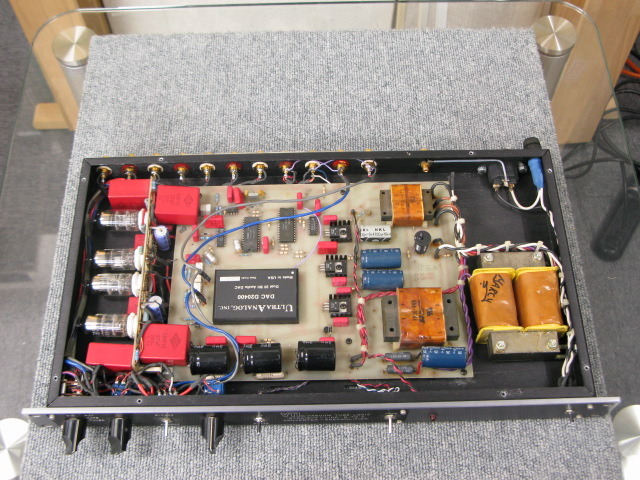
  • VTL Straightline DAC/Preamp (pics from hifido.jp; click to enlarge) Some days after the Lowther event, my friends Captain and Romo came in with "Garage" Charles and jules. Each had a different agenda, and Romo's was to get a DAC. He was very lucky that I sold this to him. This is one of my favorite DAC's. Compared to its more famous contemporaries which employed the same marvelous UltraAnalog 20-bit chip (Sonic Frontier SFD-II and PS Audio Ultralink, to name just two), it lives in undeserved obscurity. Basically, it is a DAC with a tubed output stage (with gain). It is both an excellent DAC and excellent preamp, but there is a quirk. As DAC Switch the Selector to Bypass and it works as a DAC. The sound is classic UltraAnalog, rich and detailed. Compared to the darker SFD-II, it is a little lighter on its feet (a plus) but perhaps a little less steady with big orchestral's. Absolutely first-rate, that is for sure. As Preamp Here lies the quirk. If one uses the Digital input, the sound lacks beef. However, if fed a line level signal (like we did on this occasion with the YBA WD202 DAC) the sound explodes with color. Indeed, as a preamp, I think it is as good as most that have come my way! That is accolade indeed. You get Two in One, but you cannot use both at the same time, funny, no?
  • SinoVT TP-215AI This cute 6V6 PP amp (reported here) seems to have been discontinued, and in any case this brand is a little difficult to source in the West. Charles heard this some years ago at my place. Subsequently, he bought two. On this day, Charles came to buy mine. The SinoVT did a reasonable job driving my Ruark Crusader II, and even the "Big Fat Lady" B&W Matrix 801 MkII, amazing considering it is just 7 wpc (pentode operation). More below.
  • Ruark Crusader II These were covered in a previous article. Using the VTL DAC into the SinoVT, the sound was very good, and everyone nodded in approval. I am puzzled as to why these three-way's with diminutive footprints are not more sought after in HK.
  • B&W Matrix 801 MkII For my assessment of B&W, especially the Matrix series,  of which I am fond, read my Overview. For the longest time, together with the Spendor SP-100, the Matrix 801 was a perennial on Stereophile's list of Class A components (indeed, read its most amazingly detailed review, written by a musician). I have had mine for a long time, but rarely used them, as I had my horns, which could use SET amps. But the Matrix 801 had retained my loyalty otherwise. Driven by the 7 wpc SinoVT, sound was surprisingly big-boned and decent - that should completely dispel the myth that the 801 is difficult to drive. We then switched to the Bryston 3B, which immediately firmed up the sound and put things into scale. Splendid loudspeakers of reference caliber!
A rare glimpse of my old place, in transition. Note the beautiful Lowther TP-1's in the back. In front are the B&W Matrix 801 MkII and Ruark Crusader II. On the floor is Sun Audio 2A3. You can also spot Unison Research, Cyrus, NAD, ARC, Technics, Micromega, Audionix and Lenco, among others.