Showing posts sorted by relevance for query 3020. Sort by date Show all posts

19 August, 2012

Review: NAD 3020 (original version)

Review: NAD 3020 (original version), Part I
Preview: TAD TSM-2201

Last Revised Feb 29, 2016 (More recent experience of 3020 + Klipsch added)

Review: NAD 3020 (original version), Part II describes
NAD 3020 Driving Klipsch Forte


Recently, I helped a Macau friend pick up his NAD 3020 amp from repair. Back home, I tested it briefly and was quite impressed, even astounded.

NAD 3020 (Official Info has Data Sheet and Manual)(Service Manual pdf file)
This one is the original icon, without any suffix, probably the most famous integrated amplifier of all time. There is a huge amount of info on the internet, and I shall provide only few links. There are some interesting latter-day reviews. It's worthwhile to read these:

--wikipedia entry
--TAS review (Chris Martens)
--tnt review
--Page 25-26 of TONEAudio article  (large pdf file; takes a moment to download), where the beneficial "benign error" was mentioned.
--NAD vs NuForce

Later 3020 Iterations The much emulated 3020 series had a long life. The original 3020 morphed into the versions with alphabetical suffixes, A and then B, and there are only small differences between them. BUT, starting with the 3020E, significant revision was made. This then became the 3020i and there was also 3120. There may be even more but I am far from being a NAD historian. It seems the general opinion is that only the 3020's up to the B version have that je ne sais quoi quality. Certainly my previous encounter with the lackluster 3020i is in keeping with this sentiment.

Phono The 3020 has only MM phono; whereas the 3020A/B have MC/MM, selected by a switch. Therefore low-output MC users are likely to prefer the A/B versions.

Sound I hooked this up to my rig of the day:

Analogue: Lenco GL-75/SME 3009S2i/Denon DL-103R into Denon AU-3000LC SUT
Digital: YBA WD202 or Sony CDP/DAS R1
Loudspeakers: TAD TSM-2201-LR

Brief Note on TAD TSM-2201-LR This recent addition to the TAD line (info) is a killer, selling like hotcakes here in HK. Its modest price (manufactured in China) belies its quality. It has a bona fide monitor sound, needless to say highly revealing, yet it is also musical. There shall be a detailed review here later.

NAD 3020 drove the 86db 4-ohm TAD with no signs of stress Despite its 20 wpc (into 8 ohm; therefore 40 into 4 ohms) rating, at my normal listening level, only the first two lights flickered occasionally. It was almost a perfect match, the warm (but not overly so) and musical 3020 together with the highly detailed TAD with extended treble. Only in the largest orchestral pieces did I sense a bit of compression. The TAD is brand new and not yet run-in, yet the results was comparable to what I tried just before, with my Leben RS-28CX and the trusty 100 wpc Rotel 870BX amp. The latter combo surely yielded more details and power, yet the NAD was musically their equal - now, that says something! The phono was also surprisingly good, and quiet.

NAD 3020 Driving Klipsch Forte This is written at a later date. See Review: NAD 3020 (original version), Part II

With the stellar performance, now I have to revise something I wrote before.

My previous NAD experience I owned an 3020i before, and was not too impressed. I wrote in my Integrated Amplifier Overview: "...For once I agree with Ken Kessler that the "venerable" 3020 is flaccid-sounding and hopelessly over-rated. I got a 3020i as a close-out from Ming Fat and till I sold it some years later I never realized what the hell was it all about!. I much prefer the current remote-equipped 315BEE, which garnered rave reviews everywhere. After reading the detailed review by Ken Kessler in Hi-Fi News I bought one, and that's a first for me with this reviewer! Now it's the 316BEE. I also have a 325BEE in NYC. Buy any of their BEE series with confidence..." OK, now I have to eat my own words. I know why. The original 3020 and the 3020i are very different animals. The original 3020 is now one of my favorites, and that article shall be duly modified.

The 3020 is a classic that absolutely deserves its fame!

19 February, 2016

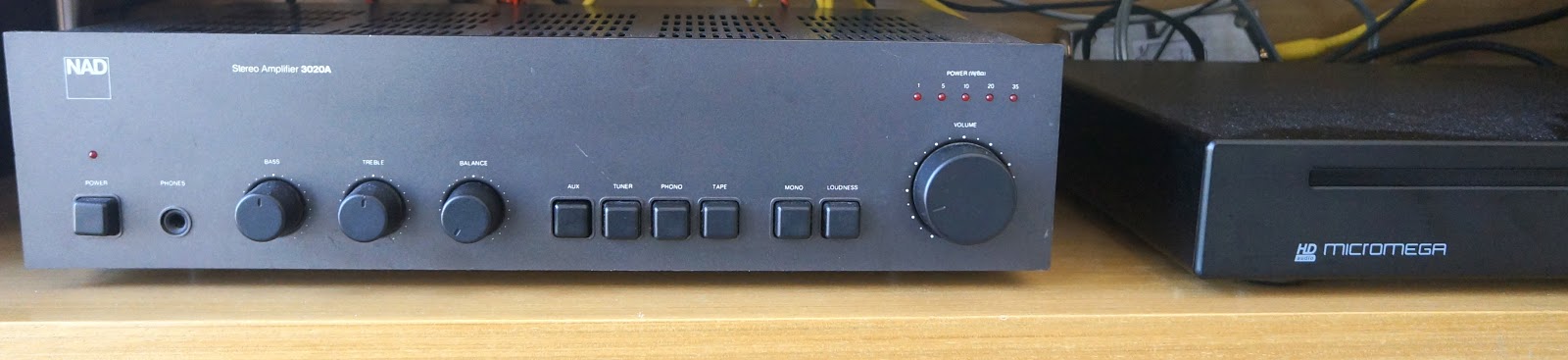
NAD 3020, 3140, Micromega CD-20, Klipsch Quartet

Note NAD3140 atop NAD3020 atop Micromega CD-20. Click pic to enlarge.

Home Visit: NAD3020 meets Klipsch Quartet
Review: NAD 3020 (original version), Part II
NAD 3140, 7020, Micromega CD-20
Talk Horns - Klipsch, the One-Stop Solution, Part IV

Note: Previous articles in Talk Horns - Klipsch, the One-Stop Solution (Part I, Part II, Part III) treat mostly what is now called the heritage Series, especially La Scala, but I'd think they make supplementary readings for this article.

Review: NAD 3020 (original version), Part I covers the same version of 3020 driving TAD-TSM-2201


During the CNY holidays I found some time to hook up with old friend Hoi, a very busy man/scientist who has scaled down his hifi from a complicated Altec horn system with electronic crossover and multiple amps to the current system you see in the pic.

Klipsch Quartet (sold 1989-1996) There is not too much info on the Quartet per se on the internet. But there is a lot more info on its slightly bigger sibling Forte II (Soundstage review; also this HiFiclassic review of its similar predecessor, Forte I), which is very similar, employing the same treble and midrange drivers/horns, the same 12" rear passive radiator, differing only in having a bigger woofer (12" vs the Quartet's 10"). The Forte's have considerable underground reputation and there are a lot of forum discussions, mostly on aftermarket mods. These are low for "floorstanders", so most users raise them so as the horns are at ear level. Also, because of the rear passive radiators, they cannot be placed against the wall. Note too these are still bona fide Paul Klipsch designs.

NAD 3020/3140 Hoi's 3020 is the original (see my review), but he is only using it is preamp, connected to the 3140's power amp section. From the looks of the knobs, the 3140 should be a contemporary of the 3020, and it puts out double the 3020's power (40 watts vs 20 watts). Hoi mentioned that the 3140's power amp section is not quite as refined sounding as the 3020's, but he preferred the higher power handling. In passing, in the pic also note the receiver version of the 3020, the 7020, essentially a 3020 + 4020A (my tuner review here).

Micromega CD-20 This is one model above my CD-10 (see my review), differing solely in having a better power supply. Hoi mentioned that he auditioned all three, and the CD-20 outperformed the CD-10 in large-scaled music; he also preferred it to the flagship, the upsampling CD-30.

Hoi's Comments
  • Bass Hoi regards the Quartet and Forte's as some of Klipsch's best designs. I agree. Hoi says, aside from a very large room, the Quartet has better bass extension and performance than the La Scala. I beg to differ (see below). Extension is one thing, impact another, as long as it is tactile, there is room for difference.
  • Tubes Hoi also uses tubes with the Quartet's (see the Unison Research Smart 845 on the floor, which is used with the McIntosh C20). He thinks now that is the minimum required for the Quartet. Maybe, but with the La Scala etc I enjoy much lower power. Well, if Hoi is totally satisfied with the performance of ss with Quartet, why would he tinker with tubes? :-)
  • 3020's Preamp Section Obviously Hoi is satisfied with the performance of the preamp section of the 3020, which he thinks impart most of the sonic signature (spacious and tubey feeling), although he also thinks the power section of the 3020 is sweeter than the 3140.
  • Tone Controls Hoi opines that tone controls, including the infamous Loudness Control, are a must to compensate for various recording deficiencies. I can allow, even sympathize, with that, and would not argue with those who regard these as necessities. But I personally don't need to have these, even at very low volumes (where the loudness control is said to cut in), because with my references of 15" woofers, bass can be physically felt even at low level. To me, this reflects that the system's bass is perhaps too lean. BUT, if you have these knobs, DO use them to equalize!
My Notes
  • Sonic Impression We were dining and chatting, but the sound was very familiar to me. You see, I have recently acquired another NAD 3020A and is now using it in my "new home" reference system with Micromega CD-10 as one of the sources, although partnering Yamaha NS-1000 (write up on this latest iteration to come). Do not forget I have also used the Klipsch La Scala and still own a Heresy I. As expected (as I know Hoi's preferences quite well), the sound is a little on the dry side, but has good balance, rhythm and pace, not to mention the kind of presence that only horns can render. But with the solid state, for me, bass is decidedly lean - I think I'd prefer tube electronics. Note online you can find a lot of Klipsch people who like solid state (including Hoi I think) - they point out the impedance curve is not so straight and ss would deal better with these. I think it is just the opposite - damping restricts bass as much as controls bass. I am sure this may be heresy to some - more on this perhaps in a later HiFi Basics article.
  • vs Cornwall and Heresy Aside from the rear passive radiator, designed to augment bass with a smaller woofer in a smaller enclosure, the Forte can be reasonably compared to these two look-alike classic Klipsch designs. As I have heard the much more expensive Cornwall (15" woofer) driven by tubes, resulting in a lot heftier bass (here), I'd prefer the Cornwall. But if you don't want to fuss, you are likely to find the Quartet (or Forte's) much easier to get quality bass from than the idiosyncratic Heresy (see here).
  • The Alnico Question Then there is this the BIG question. All Forte's and Quartet's are Ferrite. But Cornwall and Heresy can be had in earlier alnico versions. Personally, if obtainable, I'd prefer alnico. For more on alnico vs ferrite, and my experience with both ferrite and alnico La Scala, see here.
  • In Modern and Overall Terms Hoi's room and placement are not ideal, yet the sound was quite good: nothing vintage or outdated about them! I'd love to hear these further apart and more in-room, and more against the side walls; I think that will carve out a much bigger stage and generate heftier bass. I think there are a lot of room placement options for these, and they are relatively compact for what is on offer, making them suitable for smaller rooms. Apart from Klipsch, I can think of few designs that can wed horn virtues to conventional infinite baffle designs; that have good bass, yet retain high efficiency. IMHO, these are great speakers that can hold up against many much much more expensive modern speakers. They are very cheap, and Best Buys. 

29 February, 2016

NAD 3020A, Yamaha NS-1000, Micromega CD-10, Cyrus I

Cyrus I on top. Click to enlarge.

NAD 3020A Meets Yamaha NS-1000
NAD 3020A vs Cyrus I
Micromega CD-10, Part III, vs Sparkler S306
Review: NAD 3020A
Review: NAD 3020 (original version), Part III

Note: Review: NAD 3020 (original version), Part I covers 3020 driving TAD-TSM-2201; Part II covers 3020 driving Klipsch Quartet. As to me the 3020A sounds identical to the 3020, I also label this article as Part III of that series. In this article I shall describe sonic aspects in more detail than before.

See also Micromega CD-10 Part II  for basic info and more on the CD-10.

NAD 3020A (Manual available through Official Link) There are tons of info on the original 3020, but little on the A and B per se; this is because they have only minor differences (I will attest to that in my Listening Notes below). For basic info, see above links to the 3020. Both A and B versions have minor revisions and differ from the original (MM only) in having switchable MC/MM, thereby facilitating use of low-output MC's. Serious Vinyl People like me would prefer the A and B versions.

NYC Experience 1 - My First 3020A Ever since I had the 3020 experience in HK (links above) I wanted one. My first was bought almost two years ago from Ebay UK, a 220V unit. I had it mailed to NYC, intending to bring it back to HK. Somehow I had forgotten to write that up, and by now I had forgotten the details. Suffice to say, in NYC, even handicapped by the use of a step-up transformer, it went up against my expensive stuff and never batted an eye. No, it wasn't the best at this or that, but in overall terms its musicality was simply astonishing, duplicating the previous HK experience. Its phono section was also simply excellent and capable even with my very low output MC's! Somehow I procrastinated in bringing the unit back to HK. I am due soon again in NYC; maybe I will re-test it if I have time.

NYC Experience 2 - A Sour 3020 Note Bolstered by the experience, I immediately started hunting for a 110V unit, and soon got one from US Ebay. It turned out to be a lemon. The preamp section was fine, but the amp section kept blowing fuses. I returned it, but am pissed off that the shipping fee was not refunded, and I had to pay for return shipping. IMHO, if you sell a lemon, you should be fined/warned by Ebay, and you should pay the shipping fee both ways! That was almost $60 down the drain. So be careful shopping!

HK Experience - My Second 3020A I picked up my second unit from a very friendly HK seller a few days into the CNY. Previously he had blown the 1A fuses when he accidentally shorted the outputs while disconnecting the unit. That the unit functioned well attests to the soundness of protection. I had to get replacement fuses but, not knowing whether the original is a quick- or slow-blow, I opted for a quick-blow 1.5A (the schematic does not seem to tell me which one; if you know, I'd appreciate letting me know). I lost no time putting it up against my Nait 3, in my System A:

CD Transport: Sony BDP-S190 Blue Ray Player (Belden 1694A)
DAC: Sparkler S306
CDP: Micromega CD-10
Integrated Amps: Micromega IA-60; Naim Nait 3
Speakers: Yamaha NS-1000

System A Notes If you'd like to know more of what I think of my System A, please read my two previous articles: Review: Weiss Minerva vs Sparkler S306 vs Sony BDP-S190
details the strength of the Sparkler DAC; Review: Micromega IA-60 Integrated Amp; CD-10, Part II treats the Micromega CD-10, and the amps I have used in this system, including the Micromega IA-60 and Naim Nait 3. The context is important for the comparisons I am about to make.

Cyrus I I still own two of these, and it is still one of my go-to amps in a pinch; ridiculously cheap, handy, compact, workman-like and all-around competence. It was briefly treated in my Integrated Amps Overview. Given my fondness for it, I'd not mind to try the II and III someday!

Channel Classics 25 years - sampler cd Listening Notes
  • Test Discs For the A/B comparisons, my usual Channel Classics and Manger discs.
  • NAD 3020A General Notes As mentioned, its all-around excellence is perhaps unparalleled. You are just immersed, though the audiophile half may still asks questions! :-) Ease of Matching As documented, it also seems to partner every speaker I have heard well! Soft Clipping Although I listen to large scaled orchestral music, the power indicators barely flickered (the second one occasionally). Therefore, I have no use for this feature and it is always off. Power/Dynamics As expected, given my previous experience with the TAD-TSM2201 in a larger room, the 3020A has no problem handling the demanding Yamaha NS-1000, but in a rather different fashion (more description below). Soundstage/Imaging/Hall Sound This is the most interesting aspect of the amp. The airy feeling is amazingly close to tube amps: there have been many solid-state power amps, particularly Class-A designs (like Pass Aleph, old Krells and Thresholds etc), that have been said to be tube-like, and I have used quite a few of these together with excellent tube preamps (a constant for me). IMHO, even without the help of a classic tube preamp, the 3020A betters those power amps in the depth and enveloping sense of soundstage. Imaging is very good but always integrated with the soundstage and hall sound. Not a weak link. This is not to say that, compared to the best tube gears, one fails to notice that some of the bloom seem a little artificial and fuzzy, but who cares if it sounds so great?
    Image result for manger cd
  • 3020A vs 3020 The sonic signature and immersing experience are so similar that I have to conclude they are very similar, if not identical. For me, 3020 = 3020A. I suspect B is the same. Which is why I also labelled this article as 3020, Part III.
  • NAD 3020A vs Micromega IA-60 vs Naim Nait 3 Overall In many ways, the NAD 3020A is like a cross between the Naim and the Micromega. Power/Dynamics At louder volume, the 3020A is a little more at ease than the Micromega IA-60, but less composed than the Naim Nait 3. Interestingly, as TNT noted (links above; Part I), one always wants to crank it up further, a sign that the increasing decibels are compressed (understandable for the basic wattage rating). Soundstage/Imaging/Hall Sound Here the NAD hits its stride. The Naim is more upfront and less accurate about hall sound/ambience clues. The Micromega is more spread out, but on a somewhat smaller scale, with images of less substance. Also of note is that, when the going gets rough, the NAD preserves more of these spatial clues than its rivals. Transients The leading edge of the 3020A is very good, not quite as fast as the excellent Micromega IA-60, but never feels wanting; and definitely not like some of the relentless modern stuff. Rhythm and Pace Reviews such as TNT (above) have faulted this aspect, but partnered with a great CD source (either Sparkler or Micromega) this is not the case at all. The NAD perhaps is more like the Micromega IA-60 - incisive; as opposed to the Naim Nait 3's slightly slower and more sinewy way. These amps illustrates why I just love well-designed integrated amps -each is imperfect, yet an irreplaceable gem. Depending on one's associated equipment, one's preference may change.
  • NAD 3020A vs Cyrus I General As I spent little time on it, this is perhaps not a fair test. My Cyrus I had not been fired up in several years, and should benefit from some re-run-in.. Yet, the Cyrus I immediately yielded a very decent sound, clear and lucid. Power/Dynamics Clearly the Cyrus I is as powerful as the Naim Nait 3, but with a dryer sound as compared to the Naim's fuller contour. Soundstage/Imaging/Hall Sound The Cyrus I is perhaps more like the Micromega IA-60, with good spatial clues but less fleshy images. With increasing volume, control is superior. Transients The leading edge of the Cyrus I is very good, almost as fast as the excellent Micromega IA-60. Rhythm and Pace This is where the Cyrus I loses out a little. Incisive as it may be, its rhythm and pace does not quite have the subtlety of inflection that its rivals possess (I include the Micromega and Naim here). I suspect some of this is due to the long idle condition of the unit. When I have time, I'd love to re-run it to form and re-compare.
  • Micromega CD-10 vs Sparkler S306 Finally I got around to re-setup the Micromega in this system; one reason for this is to circumvent the lack of muting of the Sparkler S306 as used with the Blu-Ray Player (see links above).  Initially, the sound was more rounded and somewhat more indistinct than that of the Sparkler. Unusually, I finally substituted an old Audio Note (UK) AN-V (silver) interconnect and that did the job. Sound was clearer, bass quicker and more balanced. The Sparkler S306 (transport Sony BDP-S190) was still more incisive, but the Micromega ran it close in all parameters. I don't use silver interconnects often, but this shows the Micromega (and my setup, bass-resonance prone) benefits from some careful matching. Both are to stay: For the best material, I still prefer the Sparkler S306/Sony BDP; but for average use, the Micromega is more than satisfying!


04 January, 2013

Editor's Note: 2012 in Retrospective, Best Buy of the Year

Nothing beats Western Electric (pictured 133 on top and 124B). Click to enlarge.

Editor's Note: 2012 in Retrospective, Best Buy of the Year
Follow Up: Sony BDP-S190, Part II
Follow Up: Sony PlayStation 1, Part II

Revised Jan 6, 2013

Once again, I have failed to write the yearly retrospective before the year's end, but this time I have more excuse than before! The year 2012 had been quite a mad year for me, and personal matters took the helm. This necessarily means fewer things to write about, but it shall not be for naught I assure you. As I look back, my 2012 in audio was idiosyncratic (I like that), and MOST meaningful for rediscovery of "old friends" (I like that even more).

Most Notable Events
  • Western Electric Without a doubt, the biggest event of the year was: Nothing New Under the Sun. Western Electric (posted here) 133A and 124 amplifiers worked their magic, and reminded me in no uncertain terms that WE remains supreme in audio achievement, bar none. People have asked me repeatedly why I had put aside my 133A for so long; I can only say: so as to explore other things, worthwhile or not....
  • Mono Analog Replay Mono Analog Replay (treated in at least 3 articles here), which some have advocated for years, is definitely not anachronistic, not a step back. It is simply something that makes one re-evaluate what one is listening to. One asks again, perhaps Less is More?
Best Sound of 2012
I am not going to be humble here. The best sound I have heard in 2012 was from my very own Western Electric gears.

Most Important Acquisitions
  • TAD TSM-2201 (reported here). This paradoxically at once boldly-styled and low-keyed design was a match made in heaven with Kondo M7 + Ongaku (result here). You are certain to hear more about this.My loudspeaker purchase of the year.
  • KEF LS50 The co-axial design is superbly coherent. You shall too hear more about this (preliminary findings here).
  • Denon DL-102 Mono Cartridge (reported here). Mono is all the rage. This studio/transcription perennial deserves its fame.This very heavy cartridge needs a robust arm to do it justice.
  • Thomas Schick Tonearm is a 12" bargain compared with others more expensive (tested here). One day I'd love to install the Denon DL-102 on the Schick.
  • Sony SCD-XA5400ES SACD player for once convinces (reported here).
Thorens TD309 reviewBest Buy of the Year

  • Thorens TD-309A turntable (here) This humble turntable delivers more than one expects. The tonearm performs way beyond expectation, and is a great match with the heavy Denon DL-102 mono cartridge. In terms of one-stop solution, this TT now displaces even formidable rivals like Clearaudio Concept (a previous Best-Buy). I'd love to try out Koetsu and stuff on this arm, but time is in short supply.
  • CineMag CMQEE-3440A made famous by Bob's Devices (here). Whether you DIY or buy from BD you are certain to be happy.
  • Denon DL-301 Mk II MC cartridge is a dark horse but its superb musicality is instantly captivating (reported here).
  • Canare L-2T2S (here) is superbly musical for a ridiculously low price.
  • Sony BDP-S190 Blue Ray Player (here) is superb. Follow Up: Since that initial evaluation, I have confirmed the transport section of this entry level Sony Blue-Ray player is as good as any previous DVD models, every bit the equal of the underground classic DVP-PR50P (a previous Best-Buy) (in fact they are indistinguishable). The analog out sound too is very clean, audibly cleaner than the DV-PR-50P but perhaps just a little less warm and emotive. I suspect any Sony BD as well as DVD player shall deliver excellent sound. Best-Buy in digital for sure.
Vintage Rediscoveries

  • Yamaha NS-10M (posted here) shows the best of yesterday is fully competitive today.
  • NAD 3020 (here) proves it is immortal. 
  • Technics SL-1200 Mk II (here) surprises yet again.
  • Sony PlayStation 1 (here) shames most current digital products. Follow Up: In one go I performed two of the modifications outlined in the dogbreath page: removing the muting transistors as well as the output blocking caps from the signal path. I am sorry to report that while more details could be had the sound lost some of its musicality - its raison d'etre and its magic. I suspect I prefer the sound with output caps, though it may take some trial and error to reach an improvement. You shall hear more about this PS1!
Suggestion for a US $1k system that will shame your friend's $10k system
This requires you to source used goods, from the likes of Ebay, but you shall be rewarded amply. Not cheaptubeaudio, but cheap audio for sure:

  • Yamaha NS-10M
  • NAD 3020 (not the i version, please read my link)
  • Sony DVD player (as the Blue Ray is more expensive, I am sure the current entry-level DVD players are likely sonically as good as their over-achieving predecessors. I see the DVP-SR210P, successor to the 200P, sells for $30! :-) Even I may buy another one to try!)
  • Technics SL-1200 Mk II. Since the NAD only has an MM section, if you use the Denon DL-301 Mk II cartridge, you will need to add a step-up transformer (suggest the cheap Denon AU-300LC or the older AU-250 (here) and that will increase the budget a little. If you stay with MM cartridge, I suggest the cheap and cheerful Shure 97xE (<$80).
  • NAD 4020A (here), the original matching tuner for the NAD 3020, if you need a tuner.

04 April, 2022

Western Electric 755, TA 4189A

Click pic to enlarge. right, Vincent's NAD's. Next to WE, beauty and the beast...

Home Visits (22-1): Western Electric
Letter from Hong Kong (22-3): icefox sends goodies

Regular readers know that when I was in Hong Kong, my friend icefox often acted as my taskmaster, making me work hard. This man knows virtually everyone, especially the ones worth knowing (not at all in the majority). He knows almost all the WE players in HK and the greater Guangzhou area and is a constant source of good information. He recently sent me the videos below, which I hope you will enjoy. Much of the music will be unfamiliar but I think that's not so important.

Note: Although I am not in HK, icefox is, and that was where all this info was related to me via wechat.

HK: Vincent's WE 755 We have met Vincent before. Not so long before I left HK in 2018 I chronicled his WE systems and Altec 604 (here). He has changed from the Altec 604 to the WE 755. In this video, however, unlike before, he's not using the WE 133 replica amp (using all genuine parts) but an NAD 3020 (or 3020A). In the video, the NAD is in the back and the WE133 in the front are not used. Bluetooth was source and speaker cable Belden 9497. I of course asked which NAD is better and he said there is not much difference. As for the heart of the matter, most importantly, icefox said "...(this is) the simplest nice sounding WE system I have ever heard...this combo puts a lot of big but poorly executed WE horn systems to shame!" and that's a lot coming from him! icefox said:"... the 133 sounds nice too but when you consider what NAD 3020 could do, it's such a gigantic bargain vs those expensive tubes that one requires to operate the 133..." And now, he even said this!!!!!!!! "when you have a WE speaker, the WE amp is not mandatory!" The Cabinet Now, this is very important. I have heard plenty of 755's, from Alnico WE and early Altec's to later ferrite Altec's. It is still the most iconic fullrange. But, often the sound is sub-par. In my experience, most, if not all, modern cabinets do not sound good (just as in the case of Lowther). If it's MDF, you can just totally forget about it. To avoid the trappings of a bix, some use open baffle, but that has its own can of worms. In this case, Vincent's are housed in original Altec 618 cabinets (literature at bottom), which is a solution adopted by many. But, as icefox says, not all 618 cabinets are created equal (many are DIY's of widely varying qualities). Vincent's apparently are particularly fine specimens.


Taipei: Mr Han's WE TA-4189A 台北韩先生 He is an acquanitance of icefox. I have even less info on this. Suffice to say, this is a pair of fullrange Field Coil WE (power supply at bottom of article), driven with WE 94C amps, fed by Studer A730 directly, no preamp. This is Mr. Han's second system, his main being WE 15A (not available this time).


China: Foshan (Guangdong) 佛山西电镖 This is the WE Replica of the fellow who makes close replicas of WE stuff, including Vincent's 133. Think along the lines of Line Magnetic.


Well, I cannot thank icefox enough for these footages, which I hope you will enjoy!


02 May, 2024

Douk H7 Pro T8 Pro Nobsound

Click pic to enlarge. Left rack, beneath the TT is the Marantz 94 Limited DAC, beneath which the Marantz CD63 used as Transport (with Belden 1694A); Right rack, The Douk pair atop the MFA Magus Preamp.
Brief Review: Douk H7 Pro, Part II; Douk T8 Pro, Part III

Douk T8 Pro, Part I, II
Douk H7 Pro, Part I

This is to tie up loose ends. I brought these over to Hong Kong, partly to see if the H7 Pro (with 24V PS) can drive my B&W Matrix 801 Mk II, partly to further and properly assess the XLR functions of these 2 devices.

I wish I had 2 pairs of XLR cables, but I didn't. So, although my Marantz DAC has XLR out, I had to use its RCA Out into the T8 Pro RCA In, which was in turn connected by my only pair of XLR cable (the super Gotham GAC-3) to the H7 Pro. Loudspeaker cable has always been my trusty Belden 1810A, 4 conductors used as bi-wire.

Burmester "Art of the Ear" Test CD II Due to time constraints, I used only 1 CD, the Burmester Test CD II. Too bad my Manger CD is in NYC. As this by-now collectible CD has long been OOP, my copy is a Chinese Counterfeit. I bought it in SZ 万商 many years ago, but similar copies are still available on TaoBao (search "Burmester CD II; best price is RMB 15 for a bare-bone copy; don't spend too much more as even the more expensive ones are counterfeits; I won't give links due to its counterfeit nature; :-) Principle, huh?). Funny, I don't like at all Burmester the company, but this Test CD is useful (much better content than the other volumes). Most tracks I just sample for 10-20 seconds, but a few favorites I can listen for longer (Tracks 4, 7, 8, 9, 10, 12, 15). Now, this "replica" is a little more digital sounding than the original, so sometimes a little unwanted hash is expected. Also keep in mind many of the original CDs can still be bought, no doubt in superior sound, though that'd be without the convenience of being all under one roof.

(Before) Douk Preamp XLR Out to Bryston 4B Amp XLR In (Gotham GAC-3) This was chronicled in the Douk T8 Pro Review, Part II, link above. It was not entirely successful.

1. Douk Preamp XLR Out to Douk Amp XLR In (Gotham GAC-3). Sound was quite decent. Instantly, I felt the imaging, soundstage and layering were definitely superior to whatever I had used before, be them NAD 3020 Integrated or MFA Magus or Counterpoint SA-3000 Preamps into Bryston 4B. Even at my usual listening volume, the amp was pretty unfazed. Not the most dynamic, but decent enough and no sign of struggle. Definitely more power than the NAD 3020. However, at least initially, the sound still sounded a trifle lean at times. Part of this can be ascribed to the CD.

2. Douk Preamp RCA Out to Douk Amp RCA In (with Sommer SC Club Mk II) I did this to see if a change in cable would mellow out the sound a little. Yes, as I predicted, it did sweeten the mix, but the level was lower, and volume had to be turned up pretty high. At least I know if I had more cables I could do more.

3. Douk Preamp XLR Out to Bryston 4B XLR In (Gotham GAC-3) This was a Repeat of what I had done before, but this time around, the sound was significantly better. I attribute this to the extra use the GAC-3 had received since before. Although lacking the extra air the Douk Amp brought about, the Bryston seemed more composed than the Douk (it has tons more power than the Douk).

4. Douk Preamp RCA Out to Bryston 4B XLR In (Sommer thru Neutrik Adaptors) This was to use the Sommer cable, which again did sweeten things a bit. But, now, the difference between (3) and (4) was small. Not much grain remained.

Observations
  • Douk XLR In and Out They perform excellently. When properly configured, the XLR I feel is superior in power and confidence of delivery. In this price range, it's insane to get this! Of course, only if it's useful to you, and most readers of this blog would not be XLR users.
  • Douk H7 Pro vs Bryston 4B The H7 Pro cannot begin to match the sheer oomph of the Bryston, but it does a decent job, and surpasses it in air, soundstage and imaging, even refinement. Not bad at all!
  • Tonality As a tube afficionado, this combo still lacks the ultimate in tonal opulence, but it's not that far away. Cable changes should close the gap significantly.
  • Cabling IMHO, my cables, almost all cheap professional cables, are highly neutral whether used with tubes or sand. BUT, cable matching with sand amps is not at all my forte. Perhaps in due time I shall construct a few more XLR cables (like Sommer).

02 July, 2018

Lowther TP-1, B&W Matrix 801 MkII, VTL Straightline DAC/Preamp

Reviews: Lowther TP-1, B&W 801 Mk II, VTL Straightline DAC/Preamp
Overview: Lowther
Ruark Crusader II Revisited

This Blog is sort of a real time audio diary. For the moment, this is even more so.

Extra! Closing Up Shop
My friends know, due to family circumstances, I am soon to (more or less) wrap up things in Hong Kong, and spend more time in New York. Now, you all know.

This is why I am transferring some of my prized possessions to my friends. In the last two articles, you have read about my prized TAD TD-3401 in its new home. You shall soon read the same about the Tannoy Canterbury. The departure of those two loudspeakers signifies the closing of an era for me.

As anyone who has re-located, not to mention with way excessive baggage, knows, it is pandemonium. I don't know how I am going to survive it. But friends help, and writing, again, is a catharsis. The recent articles, more of a potpourri, reflect this reality.


Drunken Goose Palm!

Audio Comaraderie
In the last entry, I reported on the visit by icefox and company to my place. What I did not report on was that I scrambled to offer them something to snack on, very humble offerings (like 759 Spanish ham, sardines, Taiwanese crackers and udon; with some privately sourced organic peanuts, fried) with some equally humble generic wines.

The next day, I was really surprised to have received an email from To Sir. He had just prepared some Goose Palms 醉鵝掌 marinated in rice wine, Hence the name Drunken - this classic method has long been used by the Shanghainese to prepare chicken and other small birds. He insisted on delivering some to me, as he knows I am a drinker and this dish is supposed to go well.

I must say To Sir's take on this classic recipe is excellent! But I am even more grateful for the warm-heartedness, from a man I have met only once! In some ways, he reminds me of our NYC friend Kevin (here). No "thank you" is enough!

Removal
How do you sell a "warehouse" full of possessions? You don't; I don't really try very hard, but friends have helped me to unload a bit. And also, re-hooking some of these up have been a very pleasant reminder on why I owned them in the first place. Aside from the major events of TAD and Tannoy, here are some recent activities, and I'll take this opportunity to re-evaluate some of these and write a few words. In order of occurrence:
  • NAD 3020A I sold to someone I didn't know. As usual for such low-priced items, there was no testing and the transaction was in the MTR station. The next day, I received a call; the new owner breathlessly told me how wonderful the NAD was - it completely outclassed his vintage Conrad-Johnson preamp (no news to me) + 6A3 SET amp through his University loudspeakers (sounds like the basis for a pretty good system - too bad I have no time to visit). To recap, I have written extensively in this blog on the 3020 (click here) and as of this writing still employ it for my Yamaha NS-1000 (which the icefox crowd auditioned). I suspect there shall always be a 3020 in my possession and use; after all, it is a benchmark. Immortal!
  • Lowther TP-1 Complete Loudspeaker Names and Iterations Lowther model names for their loudspeakers and cabinets are highly confusing (like the many subtypes of Acousta), and this particular model even more so. Mine is the classic version with beautiful "Queen Anne" legs (TP-1B), which was/is more expensive than its plainer straight legs counterpart (TP-1A). A good guide is the Lowther Voigt Museum, which however I think is not complete. There were other later TP-1's, including "London" (not the current repro) an perhaps others. Currently, Lowther UK also offers the "TP-1 Imperator", which seems very different as it is front firing, though back loaded. My Pair My pair can be seen in the pic at the bottom of the article (similar to the units well documented with pictures here and here). I have had mine for almost twenty years, but haven't used them in the last fifteen. For a little info on how I got my pair and some old listening notes, click hereThis Time Around After the removal of my Tannoy Canterbury and TAD TD-3401, I was finally able to access them. It was serendipitous that my friend wher called me up around this time, saying a friend of his is interested. One day, we dragged these out. One has an intact PM3A with rubber surround (its mate has a short); the other a PM2A Silver with disintegrated surrounds (even worse is its mate). Despite this, the TP1 made mellifluous music when directly driven by my Sun Audio 2A3 (even with Russian tubes; source was Sony transport, YBA WD202 DAC). The driver with bad surround naturally had not much bass, but the intact PM3 was simple divine. The house was filled with rich, good music, so airy that we did not feel any need for supertweeters. Amazing! My Observations Based on my own wonderful experience with the TP-1's, and also the many Lowther's and as many DIY/repro cabinets I have heard, here are my views which I know is going to grate on many people: 1) Front firing Lowthers must have good bass horn loading to sound good; 2) Original cabinets sound much better than most DIY and Repro cabinets (no matter how touted or even "official"); 3) If DIY is necessary, avoid MDF and other rigid material; 4) As the repro cabinets all originate from China, we get to hear them in Hong Kong. Suffice to say I have heard my share and I am sorry to say I am singularly unimpressed - they usually sound so tight, the antithesis of a good pair of vintage Lowther's; 5) The Cabinet is much more important than the Driver used (even the cheapest PM6A produces excellent sound, IF housed right); 6) I am not impressed by the many Lowther-like drivers (like AER) that are said to be improvements. Overview Aside from the incomparable TP-1 I have heard excellent sound from a model with doors (likely the "Ambassador"). Possibly other large Lowther's like the Audiovector should sound good. I have also heard very good sound from some Acousta's, the most amazing being the "Dual-Position" firing into the corners (a bargain). I am sorry I cannot be more enthusiastic about modern cabinets or DIY efforts.
STRAIGHT-LINE VTL 画像STRAIGHT-LINE VTL 画像
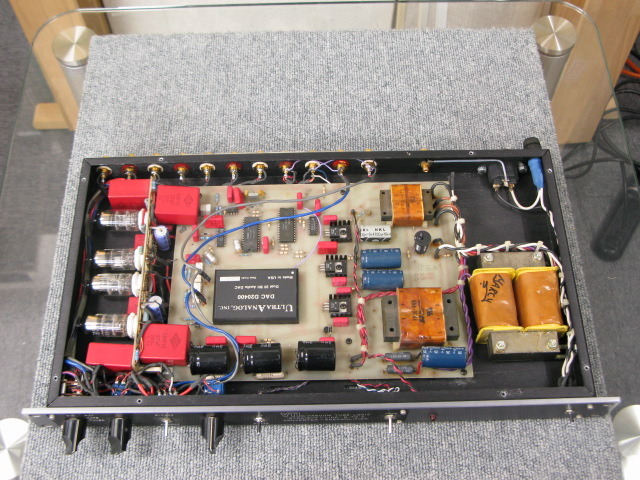
  • VTL Straightline DAC/Preamp (pics from hifido.jp; click to enlarge) Some days after the Lowther event, my friends Captain and Romo came in with "Garage" Charles and jules. Each had a different agenda, and Romo's was to get a DAC. He was very lucky that I sold this to him. This is one of my favorite DAC's. Compared to its more famous contemporaries which employed the same marvelous UltraAnalog 20-bit chip (Sonic Frontier SFD-II and PS Audio Ultralink, to name just two), it lives in undeserved obscurity. Basically, it is a DAC with a tubed output stage (with gain). It is both an excellent DAC and excellent preamp, but there is a quirk. As DAC Switch the Selector to Bypass and it works as a DAC. The sound is classic UltraAnalog, rich and detailed. Compared to the darker SFD-II, it is a little lighter on its feet (a plus) but perhaps a little less steady with big orchestral's. Absolutely first-rate, that is for sure. As Preamp Here lies the quirk. If one uses the Digital input, the sound lacks beef. However, if fed a line level signal (like we did on this occasion with the YBA WD202 DAC) the sound explodes with color. Indeed, as a preamp, I think it is as good as most that have come my way! That is accolade indeed. You get Two in One, but you cannot use both at the same time, funny, no?
  • SinoVT TP-215AI This cute 6V6 PP amp (reported here) seems to have been discontinued, and in any case this brand is a little difficult to source in the West. Charles heard this some years ago at my place. Subsequently, he bought two. On this day, Charles came to buy mine. The SinoVT did a reasonable job driving my Ruark Crusader II, and even the "Big Fat Lady" B&W Matrix 801 MkII, amazing considering it is just 7 wpc (pentode operation). More below.
  • Ruark Crusader II These were covered in a previous article. Using the VTL DAC into the SinoVT, the sound was very good, and everyone nodded in approval. I am puzzled as to why these three-way's with diminutive footprints are not more sought after in HK.
  • B&W Matrix 801 MkII For my assessment of B&W, especially the Matrix series,  of which I am fond, read my Overview. For the longest time, together with the Spendor SP-100, the Matrix 801 was a perennial on Stereophile's list of Class A components (indeed, read its most amazingly detailed review, written by a musician). I have had mine for a long time, but rarely used them, as I had my horns, which could use SET amps. But the Matrix 801 had retained my loyalty otherwise. Driven by the 7 wpc SinoVT, sound was surprisingly big-boned and decent - that should completely dispel the myth that the 801 is difficult to drive. We then switched to the Bryston 3B, which immediately firmed up the sound and put things into scale. Splendid loudspeakers of reference caliber!
A rare glimpse of my old place, in transition. Note the beautiful Lowther TP-1's in the back. In front are the B&W Matrix 801 MkII and Ruark Crusader II. On the floor is Sun Audio 2A3. You can also spot Unison Research, Cyrus, NAD, ARC, Technics, Micromega, Audionix and Lenco, among others.


22 August, 2008

Review: NAD 315BEE integrated amplifier

Review: NAD 315BEE integrated amplifier
(Last revised, 26/08/08)

PART 1: Background info

NAD has always been a good budget brand that delivers good driving power per dollar. Its very long history means it had both wildly successful products as well as many lemons. While NAD have always designed their amplifiers, many of their other products, like tuners and turntables, were simply re-badged products and varying in quality.

I once had a 3020i and did not like its bland and flaccid sound. On the other hand, the 412 tuner (OEM) was really excellent (but not the model that followed it, a Japanese one). They also have traditionally put out good sounding CD players, though I have never owned one.

Now based in Canada, in recent years, NAD have been expanding into the higher end a bit, with questionable success. However, recently their more humble products with the designation BEE (initials of chief designer, like Marantz's KI) have been garnering quite a bit of critical success, by even magazines like TAS and Stereophile. This has helped them regain footage (and dealership, like in Taiwan). On occasion I have heard them to usually good effect. I actually think the company has improved a lot and now walk a fine balance between hifi parameters and musicality.

This is a brand new design. Although I have read reviews of this amplifier in 6moons and Soundstage, I never paid much attention to this product as those magazines are frequently questionable.

A few weeks ago I checked out a stack of old HiFi News from the library to read in Shenzhen. And Ken Kessler's review of the amplifier (November 2007) caught my attention for the following reasons:

1. Although I don't at all like Ken Kessler's review of "high-end" stuff, nor his overpraise of current tube products, this is an unusual review of a very cheap entry level integrated, which he bought. Note that KK does have perspective in the "cheap-end" and an interest in vintage and audio history. Hence he compared this amp to the "classic" 3020.

2. I totally agree with him that the 3020 is nothing special.

3. Unlike other net reviews, he used really good source (Marantz CD12/DA12, tweaked by Ken Ishiwata) and serious loudspeakers in his testing. Both the Ls3/5A and Sonus Faber Guarneri pose serious challenge to any integrated amplifiers, especially the latter.

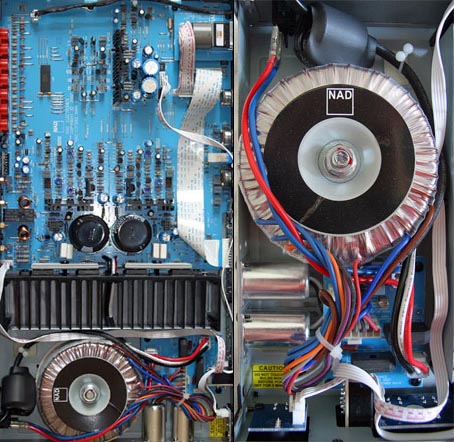
4. Although I am no technocrat, usually I do believe in simplicity and am skeptical of too much control circuitry. NAD's "soft-clipping" I know is useless from my experience with the 3020i, and all serious users switch it off. NAD's amps also have controlling "Power Drive" circuitry, which I am somewhat skeptical of too. But here The excellent Paul Miller provided really useful technical information that made this entry-level amp much more attractive to me. The simpler "Power Drive-S" is not even electronic! I like that. The quartz-halogen bulbs referred to are the 2 silver-colored tube shield-like cans next to the (good-sized) power transformer ( for better reading, remember you can click on the pics to emlarge).


And I was really quite attracted by the measurements, particularly the healthy peak level figures for even 2 ohms and that is comforting if I have to use it to drive speakers like ATC.

After reading the comprehensive review I was already tempted to buy one. Contributing to the final decision were:

  • Good looks (I prefer black/olive to the more popular silver/titanium).
  • Small size (only 2/3 as tall or deep as standard).
  • Remote control that is simple and effective (pictured in HFN).
  • Very reasonable price of $2xxx. As water goods is only a little cheaper, and no black color, I'd advise buying hong hoods.
  • My fetish with integrateds.
Part 2: My own listening experience

What started out as fun ultimately turned into a big "shootout" feast. But before the comparative listening (next part and future articles) the basic run-in and listening first.

From the start, it was apparent that this belongs to the "big" sounding camp. None of the usual over-emphasis on treble/imaging (=tiny and not live) stuff for this amp. This one majors on "presence".

At first sound is a little unruly and slightly coarse at high levels, but after several days of run-in this has disappeared.

In order to run it in I had it almost constantly on, by running it both in the living room and in the study. This thing generates a fair amount of heat, and that created a problem in my study during the first really hot days. That boiling hot day I used a fan on myself, no room air-conditioning. With the windows closed and the amp place high up on the (deep) bookshelf (its slim size enables this to be done), ONE time the amp muted itself, and I found the fins too hot to touch. After opening the windows, I could place it even higher up (now <1.5' from the ceiling) and do not have any issue even driving tougher speakers like ATC A7. The amp partnered all speakers very well, including Usher S-520/X-708 and KEF LS3/5A.

My main concern was classical replay. You shall note that KK did not even use one classic track and the German expressed reserve (with his weird speakers). Initially I was a little bothered by the coarseness. But not to worry, after running in, the amp turns out quite neutral in classical reproduction, be it solo intsruments or orchestral works.

Its overall neutrality can be glimpsed from one fact: It effortlessly reflects the effect of gear change. It can reveal the astonishing difference between the three TDA1541 16-bit CD players I used during the evaluation (Naim CD2, Sony R1/D1 and Esoteric P500/D500); and between all the speakers used.

Its capability can only be appreciated by partnering it with gears much oustside its price range. The better the gears, the better the sound with this little amp. It's a big mistake to base a review of this amp on partnering it with cheap speakers and CD players. It deserves better, like what KK had done.

During all this, it never put a foot wrong, and was always emotionally generous. It cuts to the core of music and is never boring. Do be patient with run-in.

And yes the remote is a pleasure. It now sits high up on my shelf, controlled from my desk-top. For this convenience, it has replaced the Cyrus I in my study. It is now playing through ATC SCM7 (placed on top of my bookshelves), fed by a Cambridge Audio DV87 player. Sound is great while I type! Oh, I just got myself a dirt-cheap and somewhat beat-up NAD 4020A tuner and it works wonders here too! The remote can control the matching NAD 515BEE CD player too; anyone wants to sell me one???

Next up would be comparisons with Cyrus I and Naim Nait II. This shall be followed in due course by comparisons of the small speakers and CD players mentioned in this review. Using this little amp? Why not?

Stay tuned...