Showing posts with label Brand-Wavac. Show all posts

13 September, 2018

Classical Recommendations


Listening Notes: Comfort in the Same
Classical Music Recommendation: Neglected Gems from the Chicago Symphony Orchestra and Other Lost Treasures

Weeding Out The first days back in NYC were spent on household chores, chief among which the redistribution of space ("creation" being a misnomer). This shall prove to be a continual struggle for the foreseeable future, a plight most New Yorkers would share in. I had already put away more than half of my wardrobe for donation; the kitchen and living room are to be pared down next.

In anticipation of the arrival of a large shipment of household goods from HK that demands shelf and closet space, which have long been usurped for audio storage, I shall be weeding out my LP collection, some for donation, and some perhaps for sale as dollar LP's if friends are interested. Anyone local?

Books too shall be donated - they used to play a role as vital as music, but I guess all titles of my once-favorite authors, such as Borges and Thomas Mann, can be readily found in the library if needed. As I buy ever fewer CD's, I rarely buy books anymore, instead preferring to borrow from the local library. I enjoy browsing the new arrivals and once in a while check one out to read, just like I'd the New Yorker magazine. As streaming is to music, the library is to books, but better, as what we get to enjoy, albeit not to own, is a hard copy. Reading on the Smartphone or tablet screen? No, thank you. Just try to get through The Magic Mountain on a screen!

The big question is, now that I am without HK's surprisingly excellent library resource for new classical music issues, should I contemplate a streaming service such as Tidal? Not now, as time is very limited, and here in NYC, vinyl is king; but I see the attraction and, having a few DAC's, unused cheap android tablets and a Chromecast on hand, I guess I am always ready to go.

Comfort in The Same
Partly due to jet lag, for more than a week I did not fire up my audio. Then one day, venturing a bit further out I lucked out at a small local thrift shop, where I picked up a few pop records, including Led Zeppelin's Graffiti and Stevie Wonder's Innervisions., as well as a UK EMI of Suppe Overtures. A day later, feeling more energetic, I went into Manhattan and bought more than $500 worth of concert tickets for the season (Carnegie and Geffen Hall) and scooped up more classical LP's and a few CD's along the way.

Despite having likely close to ten thousand LP's, these new acquisitions are the ones that motivated me to fire up one of my stations, then another. That is human folly indeed - what one already has more often than not is not as stimulating as new arrivals.

Astonishingly, despite a long period of disuse, the systems sound even better than I remember from six months ago. This had happened before here in NYC, but not in HK - I'd guess the drier and cooler climate here helps.

First System II, Thorens TD-125/SME 3009i/Denon DL-304 into Langevin 402B SUT into Shindo Monbrisson into Wavac MD-811 driving YL horns. I was pleasantly reminded of the power and ease of reproduction, but found the sound improved, particularly in the bass, which is even more tactile than before. Last time just before leaving I had changed the Gotham GAC-2 interconnect from preamp to amp to Gotham DGS-1, and I think that is what I am hearing. Then I fired up System III, and it too sounded just as I remembered, a trifle leaner than System II.

Unsung Gems from the Chicago Symphony Orchestra Reiner is famous among audiophiles for his Living Stereo Chicago recordings - who doesn't have his Scheherazade or Thus Spake Zarathustra, among others? But he was actually even more prolific in the recording studio than we think. Although not known for his Beethoven, I was mesmerized by his Pastorale (White Dog), a reading of singular power, not as mellifluous as Walter's justly famous account, but lean and lithe (almost "HIP" informed) and equally valid, and I'd rank it with other great ones like Karl Bohm's. It is also noticeable for its sound - this must be one of the best Living Stereo's I have heard, cavernously spacious, yet every strand easily audible. The other Reiner gem is his Symphonia Domestica, surely the least known of his great Strauss recordings. The maroon label Victrola sounded absolutely resplendent, and made a convert of me for this score, which had previously eluded my grasp in other versions. I reckon the SACD remastering still currently available should be pretty good too (in general I found them better than the first Living Stereo issues). The best Strauss playing has a sheen, illuminated from within and should never sound forced; so it is here, as good as any (Berlin and VPO included) on disc. Jean Martinon had a hard time in Chicago, but his recording of Nielsen's 4th (Dynagroove) is immortal. Talking about playing with fire! Never equalled, but sadly little known.

Also magnificent is under-rated Dorati's Miraculous Mandarin (Mercury; certainly less known than his Firebird), played idiomatically by the BBCSO. What is equally remarkable is that the system renders hard rock euqally well. In Led Zep's Graffiti - the bass and drumming are just tightly rendered, tactile, purposeful, and the music is moved inexorably along, and this from an MC, not even MM!

System III consists of Thorens TD-309/Denon DL-103, Mobile Fidelity StudioPhono, Schiit Saga and Langevin 102 into the same Wavac amp driving YL horns. It is by character a trifle leaner, but suits Martinu's concertante works to a T. I rediscovered the Concerto for Violin and Piano, and I think it is a neglected masterpiece, impeccably rendered by the Supraphon team here. Even more surprisingly was another neglected conductor, Viennese-born and trained Henry Krips (brother of better known Josef), here turning in stunning accounts of Suppe Overtures (EMI), the best I have heard, by a large margin. How the music breathes and how well the rhythms are sprung should provide lessons for modern conductors. The early stereo sound is good though a little coarse, but in my book it now stands together with Arthur Fiedler's Gaite Parisienne and Piero Gamba's Rossini Overtures as the best of bob-bon's. The system also does well with rock, as Stevie Wonder's Innervisions just sound unpredictable, ecletic, kaleidoscopic and, most importantly, interesting.
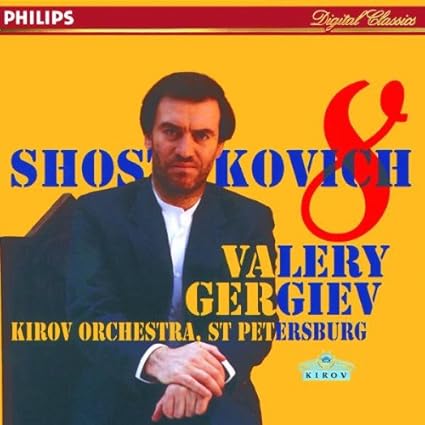
Symphony 8In System III, I also played CD's through the Sparkler 303 CDP. The sound is commensurate with the analog. I was totally enthralled with Gergiev's first Kirov recording of Shostakovich's 8th (Philips), which is both sonically and interpretively at least as good as the more current version (orchestra renamed Mariinsky, on its own label), and that says something. Highly recommended.

Afternoon chez Kevin
On a rainy afternoon I visited Kevin (previous visit here) and over a glass of wine listened to his many new acquisitions. Hidden from view in this pic are the turntables. His new 2-armed Lenco GL-75 now sports Andy's Decca tonearm fitted with a Shure M44-7, which he (like me, reported here) is very enthusiastic about; it certainly sounded more lively compared to the Rabco linear tracking arm fitted with a Pickering 380 (too heavy, I wonder...). In comparison, the VPI Prime turntable just sounds, eh, dull.

There is a new Chinese tube preamp (top of front rack), but I still preferred the Citation I. Driving a newly restored pair of McIntosh MC-30, the Altec A7 horns were lovely, but I think all that extraneous stuff in front center, especially the equipment rack, ate away at the sound a bit.

We talked about some projects. I'd like to loan him my Shure SC35C for comparison with the M44-7. Also, it is time to match my McIntosh C20, C22 and MX110 to the MC-30! As usual, watch this space!


The bulk of the article was written around 911, a day any New Yorker would never forget. 17 years ago, I was in a HK bar around 9 pm (12 hours from EST). All of a sudden, the TV flashed the extra, with footage of tower ablaze. The silence in the bar was eery.

We all harbor sentiments of disapproval and disdain, but it is a long way to pulverizing hatred that destroys the life of others as well as self-destructs. In face of so much misery in the world, we all shall be more grateful for our existence. Peace.

20 June, 2018

Sparkler S306 DAC, RELStrata III for Quad ESL-2812, TAD TD-3401

TAD TD-3401, Part III: with Full Wavac System
The Amazing Sparkler S306 DAC, Part III: 
Sparkler S306 vs 47 Labs Shigaraki
Subwoofer for Quad 2812
Talk CAS: Cheapo Bluetooth Device vs. Meridian Explorer
Talk CAS: Tidal, Youtube, Radio Garden

The better half of this article comprise further reports on TAD TD-3401 and Sparkler S306 DAC. However, I also tie up some loose ends here.

TAD TD-3401, Part III: with Full Wavac System
On Sunday I re-visited Sang to spend more time with the TAD-TD-3401. This is basically a brief report that is the continuation of the last report (Part II) below (or here). On this day we tested out the full Wavac system by using the Wavac PR-X2 preamp in lieu of the Verdier Control B. The sound, as expected, was crisper than using the Control B. The piano sound was just awesome.

On this day (after much begging and cajoling) my taskmaster icefox finally agreed to come to listen again to my current systems. I was just about to leave Sang's place when icefox arrived in Yuen Long earlier than expected, and I asked him to join us at Sang's place. icefox was impressed by the performance, and harbored the same opinion that the 3401 is superior to the 2401/2402.

Regarding the Wavac, icefox still wished that it could be a tad cooler and thought the piano a little too clanging. For me, it was the opposite. More than most audiophiles, I am very particular about the leading edge, and have always thought the Wavac to be better on this front. However, since the TAD TD-3401 is a faster and more precise transducer than the Tannoy Canterbury, the resultant sound could sometimes be a little sharp. It is a small price I am willing to pay (especially since we get more details with the Wavac) but I can totally understand the other camp. So we were all consistent in our preferences.

Very soon, To Sir and then Mila joined us too. To Sir has a self-assembled big TAD System (which I have never heard) and is obviously a TAD expert. Both he and Mila were delighted with the 3401.

Now we go back a day or two...

Top Shelf: Note Sparkler S306 under 47 Labs Shigaraki DAC, behind Shigaraki Transport.

This is my third write-up of the Sparkler S306 DAC. For basic info please read Part I, where the Weiss Minerva proved utterly inept in its face. In Part II, the S306 went head to head with NOS AMC without shaming itself.

Sparkler S306 DAC
As mentioned in the links, ever since I bought it, I have used my S306 (serial Number 2) exclusively in my Yamaha NS-1000 system. Just could not bear removing it. Yesterday, however, with a little extra time on my hand, I decided to implement it in my Kondo system (pic above):

Transport: 47 Labs Shigaraki (Belden 1694)
DACs: 47 Labs Shigaraki vs Sparkler S306 (Gotham DGS-1 and 2111)
Preamp: Audio Note (original; Japan) M7
Amp: Kondo Ongaku
Loudspeakers: TAD TSM-2201
Subwoofer: JBL 12" paper cone 

Just one recording for illustration shall suffice. In the EMI (Warner) Oistrakh box is a performance of Schubert's Piano Trio No. 1 (with his long-term partners Oborin and Knushsevitsky). This 1958 recording is good but not exceptional in sound. In fact, with the 47 Labs Shigaraki DAC, in this Kondo system there was some harshness in the upper midrange, particularly with the Gotham 2111.

I was dumbfounded when I swapped in the Sparkler. It is very hard to describe the tonal differences, but the bit of hardness is gone with the S306, despite its being obviously more airy in the treble and elsewhere a little leaner than the Shigaraki. What is easier to describe is the utterly sinuous quality of the Sparkler. While the 47 Labs delivered a musical performance, with the Sparkler it is at another level: there is more resolution; the leading edge is sharper; the three instruments are more separated and easier heard; Oistrakh's playing is more sinuous and the cellist more mellifluous. The whole performance sparkled (pun intended) with an utterly disarming rhythm and pace.

This is not the first time Sparkler astounded me in its grab of musical intent. I have not reported this before, but in my Yamaha system, I once played the Andris Nelsons recording of Shostakovich 10th (DG) and felt something amiss: there was a brooding and threatening atmosphere that went missing (compared to my first hearing the CD in the same system). I checked and, lo and behold, the DAC was not connected and it was the Sony Blu-ray player's analogue section I was hearing. Now, as I reported in Part I, the Sony is no slouch, but it just did not deliver the charged atmosphere the way Sparkler could.

And so, despite the use of its matching transport, the 47 Labs Shigaraki DAC was displaced by the Sparkler S306 in the Kondo system.

The 47 Labs Shigaraki continues to serve in the system below as the DAC for the Sony DVP-PR50P, and it improved upon the Arcam rDAC and Sony's own analogue output.

Time Out: World Cup
After playing the imitable Celibidache's Brahms Symphonies, it was time for some food. Once again I opted for 肥姐 蠔餅 (Fat Lady's Oyster Omelette) which I wrote about last time. This time a plain red went well too with the dish.

On this day it was Germany vs Mexico; the latter's quick and precise counter-strikes were really impressive. In a way, Germany played like a bad DAC - no finesse; whereas Mexico was like the Sparkler, microdynamically alert,with tensile strength, exceptional leading edge, PRaT.

Time Out: Subwoofer (REL Strata III) for the Quad ESL-2812
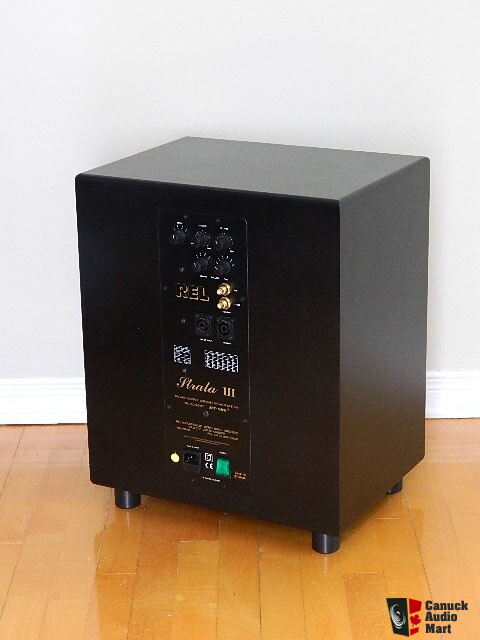
As you know, the Quad ESL crowd is a special breed. They swear by their ESL and are in general very reluctant to add a subwoofer. So, I am proud to say that after listening to my 47 Labs 4737 augmented by subwoofer (here) both Quad ESL-2812 owners WSS (whose system was last reported here) and JL were persuaded to give it a try. They lugged my down-firing REL Strata III from icefox's cavernous place (he used it to augment his Tannoy) to WSS's small den.

REL STRATA III Subwoofer, Black, Mint Condition!The REL Strata III was an old product, but one of the more expensive offerings. It was generally very well received at the time and you can find quite a bit of info on the internet (pic borrowed from canuckaudiomart).

The afternoon I was there, with the low-level input we tried crossing over from 69 Hz to 95Hz. All worked quite well. The volume is indented. We started with 3 small clicks, but eventually went down to just one click. If you touch the woofer unit, it was barely vibrating. This very small bass augmentation however had the eminently audible effect of improving upon the liveliness of the presentation. The ESL always been too polite for me. It is good for a few instruments, but when the orchestra comes in, it is always underwhelming. The subwoofer improves upon this most important aspect. The effect of the subwoofer here is a bit different from what I get with my own systems - with the ESL one picks up the gain in presence more than bass extension. I am not sure whether that is due to the ESL or this REL. The important thing is, used judiciously, it is definitely a plus for the Quad ESL-2812, though I think other subwoofers may be worth trying too.

Back to the icefox crowd.


Click pic to enlarge. The black Bluetooth Device next to the Meridian Explorer.


The Bluetooth Crowd and the Generic Cable
Back to the icefox crowd. They spent a few hours in Yuen Long, but the program didn't exactly unfold the way I had wanted it to. After two hours with 15" woofers, I am sure anything else is an anti-climax. It would have been better the other way around. :-) Nonetheless, I don't think the sound at my place disappointed them unduly.

This is also the Bluetooth Crowd. Many of them use Tidal Streaming through their Cellphones. Arranged in advance, icefox brought his el cheapo Bluetooth device (from Taobao, less than USD 50; the black thing). Despite its small size, I think it has the latest technology. We connected it to the Kondo M7 with icefox's generic RCA cable, and the sound was quite acceptable, better with some cuts than others. icefox also played some youtube, which to my ear sounds even better. We then did some brief comparisons.

Tidal (Cellphone) vs Macbook Pro My Macbook Pro is very basic, unadulterated iTunes (no "mandatory" Amarra) playing lossless AIFF files. Through Bluetooth, the Macbook has a warmer and more detailed sound.

Meridian Explorer (USB) vs Bluetooth We then played my Macbook AIFF files through Bluetooth and also through USB (my favorite Unitek) connected to the Meridian Explorer. The USB connection is again warmer and more detailed. It better be, as I actually hold the Meridian Explorer in high regard (here). Actually, from memory I also think the sound through the wireless dongle of my Arcam rDAC is better than the Bluetooth.

Image result for Radio gardenInternet Radio Through my Macbook icefox also played his favorite Italian Radio Emiglio Romagna, but not through the official site, instead using Radio Garden. I can attest it was very good and the programming of much baroque music was to my liking. I also like the fun way one navigates in Radio Garden. Give it a try!

Belden 8451 vs Generic Cable We then compared the two 1/4" to RCA cables. My go-to 1/4" to RCA cable, which I use with my Meridian Explorer and Fiio X-1, is a DIY one is made from Belden 8451 (info) with Amphenol connectors. The sound was at once more controlled and detailed, but the crowd pointed out correctly that it was also a little tighter than the generic one.

For a while, there has been a little bit of a phenomenon going on with those around icefox (that means a lot of people). People give generic cables (some from Apliu Street) serious tries and devote much time to comparison, just like, e.g., one would compare Audioquest with Kimber. In general, these are pragmatic people who rightly eschew expensive cables. Many also use cables of vintage origins (WE or not). Many of these people own expensive systems (such as the two WE systems recently featured).

I don't have any problems with this. However, from the vantage point of a professional cable user, I do think one can achieve just as much, and more, playing around with professional cables and other things. Take an example, at our WE/Altec 604 friend Vincent's home, I didn't report it, but we did compare my DGS-1 with his favorite generic cable. To me, the DGS-1 was just more nuanced and had more finesse (I gave him a pair). Similarly, while the generic cable that came with my Thorens TD-309 was surprisingly good, it was surpassed by Gotham cable. Note too these about generic cables: 1) they vary greatly in quality; the ones that come with your USB devices, TVs, TV boxes etc are usually not too good; 2) they are usually smoother, less dynamic and extended at the frequency extremes, which I'd venture is why some audiophiles use them, but imho this is more of like patch-up works on flawed systems.

Nonetheless, the exercise with the Bluetooth device was highly entertaining and downright fun! How often can you say that about audio? As CAS is just peripheral to me, I can entirely see the point of doing things on the cheap, and the quality was pretty good! BTW, like me, icefox thinks usually the expensive, complicated, technical and "serious" CAS systems sound terrible. YMMV.

12 June, 2018

TAD TD-3401 and That Certain Atmosphere Verdier Wavac Tannoy


One Glorious Day!

Review: Pioneer/Exclusive/TAD TD-3401, Part II
My TAD TD-3401 Finds a New Home

TAD TD-3401, Part I

Audio Personalities There are many types, and in my experience the personality governs the outlook on audio.

There are those who never waver in their beliefs (no matter how unfounded), like "never tube" or "never solid state" (Religious Fanatics); those who anally/constantly tweak their systems and proclaim incremental improvements every time (Sales); those who believe in A/B'ing the smallest things yet fail to look at the big picture, like the obsessive cable swapper, or those vintage gear tube rollers prevalent in HK (Anal Retentive, + Religious Fanatics); and so on. In the end, these are people who know too little about music and overly confident in their own hearing ability.

And then there are the masochists, who for some reason struggle with what they suspect are no good. My friend/taskmaster icefox has long assigned me to this category. But he is wrong - I have consistently transformed what others (even I) have lost faith in. There are no better examples than my journey with Tannoy, perhaps even TAD. I know I am seemingly drifting off but the following bits have bearings on the evaluation of the TAD at hand.

Tannoy For the longest time I was really lukewarm towards Tannoy. Having already heard some really good horn systems in NYC before I came back to HK I was not at all impressed by the HK Tannoy scene, populated by "the older the better" and "only vintage need apply" types who believe in the pecking order Silver > Red > Gold (Black is too rare; and HPD and modern stuff need not apply). Oh, I heard all of these, many times - many times too many. I heard largely execrable sound from these people's Silver's and Red's - honestly, I don't have a clue what they listen to. On the other hand, some of the Gold's were semi-decent, or at least showed potential. To test it out myself, I bought a pair of Lancaster (12" Gold") and quickly got pretty good sound out of it (with the help of Aurum Cantus super-tweeters; this is >15 years ago). Of course, it is still a little slow in transients, but much better than older Red's and Silver's. A few years later (> 10 years ago, before I started this Blog) my friend Andy L sold me his pair of Canterbury HE when he switched to the TAD TD-3401 (see below), and I sold the Lancaster's to my friend whlee, who still uses them.

Interestingly, I never have really directly written much about my own Canterbury's, rather spilling perhaps too much ink on others'. During the time Andy had it, he only got fair sound out of them (in a smaller room with DIY 300B). I took them up likely because it was a challenge, not because I really clamored after them. I was after all very happy with my Klipsch La Scala's then and, having to make room for the Tannoy's I was really sorry to see one pair of my La Scala's go. When I first got the Canterbury's, the sound was rather terrible and grey and it took quite a long time to open up (my take is that the hard edge needs a lot of running-in). Masochist triumphed in the end! In the coming year, I should write more about Tannoy's - my own experiences!

TAD As for TAD, the scenario was hardly as dramatic. However, it was true that for the longest time I was not impressed by the very expensive large TAD's I have heard in HK (mostly 2401/2402) and never thought about them, until I heard the TD-3401, as documented here. Now, that is what horns are supposed to sound like! When Andy moved on to DIY TAD systems and other stuff, I grabbed the chance to acquire the TD-3401, and it was bingo from the word go in my place (see Part I). There is also a bit more of TD-3401 listening notes here.

My TD-3401 Finds a New Home
Due to family circumstances I am letting go of quite a bit of my stuff, so on this past Sunday I officially passed the TD-3401 over to my friend Sang, whom you have encountered many times before in this Blog. Sang is a bold soul, as he has never heard them before!

Tight Corners It took a while for the two of us to maneuver each >70 kg beast down the narrow flight of stairs, and Sang's wife Carmen helped a lot too. Basically, what I did was protect the loudspeaker with carton paperboard (from large TV box) which were affixed by a Ratchet Tie Down (飛機帶). We let the loudspeaker slid down slowly the stairs as we prop it up from below. Meanwhile Carmen was pulling on the Tie Down from above, lessening the pressure on us a little. 

We also took my Wavac gears (PR-X2 preamp and MD-300B amp) along for some fun.

Equipment (click pics to enlarge):

CD Transport: Softone/ICL Model 2
DAC: Audio Note UK DAC-2 (old version; PCM-63)
Turntable: Technics SP-10/Audio Technica Arm/Denon DL-103
Preamp: JC Verdier Control B
Amp 1: JC Verdier 300B
Amp 2: Wavac MD-300B 

Click to enlarge. The right lower corner (sofa not seen) is actually the best listening position here.

Sonic Notes

  • Placement These were placed where the Verity Audio Rienzi were previously (left pic, before; top pic, now), and they blended right in with Carmen's bookcases (though partially blocking them). Mind you, this placement is not ideal for such large loudspeakers, but they will have to do for the moment.
  • Tweeter Positions At my larger old place I had the tweeters on the outside, and so we tried it out first this way. Somehow closer together in this smaller place the sound didn't quite gel and so we switched the loudspeakers. With the tweeters on the inside things became well focused.
  • Grills Though the grills were actually quite transparent, perhaps they did soften the treble a little (which can be good). However, we all agreed that these loudspeakers look stunningly beautiful without the grills, so they were left off.
    Atmisterkellys.jpg
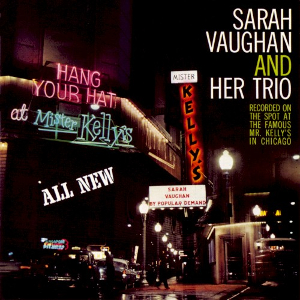
  • vs Verity Audio Rienzi When placed in similar fashion, previously the sound of the Rienzi was actually very good and earned my complete approval. The Rienzi is taller and, being augmented bookshelf type, threw an airy soundstage, but the images, as is usually the wont, are on the small side. Everything is Fleshier and has More Atmosphere It took seconds to tell that Everything is more Flesh and Blood with the TAD's. With jazz, there was no contest, no matter it was Miles' Kind of Blue (Sony) or Sarah Vaughn's Live at Mister Kelly's (EmArcy). For the latter, Carmen remarked that it was like being in the (smoky) club. Mind you, this CD is also the one that got my shidi hooked on the TAD's (see previous links; I urge you to get this CD). Classicals too benefited from the added weight. The opening of Tchaikovsky's Manfred (LPO/Rostropovich, Warner) had Sang shaking his head in disbelief - mine too, the brooding atmosphere was just absolutely compelling! Tonally Similar (Neutral) Sang remarked that the small Rienzi and the large TD-3401 actually have very similar tonal quality and balance. I agree and, as the TAD is of monitor origin, this attests to the neutrality of the Verity Audio.
    Image result for michael rabin magic bow
  • Air, Soundstage and Height The TAD is shorter and has a much wider baffle and this can lead many people who are used to bookshelf types to not "visualize" well. Also, the horn midrange and large woofer produce so much energy that some may think there is not so much air on top. Yet that cannot be further from the truth. What we perceive as "atmosphere" is in fact these energies converging to make sense of the recording. I personally felt nothing much lacking but, as mentioned in Part I before, if possible I'd raise the loudspeakers to ear level. Lacking stands we tilted the front a little (employing past issues of National Geographic) and that lifted the images a little. Make no mistake, it was still excellent, not like the pitiably low images produced by the Quad ESL 57 in smaller spaces. Sang subsequently reported that he got even better results from sitting on the floor. Ha! Raise them!
  • CD vs LP Commendably, in this setup, digital and analogue have very similar balance and hence near-parity, which is what I always advocate. However, with digital replay, some passages could be just a tad (no punt intended) sharp, a character of the TAD (these monitors were used in the analogue era); whereas with analogue this was not a problem. Michael Rabin's The Magic Bow (re-issue LP) was very finely rendered; so was a favorite Musica Antiqua Koln Bach LP (Archive), which compared with before was just juicier (if such a term can be used for this ensemble). Delightful!
  • DAC-2 Comes Full Circle Sang recently bought the AN DAC-2. As this old BB PCM-63P version is very rare and I haven't seen any other unit beside the unit I used to own I took a very close look. Holy! It is my old unit (treated in detail here), re-sold to Sang! Now, that must be Audio Karma!
  • Wavac vs Verdier We briefly switched to the Wavac MD-300B (still using the Verdier Control B preamp). This combination is one I have never tried before, and it was quite winning. The result was largely similar to what had been carefully compared before (here, with no less a roster than icefox and Carmen's brother Danz!). We did not try the PR-X2 preamp this time. One thing of note: the Verdier now sports Shuguang 300B whereas the Wavac uses Russian tubes; if you ask me, swapping them might yield interesting results (as the Chinese is more ying; and the Russian more yang.) More to follow.
Conclusions
  • TD-3401 No question about it, A Masterpiece! Here in a relatively small enclosure and with a small horn one gets a full blown horn sound, something that very few horn loudspeakers can achieve (one exception may be the JBL L-300). The excellence in air, dispersion and presence is once again confirmed. In fact, aside from the constraint of the smaller space, in some way its performance in Sang's home is even better than at my old place, as I had never really had much time to it.
  • vs Tannoy Canterbury HE Head to head with the Tannoy it is a toss up. In use, the Canterbury is richer, more forgiving, even more efficient and, due to its larger volume, more powerful and extended in the bass. Although the Canterbury is a modernized Tannoy, the older TAD sports a house sound of even faster transient and its portrayal of the leading edge is even cleaner and superior.
  • That Precious Atmosphere One problem with most modern loudspeakers is the lack of atmosphere. No matter how good the soundstage and imaging are, no matter how balanced they sound (if that), they do not render atmosphere well. I have often pondered why. My take is you need the combination of horn drivers and large woofers to reproduce atmosphere. We have recently marveled at the atmosphere conveyed by our friend Eric's epic horn system. But in this relatively confined space I was surprised that the TAD was able to convey some of that atmosphere (with jazz, that is a given; but with classicals that is impressive) - along with high quality bass, this is the most precious thing in audio. Basically, when you have that, the system is already made. One can only further refine it. Salut!

23 October, 2011

The Yumcha Diaries 飲茶後記: 24-10-11 Tannoy Wavac

Click pic to enlarge; note new Wavac monoblocks on top of cabinet

The Yumcha Diaries 飲茶後記: 24-10-11 Tannoy Wavac
Overview: Wavac Part III

I am severely backlogged!

We have heard so much in the past 2 months, but I am dragging my reporter feet. One of the reason is the beautiful weather lately, making me want to do other things than sitting in front of the computer. Another is my recent effort on cleaning up my house; it all started with Robin's rack, which he left for me. That called for creating space where there was none!

Of course, Tannoy gets priority, so this report jumps the queue. I shall try to tie up home visit loose ends later.

On this day, after yumcha, we re-visited Karma. First, congratulation for the successful back surgery! The household had not been idle; since the last visit, the living room had been completely re-arranged, and with sonic benefit!

One of the great things about Tannoy (and big horns like our friend JC's Avantgarde Trio) is room-filling music. You don't have to sit like an idiot (which is most audiophile) fixed in one spot. I sat off to one corner, stretched out my legs on the sofa, and enjoyed the music! At the new spot for the dining table, where we had tea, the sound was wholesome even with a pillar blocking the view (look at the pic in the previous visit report, where the clock was)! This is how a proper system should sound. Besides the re-arrangement, the other significant change is that Karma purchased the Wavac MD-805 monoblocks (perched on top of the cabinets)! We tried many things, but I shall only briefly touch upon some of them:

Wavac PR-T1 - XLR vs RCA input I brought my Musical Fidelity M1 DAC, which has an excellent balanced output. We compared the Wavac PR-T1 preamp's RCA input (using Gotham GAC-4) and XLR input (GAC-3). There is no question in my mind the balanced input is more composed. This is a more significant comparison than most, because the PR-T1 uses an input transformer for the XLR input. There is no bandwidth loss, attesting to the excellence of the input transformer.

Wavac PR-T1/MD-805 vs PR-X2/MD-300B I was glad finally I had the chance for a re-match of my much cheaper Wavac PR-X2/MD-300B combo vs the expensive PR-T1/MD-805. Last time when we compared them at Danz' place (report here), I appreciated the more expensive system's authority but had a nagging suspicion that the cheaper one has a bit more nuance. This time, I am sure. For sure, the big brother is more commanding, but I would say the younger one is a little lighter on foot, more on the fly, a little more spontaneous (at the expense of weight of course). At this point, Karma's Canterbury are new and harder to drive, but when he finally runs them in (which shall take at least months of heavy use) , I'd like to have yet another re-match. For myself, I shall happily continue my romance with my Wavac set. In my place, I don't quite need the extraneous power. However, I'd not mind to be able to upgrade to a higher Wavac 300B model at some point.

A wonderful afternoon, and I think Karma has found his partner for life in audio!

13 August, 2011

Tannoy Canterbury and Karma


Tannoy Canterbury and Karm
a कर्म
A few brief words before we dig into the meat. If you don't already realize, there is a recent spate of activities on the Tannoy Canterbury front that occurred almost synchronously and suddenly, leading me to ponder that it must be karma, that one action leads to another...

You see, for the longest time I only knew my pair of Canterbury HE (hard-edge). Then Danz contacted me through review33 and we got to meet and I got to know his older version (foam surround).

Then it was a long lull until the incredible recent flurries, 3 new pairs of the latest SE version (like HE, hard-edge) in as many months!!! (for details on the various versions, click here). In Chinese, now it is 三代同堂 and things are changing fast.

First, shadow-green got his pair. Things are moving fast for him. Since last visit, he has ditched his Goldmund amps and has just received delivery of not one but two amps from YS Audio, a 300B amp and a KT120 amp (pics here). Running in these is going to take some effort! I sure shall re-audition when SG is ready.

Literally, right on the heels of SG came abc2009, whom we also visited (click here) and who presumably now is running in his mint pair. A Fisher rematch looks to be on the horizon.

Life and Karma
And now let me introduce you to my old friend, moniker leben (German for Life). As readers may know, if possible I usually use people's monikers rather than real names in my writing. But for this article, for such a special name, for a special person, for celebration, I am going to use his real name, Karma.

Though we have not been in contact much, I have known Karma for almost two decades, from the days of my Yahoo Group Cheaptubeaudio. Hailing from the land (ex-Kingdom) of Sikkim, Karma is well-read, a professional (though to me he seems more a philosopher) and, most importantly, generous to a fault and a true gentleman. I think I can gleam Karma's spiritual side. His comfortable abode (below), his choice of moniker, even the name of his previous loudspeaker (Living Voice) all conveyed a spiritual dimension, life's force if you will.

Out of the blue, Karma started to renew contact with me through review33, and one day together with agentsmittie he came to my house for a brief audition of the Tannoy Canterbury. It was incredible how quickly he made the momentous decision to get a pair, and how quickly a new pair arrived from the UK! As they say, the rest is history.

Mise-en-scene: Cut to the Day Before
At Karma's request, on Friday, the day before yumcha and our visit to Karma, I organized a meeting at Danz' place to audition his latest effort (for equipment, see last visit). Thanks to Danz and his maid for providing us with a nutritious and healthy lunch (for pic of the delicious udon, click here).

The equipment has not changed, but Danz has been tuning his system for a better balance, mainly by REMOVING various power conditioning devices as well as swapping out various boutique cables for cheap professional cables like Gotham.

Danz' effort has paid dividend. As in the last visit, the system was quite awesome with audiophile discs, but this time classical playback improved significantly, though I'd have preferred still more elasticity and easy refinement. In Danz' case, it is almost the classic audiophile case of leaning towards all-roundness vs razor-sharp precision. There is no perfection in this world, and each has to choose his own destiny.

The Yumcha Diaries 飲茶後記: 13-08-11
Of course I could not pass up the chance to hear another pair! On this day, after yumcha, two carloads went to Saikung for a visit. Karma's house is tugged deep into the hill, surrounded by wild vegetation (and yes there are sometimes snakes). The inside of the house is simply, but nicely, organically and richly decorated and we felt instantly at ease and at home. Equipment:

CD player: Micromega Stage 4 and Denon DVD player
Preamp: Wavac PRT-1
Amp: Wavac MD-300B and Lavardin IT
Loudspeakers: Tannoy Canterbury

The Canterbury's are literally brand new, and not ideally placed (rather close together relative to listening distance), yet the sound was already quite promising. We experimented a little with toeing in, but the effect was not significant. More interesting was the effect of closing the ports (there are 2 adjustable ones in each speaker); we unanimously preferred them open.

IMHO, as happened many times before, removing the wooden tuning devices under the preamp was highly beneficial. Equally significant for me was replacing the rigid and thick boutique power cords with more humble generic ones. All these moves livened up the sound.

We also briefly tried out the Lavardin (used as an amp). Everybody preferred the 300B amp for its openness and liveliness. I was disappointed, and intrigued by the under-performance of the Lavardin IT (as it has a rather famous audiophile reputation). I'd not mind borrowing it from Karma and play with it, to see better for myself what all the fuss is about. But I do have to say I have never heard Tannoy fare better with solid state.

I'd like to thank Karma's graceful wife Jennifer and her maid for laying out a full table of snacks for afternoon tea. Tea from Sikkim tasted good, rather like a Darjeeling.

With acquisition of the Canterbury, I reckon Karma is in a new state of flux. I could only say to him, "take your time".

One thing is for certain, for almost everyone, the approach to sound before acquisition of Canterbury had to be drastically revised afterwards. Almost without exception, in my experience of Tannoy visits, fancy interconnects, tuning devices, power cords, power treatment etc all had to be ditched. Which goes to prove, for the Tannoy heavyweights (as for most else), simple is best. I think our friend JCR33 said as much before about his own experience.

Back to karma, the concept is more sophisticated than any translation can convey. It is not simply fate; the Chinese term 因緣 (不是姻緣) is much closer. Should you be interested in karma, the wikipedia entry is a start. All I can say is, our collective actions and beliefs in the modern Tannoys Prestige loudspeakers (I include the awesome Westminster in this) are bearing fruit and enhancing our lives.
Link

22 July, 2011

Overview: Wavac Part II - PR-T1 MD-805 MD-811

click on pic to enlarge

Overview: Wavac Part II
Review: Wavac PR-T1, MD-805 and MD-811

Wavac Overview Part I

Belatedly, here is Part II of my Wavac experience. To pick up where we left off in Part I, after Danz heard my Wavac combo, he decided to acquire a set. I loaned him my set but he continued to source for Wavac on the internet. In a surprisingly short time, Danz made the decision to go for the higher models. The MD-805 monoblocks were sourced from the UK and these arrived in HK while I was in NYC. Then Danz found a set of PR-T1 in New Jersey. Not quite knowing how impossibly heavy these are I volunteered to take these back for him so he can save on the considerable delivery charges. So the seller dropped them off in NYC and I was surprised (to say the least) by the very heavy weight (69 lbs) of the 3-piece PR-T1. However, the compensation was that I got to play with this beauty for more than 1 month in NYC before I got back.

clcik on pic to enlarge

Work of Art: PR-T1

In contrast to my more humble PR-X2, you can actually find some user comments and even review for this flagship preamp (enjoythemusic). Most certainly a work of art, aesthetically I'd say it is likely the most beautiful preamp I have seen.

I did not open up the power supply, only the main chassis. Although both use 2x 12AU7 per channel, If you compare it to the innards of the PR-X2 (in Part I) you shall notice that while the amplification circuit boards are quite similar the PR-T1 is distinguished by: 1) the presence of 2 large output transformers; 2) presence of 4 input transformers; and 3) a high-precision stepped volume pot. With all these transformers, the PR-T1 easily provides balanced XLR inputs and output, in addition to the RCA provisions.

In my month with the PR-T1 I used only the RCA output. As for inputs I used mostly RCA but I did try out the XLR in with my AQVOX phonoamp (reviewed here). As with my PR-X2, this is a high-gain design (favored by SET amp designers) and the gain pots proved useful in attenuation, although in this case of stepped resistor volume pot non-linearity at low volume settings is not a concern. The sound was wonderful with almost everything I threw at it: phenomenally detailed, with great presence and dynamics, a dark background and great tonal allure. There was not even a hint of frequency roll-off at extremes (that can plague designs using lesser transformers). This is one in the top echelon.

Odd man out: MD-811
Before proceeding to the magnificent MD-805 monoblocks, let me take a detour. I feel almost guilty, but for the sake of narrating my experience with Wavac, this has to be.

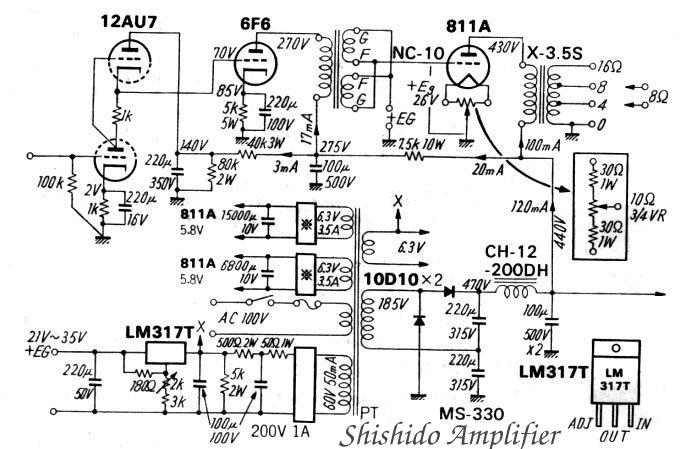
This discontinued MD-811 was relatively affordable ($4000) a decade back, and there were quite a few useful reviews (enjoythemusic; positive-feedback; and most unlikely HomeTheaterReview). 811(A) is a transmitting tube, cheap and readily available. But the design of Wavac was certainly not compromised. Despite its relatively low cost, it is largely of the similar design as the current MD-300B, employing the company's trademark interstage transformers. The following circuit is likely an earlier one, using 6F6 rather than the later 6Y6, but you get the idea:


By chance I spotted one on Audiogon while I was in NYC, and took delivery from a very nice gentleman before arrival of the PR-T1. The unit was in very good shape, and came with extra valves. Basically, aside from the power tube, it uses the same tubes as the MD-300B, a pair of 12AU7 and a pair of 6Y6.

Turning on the amp there was a sense of deja-vu. Its very quietness mirrors the 300B based amp, and it ran for long periods with stability. But it was also immediately apparent that the tonal balance is significantly different. Although the MD-811 has a beautifully refined treble, the MD-300B amp seemingly has more air on top. I was not sure whether there was some loss of detail compared with 300B (few tubes can match up in this regard) but after extended listening I think it is just apparently so. The MD-811 has excellent detail retrieval, but its much fuller bass, of the character that Dick Olsher (a very good reviewer usually) wrote about in enjoythemusic (see above link) tilts the tonal balance to make the treble seem a trifle subdued. .

As rolling tubes did not change much the character of the amp, loudspeaker and ancillary matching became more of a concern. My YL horns have 15" woofers and a full bass. I did not have my MD-300B on hand, but when I switched in my Elekit 8300 300B amp the bass was more controlled.

Herein lies the surprise: contrary to usual expectations, the MD-811 did not match well with the PR-T1. Admittedly, one is a flagship product and the other entry level; still, one would expect more synergy from the same company, such as I experienced with the PR-X2/MD-300B combo. With the PR-T1 switched in, bass was most certainly over-ripe. The MD-811 matched better with a leaner preamp, such as Elekit's TU-875. There, you see, because of this I was a little uncertain of the nature of the PR-T1 until I came back to HK.

Enter the Dragon: MD-805
One day, after yumcha, JCR33 and I went to hear Danz' setup, a little stressful for me, and you shall see why.

We only used Danz' MD-805B monoblocks, but started the session with MY PR-X2 preamp. I was instantly amazed by the physical beauty and awesomely clean power of the MD-805. Basically it held the Tannoy Canterbury in a visor-like grip and would not let go. To make a comparison, subjectively I think it is quite a bit more powerful than the Unison Research Smart 845, Airtight 211 and Kondo Ongaku I have heard. I doubt with even less than 90 db loudspeakers they shall be found wanting.

Switching in the PR-T1 was a humbling experience. Immediately everything became more fleshed out and smoother at the edges. At Danz' place, clearly the PR-X2 was leaner and even a little edgy, something not apparent at my place. As a whole, the sweeping power and commanding authority of the PR-T1/MD-805 combo was unassailable, so much so that the picky Kondo guru JCR33 nodded in approval. I can only console myself with the thought that in terms of detail, treble air and bass contour the more expensive setup (newly installed) has perhaps not necessarily yet (for my taste) completely over-taken my similar Wavac setup, which has been in place for much longer. With time, I look forward to the time when this system completely trounces mine.