Click pics to enlarge. Micromega Stage 2 to left of Yamamoto CA-04L.
Review: Micromega Stage 2
Overview: Micromega, Pinnacle of Bitstream
This article is about Re-Discovering an Old Love, or rather Sibling of one (it happens). Our memories (not just of audio) are both surprisingly reliable and unreliable at the same time.
My Digital Journey really started with the Bitstream era. Simultaneously in Hong Kong I was exposed to all the 14- and 16-bit classics, which immeasurably broadened my horizon. In HK I have owned the majority of the Bitstream Micromega, so this article will start with the Stage 2 player, which will be followed by an Overview of Bitstream and Micromega. My own audio journey is tightly coupled with my digital exploration; if interested, please read my last article.
The Concept Series, to which the Stage series belongs, are all housed in the same box. Here we will deal only with the CDP's. The rest will be treated in the Overview Section.
Recently, I chanced upon a Stage 2 at reasonable price. The owner had re-greased it (this is of vital importance and will be discussed later too in the Overview). Given my fond recollection of my old Stage 1 in HK, I decided to purchase it. It works flawlessly.
For the difference between the Stage players, I translated the included manual, which was only in French (owner had been in Europe).
Stage 1: it is the youngest of the range and yet stage 1 benefits from all the technological achievements of Micromega. It allows itself for a product of this level to be built with the same care as its elders, with the same type of components such as 1% film resistors, polypoprylene or polycarbonate capacitors and the latest models of "Bitstream" circuits, The result is felt from the first minutes of listening with a sound that combines accuracy of timbres and dynamics without forgetting the legendary transparency on which Micromega has built a reputation that many envy him.
Stage 2: thanks to an analog-to-digital conversion using differential time alignment mode, Stage 2 takes a new step in sound reproduction which, while preserving the qualities acquired on the previous model, goes much further in the low register with increased dynamics.
Stage 3: This is the player integrated at the top of the range and Micromega wanted to make it a figurehead.The analog section receives two specific transformers allowing to overcome the problems due to the interaction between the digital and analog sections and to go even further in the search for the primordial micro-information in the perception of the emotions of the performers.
All of these employ the Philips TDA-1305 1-bit chip. The 1 uses just one, The 2 uses two, and the 3 adds more power supply. The TDA-1305 has a very good reputation. Some regard the TDA-1305 as a cheap implementation and it was indeed used in quite a few budget CDP and DAC (like Cambridge). Nonetheless, Micromega's implementation was brilliant and, from transformers (Schaffner) to caps (Wima and Philips), Micromega used good parts. Google Images and you shall see.
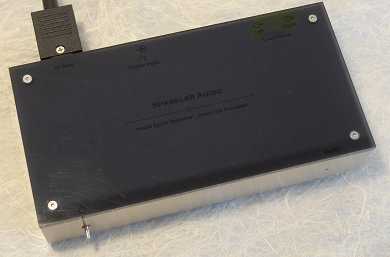
 I am not going to spend too much time describing the sound. Right off the bat, even from memory it is obvious to me it trumps the Stage 1 in every parameter. Surely 20+ years on I must have gained a little setup skill yet this simple system is not that different from what I used then. I mentioned in my detailed Review of Yamamoto CA-04 that a good bit of the excellent sound in CD replay should be credited to the Stage 2. I also did briefly compared the Micromega to the Sparkler S303 CDP (NOS). I also used the digital out of the Stage 2 with the Micromega MyDac (AD1835 chip) and Sparkler S306 NOS DAC. In the case of MyDac, there is little question I prefer the 1-bit Stage 2. In the case of Sparkler, the Stage 2 also proves to be as good in PRaT (!) and is simply sweeter in the treble. It is the highest accolade for me to say the Stage 2 is as good as the Sparklers! Or: I am in love with the Stage 2.
I also tested briefly the headphone output. As soon as headphone is inserted, the display above changes. As you see from the pic, a "4" replaces the "2". No, it has not become a Stage 4, as that is now the volume indication. Sound? Surprisingly excellent! Crisp and involving.
Overview: Bitstream
As chronicled in my last article, bitstream, particularly at the cheap end, can be thoroughly uninviting. This is unlike the 16-bit era, where the cheap TDA-1543 NOS players sound thoroughly enticing to some of us now (they were completely ignored by the audio press). For those who want some history of DAC chips, see DutchAudioClassics (rather incomplete).
Even with mid-priced and high-end bitstream, truly outstanding products are few. Usually, bitstream is quite smooth, and some would call it musical. But usually, the last bit of detail is not there, and hall sound and bass definition is not as good as multi-bit designs. Also, few truly distinguish themselves in PRaT. Here are some famous and not so famous ones.
Philips The most beloved of their bitstream is probably the well-built 850 Mk II (SAA7350; and Mk I and 840 [SAA7321]). Many units are still working. I find it reasonably musical but lacking in some detail; many others find the same, and employ it as Transport (in this role it is above average, but still not the best). Its successor, the less solidly built 950 (SAA7350; and its cheaper siblings 930 [7350] and 920 [7341]) can be written off. Better sound can be found in the higher priced and better built statement LHH series. I have heard the LHH-200R, but it is definitely nothing special compared to the LHH-300R that I owned (very sweet and solid sound). I have not heard the even more expensive ones in the series. Earlier ones used the SAA7321; later ones, usually with an "R", used the famed TDA-1547.
Marantz The first Marantz that I heard was the excellent CD72 Mk II (TDA-1547; Mk I SAA7350). It was ubiquitous and always made a musical sound, preferable to Philips I thought. I still own the predecessor, CD62 (SAA7350) which is excellent. Later I owned and heard many of the wildly popular CD63 (including Mk II, SE and KI; SM5872) but they are not as good as the better built 62/72. I have heard the more upmarket CD10 and CD16 (TDA1547) many times but somehow they never impressed me. Neither did the CD17 (TDA1547) which I briefly owned. My thinking is the CDM12 machines, like the CD63 and CD17, have a lighter sound.
Studer The D730 (TDA-1547) is excellent and highly desirable, but I prefer the A730 (16-bit).
DPA (Deltec) Now, this gets interesting. I owned the 2-box DPM 1.3 (TDA1547). Designer was Robert Watts, now of Chord fame. There was a lot of then-cutting edge design, including re-clocking. 4 toslink connect the 2 units. If not for Micromega, this would get honorable mention. It was quite detailed and musical enough but, ultimately, a little too literal (as is always the case with Chord). I have also heard the lower-end Little Bit (SAA7350), which was quite nice and sweet!
Meridian 203 This used the SAA7321. Musical but kind of veiled and lacking in detail.
Pioneer I owned briefly the PD-T05, pretty good but not as good as the T-07 (SAA7350), which however is still lacking in ultimate resolution or excitement. The Stable Platter is a classic though and many use them as transports.
Metronome This is another French company that specializes in digitals. Mine was an early 1-bit unit, the model name of which I have forgotten about. Its resolution was not the greatest but unusually it excelled in dynamics, which made classical music replay superb. BTW, this company is OEM for the digital products of Jadis.
Audio Alchemy DDE 1.0 (SAA7323) This budget bitstream DAC was a bestseller and fairly good, but I prefer its non-bitstream sibling DITB (AD1853). Audiolab 8000 DAC (TDA1547) Pretty good but not very dynamic. Cambridge Audio Dacmagic (TDA1305) A bargain but it is a little coarse and lacks the last degree of slam and heft. Museatex Bidat (TDA1547) and Melior (7350) I heard many times in second-hand shops. Musical but still lacking. Naim I owned briefly the CD3.5 (TDA1305). Quite good, but it was bested by the 16-bit CD3, not to mention the CDI and, my favorite, the CD2. Proton AC-422 (Dual 1-bit) I bought at Harvey's clearance for $100. Smooth and detailed but lacking in slam and rhythmic finesse.
There are many others that I have heard but forgotten about. Just as well.
Overview: Micromega
Although not founded by him, Micromega is basically Daniel Schar. For some interesting French audio lore, read the first few paragraphs of this article. First, the products that Micromega OEM'ed:
Leedh When I first got to HK, I actually saw the leedh CD players many times in second-hand shops, commanding princely sums. They look exactly like the higher end Micromega then, except they have gold instead of black facades. Haven't come across them in a long time, anywhere.
Goldmund Only the original Goldmund CDP was a re-branded Micromega. Later ones range from modified Japanese multiplayer to designs that look like Metronome.
Revox Micromega made at least all the electronics in the Elegance Series. Note the familiarity to the later Micromega Minium series. I once owned the S22/S25, and they sound no different from the Minium.
Now, the Micromega brand:
Digital Although Micromega make full systems, they make digitals best. There is no if's, and's or but's, Micromega Bitsream products represent the Pinnacle of Bitstream! They are even better than their later designs, which are no slouch.
CD F1 and 16-bit Era These all use the classic TDA-1541. The CD F1 series, integral players and transport, are rarely seen now, and coveted. The original bread loaf Duo DAC is 16-bit and I never managed to get one in HK somehow. I also had a Micromega badged Modifed Philips CDP but I forgot the name - it could be the Optic, but I think it is even earlier.
Modified Philips Bitsream CD Players The Leader and Logic (SAA7321). This happened very early on, as lower-end offerings. I have not heard them.
Solo, Duo, Trio These represent Micromega at their best. They span the time of the classic Philips swing arm mechanisms, from CDM1 to CDM3 to CDM9/9 Pro. They are all top-loading players with a puck that is attached to a CD sized disc (there is knot pattern that looks somewhat like kevlar, surely for damping). The Solo is obviously a one box player. Earlier ones have a slanted front (I still have one). The sound is musical. The Duo obviously comprise a Transport and a DAC. There are several iterations. The Transport is named Duo CD, with later 2.1 and 3.1 (the original has either CDM3 or CDM9 Pro; the 2.1 CDM9 Pro; the cheaper 3.1 CDM9). The cheaper Duo DAC is a slim bread loaf (The BS and BS2, using SAA7321; I still own the latter) This sweet DAC is probably no better than the one in the Solo and can be improved (like others) by adding a anti-jitter device. But the Duo Pro DAC is another story. It is designed to be placed underneath the Transport (which has spike feet). I still have the Duo CD 3.1/Duo Pro combo. The sound is a big step up from Solo. Much higher resolution and dynamics. It also has balanced out. The Trio adds one more box of re-clocking/anti-jitter, and the sound is for sure the best Micromega has ever produced (still SAA7321). It has the most amazing dynamics, fantastic for classical replay. I used to have one but unwisely sold it to conserve space. Tip: 1) be careful with the heavy acrylic top lid, which can come banging down if improperly handled; 2) as with any top loaded machine, the disc initiates after the the lid comes down. Disable the mechanism and operate manually with the lid open; this will improve the airiness; removing the cover or box of an ordinary CDP will achieve the same result)
The Concept Series After Philips moved to CDM12, Micromega launched the Concept Series. all are housed in the same black box with blue display and red buttons (this is French red and blue, quite beautiful to my eyes; unfortunately our own red and blue are much more problematic). The first CDPs were the Stage 1, 2 and 3 (treated in the first part of this article in detail). The lasers often developed problems. Although there were other theories, I think it is fair to say we now know it is due to grease drying up. A proper cleaning and re-grease (with something like lithium grease) usually solves the problem. This problem was Philip's problem, and in this era many other CD players also suffer from the malaise. No matter, the problem basically capsized Micromega and it never recovered its scale before the plague. The problems were probably what led Golden String, then distributor, to dump them in big sales. I bought a Stage 1 and had to exchange a couple of times. One time I put in a disc, and the drawer suddenly opened and the disc came flying out with a spin (much like 007 Goldfinger, remember that hat?) It was the first time I heard the CDM12, and I was entranced by its openess. Mind you later I acquired my second-hand samples of Solo, Duo, Trio and I still held the Stage in esteem, which was why recently I bought the Stage 2. There is something unforgettable about it. My friend Hoi auditioned all three and bought the 2, saying the 3 was too hifi for him, but should a good and reasonably priced sample of the 3 (or 6) comes my way I shall grab it to complete my assessment. Stage 4, 5, 6 When the European Union made a rule that all machines must have an on-off switch, Micromega revised the Stage series (if you google pics the circuit boards are somewhat different from the corresponding 1, 2, 3) but the sound (and the problems) remain the same. Drive 1, 2 and DAC 1, 2 These separates are similar in design to the integrated players. I bought the Drive 1 and DAC 1 and the sound was certainly a cut above the Stage 1 alone, difference likely due to separate power supplies. The Concept Series was a Full System, and are here some of the other products. Tempo 1, 2 These are amplifiers. I owned the Tempo 1, which runs fairly warm. It is very sweet sounding but not quite powerful enough for loudspeakers like LS3/5A, but if you paired it with a more efficient loudspeaker like Audio Note UK AN-K, the sound is astonishingly good (I found out when I sold that as a set to a friend). There was also a tuner, but it was not cheap and I never got to hear it.
T Series Slightly earlier but overlapping with the Concept series was the T Series. T-Drive 1, 2 and T-DAC These are half-size components with are slightly more upmarket than the Stage series, with balanced input and outputs. I have never owned them but have borrowed them. Sound is similar to the Stage series.
Micro Series This mini-sized series predated the Concept series. It is also a full system (no tuner I think). I own a full set. Microdrive This small top-loader used the CDM9 and a small puck. Sound is excellent but as with many Philips servo of that era, some of the strokes of the display can go missing. Microdac This is a beautiful machine, the only one in the series with an acrylic top. Sound (SAA7321) is so sweet! I had two and sold one to my friend whlee. Our Toronto friend Joe (remember Quad system?) swears by it too! Variodac This is a DAC with Preamp function and extra inputs built in. Microamp This is the craziest one. It has the same size, but runs really hot, so there are two long and jarring heat sinks attached to the back. Stacking on it is not recommended. Sound? Surprisingly excellent and, unlike Tempo 1, it can drive LS3/5A to acceptable level! Considering this is before the time of space saving SM power supply, a super accomplished Mini Series!
Minium Series This is precursor series to their current products, after the debacle of the CDM12. The style harks right back to the Revox S Series. I have only heard the CDP, musical enough (the rarer TDA-1549). The sound is likely similar to the current products.
Aria and Classic Solo Much later Micromega made some half-hearted effort to revive the classic looks. The Aria was visually striking but expensive, but for the price CDM12 and AD1853 did not seem attractive. The Classic Solo was also a curious product. It looks very much like a Solo, but also uses the CDM12, though with the TDA 1547 chip, but its price, again was on the expensive side.
The Current Products For this I refer you to their webpage. The lineup hasn't changed in a LONG time. I have used the CD-10 and IA-60 (here) and they are quite decent and under-rated. Undoubtedly, the most striking direction of Micromega is the M series products, which take after Devialet (I wonder if they are OEM), but are significantly cheaper. I'd not mind a chance to hear the M-one in my system (I doubt I'll get it).
My Series I have to single out this series from the current lineup, as they offer compact form and great sound. In NYC I have the MyDAC, MyZic and MyGroov; in HK, the MyAmp. I have covered all of them in this blog. Incredible values!
I am sure I have forgotten something but, there, finally an Overview of one of my favorite companies.



 Posts
Posts