Cheaptubeaudio has had a long history of advocating reasonably priced but excellent tube gears, particularly Singled-Ended Triodes. This Blog however covers a lot more than SET, and is not exclusively tube-related. Cheaptubeaudio prioritizes coverage of unusual and rare gears, particularly vintage ones, on which little info can be found on the internet.
Letter from Hong Kong (20-2): Eric L pitches $7 generic Bluetooth Device against $125 name brand. Editor's Preface: This Second Article from Author Eric L is a delight. It starts with how he got into HiFi in a Hong Kong era that I had missed, but that would be familiar to many of my HK friends. And then he went into Critical Mode and the Result Surprised him! I absolutely relish his completely unbiased comparisons. At the End I'd like to say a few things in the Postcript. The above is another of Eric L's photos. How I started my HiFi Journey I started listening to music when I was a little kid of 6. I grew up with music from LPs, played through a Thorens Turntable and a Sansui SS Stereo Amp [Editor: HK in that era was not what it is now; that setup would be at least mid-fi]: Sound of Music, Beatles and Carpenters. For some reason, I also liked to play Beethoven's Symphony No. 5, even if I was not exactly a classical guy. When I grew older (still some 40 plus years ago) I started to hang around HiFi shops like Excel in Central, HK, a renowned stereo shop selling Linn Sondek , Naim (I'm still a fan of older Linn and Naim stuff), Mark Levinson and JBL 4343 etc [Editor: Excel is still around]. There was also Radio People, that carried B and W, KEF 105, Quad, Nakamichi cassette deck etc. Of coz, the salesmen knew exactly that I could not afford to buy even a screw off any of their products but they still had fun teasing me and occasionally would allow me to sneak behind the big spenders to listen to some of their exotic setups [Editor: how heart warming! Try that today!]! That would have definitely made my day and enabled me to boast to others; but wait, there's none like me at my age group to boast to...
My UnclesI'm lucky in a way that I have a few uncles who owned some really expensive and exotic equipment. One owned a full set of Cello (total 8 pieces): Performance Amps, Preamp , their crazily expensive equalizer and flagship Stradivarius speakers, plus dCS DACs. He would invite me to his place from time to time to "enlighten" me and my friends (I got company finally~). Of course, no matter the sound was good or not, or if I knew if it was good or bad, I would pay him back with generous eulogies and praise to secure a future invitation, hehe! Down the years, as I came to know a bit more about the meaning of good sound, I can safely say that his stereo system did have amazing dynamics and sound effects. Another uncle had a completely different approach and they both would laugh at each other's setup; this one was using a Philips CD100 connected to unnamed 845SET monoblocks driving a pair of Top Tannoy. Imperial Sound? Quite musical to my limited ears.
All through my journey, I kept asking what the best sounding system should sound like. I kept finding cheap ghettoblasters with poor HiFi attributes to be extremely musical despite exhibiting a lot of distortions. On the contrary, the more expensive the equipment, the better the soundstage, depth and slam, the more embarrassingly the lack in excitement and musicality! It is so hard to have HiFi attributes coexist with feet tapping musicality! One thing I truly look for is honesty of a system. After all, the sound coming out of it cannot be better than the actual recording or performance, be it live or a studio effort! Well, stereo equipment is not an art to me, it's more like a craft instead. It has to portray the essence of music such that one can effortlessly immerse in it. Back to HK Coming after the LP era, CD was hailed as the most convenient format that can replace cassette and analog. Since my Red Dog RCA LPs that I bought with my pocket money were all given away generously by my cousin (thanks a lot pal!), I sold my system in Canada (LP12/Ittok2/OrtofonMC20 Naim pre-power/ Linn Kan) before coming back to HK. I had to start from scratch again, yet another painful search for musical truth! After a long search for the absolute sound of my own, with limited financial capacity, and numerous failures, I finally came to realise what I'm looking for. Thanks to a few experienced veterans, in particular Dom (HK distributor of 47 Lab, Sparkler Audio, Mussette, TotalDac etc; he persosnally uses the Pitracer CDP and 47 Lab's top turntable and the extremely scarce Miyabi cartridge, among other exotic stuff), I settled down with Gaincard as my ultimate amp. With a mere 25Wpc, it fits the job perfectly for my purpose - that is to play music which can touch my soul. I'm also extremely satisfied with my Dynaudio Crafft, which I think can sound as natural and dynamic as many speakers up to 3 to 4 times its price today. Even after 30 years, the sound is still as good. Is it the best? By far no, but it ticked all the boxes for me!
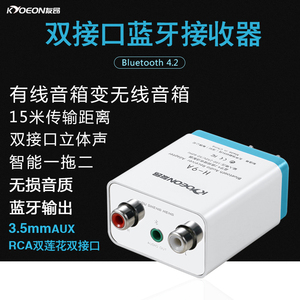
Everyday you learn something new! Three Bluetooth Receivers under 125 USD Face Off So much for the babbling. After you heard about my $7 USD cheapo BT receiver (H-9A), I got another cheap BT (Wenliang) from my friend. AI also acquired an iFi Zen Blue. So I was ready to carry out a mini face off of the three! Source is still the almighty You Tube through my ancient 10 year old Mac Air which no longer supports the latest IOS.. Plus I have my Sparkler CDP 503 II Spiral back. I also borrowed from my friend Kwong a pair of Silvercom silver I.C. and some cones bought from Taobao (again). I was ready to rock and roll.
My anchoring system is the 47 Gaincard and the newly acquired icOn4 TVC AVC Line Control and Dynaudio Crafft. The newly acquired icOn 4 is so good that it blends into my system effortlessly and seamlessly. I would talk about it more perhaps in another separate post. But this is definitely one of my most important purchase recently, since finding the perfect linestage to match with my Gaincard is actually more difficult and demanding than one would imagine!
Fast forward to Father's Day weekend; I negotiated a full weekend's privilege to listen to music almost all day long (if not, it would take another week or two to complete this A/B/C comparison). Analyzing is usually demanding in terms of the focus and concentration needed to critique the minute difference between one piece and another. But interestingly this time, this was not so much the case!
H9A out, ZB in I unplugged the cheapo H9A and hooked up the iFi Zen Blue (ZB). I was expecting some sort of improvement over the H9A, but the sound , though different, did not seem better. I decided to run more songs through it. The night before, the ZB somehow refused to produce sound even when paired but it miraculously worked smoothly the next morning. Occasionally it would get unpaired but pressing a few buttons would make that work again. It's a nice looking device made of metal and has a "zen stone" shape. After fiddling with different combination, I sensed something was missing with the ZB which I could not explain. ZB out, Wenliang in I then hooked up the Wenliang that my friend Kwong lent me to see if I had missed anything. The unit is well built with a built in LPS but unfortunately once it was hooked up the sound became one-dimensional and soundstage had collapsed completely. I immediately unplugged it and listen to my CDP which was a treat but I sensed the sound can be further improved (perhaps another post). Now I began to question myself if my previous wonderful BT experience was for real??
H9A back in On the morning of Father's Day, with the special freedom granted me in full effect, I woke at 7am and the first thing I did was to unhook the ZB and swap back in the H9A. Voila, everything came back to live again!!! All the musicality, involvement, soundstage, airiness, PRAT were in full swing and I was involuntarily tapping my feet and following the tunes with immense pleasure and delight!! I tried all the songs that I have used as reference, esp the Youtube Tiny Desk 's Free National mini concerts. I just loved the vibrancy and sophisticated dynamics of the musicians ! I even tried Chris Jones' No Sanctuary and compared it to my Audiophile CD version - I must say perhaps the BT is 80% in hifi terms but I feet no loss of musicality. Man I can live with it any single day! ZB may have an edge on speed and instrument spacing, but the airiness as well as the ebb and flow of music have been largely missing, even simply lacking. Sadly my very high hopes did not pan out; of course, I would not give up that easily. Be prepared for a follow up once I can get a handle on it. In the end, I am keeping my H9A. I also learned that they have a latest version with BT 5.0 and an additional USB input too, and for almost same price! I have already asked my friend to buy a few more H9As for me as spare, LOL!
Free Nationals at Tiny Desk Chris Jones "No Sanctuary" Nils Lofgren' keith Don't Go"Nils Lofgren's guitar is so fierce and piercing and his voice so sincere that how can one not be touched by it? Liang Bo 's "That Boy" is so polished, forceful, soulful that I think even those who don't understand Chinese will like the song. [Editor: this video is from a Chinese version of America Got Talent; this fellow took the crown]
FKJ performance at "Live at Salar de Uyuni, Bolivia" is so spiritual and uplifting that I can dive into music while watching the grandiose and breathtaking scenery. Such a treat. These are songs that I must play once or twice every other day or two~ Another live performance from FKJ at La Fee Electricite is shorter but no less impressive and this is the one that i would loop as well! Yet another favorite is FKJ and Masego playing "Tadow" and I can't stop tapping my feet on this one. Those slickest saxaphones, but both of them are crazily skilled and talented!
Man, am I having so much fun listening to Bluetooth! With a sea of live performances not available on Spotify and CDs, I am in heaven! Editor's Postcript: 1) We thank Eric here for bringing us more Virtual Home Visits as well as more music suggestions, and we look forward to more articles from him in the near future - a round of applause for cheap fun!; 2) After I posted my BT experience, Eric left comments that echoed mine and one thing led to another. I think I can relate to his experience (and that of my HK friend icefox) but those who have not yet used BT, or who dismiss it (including some of my friends), may not. The important thing of course is: does BT get across the music experience? We obviously think so, but you have to try it as a musical, not hifi, experience to see; 3) The H-9A may be viewed as a David by some, but I actually think there are many David's, such as my Aukey and HK-008 that I wrote about. BT is very basic, and there is not much that you can do to improve or degrade the sound. Newer chips may be more inclusive but they are still functionally similar to older ones. In all these devices, the onboard digital to analogue conversion and power supply are generic and rudimentary. I think there is no need to hunt for a particular model - just experiment on your own. As a corollary, the still inexpensive iFi is not a Goliath either. After run in, who knows? Perhaps Eric L will reconsider. Also, it has digital outputs, which from my experience is unquestionably an upgrade path, though that feature can be had for much less too. Of course, that's an extra component and another cable. As I have said, the built in digital to analogue conversion in cheaper devices cannot be very good and an extra DAC of one's choice will reap benefits. Until the next round...
Click pics to enlarge. The Dynamic Duo on top of Artemis Labs Preamp. Note the Volume Knob Positions. Also note the left edge of the Scythe's Front Plate, with its beveled curve (not a chromatic aberration). Review: FX Audio TUBE-01,The Mouse that Roared! Review:Scythe Kama Bay Mini Pro D-Amp, Spinach'ed Popeye! New York Diary (20-17): Streaming on the Cheap;Bluetooth, Part II; via HDMI, vs USB; iPad vs Chromebook, Spotify Redux
The more I stream, the more I stream. This is a continuation of my last article (just roll down). Like all addictions, it can be hazardous to one's health. I am probably streaming music at least 10-12 hours a day, and on the computer for about as long. Not very good. But, what is good now, I ask? Worldwide, Ugly Politicians are using this window for their own gain. No wonder I am becoming more unhealthy!
During this pandemic, another bad thing, though far less harmless, is that we give ourselves reasons to buy things. In the US, alcohol consumption is up 50%, but I am actually consuming less (though I stock up). I have at least several audio things on my mind. The big word now is "essential". No, they are not, for sure. I fight the expensive ones off, and then I am still curious. What better consolation than to buy a few cheap and cheerful things?
FX Audio TUBE-01 Given my positive experience on what a good tubed buffer has on Bluetooth Playback (in my last installment, but my iFi iTube is not exactly cheap), just for journalism's sake I started looking for a cheap buffer that would do the trick, and soon my attention was focused on the FX Audio Tube-01, a well liked el-cheapo unit that has over a long time been much vaunted over the internet. This long-running and informative Audiokarma thread is testament to that. Somewhere it mentioned the tube is connected in triode. Looking at the board it seems there is no opamp in the signal path but there is an area that is not accessible to the eye so I cannot be sure. Also, keep in mind the same device is also offered under several different brands. There is also a version with tone controls but it adds a pair of NE5532 opamps to accomplish the task. So, better stay with the simpler version, I'd say. The funny thing about this thing is the confusion over whether it is just a buffer or a preamp with gain. There is no question, the spec states a maximum output of 3V, much higher than a buffer's usual 2V, so this is a preamp with gain, not just a buffer. Given the very low price, it is quite well built and good looking. Power Supply is a 1A 12V DC Wall Wart. Ergonomics Little. One in, one out. Tubes Stock, it runs a Chinese 6J1 in each channel. Warning! This is a miniature 7-pin tube, and the socket is very tight in its grip. I cracked one of the stock tubes during installation. Fortunately I had bought some used old 6AK5's (equivalent tube), but installing them was difficult. If you have a tube straightener it would have been easier. If just one pin is a little skewed it would not go in. It took me many attempts to get my Sylvania's in.
Scythe Kama Bay Mini Pro D-amp (SDA35-2000)
This was solely an accidental diversion. While researching my Dayton BTR-01 I somehow discovered the TNT 2009 Rave Review of Scythe SDA-1000 Kama Bay D-amp that uses the Yamaha YDA138 chip to produce 10 wpc. As an occasional student of cheap and cheerful T and D amps (Lepai and SMSL), I mopped it up. I just loved the looks of it, but it is unfortunately long unavailable. Then I discovered the (?2000) Mini Pro (still available but in short supply) that uses the Maxim 98400A chip to produce a higher 20 wpc. This Italian Review (translated) is the only one, but it is good in relating the history of Scythe audio products. See, Scythe (a Japanese company, products manufactured in China) has long ago abandoned making audio products, and that is a shame, as they were not run of the mill. This is a little like Elekit, which makes toys and AI type stuff for kids; audio is just a sideline. As one who cares about aesthetics, I just love their industrial design, something that most Chinese products are seriously lacking in. Even this little thing, though not as striking as its illustrious predecessor, still sports subtle details (see top pic); additionally, it has only 3 feet, surely audiophile thinking. Power Supply is a Switch Mode Computer type brick capable of 3A (that is generous). Unusually, it also comes with a bag of cables and mounting brackets for installation in a desktop hard disc drive! Ergonomics For such a small thing, it packs a wallop. In the back there is an RCA input; in the front, a Minijack Input and a Headphone Output. Internals See bottom pic for the jam-packed interior.
System Used: BT: Dayton Audio BTR-01 Bluetooth Receiver (S/PDIF out; Belden 1694) DAC: Micromega M1yDac (Kimber KCAG) Preamp: FX Audio Tube-01 Amp 1: Scythe Mini Pro Amp 2: Akitika GT-102 Loudspeakers: LS3/5A (Audiomaster 15 ohm) Linear Power Supply: MW122A
Round 1: Scythe Solo I first connected just the Scythe. I was totally surprised by how well it drove my 15-ohm LS3/5A. In this respect it definitely outpaced my Lepai and likely my SMSL (but then it has a larger 3A PS). It has pretty high gain and I didn't need to turn the volume knob beyond 10:30-11:00 O'clock. Sound was just what I expected, neutral and clean. Importantly, it was in total control, amazing for such a small thing. It benefited a little from running in. If I were to set up a desktop, this would be my amp (and you can mount it inside the hard disc drive if you have an extra slot).
Round 2: Scythe + FX Next I inserted the FX between the source and Scythe. Note that as one of my stock Chinese 6J1 went south, I used a pair of old stock Sylvnia 6AK5, which is just as well. Right off the bat, I was astonished by how much gain the FX has - buffer it is not! And by how much the Sound gained in Presence and Allure. Volume Settings The system has too much gain, and I set out to find what setting is best. I tried both extremes: Maxing out the Scythe and using the FX to control volume; and vice versa - neither was optimal and resulted in less presence or coarser sound, respectively. Empirically I had both around 10 O'clock. But I wanted to know at what position does the FX outputs the normal 2V. vs Elekit TU-8500 As the Elekit has a Unity Gain setting (here) and is nearby, I recruited it for use. I maxed out the Elekit and determined the volume level of the Scythe (around 10:30). Then I substituted the FX and dialed in the same volume by listening. I was shocked that the FX reached 2V around 10:30! This tiny thing has more gain than some of my active preamps! In terms of sound, in this system I prefer the FX for its more open sound. I listened happily to this duo for many days.
Round 3: Linear Power Supply In the Audiokarma forum, there were a lot of discussions on how a linear PS improves the FX, so I dug out my little used el-cheapo 2A regulated PS (on sale now; if you buy one make sure you get the plug kit too). FX TUBE-01 I first tried it on the FX. There was definitely a difference; a somewhat weightier sound, but I thought I preferred the pacier sound of the stock SM PS, so I switched back. Dayton BTR-01 Again, there was definitely a difference, but this time in the other direction - the sound seemed just a little airier, so I kept it in. I wanted to test the Scythe too, but couldn't because it has a special male plug (with a pin inside) that I don't have in my plug kit.
Round 4: FX + Akitika The FX pleased me so much that I resolved to further test it out as a preamp. I was writing at the dining table but the sound stopped me dead in my track. What the hell! The sound is GREAT! The soundstage doubled and there was bags of air. For the last few days I just stayed with this combo, which did everything well. For this article, I performed a reality check. FX vs Artemis Labs LA-1 I have been using the Artemis before the dynamic duo's arrival. The change in sound after I swapped in the Artemis was quite subtle, definitely not night and day. Perhaps the Artemis was just a little more solid in its foundations and had even sweeter treble. The diminutive FX emphatically did not at all shame itself, particularly with BT material. Most astonishing!
Round 5: Streaming HDMI Using a generic HDMI cable, I connected my Chromebook to the $10 Wiistar convertor, (which has to be powered by 5V USB). I then connected the Wiistar to the Micromega MyDac via optical or coaxial and compared the sound to USB. I clearly preferred the HDMI to USB, warmer and smoother. Of course, the connection is highly impractical for a laptop but if I have a desktop this may be an alternative to USB (which also benefits from being converted to S/PDIF).
Round 6: iPad vs Chromebook During the Memorial Day sales, I got a good deal on the current iPad 10.2". I streamed NML through it. I don't know why, the volume is definitely lower by at least a couple of notches; the sound is more sluggish and lacking in sparkle; and the soundstage is a little more constricted. For sure the Chromebook is preferable.
Spotify Reconsidered After my last article I actually surfed Spotify quite a bit looking for things that are not in NML. For me, it is actually a useful supplement. e.g. it has quite a few Doremi albums. This is a label specializing in historical reissues and live performances. An example, one of my favorite pianists is Reine Gianoli, whose wonderful Mozart sonata cycle, originally on Westminster LPs, can be found on Spotify but not NML. Of course, Spotify is also good for Jazz and Pop. I listened to a few cuts of Cantopop (like my favorite Shirley Kwan) and they sound great on the LS3/5A.
Comments
FX Audio TUBE-01 This thing is unbelievably good! Good enough to use in your main system. Highly Recommended.6J1 Variants This tube is derived from 6AK5, a tube with an excellent lineage (here). Developed by Western Electric (403A/B), the 6AK5 is excellent sounding. I just bought a few used ones from Ebay and they are cheap and sound great. There is good reason why a lot of Chinese gear use 6J1 and 6N3: both of these tubes have good sounding US precursors (5670 and WE396A/2C51 in the case of 6N3). On the other hand, avoid those that use 6N1, as there is no exact equivalent.
Scythe Kama Bay Mini Pro It is a good little amp but will be difficult to get. Of course, it is still not as good sounding as the Akitika!
Linear Power Supply Traditionally a Linear PS is regarded as better than Switch Mode. But my experience with Switch Mode power supplies have been largely positive. My LTA and Micromega sound great with their SM power supplies, as do this round's dynamic duo and the Dayton BT. No reason to lose sleep over it.
Click pics to enlarge. Dayton BTR01 in action. Aukey BR-C1 in foreground; iFi iTube and Micromega Mydac in left background. NY Diary (20-16): Streaming on the Cheap; Bluetooth, Part I Review: Three Bluetooth Receivers, Dayton BTR01, Aukey BR-C1 and HK008, vs USB Review: iFi iTube, Part II Streaming Naxos Music Library (NML) (with Chromebook)
This is a very long article that follows my Bluetooth Journey chronologically, not a more categorical presentation. I chose this way because it would tell more of the joys and frustrations of the journey.
This is picking up where I left off in the last Diary Entry on Streaming NML (here). Since writing that, I haven't stopped streaming but have done some adjustments, and some of the results surprised me, to say the least. I'll start with a bit of re-cap.
BEFORE: Ancient Dell Laptop + Unitek USB Cable The Unitek is my go-to USB cable (better than the Belkin Gold, see here; but it seems available only in HK). The Dell was a loaner, pre-Windows 10 but running the 10 (I also tried my even older XP Dell; it displays but cannot run the NML Player). Sound With the Micromega DAC, sound was quite good. The treble was surprisingly detailed, but sometimes with a steely tinge on period instruments or when the going got rough. Cable SwapsI dug out more cables and toggled them, resulting in a somewhat warmer, but just as detailed, sound. So the updated system:
Bluetoon Receivers: Aukey BR-C1 and Dayton Audio BTR01 (chronicled below) DAC: Micromega MyDAC (DIY 47 labs) Preamp: Elekit TU-8500 (Gotham GAC-2111) Amp: Akitika GT-102 (Acrotec 6N-1010) Loudspeakers: Audiomaster LS3/5A (15 ohm) Stands: el-cheapo Energy stand used without spikes Blue Ray Player: Sony S-5000ES (Audio Out; Canare 2T2S) Turntable: Audio-Technica AT-PL120/Denon DL-301ii
My New Chromebook(skip this part if you have no interest in Chromebook) As described in Diary (20-8), some time ago I irrevocably crippled the browser of my 2012 Macbook Pro and computing on ancient laptops has been a patchwork. Finally I couldn't stand it anymore and impulsively bought an entry level Acer Chromebook 14 for $200, before tax. Considering that computer prices have shot up with increased demand during the pandemic, that was a comparatively good deal. I ordered it from BJ's and was shocked it showed up the next day. I guess it was available at my local store and they delivered it together with other people's groceries. Nonetheless, efficient and deserving of praise! Basic but has FlawsOpening it up surprised me - a nice carrying bag is included. This is my first Chromebook, and it is a very basic one. I liked the fact that it has an aluminum chassis (of course at the cost of additional features). The screen is large, but images, though fairly good, lack some contrast (Apple it ain't). Working on it feels remarkably like working on a Macbook Air. I use the computer to mostly read the news, write (obviously) and watch a little youtube, certainly no gaming and high demand stuff, so this basic model is good enough for me, and I can sit and write with it on my lap for hours. I open multiple tabs when I write (sites with relatively little ads and pop ups) and stream music at the same time, and the speed is acceptable (not with some youtube videos though) and happily the battery lasts forever. I/O's are few, 2 USB and a HDMI but regrettably no SD card slot. I also tested the earphone out and it was acceptable (no worse than Apple). DrawbacksThere are a few, some unforeseen by me. It's not the price, but the ecosystem.KeyboardIt is a little different, but adjustment is easy. I do miss several keys that I use a lot (Pg Up/Dn, Home, End and Delete) and hence cannot yet execute some DOS commands (but these keys on an external keyboard work). There are Chromebook shortcuts for these but it will take a little time to learn them. Input Sometimes I have to type in Chinese (not that often). With Apple, it is the best. With a PC or Android Cell Phone, I use the very good Google Pinyin Method, which can easily toggle between the Traditional and Simplified Chinese characters. So I was really surprised the Chromebook cannot; it's one at a time (reason here). And the Fuzzy Logic is not as good. This is a minor gripe though. Wechat This is the Social Media almost all Chinese use. On my Mac and PC, I like to install the Wechat app and use it when I type a lot. But despite some unofficial attempts, this is basically not possible on a Chromebook. As for Wechat's web edition, it can be displayed but fails to login even after scanning the QR Code. This may not be surprising as anything Google is not available in China. So for those who have to interact a lot with Chinese friends and associates, the Chromebook is not a good choice. This is not my case, so it is good enough for me.
Round 1: Initial WoesUSBAargh! I plugged the USB in, and NO sound from my Micromega. MyDAC requires a driver for Windows, but this Chrome ecosystem is apparently different. Next, I thought of my Meridian Explorer but could not find it. Anyway, that was a disappointment (but there is a surprise later). So, I grudgingly continued to use the ancient Dell. Bluetooth (BT)A day later, I decided just to try out Bluetooth. Last year I tried out some cheap Bluetooth stuff with my then-functioning Macbook Pro, and I had great difficulties (here). So I got them out. Well, the Chromebook proved better in this department. The Dayton BTR-01 was detected but would not pair, (surprise later too) but I was glad the Monoprice BHS-839 Headphones paired (it will see some use in the kitchen). When all seemed lost... Round 2: Aukey BR-C1 Bluetooth ReceiverThis is a tiny (2") el-cheapo Rechargeable BT Receiver with a mini-jack analogue output. I bought it from Amazon soon after I wrote the Bluetooth/Monoprice Earphone article. Make sure you read the purchasers' feedback (that was what I did when I tried to decide which one to buy). The top one from a tech-savvy guy is most interesting, and I will quote him below.
Upon first play using one of my reference pieces I use, 1.618 by BT, I knew something was off about this gadget. Being a bit electronics and audio proficient, I opted for an autopsy.
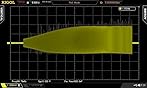
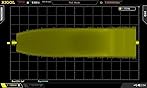
1st image: 65-second, 20 Hz to 20 kHz logarithmic sweep at -3 dB and half system volume w/ 85-86 uF stock output capacitors & filters. 2nd image: 65-second, 20 Hz to 20 kHz logarithmic sweep at -3 dB and half system volume w/ ~290 uF output capacitance.
I set up the wrong multiplier for the scope between both sets of measurements. Please compare shape, not the measured values.
The micro responsible for driving this entire device is the ISSC IS1681S made by the Microchip subsidiary ISSC. It's a Bluetooth 3.1 + EDR device that supports a mic and stereo sound. The power source, aside from being plugged in via USB, is a 2YL6 "jellybean" Li-Ion SOT-23-5 charging regulator and a 250 mAh, 0.9W lithium battery. ISSC's site change that this IS1681S can live for 10 hrs on a 120 mAh battery. I didn't map the schematic, but 2x A2SHB-marked transistors, also a jellybean part, drive the left and right channels though 2 caps in parallel-ish and one inductor. The capacitance of each channel on the board is 85-86 uF, which is where I make my point.
A crude linear intensity sweep showed roll-off for everything below 650 Hz. The 3dB point is dead on 51-52 Hz, and the 6 dB point is at 20 Hz. This means that any low mids and high bass is easily being attenuated. As the capacitance is driven by MLCC caps, 0805's being the largest used here, which suffer from letting DC through at higher loads, the isn't enough for driving any decent speaker setup. Even at half volume I was getting a significant DC offset.
I had some 220 uF's sitting around from another project, specifically EEU-FR1C221, so I cut the leads of two of them and soldered them on. Away went the DC offset. Away went the 3 dB & 6 dB low-mid & low frequency attenuation And up went the peak-to-peak amnplitude. I can go louder now along with only a 0.82 dB roll off from 97 Hz to 60 Hz, which is good enough for me. My monitors go down to the mid 50's. Frequency response is flat from 97 Hz to 20 kHz.
Why does this matter? Aukey spent the time and money to inlay 4 steel pieces and 2 screws holding them in to add 20 grams of mass to this device. I'll admit that the thick-walled ABS case and rubber foot coupled with the texture of the plastic are spot on for the feeling of quality. I didn't expect perfect audio, but I didn't expect +6 dB attenuation in bass. The range of the bluetooth transceiver is great, despite the steel blocking a good part of the antenna on the left. However, if they remove the steel and minorly adjust the PCB layout, they will be able to accommodate similarly spec'd electrolytic caps and provide *excellent* sound for bluetooth device that costs $20.
Aukey, please remove the weights and use the cost differential to fix the frequency response. you do this, you'll get 5 stars from me. 2 were taken off because that roll-off starts/stops pretty high up in my opinion and physical presence was prioritized over function.
Amazon gave me a discount for leaving this guy in my cart for a few days (doesn't mean that it will or won't happen to you) so I got bluetooth audio that sounds equivalent to a shielded line-in input to my monitors for $12 so this was a fun experiment that netted me a very capable device I'll want to keep. I want to buy more, mod them, and share them.
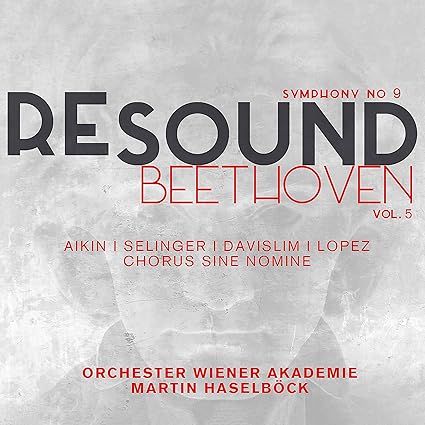
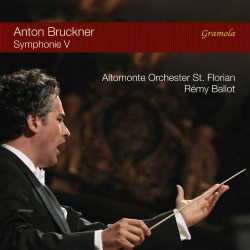
And They Lived Happily Ever After? When I first got it last year, I tested it briefly and it did not work with my Macbook Pro either. I almost forgot about it this time. In the early evening, I brought it out for a trial. ConnectionSURPRISE! It paired easily with the Chromebook! The connection is fairly stable, though at times it'd stutter a little, though overall it is acceptable. Sound Level At first, the sound level was quite low and I had to crank the volume up. Then I realized and checked the Chromebook's volume, which was at my usual low setting (I usually work almost silent, preferring to listen to music from my real systems). I maxed it out and, voila, the level became more normal, though I am certain it is below the standard 2V. Ergonomics For this price, don't expect that much! It has a lot of features for car and earphone use, which is useless to me and irrelevant here. Battery There is a Lithium Battery inside, and USB charging is easy and quick. Once charged, it lasts forever. If you don't want to do recharging, of course you can have it permanently hooked up with a USB charger (not included). Audio Output There is only a stereo Minjack. I used a generic adapter for RCA. Weight It is so light that it tends to be dragged back by the interconnect (and adaptor). The Vibrapod gives more traction as well as control vibrations. Sound I mostly streamed NML. Initially,I was a little unsettled. It seemed more generalized, less detailed. On the other hand, it seemed rather pleasant, not much treble glassiness. Cable swapping made only a small difference (I settled for the Kimber KCAG). Anecdotally, the sound reminded me not a little of my 2018 Bluetooth session with my HK friends icefox et al (here). Then,as I gradually grew more and more acclimated to the sound. I started to suspect I might find it on par with the USB streaming before.I found that hard to accept, as Bluetooth, especially non-Apt X and low-end ones, are universally regarded as way inferior and not fit for audiophiles. It took another day of constant streaming to sort out my impressions. All that remained was switching back and compare (which I did two days later to the same conclusion). Yes, in this system I prefer the Aukey Bluetooth. It's too bad my other BT devices don't work (surprise later). In the next bullet, I shall dwell on its virtues. Radio I spent some time enjoying Radio Garden (link set to Italian Radio Emilia-Romagna). I roamed over the globe, stopping by in Africa and India for some stirring music, finally checking in to RTHK4, Hong Kong's classical (and jazz) radio. Around the World in one hour! I urge you to explore this site but warn you that it can be addictive! :-) Pro's Some of you will no doubt question my high end credentials for preferring BT. Although it is hard to isolate the various elements, a few words to explain my preference are in order. Organic It is about the whole, not the components. There is something holistically right about the BT/Aukey. It breathes naturally and gets to the heart of the music. Now, as mentioned in my first article on NML streaming, its free feed is not even close to CD standard, not to say hi-res, though it is good enough for me (and mrgoodsound, though as a subscriber he may have a slightly better feed) to enjoy the music. Smoothness Compared to the USB streaming before, the Aukey BT is smoother, which is why initially I had to undergo a period of adjustment for what I first perceived as loss of high frequency content and detail. After more listening I became aware that there is about as much detail there, but the distribution is different. With USB, the images are smaller and the edges are sharper; with the BT, images are more fleshed out. I can imagine in the wrong system (say a less resolved one) the BT could come across as more muddy or bloated. But in mine the massed strings certainly sound more real. Soundstage and Hall Sound In terms of depth, the Aukey extends a little further back, but that is not significant compared to its surprising ability to convey the Recording Venue (Hall Sound). In my opinion, accurate Hall Sound goes hand in hand with Listening Comfort. Years of listening to classical music in audiophiles' system taught me the vast majority have no idea of what the hall sounds like - what they hear is a cardboard cutout. Case in point: I went through the excellent Beethoven Symphony Cycle by the Vienna Academy under Martin Haselbock (Alpha). They were recorded in different venues (each deliberately matched with the venue of each work's premiere) and I definitely hear the different halls. Another example: Remy Ballot's Bruckner Cycle was recorded in St Florian Cathedral, where Bruckner was based, and I can hear the reverbs. For a 16-bit aficionado (I am confident the 16-bit chips have the best hall sound, bar none), that's quite something to say! The small orchestra is clearly heard; the vibrato-less strings never grating, very exciting! If you have a streaming service, try it! The cushion of the hall sound lets me hear the really big symphonic works with comfort. Con's Effective Distance It is not very much; long distance champ it is not. But, are you kidding? For $15, I have no complaints. Also, here I do want to address the question raised by the technically minded Amazon commentator concerning the stock unit's roll-off under 670 Hz (-3db at 50-52 Hz; -6 db at 20 Hz). In my opinion, the very gradual rolloff to -3 db at 50 Hz is nothing much to worry about (unless your system is really lean in the lower midrange, midbass and bass) - not a few tube gears probably do that, and cable changes are able to help. In my case, I worry even less as the LS3/5A has a signature midbass bump that will flatten out the curve some, especially since I am using wood-based stands (without spikes) that probably make bass yet a little fatter. Indeed, I am not lacking in bass. I don't feel the need for a sub.
Round 3: Extra! + iFi iTube Late one night, I was playing Bruckner. I was actually contented but the idea of adding a Buffer came to me. I pulled out my little used iFi iTube (my review) and connected the Aukey (with KCAG) to it, using the Belden 8451 to connect to the preamp. Wow! It's not just better, it is significantly better! As Buffer (0 db Gain) I was not surprised that the Buffer sweetened the strings and brass a little, but I was happily surprised by Greater Ease and even more by the Enhanced Dynamics! That adds a lot to the big symphonic experience (like Bruckner)! Aukey has no spec's so I don't know whether there is an impedance issue, but the buffer surely improves things. As Buffer (6 db Gain) Even though the volume knob on the preamp had not even reached 12 o'clock, over the next few days I also tried out the 6 db gain setting. Unlike the previous round, I heard a little difference. Perhaps because I feel the Aukey is low in output volume (or perhaps the compression of the BT plays a role too) the additional 6 db gain adds a little more spice. I A/B'ed some: this is different from cranking up the preamp by 6 db; the attack is a little better. This is the setting I now use. As Preamp (6 db Gain) I briefly tested this, eliminating the Elekit preamp altogether. Just like before, the iFi did not cut it - the perspective is flatter and there is less presence. Maybe good enough for the desktop (which is what some of the reviewers use), but not in a real system. vs Chromebook Audio Out At the end of my comparisons, using the same cable and adapter I connected via the headphone output. I had tested this a few nights ago with my Grado SR-80 and it was par for the course, no worse than my Macbook Pro (not saying much). In this system, the sound was acceptable but not as wholesome as the Aukey. The tinny treble (strings) though was much improved; surely the iTube has helped!
Round 4: Miracle 1, Dayton BTR01 Revived! + Micromega MyDacThe Dayton is a Parts Express Product. It is a BT 3.0, non-AptX Receiver. As I was finishing the article, I opened it up and took a pic. The Chip used is CSR 57E6-87CG. The Op Amp NE5532P is seated on a socket, so should you like you can do some rolling. I googled the chip and guess what I found? A pic of FX Audio BL-MUSE-01which looks exactly the same. I investigated further and found the innards are identical too! So, The Dayton is OEM'ed by FX Audio, which is a reputable Shenzhen enterprise. Dayton is out of stock right now, though more are due in imminently, whereas FX can be bought anywhere on Amazon and Ebay (the cheapest I have found is this). However, should you be interested, personally I'd pay a few bucks more and buy from PE, because they have a 5-year Warranty and are famous for their service. During this covid crisis, Parts Express must be hurting and they have lowered their free shipping requirement from $100 to $49, and you can include a few adaptors or whatever you need with your order! Of course, those near Hong Kong I am sure can easily purchase the FX from Taobao for even less. Connection As mentioned, first I had trouble; it was detected but would not pair. This was when I was using the Aukey. I moved it further away and plugged it in and forgot about it for about 2 hours. After a while I saw the blue light blinking and I was suddenly able to pair it! I moved it back into the system and it maintained the connection (I turned off the Aukey). As a matter of fact, it has been almost 3 weeks; every night I broke the connection when I turned off my Chromebook and it would re-connect with no problem the next day. The connection is super-stable (visible direct line) I suspect the initial impasse was due to too many devices around. Now, another strange thing: I tried again with my old Macbook Pro and, unlike before, it paired! Go figure! I have no idea why the Dayton works now with my Macbook but not before. Perhaps the 2 hrs of "warming up" did something? Ergonomics This is a small but quite well-built device, with great ergonomics. Power Supply is via a 12V wall wart (Linear PSU is a possible upgrade path).There is a stereo pair of Analogue Output as well as a pair of S/PDIF Outputs (Coaxial and Toslink). The Digital Outputs allow me to use a DAC of my own choice in lieu of the onboard one. I wasted no time. Sound I first used the Coaxial Output (Belden 1694A)into the Micromega MyDAC (iFi not used). A big smile broke on my face! The sound has everything the Aukey has, and significantly more.Retained is the musicality. Improved are the resolution, dynamics, even treble smoothness. In fact, the punch, and bass heft, sometimes surprises me. Brass and Massed Strings have sheen, no etching on most discs; no easy task! Fabulous! Toslink Actually I knew from before: with the Micromega, Toslink (Monoprice) is almost indistinguishable from Coaxial, and so it proves here (I think there must be some re-clocking inside). Analogue Out I connected it with the KCAG to the preamp. No surprise, sound was still quite good, but a little flatter and not as dynamic. I even added the iTube buffer (+6 db) to beef it up, but the sound was naturally still better with the Digital Outputs. However, just like the Aukey it is pretty decent and would be satisfactory without an A/B Comparison. Lossy NML vs lossless AIFF I played my lossless AIFF files on iTunes. At first, they stuttered kind of badly, though not disconnecting, but that went away after I turned the BT off on my chromebook. Streamed over BT (lossy itself), the difference is there, but not by as much as one would think. Previous Review When I bought it, there were only user reviews. Imagine my surprise that there is now a TNT Review. Damn! I could have been the first! :-( But, wait a second, I just finished reading it. It is a complicated and crazy review, which I completely disagree with (rare in my experience with TNT), so maybe this review will right things!
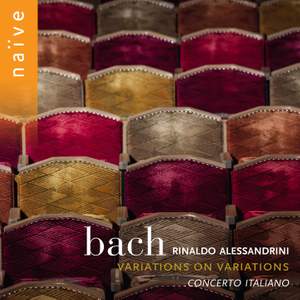
Round 5: BT vs USB On my Macbook, I have almost 1T of music stored as AIFF in iTunes. In there is an AIFF file of Concerto Italiano's recording of Bach's Goldberg Variations (orchestral transcription) which I love and have previously recommended. So I played the lossless file via USB and compared it to Chromebook playing the lossy NML file with BT. Suffice to say, as an audiophile, I think the USB is still better, but, being a direct connection, not by as large a margin as I'd imagine. Somehow, despite the better resolution of the USB, the wholesomeness of the BT still came through and it is not shamed (I can see with certain music it might even be preferable). HK008 dangling on the DIY minijack cable. Aukey on Keyboard. Round 6: Deja-Vu (HK008) After 2 weeks of thorough immersion in streaming, a few days ago I finally fired up my horn rig because, as is my custom, I wanted to test again the TU-8800VK before shipping it out. This is a much more efficient system, so I didn't use the iFi and just inserted the Aukey via the amp's Minijack input, and it played delightfully. System:
BT: Aukey BR-C1 or HK008 (DIY Mogami 2534 with Rean Minijack connectors) Amp: Elekit TU-8800VK (Belden 9497) Loudspeakers: Klipsch Heresy I Subwoofer: Pioneer SW-8
A few hours later, the Aukey ran out of battery and had to be recharged. I substituted the even smaller $10 "HK008" (Amazon), which paired instantly. Amazing! The sound is virtually indistinguishable from the Aukey, so I am not going into details. I continued my streaming with the HK008 as I wrote, until...
Round 7: Miracle 2, MyDAC USB Revived! This is truly amazing (to low tech me). I had almost finished the article when I wanted to find out the cost of a used MyDAC. I poked around and ended up wasting some time reading old reviews, one of which reminded me that there is a small switch behind the MyDAC that switches between USB 1.0 and 2.0. For Windows, 1.0 does not require a driver but 2.0 does. I looked behind my unit. It is set at 1.0. My heart sank but I connected my Chromebook anyway. No sound, as before. What the heck, I thought, and tried out the 2.0. Success! I think that may be because my Chromebook's USB is 3.0 and it won't work on the 1.0. As for the Macbook Pro, may be the USB is 2.0 and that works on 1.0? I have always thought it was from 2012, but I just checked it, and it says "Late 2011". The 3.0 came out in 2011, but maybe my Mac still had the 2.0. BTW, my Unitek Cable and the Extension are 2.0. Anyway, that teaches you again the well-worn lesson - don't give up until you have tried everything! Sound Now I am able to use the same NML lossy files and make a direct comparison between USB and BT. There is no question the USB is still better (in bass heft particularly) but the BT is not far behind. For the small difference, until I have a dedicated computer in my audio system (may never happen) I am staying with BT.
Comments
Chromebook I don't make much demand on my computers, so my cheap and cheerful unit is welcome. Its ecosystem reminds me of Apple more than PC. It is not an ecosystem of choice for those who have to interact a lot with Chinese friends and associates. More relevant for here, from my limited experience above, in terms of streaming, BT seems OK. As for USB, I think it is OK too. As USB 2.0 came out in 2001, before Computer Music has taken off, I doubt there are many old DAC's with only USB 1.0 input. Because the USB didn't work earlier, I bought a $12 HDMI to S/PDIF Converter (also has a Minijack out) which has just arrived. I shall stream via the HDMI output. I might also reclaim from a friend my Musical Fidelity V-Link (a good USB to S/PDIF convertor that does re-clocking) to try out. As I believe S/PDIF to be better sounding, that would be interesting, but it will have to wait as I'd not like my friend to worry about my knocking on his door during the pandemic. :-) :-(
Akey BR-C1 and HK008 You can add streaming to your main system for peanuts. With some care, the sound is not bad at all, even good enough for this jaded audiophile. Despite their limited ergonomics, they punch above their weights, literally. Recommended. Also, make sure the distance is not too great and avoid having multiple BT devices on at once as it will cause pairing problems. AND, they are so portable that you can take it to your audiophile nemesis' place to embarrass him (I do that even to my friends, and certainly my HK friend icefox does too)! And good for a gift! The HK008 is not available right now but any generic one will likely be an equivalent. I regard BT as a bona fide Music Server! For those who do not already use a DAC in their system, these are reasonable choices. Given the somewhat lower output, use of a buffer, especially one with gain, will significantly improve the sound.
Tube Buffer The iFi I use is now in its Mk II iteration, and it is not exactly cheap, certainly not commensurate with the prices of the BT devices. But there are very cheap ones available, and I intend to try out one of these soon (FX).
Dayton BTR01 as vilified by TNT reviewerI completely and wholeheartedly disagree with the TNT reviewer I cited earlier. That reviewer basically worked in an obstacle course, and, unforgivably, he did not test the digital outputs of this fine device. Had he used the digital output options he would have been surprised. If you ask me, that reviewer's own home limitations disqualify him as a reviewer, no matter how good his ears are/were. His must be the most incomplete review I have ever read on TNT - in the end, that review is more about HIM and his HOME than about the device. Sigh...TNT, you can, and usually, do a lot better! The corollary is, think of BT as a cheap Streamer, not something to send audio over long distances. This is important conceptually. If you want more distance, I am sure it is not impossible but be prepared that implementation will take more trial and error, not to mention more money and possibly frustrations.
Dayton BTR01 as I Hear It The Dayton is a GREAT device, and a great bargain, whether you use its analogue out or, much better, its Digital Outputs into your DAC of choice. Or you can get the FX Audio BL-MUSE-01, as it is exactly the same. It is musical and, at least with lower-res files (like the NML), does not even shame itself against the standard USB. Grant you, its Distance of Operation (the only thing the TNT reviewer was concerned about) I cannot assess, as here in this room everything is within sight. But, based on Features and Sonic Attributes, HIGHLY RECOMMENDED!For those who already has a DAC in their system with an unused Coaxial or Toslink Input, this is a no brainer - downright FUN!
BT vs USB As mentioned above, the USB resolves more and is more audiophile oriented. However, there is also something wholesome about the BT, perhaps a subtractive virtue. It sounds best when it is digitally extracted. With a suitable DAC, like the crazy bargain but highly musical Micromega MyDAC, BT is highly satisfying! As I don't have a computer in my audio systems (that may someday change), the BT is now my choice for Streaming. This is because I don't work at a desktop and literally have the laptop in my lap. I'd use the USB if I do work at the desktop but as it is I'd not like to be tethered to a USB cable. The price of this, ultimate resolution, is an acceptable price to pay. The most important thing is, it can be musical.
Audiophile Phenotypes and the Good and Bad Things about Computer Music Today in computer music, there is little question purchasing hi-res files (once so touted) is rapidly waning and Streaming is already Mainstream, even for audiophiles (not so good for musicians). If you consider youtube a form of streaming (which it is) it is astonishing how many audiophiles partake in that experience (my friends all do it, and think of those Ken Micallef clips mentioned in the last post). The great thing about computer music is that so much of it is available free or for a small fee. I think all can agree on that, but audiophiles differ greatly in how to receive (retrieve) the stuff. For people like me (and likely my colleague mrgoodsound), with streaming, as long as the music sounds good enough, absolute sound is of no concern. The important thing is to explore music, and when we are listening to something new and exciting, analyzing the sound is the last thing on our minds, and that is why I think one does not and should not need to spend too much on Streaming Equipment. I also think, people like us are likely to buy the music we discover (especially hard copy; I know mrgoodsound does). But I know many audiophiles have a different mindset, and they demand "the best" when they stream, which is why in 2 consecutive recent issues, Stereophile's JVS (kind of an audio Decameron figure; even his prose smacks of it) reviewed 2 Music Servers (Innuos and Wolf) with base prices of USD 13,750 and 9,295, respectively. And you still need to provide the DAC! I am afraid the only people well served at these extreme prices are the manufacturers and the reviewers. If I go with Aukey or HK008, my Music Server + DAC is less than $15! What I am saying is, I doubt these will turn around a piece of music that I do no take to. Maybe you ask, when is "good enough" good enough? Well, for me, proof of Good Enough (my motto) is that I have listened happily to BT Streaming for more than two weeks on my LS3/5A. Seriously, I don't even feel like I need my big rig, such a game changer it is! During this long period, I had gone through many Symphony Cycles: 3 Beethoven, 1 Brahms, 2 Bruckner and a Prokofiev, and that is just symphonies! I even thought that I should not have shipped some of my favorite CD's back from HK when I relocated - they are mostly available on NML.
BT Upgrade? Another proof of how much I love BT is that after my experience with the Aukey but prior to the successful pairing of the Dayton I was contemplating taking a risk and getting the Arcam rBlink BT Receiver (AptX), which has been discontinued and is now on sale for $150. I have always liked Arcam and had their first-generation rDAC. The Arcam is obviously better built and ergonomically similar (no optical out though). After my success with Dayton I banished the thought, as its digital output is probably not that different and I don't really need the DAC part of it. But if you don't have a DAC and want BT, you may want to consider it. As for on the cheap, I am actually tempted by many Amazon/Ebay offerings that promise long distance BT for $50. Not many of these though have Coaxial Out. For me, a good BT digital Output is now a requisite, that is all I need. Also, I haven't yet tried a better PSU. I do have a 3A Multi-DC-Voltage Linear PSU around but, being easily satisfied, I somehow never put it into use with my numerous wall wart devices! Good enough is good enough for me, but I think this time I shall try it out. As I am streaming day and night, any improvement will be welcome.
My Doubts about Computer MusicCorollary, despite its strengths, I suspect there is something not entirely wholesome about USB Streaming. Grant you, I am not at all the last word in Computer Music, but I continue to harbor doubts. Cheap and cheerful is where I draw the line, and this round of BT experience is supportive. I think back about my HK friends, icefox and his cohorts, all uber-experienced audiophiles (and audio wanderers, even vagabonds) used to auditioning big and megabuck systems (which include expensive Music Servers) - perhaps I now really know what they were experiencing. There are so many bad computer audio setups out there (including at shows and dealers) that I completely distrust writers who wax lyrics about them. Remember: Cheap is good, but Cheerful is even better! Since when has our audio hobby become a big technical mess? BT is just Simple, Unadulterated Joy, a rare phenomenon in audio today!
NML Youtube SpotifyMind you, lest you wonder, for a very serious classical listener who wants the broadest coverage of music, Spotify is out of the question, and even Tidal and Qobuz are not in the equation (they have hi-res files but are way behind NML in coverage). But then, even NML is not perfect. There are quite a few esoteric labels not under its stable, and even for those that are, selected albums can be missing. As an example, Vikingur Olafsson, the trendy Icelandic pianist whose Bach track below notched around 8 million views on Spotify, is a DG star, yet his other DG albums are not on NML. I suspect this may be a calculated move on the part of the label. CD Recommendation All of my recommendations come from Streaming. For each one you see I'd estimate there are 20 albums that I decide not to include. This is not at all because they are not good, but because I deem then not generally recommendable (e.g. esoteric, difficult or sonically compromised). Quality The NML Free Feed (likely 64kbps) is good enough for me, and my listening experience is so much the richer for it. I'd not mind listening to Tidal or Qobuz too, but where'd I find the time? vs Youtube Using BT, I listened to the Bach Youtube below (official); it is virtually identical to the NML feed, so I may listen to the occasional Youtube through BT in the future. vs Spotify This gets fascinating. Spotify says its non-premium stream is 160 kbps, which should sound a little better than NML's 64 kbps. So I used the same Bach track as comparison. It sounds no better, so I think 160 is likely the maximum. BUT, this is crazy: it sounds different, and worse for it! I went back and forth, and the Spotify definitely is louder, has less treble definition and more bloated bass. I also compared Spotify with Youtube by using Carla Bley's Live 3 Blind Mice Track, which features as drummer Billy Drummond, one of the Musician Audiophiles in Ken Micallef's series, and the result is the same. I am certain Spotify equalizes the sound for more bass, like the "Loudness" function of yore. In its Android app, there is an equalizer function which one can use to remedy, but the web player offers no such facility. Nonetheless, I shall explore a little more of Spotify for what is not on NML (like Jazz). I searched for one of my favorites, Bruckner's 8th Symphony, and while there were few, I was surprised to find a 2014 live New York Philharmonic performance under Alan Gilbert. I listened to the whole 80 minutes (excellent performance).
Basic RepertoireAny Bach keyboard music, especially when it is played so well by Vikingur Olafsson, is Basic repertoire. While we are on the keyboard, I am a fan of the eclectic keyboardist Carla Bley.
From now on, classical recommendations will be delivered in an article. For the latest one, click on Bruckner. For the two before, click on Bach and Brahms below. For even older articles, roll down and click on the Label "Classical Music - Streaming" or "Classical Music - Basic Repertoire". For older CD and SACD recommendations, there is also a separate label "Classical Music - CD and SACD"
For the one before, click on Bach
Going back one more, click on Brahms
This Round's Classical Pick
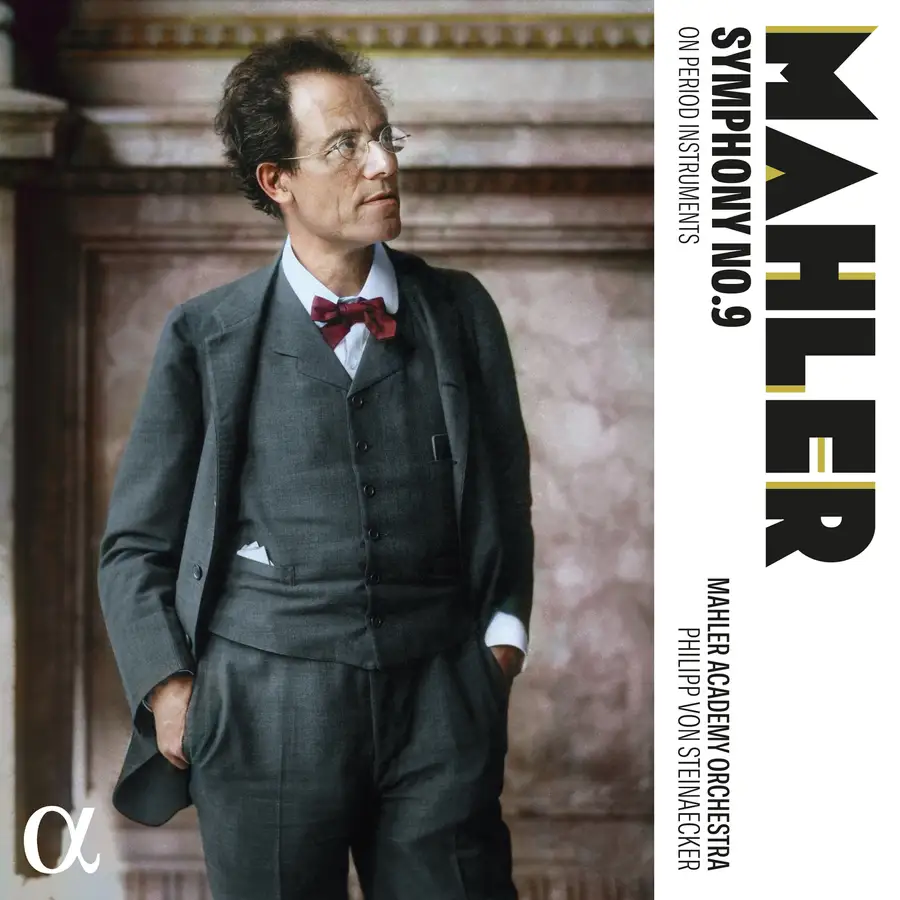
One of the best Mahler 9 in terms of color and sonority
Historical Choice: Budapest String Quartet
Bridge has several volumes of their recitals at the Library of Congress. The Beethoven boxes are immortal, never surpassed. Very reasonable sound.
Dido and Aeneas by Les Arts Florissants under Christie
My Classical Music Blog
I keep a small Classical Music Blog, to record my impressions of the (few) live music events I have attended. Occasionally, if I find time to attend other arts events, they are duly recorded too.
Reviews of CDs, LPs and DVDs I listen to appear in this Audio Blog, however.
HiFi For Sale (Hong Kong only)
Temporarily unavailable
For Questions and Comments
For Comments Comments are welcome any time. After moderation, they shall be published.
For Questions As a rule, don't forget to tell me what you use, and what do you think of the sound, and reservations if any!
A. Questions related to an article/review
(1) Click on Comment (under each article) and post your comment or question; (2) After moderation, the comment/question is published and answered under the article. Hopefully, my response shall be prompt, but give it a few days. (3) Don't forget to tell me what you use, and what do you think of the sound, and reservations if any! My answers may not mean much if I don't know what you're using and how you feel.
B. Questions NOT related to an article/review
If your question has nothing to do with any of the articles, just pick any article, no matter how irrelevant, and post your question. I will get it anyway, but I won't post it as a comment. Instead, if I can answer the question, I'll post both the question and answer in the Reply Section below, in Letters to the Editor-Reply. Again, don't forget to tell me what you use, and what do you think of the sound, and reservations if any! But not all questions get this treatment. Some are just too general to be answered.
C. Email (if necessary) If your suggestion or comment is more of a private nature, you can email me at:
cheaptube@hotmail.com
Unless the subject is very close to my heart, I tend to be quite tardy in replying to individuals, and replying by email can be cumbersome. So, only if absolutely necessary.
Counter 点击次数 (Starting from 由 - 8888 on 18/01/09 开始)
Unique Visitors 访客人数 ( Starting from 由 - 3333 on 22/01/09 开始)
各國訪客 (Starting from由 - 0 on 28/12/2010 開始) 已錄到的國家有 194 Countries and Counting!
If you click Flagcounter you would notice an anomaly: very very few hits from China (accounting for <0.1%) . Blogspot, one of the world's largest, is not accessible in China, which is highly unfortunate even if I write mostly in English.
HiFi CD/LP 天碟一只
This very early Reference Recording LP commands a good price. The CD was not issued by RR, but rko, and I think has been discontinued. The music is strange , best known in HK for 大鼓跌落地.
There are now 3 main Stations in my listening room. Any can drive the same amp and loudspeakers. They undergo frequent changes (in particular the analog playback setups). I use long interconnects between the preamps and amps to facilitate this matching.(Last revised Sept 15, 2019)
Reference System I (Station I)
This one is in front of my chair. I can reach and touch the controls of the preamp.
Alternate Amplifiers: -Sunfire 300 and other amplifiers are used depending on speakers used. -WE 124 (this amplifier is only exclusively used in this system in partnership with the WE106 preamp, an invincible match, but they are rarely used)
Main Loudspeakers: -YL Acoustics 4-way Horn Speakers (used with SET amps) Alternate Loudspeakers (rarely used): -Magnepan MG 1.7 (used with Sunfire 300 amp) -Sonus Faber Electa Amator II -Martin LoganSource (used with Sunfire 300 amp or Elekit 2300B)
---------------
Reference System II: This station is at the other end, housed on 2 racks, and drives the same amplifier. It is quite different in sound from System I. This station can be fully balanced (but not usually). Turntables: 1-Linn LP-12 Lingo/Ittok LV-II/Airtight PC-1
2-ThorensTD-309/Koetsu Black Goldline
3-Technics SL-1200Mk2/Denon DL-102 (mono)
Main Full Function Preamplifier:
-Shindo Monbrison (built-in twin MM and MC input)
(Occasionally vintage preamps: -Dynaco PAS 3 (MM Input); -Harman Kardon Citation I (MM Input); -Brook 7)
Phono preamps and Step-Up's:
-Aurorasound Vida (separate MM and MC inputs) for the Linn LP12 and Technics SL-1200
This is now for reference and archival purposes only. Some of my older articles refer to this. A lot of the gears have been sold or consigned to friends.
While I was in HK, I had 2 locations. The "older location" was where my reference was. The "newer location" was where I spent most of my time from late 2012 to late 2018 (Last revised Nov 15, 2019).
Old Location
Station I:
Loudspeakers: --B&W Matrix 801 Mk II --Audio Physic Step --Ruark Crusader II
Analogue Sources: --Goldring/Lenco GL-75/SME 3009S2i/Denon DL-103R --Kuzma Stabi-Stogi-Ortofon Kontrapunkt C
Digital Sources (RCA/Single Ended): --Sony CDP-553ESD as Transport --YBA WD-202 DAC
Full-Function Preamplifier (RCA/Single Ended): --Wavac PR-X2 --Leben RS28CX Phonoamp and Step-Up: --Kondo KSL-SFz and M7 phono --Denon AU300-LC, AU250, AU320 --Lehmann Black Cube --Audionix ADN-III --Ortofon MCA-76, T-10
--------------------------------------------------------------- Newer Location System A: CD Transport: Sony BDP-S190 Blue ray player DAC: Sparkler S306 CDP: MicromegaCD-10 Integrated Amps: NAD 3020A, NaimNait I and III Preamp: EAR912 Amps: WE 124B and 133 Speakers: Yamaha NS-1000
System B The alternate system: Main Digital System: 47 Labs Shigaraki 4716/4715 Transport/DAC Preamp: Audio Note/Kondo M7 (Integrated) Amp: KondoOngaku Speakers:47 Labs 4737, TAD TSM-2201, Pioneer S-A4SPT-PM and VP, Rogers LS3/5A (15 ohm, single wire)
Subwoofer: JBL
System C Quick listen: CDP/Transport: Sony DVP-PR50P Integrated Amp:Flying Mole CA-S10 Speakers:47 Labs 4737
I have been participating on the internet in various hifi sites for almost 20 years. Looking at things now makes one really weary of the word "progress".
In many ways I miss the earlier USENET newsgroups the most. Posting is super fast and the lack of picture hosting is a real blessing in many ways. Things were simpler then.
Then I created my own Yahoo Group (see link), but I really find the format cumbersome, and now only maintain the site for archival purposes. Who knows, one day I may re-vamp the thing, but too little time....
A few years ago, before the establishment of this blog, I had been active in review33, a site that still a useful second-hand forum (link below). Unfortunately, HK is small and people actually get to meet, which is NOT an advantage for an internet forum. The traffic evolved into 同仁活動, Chinese for insiders' game. There were few honest opinions, and feuds and flames developed over the littlest things. Then there were splinter groups, IMITATORS that are of even more of a 同仁活動 insider nature. That diluted everything and what got lost is HiFi. It would be fair to say most of the forums in HK now contain more junk than value.
Since then I have concentrated on my Blog. It is nice to be able to archive everything well and not let things get covered by waves of garbage. Writing articles take lot more than than posting in forums. Many have long periods of gestation and repeated revisions and editing. I hope you enjoy them.


 Everyday you learn something new! Three Bluetooth Receivers under 125 USD Face Off





 Posts
Posts