Showing posts with label Brand-Linn. Show all posts

22 February, 2019

AkitikA GT-102 Power Amplifier, Audiomaster LS3/5A, Linn Kan, LM3886


Review: AkitikA GT-102 Power Amplifier, Part I
LS3/5A vs Linn Kan

A Tale of Two Amps It's funny how things are. After building and enjoying the Elekit TU-8152, somehow I was on a roll, and summoned enough resolve and energy to build the solid state AkitikA kit, which has been languishing on my "workbench" for several months.

Kudos First of all, Kudos to Stereophile, where I first read about AkitikA. Even though I don't have that much time on my hands, I am a sucker at heart for affordable kits (think: my cheaptubeaudio roots). Midway through Herb Reichert's Review, I have already decided to buy it. I hope Stereophile some day will get to review Elekit!

Second, Kudos to AkitikA, for offering such a good sounding product at such a low cost. Even more admirable is the fact that they did not raise the price even after the rave review, a rare thing in my experience (unlike Bob's Devices, for example). It has to be said too, that it makes some successful tube kit providers (like Bottlehead and Transcendent, to cite only two) seem overcharging (imho these probably got too successful for their own good, and I know their products; they are definitely too expensive when compared to, say, Elekit).

AkitikA The Official Website is excellent, organized to a T and instantly confidence inspiring. Founder Dan Joffe is a bona fide electronic designer as well as amateur musician (hence I believe his ears), who started it to update Dynaco products. Its niche was, and is, the restoration of solid state Dynaco equipment. The Updatemydynaco pages are fascinating. In fact, the amplifier modules are very similar to those in the GT-102. They almost make me want to get some of the ss Dynaco's on the cheap and do some restoration! It also seems Joffe is a respected figure in some DIY forums.

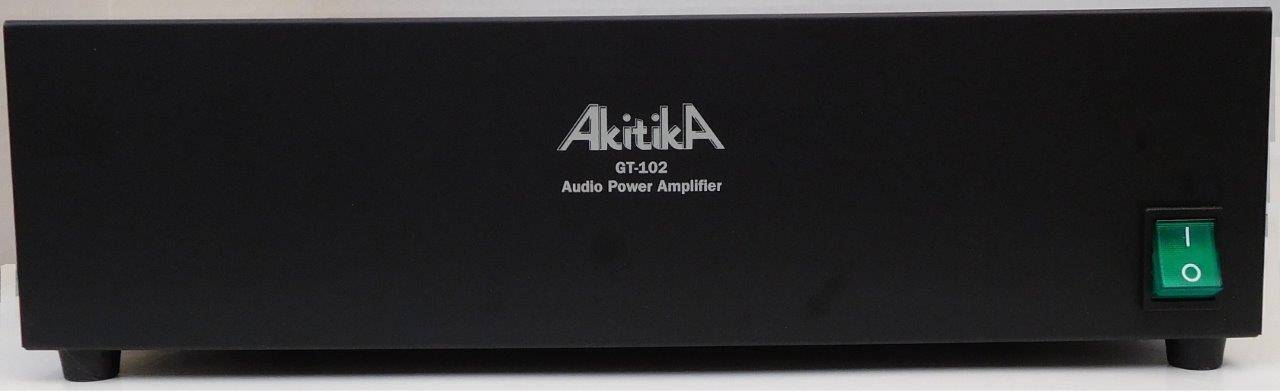
AkitikA GT-102 This is a stereo power amplifier, with a very successful predecessor, the GT-101. The Stereophile review and the official website are excellent and thorough, so I need to provide only brief comments, only those of interest to me.
  • LM3886 Op Amp What really got me interested is that it uses the LM3886 Op Amp, the same Op Amp used in the iconic 47 Labs Gaincard amplifier, which I still own and love, and which has spawned countless Gainclone amps (I completely agree with Reichert's succinct comment on this, which is that most of the clones, including successful commercial ones imho, just don't have that je ne sais quoi quality of the original). In passing, I should mention that I have not formally "reviewed" the 47 Labs Gaincard (4706), but I have commented on it often (should you have the time, use this link and this link for the bits and pieces I wrote; pardon the disorganization).
  • Design and Spec's As a tube man, I am certainly lost. You can get all the info you need from the links. The AkitikA website has the downloadable massive manual, which goes into great details on the design for all to see. It is useful to know, unlike the ultra-minimalist Gaincard, it has a lot of power regulation and protection, and power-on relays. I note from the website that not a few users use them with difficult panel and ESL loudspeakers without problem, despite Stereophile's measurements which show the amp working best into higher impedances, which AkitikA agrees with. Official data shows it to be 50 wpc into 8 ohms, almost doubling into 4 ohms, but Stereophile's data is contradictory.
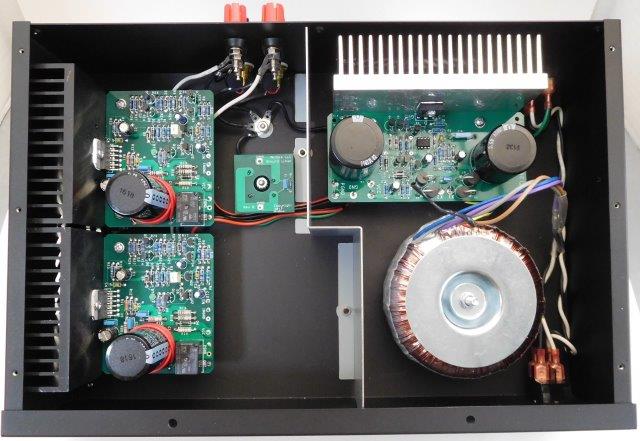
  • Component Quality From the pic, you can see that they are of very good quality.
  • Price $314 for the kit ($488 for assembled) + $26 shipping. For the complexity on offer, I am impressed. This man is not only a designer, he must be a good businessman who can deliver the goods at this price. On the other hand, perhaps he is not a good businessman as one wonders how can he make a profit. More, there is a 30 day money back guarantee, which I doubt anyone will use.
Building the Kit I did it in several sessions. I did not keep time, but I think it was more than eight hours, part of it due to some mistakes that I made.
  • Instructions The manual is massive and, except for a few places, very clear. I do think even a novice will be able to do it. Personally, I like the Japanese manual style (very detailed diagrams and few words) even better, but then this solid state amp has a lot more parts than most tube kits, so I understand.
  • The Printed Circuit Boards They are of good quality, but on the small side. Checking all the parts and stuffing the boards took quite a bit of time. No SET amp, this!
  • Soldering I must emphasize that one must follow the instructions and use a small solder tip. In many places, traces are tightly spaced and there may only be room barely larger than the solder tip to solder on. I'd surmise some novices will find this a little challenging.
  • Wiring Being a Tube Kit Builder actually hampered me a little here. Ground This amp uses a Star Ground that is not so common with tube stuff and that actually demands more wiring. It took getting used to that the ground wire of the speaker post is much shorter than the hot wire. Harness One has to build a harness with different wires and lugs, a little tricky, but all was well explained. But I made a mistake here (see below). Here for connection to the loudspeaker post I substituted my trusted Belden 9497 for the stock cableSignal Cable This is where I made my biggest mistakes. I followed the instruction on Page 27 that tells you how to dress the cable but did not refer to the full instructions on Page 51. Big mistake. Here I substituted the Gotham GAC-2, which I had used successfully for my PAS 3 project, for the stock one. On the amplifier module, after soldering the +/hot wire to IN, the instruction on Page 27 is to solder the drain wire to IN GND, which I did with the bulkier shield of the GAC-2. Then I wondered why there is no mention of the -/ground wire (which I thought should go into the extra and vacant IN GND). Later, when the RCA Connector Ground Lugs were installed, there was no mention of the drain wire/shield. Non-plused, I went over everything and still scratched my head. Finally I read the instructions on Page 51. On my! Basically it tells you to remove the -/ground wire from the stock shielded cable, and use the shield/drain wire as -/ground! This is most unusual, and I have never encountered this before. I was not about to undo the harnesses, so I soldered the GAC-2 shield onto the RCA Connector Ground Lug, which already had the -/ground wire attached. For the amp module end, I unsoldered the GAC-2 drain/shield, cut it, and soldered on the -/ground. This is as I would make an interconnect, shield attached where signal starts and not attached where signal ends. I am not sure what changes this makes to the sound. I wonder why AkitikA prefers to use the drain as -/ground wire - I'd guess the sound of coaxial wire is preferred. In that case, for me Gotham DGS-1, a coaxial cable, would work even better. I'd suggest adding a line on Pg 27 on the special nature of the cable. Lesson: follow every instruction!
  • Operation Mine worked flawlessly from the word go. The relays kick in after a few seconds and one is ready to go. Smooth. And, it is dead quiet.

Bowmboi by Rokia TraoreListening
  • In System III I To test out the amp with as little outside influence as possible, I first employed my System III's front end, comprising the Sparkler S303 CDP and Schiit Saga used as passive preamp. Not to mince words, I was impressed right from the startWarm Up does not seem to be necessary. Sound is very good from the start.
  • Linn Kan I grabbed these for my first session, as they were easiest to get to. These are first generation (I) and employ the same KEF woofers as the fabled LS3/5A. They were placed way in-room, on my Sonus faber stands (kinda near-field listening). The Linn Kan usually prefers close to wall placement as its treble is sharper and bass leaner (than the LS3/5A), and in this position it can sound lean even with tube amps (like my Elekit TU-8300 300B amp). Not the case here. With the AkitikA, the bass is rich, yet tactile, making this the best sound I have had from the Kan I. The Saga is very transparent, and can sound sharp, yet here the combination work superbly well together. The sound is detailed, with notable rhythmic elan. Vocals, male or female, were perfectly rendered, as exemplified by the vitality on offer in Hugh Masekela's Hope (CD, Triloka, OOP); and by the subtle and sinuous delivery of Rokia Traore in Bowmboi (CD, Nonesuch/tama, also OOP).
    You Won't Forget Me
  • Audiomaster LS3/5A (15 ohm) Delighted, I was thus motivated to retrieve my LS3/5A. From the Stereophile review, I knew it'd work a treat and it sure did. The sound was even better than the Linn Kan. Being a fuller sound benefitted the vocals of Traore and Masekela even more. Here I'd say Herb Reichert's findings are right on the money (even if the Falcon LS3/5A he uses are likely sharper sounding than my vintage pair). The sound is so good that I am sure you could do worse by using an inferior tube amp. The AkitikA is warm and inviting, yet its fast transient speed actually complements the LS3/5A, which is usually a little slow sounding with tube amps.

    Bach
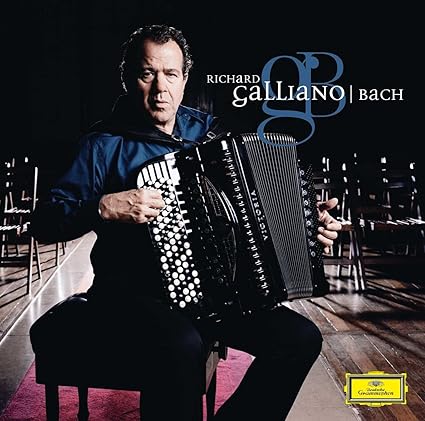
  • In System II Further encouraged, I connected it to my System II front end, comprising Sony XA-5400ES SACD/CDP, Technics SP-1200 Mk II/Shelter 201, Thorens TD-125/SME3009i/Denon DL-304, Aurorasound Vida phonoamp and Shindo Monbrisson preamp. The sound gained from System III, richer and with an even wider and deeper soundstage. With a tube preamp, vocals are naturally even better. Shirley Horn's priceless You won't forget me (CD, Verve) was so utterly compelling that I just had to listen from start to finish (which never occurred before). Not only were the fine modulations of Horn's voice as well rendered as I have ever heard, the piano (herself) and the solos of the guests (a starry cast, including Miles) had startling definition and realism, as did the ambience and audience noise (little). On Richard Galliano's Bach album (CD, DG), I too could not help just sampling, and had to listen to the entire Violin Concerto. For either album, I was not at all sure I'd exchange the amp for even the best tube amps.
Comments
  • Sonic Assessments Overall, there is little question that the AkitikA is an overachieving amp. The most gratifying thing is, no matter what I played, I was gripped and could not stop listening. I am likely to keep it and the LS3/5A for a quick listening system, such is the synergy between them. The LS3/5A works well with UK classics integrated amps like the Naim Nait, but here it is taken to a wholly new level. Rhythm and Pace The AkitikA even trumps the UK amps in PRaT that the flat-earthers so covet. Solid State? Although the AkititkA is just a little warm sounding but, lest you misunderstood from the listening notes above, it is not tube-like. Although vocals and instrumental timbers are alluring, the treble, though not lean, is not quite as harmonically fleshed out as a tube amp. Tube die-hards may demure, but the AkitikA compensates by its enticing performance in other areas. My Mods Here I must say that my substitution of the signal cable and the loudspeaker cable must have an effect on the sound. For people who don't know, the Belden 9497 cable is a very even performer that I have written a lot on; it almost never sounds bad with any loudspeaker, that I am confident about. The Gotham GAC-2 is a very reasonably priced but superior shielded two-conductor cable, which I used for my PAS 3 project (you can read about its effect here). Both cables are likely more transparent than stock offerings. Note that while I'd say the AkitikA is a little warm sounding, I'd not use the word "dark" at all, and my mods may have contributed a little in this area. YMMV. Gainclone? This is not your ordinary "Gainclone", as it is certainly a much more complicated amp. Does it bear any resemblance to the 47 Labs Gaincard? I don't have the latter with me but I know its sound pretty well. I'd say: 1) with both one just keeps on listening to the music; 2) both have rhythmic finesse, but I think the AkitikA is even more accomplished; 3) the 47 Labs Gaincard is a little warmer; 4) obviously, the AkitikA is more powerful.
  • More Coming This is Part I because I intend to further explore this amp with my other loudspeakers, in particular the electrostatic Martin Logan Source. I also may break my own rules and try it out with my 104 db horns (think a Jimmi Hendrix track), which has been the exclusive provenance of my tube amps! I may also take it to my friends and see their reaction. Lots of thoughts, too little time, but this is a fun amp for sure.
You can rest assured there is more to come.

25 June, 2011

The Yumcha Diaries 飲茶後記: 11-06-11 Sonus faber Jadis Boulder Linn

2 views of the Phoenix

The Yumcha Diaries 飲茶後記: 11-06-11The Sonus faber Fenice
Jadis JP800 JA800
Boulder 2008
Linn LP12 with Akiva and Urika

I just got back from NYC when I received a surprise call and from our dear 鄔 Sir Sir, and an invitation to re-visit 盧華煇, aka ML. I had long gotten wind that shortly after our last visit, his system had undergone several major changes. After yumcha, I went alone. Here's the current setup (changed component in red):

Vinyl 1 - Clearaudio Statement-Goldfinger
Vinyl 2 - Continuum Caliburn-Cobra arm-Airtight PC-1 on dedicated stand (not heard on this occasion)
Vinyl 3 - Linn LP-12 Lingo, with Akiva cartridge and built-in Urika phonostage.
Phonopreamp - Boulder 2008
Digital Transport- Metronome Kalista Reference SE on stands
DAC - Wadia 931 Controller + 922 monoblock DAC
Preamp - Jadis JP800
Amp - Jadis JA-800 monoblocks
Speakers - The Sonus faber Fenice
Cables - Siltech speaker cables
da Venezia, the Sonus faber Fenice
Must-Read: Detailed Examination of the speaker (What HiFi)
The raison-d'etre of the visit was this limited edition flagship, called Fenice, one of 30 pairs in the world. I wonder whether the mainland Chinese owners will ever learn how to pronounce the "c" in Italian, though as a whole things have improved - at least some of the newly rich know how to pronounce Gucci, a testament to the success of the Italians in promoting their luxury goods.

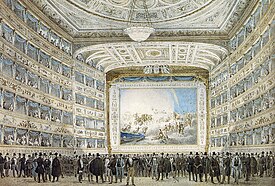
In case you do not know, La Fenice, the phoenix, is also the name of Venice's venerable opera house, which had literally risen from the ashes to remain as much a symbol of the city as San Marco, the gondola or whatever (good read). While I have never set foot inside, I did once stay in the very nice hotel next to it, of the same name.

You may know from my Sonus faber overview (last article, scroll down; or click here) I am a fan of the company's founder Franco Serblin, who has NOT been with the company since 2005. But I no longer have interest in this company now that Serblin is long gone. To draw a parallel, do you think current Mark Levinson is nearly as interesting or as good sounding as the older classics (the answer is, for my taste, no; and they are boring as well)? Still, I'd not miss the chance to hear this rare bird and I am glad I did.

It should be mentioned that in ML's room, the speakers look smaller than his previous ones, and more right in size. Make sure you read the interesting link I provided above, for the design is really quite unlike anything else, though somehow something reminds me of the Clearaudio Statement, also residing in the room. ML told me one of my "friends" (he never mentions names but usually use the euphemism for this "class" of ignoranti, arroganti, illiterati and stronzi of the HK audio scene) insisted the design is totally wrong before hearing a note, but ML thinks the designer should know better. As long as all roads lead to Rome, it is beneficial to try out new things.

Jadis JP800/JA800
ML aptly switched to a tubed system to drive the Fenice. I am sure Sonus faber Asia is still mightily disappointed that ML did not choose Audio Research, which is also not only distributed by them, but owned by the same mother company (incidentally, it may be time to write an overview to recap the glorious past of ARC, now that it is a completely different and much less interesting company without the great William Johnson).

As you may have read from my short Jadis Overview (scroll down below; or click here), I think the JP800 is an updated version of the venerable JP80, and even the tube complement look familiar (ECC82 X 6, ECC83 X 2, EL84 X6, EF86 X 2' all those tubes used in the power supply!). I was glad for the opportunity to hear it. Being a SET user, I am less enthused about the monstrous high-powered JA-800 monoblocks, which employ KT90. They surprisingly did not run too hot, and apparently each tube can be individually biased.

Boulder 2008 phono preamplifier
I was really pleased to be able to also audition ML's new phonoamp, the wonderful Boulder 2008 (Stereophile review). I have previously heard this at our friend 珠寶梁 Jewelry Leung's place to marvelous effect. It was an experience difficult to fault and since then it has gone to the top of my wanted list, despite my usual preference for some tubes in the phono chain.


Volare, or plus ça change?
Since I have previously examined in extreme detail about sound at ML's place, which in my opinion is much more determined by the room as well as power conditioning than by equipment, and the tonal difference between loudspeakers at his place is much smaller than usual, I shall make just a few points:

--The overall sound is improved from the 2 previous visits. A fuller and somewhat more alert sound that can go louder than before without altering image specificity.

--The phono setup is improved. Compared to the FM Acoustics 222 MkII used previously, through the Boulder the Clearaudio Statement/Goldfinger gained some much needed rhythm and pace, though it is still definitely no champ in this department (as a comparison with the LP12 shows). For myself, I have always preferred the sound of Boulder to FM Acoustics (its home electronics all sound colored and artificial to me), so this result does not surprise me.

--The LP-12 shows a clean pair of heels to the Clearaudio in many areas. While everyone preferred vocals through the Linn than the Clearaudio, with guitar music I also found the Linn to be much more informative when it comes to the feeling of plucked strings, portrayal of the leading edge and even the quality of the bass notes' sustains. The on board Urika phonoamp seems to me an excellent one.

--We spent quite a bit of time testing out 2 sets of jumpers for the speakers. IMHO the Audio Note silver jumpers decisively outperformed the stock ones as well as a set of Siltech. I should say though that personally I always bi-wire with loudspeaker designed to be operated so.

02 June, 2011

Group Review: 8 Phonoamps (ARC, AQVOX, PS Audio, Musical Surroundings, YS Audio, Linn, Elekit)

Group Review: 8 Phonoamps
ARC PH-1 and SP-9, AQVOX 2CI mkII, PS Audio GCPH, Musical Surroundings Phonomena II, YS Audio Solo 2, Linn Kairn, Elekit TU-875
Vinyl Talk: Phono pre-preamplifiers
Vinyl Talk: How good are outboard phonoamps?

In this age of the line preamplifier, many people actually prefer outboard phono units. For people like me though, who have held on to vinyl through the birth, middle age and old age of CD, full-function preamplifiers with built-in phono stages are still de rigeur.

It can be said many of my reference (tube) preamplifiers (Nagra PL-P, EAR 912, Verdier Control B, Shindo Monbrison, not to mention older units like ARC SP-10/11, Melos 222, Counterpoint SA-3000 nor truly classics like Marantz 7C) have built-in phono sections of exemplary quality that cannot easily be outclassed by even expensive outboard units. That said, occasionally I do play with some, and recently I tried or (re-) tested quite a few while setting up my various setups in NYC.

For the record, I prefer at least some tubes in the phono section (even with my efficient 100 db horns). I used mainly 3 turntables with my SET setup (see also sidebar) and this rambling review is in no particular order:

--Thorens TD-124/SME 3009 S2 imp/Denon DL-304
--Clearaudio Concept/Koetsu Black
--Audio Technica AT-PL120/Denon DL-102 (mono)

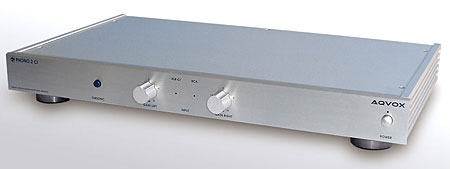
AQVOX 2CI MkII
This one intrigued me the most. Ever since I read Fremer's review in Stereophile I have wanted one, not because of Fremer, but because of the design. Not because of its fully balanced nature, but because of its innovation. My experience with this phonoamp tuned out to be exactly in line with the very thorough report in Stereophile, as well as reviews in tnt-audio and 6moonspositive feedback and particularly from 10 AudioSalute!

The seller of my unit had balanced tonearm cables whereas I do not, and was not about to re-terminate. So I started with the RCA inputs. It performed well but not quite distinctively. So I moved onto the XLR input. Not about to buy their own adapters, I decided to use my cheap Chinese XLR to RCA adapters. I knew this would not work as is, and certainly no sound was obtained by plugging them in directly.

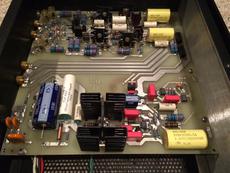
I opened up the adaptors and saw that pin 3 is tied to pin 1, and that is the connection you have to break (pin 1 should not be used). Some quick de-soldering action later, voila! And what great sound! One play of Kondrashin's Philips LP of Shostakovich Symphony No. 15 and I decided it is going to be a long-term relationship. If you know this symphony, you will know that the equipment's main job is to (1) portray accurately the battery of percussion; (2) to convey a certain quality of life ticking away, an enigmatic quality. You may think (1) is not so difficult, and certainly the AQVOX performed miraculously in this aspect. Certainly, I tried the same LP on various phono setups, including tubed ones, and AQVOX's performance remained unrivalled. Even more importantly, it conveyed (2), proving it is not just merely an analytical machine, but a master communicator! A winner!

Audio Research PH-1(PH1)
It is interesting to study how ARC makes phono equipment. Indeed ARC played the most important role in keeping tube preamps and tube phono equipment alive during the transistor years. All the older tubed SP series (which they in recent years revived a little) preamps have built-in phono sections (seriously speaking, they are only MM stage) of superb quality. I have owned and am quite familiar with the SP-3, 6, 8, 9, 10 and 11. In HK, until a few years ago I used the SP-11 MkII as my reference (still with me). With my sensitive horns, the lowish phono gain of the SP-11 (higher than the others) was enough even with my MC, the Denon 103. During these years, ARC made the mostly solid-state MCP series of phono pre-preamplifiers to satisfy the requirements of increasingly low output MC cartridges.

In 1989, ARC abandoned the SP series and introduced the LS series linestages. Of course, they needed to make outboard phonoamps to go with these, and the PH series was born with the introduction of the solid-state PH-1. Since I have always had ARC SP preamps around and they have superb phonostages I did not really need to try these out.

When ARC introduced the tubed (actually hybrid) PH-3 I did try it out. The sound was not quite like the phonostages of the SP series: less full bodied even after tube-rolling, a lighter sound. But its Achilles heel was a lack of dynamics. The nominal 54 db gain was a bit over-rated IMHO. I sold it after a while.

Fast forward to now. Recently I got a PH-1 (full info here) in excellent condition, and I was surprised by its performance. At 48 db, the gain was low and I could not use it with my MC's even with my horns. But partnered with step-up transformers the sound was crisp and full, dynamic and lively, in the best of the ARC tradition.

There is an interesting review of PH-1 by Stereophile-Robert Harley. There is also an interesting comparison of PH-1 vs PH-3 in Audiogon. For me, the PH-1 is a keeper, a better phonoamp than the later, popular and rave-reviewed PH-3. For one as dedicated to tubed phonostages as I, that says a lot. YMMV.

Musical Surroundings Phonomena II can be quickly dismissed. Although it has enough gain for my MC cartridges, and loaded with features, I found the sound curiously lacking in finesse. It has good bass and reasonable dynamics but, most annoyingly, strings lacked sheen. I played several Heifetz mono LPs through the Denon DL-102 mono cartridge and the violin sound was so lackluster it was not better than the AT's built-in phono!!) A switch to the ARC PH-1 immediately restored normalcy. So much for all the rave reviews; it turns out the small prints are much more important than the rest of the reviews.

PS Audio GCPH (Stereophile, What HiFi?) fared much better (see also my previous experience). You can frequently find this phonoamp discounted and so it costs just a little more than the Phonomena, but its performance is in another league. There is just more music, and it performed evenhandedly with all set-ups. MM and MC alike. Heifetz? Yes, I recognize the sound, though I still give the edge to the PH-1. For a cheap full-function phonoamp, the GCPH is well worth considering.

YS Audio Solo 2 Phono pre-preamplifier
And now for something different, but what exactly is a pre-pre? Well, if a phono preamp is like foreplay (which is after all something before amplification), a pre-pre must be what happens before, I guess perhaps seduction, or whatever it takes to get to foreplay.

The active phono pre-pre is now a rare bird and no longer fashionable. In this high-noise age, it is no wonder stressed out audiophiles demand low-noise, and for additional gain when using low to ultra-low MC's usually opt for the even older but quieter technology of Step-Up transformers. An additional powered unit and an extra set of cables certainly can be cumbersome. But I have always thought the active pre-preamplifier has a valid reason for existence, as transformers can be colored and bandwidth-limited, and I still own the wonderful Klyne SK-1 as well as the Mark Levinson JC-1DC (one day I hope to acquire a Counterpoint SA-2). For myself, and perhaps I belong to a minority, if gain, noise or tonality are not issues, I prefer the potentially greater dynamics of fully active amplification rather than having a transformer in the signal path, but as always experimentation is the key here.

YS Audio Solo 2 is that rare bird. As a matter of fact, I cannot think of another CURRENTLY produced phono pre-preamplifier!! And it is one with a twist too. It is basically a solid-state device, but with a tube regulator (solid state rectification >> solid state regulator >> 6N3 regulator >> to gain stage)! I got it in HK but took it to NYC, where I proceeded to try it out in august company. Using the Chinese stock tube it proved immediately a winner. I set all my MC/MM full function preamps to MM and connected the Solo 2 with Kimber KCAG. As expected, it immediately proved its superiority over the JFET section of the Elekit TU-875. More importantly, it was not shamed by the step-up transformers inside the Verdier Control B as well as the EAR 912. Noise is acceptable for use with my Tannoy Canterbury HE, Gain is very good and sounds like more than its spec of 20 db. In NYC, it proved quiet enough to use with my 100 db YL horns. I also tube rolled a bit. The WE 396a proved superior, though a little noisier than the stock 6N3. Unfortunately, my Bendix 2C51 on hand proved too noisy in this circuit. But it is amazing the tube regulator has such effect on sound.

Why not get a free line preamp with your phonoamp?
Outboard phonoamps come in all sizes and prices, but I can tell you one thing: it will take quite an expensive phonoamp to outperform the phono section of (usually older) full-function preamp. And so it makes sense to buy an older full function preamp and just use its phono section via the tape loop. In such case, you would not want a bulky or hot tubed unit, but there are ample choices.

An example is Linn Kairn with Brilliant power supply. Used in MC mode, it has high gain, is quiet enough, and tolerant of loading (works equally well with my Denon DL-304, Koetsu Black and Ortofon MC-5000). Some say it is as good as the Linn Linto. I don't think so, but the performance is certainly very good. For the same price as an outboard phonoamp, you get a full preamp and remote facilities (the preamp ain't bad, but I am a tube man)!

Of course, it would be even better to go tube. Here, you'd want a unit that is not too bulky or hot. I highly recommend the hybrid ARC SP-9's phono section, which offers 46 db of gain. The vinyl replay is pristine, quiet and nuanced, and if I am forced I'd think perhaps even better than the PH-1 . The whole preamp uses only 2 tubes and is only warm to touch. I bet its line section will outperform almost all solid-state preamps in overall strength. Considering its price is only a little more than the PH-1, I think the SP-9 is as good a place to start with tube phono as any. As a matter of fact, the SP-9 is really hard to beat in overall performance, even with much more expensive equipment. It serves as a benchmark for me (see here).

If you're willing to build it yourself, the Elekit TU-875 full-function preamp is a no-brainer. Its MM stage is fully tube, liquid and airy, the MC is more than useable and quiet (though as noted not as good as the YS Audio Solo 2). It is small and simply wonderful as a phono unit, and you get an excellent line section. More on this preamp later.

04 January, 2011

Talk Vinyl: Air Tight PC-1, Ortofon MC-5000 (and MC3000MkII)

Talk Vinyl: Air Tight PC-1, Ortofon MC-5000 (and MC3000MkII)

HiFi Letter from NYC 2010 (9): Magnepan 1.7 Redux
Clearaudio Concept Part IV

Right before I left NYC, I invited newly acquainted AL, a vinyl expert, to listen to my new cartridges (he had expressed interest in the Ortofon MC-5000). He brought a friend and my friends Mark and princetonsound also came. I barely had time to set up 2 systems for them to listen to.

Air Tight PC-1
I first heard the Air Tight PC-1 at ML's place several months ago (report here). I liked it but did not scrutinize it too much as we focused on comparing the Continuum and Clearaudio flagships.

Fortuitously in NYC I acquired a used, but low-hours, sample (not Supreme). I swapped out the Koetsu Black (mentioned previously here) on my Linn LP12 and the sound was instantly captivating through my reference balanced system, similar to that reported before :

Analogue Source: Linn LP12 Lingo/Ittok/PC-1
Phonoamp: BAT P5
Preamp: BAT VK3i (reviewed here)
Amp: Audio Research VT130
Speakers: Magnepan MG1.7
Cables: Fully balanced Gotham GAC-3

The PC-1 has a healthy output of 0.6 mV and did not cause the Phonoamp undue distress. Its internal impedance is 2.5 ohm and I loaded it at 30 ohms on the P5.

It excels in mid-range presence, and with its well-controlled yet full midbass yields a very live and direct sound not unlike horns, or a little reminiscent of Decca cartridge if you will (funny that JV in his TAS review compared it to a Decca). Its bass control is obviously superior to the sometimes rowdy Koetsu Black (the LP12/Ittok may be to blame too), but the treble and high-midrange is a little more clinical than the Koetsu. All in all, all my friends, including Princetonsound and AL, were impressed.

Just a brief word on the Maggies. They sound better in my new room, like all other speakers. Bass is more robust and the top smoother. I am pleased.

Ortofon MC-5000 (and MC-3000MkII)
This time I brought both the Clearaudio Concept TT and Ortofon MC-5000 to NYC. The MC-5000, like the similar MC-3000 MkII, has a ceramic body, uses the replicant stylus (same as in the previous Ortofon statement product, MC Winfield, as well as the current A-90!), an has a very low output of barely over 0.1 mV, mandating the use of step-up transformers. Installation on the Verify arm proved a breeze, and I was immediately rewarded by the sound through the more casual setup:

Source: Clearaudio Concept/Verify arm
Step-up transformers: WE 285L and Langevin 402B (into AN silver cable)
Phonoamp: Linn Kairn (using tape out and Gotham GAC-4 cable)
Preamp: Langevin 102 preamp (vintage cable)
Amp: McIntosh 2200 (Acrotec cables)
Speakers: Magnepan 1.7
As I'd expect the sound was wonderfully detailed, dynamic, and with very wide bandwidth. No frequency called attention to itself. I had actually worried whether the 5000 would be a good match with the crisp sounding Concept. There was no trouble whatsoever. In this different system it did not quite project like the PC-1 did, but in terms of neutrality it was well nigh perfect. By neutrality, please do not think of the clinical kind. Percussion were reproduced with all their sheen, not tinged with whiteness as in lesser analogues (not to mention digitals).

I am also very pleased by the Concept, particularly the arm, which seems to work well with everything, and I still have room to spare in the counterweight for a somewhat heavier cartridge (these now are around 10 gm).
America, in music
Mr AL evidently liked the reproduction of one of his favorite LPs, Varese's Amerique (Vanguard). My copy was an early one, not a re-issue. If you don't have it, I'd urge you to get it for the strangely beautiful music that still sounds modern after all these years.

Words about the 5000 must have spread fast! Despite my protest, my copy was snatched up by AL's buddy, guru TM who merits a separate report all by himself.

A brief note before I stop: In HK previously I had installed the "legendary" MC-3000 MkII on the same TT and if my memory is correct, the 3000 is a little smoother and richer, particularly shining on massed strings. Both are cut from the same beautiful cloth and would be great buys. There are out there a lot more users of the cheaper 3000, and very little info on the later 5000. I hope my little bit helps. You'd be sure to hear more of these beauties in the articles to come.
Addendum on PC-1:
reviews by Ken Kessler; TAS