Showing posts with label Brand-Bryston. Show all posts

23 October, 2011

Review: Verity Audio Rienzi meets Softone ICL

Click pic to enlarge.

Review: Verity Audio Rienzi III

1, 2, 3, Go! Softone ICL

OK, I admit it, part of the reason for the revisit was for the fantastic and wholesome breakfast: eggs, sausage, fresh carrots and cabbage, and home-made bread! Thanks and thanks again! How am I going to do without today! :-(

Before and during breakfast, we had round 1, which used the resident ASR Emitter I Exclusive. Since the sound was not much different from before, I shall not dwell on this part and refer you to my previous reports (here).

Mostly Softone ICL (official website)
This came about because our host Sang just acquired the ICL Model 3 CD player. Yes, contrary to what you read in the commercial press, many people still buy CD players! He wanted to play with my ICL Model 2 DAC and I wanted breakfast, so the visit was arranged. Since I have read that the Verity Audio Rienzi is friendly to flea-powered SET amps (based on a review in Ultra Audio), I decided to take along some extra stuff, and the challenger system was as follows:

Transport/CD Player: Softone Model 2
DAC: Softone Model 3
Preamp: Bryston 0.4B
Amp: Softone Model 1 (300B amp; discontinued; on the floor in the pic)
Speaker: Verity Audio Rienzi
Cable-Analogue: Canare (cheap 75 ohm) and Belden teflon silver-plated (looks like Cello String, but white)
Cable-Digital: Belden (yellow)
Cable-Speaker: Belden 9497
Cable-Power; generic

ONE OF THE MOST JOYFUL MOMENTS IN MY HIFI JOURNEY. Yes, in terms of fun and delight, not absolute performance. And vindication for Verity Audio also. Previously, I had not been too enamoured of Verity, indeed for all speakers of this kind, with one small speaker on top of a "subwoofer" module.

But, on this historic day, with the full system as described, the system cast a huge soundstage, with instruments reaching into the far corners (whereas the ASR only had the center, not even particularly full at that). Instruments gained presence and size, with beautiful and correct timber. Amazingly, the sound had excellent live presence. The voice of Buena Vista Social Club's Omara was smoky and the band swinging. In the duet of Ray Charles and Nora Jones, not only were the voices beautifully differentiated, they tightly inter-weaved to covey a feeling of duo partnership. Grappelli's violin was sinewy, and the system coveyed effortlessly the rhythmic finesse, as it also did with Take Five.

Even with the classical and bigger stuff, the system did well. Yang Tianwa's violin on this most delightful Naxos series was bewitching; with a good system, you should be feeling the bow's return as well as the finger's action, and I did. The orchestra accompaniment had good weight. Musica Antiqua Koln was swinging in this wonderful account of the Brandenburg's. Even more impressively, the second movement of Shostakovich's Fifth Symphony showcased the gutsy playing of the lower strings and very good dynamics. The only track that exposed the limited power on hand was a closely miked piano track.

Now a few words on particular components in the system. I shall not be exhaustive as I am sure I will write a Softone/ICL overview one day:

Softone Model 3 This is a wonderful CD player as well as a transport. Using the same Philips CDM Pro2 laser mechanism, I wonder why people buy over-priced transports like Orpheus and Weiss. As a CD player, the sound is refined and very clean.

Softone Model 2 This is a best-buy DAC that handles up to 24/96. Being tube buffered, the sound is warmer and weightier than the Model 3, and hence likely more suited to the high resolution Rienzi.

Bryston 0.4B This is a surprisingly musical preamp of older (and better imho) vintage. It has absolutely nothing "transistory" about it. To this dedicated tube preamp user, this is the highest praise.

Softone/ICL Model 1 This is a surprisingly sophisticated design (as most ICL products) 300B amp (there is also a 2A3 version) of fixed bias design, with 330V at the plate and the 300B run at 65 mA. Surprisingly, using only small output transformers, it can be driven very hard and outperforms many a costlier SET amp. Since I had not used it in a long time, I randomly took a pair of Chinese 300B and tested it in the morning. I measured it to make sure it was not over-biased. Boy, it was only running at 33 mA, lower than you'd run a 2A3. You know what? I did not re-bias since it sounded just fine with my Tannoy. So, this amp now is running at much less than full power; I'd estimate only outputting 3 watts or so.

Verity Audio Rienzi This experience completely changed my view of VA. Previously I had heard several pairs at shows and in homes. At best I'd say they were hifi-ish, not particularly attractive (I'd say the same about the over-rated Wilson Watt/Puppy). I had even heard a higher model driven by a full Monty DIY EL34 amp and the sound was sleep-inducing. So imagine my surprise this time. The Rienzi is lightning fast and superbly transparent. It may be a trifle too bright for my taste but I think that can be easily rectified. More importantly, unlike most Wilson Watt/Puppy, the two boxes appear to be coherently integrated (although not so when the ASR was used). Most surprisingly, it has excellent rhythm and pace as well as a live presence, very rare qualities in loudspeakers.

The Rienzi is obviously a tube and SET friendly loudspeaker. Given the already mightily impressive performance with the lowly Softone/ICl amp, I would say it is a marriage made in heaven. My great happiness is not only for the host, but also because I am happy there is another good loudspeaker for SET amp users. There is no way I personally would use this speaker with anything else but tubes, and preferably SET amp at that.

Of course, the Rienzi is still not a large, nor fullrange, speaker, but given its modest footprint it is a worthwhile effort.

Epiphany!

03 September, 2010

Review: YAMAHA NS-1000

Note: After the big job of re-labeling I just performed on this Blog, as part of my re-organization, I'm going to eliminate my other sister audio Blog (Review and Overview), to let everything be archived here. Today I'm duplicating all reviews from my sister Blog here. This may cause inconvenience for a few users who follow some of my items; my apology. In the long run, this shall be a lot more efficient. For regular posts, scroll down to 01, Spetember and below.

Figure: The making of Yamaha Beryllium drivers (via TheVintageKnob)

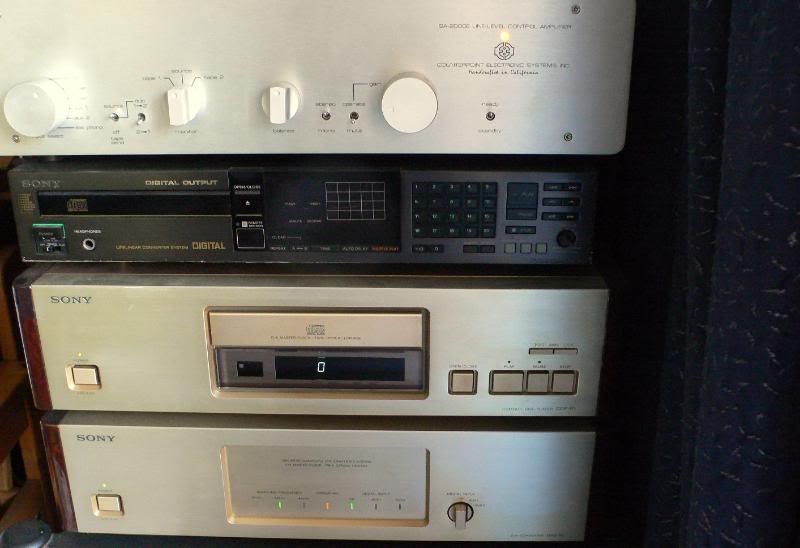
Review: YAMAHA NS-1000 (Sony CDP-R1/DAS-R1 and CDP-553ESD; Meridian 206; Counterpoint SA-2000E; Bryston 4B)

Before my coming articles on iPod and Music Server, I'd like to introduce you to this famous pair of monitors, which I happened to be using for the assessment of my digital iPod files.

YAMAHA NS-1000(M), from the mid-70's, enjoyed a long production life, and has several permutations. It is famous for being a very accurate monitor, and even more for being the first to utilize Beryllium drivers, not one but TWO at that, pre-dating Focal JM Lab by almost 30 years! Talk about "progress"! Read this site for history, spec's and more (make sure you click "more")! NS-1000 is also undeservedly infamous for being "bright".

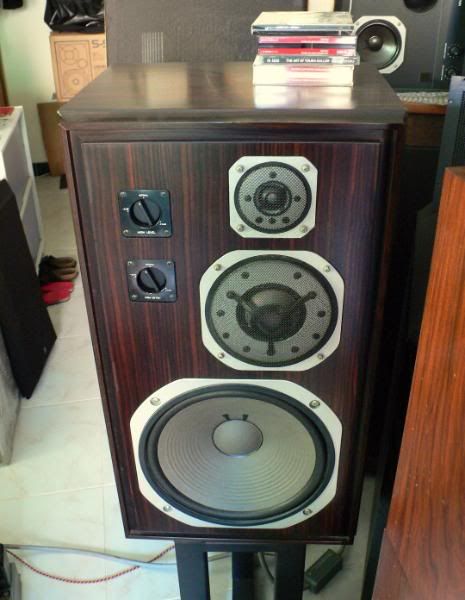
Figure: Right speaker (designated) of mirror-image pair.

My pair (serial # 11466R/L) is the heavier "home-use" version with REAL wood cabinets, and how beautiful they are. These used to belong to a friend of tubediyer and I had the luxury of trying out before buying.

When they first arrived, sound was decidedly sluggish, probably due to long-term dis-use. I have them 2/3 of the way into the room, in relatively close-field position. After re-running them in, sound steadily improved. One day, I began to get only intermittent sound from the right mid-range unit and it eventually lost sound altogether. I took it out and found that the soldering joint for one crossover cable had completely disintegrated! I had difficulty cleaning and re-soldering the terminal. But after I finally managed to do it, sound took a significant step forward.

I have been driving the Yamahas from my second station, appropriately a half-Japanese one. Let me digress a little to talk about these CD players. The SONY CDP-R1/DAS-R1 was the flagship of the 16-bit TDA 1541A era. Connection using the propreitary SONY Twin Link optical cable is said to offer the best jitter reduction. Although this method does not seem to confer more details (and non-ATT opticals are not my favorites), compared to the other S/PDIF inputs though a darker background is revealed. What I love most about this DAC is its composure, an ability to maintain a rock-like stability during loud passages. I personally judge its ability in this regard to be better than most of the theoretically superior 24/96 and 24/192 decoders, including the very expensive ones. And better than most of the famous professional CD players of this era, including Studer/Revox (D730/226) and EMT (mind you, I have the EMT 931) , though perhaps not better than the little-known SONY professional 3000, a rare bird that I had the good chance of hearing in NYC recently.

A replay of a Bruckner or Mahler symphony is such a pleasure through this machine. Let me cite some examples. On the Tennstedt Live LPO Mahler 5 (Japanese EMI) the first BIG orchestral crescendo is not rendered correctly on most machines. On the R1/D1 you can hear the entire backbone of the cresendo, and it just seems steadier, longer and better, each moment a little more than the previous, and isn't that what we want?? On most machines, the crescendo just peaks too quickly, a sort of premature ejaculation! Last night I played the ALTUS (Alt-129) Shostakovich 1st, captured by Japanes engineers in the late 60's, and the recording has a shocking realism, definitely among the best live recordings I have heard. I must tell you that through the Sony combo it doesn't matter whether I am using the Yamaha or the sensational Usher X-708 I can rest assured I get all of that. Here I must also praise the worthless (in terms of current price) CDP-533-ESD, which uses a priceless transport and delivers a pristine signal that I sometimes prefer to the R1 (hush...)!!! If you find one with laser in good condition, grab one, it'll slaughter most modern transports! And the sound through its own DAC is not bad either...

Figure: Meridian 206

That said, there's a downside to the Sony R1/D1: a certain inaccuracy in rhythm and pace, something most audiophiles who just listen to slow saliva songs do not undertsand . So, while it plays the 3 B's great, Stravinsky's unusual meters may just seem too earthbound. Even in vocals, my newly acquired Meridian 206 (Delta-Sigma version) just beats it. Nothing is perfect, as the Meridian shall lose something in large-scaled replay. There are many generations of Meridian. I don't quite like their 1-bit era, but this 206 is a surprise indeed. The sound bears more resemblance to later 506/508 Meridians, which are not that far off (even better in some ways) than current ones. One can safely say though, Meridian knows their digital!

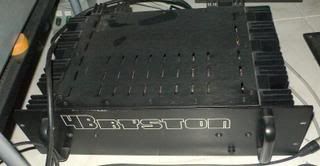
Figure: The original Bryston 4B. Ugly!

Where are the contributions of the preamp and the amp? They are sleepers and guardians. The Counterpoint 2000E is just a 3000 in linestage configuration and a close approximation to the 5000. The Thousand Series is in general more analytical than the older Point One series, more extended at the frequency extremes and less euphonic. The E version denotes balanced-out option provided by IC conversion. Despite that, I have determined that it is the better way to connect the XLR-in-only Bryston 4B, losing very little the tube liquidity and gaining dynamics. Now to the amp, my 4B is an old version, which looks a lot coarser than the subsequent ST and SST versions. However, in terms of driving power, the older versions is a powerhouse and more powerful! It is supposed to be "coasre", but I find an hour of warm-up and mating with a tube preamp is just fine. The 4B its little brother 3B are my ss workhorses.

The setup drove Yamaha beautifully. I get a big sound and do not suffer from so-called "agressive highs", and this without attenuating much of the pots! The 90 db Yamaha's are not that difficult but do need power for the bass to fill out. After a good amount of run-in at good level, sound is fast. and the amount of detail it retrieves is simply phenomenal. With my setup, nothing grates the ears. Most of the negative criticisms simply reflect the low-quality equipment people partner these with. What's pricelss is the sense of presence, as evidenced by playback of the CDs mentioned above. The comments about its similarity to JBL is not completely unfounded. Bass is deep and tight, but peters out around 40 Hz, though it does not have the mid-bass coloration of JBL. Meanwhile, the soundstage is to die for, matching the best of the modern speakers. What is really unusual to me is that they lack almost nothing; it's hard to pinpoint particualr weakness. Great Monitors that I can trust testing to!

A lot of people have heard my Yamaha's and they were all surprised by the performance of these 30+ year-old designs. Robin the music-loving Scot came one fine day and could not stop marvelling. He is as good a judge as any, as he has recently got a pair JM Lab Mini-Utopia Beryllium! Two weeks ago Danz also came by. He was amazed that they sounded nothing like what he heard before. We had all heard these previosuly at a delaer, driven by a Music Server and Benchmark DAC. Very dry and distorted sound; perhaps the computer playback had needed some improvement. Well, matching I guess.

10 comments:

CapnDad said...

Hi,

I'm scouring the internet trying to find the right configuration (left/right) for the NS-1000M speakers. i.e. aer the tweeter and midrange speakers supposed to be on the outside or the inside? I've had them on the inside for the past 25 years and I think I'm wrong.

thanks,

John Davis

CapnDad said...

Hi,

Are you saying that the NS-100M speakers ae to be configured with Left and Right from the listeners perspective or from the speaker's perspective? I've had the tweeters and midrange speakers on the inside for the past 25 years, but perhaps that's been wrong all this time?

Thanks,

john Davis

doctorjohn said...

Hi, sorry for late reply.

I was told to have the tweeters outside, but have no link to back this up yet. Let me call the person who told me this.

In general (as in JBL) the studio stuff has no definite rule. The NS1000 manual says it can be placed horizontally too (this gives better sound with a lot of pro or pro-derived speakers)

Centrally placed tweeters may have better "pinpoint" imaging, but outwardly placed ones may result in a better soundstage. Mine is quite enormous!

Experiment with toe-in too.

Glad to hear from another user. Cheers.

CapnDad said...

Thanks for the reply. We spent all day Saturday setting them up. We experimented with toe-in,distance apart, distance from the ear, and so on. We ended up with the Tweeters on the inside mainly because when they were outside they felt like they were too far apart. but not having a lot of room, we surmised we could just switch them to compensate rather than push them closer together.

That worked well. At the end of the day after all the small moves, an inch here and an inch there, they sound amazing!

We've had them for almost 30 years now and I've had them repaired once... last week...when the tweeter separated. Now they sound good, or better, than new.

Cheers

CapnDad said...

THanks for the reply.

We spent all day Saturday setting them up again after coming back from Tweeter repair. The Tweeter had separated so there was no crack and no need to replace the domes with inferior cone products.

We experimented with the Tweeters on the inside and the outside, but ended up with them inside. A lot of that has to do woth room size, and we just felt that on the outside they needed to be pushed closer together. Rather than do that we switched them.

That, combined with a lot of toe-in experiments in half inch increments, got us the sound we love. Good sound stage, great tone, and much less fatigue than we've had in different rooms.

Great speaker, and I can't believe sometimes that when I bought them it was simply because they sounded good.

cheers

doctorjohn said...

Hi, I am glad you're finally getting the sound you want. I spoke to some friends and we all agree there's no fixed rule.

One day I'd urge you to try them horizontal. My space doesn't permit it though previously I got great result from my JBL 4312B that way.

A tube preamp can remove most of the "glare". In my system the Yamaha never sounded harsh at all. Curious what gears you're using?

TruthSpinner said...

In my pair I experience ringing from one of the midrange drivers when I knock on top.

Any idea what might be causing this?

doctorjohn said...

Curious, this ringing. Tubes can ring due to microphonics, but drivers! You don't happen to have a tube preamp on top?

CapnDad said...

I must have missed your earlier reply when you asked what gear I'm using. I'm running a MacIntosh MA6300 Integrated Amp, Rotel RCD971 HD CD Player, and a Linn Basik turntable.

TruthSpinner said...

Nope, this happens under all vercumstances. Somehow I am able to induce hearable (quite so) vibrations in some metal part(s) inside the driver, and I guess this should not be possible?

15 October, 2009

The Yumcha Diaries: 10-10-09

(Click on pics to enlarge)

The Yumcha Diaries: 10-10-2009


Part I. Pondering the evolution of the Republic took second place to music.
LKT, a famous photographer of HK, is an old friend whom I haven't kept in contact much. Recently we met again because of certain hifi matter. 10.10 双十 is a day that should not be forgotten, not because it's Taiwan's National Day, but because it's significance dates back to the old Republic, a day in history. After yumcha, three of us went uphill to LKT's beautiful flat, where we were later joined by mutual friends the Robin couple. LKT is a frugal audiophile who dabbles in DIY stuff. System:

Digital: Eastern Electric (1 tube)
Preamp: Much modified Ming Da tube preamp (5Z3, 2x 12AX7; 2x 6DJ8)
Amp: Bryston 4B SST
Speakers: Proac D28 (jumpers)
Cables: Lots of DIY silver stuff

From the start the system showed a preference to jazz, which had good presence. However, with violin and classical material, midrange was a bit sucked in and sound a little thinned out, though never unpleasant. We were very happy with the various esoteric CDs he played for us (highly recommended; see pics; click to enlarge). After a while, I noticed that he had both the +/- of the speaker cable into the woofer input, and therefore asked him to try having the + going into the tweeter input. Much to our surprise, the sound transformed, much more than usually, into a much fleshier whole. The midrange was no longer reticent, the presence even stronger, and the whole was organic sounding. Not bad at all for a little work! Decent sound! After this, we just spent our time sipping tea, eating the excellent 绿豆糕 from Taiwan, and listening to interesting music. How refreshing not having to listen to yet more "audiophile" albums!

(Click on pic to enlarge)

Part II. From Beryllium to Beryllium

Then everyone went to Robin's place to audition his Yamaha NS1000. I reported a visit in January (click here; check out the equipment list there too) and much has changed since then. The first thing that happened was when Robin (unusually) picked up a Garrard 301 in Taiwan for a good price. he is using it with Audio Technica's evergreen OC-9. The next big change came about when he visited me some months ago. He expressed his reservation about Beryllium and I demonstrated my Yamaha NS1000 to him. He had long been interested in this legendary speaker due to reports in the UK hifi press, like HiFi World. Robin was immediately smitten by its sound and got a pair soon after. recently we have been playing with these and I loaned him a pair of Foundation.

The sound of the turntable was positively one of the best phono setups I have heard (using ARC Sp-11's phonostage, which seems to have more than enough gain for the OC-9). Fully fleshed out sound with beautiful dynamics and a fast leading edge that is just right. I was mightily impressed by the OC-9, which seems to possess the usual AT virtue of clarity and speed but habor not even one whit of AT's somewhat hot treble. It makes me want to take out my ART2000 and install it! Compared to the JM Lab Micro Utopia Be, the Yamaha just seemed so right, and so Beryllium tweeters need not be hot-sounding. Compared to my in-room placement, it suffers little from placement against the wall, sacrificing just a little depth and with a mild boost in bass.

Compared to the LP, the Stello setup seemed rather anemic. Even the host was not too interested. Work is in progress to bring the digital chain up to par with the phono, no easy task.

What a bargain, the Yamaha. For more info, read my observations on my own pair (click here).