Click pics to enlarge. Note DG Karajan box on top. Bottom L is part of the DVP; to the right, the Gophert SMPS.
Letter from Shenzhen (23-3): Home Alone with Revox 720 722 Loose Ends
Streaming Classical (23-1): Karajan Haydn Mozart
Book: John Berger
Streaming Classical (23-1): Karajan Haydn Mozart
Book: John Berger
Early on I decided not to go to Guangzhou and rather spend CNY by myself. Aside from the usual daily chores, I did a few things (not all audio related) which I shall record here. As during this time I had the Living Room (LR) all to myself, the first thing I did (on New Year’s Eve) was...
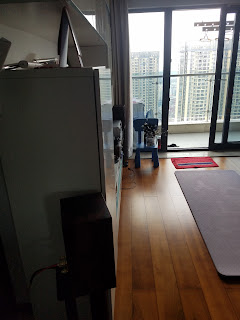 Reconfiguration of the LR System Before I was using various Aiyima products (mostly T9) to drive the Anubis LS3/5A (here). Since my main listening room, the study, now has transitioned to all-tube (here), I moved my trusted Revox 720/722 combo out to the LR and installed it. Chinese Bubugao DV-997 serves as CDP. Bubugao was maker of now-defunct Oppo, which were once widely popular (and perennial recommendations in trade mags) for their universal players. Mine is just an old DV Player, but a top one that is sonically superior (modified a little by someone in HK, then HKD 1K). General Sound Despite its relatively compact size, the Revox 722 has plenty of power to spare. Compared to the Aiyima T9 (run at 24V), sound is much more authoritative in my big LR (speakers are 2.6m apart, and I listen from the sofa, 3.4m away). This portion of the LR is 3.6m by 4.2m, but it is an artificial mental line, as the space extends much more to the left (the dining room and open kitchen) more than doubling the area. It is a joy to listen to the Revox pumping out juice, and the Anubis sounds significantly better than usual too. I mentioned to jules last night that a lesser system in a big room can be even more satisfying than a better system in a smaller room, and that may be the case here. No, it doesn’t quite have the details and refinement of the main system, but having music resounding in a large space is something else. Revox 720 Preamp As I needed at least 2 inputs, the preamp comes in handy. It also has balance adjustment (a slider rather than a knob, as is the volume), which is very useful for me, as I like to sit near the window rather than in the center. Which is also why I toed in the left speaker quite a bit. With the help of the balance feature, I can get the music filling out the center. This is also the reason why I don’t use the Aiyima T9 as Preamp, though I may re-evaluate it next round. I don't have much use for tone controls but would like a balance knob (unfortunately not present either on T9 nor my tube preamp in the study). The 720 actually has a decent tuner, but there are no classical stations here (HK has RTHK4). Aux vs Tape In I had the DVP hooked up to the AUX and the Aiyima T9 Pre Out to the Tape 1, and found that the DVP was much louder. Reversing the inputs brought the opposite. So the Gain of Aux is much higher. I only just now recall that the Revox Preamp has small screws below each input to adjust the gain. Next round I shall look into this to equalize. Aiyima T9 Now I had the Aiyima T9 connected to the AUX primarily to use it via its Pre Out for its Bluetooth (which benefits from higher gain). In Pre Out mode, the power meter cannot be relied upon for adjusting correct level. So it was empirical and more precise tuning shall have to wait till next round. I also did test the Aiyima as DAC. I connected the Coaxial Out (using XLR 0.4) and Optical Out (generic) of the DVP. Sound was initially comparable, but after some to and fro I came to realize that the DVP analog out is better with the swells of massed strings - just more real. And so I removed the digital connections. I may test out my other BT devices later, as it’s kind of clumsy to use the T9 only as BT via pre out. So much for this setup for now.
I get up early, usually around 6:30. The sky is still dark. After boiling water, I’d have some instant coffee, just for the jolt. Still considering a coffee maker (one more item on the cramped kitchen counter). Usually, I’d just read till the sun comes up. But in the past few days, I’d turn on the lamp by the sofa, turn on the system and start listening to CD, something I haven’t done for almost 2 years!...
KARAJAN Symphony Edition (DG), Haydn, Mozart This 2008 38-CD megabox is a great bargain, and solid basic repertoire. Amazingly, unlike many other boxes that come and go, it’s still in print, 15 years later, still at bargain basement price (Amazon is $53). I don’t have that many CDs here, though I have 4 boxes of Bruckner and 2 of Shostakovich (that shows you where my sympathies lie). What better music to play during the new year than Mozart and Haydn? I started with Mozart on New Year’s Day. It is not an exaggeration to say the music infused my soul and was uplifting. I soon went through all 3 CD’s. Karajan made some very good Mozart recordings before on EMI (overly reverberant acoustics) but these 70’s recordings have better sound. The execution is just perfect - one hears everything when one should, and nothing when one shouldn’t - artless indeed. There is little question that the BPO of old was much better than its impersonal counterpart today (imho, Abbado and Rattle ruined the orchestra’s classy sound). Down to the last piece, they are coherent and meticulously balanced - classical indeed. Then I moved on to Haydn, and it was an even greater joy. The Paris and London Symphonies total 7 discs, and I’m one short of the finish line. Not having re-visited these in decades (I have these on vinyl) I am highly impressed by the discipline and verve of the team - everything moves forward, nothing sticks out, and there are moments of humor and even Brucknerian grandeur. I grew up on the Bernstein, Ansermet and Szell recordings, but these are even better in overall execution (and sound). The only other one worth noting is Kurt Sanderling’s Berlin RSO set of the Paris (Eurodisc), absolutely proper and sonically superior (oop; but probably can be streamed). Of course, I’m not talking about HIP Haydn that is prevalent now. Mind you, I’m a fan of, say, the ongoing cycle of Il Giardino Armonico/Antonini (Alpha) but I think there’s more than a place for these grand old performances with big orchestras. Where the small HIP ensembles can deliver a shock, the bigger BPO can deliver grandeur, and that’s a completely different thing. To use an audio comparison, it’s almost like a small room compared to a big one. Karajan is not “known” for his Mozart and Haydn, but here I think he is owned his due. This box set is a contender in every composer and can form a keystone in one’s library. If you still prefer CDs, get it. You can stream almost all of it too.
Sometimes though it’s better to have no music at all. In the wee hours or first thing in the morning with coffee, a good book is bliss...
 JOHN BERGER A Fortunate Man Despite the limited resources (in English), I’ve read more books here in SZ than most time in the past. I actually have a little personal thing relating to Berger. Many years ago, an artist friend of mine recommended Berger’s Ways of Seeing, but I forgot about it. A few years later, a Taiwanese friend was translating the book, and asked me to go over the proof. I did, and made many suggestions that she might not have liked. Truth is, as a sometime translator (erstwhile and amateur; I have done poems, art catalogs and exhibits etc), I realized the big divide between the very precise English of Berger and the inherently imprecise Chinese language. Then, I realized what a masterpiece the book is. Fast forward to recently, when I borrowed this book from the very limited English book selection of the local library. Like Ways of Seeing, it is one of the most engrossing books I have ever read.
Berger calls it an essay. It follows the practice of country physician John Sassall, and probes in depth the relation between the healer and his subject. It surveys the landscape of a less affluent sector of society. Importantly, it emphasizes the devastation of cultural deprivation - spiritual poverty. The work is prescient of our current society, urgently in the UK but just as true in the US. A social commentary and condemnation that is even more relevant today. Should you be interested, there is a huge amount on this book on the internet. I started it sometime ago, but finished it this CNY. Everyday I still think of the book - that’s how good it is. Of course, as a trained person in the field, I can easily relate to the subject, and indeed find the hero, practicing solo, highly skillful and, well, positively heroic.The only problem is, I have trouble thinking of what to read next. I may also write another short article on this book, as I’d like to share some of the texts with you.
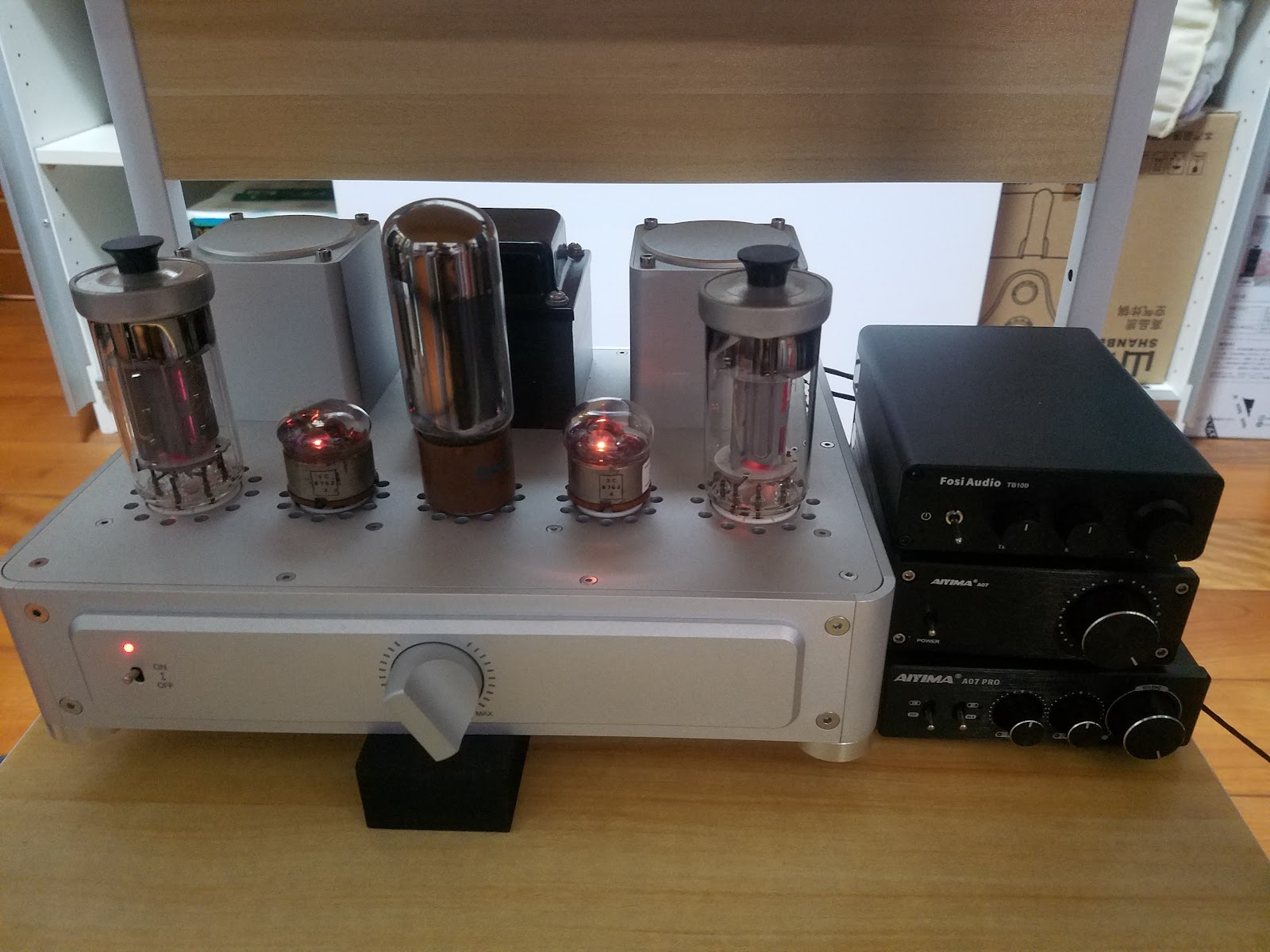 More Aiyima Previously, I had tested out the Aiyima A07 (for many, a perennial fav) and its latest incarnation, A07 Pro (with the Fosi TB10D thrown in too). In preparation for writing a short article on the trio, I have re-listened to them in my main setup as well as the LR. Watch this space.
Tidal Some time before the CNY, my HK friend Sang/Seng, whom I had featured (as Home Visits) many times in the blog, surprised me by including me in his new Family Plan of Tidal. This had not come out of nowhere. Seng has always been an avid classical listener and loved to browse and buy CDs. For the longest time, I had been persuading him to start streaming seriously (he had Spotify, but the LOUD ads are basically intolerable), to start with Bluetooth for nothing. About half a year ago he finally capitulated and bought the FX Audio BL-MUSE-01 I had previously recommended in this blog (here). He was using its digital out into his own DAC and deemed it satisfactory. Not long after he established his footing, he took the leap and subscribed to Tidal! And so, I have Tidal here, and I love it for the pop and jazz on offering. I shall be penning a Tidal article, likely in conjunction with some of our other authors in HK.
I get up early, usually around 6:30. The sky is still dark. After boiling water, I’d have some instant coffee, just for the jolt. Still considering a coffee maker (one more item on the cramped kitchen counter). Usually, I’d just read till the sun comes up. But in the past few days, I’d turn on the lamp by the sofa, turn on the system and start listening to CD, something I haven’t done for almost 2 years!...
KARAJAN Symphony Edition (DG), Haydn, Mozart This 2008 38-CD megabox is a great bargain, and solid basic repertoire. Amazingly, unlike many other boxes that come and go, it’s still in print, 15 years later, still at bargain basement price (Amazon is $53). I don’t have that many CDs here, though I have 4 boxes of Bruckner and 2 of Shostakovich (that shows you where my sympathies lie). What better music to play during the new year than Mozart and Haydn? I started with Mozart on New Year’s Day. It is not an exaggeration to say the music infused my soul and was uplifting. I soon went through all 3 CD’s. Karajan made some very good Mozart recordings before on EMI (overly reverberant acoustics) but these 70’s recordings have better sound. The execution is just perfect - one hears everything when one should, and nothing when one shouldn’t - artless indeed. There is little question that the BPO of old was much better than its impersonal counterpart today (imho, Abbado and Rattle ruined the orchestra’s classy sound). Down to the last piece, they are coherent and meticulously balanced - classical indeed. Then I moved on to Haydn, and it was an even greater joy. The Paris and London Symphonies total 7 discs, and I’m one short of the finish line. Not having re-visited these in decades (I have these on vinyl) I am highly impressed by the discipline and verve of the team - everything moves forward, nothing sticks out, and there are moments of humor and even Brucknerian grandeur. I grew up on the Bernstein, Ansermet and Szell recordings, but these are even better in overall execution (and sound). The only other one worth noting is Kurt Sanderling’s Berlin RSO set of the Paris (Eurodisc), absolutely proper and sonically superior (oop; but probably can be streamed). Of course, I’m not talking about HIP Haydn that is prevalent now. Mind you, I’m a fan of, say, the ongoing cycle of Il Giardino Armonico/Antonini (Alpha) but I think there’s more than a place for these grand old performances with big orchestras. Where the small HIP ensembles can deliver a shock, the bigger BPO can deliver grandeur, and that’s a completely different thing. To use an audio comparison, it’s almost like a small room compared to a big one. Karajan is not “known” for his Mozart and Haydn, but here I think he is owned his due. This box set is a contender in every composer and can form a keystone in one’s library. If you still prefer CDs, get it. You can stream almost all of it too.
Sometimes though it’s better to have no music at all. In the wee hours or first thing in the morning with coffee, a good book is bliss...
Berger calls it an essay. It follows the practice of country physician John Sassall, and probes in depth the relation between the healer and his subject. It surveys the landscape of a less affluent sector of society. Importantly, it emphasizes the devastation of cultural deprivation - spiritual poverty. The work is prescient of our current society, urgently in the UK but just as true in the US. A social commentary and condemnation that is even more relevant today. Should you be interested, there is a huge amount on this book on the internet. I started it sometime ago, but finished it this CNY. Everyday I still think of the book - that’s how good it is. Of course, as a trained person in the field, I can easily relate to the subject, and indeed find the hero, practicing solo, highly skillful and, well, positively heroic.The only problem is, I have trouble thinking of what to read next. I may also write another short article on this book, as I’d like to share some of the texts with you.
Tidal Some time before the CNY, my HK friend Sang/Seng, whom I had featured (as Home Visits) many times in the blog, surprised me by including me in his new Family Plan of Tidal. This had not come out of nowhere. Seng has always been an avid classical listener and loved to browse and buy CDs. For the longest time, I had been persuading him to start streaming seriously (he had Spotify, but the LOUD ads are basically intolerable), to start with Bluetooth for nothing. About half a year ago he finally capitulated and bought the FX Audio BL-MUSE-01 I had previously recommended in this blog (here). He was using its digital out into his own DAC and deemed it satisfactory. Not long after he established his footing, he took the leap and subscribed to Tidal! And so, I have Tidal here, and I love it for the pop and jazz on offering. I shall be penning a Tidal article, likely in conjunction with some of our other authors in HK.


 Posts
Posts