Showing posts with label Letter from Italy. Show all posts

26 September, 2022

Nagra VPA MSA Quad 77 909 Pass F5 Pamphonic 3000 Tektron

Click pics to enlarge. Top, One of the Author's many setups. Nagra PP 300B amp in center; VPA monoblocks flanking it, all driving the Tannoy Yorkminster.

Letter from Italy (22-3): M Surdi on What Make His Tannoys Tango

Editor: There is so much I agree with and want to comment on, but I want to preserve the densely textured wholesomeness of M Surdi's writing that I shall refrain and perhaps later write a companion article. Keep in mind his room is fairly big.

Previously, M Surdi wrote on his long Tannoy journey, an article not to be missed (here). The current article discusses the electronics matching during the long period.

We may take it as a given that all audiophiles are OCD afflicted. However, even terminal maniacs must balk at a blow by blow description of the decades long pairing of the four sets of Tannoys I have described in my previous post - some 25 different power amps and integrateds (and that’s keeping preamplifiers out of the mix).

Any credit accorded to my musings should also take into account the fact that musical proclivities may change with time. As an archetypal Sixties survivor, I’ve travelled the usual boomer arc from rock to baroque, Animals to Allegri, ZZ Top to Zelenka, and most alliterations in between. The Tannoys caught me in mid-journey, when punch and drive (represented by Tina Turner belting out Acid Queen, on AR-LST’s no less) were gradually giving way to midrange, proportion and all-around tone. This obviously had an impact on amplifier choice and preferences (though Biber’s Missa Salisburgensis is no chocolate box affair).

That being said, in order to cut through product clutter, I’ll be passing my judgments by amplifier categories: transistor, class AB to A; tube, push pull to SET; and class D; with some final comments on bi-amplification. With the intent of keeping things from getting even drier I’ll also be throwing in some gratuitous comments on mismatches and quirky combinations. Not, however, before raising Two Useful Signposts: best amp ever heard on Tannoy’s are the Nagra VPA monoblocs, hardly a surprise since these are the best amps I’ve ever owned (and sold off because of serious mental issues). Worst amp, and by a long chalk, is the noxious Meridian 551, a high powered sand amp which in conjunction with the equally toxic 501 all digital pre was so bad that even patriotic British reviewers could only hang their heads in shame.

Now, to Sand Amps and Current Capability. It is a well known fact that dualcons are current friendly, paper sensitivity figures notwithstanding.This is due to the unavoidably exacting 2nd order crossover, which is not the easiest of electrical loads. Trading quantity for quality however is a generally unwise gambit and dualcons are not shy about revealing grit and glare. Worst case scenario is represented by the previously denounced class AB 150+ watt Meridian (on the DMTs), which exhibited glassiness to rival the entire window surface of the Burj al Khalifa. On the other hand the most memorable sandamp pairing was obtained with the equally class AB 50 watt Nagra MSA, (on Yorks and Cants), a combo so good that it beat out my reference, 20 watt class A Pass Labs First Watt F5. It may also be noted that the Yorkminster-Quad 909 pairing was unimpeachably endearing, to the point of setting something of a record in the price-value sweepstakes. Quirkiest solid state combination (with the DMTs) was the obscure Ariston Amplifier, a Scottish OEM Nait wannabe, which substituted the cheap Naim volume pot with an even cheaper and nastier integrated chip. Not too bad really but inferior to Stan Curtis’ equally IC kneecapped Quad 77 integrated. Not recommended finally would be pairing the otherwise patient DMTs with the dependable Mission Cyrus 2. This supposedly safe combo produced bass mooing which would have done a herd of Angus cows proud. Even Tannoys get the blues sometimes.

R. Pamphonic 3000.

In my experience Tube Push Pull is the default configuration for dualcons. I’ve had this architecture in anything from giant 845 transmitting triodes to midget ECL 82s, along with pentode, beam tetrode and strapped triode combinations, with results that have consistently achieved both current delivery and tone quality - with one noteworthy exception: I really do not recommend the extremely popular Leben 300 with the Cants. I own the 300XS version, expensively retubed with Blackburn Philips EL 84s, Blackburn Mullard ECC 83 and JAN 5751 drivers. The Leben is expressly designed to accommodate both the high gain ECC 83 and lower gain 5751 twin triodes, but exhibits notable transformer induced hum with both of them. This is due to a defective layout which I would ordinarily consider a deal breaker, were it not at least partially redeemed by an excellent build and a singularly captivating sound. The mains derived hum is nonetheless unbearable using the high gain Mullards and weaker, but still obnoxious, with the 5751. A pity really, but there it is. Quirkiest tube configuration was with my father’s late Fifties Pamphonic 3000 integrated (on DMTs, Edinburghs and Yorks). Not the last word in cone control but well provided with musical as well as sentimental value. Single Ended Triode setups are where the rubber meets the road when evaluating dualcon compatibility. Somewhat contradictorily, SET amps are designed for simplicity but discussion of their performance quickly gets complicated, so I’ll give you the short version first. Can you, should you use SETs on Cants? The answer is yes, but. And it’s the but part that needs some delving into. The issue here is performance vs.power. To put it bluntly, the lower the power the more immediate the result, but what you gain in sheer musical communication you lose on dynamic swings. My SETs are custom made to my specs by Tektron of Italy (disclosure: yes, I am friendly with them). I pigheadedly favored 2A3 and 45 DHTs driven by 6J5 single triodes (look Ma, no 300Bs). This means that on a good day I can get a whole watt out of the 45s, almost, and a whopping 2 watts out of the 2A3s. Leaving aside preamplifier and tube options, which could be extensively discussed elsewhere, this means that ideal results are content dependent on music played. Turning to boomer alliterations again, both acoustic Dylan classics and De Rore quintets easily approach perfection. Janis Joplin’s Pearl on the other hand, or my favorite Alessandrini version of Monteverdi’s Vespro are tremendously enjoyable, but while Janis’ voice is truly heartrending and the baroque violin passages almost unsettlingly moving, the rhythm section behind the voice has no propulsive strength, and the violin vaulted spaces are merely alluded to. You want those, you need my 20 watt 300B push pull Nagra amp. Volume is not the issue here - I can easily fill my 50+ sqm listening room with the 45s, nor are microdynamics, but macrodynamic contrasts are muted, and tube rolling is not that helpful. And the Missa Salisburgensis is really not a thing. This also begs any technical discussion of the ever varying effects of cetacean output impedances, even with dedicated 8 ohm tap only trannies. Listening to SETs is an (educated) ear‘s first proposition, and as such gladly accepted by the Canterburys. As to quirks I fondly remember my first elephant driving flea, a Tektron ultra minimalist 6EM7s desk amp which sold me on the whole custom SET concept (reported on 6moons). 

L. Tektron 2A3 amp.

Class D, or chip, amps are easily disposed of. I’ve used Trends Audio and Amazon ordered 60 bucks SMSL thingies to excellent effect, thus faithfully replicating Dr. John’s impressions (here). As far as I’m concerned, when budget considerations intrude, go for the Cants and click the SMSL 36 Pro for an apparently lopsided but actually very well reasoned allocation of funds. Always assuming audiophiles have any familiarity with reason, of course.

About Biamping now. Dualcons are excellently suited to this and I‘ve rigged twin Quad 909s horizontally on the Yorks and tried out an extreme horizontal setup on the Cants using 45 SET monoblocs on the highs and a SET 2A3 two chassis stereo on the lows. Also quite recently, to purge myself of this excess I’ve vertically amplified the 15 inchers with two SMSL 36 matchboxes. In all instances the effects were as expected, expanded soundstage and different, though not necessarily superior, bass articulation. A possible improvement then, but to my ear not worth the hassle and the danger of 16 plus cables lying around. Also, the larger soundstage may, or may not, have been paid for with a minute loss of immediacy.

All in all, less is more to my fusty 20th century taste. Lastly and leastly, the obligatory mention of cables. Though I generally biwire lately I have fallen into the habit of single wiring my antiquarian SETs with Belden 9497 as a philological tweak, this despite my having penned a few years ago (here) some pricelessly witty, if ever so tolerant, remarks on Dr. John’s predilection for the very same cable.  Must be a lesson for us all there. (Editor: LOL. It's so wonderful that because of that we actually became friends!).

01 August, 2022

Tannoy Canterbury Yorkminster Edinburgh DMT 2

Letter from Italy (22-1): Signore M Surdi and his incredible Tannoy Time Capsule

Sept 26, 2022 Update: Signore Surdi has written an article on all his amp matching with the various Tannoys. A wonderful read!

Editor: A few weeks ago, I was beyond giddy when I received an email from Signore Surdi. Somehow, although from way back, we had lost contact till now. Suffice to say that he now shares with us his incredibly long journey with Tannoy. Long time readers know my devotion to the Tannoy Prestige series, particularly the Canterbury, so I am very grateful that Signore Surdi shares this, as it fills in some important gaps in understanding the Prestige Series, and beyond (e.g. you won’t find much otherwise on the Yorkminster.) This is especially valuable now as the Tannoy company seems to have moved further and further away from their legacy (and the name Prestige is not really in active use). Peruse their website and see the chaos for yourself.

Signore Surdi has written quite a few articles on audio. I urge you to read some of these, even through translation, as they are quite entertaining. They will show you where he's coming from, and enhance your reading of his marvelously completist Tannoy story, second to none on the web (when it comes to modern Tannoy Prestige).

In English: 1) this 2018 article using Canterbury SE, comparing Nagra 300P to the Tektron 2A3, is a must-read, and not only to 300B and SET fans (certainly to me, as I have always wanted to hear the unusually designed Nagra PP 300B amp). More, it is highly entertaining, particularly the architectonic comparison to cathedrals! 2) this review of Pass HPA-1 features also some of the stuff in the above article. A good read; 3) for more, look under Michele Surdi here.

In Italian: 1) this article lists the current setup and a lot of the stuff used by Signor Surdi over the years - many vintage classics that overlap with my story, and likely yours! 2) if you still want to read on, here are a few more in Italian.

In fact, losing myself reading Signore Surdi’s many articles significantly delayed the publishing of this article. My apologies! Without further ado, now his Tannoy Story! BTW, it was delivered to me in perfect English, and there was not much I had to do.

Click pics to enlarge.
-----------------------------------------------------------------

Having misspent my youth on current-starved crossovers and ever more powerful amps, dearly acquired wisdom brought Tannoys to my middle age. I started off with a professional model, the 15 inch DMT 2, probably the best bargain of my hifi life. This was in the early Nineties and the pro models cost considerably less than those in the higher end domestic range (Prestige, now that’s a classy moniker). The big 15 inchers came in at something less than €3000 in today’s currency and for the price you got two massive floorstanding Dual Concentrics with sturdy rubber surrounds (as opposed to the infamous foam rubber which afflicted the lamentable Seventies production runs) and a conveniently overbuilt sliding terminal biwire arrangement which, by the way, permanently converted me to the advantages of biwiring.

Over some years they were paired with anything from the Quad 77 integrated to the almighty Nagra VPA 845 monos in a 20 sqm. (square meter) room with suspended wooden flooring and rattling glass-pane doors. As many audiophiles know it’s not easy to budget for both speakers and real estate.

In time however one speaker developed a slight voice coil misalignment and since I was planning on moving I traded the DMTs for a pair of Edinburgh HEs. These, though meant as a stopgap, were on the whole a better match for the room, both sonically and aesthetically.

A new house with a 40 plus sqm. listening area mandated new speakers and, after much deliberation, I opted for the 12 in. Yorkminster HEs instead of the 15 in. Canterburys.This turned out to be an excellent decision in some ways, less so in others, as will be explained later.

Finally, yet another move to a some 60 sqm. venue led to the acquisition of the resident Canterbury SEs, the last of the Coatbrige Tannoys - we shall not see their likes again.

Onto the important details now: design, build and sound.

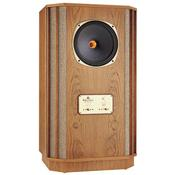
As to design, the DMT has an injection moulded LF cone while all the others employ the classic (and now unobtainable) kapok based natural fiber composite. The DMT and the Edinburgh share the tulip tweeter, while both the Yorkminster and the Canterbury mount the top-of-the-line Alcomax based pepperpot version. In my experience differences between synthetic and natural composites, rubber and fabric surrounds and 12 and 15 in. cones are chiefly room and amplifier dependent. But the difference between the tulip and pepperpot circular horns is very clearly perceptible, i.e. a generally clearer midrange and more refined highs. All the tweeters however are susceptible to transistor glare, though they do respond very well to the rather elaborate tone controls which, absent in the professional monitors, in the domestic models mercifully substitute knurled screw plugs for inherently fallible pots. Twin circular reflex ports are frontal on the DMTs and backmounted on the Yorkminsters, while the Edinburgh and Canterbury have similar lateral Onken type slots. The Canterburys’ ports however are equipped with moveable wood blinds which can gradually change the enclosure’s response from quasi-acoustic suspension to full frontal bass reflex. This is providential for room adjustment and I currently set mine to an asymmetrical open and closed configuration to allow for different sidewall reflections.

As to build quality, the DMTs first acquainted me with the charms of moving 50 plus kg. boxes around. Their finish is quite different from the customary Tannoy wood veneers: matt gray front and back, with metallic speckled gray laminates on all the other surfaces. Practical for studio use, yes; handsome, no; but an acceptable enough outcome. As for the Prestige products, traditional walnut everywhere (except for the bottom on the Edinburgh); and lightweight Tygan type grilles sporting the celebrated brass lock and key fixture, about which I shall now briefly rant. Apart from being in terrible taste, this Olde English marketing gimmick is not only totally useless but potentially harmful at the volume levels the bigger dualcons are capable of, since the metallic lock mechanism which is mounted on the cabinet can quite conceivably ring or buzz. Another famously useless though altogether harmless feature is the grounding terminal. I have seen some instrumental evidence of minutely better distortion figures when this in use, but have yet to find somebody who can attest to an audible effect. Addressing the Yorkminster’s build is rather more complicated. The hexagonal cabinet is quite tall and puts the Van den Hul wired 12 incher at a somewhat greater distance from the floor than the other models (more on that when evaluating its sound), but the enclosure is distinguished by the liberally Tygan-garnished, laterally mounted walnut strakes. The sole function of these, as far as I can understand, is to winsomely mimic the distributed port grilles on the older corner horns such as the Autographs. Also, the back of the speaker is in a plain brown vinyl wrap, which is simply unacceptable for the €18000 asking price. To cap all this, the heirloom grade solid walnut cabinet top warped slightly after 4 years. On the positive side, such as it is, the grilles are set in a heavy solid wood frame which eschews the key thing for a better thought out snap fastener, and the speaker terminals are excellent WBT Midlines, with really beautiful WBT/Van den Hul external links. All of this may be contrasted with the flawless cabinet of the successor Canterburys, which come Furutech wired with the same laudable speaker terminal setup but with grilles which may be at best called perfunctory ,though proudly sporting the afore-damned key arrangement, and with equally perfunctory and flimsy Furutech external links. Both the Yorkminsters and the Canterburys, finally, come with optional spikes and floor protectors. Good luck leveling those, I say.

Final comments on the speakers’ sound will be disappointingly sketchy, since I’ll be talking about components used over the last thirty years in three different listening rooms with a catholic selection of upstream gear, not to mention the inevitable changes in my musical tastes. I’ll start out with the assumption that interested readers will be familiar with the Dual Concentric sonic signature. This however does vary to a marked degree according to cabinet construction and as I have tried to show - not all Tannoys are built equal.

I recall the first thing I noticed when listening to the DMTs in the unfortunate 20 sqm. room was not their effortless dynamics but, somewhat surprisingly, their neutrality. In a midfield setting, obligatory under the circumstances, the imperceptible cone movement, coupled with the characteristic point source effect, makes for an eerie similarity to big electrostatic panels. Until the bass punch to the midriff comes along, that is. The tulip tweeter will not be mistaken for a silk dome, but it has none of the vengefulness often typical of other horn designs. An assertive performance then, but on the whole a commendably balanced one.

The Edinburghs which succeeded the DMTs in the same room for a year may, more than a little unfairly, be considered the slow horse in this roundup, saddled, as it were, with the same tweeter as the grey pros, but lacking some of their knockout kicks. On the other hand, besides being somewhat easier to set up, they are visually quite attractive and bear every hallmark of a classic keeper.

I have long since grown bored with grading my components but the somewhat incontestable fact is that, badly built fake vintage cabinet notwithstanding, the Yorkminster's performance is the one nearest to my ideal of a BBC monitor that is perfectly integrated with a passive subwoofer. I suspect that this is due to the combined effect of the superior pepperpot tweeter, a slightly higher LF cone placement and the stylistically incongruous rear firing moulded ports, which are not, as is generally the case, awkwardly susceptible to rearwall proximity.

Where does that leave the Canterburys then? In their own singular niche, as most owners will gladly attest. This proprietary space is defined chiefly by a sensitivity second only to that of the giant Westminster horns, a vast air displacement ability, and a somewhat counterintuitively nimble response to cabinet tuning. The first two properties mean that they will energize a room with no great need of consummate positioning, while the third affords an easy and just possibly non-obsessive path to optimizing soundstage clues, microdynamic shifts and the like. Again, the Canterburys make this a productive but hardly obligatory chore.

Which brings us to the inescapable discussion of the beaming bugaboo, which occasionally haunts reviews of the Dual Concentric speakers. As for myself I never experienced this phenomenon in my smaller room, and was indeed blissfully ignorant of its existence. After having read of it, however, in my larger listening spaces I very occasionally noticed some enhanced directivity. Cognitive associations aside, my take on the subject is that beaming is a markedly marginal operating hazard of the dualcons. It does exist, if only in very particular conjunctures, possibly ascribable to room reflections but, in my opinion, far more related to microphone placement. In the real listening world I find it more akin to a statistical aberration than to a certifiable shortcoming. All of the above finally may entail a discussion of amplifier matching, not to mention cable choices. This however would lead us down a very, very long memory lane and must be left, on demand, to further chapters.

Editor: Una Stravaganza! As a fellow Tannoy traveler, I agree with virtually every point Signore Surdi makes! Yes, we would love to hear about amplifier matching!