Showing posts with label Brand-Infinity. Show all posts

11 September, 2023

Altec 604E Infinity RS-1B ARC D90B 6F8 vs 6SN7

Click pics to enlarge. Bell 2122C atop the 604E. Note the contraption in front of the added tweeter, an imitation of the passive Xinshe 597. On the shelf Chinese Preamp with 6F8G, next to Conar SE EL84 amp (not used).

Letter from NYC (23-13): Labor Day Weekend+, Part IV (Tuesday), Escape from NY!

Written in Shenzhen

(Continued from Part III (Monday)) Now, I had not planned anything for this day, as I had to fly back to HK middle of the night. It was a busy day. As usual, I woke up early, and did laundry. Then I started to move the various gear back to their storage. Turned off some power banks. Closing up shop. Then the building superintendent came to inspect the balcony. And then the Telephone Rang...it was Kevin...

Kevin had some uncooked stuff left over from a BBQ party the previous day and wanted to invite me and Andy to listen to his recent endeavors (see below). I was hesitant, but how could I refuse? So I galvanized myself and did as much as I could have before Kevin picked me up around 12:00. We then picked up Andy, who had a big surprise. His friend had gone fishing and gave him a Fluke from his crop. This we took to Kevin's house. Dead but fresh Fish...

Altec 604E And so we listened to the latest iteration of Kevin's Altec 604E. I don't write about every one of our meetings - how could I? Suffice to say, over the 2 months in NYC, I came here a few times. I shall take this opportunity to explain it a little. The modern crossover is likely not bad. To balance the sound, Kevin had tried adding tweeters. The last round was with EV (the ones used in Klipsch) but he had settled on the ones in the pic (L-pad used). We don't even know what they are but they do help to raise the image height and impart a little more openness. More interestingly, sometimes Kevin adds a Diatone fullrange (mounted in the center of an LP). One time before, I listened to each, connected or not, and concluded it did make a difference for the better. This round, we listened to them being driven by Bell 2122C, but with a Chinese Preamp in front. This one employs 6SN7 and has regulator tubes. In a previous round, it sounded superior to its sibling without the regulator tubes. 6SN7 vs 6F8G Kevin had been running the preamp with the 6F8G (with adaptor) I gave him a long time ago. On this day, at his asking, I brought a pair of RCA 6SN7, and sure enough, it outperformed the 6F8G. The 6F8G has more oomph, but the 6SN7 is more subtle. Interesting, as many on the net professes the superiority of the ST 6F8G. Andy chipped in, and said from his own experience he prefers the 6SN7 too. This round of the 604E was the best I have heard, and really quite decent, but I still say, with A5/A7 around, why bother? They are all equally difficult (a way of saying: impossible) to get perfectly right, but the A5/A7 are for sure better endowed.

During all this time, Kevin was in and out. The dead fish took over and he prepared half of it for us in the upstairs kitchen. Perhaps you don't know this: he was a trained cook!!! Instead of steaming, he poached the fish and it was excellent, aided by some Chinese broccoli. Of course, Andy's wines helped!

Infinity RS-1B and Audio Research D-90B Kevin's Infinity had featured in the blog more times than I can remember (should you care to peruse). Previously, like Andy, he had used the VTL MB-450. He swapped in the ARC D-90B and it made a surprising improvement. There seemed to be enough power, and with the added benefit of a more refined sound. The D-90B (arcdb) is a somewhat unusual one from relatively earlier times. Instead of 6550, the B version sports 5881, at a slightly lower power. Driver tubes are different too, no 6CG7 and introducing 6922. Kevin's unit was bought from Leo and has good tubes in them. Russian 6L6WGC and nice Hungarian Tungsram 6922s. So it seems that the ribbon panel of the Infinity is not that hard to drive! Good news. It is interesting that the same ARC 90B sounded lean with the B and W M801 (Kevin preferred his CJ MV-75 there). And so, finally, the Infinity had come into its own this time around. We happily listened to Prokofiev's Cinderella Suite (OSR/Ansermet, London STS). Very good. The Infinity is perfect for Prokofiev, and it recalls listening to Romeo and Juliet (Cleveland/Maazel, London) upstairs at Andy's (it's been ages).
 
Kevin dropped me back in Flushing around 3:30. I returned some magazines to the library and ran some errands. Back home, I frantically mopped up and packed. Around 9:30 pm Kevin picked me up and drove me to the airport. Thus concluded this round of mad dash and my return to NYC. I had the feeling that I had escaped, far from the madding crowd.
 
Poached Fluke and Chinese Broccoli
Another occasion, authentic HK style food in a restaurant
Another time, cheese from NJ Amish Farm
Below Halal Food Take Out
A bit of the silver ARC D90B can be seem on bottom shelf
This Ultra-Analog Classe DAC is excellent. CJ MV75 below (meters added)
Wild assortment of Decca cartridges and accessories
TT Galore
Can someone give some info on this driver?

28 September, 2022

AR LXT Cello Amati Infinity IRS III B and W Matrix 801

Click pics to enlarge. Top, Infinity IRS III. Icefox in center; our friend wosirsir, who has appeared in this blog many times, on the right. 

Letter from Hong Kong (22-9): Icefox sends Goodies

Addendum 9/30/22: One more pic of Cello brochure added

Our Honorary Consultant in HK, Icefox, graces my wechat with many photos and videos each day. I'd like to re-post everyone here, but it's not possible. Some systems (especially horns) are totally obscure and highly complicated that it'd be hard to report. So, a few periodically.

R, Humphrey's.

Cello Amati/AR LXT
Just a couple of posts ago, M Surdi mentioned, albeit in passing, his days with the AR-LXT. Well, you know what? This part of the post has been in the pipeline for a while, but it's a good time to bring it up! Our old friend Humphrey, whose complicated WE systems are legendary in HK, has been mentioned in this blog several times, but not formally written up by me (my fault). This article though contains a blip on him. Recently, apparently, he brought out the Amati/AR-LXT's and drove them with contemporaneous old Mark Levinson's to great effect, according to Icefox. I had actually listened to one Amati setup here in SZ many years ago, but it was not well executed, and I didn't report on it. Maybe time to seek out the fellow again. I also asked my NYC friend Andy, who went through all that in real time. He said he preferred the AR3 to LXT at the time. Well, it's not something I'm interested in, but I'd love to hear a well set up system of any of them. Also, if you are interested in the differences between the Amati and LXT please Google yourself.


Infinity IRS III
Long term readers would know my fondness for Infinity Line Source loudspeakers, and my many reports on the setups of my NYC friends (Andy's IRS Beta, Mark's IRS Beta, Kevin's RS-1B; there are quite a few more follow ups if you just search Infinity on this blog - top left). A significant thing to know is that all these friends are also horn users. If you think that's coincidence - it is not, because of all designs Horn and Line Source can best reproduce dynamics - read this article which cites Keith Howard's excellent work. This iteration sent by Icefox however is by far the most luxuriously partnered, what with Western Electric amp driving the treble and midrange, and Karan ss amp doing duties for the bass column. According to Icefox, the sound is Holy Moly!

B and W Matrix 801
One of my favorites (I still have the II in HK) and my NYC friend Kevin still has his III.  Most of the recordings for the boomer generation were likely monitored on these. Here's a nice setup with videos. You have no idea how much time it took me to load the 2 videos below! Enjoy!


Below, Cello Amati Brochure, Setup with Cello amps and amid collections that also feature Tannoys.


29 October, 2019

Infinity RS-1B, Altec 604H, VTL MB-450 Series I


Click pics to enlarge. My earlier Visit 1. VTL MB-450 monoblocks have replaced the previous CJ Premier 8 on the amp racks. Between the Infinity panels is my Thorens TD-124. What are the dishes? Clockwise from top: Pocket Pastry with Chives and Eggs, plus Chinese Flatbread; Fried Eels; Spicy Tripes; Mustard Green with Other Vegetables; Braised Pork.

NY Diary (19-15): Infinity RS-1B and Altec 604-H Redux
VTL MB-450 vs Conrad-Johnson Premier 8

As mentioned many times before, our friend Kevin is a dynamo. Just chronicling his quest is enough material to sustain my Blog! :-) This is the latest update.

VTL MB-450 (Series I) After my last visit (peruse for the other equipment used), Kevin bought a pair of VTL MB-450. This is the same amp that Andy (who inspired both Kevin and Mark to get into Infinity) has used for over 10 years (here). This is the series I, which has a much plainer look (that I prefer) than the later II and the current III.

Talking about product longevity, this amp actually harks back to the even earlier MB-300, which is why this Stereophile archived review link grouped all the MB-300 and MB-450 Series I and II reviews together. Quite a good read, with some caveats, as we shall see.

Each MB-450 uses a 12AT7 and a 6350 to drive 8 x 6550's, switchable from Tetrode to Triode Operation. Andy's Svetlana 6550's had lasted him for over 10 years and that is astonishing given how hard they have to work driving the Infinity panels. Kevin's amps on the other hand are now tubed with current production Gold Lion KT88's. As with VTL, fixed bias for each tube.

Visit 1 Not long after, I got to hear them. As soon as I heard the first piece, I said I preferred these to the CJ Premier 8's. Kevin laughed and said, "I predicted you are going to say that and I mentioned it to Andy last night!" Well, we know each other well indeed; I know myself well too, as I too knew even before the visit that I was to prefer the VTL.

So why my preference? I have thought of writing a CJ Overview as I have heard plenty of them and used a few, but...Well, I find CJ products too colored. To use its rival ARC as an example, if I compare their products of the same vintage, I almost always prefer ARC, for its more neutral sound. Some tube warmth is undoubtedly desirable, but CJ over-eggs it, especially as it evolved. Basically for a long time they just added more and more, and larger and larger, capacitors, particularly in the preamps. The Premier series preamps are widely used in our circle, but I personally  do not favor them. As for the amps, I find them even more unacceptable. To me, CJ's use of high bias and current on the power tubes wastes power, leads to short tube life and frequent failures, produces a tight sound, but somehow does not translate into power when the going gets rough. Here, the CJ LP275, a latter day (but less well built) version of the Premier 8, was a wimp compared to the diminutive EAR 509, a neutral amp closer to the VTL in sound. That said, the popularity of CJ must owe a little to the remedial effect it has on lean systems (prevalent). It should also be said that more recent CJ products have moved towards the more neutral side.

And so it proved here. The sound of the MB-450 was surely more neutral than the CJ, more powerful too as I expected. Kevin preferred Triode Operation because of its sweeter sound. In this system, with Kevin's audio preference and the ribbon panels, there was really not much sweetness, but I left pretty satisfied. It should be noted that in one of the Stereophile's reviews, a much younger Michael Fremer favored the sound of the CJ Premier 12 (which can be thought of as a smaller version of the 8) to the MB-450. Horses for Courses.

As predicted (see link), the Altec 604-H (right pic) sounded better with the McKintosh C20/MC30 combo. Things fleshed out. On James' Lenco 78 turntable, Kevin replaced the original arm with a modified Rega 300, and the result was enormous, much better balance and bass, a tribute to the Rega arm.

Visit 2 Just yesterday we met again. In the interim, Kevin had built new power cords for the VTL's and according to both him and Andy it made a big difference. Indeed the sound was a little fuller. Kevin is now using the Tetrode Mode for its greater control and power. He said the power cord smoothed out the sound enough for him to make this choice. Kevin had switched cartrdiges. The VAS-modified Ortofon 2M Red sounded better than the Decca on his Thorens TD-125/ET arm (this arm is said to be light in bass, and so it proves). The Decca Gold (VdH stylus) also sounded better on the VPI. A good switch. On this occasion, we also heard his digital system with a Wadia 2000 transport, which sounded pretty good. It was too bad I had to leave early.

The job is not quite done. While I liked the more neutral sound of the VTL, I do think the system could use a little more warmth, but that is surely to come soon.


Note my Thorens TD-124 now has a 12" arm board made by Kevin. Lunch is Seafood Pan-fried Noodles.

09 September, 2019

Infinity RS-1B Altec 604-H VAS Re-Tip Cartridge Repair Monster Alpha Genesis 1000 Decca VdH SC4E Gold


Click pics to enlarge. A Tale of Two Positions. Top, Initial Position, rather missionary; Above, Final Position, freer. The Bass Columns are all the way in the Back Corners, barely visible below the unused horns. The Front Panels are driven by CJ Premier 3 on the rack and Premier 8 monoblocks in the center. The Bass Column is driven by a Professional Crown Amplifier on the rack below the CJ P3. The Lenco in the center is not used on this occasion. The Thorens TD-125 with Decca Gold (VdH tip) is to its right. Below the Thorens are the Yamaha DVD player, TEAC DAC and Chinese Server. A bit of the VPI turntable is visible behind the left Altec A7 horn system. McIntosh C20 + MC-30 drive the Horns. Poor B&W 801's are covered up in purple.

Background and earlier session with the Infinity RS-1B here.

Infinity RS-1B, Almighty!
To paraphrase Anna Karenina a bit: All great sounding systems are more alike than different, and easy to write up; whereas bad systems are bad in all sorts of different ways and test a writer's patience (not to mention friendships). Now, this article is super easy to write!

This man Kevin is one of the most incredible audiophiles I have encountered. Over the course of a very short 2 years, he has gone from someone who was using a small Fostex full range to Altec A7 horn system, then B&W 801 and then now Infinity RS-1B (amply chronicled in this blog, search link). If audio is a degree, then in 2 years he went from high school to post-doc! Of course, he was helped along by Andy, and benefitted from Andy's many connections. I tell you, if you have the chance to connect with older audiophiles, do so; it is likely more beneficial than hanging out day and night on the internet. One thing great about Kevin is, whatever "advice" we give him (some just guesswork from experience), he would try it out. Even if the conclusion is different, the experience is worthwhile. Yes, audiophilia is serious work.

This pair of Infinity RS-1B came on the heels of Sad News - the departure of Andy's long-time friend, Mr Ma, a notable tech wizard familiar to many in upstate New York. When he was young, in Taiwan, Mr Ma serviced the very complicated Studer components and most things are just piece of cake to him. I should have touched upon him in my last article below but somehow didn't. Suffice to say, Kevin went with Andy and bought the Infinities which were languishing in the garage and also took home a pair of Altec 604-H.

Last weekend Kevin called us and told us of the great progress he has made since my last visit (here). I of course was a bit skeptical, as this kind of call has happened often with audiophiles. Gratifyingly, it proved otherwise on this occasion.

Image result for karajan sibelius 4 dg discogsIn-Room Kevin had drastically rearranged his room. He removed his sofas (to me unnecessary) and moved the Infinities forward (just as I'd like, as chronicled with his Altec's here and at one time his B&W's here). It is my firm opinion that in-room usually sounds the best. And this time, as in the past, it is proven again. The sound was wide open and dynamic, just superb, as one would expect of Infinity (at its best). Surprisingly, the bass alignment was excellent, and I could not detect any incoherence - an achievement! Closer Together We first listened to them this way (top pic), and the sound was highly focused, super-detailed, but somewhat tight and relentless. Further Apart Then we pulled them apart (second pic from top). Aloha! The strings in Sibelius Symphony No. 4 (Karajan/BPO; DG) sweetened considerably and everything relaxed; both Andy and I nodded in approval. Dialed in, as far as I am concerned, a total success! As a matter of fact, it sounds even better than Mark's Beta, as last heard here.

Image result for britten pagodas cdLoudspeaker Placement Again, as I have expounded many times in the past (search link), this illustrates the absolute importance of loudspeaker placement. For people who have a choice (I know many don't), it is imperative to try to find the best position. It is also true that in-room and near-field positions are freest from boundary effects.

Digital vs Analog To balance the system, this time Andy brought over material in both CD and LP format . We are in total agreement that digital and analog should sound similar in tonality at least. Here. tonally the modest digital setup was definitely warmer and fuller in the bass. The Sibelius was definitely better in CD form when the speakers were in initial position. Ditto Britten's own recording of his Prince of the Pagodas (Decca). But when the speakers took up the final position, wider apart, the sound smoothed out in the treble, to make the analog sound more open and detailed, without stridency. I judge it superior but, knowing Andy, I'd think he still prefers more warmth. Nonetheless, the way analog breathes and brings out the full harmonic spectrum, and how it makes one aware of phrasing, simply can only be approximated by digital. We discussed how the ribbons have their own sound, likely not easy to fully warm up.

Two Decca Cartridges Both have the Van den Hul re-tip, and both exhibited the Decca's virtue of fast transient time and evenhandedness. Detail is probably more than the original ones due to the VdH mods. Overall the Decca SC4E on the VPI Prime was preferable; indeed this marked the best sound I had heard on the VPI (that says a lot for me, as it is not my favorite brand). Andy is very particular about the TT used with Decca's; while his current choice is Nottingham, he gave approval to the VPI. The Decca Gold on the Thorens TD-125 (with tangential arm) was not far behind. As a Decca fan, I was quite happy with both; surely with time and some cabling experiments the sound would further improve.

Altec A7 I don't know what he did, but on this occasion the A7's sounded quite good driven by McIntosh C20 + MC-30. It was the best sounding since he moved them further back. This is just a footnote, as we didn't pay too much attention being more distracted by the younger brother...

Altec 604-H
A dining table and a few chairs separate the two ends of the room. I did miss the old couch, which I think he could have kept! But now at the other end is another horn system! The Altec 604-H is the last alnico iteration of this classics, which I have heard many times in HK (read this home visit in HK). The Bell 2122-C's were not optimally tubed and lacked impact compared to the Sun Audio SV-2A3, Sound showed potential and was in keeping with many others I have heard, though bass certainly could have been fuller. I told Kevin that one time I heard a McIntosh amp worked well with the 604. Kevin followed up and called me that sound had further improved. That would have to wait till the next report.


Altec 604-H driven by Bell 2122-C's and Sun Audio SV-2A3 (behind). Preamp is Conrad Johnson PV-5 and turntable is a Lenco L-78 with original arm and ADC cartridge.

Monster Alpha Genesis 1000 (VAS Repaired)
A few days later we had a lunch gathering at Andy's. He wanted us to hear his resurrected Monster Alpha Genesis 1000 Cartridge. This was a famous cartridge in its days, and Stereophile online has an article on its sibling 500 compared to the 1000.

Andy's 1000 is certainly not the first one Steve had repaired. Here is an interesting report on his job with this cartridge.

Our impressions were certainly in keeping with the Stereophile report. The Monster was made by ZYX, which still makes them more or less the same way. I am not a fan of ZYX, which I have heard many times in HK - its usual literal manner holds no fascination for me. On this occasion though, they sounded pretty good with Andy's A5's driven by a pair of vintage Bell 2122's. Andy's 1000 broke off after not much time, and he had waited all these years for a re-tip. Andy said VAS Steven's re-tip is likely better than the original. We enjoyed the music together with the sumptuous lobster noodle and seafood tofu soup.

08 July, 2019

Decca Super Gold Infinity RS1-B Nottingham Space 294


Click pics to enlarge. Top, Decca Super Gold. Note the unused blue wire (-ve) as the Decca only has three pins (common ground).

NY Diary (19-8) Days of Wine and Roses
Decca Super Gold Cartridge
Infinity RS-1B

The gang was rolling yesterday! It's been a while since we were invited to R's for lunch and we were eager.

Women's Soccer I was picked up just before 11 am, which unfortunately made me miss most of the first half of the USA vs Netherlands Women's World Cup Final. Compared to, say, 10 to 20 years ago, the overall standard and environment of women's soccer have improved significantly and this series has been a huge crowd pleaser. In my opinion, many teams (not just the USA) play with passion, hunger for success and grace, which are frequently missing in bigger-money men's soccer. Salut!

It was only during intermission that I rejoined the gang in audio listening. I watched a bit of the second-half, up to the controversial penalty kick before adjourning for lunch. I forgot to take a good pic of the seafood stew, only what's left! For dessert we brought a pecan pie and Chinese Egg custard tarts, enjoyed with aged pu-er tea and, later, coffee.


The new Turntable, Nottingham Space 294 Turntable with Ace-Space 294 Tonearm. Below, R's dynamite wine cellar.

Miles Davis - Sketches of Spain.pngDecca London Super Gold Cartridge
R's living room system has not changed much (see here, for pics too), but the recent addition proves to be a game-changer!

At first Stan Getz (Verve) was playing. I am not a great fan of Getz but it sounded pretty good, better than last time. Then R played a thrice familiar LP, Miles Davis' Sketches of Spain, and, even though it is a mono copy, I was floored. Although Miles' tone in my opinion was a little on the white side, the castanets just jumped out at me; more notably, the brass chorales were uncommonly lucid, as I have never heard before. The way you can separate every player but still hear them harmonize perfectly was just mesmerizing. It left me dizzied and surely I gained new respect for Gil Evans' arrangements.

No need to hear more, as I have long been a Decca/London fan ever since my experience with the ffss MkIII (here). So I attributed most of the sonic characters to the venerable Decca/London Super Gold cartridge, still in current production (see review here), though the one we heard is an old one Andy sold to R. This is a moving-iron cartridge with a healthy 5 mV output, so only an MM phonostage is needed. Of course, the Nottingham Space 294 Turntable/Ace-Space 294 arm (TAS review) surely has contributed a stable platform for the Decca/London to shine. Although in HK I had heard many Spacedeck's some years ago, I'll admit I am not a fan of Nottingham (don't like their looks), but Andy, who knows everything about Decca/London cartridges, had always been on the search for the perfect turntable/arm for his many Decca cartridges. Some time ago he found out that the late Tom Fletcher was a Decca/London fan, and reasoned that his designs must be friendly to the cartridge. Based upon his reasoning, he urged it upon Mark, who bought a 294 and sold his Spacedeck to Andy. Judging from this outing, it is an excellent match indeed, and R has already stopped listening to his Rockport Sirius/Jan Allaerts (we didn't find it special either; this cartridge did not sound anything special on at least 3 turntables).

We left a little early to avoid the heavy traffic returning to the city at the end of the July 4th weekend. When we left, Miki, R's wife, gave several of us some flowers from their magnificent garden. We then went to Kevin's place.


Look carefully and you shall see the top of the bass columns behind the Altec A7.

Infinity RS-1B
Wow, this man is gun-ho! Not long after Kevin got the B&W 801 (here) he heard Mark's IRS Beta (here). After the sudden recent demise of Andy's friend Mr Ma, several of the gang went to sort out things for his son, and Kevin bought his Altec 604G, which came with this pair of Infinity RS-1B stored in the garage. It was in challenged cosmetic condition but Kevin just restored it beautifully.

The RS-1B is a lot smaller than the IRS Beta and much more suitable for most people (read this 1985 Stereophile Review).

Driven by the Conrad Johnson Premier 8 borrowed from R, the sound was promising though the you-can-touch soundstage of Mark's IRS Beta was missing in this smaller room. But you shall be hearing more about this I am sure.

01 February, 2019

Infinity IRS Beta MFA Luminescence ARC Reference Two Reference 600 Goldmund Studio Madrigal Carnegie


On center rack, under the Thorens TD-125 turntable (fitted with a Rabco arm) is the MFA Luminescence preamp; beneath is the Infinity Electronic Crossover; Audio Research Reference 2 seen on bottom shelf of rack to the left; Goldmund Studio Turntable on rack to the right.

I am truly delighted to publish this article on a second pair of Infinity IRS Beta in our circle. The first pair of course is Andy's (first reported here). Ever since he heard them, our friend Mark has clamored for a pair. After many years he is finally able to fulfill his dream. Congratulations!

HiFi Basics VIII: Home Visits, Peer Influence, Mentors and an Open Mind
1205irsbeta.jpgPeer Influence Perhaps second to the unfortunate hyperboles regularly dished out by audio magazines (particularly TAS), one of the main reasons why audiophiles are so addicted to the hobby is actually peer influence. The more connections (including internet peers) one makes, the more things one discovers and potentially covets. This is the arguably beneficial aspect of having peer groups and peer support. Unfortunately, there are negative aspects too. The Peril of Like Minds One would think like minds would foster growth, but my experience tells me this is not so with audio. Small Circles of like-minded audiophiles usually have nothing much to offer in terms of good sound. Just three very common examples: 1) DIY'ers and modifiers put too much emphasis on material factors and sneer on commercial gear but their creations are often highly unmusical; 2) the majority of Tube Rollers and Vintage Aficionados are too into historical values to pay sufficient attention to performance factors; In HK, the "LS3/5A is the best loudspeaker ever" crowd mostly know nothing about high fidelity, indeed little about music reproduction. The smaller your world, the less the sound of your system is going to improve. Mentors are important in all fields of human endeavor, and audio is no exception. Problem is, no two individuals are alike, and social norms get in the way. The rare truly enlightened mentor works with the preferences and idiosyncrasies of his protege, to encompass them in a solution, but the average mentor often gets in the way, and forces his solution down the throat of his charge. The important thing is, the protege must grow up and there is always a "let go" moment. Unfortunately, in the Confucian East, where respect for the so-called sifu is taken to ridiculous extremes, we are all often left with a bunch of copy-cats. Astonishingly, "#me-too" is proving far too common in our age, even in audio.

Home Visits The audiophile experience knows no bounds. No audiophile, no matter how much time or money he has, can be said to have experienced everything great (our friend icefox in HK comes close though). Thus it is important to seize the opportunities for home visits in order to broaden one's horizon. But there is a catch from my viewpoint. Current vs Old Gears Unduly influenced by the magazines, many audiophiles believe in progress and foreswear anything but recent gear. This is a BIG mistake, as my experience tells me the best systems all have one thing in common - they have at least quite a bit of older or vintage equipment in them. Put it another way, I have heard many ultra modern systems, including much of the most expensive loudspeakers and electronics covered by TAS (like Jonathan Valin's stuff), but while at best they can sound reasonably good, mostly they don't make it to the best (this Blog has a Year in Review feature, where I list the best sound I have heard that year; browse should you like). Mind you, by no means is vintage anything better - far from it, most adherents don't do so well. But, and this is a big but, the discerning ear is capable of turning good vintage into gold. Stores and Shows For myriad reasons, Stores and Shows usually don't put forward the best sound, but they are important for audiophiles starting out or without peer support, especially in the US, where many are not even within driving distance of a dealer. In a place like HK, audiophiles are much luckier  - there are many stores and many specialize in second hand stuff, including vintage stuff. HK is also so small that many audiophiles get to do a lot of home visits.

Progress? There really has not been progress in audio. Detractors will point to the digital revolution (for it is that) but for us old-timers analog is still vastly better. The modern denizen of the world prides (positive) attitude and individuality, but ironically that is precisely what modern audio lacks, and this lack is unacceptable in audio, a venture into the senses. Beware! Reviewers always say something "tugs at the heart string", but if it is something modern or recent, take it with a coarse grain of salt.

Open Mind Hence, it is important to keep an open mind. While I am a big proponent of good vintage gears, efficient horns and low powered amplification, I am not adverse to other approaches. I still own ESL (the overachieving Martin Logan Source), panel (Magnepan 1.7), dynamic classics (LS 3/5A, Sonus faber Electa Amator II), which I enjoy from time to time. And I am certainly fond of BIG Line Source loudspeakers like the Infinity IRS Beta, as executed by my friends (this article tells you why), even if I personally would not take this approach. There are too many dogmatic audiophiles, all claiming there is only one way to heaven, but none of them are right.

Experiment, fail, stand up again, own, disown - there is no expressway. No amount of internet discussion and queries can substitute for hands on experience. Last, I'd like to say, for every successful system, there are dozens of failures. It is easier to identify problems than to appreciate virtues. Only the trained ear can do that. Aside from appreciation of real music (as opposed to audiophile stuff), getting to experience first hand the various approaches to audio reproduction helps one grow. Persist!

The Mighty Infinity IRS Beta, another pair!

On Sunday, Andy, Kevin, James, VAS Stephen, his lovely wife Jenny and I descended upon Mark's Long Island home to listen to his newly acquired Infinity IRS Beta.

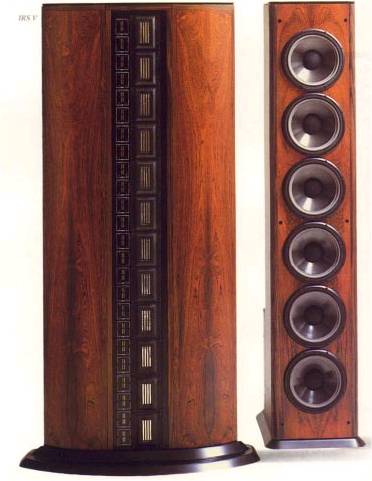
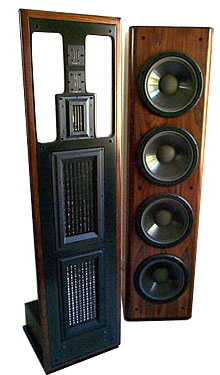
Background This Stereophile Review by J Gordon Holt et al is truly excellent (no one writes like that anymore). Each side has 4 x 12" woofers - making it the equivalent of a 24" woofer. Given enough power, the system certainly can deliver real world dynamics. While touted, as Holt describes, the IRS Beta is certainly not without flaws. The Beta was supposed to be the flagship, but its success spawned the even bigger IRS V, which was regarded by some, including Harry Pearson of TAS, as better and the best (here). Unfortunately, the V's monstrous size and weight (the floor has to support 1,500 lbs), not to mention price, precludes its use for most people. Regardless, the IRS Beta is truly a legend.

Rather than dialing them in himself, Mark basically emulated the settings of Andy, which deviate significantly from the settings Arnie Nudell recommends. Infinity advises to have the bass cross over at 110 Hz, and the three knobs behind the panel to be close to center, which is not how Andy hears it (note too that JG Holt literally did it differently from Nudell; see link above). This is legitimate - after all the knobs have to be used to accommodate the room. It should be said too that the dimensions of mark's basement are quite close to Andy's (by eye).

The system we heard on that day comprised the following:

CD Transport: MBL 1521
DAC: MSB Link (Nelson) with Powerbase
Turntable: Goldmund Studio/Goldmund T3F arm/Madrigal Carnegie Cartridge
SUT: Ortofon T20
Full Function Preamp: MFA Luminescence
"Buffer Preamp: Audio Research Reference Two
Panel Amps: Audio Research Reference 600
Bass Column Amp: MBL

Saint-Saëns: Symphony No. 3 "Organ Symphony" / Debussy: La Mer / Ibert: Escales (Ports of Call)
I have recently been evaluating RCA Living Stereo LP's and CD's (article to come), so I immediately played the SACD (CD layer) of Munch's famous recording of Saint Saens' Organ Symphony, one of my all-time favorites. Just a few bars were more than enough to convince me that this system is going to be Best Sound of the Year in my Year in Review, and it is just January! So, I can totally understand the beatific smile on Mark's face. No, one does not come across this kind of sound often, and I reckon most audiophiles have never heard sound like this. You could pick out and "touch" any instrument in the mix, so clear was the soundstage. Most impressive for me were the clarity of the celli and the breathlessly chirping woodwinds, which most systems would struggle with.

This is not to say the system is perfect but the virtues far outweigh the deficiencies. While there was no grating in the treble, there was a certain "whiteness" to the sound. While this is to be expected from ribbons, I did think it should be warmed up further. With vinyl playback, I was surprised by how close the sound was to digital.

MFA Luminescence I had thought the MFA Luminescence (used for phono amplification and fed into the "Bypass" of the Audio Research) would contribute more warmth - the unit of my HK friend jules sounded warmer from memory; but then this model had gone through many iterations and a lot depends on tube rolling too. We played a Carpenters CD, and the voice of Karen Carpenter was definitely too lean. James started to tinker with the crossover frequency, opining that 134 Hz sounded better, but Andy and I would not agree; to me that muddled the sound. What really made the difference was Andy's highly effective move to switch the loudspeaker cables, which fleshed out the sound and restored normalcy to Karen Carpenter's voice.

Goldmund Studio/T3F arm and Madrigal Carnegie Cartridge These are exotic but coveted items.  Andy has the Goldmund Studio turntable but I have not heard it. It is an unusual beast, a direct-drive on a suspended chassis!!! Andy says it has a very special ambience (Roy Gregory of HiFi+ seems to be impressed too in his survey of new direct-drives). Andy told me the one Mark has is a later version with a better JVC motor than the original's Pabst, and the T3F arm is also better than the T5 arm. As for the Madrigal (Mark Levinson) Carnegie Cartridge, it too has a solid reputation. Judging from remarks made in this vinylengine thread, Benz was the OEM and its sound is highly neutral and resolved (various people compared it to the Ortofon MC3000, Ortofon Rohmann and AT OC-9), which jells largely with my own impression. Mark uses it with the Ortofon T20, which is itself on the neutral side. No wonder I found the sound to be quite similar to the MSB digital (I have to say MSB is not a personal favorite either). Next time I visit I shall bring a few SUT's that I think will change the sound.

In all, a fuller mid bass would be beneficial (for all ribbons indeed) and Andy suggested moving the bass columns more into the corners. This was not carried out as the loudspeaker cables were not long enough. As we left it, the bass contour could use some shaping. I thought the MBL (I don't like their electronics, especially in the bass - they all lack a tactile feel) was likely not the best candidate for the job. As this article went to press, I just learned that Mark had recently changed to an Accuphase amp, which reportedly did a much better job.

Rome was not built in one day, and neither would a great Infinity System be. Andy took a long time to arrive at his current settings and Mark had benefitted greatly from his experience. I am sure further improvements can be wrought with time, but it is already mightily impressive.

It was a great day. Icing on the cake was the joyful time we spent eating Chinese Hot Pot, one plain, the other fiery hot. There were fish balls aplenty, two kinds of beef, squid, large prawns, conch, bamboo shoots and other vegetables, all washed down with all kinds of alcoholic beverages. What was particularly gratifying was the long time spent at the table debating various issues.

Here, big thanks to Mark's wife and father-in-law, who had to skip church service to prepare all the food. There was so much leftover that we are already scheming for a return visit to mop them up.
21 May, 2018

Why are Horns the Best?

Why are Horns the Best? 
SPL, Loudness, and Dynamics

Revised 6/19/20: Finally, the the HiFi News Article is available online! It is worth reading in its entirety. A MUST.

The May 2018 issue of HiFi News had just arrived at the local library. I was shocked to read that HiFi News had just absorbed Stereophile. Well, I suppose that is good, two of the better HiFi magazines (Ken Kessler notwithstanding). But that is not what I want to talk about.

In the issue there is an excellent article by Keith Howard (as usual) on how loudspeakers struggle to reproduce musical peaks. He cites the research of Marshall Chasin, which is basically the benchmark. The table below is from Chasin:
Image result for decibel levels of musical instruments

Basically there are several points to note:
  • By Peak Level it is meant the instantaneous oscilloscope peak, which can be very short (milliseconds), not the much slower averaging response you see on the average VU meter.
  • Basically nearly all loudspeakers fail BADLY trying to reproduce such peaks. EXCEPT horns! This is incontrovertible, as Keith Howard had made dynamic simulations.
  • Aside from horns, only Line Source Loudspeakers need apply. The Infinity IRS V (more info here) is cited as an example (others would be Carver, McIntosh etc). Indeed, I have heard these, and can attest they are great. Note that for a stereo pair, there are 108 driver units, and 4000 watts of built in power amp for the woofers. By my calculation, the surface area of each woofer column is equivalent to a 30" driver.
Seen in this light, the large total area dedicated to bass reproduction in our friend Eric's horn system (last article; just roll down) is not at all extravagant (30" subwoofer, plus double 15" woofer each side).

Horn Colorations? I reckon the horn's ability to play loud and sound dynamic, and real, is tied to its ability to reproduce peaks. This is why horn lovers, including myself, find the horn's realism unrivaled. Keith Howard freely admits horns can achieve these peaks naturally, but he pointed out the horn colorations. Now, this so-called cupped-hand phenomenon is commonly quoted, and indeed can be heard in badly implemented horn systems. However, in a well implemented horn system, such as Eric's, or the many I heard in NYC, including mine, I almost never hear such undesirable sounds.

Horn is the ONLY way to go, if you have the space!

05 April, 2011

Letter from NYC 2011 (14): Infinity IRS Beta redux

Letter from NYC 2011 (14): Infinity IRS Beta redux

Close on the heels of my visits to MW came a re-visit to AL's magnificent palace. You will remember him as the man whose system I heard on a previous visit earned my nomination for best sound of 2010.

AL is a meticulous man. A look at the facade of his nice house will tell you something. This time I walked in to find a recently acquired EMT 930 in the middle of set-up. More interestingly, he seemed to have been doing work on some cartridges under the dissecting microscope! Now, that's a pro!

A twixt, unlike last time, this time we listened to only digital playback, unusual for this vinyl man. And was it awesome! List of Gears:

CD transport: CEC 1
DAC: Sonic Frontier SFD II MkII
Preamp - Audio Research Reference II Mk I.
Amp for Tweeter/Midrange column - VTL MB-450 monoblocks (8 x 6550 each)
Amp for Bass column - McIntosh MC-2500 (for bass column)
Loudspeakers - Infinity IRS Beta

Let's cut it to the chase: this is likely the best sound of 2011. What, so early in the year? Why not? How often do you hear things that prompt you to rethink?

If anything, the sound was quite the equal of the analogue playback we heard exclusively last time. The holographic field was populated by flesh and blood images of exquisite texture. This once again confirms my long-held view that the SFD II DAC is STILL unsurpassed in many areas. Also, the experience prompted me to re-evaluate CEC transports, some of which I have heard to be slow and not quite revealing. Not this one. Dynamically the music was marvelous, and, if my memory serves me, trumped the vinyl playback (leaving one to wonder about the gain structure of vinyl playback). I'll just cite one example of excellence: the orchestra in the Messiaen Turangalila Symphony (EMI/LSO/Previn) heaved and sighed, and one could clearly separate the various percussion and keyboard instruments. Again, what a lovely recording that everyone should have. For me, the orchestra in this piece swoons like in Scheherazade, and can be orgiastic as in Scriabin's Divine Poem, and the system captured everything in glory. All this from a cheap EMI forte re-issue; I wonder what the famous LP (pictured right) would sound like here.

Back home, lazy and still jet-lagged me immediately set about to improve my Maggie setup a bit more. In my narrower room, I cannot hope to emulate AL's panorama, but a little improvement is definitely possible. I also pulled out a copy of the Messiaen (Salonen/Sony) to play. Can there be greater tribute to AL's system? I think not.