Showing posts with label Home Visit. Show all posts

17 April, 2022

Audionet Audioplan Lumin Holo Spring Watson Emerson Analog

Click pics to enlarge.

Letter from Hong Kong (22-4): E Lo goes on revenge visits
Home Visit (22-2): Audionet, Audioplan, Lumin, Holo Spring, Watson Emerson Analog

Due to COVID pandemic in HK, home visits have been almost non existent. Lately, COVID cases are steadily in decline and I took this opportunity to visit my long time audio buddy Kwong.

We are all for spending wisely and we both are cheapskates who dig cheap tweaks.

He lives in a village flat with a decent and spacious, rectangular living room ideal for hifi listening. After all these years, his core equipment was originally based on the Audionet ART CDP and SAM int. amp and the lesser known but reputable Audioplan mini tower Kontrast III with internal silver wiring. Later, he added both a super tweeter and a cheap but highly effective Roger ASB 100 subwoofer. Also an Audionet AMP3 was added for bi-amping: the super tweeter  LCY 100K MK1 and loudspeaker tweeters were driven by the amp section of SAM and the loudspeaker bass woofer by AMP3.

More recently, he added Lumin A1 Streamer and Holo Spring 1 fully moded DAC, using AES connection, which is the preferred way.

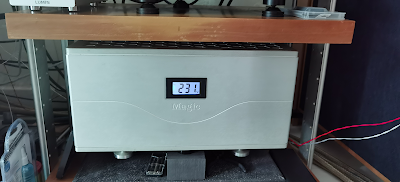
He is also using the monster Longyu Magic 5000 power re-conditioner and Rayaudio's power regenerator. Power supply of A1 was being upgraded by Ray. He is very particular in treating electricity right!

For IC and speaker wires, he uses mostly Gotham. Power cords are Ray's DIY.

I also brought along my Wattson Emerson Analog (WEA) to compare against his Lumin/Holo combo.

What I heard was a really top quality system. The sound is smooth, analog and superbly detailed, yet musical, with a wide and deep soundstage and accurate timbre. Bass department is no slouch, rounded, taut, ripe with impact. This 4 way system is actually competitive with many large floorstanding speakers!

WEA face off with A1/Holo combo I think there is no clear winner. Both are smooth, analog sounding, with great detail retrieval but different presentation. The WEA was slightly more upfront and immediate, with more defined instrumental outline, and background was a tad darker. The A1/Holo was a bit more laid back, but equally musical, with ripe and authoritative bass and natural midrange! Of coz, their brand new tag for the latter was over 60k combined! Even Kwong was initially surprised on how good WEA was when it was first hooked up. He even  thought it was even better than his A1/Holo, but of coz with more serious listening, there was no clear winner and that each of the two setups had its own forte!

Holo Spring fully modified R2R NOS Mode
Lumin A1 streamer (you can forget about its internal DAC
LONGYU power re-conditioner helped shape a solid foundation
LCY 100K MK1 Super tweeter gives all the air in the top end

Songs played through Tidal:

Bass drops (Nened Vasilic), great demo for plucked bass, yet entertaining.
Birds and the Bees (Jim Hall and Pat Metheny Live), Jim's guitar is so slick, like matured claret.
Madiba's Drive (Antonio Forcione), musical, hifi and joyful Afro tune!
These Bones (Fairfield Four), the bass voice is so... bassy and throaty lol.
Cherry (Masaharu Fukuyama), great voice and the guitar is so realistic. Great melodies.
Japanese Roots (Take Dake, Neptune Kaizan), great hifi demo, yet interesting music.
At James Infirmary (Baba Blues), the guitar, his voice and the penetrating sax are so raw, yet genuine and with anger.
It had to be you (David Gris and Martin Taylor), Gris' dobro has so much attack and realism.
Practical Arrangement (Emil Scholsberg), such genuine voices.
Mon Soleil (Ashley Park), Ashley's got great talent in both acting and singing!
Over the Rainbow (Live, Melody Gardot), always so sexy; lazy voice, great interpretation and reinvention.
I will Survive (Live, Musica Nuda), raw voice and bouncy bass.
Limit to your love (James Blake), showcasing crazy low bass test track.
Day O (Live at Carnergie Hall, Harry Belafonte), better than CD, but not LP.
Practice Love (jazz version) (JJ Lin), the bass can really carve sharp turns!
Visit me if you have time off (Chen Guo) male speech is so magnetic, his voice is not even the main theme of the song...

04 April, 2022

Western Electric 755, TA 4189A

Click pic to enlarge. right, Vincent's NAD's. Next to WE, beauty and the beast...

Home Visits (22-1): Western Electric
Letter from Hong Kong (22-3): icefox sends goodies

Regular readers know that when I was in Hong Kong, my friend icefox often acted as my taskmaster, making me work hard. This man knows virtually everyone, especially the ones worth knowing (not at all in the majority). He knows almost all the WE players in HK and the greater Guangzhou area and is a constant source of good information. He recently sent me the videos below, which I hope you will enjoy. Much of the music will be unfamiliar but I think that's not so important.

Note: Although I am not in HK, icefox is, and that was where all this info was related to me via wechat.

HK: Vincent's WE 755 We have met Vincent before. Not so long before I left HK in 2018 I chronicled his WE systems and Altec 604 (here). He has changed from the Altec 604 to the WE 755. In this video, however, unlike before, he's not using the WE 133 replica amp (using all genuine parts) but an NAD 3020 (or 3020A). In the video, the NAD is in the back and the WE133 in the front are not used. Bluetooth was source and speaker cable Belden 9497. I of course asked which NAD is better and he said there is not much difference. As for the heart of the matter, most importantly, icefox said "...(this is) the simplest nice sounding WE system I have ever heard...this combo puts a lot of big but poorly executed WE horn systems to shame!" and that's a lot coming from him! icefox said:"... the 133 sounds nice too but when you consider what NAD 3020 could do, it's such a gigantic bargain vs those expensive tubes that one requires to operate the 133..." And now, he even said this!!!!!!!! "when you have a WE speaker, the WE amp is not mandatory!" The Cabinet Now, this is very important. I have heard plenty of 755's, from Alnico WE and early Altec's to later ferrite Altec's. It is still the most iconic fullrange. But, often the sound is sub-par. In my experience, most, if not all, modern cabinets do not sound good (just as in the case of Lowther). If it's MDF, you can just totally forget about it. To avoid the trappings of a bix, some use open baffle, but that has its own can of worms. In this case, Vincent's are housed in original Altec 618 cabinets (literature at bottom), which is a solution adopted by many. But, as icefox says, not all 618 cabinets are created equal (many are DIY's of widely varying qualities). Vincent's apparently are particularly fine specimens.


Taipei: Mr Han's WE TA-4189A 台北韩先生 He is an acquanitance of icefox. I have even less info on this. Suffice to say, this is a pair of fullrange Field Coil WE (power supply at bottom of article), driven with WE 94C amps, fed by Studer A730 directly, no preamp. This is Mr. Han's second system, his main being WE 15A (not available this time).


China: Foshan (Guangdong) 佛山西电镖 This is the WE Replica of the fellow who makes close replicas of WE stuff, including Vincent's 133. Think along the lines of Line Magnetic.


Well, I cannot thank icefox enough for these footages, which I hope you will enjoy!


23 December, 2020

Shindo Lafite Field Coil Monbrison 300B Wavelength Crimson 71A


Click pics to enlarge. Beneath the TV are the Monbrison Preamp and the F2A amp (only side showing). Beneath are the 300B Limited monoblocks. The DAC (pic below) hides behind the screen.

Brief Home Visit: All Shindo Setup

Weeks ago, before this current Fourth Wave in Hong Kong, I visited R (with his wife and son), a former student and ENT specialist, who is a classical music aficionado. The visit was relatively short and, as courtesy, I voluntarily wore mask almost the whole time.

His living room (I reckon around 400 sq ft) is way too big for his gears. R is a very considerate family man who plays his music at lowish level, lower than I'd like. He also prizes refinement over loudness. I knew that from a previous visit to his old flat, before he got into all Shindo.

Throughout, R just streamed music. No LP was played. DAC is an old Wavelength Crimson, which employs, by chance, the 71A tube (not a current version). Preamp is the Shindo Monbrison (newer version than mine), which drives the 300B Limited monoblocks (all WE tubes). This marked the first time I listened to Shindo loudspeakers, in this case the Lafite.

A Word on Field Coils Before permanent magnets became the norm, field coils were used. Each driver needs a power supply (tube traditionally) to deliver the magnetic field and the PSU can be bigger than an amp! Being very old drivers, vintage field coil drivers are highly prized (beside the rare-as-hen's-teeth WE's [a coming WE report will have pics of these], many others, like Jensen and Motorola, made them). The Lafite is an 8" full-range field-coil driver (Official Spec's). I doubt Ken Shindo developed it all by himself. After all, Japan has well established companies specializing in making field-coil drivers, from the "more reasonable" Maxonic to the ridiculously expensive Feastrex (which I have heard but was not won over on that occasion). One thing, the DC PSU can be done on the cheap, or can be very expensive. Today, except for DIY efforts, boutique units are usually solid state. Thumbs down to all the Shindo dealers and the small circle of writers who write about them - none of them ever wrote as much as one word on the internal power supply of the Lafite or the larger Latour. I reckon it is solid state.

Perhaps because of the lowish volume, sound was smooth but not quite lively enough for me. Indeed I did not quite feel the directness of a full-range driver, not to mention the qualities mentioned by the dealers and select writers (next paragraph). Indeed the sound reminds me a little of another Shindo system, my friend Simon's, which though showing some WE qualities, was smooth rather than direct, and lacking somewhat in presence.

Aside from a couple of user comments, there is no real Lafite review on the internet. There are "reports" on the dealers' setups by the likes of Jeff Day and partimeaudiophile but these (especially the latter) look like insider activities that really should not see print. When dealers and writers wine and dine and party together, what do you think happen to the reports? They look like ads. You'd think all these minds will do some useful poking or probing, like finding out more about the PSU, but no. It bothers me that a small group of writers and dealers befriend each other and generate lofty prose that some people buy into (now, Art Dudley did not do that). You only see them do this for expensive stuff, right? And it also irks me that, as happens so frequently, reviewers with little experience in horns and vintage equipment wax lyrics on these modern systems.

This is not to say I think the Lafite is over-rated. I think there are several problems with Raymond's setup: (a) he has plenty of room but the system is placed against a wall, and I advised him to relocate that to where the sofa is (where I took the pic). This would put the loudspeakers in the middle of the room and they should sound more open; (b) equipment are placed on Sound Mechanics stands (this is a HK brand that use HDF, which hopelessly damps the liveliness out of music[very expensive Finite Element does that too]). So, waiting for those to be rectified, I'd postpone judgement; indeed I hope to hear them again!

12 December, 2020

Western Electric 126 20A 124

Click all pics to enlarge. Above, a beautiful street photo of Eric.

Workshop Visit: Eric L encounters Western Electric 

It's not everyday that one can witness the sound of a vintage Western Electric Amplifier.

I went with my old classmate Dr. Lo to his friend Ray's Workshop for a listen. Ray was the designer of Monarchy Audio back in its hey days. when his Pure Class A Amps and DAC's were winning a lot of followers and accolades [Ed: see Footnote 1]. The W.E. amp had been sent to his workshop for a major overhaul and was ready for a brief hearing! I would not want to miss this opportunity of course.

 
It is said in the old days cinemas employed up to 20 of these units, and there were more than 20000 units produced, which, after dumping and attrition, are now probably all in the hands of avid collectors. This W.E setup is a rare duo mono setup [Ed: see Footnote 2]. On each shelf, the top is the phono section, middle part is volume control and preamp and bottom part is the amplifier. Some of the caps and resistors have been replaced and the volume knobs repaired. All the tubes were housed behind the shelf as you can see in the photos. Push-pull mode with 24wpc.

Setup was hooked up to Rayaudio CDP and Monarchy Audio Bookshelf speaker . We were set to play Teresa Tang's lately released CD with historic recordings that have been discovered recently. The sound was extremely seductive and one was drawn into the music completely; as Ray described it, it was like being doped. The richness, lushness; and the satiny voice was well presented yet not overly sweetened. All not mindful of today's HIFI standards; not chasing the wide and deep soundstage nor pinpoint focus - it's the musicality that shines, as expected. We then changed to his modified LS3/5A, and the sound became clearer and imaging improved but yet we missed the magic of the richness and layered bass.


Then we switched over to Ray's new DIY 300B monoblock - sound was definitely more modern yet still immensely musical and more analytical at the same time. Microdynamics of violin passages were well presented with excitement on the rise and fall of the bow. Teresa's voice was more focused albeit less magical than WE - it's no slouch at all. I prefer this amp to W.E. as a better all rounder.


There's no point in criticising the sound of W.E. though - one should admire the virtues and forget about the shortcomings - the music was extremely sexy and seductive indeed. Had a wonderful and memorable time even though it's a brief session only!

Editor's Footnotes: [1] HK based MonarchyAudio made some good products. I am not exactly a fan of its DACs, which I have experience with, but I do vouch for its anti-jitter (re-clocking) device DIP (I still have a Mk I), which to me sounds better than its affordable rivals at the time, Sonic Frontier's Ultra-jitterbug or Audio Alchemy's DTI; [2] Thanks to our friend icefox, the rack has been identified as, from top down, 126 amplifier; 126 control; 126 power supply, 20A, 124 power amplifiers.

02 March, 2020

Home Visit: Custom Klipsch K402 Peavey FH-1 Horn System Klipsch La Scala Triode Labs 2A3 Amplifiers

Tom's reference system with K402 horns atop Peavy FH-1 Bass Bins!


Home Visit: Custom Klipsch/Peavey Horn System Klipsch La Scala Triode Labs 2A3 Amplifier


By mrgoodsound 

One of the unique mainstays of this blog are the articles featuring the systems of doctorjohn's audiophile friends and acquaintances. This is something fantastic for the reader, as it allows them to read the author's opinions and perspective on equipment outside of their ownership. One can even argue that such assessments are more objective, and therefore more valuable, if such readings are to be used as purchase guidance. The more I think about it, the more strange it is that documentation of such visits are so rarely seen on other audio blogs, forums and sites. I would know, I spend 70% of my free time reading them.

I strongly believe that visiting other hobbyists and listening to their systems, and thereby digesting their personal approach to audio, is one of the most vital and important things ANY audiophile can do. In the digital age, it is very easy to get caught up entirely with the writings of usergroups and forums and base your entire perspective or outlook on any one subject on the biases of others. This can be said for any topic, but when so many people are basing purchase decisions of upwards of thousands of dollars on the opinions and advice of strangers on the internet, it becomes concerning! I would say about 90% of what is written on audio forums is complete bullshit and noise. I will up this to 95% concerning vintage audio equipment, as it is often completely unclear if said component was even in proper working order when auditioned and written about, even if the author claims the unit was 'restored'. Just search for a topic such as 'Garrard vs Thorens vs Lenco' to read definitive opinions from people who have listened to these tables with dried up bearings and worn out idler wheels.

I digress. I would consider myself an introvert but will never pass up an opportunity to hear someone else's system in person. Not only do such human interactions and connections with fellow hobbyists ('kindred souls' as John likes to say) keep us alive and mentally well, but they can often open new doors we didn't even know existed, or accelerate the audiophile's journey by leaps and bounds. I have been fortunate enough to make friends with several local audio enthusiasts who have helped me in various ways.

Klipsch La Scala's - A Chance Encounter


The subject of today's home visit was the La Scala. In my quest for more efficient speakers, I became interested in the La Scala's as a turnkey fully horn-loaded system with excellent efficiency. Doctorjohn's previous experiences with the La Scala here and here were extremely encouraging and I started to hunt for a pair locally. I randomly decided to check the Klipsch Community forum, where I found a member named Tom who was local to me and owned a pair. I quickly messaged him to explain my situation and ask if he would be willing to let me listen. To my surprise, he was not only welcoming to the idea, but within walking distance of my house!

Equipment:

DAC: Musical Paradise MP-D2
Preamp: Wyred4Sound STP-SE
Amps: Triode Labs 2A3 Integrated, Classe CA-200 (bi-amping)
Loudspeakers: Klipsch La Scala; also DIY Klipsch K402/Peavey FH1 horn system

Tom's pair were 1982 production with ceramic drivers and more than a bit beat up cosmetically, but he got them for a song and will be re-finishing them by himself eventually. I did not get a picture of the La Scala as we moved them from his second room (no small task) to in front of the big horn system pictured above for a listening session. From the very first few notes I knew these speakers were very competent, and I became convinced of my quest to obtain my own pair. Though Tom's system is set up for bi-amping, I specifically asked to hear them driven from his 2A3 amplifier, full-range. His listening space was well-treated with furniture and strategically placed panels, but not over-damped. The sound was satisfying, with all the hallmarks of a good horn system, without any trace of shout or squawk. Through Tom's digital front-end I played piano, vocals, Russian stage music, Led Zeppelin and more at volumes both reasonably loud and soft. I was left wanting for very little, though I kept returning to Glenn Gould piano works to hear them with the immediacy and fullness of the La Scala. I have to get a pair!

DIY two-way system with Klipsch K402 horn and Peavey FH-1 bass bins


As is usually the case with such meetings, more time was spent chatting than actually listening. Although the purpose of my visit was to sample the La Scala, I asked Tom if he would hook up his main rig for me to try. Tom's system is at what I would call the 'developed' stage. He has a very clear idea of his own preference and has assembled something really formidable to match it. Component changes are made infrequently and in isolation. Congratulations are in order for him, this is where everyone would like to be some day!

Tom's two-way horn system is using the imposing Klipsch K402 horns. I am no Klipsch expert but I don't think these are commonly sold to the mass market and are for live sound applications. I am not clear on the compression driver used, it may have been the Klipsch K69A. The bass bins are the professional Peavey FH-1 which are compact folded horns very similar to the bottom half of a La Scala. In the photo, a hat is on top of the bass bins using newer Tractrix horns from Klipsch although it is not connected. The K402s are propped on top of this hat with a metal support. The system is joined with an active pro audio crossover. I asked Tom how he approached the daunting task of configuring an active crossover, and he explained that he had a lot of help from Klipsch Community members and a measurement microphone. The crossover allows for bi-amping of the K402 horn and FH1 bass bins. A separate Crown class D amplifier is used to power an impressive tapped horn subwoofer (not pictured) that Tom constructed himself.

With the subwoofer engaged (though it was not necessary for my taste), this is a truly impressive and full-range, fully horn-loaded system. Compared to the La Scalas playing on their own, the sound gained greatly in terms of scale and openness. Aural images became lifelike in size. The amount of 'breath' the music was afforded without compression or strain was previously not experienced for me. The low frequencies had the articulation and pitch of an open box but with the attack and presence that only a horn could provide. With the subwoofer engaged, the depth was seemingly limitless and provided a foundation to the entire sound.

If I could nitpick any one thing, it's that the image height was a little too tall, though Tom & I agreed this would be rectified if the K402s were placed directly on top of the bass bins. Though the system was 'only' digital, I cannot fault that as with the 'complications' of multi-amping, additional boxes for a phono source could quickly prove a headache. Beyond that, even modest digital sources like budget CD players can still truly impress with a carefully tuned, full-range loudspeaker system like this.

I thank Tom for his hospitality and the opportunity to experience his awesome system. Cheers!

Triode Labs


I will briefly mention Triode Labs here as I frequently come across their amplifiers in the homes of local audio aficionados and on the local second-hand market. Triode Labs is a Canadian manufacturer of tube amplifiers with a wide line up of single-ended and push-pull amps. I will be blunt, I do not think their amps are the greatest value when purchased new. Their basic models feature Hammond transformers which are nothing to write home about, and the more expensive models have Japanese Hashimoto transformers (Hi-B core silicon steel) which are better but the prices start to run away pretty quickly from the actual value.

An older Triode Labs 2A3 amplifier using James OPTs

However, there was a period of time where Triode Labs was using really superb James transformers from Taiwan, as is the case with Tom's model. James is now unfortunately defunct and their products no longer available, but these models still pop up on the second-hand market for reasonable prices. I have heard 2A3-based Triode Labs amps using James transformers on three occasions now, they always manage to sound decent. Their amplifiers are always well assembled and generally sport professional automotive paint finishes on the chassis. I just think there is better bang for buck to be had from independent builders, but would not discourage anyone from trying these amps out.


14 September, 2019

Kronos Pro, Air Tight PC-1 Supreme, Audionet, Auralic, Mola Mola, Qobuz, Bow Technologies, YG Anat Reference II


Click pics to enlarge. YG driven by Audionet monoblocks. Screen displays Qobuz.

NY Diary (19-12): Exotic High End, LP Kingdom, Vintage Silent Display

Two posts below I reported a trip to New Jersey. What I didn't report then were the main events of that day, and here they are now. A very full day indeed. The day started with dropping off at Paul's our gears for repair. Then we proceeded to the warehouse, and then a so-so late lunch and visit to Princeton Record Exchange, where I bought nothing, imagine! Then for some relaxation, we visited the home of JY.

Home Visit: Exotic High End
The basement was large and comforting. It housed some serious gear. JY is foremost a classical music man and an analog aficionado. The basement was spacious, comfortable and the wall of LP was inviting and comforting.

The Kronos Pro is a very expensive turntable that has garnered a good reputation. As the well written  HiFi+ review introduced, it combines suspension with twin counter-rotating platters (the latter first used by 47 Labs Koma). This marked the first time I heard Kronos. Cartrdige is the Air Tight PC-1 Supreme.

Amplification was all German Audionet (phonoamp on bottom rack, preamp and monoblock amps). Now, Audionet is very familiar to me. In HK I used to know the grey goods importer and got to hear many systems. Good power and OK/kinda bland sound but like most German gear this is not a favorite brand of mine, even among transistor offerings.

CAS is run via Roon, using a Linux Server. As JY does quite a bit of streaming and because of his classical bent, he uses the service of Qobuz, quite new to the US, which is hi-res. This is run into an Auralic Streamer, then into the Mola Mola Tambaqui DAC (another brand that I have never auditioned before), which also serve for CD playback via an old but very beautiful Bow Technologies CDP used as transport (of which I forgot to take a pic!). Bow used to be popular in HK and they sounded as good as they looked.

After suffering damage after a thunderstorm, the YG Anat Reference II were "upgraded" to "current technology" (still available on official website). I did not make a study of all the expensive cables.

Sound
We started with LP. The first one was a current re-issue Decca Ansermet Stravinsky Petroushka, and I cringed in my seat because of the lean balance and threadbare violins, the kind of sound we associate with bad digital. I really question the sound of many of these re-issues, and I as a rule don't buy them. Fortunately, after a few old LP's, sound got to be much better. In this system, interestingly the same album sounds better on London than Decca.

With a loudspeaker like that, it goes without saying that the system was very revealing. But most impressive was the dynamics - in Mahler Symphony No. 2 (Solti), the swing from a whisper to a fortissimo crash was downright awesome. A quibble is that due to the fast speed the bone-crunching dynamics sounded a bit unnatural and crescendos peaked too suddenly. However, impressive it nevertheless was! For sure, the sound was better than the many YG's I heard at HK shows.

We also asked to hear the streaming, which was surprisingly good, on par with the analog actually. Mozart's Zauberflote (Nezet-Sequin, DG) was pristine. We heard a few more cuts and stayed later than usual. In terms of CAS, JY's setup is relatively straightforward but it sounds much better to my ears than those complicated and threadbare systems concocted by many HK self-proclaimed computer audiophile guru's. As in much of audio, the more complicated it gets the worse the sound usually, and CAS is no exception.

Silent Display Then the over-generous Steven insisted on taking us to dinner. Because we had lunch late, we went to his spacious house first. He had equipment and LP everywhere on silent display. Music plays constantly when he's at work so it is no wonder he does not need to fire any of these up. He seems well on the way to become another 陽江十八子 ("Worlds's Number 1 Audiophile?" in this TAS article). Well, but Steven collects vintage only. Well, before I forget, thanks for the dinner! Some pics (click to enlarge):

Pair of Tannoy. In the corner cabinet, Fisher, Scott, Marantz 7C, ARC SP-11.
Study loaded with LP and CD. Pilot, Quad, and many pairs of Quicksilver's.
McIntosh, CJ
Tannoy Churchill, ARC D-79, CJ Premier 7, CAT SL-1, Marantz 8B