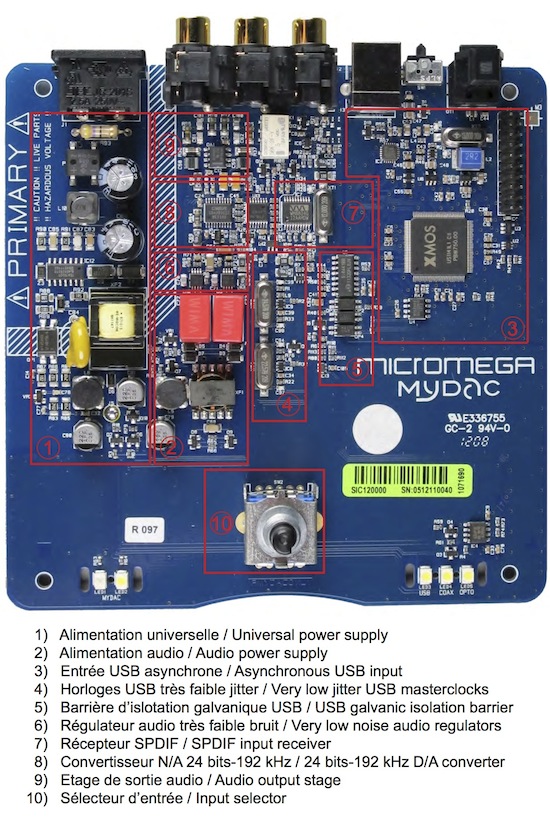
internals of the MyDAC, from What Hifi
Micro Size, Mega Sound!
Review: Micromega MyDAC, Part I
Talk CAS: Onkyo ND-S1 Digital Media Transport, Part I
Follow Up: Miraculous Transformation of my Reference System B (Kondo, TAD)
Read Part II here
(Micromega MyDAC official Literature)
History of Micromega
I am a HUGE Micromega fan. I have always intended to write a Micromega Overview, but that would take an immense effort to research and collate semi-vintage data sorely lacking on the internet and, believe me, I do make an effort to reasonably thoroughly research my subject, even if the article presents my views. Over the past 20 years I have used more Micromega products than almost anyone I know in person or on the internet. But given the premium of time, my overview shall have to wait, though I have put it on the agenda.
To make a long story short, I have used Micromega's epoch-making and -defining Trio, Duo and Solo, plus the later (and troubled) Drive 1 and DAC1 (and matching Amp 1). I have also collected their entire Micro series (Microdrive, Microdac, Variodac, Microamp). All of them gave me GREAT pleasure. There is no better digital in the 1-bit era, and even today old Micromega digital products sound great. Certainly, in the 1-bit era the dominant players like Philips and Marantz and the bit-players like DPA did not do better. Digital with a human face that makes music that goes right to the soul - that was Micromega's genius.
Micromega's History can be glimpsed on its website, but it is admittedly a revisionist's version, understandably omitting its troubled days of using Philips CDM-12 and subsequent near-demise. Although the company had their share of troubles, those are behind them now and their accomplishments far exceed what detractors would claim.
 Compare size and internals and parts with the old Microdac (pic from the net)
Deja-Vu: MyDAC
Since Micromega's recent and miraculous phoenix-like rise from its ashes (how wonderful!) I had been watching. I had intense interest in their current CD player offerings, the CD-10, -20 and -30. To Micromega veterans, these look uncannily familiar (outwardly like the old Mimium's; inside more like older separates).
Micromega had also done very well in CAS, even in the ultimate frontier, wireless, where it amalgamates its own technology and Apple's. I am not a CAS fan (though an occasional peruser) but have full confidence in Micromega's digital technology.
MyDAC has been out for a while, and you can read quite a few reviews on Micromega's own site. The most important one has got to be Robert Harley's TAS Blog article (as well as
full TAS article (pdf file). I am not a great fan of Harley's writing on subjective listening, nor the boring megabuck stuff that he usually reviews, but this time it pays to read carefully. No wonder the reasonably priced product received TAS' 2013 Product of the Year Award.
Deja-Vu MyDAC is the first product to see the light in Micromega's new My series. MyDAC instantly reminds me of the old Microdac and the diminutive My series can be regarded as the modern counterpart to the old Micro series I mentioned above. Of course, modern parts and technology can make things much smaller.
Having owned the wonderful Microdac before and having thought about buying the previous Aria and the current CD-10/20/30, I grabbed at the chance to own another Micromega DAC, even if I have little need for its USB functionality.
 L: MyDAC and NS-D1 next to Sony DVP-PR50P
Mais Oui, Un Miracle!
Since I last wrote about it, my alternate system (description here) had undergone some change. I lent out my Studer A730 to my friend Karma, and substituted the humble Sony DVP. The Sony did not have the richness of the A730 but it had charms of its own, a rightness that is hard to fault. But to test out the MyDAC, I quickly installed it into this system, which is now:
Reference System B:
CD Transport: Sony DVP-PR50P (Kimber KCAG used as coaxial cable)
iPod Transport: Onkyo ND-S1 (stock optical cable)
(Preamp) Kondo M7 Line
(Integrated) Amp: Kondo Ongaku
Speakers: TAD TSM-2201

![[Manger CD test disc]](http://www.tnt-audio.com/jpg/mangertest.jpg) MyDAC Coaxial input To cut to the chase, the Micromega MyDAC transformed the sound to a degree I did not think possible. It simply made everything more articulate; in another word, it speaks - and I use this term only sparingly (previously used for the YBA WD202 DAC, coincidentally another French device). The first track I played was Tennstedt's live Mahler 7th, from this great bargain box set (which finally releases internationally his EMI live Mahler recordings), and from the first note I was captured by the ambiance, the gravitas of the music, which so few digital products capture (CAS needs not apply).
MyDAC Coaxial input To cut to the chase, the Micromega MyDAC transformed the sound to a degree I did not think possible. It simply made everything more articulate; in another word, it speaks - and I use this term only sparingly (previously used for the YBA WD202 DAC, coincidentally another French device). The first track I played was Tennstedt's live Mahler 7th, from this great bargain box set (which finally releases internationally his EMI live Mahler recordings), and from the first note I was captured by the ambiance, the gravitas of the music, which so few digital products capture (CAS needs not apply).I was not entirely certain of my feelings based on just one CD. So I put one of my favorite Test CDs to work, the Manger Test CD. Over its 14 tracks (some of which I dislike, like the utterly boring Jonathan Taylor) I became more and more astonished by the accomplishment of this tiny device. Here, I discovered more rhythmic subtleties (like the Pulcinella track), more bowing nuances (like the Vivaldi track), more everything. The amplitude of the difference is like going from ordinary push-pull to Western Electric. I kid you not, my Kondo has never sounded better!
It should be emphasized that the I highly value Sony DVP-PR50P's own analogue output. Many people use this player as transport, but my experience tells me the external DACs they hook up usually do not sound as coherent as the onboard one, which is why the Sony was my Best Buy 2010. But the Micromega MyDAC is an exception - it is better by a significant margin.
Detour! The Onkyo NS-D1 Digital Media Transport Although it has CAS USB input capability, my interest in this device solely centers on its iPod digital output. I have the more expensive Wadia 170i, but frankly I like the looks of the Onkyo more. A second-hand specimen cropped up and I grabbed it.
The Onkyo had been well reviewed in the Uk and Europe (techradar, What HiFi), but appears much less known in the US. A later more expensive version with metal enclosure is named ND-S1000.

MyDAC USB I am sorry to say, that unfortunately shall have to wait till Part II. My old Windows XP did not seem to agree with the MyDAC (there is a short and unclear blurb on this on the official page). When I have time I shall set up playing with a Macbook, or perhaps it is time to get a new computer!
Conclusions:
- The Micromega MyDAC is a miracle (of an order even higher than the esteemable YBA WD202), offering sonic attributes that most high-end digitals fail so miserably to deliver. It goes to show talent and hearing acuity has nothing to do with price-points. Although many will view its USB asynchronous ability as its raison d'etre, based on my listening I beg to differ and say anyone with interest in digital playback (that is almost everyone) owe himself to listen to this one. In many ways, it is digital product of the decade for me.
- The Onkyo ND-S1 does an excellent job with the iPod. When I have time I shall compare it to the Wadia 170i.
- Once again, the system proves the synergy between Kondo and TAD TSM-2201. Kondo is also extraordinarily sensitive to the front end, and the MyDAC is the best of what I have tried so far, outperforming many more expensive stuff (I hope to try 47 Lab one day). The sheer refinement and details on offer now is nothing short of amazing.


 Posts
Posts