Showing posts with label Brand-McIntosh. Show all posts

07 March, 2023

Dynaudio Excite X32 Lab12 Preamp Mark Levinson ML9 Weeput Bluetooth Cambridge DacMagic Plus

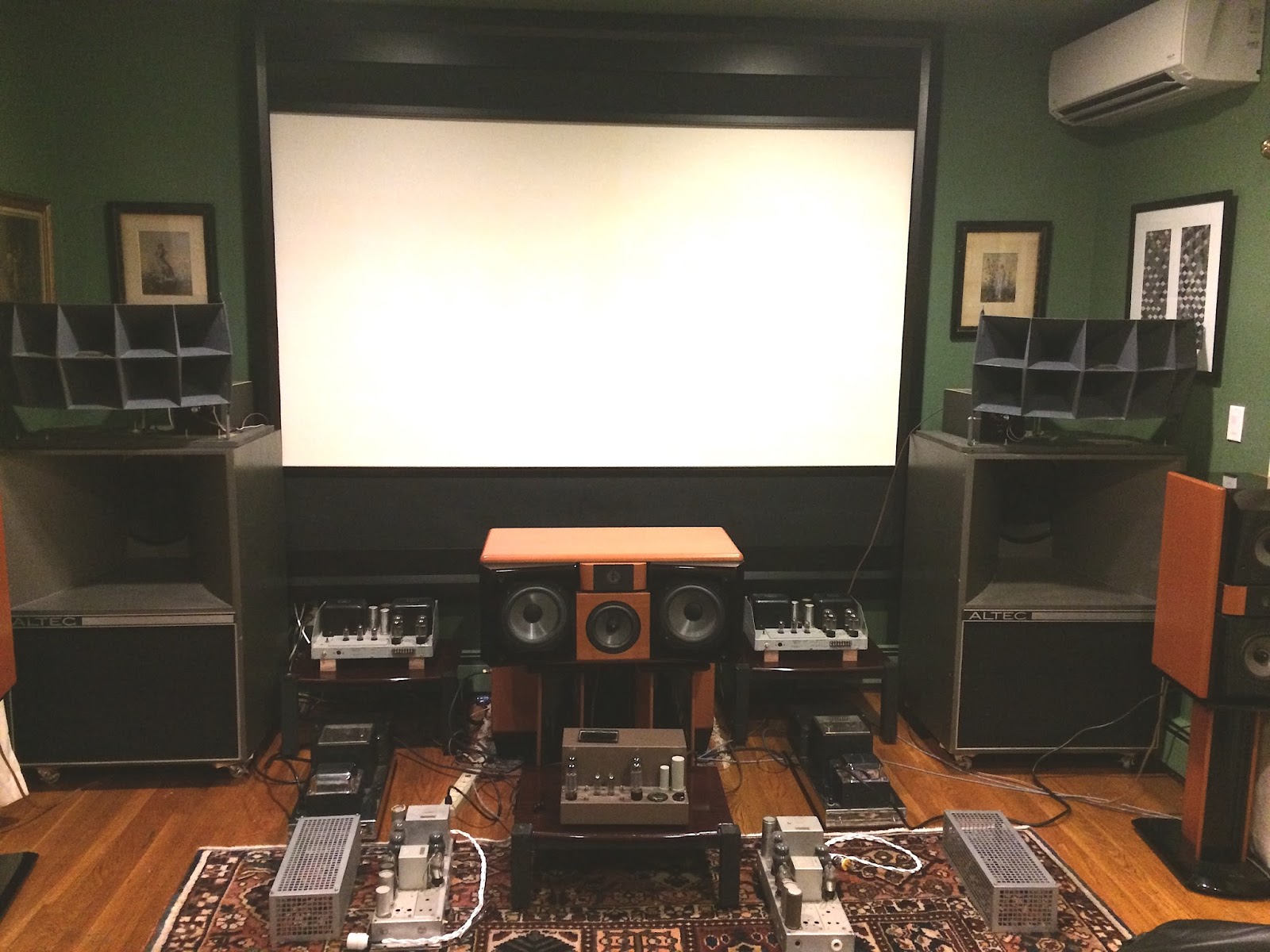
Click Pics to enlarge. Dynaudio Excite floorstander. Linn loudspeakers sold. Right rack ML9; center, Marantz, Cambridge, Weeput; left McIntosh combo.

Letter from Hong Kong (23-4): ELO Home Visit, From Below-Par to Highly Enjoyable

As I was instrumental in the selling of his Avalon Avatar to my friend, I have known Seven for almost half a year. Since then, we have been texting on hifi matters. He has a tendency to buying and selling often, sometimes reselling quickly, and equipment come and go like merry-go-round.
At first the performance of his setup was quite mediocre at best and did not arouse my interest at all. I admire his courage but the purchases he made are not things that I would usually consider. Recently, when he said he would like to try McIntosh amp, I told him about my bitter experience with my Dynaudio Compound 2 and McIntosh MC7300. Of course, like many Hifi lovers, he bought it anyway. Luckily, he actually bought the Dynaudio Excite X32 and Lab12 Preamp based on my recommendation.

He said he compared the X32 with Focal floorstander and Wharfadale Jade 5 and preferred the Focal (a name I also respect) to Dynaudio. He also told me the Lab12 Pre was not as good as his other DIY preamp.
Well, sometimes you never know! I just want to verify if what he said is in line with my ears, so one day I went to his rented space purely for hifi listening (what a luxury!) after work since it is just a stone throw away from my workplace.

Powered by his McIntosh combo and Marantz CDP, we tested the Focal against the Dynaudio. It was apparent in the interim the sound had improved from quite mediocre to acceptable, though still with some booming in the mids and lows. My preference was with Dynaudio and, after prolonged listening and sharing views, he came to my views and eventually sold the Focal. The Lab12 Preamp was not played on this occasion.


After a very short period of time, he bought a classic Mark Levinson ML-9 Amp and hooked it up to the Lab12 Pre. I revisited, bringing with me my Luna Orange speaker cables (that I have previously reported on) to see how it would sound in his setup. On this occasion, the CDP sounded OK, but was nothing to write home about. Then, I spotted a tiny Bluetooth device (oddly named Weeput, 小沛知音, from China) that was hooked up to a Cambridge DacMagic Plus. I immediately streamed Tidal from my cellphone to his BT device. Sound completely trumped his Marantz CDP, which in comparison sounded tired, veiled and lacking in sparks. While the McIntosh combo sounded rich, fleshy, slightly coloured and musical, Lab12 Pre/ML9 provided more details and better imaging, but with a leanness and slight austerity that was not to my taste. Luna Cable came to the rescue and once again shined with its true orange colour. The sound became more organic and musical, with good bass and convincing soundstage. Everything began to make sense, PRAT was preserved, and I was starting to enjoy the music tremendously through the BT device and Tidal music - what a transformation from before! Yet, a trace of hadness is still detected .


I also suggested he paired the Lab12 Pre with his McIntosh Amp. Surely, the next time I visited, it was hooked up and immediately uncovered a perfect synergy - the neutrality and speed of Lab12 paired perfectly with the lush and big sound from McIntosh. Previously on the verge of being dumped, the Lab12 Pre had become the last piece of the jigsaw puzzle that completed the picture! I am happy that the Lab12 has found a good home!


I then played the songs from my playlist, with different genres, and Seven was enlightened since I have opened up a whole new world of music to him and he found it so fascinating! He said he had never heard his setup's performance to be so good. He has upped his understanding of music 升呢 big time lol. Once you taste the best, you can no longer settle for less (not quite yet, but I like the rhyming)!! But, right now, I can spend extended time to enjoy music at his place, and that does not happen often to me.

The surprises for me are the superb quality of the Weeput 小沛 BT receiver/DacMagic combo as well as the quality of McIntosh Amp (all it just needs is the right preamp to pair with)!

Incidentally, I also found out on why before he and his friend had preferred Wharfadale. The bass coming out from the speakers was big and with copious quantity. However, to me it's lacking in finesse, timbral accuracy, details and shimmer. Musicians played as if they just had a hearty meal and were ready for a siesta, which to me is a big NO. What really shocked me was that I found out why his peers prefer that type of sloooow sound. They mainly listen to Canto pop with limited dynamic range! They seldom listen to any other types of music and actually enjoys SLOW sound even when it is supposed to have PRAT!


24 February, 2020

Mac Attack! McIntosh MA-5100 Integrated Amplifier McIntosh MR-67 Tuner JBL Studio 590

Mac Attack! McIntosh MA-5100 Integrated Amplifier McIntosh MR-67 Tuner JBL Studio 590


By mrgoodsound 


Editor: I really knew relatively little about mrgoodsound when he came on board. After some exchanges, I became more and more surprised by the scope of his vintage interests. I am delighted he has started to write about his system and vintage equipment. I have a lot more to comment on McIntosh etc, but I'll leave that to the comments section.


12" Stentorian HF-1214 drivers

A Transitional Phase


I am currently stuck in loudspeaker purgatory. I have 3 DIY speaker projects on hold for one reason or another, 2 or 3 more DIY speaker ideas, and a shortlist of (vintage!) commerical loudspeakers that you just don't see come up for sale every day. The desire to rid myself of my current inefficient modern tower speakers for high-sensitivity, low-loss, alnico-magnet loudspeakers from a bygone era is at the top of my mind these days. Even stronger still is the desire to continue to enjoy music every night, which means making the best of the acoustic system I currently have.

JBL Studio 590


As to what I currently have, the Studio 590 is still enjoyable. It is a 2.5-way design using a compression driver in a bi-radial horn and two 8" woofers. The Studio 5 series has been around for a few years now and was reportedly Greg Timbers' (JBL Everest, JBL 250Ti) last design work for JBL before his departure. It's primary shortcoming is the nature of its crossover design, the complex filter networks and attenuation required to match the horn-loaded compression driver with its lower half. Efficiency is lost, electrical (and musical) energy is converted to heat and the critical middle frequencies shy away from the spotlight or a chance at expressiveness until the volume is increased. The sound is very modern and 'straight-up', and experiments with well-designed high-power push-pull pentode amplifiers showed that solid-state amplification is still a necessary evil, despite a published 90dB @ 2.83V sensitivity rating.

Still, this model is available factory direct and often on sale for about $1,000 US a pair. For this price, I find them recommendable and superior to the large majority of commercial loudspeakers at this price point. Much has already been written about these speakers online and I will not go into too much detail other than to say I like them but yearn for better. The best review I found, complete with measurements, was published in Aussie mag AVHub here.

McIntosh MA-5100


I browse local audio classifieds daily, for opportunities to acquire desirable vintage equipment, although this often gets me into cases of buying things I don't actually need in any way. This amplifier was one of these purchases, but I am fairly pleased with it. I picked it up along with a MR-67 tuner from a gentleman who had lived with them for over 20 years. He was a retired combat veteran and could no longer enjoy the equipment in his living situation. I felt rather bad, but he expressed satisfaction that both pieces were going to a good home.

My new (to me) MA-5100
The MA-5100 is a full-function integrated amplifier with phono section and 45 watts per channel. It was manufactured in 1966 and was one of the early solid-state units offered by McIntosh, based on silicon transistors. Firstly, my bias against McIntosh. I think modern (post 1979 production) McIntosh equipment is a travesty. The quality (I speak only of internal construction and circuit design for integrity of sound, not fit & finish) has only declined over the years, and it is to a point where they produce amplifiers that look more like computers than audio equipment inside, not to mention the frequent re-issuing of classic models that perform worse and worse than the original. Misguided engineering via over obsession with specifications (1 kilowatt amplifiers!) to produce products to appeal to those who wish to show off or are truly on the path to audio hell. Like present-day Klipsch, their sales are sustained on brand power and marketing only.

The subject of today's article is from a different era, and I am fond of McIntosh gear of the 1960s and prior. The MA-5100 is gorgeous, especially with its wood grain enclosure and original fascia lighting. It has tone controls, loudness contour, old 'LP' phono equalization, and two phono inputs; all features which I use and appreciate. The sound has traces of harshness associated with early transistor equipment, but despite this it plays with great immediacy and presence. This is only once a critical volume threshold is reached, as is the case with nearly all solid-state amplifiers. However, still impressive, and perhaps the hallmark of McIntosh equipment from this era. Tonal and timbral quality is there, and the sound is not awfully washed out like modern McIntosh amplifiers. It can be used to enjoy jazz and classical. The MA-5100 was an 'entry-level' piece and can be found for reasonable prices today. It is not autoformer coupled on the output, but this is frankly an unnecessary feature,  unless you advocate the use of Wilson speakers with 2 ohm impedance troughs.

McIntosh MR-67


The MR-67 tuner is a piece I have wanted for a while. Yes, I still listen to FM, frequently so. In Toronto we are fortunate to have many great stations still to enjoy classical and jazz music. It is a tube tuner and an aesthetic mate to the MA-5100, although their production was a few years apart. Even with a simple copper wire used as an antenna, reception is very good, and the local 96.3 Classical FM can be enjoyed. I prefer to listen to FM in mono as the sound is even more immediate and present, and without multiplexing the signal path is technically shortened. A good broadcast with this tuner sounds warm and inviting, even the commercials sound good.

For a classical novice, FM is a great way to not only hear new pieces, but learn more about them. In between or before playing a piece, the radio host will often give context to the music and who is performing it. I keep pen and paper handy while listening and write down the times when hearing something I like, then look up what was playing on the station's website later.

A tuner will remain a mainstay in my system for background listening, to provide a constant signal for warming up or breaking in other components, as well as when I come home from work too tired to think critically about what I want to listen to. I love this piece although I forsee myself replacing it with a Scott 310E if the opportunity presents itself. The Scott is nowhere near as pretty, but is on another echelon of FM quality compared to any McIntosh tuner. Unfortunately, good examples of the Scott are getting hard to find, and command high prices.


03 October, 2018

Horn Placement, Subwoofer Supplementation


Top Pic: (Case 2) Pic of R's A5 System as of now. My Bell 6V6 amps in center front. Compare with old photo below.

Talk Horn: In-Room Placement, A Tale of Two Horn Systems
HiFi Basics VII: Loudspeaker Placement - Close-to-Wall vs In-Room
McIntosh C-20 Preamp, MC-30 A

Significant Update Oct 5, 2018: Subwoofer Supplementation added. Update shaded in Grey.

Although we are illustrating with big horn systems the size of refrigerators here, I believe the principals are universally applicable, to much smaller loudspeakers, including bookshelves.

There is little question loudspeaker placement is of the utmost importance in a system. Previously, in HiFi Basics III, I detailed my own encounters of Short vs Long Walls. This article examines Close-to-Wall vs In-room Placements.

Close-to-Wall Placement By Design FEW modern loudspeakers are designed to be placed against the wall, as this intrinsically is at odds with the modern hifi values of maximizing imaging and soundstage. But there are a few dedicated designs, like the very good Linn Kan, which needs the wall reinforcement to have useable bass for most people. More recently, there is the Wilson Audio TuneTot, which receives a lot of coverage from the audio press, but to me it is a ridiculously expensive product for what it is, and showcases the utterly hopeless nature of high-end reviewers (The TAS is a particularly serious offender; their eulogies on the passing of Wilson Sr make my flesh creep 簡直肉麻!) Corner Placement This only applies to certain vintage loudspeakers, usually larger horn systems with specifically designed corner cabinets (Klipschorn and Tannoy's) to optimize bass output. The corner has two reflecting surfaces which would cause even greater havoc with most other loudspeakers. By Choice/No Choice Sometimes one has no choice but to place loudspeakers against the wall. In my experience, most loudspeakers sound suboptimal to terrible thus placed. Most would suffer from badly delineated bass and lack of air. In this situation, one would be wise to choose infinite baffle (sealed) enclosures, preferably those with monitor pedigree, as these usually work well in near field situations and have good but never exaggerated bass. As an example, my large Yamaha NS-1000 works beautifully against the wall; there is still a good soundstage and imaging (though not as good as in-room), and my TAD TD-3401 is also good in this way. Ported loudspeakers, even front-ported, do less well. Klipsch Heresy This unusual loudspeaker is actually stipulated to be used (on its own pedestal) against the floor, not the wall, but that is not that different. Without floor reinforcement, the Heresy is lean in the bass. As such, it actually works well close-to-wall.

How should Horns be placed? No doubt the size factor predisposes their owners to put them against the back (front) wall. Also, the ungainly, industrial and utilitarian appearances of many horn systems, such as the Altec's in this article, certainly do not earn them admiration from family members and that is another incentive for relegating them to the back, even in the corners. For many, it just has to be that way, BUT for those who have the room, that is a mistake.

These horns were originally used in large theaters, perhaps hanging, but usually not against the wall; and firing down a huge space (ample space around them) minimizes any anomalies. In our much smaller spaces, one needs to take care.

In my old place in HK, I had my Tannoy Canterbury's (large loudspeakers with small horns) and TAD TD-3401 half way in-room and they sounded great that way. Visitors were always amazed by the depth of soundstage and, even more, the disappearance of the loudspeakers. In NYC, I have my YL horns the same way, with similar results. Like with a lot of more conventional loudspeakers, unless restricted by bass nodes, I like the loudspeakers in-room and with the listener form close to an equilateral triangle. Some would call this near-field, or nearly so, and it should lessen boundary effects. For me, in both HK and NYC, the sweet spot for loudspeaker placement is largely the same for all sorts of designs.

Subwoofer Supplementation What a Difference a Little makes There are many purists out there who are adamantly against subwoofers, but these are mostly people who have little concept of what live music is like. Our hearing is a complicated thing - without a bass foundation not only will the midrange and upper frequencies sound leaner, but the music will lack true sparkle, which most audiophiles mistake to lie solely in the treble. The best example is my friend WSS' Quad ESL, which came to life with just a whiffle of low bass added (here). I always tell people, a little augmentation does not really augment the bass by much, but helps the overall picture, to bring things to life. As in the case of WSS, the important thing is less to hear the difference, but to feel it. When to Use? This is purely by hearing. My modern Tannoy Canterbury, TAD TD-3401 and YL horn system (with Altec 216 woofers) do not need help, but my JBL 4312 and my NYC friends' Altec A5/A7 systems absolutely do. Another case is my Klipsch Heresy, which really is severely limited by its original design (on the floor), but rather should be used "normally positioned," together with a subwoofer (detailed here). Subwoofer vs Other Means When the bass is lean, the problem can lie with the loudspeakers, the equipment or simply the room. Audiophiles have many ways to increase bass, but these should only be used judiciously, as the "remedy" is often worse than the problem. It is one thing to try, e.g., Mogami instead of Gotham (both cheap professional cables with balances close to neutral, though they sound different), it's another to use expensive boutique cables that are basically highway robbery. Case in point: Thick and stiff cables, e.g. NBS, often increase bass, but are highly colored and smear everything. Most of the time, the loudspeaker is the real limitation - it would be wise to spend time dialing in a subwoofer rather than make the bass "fuller" via other means, as one really wants more true extension rather than bumping up the mid-bass.

The owners of these two Altec systems are good friends of mine who should be familiar to regular readers of this blog. Both share a passion for music as well as many other non-musical things, such as cooking! Both are lucky to have a dedicated room. Both had their horns in the back until I came back this time. Both had their horns on wheels so it was relatively easy to move the behemoths forward. As they say, the rest is history.


Pic shows (Case 1) Kevin's A7 System, now way out in front (compare with old photo below). The turntable on the Wall Mount is now a restored Lenco G-75 (VPI relegated to the left, a corner of which can be seen behind the B&W CM5). Below are newly acquired and restored McIntosh MC-30's. On the front stools is one of my C-20's. Click to enlarge.

L pic shows the Dumpling Dinner with side dishes of Pork stewed with Dried Bamboo Shoots, Braised Peanuts and Sliced Smoked Turkey; R pic shows the older against-the-wall Placement. Also roll down to the Blog entry before this one.

Case 1: Altec A7

Since I last wrote about K (roll down to previous post) I have visited him two more times. Unbelievably efficient, over a short time he managed to move the horns forward and clear up the central clutter. All gears are now well behind and there is a clean line of sight to the plane of the loudspeakers.

The sound is totally freed up. As the man himself said, the sound now emanates from the space in front, rather than from the loudspeakers. I cannot agree more, and this also met with the approval of our captain Andy. Now, with the much cleaner and focused sound, Francescatti's tone (which could be grating in lesser systems) in his classic recording of Beethoven's Violin Concerto with Bruno Walter was just marvelously sinuous. Thumbs up! Credit is also due to K's DIY WE cable.

We also really liked the the full McIntosh combo, the Lenco/Decca/Shure M44-7 playing straight into the C-20's phono and driving the MC-30 pair. Everything sounded just right.

Case 2: Altec A5

Then we visited R (last visit). I have long suggested to relegate the HT system to the periphery and bring the horns forward. I was surprised that R was game and K carried it out single-handedly (he definitely earned his lunch)! It was quite a bit of work! Everything was dismantled (the Cary amps were heavy!), the huge HT subwoofer exchanged its space with the large HT center. The result was again a cleaner path to the plane of the loudspeakers.

The effect was much as at K's place, a cleaner sound that is free of the enclosures. The Bell 6V6 amps worked very well in this system. Marvelous!

And the Food!

13 February, 2018

Altec A5, WE124, Marantz 8B, Jadis JA-80, JPS2, Citation I, McIntosh Verdin P-153


Click pic to enlarge. Front to Back: WE 124; Marantz 8B, Jadis JA-80, McIntosh Verdin P-153. Subwoofer behind center channel.

Growing Up Without Pain! One Lucky Man's A5
Jadis JA-80, Marantz 8B, WE 124, McIntosh Verdin P-153
Jadis JPS2 vs Harmon Kardon Citation I
Letter from NYC (76) 2018 (2): Smorgasbord!

That Horny Feeling What would life be without our taskmaster R (you last met him recently, here)? Contented now with the big Wilson rig in his cavernous living room, he immediately set about to fill the void in his previous man-cave and theater room, where the Wilson's had literally struggled to be heard. Being a jazz fan under the influence of mentor/team leader Andy, he was somehow (rightly) drawn to horns (without having heard much).

The Great Debate Since the den was vacated, the team had spent much time fruitlessly debating on whether JBL or Altec or even Klipsch would be best for R. Simon has always been a JBL fan, and in some ways I concur - it is usually much easier to get good sound out of JBL (better crossovers) than Altec (notorious crossover woes, which I am not at all sure is always justified). On the other hand, I thought a good pair of classic Klipsch is a complete solution - the stock crossovers work well (and I prefer them to the many overhyped aftermarket kits) and you need not do much tweaking. However, some of us, myself and likely Andy, do feel that, when properly implemented, Altec delivers the most.

Men at Work It all came to fruition during my absence. A late alnico Altec A5 system was sourced from Andy's friend P and the I heard the team had recently labored quite hard to implement the system in R's den, one of those occasions when everything that could have gone wrong did. I reaped the fruits of their efforts as I got to hear them this past Saturday, and I brought with me a pair of WE 124.

The A5 came with the original crossovers as well as ones DIY'ed by the previous owner P. I only got to hear the latter, which have attenuators for the 288 drivers. We played several jazz records, including mono Clifford Brown, audiophile fav Saxophone Colossus etc. All with a little subwoofer dialled in (crossovered high).

Equipment (for more detail on some items, please refer to 2016 visit)

Phono 1: Walker Proscenium/Kondo IO-J
Phono 2: Versa Dynamics 2.0/Stanton 380 (with nude elliptical stylus inserted)
Phonoamp 1: Kondo KSL-SFz step-up into Harman Kardon Citation I phono section (via Tape Out)
Phonoamp 2: Lamm LP2
Preamp: Jadis JPS2 (and Harman Kardon Citation I)
Amps: Jadis JA-80, Marantz 8B, WE 124, McIntosh Verdin P-153
Loudspeakers: Altec A5 (DIY crossover)
Subwoofer: Focal/JM Lab

Sonic Impressions Overall, the sound was good and quite coherent, though not the last word in detail or nuance. I am sure a lot more of the strengths of the Altec horn system are still waiting to be unearthed but, for now, it does sound more lived in than horn novice R has a right to expect!
  • Jadis JA-80 This has always been a Jadis staple. This pair is the older, pre-KT150, version, modestly tubed with old-stock 12AU7's, Chinese 12AX7's and Russian 6550's. I know this amp quite well and in this setting it delivered sound just as I remembered it - punchy, weighty and smooth, with good transients and macrodynamically adept (with these efficient horns) but with sub-par microdynamics, failing to convey all the low level signals in the music. Painting in broad strokes, so to speak, and that is not quite acceptable for expensive electronics.
  • Marantz 8B For the EL34's, this unit has a melange of 3x RFT's and 1x Russian that necessitated some re-biasing. That done, no surprise, the ever reliable 8B turned in a good performance - the microdynamics walked all over the Jadis JA-80, restoring most of the nuances in the music. However, used with the Jadis preamp, it had a significant flaw - the slow transient speed drained the zap out of jazz.
  • Western Electric 124 What more can I say! As usual, the WE immediately established its credentials. The music simply came alive: the superb microdynamics revealed infinite shades in the music's rhythm and color. Transient speed was excellent without being breathless. The only criticism that could be levied was a somewhat lean bass in this setting.
  • McIntosh Verdin P-153 Now, this is a rarity! Likely this was not intended for audio applications. It employs McIntosh transformers and the typical driver tubes, 2x 12AX7 and 1x 12BH7. Output tubes are 4x 8417. R reported the plates of the 8417's in one amp turning red after an hour of use. We did not listen that long, but what we heard was classic McIntosh sound - Ballsy, big and bold, like the Jadis, but with much better microdynamics, though still not quite in the league of the Marantz, not to mention WE. Right is another pic from the net (click to enlarge).
  • Harman Kardon Citation I I mused at the frequent lack of microdynamics. Suspecting the Jadis JPS2 to be inadequate, I asked for the line section of the Citation I to be substituted. We had trouble with the connectors, as so often in R's place, but we did manage for a while. Suffice to say, the Citation I was snappier and much more detailed and articulated in its line stage than the Jadis - it was not even close!
Comments
  • Jadis JPS2 As heard, it performed quite sub-optimally in this system. I am pretty sure it is robbing the music of much microdynamics, no more obvious than in its pairing with its own stablemate JA-80! The JPS2 is not a favorite of mine, but I have not been previously aware of such deficiencies in the systems of my friends Paul and Simon (here; the latter in the form of the line stage of JP80). I am not sure whether the deficiencies are intrinsic or if it is amenable to tube rolling, but my feeling was echoed by this comment posted by a user on the net: "...does anyone know any other pre which has the midrange magic of Jadis JPS2 plus more resolution on complex orchestral music and more control in the bass?..." I am also curious because Dick Olsher, a reviewer with priorities somewhat in line with mine, specifically lauded the similarly configured but cheaper Jadis JPL (one chassis, no separate power supply) for its dynamic prowess. For this write-up, I went back to my post on my one of my early visits to R, and was reminded that I had already documented the problem when I much preferred my Shindo on that occasion.
  • Harman Kardon Citation I Once again, the Citation I showed its mettle. Just as it worked well with my YL horns (here), it seemed to work well with R's A5's. I also urge you to re-read what I said about it in our last preamp shootout (here). Next time, I'd like to spend more time with it IF the connection quirks were dealt with.
  • Jadis JA-80 I have long familiarity with this amp, since the 80's in fact, when a friend owned it. But I had never really taken to it then; I only liked it when it was used with GEC KT88, but then that was almost solely due to the excellence of those valves, which also could transform the McIntosh MC275 from a good amp to a great one! Speaking of which, the Jadis JA-80 is no more powerful than an MC275 in good condition, and the latter only employs half the number of output valves and occupies a fraction of the real estate.
  • Marantz 8B To me, the Marantz 8B is an evergreen. It is not perfect, nor does it immediately grab you in any parameter, but it never puts a wrong foot forward, safeguards the big musical picture, and rewards patience and time spent. It should be partnered with a modern preamp of lively presentation (think ARC, Shindo etc), or else sound may be a little slow.
  • McIntosh Verdin P-153 I think this one has potential, if one manages to get around the conundrum that is 8417, famous for its excellent sound, rarity and sometimes finicky behavior (QC issues for later production tubes and issues of ?oscillation). Given its solid state rectification (selenium) and power envelope, I wager it should sound like a more powerful MI-75, but not quite in the eschelon of tube-rectified MC-60. Just a guess.
  • WE 124 Simply, in a league of its own.
  • The Lunch Raison d'etre for the day? The specially sourced lamb, served with risotto and Shiitake mushroom sauce, was an absolute delight, washed down with a very fine 2005 Saint-Emilion and a mature Cotes du Rhone. Surely enough to make one forget audio woes. What more can one ask for?

03 August, 2012

Review: McIntosh MC-1700, ATC A7, Overview ATC

Review: McIntosh MC-1700
Review: ATC A7
Overview: ATC


All tube aficionados know McIntosh, a marriage of timeless looks and beautiful sound. Like others, in the 70's McIntosh abandoned tubes. To their credit, their solid state products sounded warm and good too, though not as good as their older tube products. Of course, more recently they have gone back to tube products, though they still make solid state ones too.

McIntosh MC-1700 You can find info on the MC-1700 stereo receiver in the wonderful Roger Russell Page. Study the various models and you shall understand McIntosh's evolution. The 1965-67 MC-1500 was an all-tube receiver. The 1967-1973 MC-1700 was its replacement, and belongs to the transitional age - while its tuner section is still tube, the rest is solid state. Its replacement, the 1973-78 MC-1900 began the all solid-state era. If you ask me, look-wise the MC-1700 is the best. Last retail price was USD 599 in 1973. That was a lot of money. According to the Inflation Calculator, USD 599 in 1973 had the same buying power as USD 3,181 in 2012! Of course, I couldn't afford it then; my unit was acquired in the late 80's for a song, but these have steadily increased in second-hand value.

Overview: ATC
This shall be a brief and limited Overview. ATC is well known by sound industry professionals, its history briefly chronicled in its Official Page. When I came back to HK in the early 90's ATC was enjoying its first flowering in the consumer market. I got to hear every model in the original range, some many times over the years.

ATC is most famous for their proprietary soft-dome midrange driver, the technology of which have been extended to the bass units of the smaller 2-ways. The model names indicate the volume of the enclosure. Thus SCM10 = 10 liters; SCM20 = 20 liters, and so forth. The original models have very heavy and damped cabinets. These models have had many "revisions" and "special editions", reflecting changing tastes - usually the later ones have more prominent treble. What I mention here are all original models, without any suffixes behind the numerical number. In recent years, these have virtually disappeared from the second-hand shops in HK - most have been scavenged by buyers from the PRC.

SCM20 (info here; 1990 review here) Likely the best known and loved of the range. I owned one for many years (original, single-wired, fabulous rosewood) and had truly enjoyed it. Mine came with Sound Anchor stands. It casts a huge soundstage, plays with authority even with the most complex music (say, Mahler). It is detailed, but nothing sticks out. Indeed, it sounds natural and, yes, like a much larger speaker. It has a reputation of being hard to drive, which led many people to use high-powered ss amps. I have used a Bryston 4B (original, partnered with a tube preamp of course) to satisfaction, but I am sure they sound their best with a good tube amp. Not anything would do, but a vintage Marantz 8B surprisingly can drive it with ease. Even juicier was the ARC D-115. I think its even load (8 ohm) is friendly to amps. The half as big SCM10 has a very similar sound but it is even more difficult to drive.

SCM50 and SCM100 These larger 3-ways using the original soft-dome midrange driver are much coveted. They are quite a bit easier to drive then the 2-ways. The sound of course is even better, particularly in the bass. I have actually visited someone using 300B for the SCM100 (of course, just near-field), but I wouldn't recommend that.

SCM7 The smallest in the newer commercial range, which have lighter builds and are easier to drive than the classic models. I used to own one, the original version. It was much easier to drive than the earlier A7 (see below) and has more treble content, but I felt the sound was a bit on the light side. Later this range changed to have protruding baffles, which are ugly IMHO.

A7 This was an oddity, without the SCM designation and an early commercial foray. It looks like a reduced SCM10 and is a forerunner of the SCM7. There are good reviews in soundonsound and hometheaterrevie. There was a floorstanding version called the A7T.

A7 vs SCM7 For a time I had both and compared them. Although they are similar in size and cabinet volume, the A7 is a bit heavier. There are significant sonic differences. The drivers look similar, but there is little question the SCM7 is easier to drive and has a crispier sound (spec has only a 1 db difference, 84 vs 83 db). Part of this is due the SCM7's reduced woofer size (5" vs the A7's 6"). The A7 tends to be a little rolled off at the top (probably needs more power). Indeed if you look at the spec's the A7 and SCM7 differ quite a bit (with the treble -2db points at 12kHz and 16kHz, respectively). Sonically, I feel it is a double-edged sword: the SCM7 is easier to drive but has a lighter sound; the A7 is more inefficient but has more authority and what I think of as the classic ATC sound. If you partnering gears are up to it, I feel the A7 shall come out ahead, closer to the performance of the SCM10.

McIntosh MC-1700 + ATC A7
This unlikely project came about because I was recruited to put together a system for a cafe. The owner wanted a retro look and the McIntosh fit the bill perfectly. Better yet, it has a tuner and phono capability!

The McIntosh has only 40 watts per channel, but its power supply is beefy. I knew it would not be a perfect match, but I also knew it would not be totally embarassed either, despite the A7's inefficiency. That was because many years ago when I first bought it, I took it to my friend Tanuski's home, where he had an old pair of Proac 3-way (not EBS, probably an old Studio) that nothing could handle satisfactorily, including Jadis JA-80. But to our great surprise, the MC-1700 did a very good job! I wrote about this in 2004 in my yahoo group of the same name:

"...I think it is UNLIKELY that it (Ed: Proac EBS) is tube amp friendly. Older Proac's are rather difficult to drive. Actually Tanuski had some old Studio bookshelves. We couldn't get satisfactory sound out...finally on the day he sold them I hooked it up to a Mac 1700 ss receiver and bingo the sound was so much better. The EBS should be even more difficult..."

Sound (Line) In my 300 ft room, perched high up the A7 gave a well rounded and familiar ATC sound. My friend Boylah said it was surprising that the old receiver was up to it at all.  For the uninitiated the slightly dark sound masks a little the great amount of detail on offer, and the midrange and bass had a fullness that belied its size. It is best to give it a high output source. The CD's buffered output worked better than the iPod's earphone out (of course).

FM Tuners section IMHO this is a VERY good tuner. Warm sound and reasonably good sensitivity.

Phono section The humble Technics SL-1200 Mk II with an el cheapo Audio Technica 5625AL cartridge gave a very good performance. Quiet!

Conclusions
  • The McIntosh MC-1700 is a very solid performer, worth every penny of its cost. With an even load it performs beautifully.
  • The ATC A7 has more than a tinge of the classic ATC sound, though it needs some care in partnering with ancillary equipment. The more you give it, the better it sounds.

09 May, 2012

Brief Review: Sonus faber Electa Amator II, Sony SCD-XA5400ES

Letter from NYC 2012 (23): A Wonderful Re-Acquaintance 
Brief Review: Sonus faber Electa Amator II, Part II
Brief Review: Sony SCD-XA5400ES 
Brief Review: McIntosh 2200
Talk SACD

Since we moved into the larger apartment with dedicated audio room I have concentrated on my big speakers and not fired up the Sf. Just before I left this time I did so because a friend who has the Mk I wanted to hear them. As his Mk I has developed driver problem he wanted to buy mine. Incidentally, if anyone knows where to fix early Sf drivers in the USA, let me know! I'd also like to hear from fellow EA II owners regarding the surrounds of the drivers: my woofer's is rubber and the rear unit's foam (a bit unusual to see both in the same speaker).

I have always loved these speakers. Read my brief review Part I, as well as my Sf Overview.

My audio room is now dominated by my large YL horns (roughly 2/5 into the room from the front wall). I placed the EA II just in front of the inner edge of the behemoths. The rear driver had about 6" clearance. The loudspeakers were a little less than 6' apart, and listening distance was 7' or so. Equipment used:

Digital: Sony SCD-XA5400ES SACD/CDP
Analog: Thorens TD-124/SME 3009i/Denon DL-304
Preamp: Shindo Monbrison
Amp: McIntosh 2200

In Love Again
Despite my suboptimal placement, and despite these not having been played for more than 2 years, I was immediately taken by the sound emanating from the EA II. My friend's exclamation a few second into the first track sums up a good part of the allure: "...what the heck, such a big and deep stage..." Indeed, the soundstage was wide and deep. The important thing is the precise images are life-sized and solidly fleshed out, not the tiny-weeny ones of many a bookshelf. As noted before, the string sound was just luscious and en masse, as it should be, but rarely are. Amazingly, the boldness of presentation almost measures up to the big YL horns. So, using a cliche, they sound like big speakers.

I think this kind of Sf sound is now partially gone. Current models sound "updated" and much more modern. But I prefer Sf's golden age. It's too bad, since I decided to keep them; perhaps i just have to unload something else...

Now, some comments on some of the auxiliary gears used:

Sony SCD-XA5400ES I really had not listened to this SACD/CD player much before, though I had set down my initial impression. This time, I decided to just run it in for 24 hours. The sound opened up further and revealed much nuance. Just an example. I compared again the original red book Triloka CD with the current Analogue Productions hybrid SACD/CD of Hugh Masekela's Hope. Previously I preferred the RBCD, which seemed to have more oomph. This time, the story is not so simple. While the RBCD still seemed to have a bit more of the primal rawness (which befits some material here), there is no question the SACD layer is very close in this regard but a lot more detailed and nuanced in the vocals and instrumental timber - more analog if you will. the CD layer of the hybrid disc also comes pretty close to the SACD. The Living Stereo hybrid SACDs also sound brilliant (Reiner's Spain is just an example; I think they sound better than the earlier RBCDs due to better re-mastering). So, a wonderful SACD player! It is either phased out or being discontinued, but you can still get it.
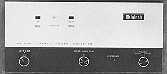
McIntosh 2200 And now, a word on this venerable machine which has served me well. I had written about my previous listening experience. This time, it matched the EA II almost perfectly, giving excellent control but a warm and luxurious sound (of course with a tube preamp). I have heard many Sf's with sharper and more analytical and more powerful solid state amps, but I think I prefer these old McIntosh's for their musicality. A bargain!

23 April, 2011

My Corner: Casual Listening in NYC

click on pic to enlarge

Letter from NYC 2011 (15): Setting Up (I)
My Corner: My Listening Stations in NYC (I) - Casual Listening

Talk Tuner: The wonderful McIntosh MR-71

Martin Logan Source redux

The Many Stations of Life
Last time I left NYC after we had just moved into our new apartment. I did the rudimentary setup of my dedicated listening room, dictated mostly by the large horns. I bought some racks and set up multiplt stations. You may ask why that many? Well, yes, I have always liked to be able to switch gears on the fly, but the reasons behind are mainly twofold: multiple stations provide better ergonomics for my various turntables; and horn speakers and panels have quite different requirements, difficult to fulfill by just a single set of equipment. As I have the number of gears required, why not?

The Casual Listening Station: Last, but not the Least
In terms of monetary value, this station comes a distant last, but in terms of use it probably comes first. In NYC I get up very early, in the wee hours, as described previously. As I drink coffee and work on my computer I listen to music at a very low volume. It's really too much of a luxury to have expensive WE tubes or the battery of the Nagra taxed for such purposes. To this end, I created my Casual Listening Station, one located right behind my listening seat and working table. The goal is to have relatively simple gears to provide what I need:

Analogue: Technics SL-1200MkII-Benz Micro Silver
Digital: Meridian 506-24 or Rega Apollo
Tuner: McIntosh MR-71
Preamp: ARC SP-9MkII
Amp: McIntosh 2200
Speakers: Martin Logan Source

Much of this I have described before. Despite the "marginal" existence of some of the gears in my cannon, this system not only excels in casual and low-level listening, it also serves as a "watchdog": the other stations have to at least equal the performance of this station to justify themselves, and it has not been easy, for a myriad of reasons! I shall make brief comments on each component in the chain.

The Source (TAS review)
I know, I have mentioned it many times: the Martin Logan Source just constantly amaze me (previous write-up's). They sound fantastic even at very low volume. The electrostatic panel and dynamic woofer are seamlessly integrated, and the latter plumbs depth that still surprises me. Unlike the Maggie 1.7, they are also small and narrow enough to stand in front of my large horns without undue negative effect.

Like the Magnepan 1.7 I had up a while ago before I fired up my horns, at first I had them placed in a relatively near field isosceles triangle of 6 ft or so. In this position, the imaging was not quite as big as the Maggies (not true when I had them much further in my old LR) and it took a little fine-tuning to achieve optimal atmosphere. With the Source relatively near field it is amazing how much the front end affects the size and height of the image.

Just 30 minutes later, I finally moved the Maggies out of the way. I was able to increase the distance between the speakers. It made a huge difference. The soundstage is now as wide as the Maggies and ambience is further improved. A trace of leaness with my vinyl playback also disappeared. I consider my setup nearly finished.

A Well-tuned Tuner Needs No "HiFi" Tuning
I acquired this McIntosh MR-71, one of the great tube tuners, a couple of years ago. Not quite true to advertisement, it was great in cosmetics but weak in performance. I had this aligned by a technician but never hooked it up until now. Wow! What a surprise! It was like having a completely different tuner, so much better the sound had become!

To tell the truth, I had not been able to tear myself away from this tuner, and to our wonderful WQXR. The announcers seem to be present in my room, in real flesh of the right size, making my speakers sound much larger than they are, equalling the image produced by the Maggies previously in the same spot. Imaging is wonderfully focused, and there is a superbly natural and palpable feel to all kind of music. And the stunning look; they don't make them like this anymore! We should give thanks that we are still able to enjoy analogue FM broadcast of high quality, and nothing does that better than a tube tuner in good alignment. Internet radio? useful but not even close in quality.

Technics Sl-1200MkII
I should put in another word to this workhorse. matched with the right cartridge, and the Benz-Micro Silver is certainly one of them, this is also another "watchdog" item in my arsenal. I am copying the use of this term from my friend AL, whose AR turntable has to be surpassed for any newcomer to be admitted. The sound from this TT is always clean and fun to listen to. It only loses to the tube tuner in body and flesh,but still outperforms the CDP handily.

Audio Research SP-9
Another word for this lovely hybrid workhorse too. Some say it has some transistor haze, but I find it just sounds neutral and transparent in the right system, and with the right tubes. It economically uses 1 6DJ8 each in the phono and line stages (I use Amperex Holland). The phono section in particular seems a great bargain. It's worth more than its low second-hand price for the phono section alone. It has enough gain and quietness for even medium output MC cartridges. An ARC preamp is also a perfect match for a McIntosh amp, be it tube or solid state.

McIntosh 2200
Under-rated musical vintage solid state amp with output transformers, stable down to 1 ohm. Perfect match for panels when used with a transparent tube preamp. Currently my only ss amp in NYC; why would I need more?

24 March, 2011

Letter from NYC 2011 (12): The Wonder of Nagra PLP

click on pic to enlarge

Letter from NYC 2011 (12): The Wonder of Nagra PLP

On the second day (should I say middle of the night) I hooked up a system for a little music:

Digital: Rega Apollo
Preamp: Nagra PLP
Amp: McIntosh 2200
Speakers: Magnepan MG 1.7
Earphones: Audio Technica ATH-AD700

Read my other articles on the Nagra PL-P

Nuance Aplenty
Even at very low volume through the Maggies, playing a Mozart sonata (see previous post) I found the combination, which I have not tried before, highly special. The Rega CDP's all-around excellence was taken for granted, but the combination of Nagra and McIntosh seemed especially luminous. I waited till much later to try out the big stuff. In my experience, all the older McIntosh amps, whether tube or solid-state, benefit from modern preamps that are high in resolution and have fast transients. The Nagra PLP certainly fits the bill.

Given its small size, the PLP does not perhaps quite possess the wide macrodynamics of much larger and heavily regulated preamps (though it is no slouch here), but its transient speed is unusually fast for a tubed unit. In fact, many traditional tube fans (who prefer murk I sometimes think) regard the PLP to sound rather like solid-state.

Together with its excellent resolution the preamp excels in microdynamics and has fine rhythm and timing. The violin also always showcases the strength of the Nagra, the portrayal so complete and seamless that one actually hears the the music as phrases merging into each other, rather than one note after another. One easily senses the bow's return, something few preamps manage to do (the Wavac does).

Harmonia Mundi, indeed
I was even more enticed when later I played much more complex music. The Herreweghe Beethoven 9th (HM) was performed on original instruments. One heard the gut strings but not too much grit, and that was just about right for anyone who has actually heard this refined period band (one of my favorites). Crispy, rhythmically sophisticated but fluid and richly multi-layered. The whole was holographically laid out by the Maggies. Oh, did I mention the skin-effect of the tympani was immaculately rendered?

Even more impressively "hifi" was the Biber Missa Christi Resurgentis (HM). Separation of the choir and voices and layering of the orchestra were uncanny. The system also conveyed the joy in the performance, surprisingly for an Easter piece.

Later, a misteriosso performance of Bruckner's granitic 8th under Giulini. The fair BBC Live recording still managed to convey a sense of occasion. Whether it was the strings in cantilena, or a solo woodwind in the wild, or brass blazing foward, all gave the illusion of a live performance, and a great one it was! There's no higher praise for equipment that can convey this sense. Throughout, the Nagra PLP kept every strand of the music intact and the fabric whole.

Balm for the Ears
The next day, or rather middle of the night, I all of a sudden remembered the Nagra's earphone output. I plugged the AT 700 into it and was immediately rewarded by detailed and fulsome sound. I managed 2 CD's worth of Beethoven Late Quartets, as performed by the Vermeer Quartet (Warner). When I finished at 6 am, I felt well. What a wonderful headphone amp! And nice cans!

Yes, good sound reproduction puts you in touch with the world and achieve harmony with nature. Harmonia Mundi!

03 February, 2011

Talk Vinyl: Restoration of Garrad 301 Part III

The Yumcha Diaries 飲茶後記: 29-01-11
Talk Vinyl: Restoration of Garrard 301 Part III
Talk R2R: Otari Restored!

Best Sound of 2011 (so soon?)!

No mincing of words here. Mark my words, what we heard on this day SHALL be the BEST SOUND OF 2011!. I know, it's just the start of the year, but this ain't no hyperbole. I simply don't expect to hear better sound in the next 11 months ! I'd love to be proven wrong, but I doubt I would be. Coming so soon after the best sound heard in 2010 these had been fruitful months, sonically.

Salute, Garrard 301!
On this day, after yumcha we went to Robin's place to listen to my Garrard he gave a second life to, and his almost fully restored Otari. I brought along the arm/cartridge that was on my Clearaudio Champion to be installed. Robin's system (previous listening report here) is largely unchanged from before, so we listened to:

My Turntable: Garrard 301 (grease)/Origin Live basic mod Rega 250/Ortofon MC15 Super II/simple plywood plinth
Robin's Turntable: Garrard 301 (oil)/Rega 250 with Michell counterweight and Incognito wiring/Ortofon Kontrapunkt B/complex slate plinth
Ree-to-Reel: Otari
Preamp: ARC SP-11
Amp: (vintage) McIntosh MC275
Loudspeakers: Yamaha FX-3

Remember the "rudimentary" plywood plinth for my (grease-bearing, see pic of belly) Garrard 301, which you were shown in Part II? As Robin said, he "...went ahead and stained the plinth a dark Indian Rosewood colour", and just as he said "...it looks rather sleek and sexy, alongside the grey metal turntable!..." We gasped at the beauty of the table. Robin used small pieces of hardwood for the legs and support, with blue-tac coupling between the support and plywood top. Robin has other ideas about the plinth but we were so smitten by its look that I am tempted to use it just as is.

I instantly felt it has a Yamamoto's "house" "sushi-table" (pic of Yamamoto A-08S here) look to it, and I love it! The occasion deserved celebration, and Robin promptly opened up a bottle of white wine!

Otari, the Vinyl Slayer!
After a few sips, the RB250 was swapped out for the arm I brought and ready for action, but not before listening to the Otari.

Between our last visit and this time Robin had put an untold number of man hours into its restoration, first meticulous alignment using oscilloscopes and other equipment acquired specifically for the purpose (now, THAT's dedication!), then (saintly patience!) replacing the hundreds of caps inside (almost finished).

At first, we played the acerbic Bartok 6th quartet. It was immediately evident that any instability previously heard had been completely vanquished. A quick comparison with the DG LP showed the R2R to be almost superior in all aspects, though a little over-bearing in its "studio-like" objectivity through the Yamaha. Robin attributed this to the so-so solid state Tape Head Preamp inside the tape deck. He has already ordered a Bottlehead Eros Tape Head Preamp which hopefully shall be built during the coming holidays.

(Detour) Talking about Bottlehead, I still have their simple and good sounding original Foreplay (now in its III version) and our friend Hoi the old Paramour monoblock parafeed 2A3 amps. Unfortunately, the Yamaha FX-3 I don't think would take to flea-powered amps, otherwise we could have an all-Bottlehead party soon!

As the tape ran we slowly realized the sound had become better and better. Like the cartridge, the tape head also needs warm-up time. By the time we reached the Fitzwilliam's rendition of Shostakovich's 8th quartet, we were literally TRANSFIXED by the life-like vista in front of us. Here were four musicians breathing life into music right in front of us, one of those rare occasions when every note feels right no matter how you analyze it, IF you want to analyze it that is. I paid attention to the bowel sounds and the leading edges of the strings and could find no fault. Utterly clear and fulsome bass, no overhang, nothing except music. The illusion of a live event was so strong it instantly challenged my conviction that a horn is the only thing that can convey this all-important feeling. In comparison with reel-to-reel, vinyl replay is inevitably a little colored in the many ways vinyl can be colored (and which many love to excess), say in tonality or portrayal of rhythm. But make no mistake, vinyl is still way better than anything digital in its conveyance of the performance, the most important parameter in reproduction and Achilles's heel of digital. The way I see it, a tube tape head amp shall perhaps improve things a little more, but I doubt it shall surpass the performance we heard in all parameters.

Family Feud
Certainly, this system's rendition of the truth is orders above what we usually hear. It is not all due to employment of R2R as source. Robin had fine-tuned his system, most importantly by propping up a bit the front of his FX-3, in other words giving them a little time alignment. This made a significant difference in coherence and more natural image size and height. If there is any limitation, it is that the space is still too small for large symphonic works, though smaller forces are reproduced to perfection.

When we played the Bartok LP, my Garrard sounded a little more musical. Robin remarked that there is a smoothness to the grease bearing perhaps. With the lesser arm and humble MC15 cartridge it delivered music in a broader stroke. Switching to Robin's Garrard, the sound was more finely etched and detailed, but less warm. I am sure part of this was due to the difference in cartridges, as I had previously matched my MC15 against the similar Kontrapunkt C and got similar results.

Then we played the Miles Davis TuTu LP. Here, again, my Garrard was a little more emotive but lesser in detail and ambience than Robin's. The bit of coldness (comparatively) emanating from Robin's Garrard was actually quite suitable for this LP and the icy brilliance of Miles.

Although the arms and cartridges are form the same families, the structural differences are likely significant, and we did not bother to swap arms. The difference between the simple wooden plinth and the slate plinth probably was an even bigger factor in the difference in sound. As a result, we did not dwell on the "duel" too much but rather just admired the sound, wonderful to say the least. But I have to say neither quite attained the level of the R2R deck.

Did I tell you we didn't even listen to a single CD?

Yamaha FX-3, The Giant Killer!
The Yamaha FX-3 deserves the last word. This large studio monitor, like its smaller sibling NS-1000, is a woefully under-rated gem. Its stark neutrality and ability to deliver the presence of a live performance is nothing short of remarkable, up-to-date in every way, and likely superior to most of the over-rated larger speakers of today.