Click pic to enlarge. Note JBL 075 on top of Altec A7, Fostex Fullrage in DIY cabinet. On top of the rack, from L to R: Sun Audio 2A3, VPI Prime, CJ MV-75. Beneath, from L to R: TEAC UD501 DAC and Luxman C32 preamp; Luxman CD-S300; and CJ PV5.
Soldiering On with The Audio Handymen and Altec
Letter from NYC (71) 2017 (10): One Fine Day with Altec's
Yet another pair of Altec! But lunch came first.
The Lunch Party On Sunday, Andy threw a lunch party for the audio gang. Early in the morning, the weather report was frightening, forewarning gusts and heavy downpour from afternoon through the night, even invoking a Hurricane Sandy scenario. Of course, nothing could have deterred the gang. James as usual came from Philly and picked up Simon and I on the way; Anthony and Jenny drove from NJ. Mark came from LI. On that day I met Kevin, who lives not so far from Andy.
 We were greeted by a cool but strong mint punch. And I noticed Andy's new Odyssey tonearm! He also dragged out his Cary 805 (misnomer; 300B driving 845) monoblocks, which ably played Ellington and other stuff for us over the course of lunch. The long meal started with some steamed stuffed tofu skin rolls and marinated pork knuckles, then proceeded to chicken cooked in fermented rice, Thai red curry seafood and a big salad. We were more than half full when the piece de resistance arrived at the table. Andy had marinated several racks of lamb. We grilled them and finished them in no time! All washed down with a bottle of South African Shiraz Mouvedre and two from Napa Valley. In all, a debauchery (I counted on my plate nine pieces of remains; surely I am a glutton for mutton). As if that wasn't enough, Simon asked for coffee and we were generously served the last of Andy's Kopi Luwak, the world's most expensive coffee (see here.) Andy was overly generous, and I feel guilty that the gang had bankrupted him; his next tonearm would just have to wait... Stuffed to a T, we took advantage of a moment's respite in the rain and shifted to Kevin's place for the next part of the program.
A7 and More
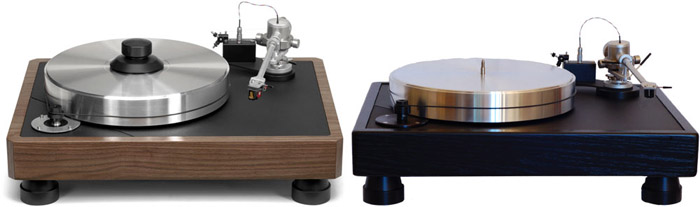
Here we met another nice audiophile wife! Kevin is a lucky man to have the large basement to himself. The hifi bug has really bit him recently and he has been upgrading his system at a good speed. First came the nice Altec A7 picked up from Pennsylvania, then the CJ PV5 preamp, the CJ MV75 amp and for this day, Stephen delivered his VPI Prime Turntable to his door. Stephen is the consummate handymen - from unpacking to listening took all of 10 minutes!
Altec A7 Background Info A word about the A7, even if I am not an Altec expert. Quite similar to its more expensive brother A5 (see brochure at end of article for comparison,) the A7 is called the "baby" Voice of the Theater. Long in production, the A7 had several variations and it can be confusing. Basically, the A7 usually employs the 416 woofer, my favorite (used in my YL; I prefer it to the A5's 515) and a high frequency driver less costly/famous than the A5's 288, housed in a cabinet similar/identical to the that of the A5. If you google, you will find lots of info buried here and there. This article by WAJ is an interesting start, and I can agree with most of what he said. Crossover Woes Altec crossovers are rather infamous for needing rebuilds/updates/revisions (at least according to audiophiles) and many build their own (like Leo's and Andy's A5's). I think Kevin's are originals. In this interesting link is an industry professional who built all his, in a meticulously tweaked system. Here is an even more interesting article from another industry professional detailing what the author thinks should be done to the A7. Note that all A5/A7 lovers love them for the same reasons, even if their approaches can differ quite a bit. Electronic Crossover For some reason it seems people in HK and the Far East opt more often to take this even more complicated path (unlike fixed crossovers, with knobs the users get tempted to constantly adjust the crossover points). I have heard several such attempts with horn systems, including Altec. Most left something to be desired, but a pseudo-A5 I heard in Brooklyn many moons ago was stunningly great (the system was tri- or quad-amped.) Amplifier Choice SET, PP, low or high powered, multi-amped, that is the question. Read on for more discussions below.
Altec A7 + CJ First we listened to Stephen's modified Ortofon Red, amplified by CJ PV5 and MV-75. I found myself listening to a sound that has long been familiar to me - a trapped and veiled midrange/bass I have heard so often in Altec's that were not done well. After a while, we moved on to an extra tonearm with Stephen's moderately low-output VAS Nova MC installed (0.8 MV, sufficient for the CJ) and things started to take a turn for the better.
Fostex + Luxman + Sun Audio Kevin has the Fostex FE168SE (Sigma series, 6") in his own DIY back-loaded horn Acousta-like cabinets. The system was probably his main system before he got the Altec's. This was now a secondary system, but all connected, ready to go. Many moons ago I had a Luxman preamp but didn't like its sluggishness (Stephen said the caps have to be changed). But this Luxman C32 sounded up to date driving the Sun Audio 2A3 (equipped with Arcturus single plates). The sound was quite wonderful, clear and sweet! Aided by a subwoofer, of course! I think we were using digital (a USB stick) as source, and the very humble Yamaha CD-S300 + TEAC UD501 combination did surprisingly well!
Altec System in Tandem with Fostex System At this point Kevin pulled off a hat trick. He blended the two systems together by manipulating the two volume controls. And it was great! Much clarity was added to the lower midrange of the Altec system. Surprisingly good! I have actually heard two-loudspeakers systems before, no less than Altec + JBL (see here!) Kevin's was in some ways potentially almost as good. Even if Andy said he heard some phase shift irregularities, and I trust his ears, I much prefer this amalgamation to the Altec's alone (with CJ, but read on...)
Altec with Sun Audio I then audaciously asked Kevin to swap the Sun Audio 2A3 into his Altec system. This turned out to be a LOT of work for him, as he had to move interconnects and speaker cables. It was finally ready, and the sound was tentative at first. While it had extra clarity, and much of the previous lower midrange mush was gone, the sound got strident when the going got rough. One factor was likely the much lower power available, but I knew I'd prefer to work with this rather than the CJ amp. As a SET amp user with several 2A3 amps, I knew the single plated 2A3's can be lean in certain systems, and likely not a match with the ruthless (I use this term in its best possible sense) Altec system. I asked Kevin whether he had double-plate 2A3's and he dug out his Chinese 2A3-C's. These are not what I expected - they are actually "bastard" 300B tubes with 2.5 instead of 5V filaments, but they have the advantage of higher outputs, 5 watts or so vs 2 watts. While I knew these are not as sweet as double plate 2A3's, we swapped them in, and after a while the sound smoothed out a little. Less strident but still not optimal. I went over to look at the TT and discovered the "VTA" to be quite off and we lowered the arm considerably after which the sound smoothed out further. At this point the ladies brought in some food. We were still very full from the epic linch, but we savored the home-made wontons and some fish balls. Kevin is not much of a drinker so James raided his collection (gifts) and we had some very expensive Napa wines and Chinese hard liquors. As we drank and ate, the sound slowly got better and better. Itzhak Perlman's style and tone in the Brahms concerto (EMI) was just as I remembered (I heard him live once) and the A7 did an incredible job at rendering tone, bowing and rhythm, even the intent of the performer; the background orchestra reasonably fleshed out too. This was at a moderate volume (there were a lot of us, remember), and I was satisfied; the cartridge and 2A3-C's were practically brand new and would need more run-in; I have confidence they will sound a lot better down the road. Andy also nodded in approval.
Some Thoughts
Although I have never personally owned any Altec loudspeakers, I have heard many A5's, A7 variations (including the -500) as well as 604/605's (largely 515 woofers with coaxially mounted small horn tweeters) systems. I have heard them sounding fantastic (occasionally), and I have heard them sounding dreadful (quite often). They are never perfect, and will never be (don't let anyone else deceive you), yet they are never dull, and they entice you to play on because their presence, evocation of the live event, is simply unrivaled. I'd gladly give them a day rather than, say, the Wilson Watt/Puppy, a minute. In HK we have a saying, they are 抵玩, meaning "bargains", not based on price only, but because they can entertain/torture you for a lifetime, I kid you not, and you would still keep them (who doesn't like a hot woman?) With these in mind, I venture a few thoughts on the evening's Altec proceedings:
- Home Use? These were theater loudspeakers designed to reproduce sound in huge spaces, driven by large amps. Theoretically, home use is a far stretch, but we have heard several successful attempts recently, haven't we? I count Andy's, Leo's and potentially even Kevin's as successes. Close to Front Wall All these people have a reasonably large space (LR or basement) and have these close to the front wall, which saves the most space. In-Room I myself believe in-room (subject to daily life constraints) yields better sound (certainly when it comes to soundstage) in smaller spaces. I place all my horn systems this way: in the US, the YL (its placement exercise briefly documented here;) in HK, the Tannoy Canterbury and TAD 3401. Note too one of the authors of the above links also have them in-room and near-field. Anyway, the most important thing is to make sure the placement has the least bass anomaly.
- Altec = Mirror Translated: Ruthless! More than most conventional loudspeakers, even those designed with skills, even modern day monitors, the Altec's never try to hide anything - the more so in our small (even large is small) rooms. Everything is reflected; even if something is just a bit off, it will be audible. This means equipment matching, including cables, to be of even more importance than usual. Tubes too - abandon the idea that what you think of as the best will sound better. Try a lot of Telefunken's and Siemens and your ears will bleed. This evening, the excellent single-plated 2A3's, which sounded quite wonderful with Fostex, did not sound so hot with the A7.
- Amplification Power and Quality With the sensitive Altec, we are talking about tube power - solid state is simply out of the question. When it comes to Tube Quality, it is usually in inverse relationship with power - the higher the power, the less pure the sound (why else are there so many SET fans?) The greatest dilemma the Altec user faces stems largely from the fact that the high frequency driver is a whole lot more efficient than the woofer, which is actually true with almost any dynamic loudspeaker designs, except that horn designs simply complain too easily: Too little power and the bass is not well controlled; too much power and the the midrange and high frequencies are less pristine. To a good extent, the evening's proceedings reflected these inescapable facts: The CJ MV75 sounded simply murky in comparison with the flea-powered Sun Audio 2A3, especially when fitted with the Chinese 2A3-C. Altec simply reflected that the Sun Audio delivered a pristine First Watt, compared to which the CJ MV75 was like grunge. Sure, one can spend over $1k to re-tube the CJ with GEC KT88's, but I doubt that will save the amp - it will improve but shall never be a Citation II nor McIntosh MC275. In any case, the excessive power is just wasted heat; note one of the authors quoted above sensibly used just a 12 wpc EL84 amp to his content. Bi-Amp This is a viable alternative. Note another of the above authors quoted used a 300B amp for the HF and a McIntosh 240 for the LF. As mentioned I have also heard a multi-amped Altec A5 to great effect. My Take I am definitely in the camp for SET (or even low powered PP amps like EL84's and 6V6's.) Personally I think some of the perception of lack of power stemmed from partnering with gear/cables that are too tight sounding. My old pair of Klipsch La Scala and current YL's do very well with BIG classical pieces on as little as 2 watts (I used 2A3 double-plates the most with my La Scala), and I expect no less, rather even more, from Altec. I am keen to re-visit Kevin, perhaps with a bunch of cables, in the future when the 2A3-C's and VAS cartridge have run in more.
- Crossover Woes? So much have been written about the poor quality of Altec crossovers, so there must be good reasons, but sometimes I have my doubts. My theory is that a lot of setup mistakes (like poor positioning and gear matching) can account for the poor sound, and it is just too easy to blame everything on the crossover. Remember I owned the La Scala - both my ferrite and alnico pairs through their original corssovers sounded excellent and played big classical pieces with aplomb. But I have heard La Scala's that puzzled me too. So much have been written on the internet about improved crossovers for Klipsch and there is a huge aftermarket - guess what, every time I heard those mods I wanted to run for the door, and this happened so many times I even wrote an article about it (here). I say, audiophilia and horns are a dangerous mix. Call me skeptical, but I have heard just too many expensive and bad sounding self-assembled horn systems (many TAD's) with DIY crossovers.




 Posts
Posts