Showing posts with label Talk Horn. Show all posts

20 June, 2020

Why are Horns the Best? SPL Loudness Dynamics

Why are Horns the Best? 
SPL, Loudness, and Dynamics

Editor's Note 6/19/20: This article was originally published in mid-2018. At that time, the article it is based on was not available online. I am briefly republishing it because I found out accidentally today it finally is available online! It is worth reading in its entirety. You MUST.

The May 2018 issue of HiFi News had just arrived at the local library. I was shocked to read that HiFi News had just absorbed Stereophile. Well, I suppose that is good, two of the better HiFi magazines (Ken Kessler notwithstanding). But that is not what I want to talk about.

In the issue there is an excellent article by Keith Howard (as usual) on how loudspeakers struggle to reproduce musical peaks. He cites the research of Marshall Chasin, which is basically the benchmark. The table below is from Chasin:
Image result for decibel levels of musical instruments

Basically there are several points to note:
  • By Peak Level it is meant the instantaneous oscilloscope peak, which can be very short (milliseconds), not the much slower averaging response you see on the average VU meter.
  • Basically nearly all loudspeakers fail BADLY trying to reproduce such peaks. EXCEPT horns! This is incontrovertible, as Keith Howard had made dynamic simulations.
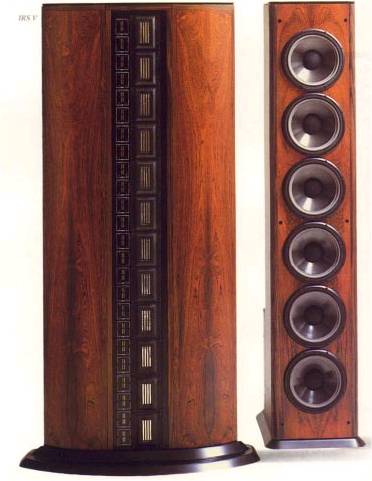
  • Aside from horns, only Line Source Loudspeakers need apply. The Infinity IRS V (more info here) is cited as an example (others would be Carver, McIntosh etc). Indeed, I have heard these, and can attest they are great. Note that for a stereo pair, there are 108 driver units, and 4000 watts of built in power amp for the woofers. By my calculation, the surface area of each woofer column is equivalent to a 30" driver.
Seen in this light, the large total area dedicated to bass reproduction in our friend Eric's horn system (last article; just roll down) is not at all extravagant (30" subwoofer, plus double 15" woofer each side).

Horn Colorations? I reckon the horn's ability to play loud and sound dynamic, and real, is tied to its ability to reproduce peaks. This is why horn lovers, including myself, find the horn's realism unrivaled. Keith Howard freely admits horns can achieve these peaks naturally, but he pointed out the horn colorations. Now, this so-called cupped-hand phenomenon is commonly quoted, and indeed can be heard in badly implemented horn systems. However, in a well implemented horn system, such as Eric's, or the many I heard in NYC, including mine, I almost never hear such undesirable sounds.

Horn is the ONLY way to go, if you have the space!

30 December, 2018

2018 in Review


Click pics to enlarge. To the right, the Grommes flanking and atop the Wavac MD-811; in the middle, the WE 133; to the left, Thorens TD-124 MkI with ad-hoc SME "3012".

2018 in Review

It has been quite a stressful year. Due to my leaving HK, for once, I have sold off far more than I have acquired. Although without many new toys, my experience has not been less vital than in years past.

Best Sound

Western Electric + Horns = Great Sound This is a truth, but of course even WE can get mangled in the hands of users with lesser ears. The WE 41/42/43 heard here was not only the best sound of the year, but also likely the best horns I have heard. However, running it very close is the sweet WE 46 system heard here.


Even without using WE, the horns in my NYC circle, three Altec's and my own YL, which I have written a lot on, have all sounded very good.

Sleepers that have given the Best a Run for the Money

This year is just as remarkable for mostly Rediscoveries!

6V6 Amps My two pairs of 6V6 amps heard at Kevin's (here) are now back in my home. I swapped out the Grommes LJ5 for the Wavac MD-811 and was delighted by the results. With both my recently fired up System I (Manley 300B as preamp) or System II (Shindo Monbrisson as preamp), the sound was just as good, if not better than before. Compared to the SET Wavac, the midrange is just as transparent and sweet, whereas the treble is a tad smoother and the bass a tad more fulsome and rolling. Curiously, in my system, there is none of the overly smooth and somewhat restrained manner experienced at Kevin's. I double-checked with my Mangar Test CD, and everything sounded just wonderful. When I get the chance, I shall take this to Andy's place and give it another sounding. Grommes, like Bell, in an old name that has a solid reputation. But I kinda suspect many other 6V6 amps (though not all, as some are pretty flimsy) will sound great too with horns. For more on 6V6, read my Overview (here).

B&W Matrix 801 Mk II Towards the end of my stay in HK, I got re-acquainted with my B&W Matrix 801Mk II. After writing about it (here), I actually got to listen to it a lot more while cleaning house. The more I listen, the more I was impressed. What a deep sound! I actually heard more details than even my Tannoy Canterbury and TAD TD-3401. And that authoritative bass belies the woofer's relatively modest 12" diameter - it managed to sound like a 15" paper woofer, the best in my book. As this article gets ready, I learned that our friend Kevin has just scored a mint pair, so you can be sure of further reports. I am glad I'll get to hear them again imminently - I miss them!

Lowther TP-1 and VTL Straightline DAC/Preamp These are real gems, not a whit outdated in sound. See the same article for details.

Loudspeaker Placement continues to be an important issue, even for bulky horns, which tend to be left against the wall. Significant improvements were obtained with them further in-room, as witnessed in the Altec Systems of both R and Kevin (here).

Subwoofer Use Many systems would benefit from the addition of a subwoofer. ESL In the case of our friend WSS, the addition of a subwoofer (my REL) for his Quad 2812 was eminently audible, not for more solid bass per se, but for an added vitality, which is quite winning! 47 Labs 4737 Addition of subwoofer utterly transformed the 4737 from a great small loudspeaker to a full system!

Honorable Mentions 47 Labs 4737 This small loudspeaker with alnico magnets works a treat with solid state amplification, less so for tube amps (here), but it is with the addition of a Subwoofer that elevated it to the Pantheon. The result was so persuasive that I sold them to my ESL friend WSS! SMSL SA-36 Pro performed way beyond expectation. At my friend R's place, I'd rather listen to it than his Jadis and Cary (here). I suspect many T amps would do a similar job. Blue Velvet Preamp A cheap Chinese implementation of this (mainly) Dick Olsher design, a known DIY entity, was surprisingly good sounding.

Happy New Year!

16 November, 2018

Horns, Classical vs Jazz Playback


The 3 B's Worth
Bach, Beethoven and Brahms on LP

In this increasingly inequitable world, with each day's passing, space is more of a premium. While the used vinyl market is perhaps still sustainable overall, space-occupying big box sets are understandably least marketable. A few weeks ago, I came across this sign in a store: "All 3 B Box Sets $2". This is regardless of the number of LP's in the box. How could I have resisted. The price is the lowest I have seen, save perhaps for a short period in the late 80's/early 90's, when people were dumping their LP's, and when I bought some Ormandy and Bernstein Columbia LP's (best sellers in their days and hence ubiquitous) for a nickel (5 cents) each.

Bach I already have the Bach box, but could not resist. The recordings and performances (Baumgartner in the Brandenburg's and Karl Richter in the Suites) are very good but the Musical Offering (Richter), a personal favorite, is the standout and perhaps unsurpassed. Beethoven Both Piano Concerto cycles are rarely seen in LP form. The great sounding Arrau/Galliera cycle not only boasts Arrau's pristine pianism but also Galliera's under-rated conducting. The Kempff/Van Kempen is justly famous and better sounding than the pianist's stereo remake with Leitner. The Konwitschny Symphony set is rare and actually more expensive, bought elsewhere for $6 and used here to give symmetry to the pic; it is invaluable for the performances, which I first heard on CD's and rank as among the best. Brahms The Abbado set is not a "real" DG box, rather issued by the subscription International Preview Society, whose Italian pressings have been criticized by some, though I have always found them more than serviceable, even excellent. The Toscanini set is one of the best ever in terms of performances (the mono sound is adequate), much superior to his nervous NBC recordings. This set was deemed good enough for reissue by expensive Testament on CD.

Tally: $16 and countless hours of pleasure.

The Audio Roundtable: One Step to Heaven, Classical vs Jazz, Horns

As the holiday season approaches, it has been kinda quiet lately. But our great leader Andy did the unthinkable: summoning us for a get together with audio on the back burner. The horns played in the background, but all I remember was Ray Nance's immortal violin playing on Ellington Indigos. We brainstormed and talked about everything under the sun.

Classical vs Jazz on Horns We all listen to both jazz and classical's. Andy ("casual listening" Altec A5) and Kevin (Altec A7) maintain that horns are for jazz and suboptimal for classical's. Simon and I demur, as we both listen to everything on our horns (for Simon, a replicated JBL L-300 system). I tend to agree with Simon that it all depends on how one tunes the system - the more excitement for jazz, the less suitable for classical's; a titration. Mark actually used to have horns, but has abandoned them for now.


Horns vs Line Source This is not a coincidence. Although Andy and Mark differ somewhat from me in their views on how encompassing the horns' merits are, we are in agreement that Line Source loudspeakers, when well implemented, are excellent. I think there is a good reason for that (see my article Why are Horns the Best?). Andy's Infinity Beta IRS system (here) is justly famous and much admired. Mark now uses the Genesis V (a bastardized version covered here) and urges Kevin to get the I/II, but I doubt Kevin will - the power needed for all these Line Source models is just too much (and totally against my philosophy, and I personally dislike the bass quality of those with managed bass).


The Day's 3 B's

Actually the day's conversation was almost entirely on non-audio things. Skip this should you like.

Babble: As we were having a lot of food, naturally everyone talks about food, just like everyone else in this world where nothing is edible without peril. Mark believes in a low-carbohydrate Diet, which I am not so sure about. We are more in agreement on cholesterol - one should not worry too much about it, as it may well be protective, according to some theory. No gathering can escape Trump and Religion, but I better not write on these - friends can get around different opinions, which strangers may not. And, of course, being all males, Libido (or lack of) comes up. If you ask me, audio probably acts as a negative feedback! You have been warned.

Binge: Andy actually made us some excellent Lamb stew, but that was not what we mostly ate. Andy had commissioned someone to make extra fillers. When delivered, we were shocked to find two large pans of noodles, one topped with Lobsters! Wow, Andy was "usurped" (his words) but we were delighted.

BoozOur world constantly asks for what is correct, and the more questions the less certain we are in anything. I am a very green person but indulges in a (sole) vice that uses mostly energy-inefficient class-A devices (tubes). Seriously, I am apologetic but am not about to dump it all for class-D/T. Well, what is great food without booz? Surprise! Bloody Mary's started the Sunday brunch. With the noodles we enjoyed Prosecco and an interesting French Riesling. Then we moved on to some reds, Pinot Noir and Argentinian et al, which I enjoyed with the salty peanuts. I was too full to eat the lamb stew, but took home some. Many thanks to our great leader!


03 October, 2018

Horn Placement, Subwoofer Supplementation


Top Pic: (Case 2) Pic of R's A5 System as of now. My Bell 6V6 amps in center front. Compare with old photo below.

Talk Horn: In-Room Placement, A Tale of Two Horn Systems
HiFi Basics VII: Loudspeaker Placement - Close-to-Wall vs In-Room
McIntosh C-20 Preamp, MC-30 A

Significant Update Oct 5, 2018: Subwoofer Supplementation added. Update shaded in Grey.

Although we are illustrating with big horn systems the size of refrigerators here, I believe the principals are universally applicable, to much smaller loudspeakers, including bookshelves.

There is little question loudspeaker placement is of the utmost importance in a system. Previously, in HiFi Basics III, I detailed my own encounters of Short vs Long Walls. This article examines Close-to-Wall vs In-room Placements.

Close-to-Wall Placement By Design FEW modern loudspeakers are designed to be placed against the wall, as this intrinsically is at odds with the modern hifi values of maximizing imaging and soundstage. But there are a few dedicated designs, like the very good Linn Kan, which needs the wall reinforcement to have useable bass for most people. More recently, there is the Wilson Audio TuneTot, which receives a lot of coverage from the audio press, but to me it is a ridiculously expensive product for what it is, and showcases the utterly hopeless nature of high-end reviewers (The TAS is a particularly serious offender; their eulogies on the passing of Wilson Sr make my flesh creep 簡直肉麻!) Corner Placement This only applies to certain vintage loudspeakers, usually larger horn systems with specifically designed corner cabinets (Klipschorn and Tannoy's) to optimize bass output. The corner has two reflecting surfaces which would cause even greater havoc with most other loudspeakers. By Choice/No Choice Sometimes one has no choice but to place loudspeakers against the wall. In my experience, most loudspeakers sound suboptimal to terrible thus placed. Most would suffer from badly delineated bass and lack of air. In this situation, one would be wise to choose infinite baffle (sealed) enclosures, preferably those with monitor pedigree, as these usually work well in near field situations and have good but never exaggerated bass. As an example, my large Yamaha NS-1000 works beautifully against the wall; there is still a good soundstage and imaging (though not as good as in-room), and my TAD TD-3401 is also good in this way. Ported loudspeakers, even front-ported, do less well. Klipsch Heresy This unusual loudspeaker is actually stipulated to be used (on its own pedestal) against the floor, not the wall, but that is not that different. Without floor reinforcement, the Heresy is lean in the bass. As such, it actually works well close-to-wall.

How should Horns be placed? No doubt the size factor predisposes their owners to put them against the back (front) wall. Also, the ungainly, industrial and utilitarian appearances of many horn systems, such as the Altec's in this article, certainly do not earn them admiration from family members and that is another incentive for relegating them to the back, even in the corners. For many, it just has to be that way, BUT for those who have the room, that is a mistake.

These horns were originally used in large theaters, perhaps hanging, but usually not against the wall; and firing down a huge space (ample space around them) minimizes any anomalies. In our much smaller spaces, one needs to take care.

In my old place in HK, I had my Tannoy Canterbury's (large loudspeakers with small horns) and TAD TD-3401 half way in-room and they sounded great that way. Visitors were always amazed by the depth of soundstage and, even more, the disappearance of the loudspeakers. In NYC, I have my YL horns the same way, with similar results. Like with a lot of more conventional loudspeakers, unless restricted by bass nodes, I like the loudspeakers in-room and with the listener form close to an equilateral triangle. Some would call this near-field, or nearly so, and it should lessen boundary effects. For me, in both HK and NYC, the sweet spot for loudspeaker placement is largely the same for all sorts of designs.

Subwoofer Supplementation What a Difference a Little makes There are many purists out there who are adamantly against subwoofers, but these are mostly people who have little concept of what live music is like. Our hearing is a complicated thing - without a bass foundation not only will the midrange and upper frequencies sound leaner, but the music will lack true sparkle, which most audiophiles mistake to lie solely in the treble. The best example is my friend WSS' Quad ESL, which came to life with just a whiffle of low bass added (here). I always tell people, a little augmentation does not really augment the bass by much, but helps the overall picture, to bring things to life. As in the case of WSS, the important thing is less to hear the difference, but to feel it. When to Use? This is purely by hearing. My modern Tannoy Canterbury, TAD TD-3401 and YL horn system (with Altec 216 woofers) do not need help, but my JBL 4312 and my NYC friends' Altec A5/A7 systems absolutely do. Another case is my Klipsch Heresy, which really is severely limited by its original design (on the floor), but rather should be used "normally positioned," together with a subwoofer (detailed here). Subwoofer vs Other Means When the bass is lean, the problem can lie with the loudspeakers, the equipment or simply the room. Audiophiles have many ways to increase bass, but these should only be used judiciously, as the "remedy" is often worse than the problem. It is one thing to try, e.g., Mogami instead of Gotham (both cheap professional cables with balances close to neutral, though they sound different), it's another to use expensive boutique cables that are basically highway robbery. Case in point: Thick and stiff cables, e.g. NBS, often increase bass, but are highly colored and smear everything. Most of the time, the loudspeaker is the real limitation - it would be wise to spend time dialing in a subwoofer rather than make the bass "fuller" via other means, as one really wants more true extension rather than bumping up the mid-bass.

The owners of these two Altec systems are good friends of mine who should be familiar to regular readers of this blog. Both share a passion for music as well as many other non-musical things, such as cooking! Both are lucky to have a dedicated room. Both had their horns in the back until I came back this time. Both had their horns on wheels so it was relatively easy to move the behemoths forward. As they say, the rest is history.


Pic shows (Case 1) Kevin's A7 System, now way out in front (compare with old photo below). The turntable on the Wall Mount is now a restored Lenco G-75 (VPI relegated to the left, a corner of which can be seen behind the B&W CM5). Below are newly acquired and restored McIntosh MC-30's. On the front stools is one of my C-20's. Click to enlarge.

L pic shows the Dumpling Dinner with side dishes of Pork stewed with Dried Bamboo Shoots, Braised Peanuts and Sliced Smoked Turkey; R pic shows the older against-the-wall Placement. Also roll down to the Blog entry before this one.

Case 1: Altec A7

Since I last wrote about K (roll down to previous post) I have visited him two more times. Unbelievably efficient, over a short time he managed to move the horns forward and clear up the central clutter. All gears are now well behind and there is a clean line of sight to the plane of the loudspeakers.

The sound is totally freed up. As the man himself said, the sound now emanates from the space in front, rather than from the loudspeakers. I cannot agree more, and this also met with the approval of our captain Andy. Now, with the much cleaner and focused sound, Francescatti's tone (which could be grating in lesser systems) in his classic recording of Beethoven's Violin Concerto with Bruno Walter was just marvelously sinuous. Thumbs up! Credit is also due to K's DIY WE cable.

We also really liked the the full McIntosh combo, the Lenco/Decca/Shure M44-7 playing straight into the C-20's phono and driving the MC-30 pair. Everything sounded just right.

Case 2: Altec A5

Then we visited R (last visit). I have long suggested to relegate the HT system to the periphery and bring the horns forward. I was surprised that R was game and K carried it out single-handedly (he definitely earned his lunch)! It was quite a bit of work! Everything was dismantled (the Cary amps were heavy!), the huge HT subwoofer exchanged its space with the large HT center. The result was again a cleaner path to the plane of the loudspeakers.

The effect was much as at K's place, a cleaner sound that is free of the enclosures. The Bell 6V6 amps worked very well in this system. Marvelous!

And the Food!

21 May, 2018

Why are Horns the Best?

Why are Horns the Best? 
SPL, Loudness, and Dynamics

Revised 6/19/20: Finally, the the HiFi News Article is available online! It is worth reading in its entirety. A MUST.

The May 2018 issue of HiFi News had just arrived at the local library. I was shocked to read that HiFi News had just absorbed Stereophile. Well, I suppose that is good, two of the better HiFi magazines (Ken Kessler notwithstanding). But that is not what I want to talk about.

In the issue there is an excellent article by Keith Howard (as usual) on how loudspeakers struggle to reproduce musical peaks. He cites the research of Marshall Chasin, which is basically the benchmark. The table below is from Chasin:
Image result for decibel levels of musical instruments

Basically there are several points to note:
  • By Peak Level it is meant the instantaneous oscilloscope peak, which can be very short (milliseconds), not the much slower averaging response you see on the average VU meter.
  • Basically nearly all loudspeakers fail BADLY trying to reproduce such peaks. EXCEPT horns! This is incontrovertible, as Keith Howard had made dynamic simulations.
  • Aside from horns, only Line Source Loudspeakers need apply. The Infinity IRS V (more info here) is cited as an example (others would be Carver, McIntosh etc). Indeed, I have heard these, and can attest they are great. Note that for a stereo pair, there are 108 driver units, and 4000 watts of built in power amp for the woofers. By my calculation, the surface area of each woofer column is equivalent to a 30" driver.
Seen in this light, the large total area dedicated to bass reproduction in our friend Eric's horn system (last article; just roll down) is not at all extravagant (30" subwoofer, plus double 15" woofer each side).

Horn Colorations? I reckon the horn's ability to play loud and sound dynamic, and real, is tied to its ability to reproduce peaks. This is why horn lovers, including myself, find the horn's realism unrivaled. Keith Howard freely admits horns can achieve these peaks naturally, but he pointed out the horn colorations. Now, this so-called cupped-hand phenomenon is commonly quoted, and indeed can be heard in badly implemented horn systems. However, in a well implemented horn system, such as Eric's, or the many I heard in NYC, including mine, I almost never hear such undesirable sounds.

Horn is the ONLY way to go, if you have the space!

21 October, 2017

Audio Research ARC SP-11, CJ Premier 3, Harmon Kardon Citation I, Jadis JPS2, Tien Turntable, Tom Tutay Phonoamp


L. Finally Got It Up! R: Reward for the Stooges.

How Many Stooges Does it Take to Move a Table? Keeping Up with Audio Handymen and Gluttons
Letter From NYC (69) 2017 (8): Making Rounds in Metropolitan NY
The BIG and BAD Preamp Shootout: Jadis JPS2, Audio Research SP-11 Mk II + Mk I Modified, Conrad Johnson Premier 3 AND Harman Kardon Citation I!!
Review, Harman Kardon Citation I, Part II
Audition: TIEN Direct-Drive Turntable
Talk Vinyl: The Western Electric Phenomenon

!Addendum (10/28/17): Citation I, Part III (more action against other preamps) has been published.

This article chronicles two long days with the audio gang. The activities far outstripped my ability to write them up (and I still have my own long-delayed agenda). I am still TIRED! I say, Far From the Madding Crowd!

Part I. The Garden State Troopers
Two weeks ago, R and Andy picked me up in the morning, and drove to New Jersey, where we were joined by James (from Philadelphia, but a frequent presence in NYC) and friends.

Click pics to enlarge. R: Workshop Front; L: Interior, system was VPI TT, modified CJ PV-5, VAS amps, JBL 4343. Note too the B&W 801 and R's Watt/Puppy 5.1. On the walls were covers of many re-issue LP's. More pics at bottom of article.

Collector, DIY, Manufacturer, all in one
First stop was Stephen's workshop, right next to VPI, where R's pair of Watt/Puppy were unloaded to be refurbished.

Stephen, an unassuming fellow, is an enthusiastic audio collector of both hardware and software (LP's and even R2R tapes!) He is also an industry professional who represents VAS, Cayin and Aurum Cantus. We spotted but did not get to hear a VAS Citation I replica. The workshop also does OEM jobs for others. Technically savvy and with a DIY bend, Stephen also does skillful restoration and mods for his friends. After hanging around a bit, Stephen generously treated us to a delicious lunch at his favorite Chinese restaurant. Then we headed to the next stop.

Click pic to enlarge. Simple but VERY effective system.

I know what you want, and I know what I want
Leo is a vinyl collector and reseller. Basically, he spends a lot of time foraging for LPs, and is apparently well known to many vinyl sellers in the NY metropolitan area. He resells quite a bit of it to the largest vinyl store in Taiwan. The very large basement has boxes of vinyl piled up and strewn all over, and what you see in this pic is just tip of the iceberg.

The man has thoroughly studied various audiophile vinyl buying guides (there are many in Chinese) and knows the price of every audiophile record. Unusual among audiophiles, he himself has a preference for Columbia LPs, and there are tons of them strewn around. As R wanted to buy some classical records, Andy (and I) picked some out for him while listening to the excellent horn system, which deserves a little more coverage.

The horns are Altec A5, the crossover made by Canadian Chinese magazine writer and audio guru "Spring" Yeung (彈弓楊). Preamp is CJ Premier 3, driving Jadis SE300B monoblocks. Most interesting, however, was the turntable:

Click pic to enlarge.

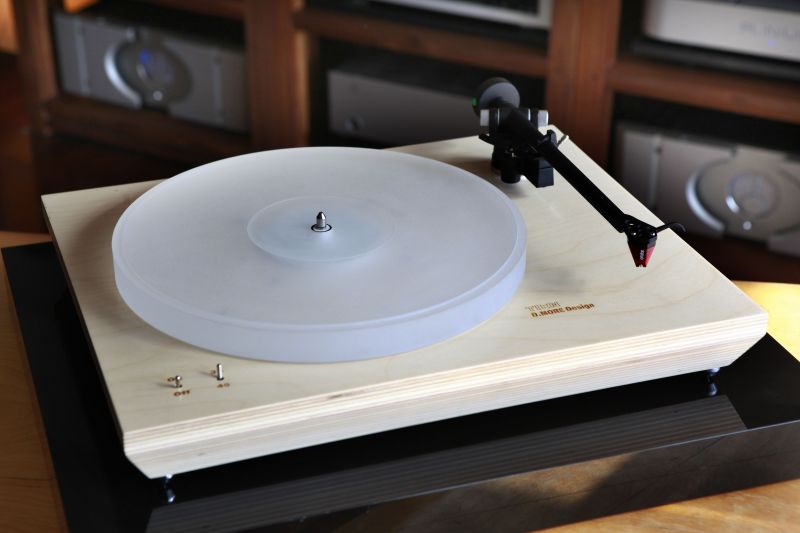
Tien Direct-Drive Turntable was the first brainchild of Taiwanese vinyl and analogue dealer Mr. Tien of Tien Audio (田昌政類比音響)(Official Blog), with industrial design by D.More (也作設計). It was very well received in Taiwan and has found distributors in several Asian countries and France. It won Taiwan's Golden Pin Design Award (here, with English description of the rationale behind the award).

For those who read Chinese, there is good coverage of its genesis in an article in Taiwan's AV magazine 高傳真視聽. Those who don't should still peruse this link for all the pics, which include various prototypes. A short description: The plinth is made of birch. The direct drive motor is obviously directly below the acrylic platter, mounted on a PCB board for control electronics. The motor is fastened by four screws with rubber washers providing some measure of isolation. Note the platter retainer (small rubber ring) around the spindle (visible in the main pic of the official blog) providing additional shock absorbance. It comes with a modified Rega arm (some bearings replaced by gem stones, exactly what not mentioned). Note also the other arm shown in the article is a more expensive version, with the front portion of the Rega arm lengthened and replaced by a carbon tube.

Tien has since gone on to design more higher end models, including a 3-motor Voyd-like design, but imho none looks as good as his original namesake. The Tien sells for Taiwan Dollar 38,000 (roughly USD 1250) which, judging from its looks and what I heard (below), is GREAT value, and deserves wider distribution. Despite that, supposedly demand so far has outstripped supply due to manufacturing bottleneck.

Leo used to use "better" cartridges but apparently he has broken a few. Fed up, he switched to the humble Shure V15MkII. In this large room, the performance of the cheap analogue setup in the system was just marvelous, and almost everyone thought it sounded better than their previous visits. It had all the presence that Altec is famous for, largely without the attending raggedness. St James Infirmary (one of many original copies Leo owns; jealous?) growls and grimly grinds along as it should. Led Zep's Stairway to Heaven was full-throttled. Most miraculously, classical playback was also very good as evidenced by 2 versions of Night on Bald Mountain: LSO/Solti (Decca) was dark and menacing; my dark horse favorite, Boston Pops/Fiedler (DG) was a frenzied whiplash. I personally think the large room and plenty of absorbance (all those boxes) contributed greatly to the good sound. This ranks as one of the very best Altec systems I have heard.

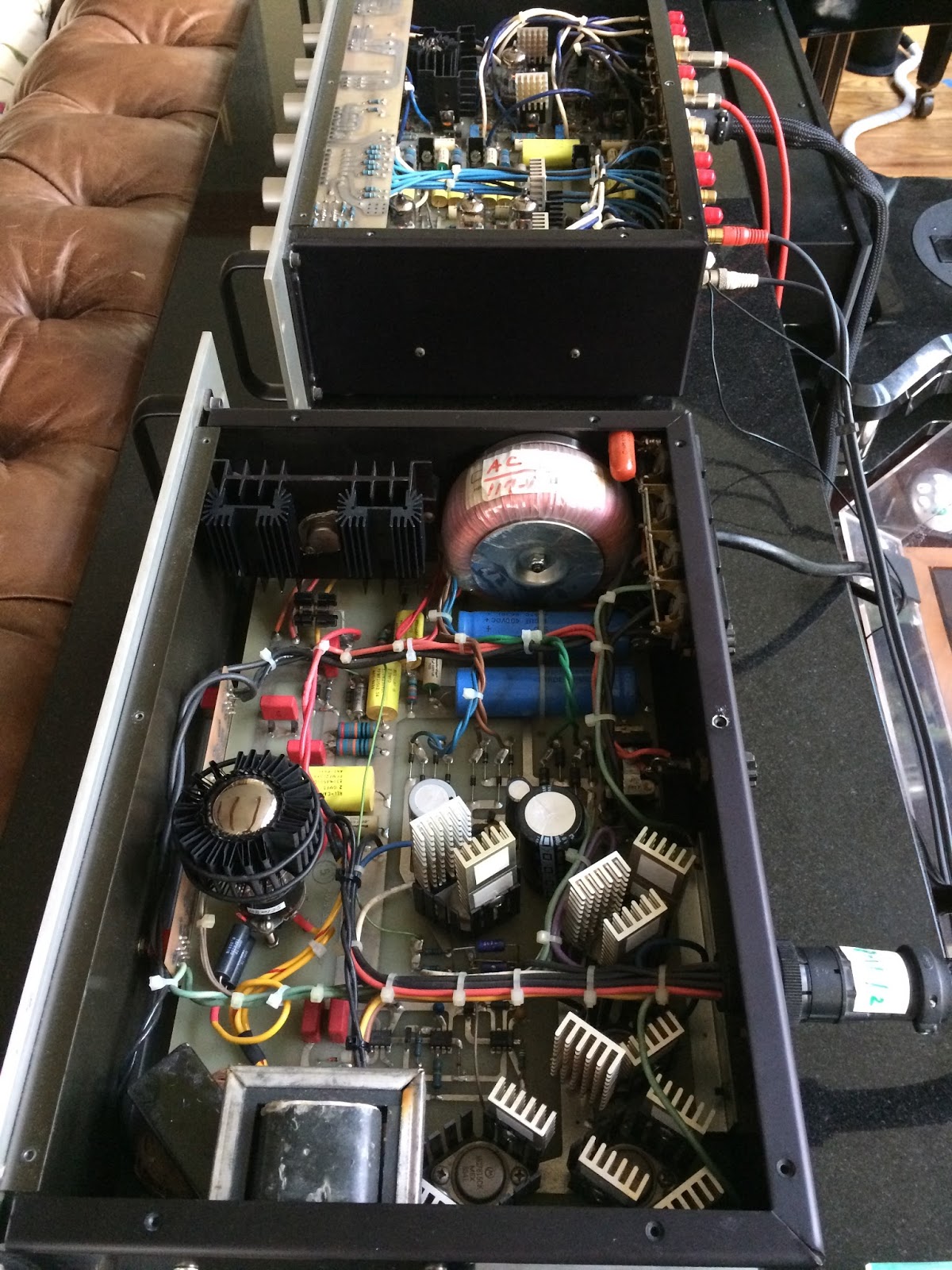
Click to enlarge. Note the added rectifier (5AR4), choke and additional heatsinks.

Part II, Long Island Reunion - The Longest Day

Last Sunday, the augmented Audio Handymen (Andy, Simon, James, Stephen and wife, Mark and I) descended on R's mansion (equipment and previous visit detailed here). Even though R already possesses the Jadis JPS2, Citation I and CJ Premier 3, he was curious about the ARC SP-11. So James brought in from Philadelphia his stock SP-11 MkII. Stephen also came with his modified tube-rectified SP-11 MkI (which he prefers to MkII) which we saw earlier in NJ.

As usual, R put us to work before lunch, and this time it was a BIG task, moving the Rockport Sirius II into the living room. The thing is definitely over 300 lb. One could do some desoldering to separate the parts but it was too much of a hassle. So four of us held the corners and lifted it up while two quickly shoved the dolly under. Unfortunately the dolly could not clear the rear legs and we could not lift it up higher, so an extra person came to the rescue in the back and finally it was done. Unloading was much easier. The Rockport actually looked very nice in the LR but we did not get to hear it as there were no air pump and vacuum yet in the living room (hole on the floor would have to be drilled for the tubings to come from the basement motor unit). Now, that was the physically taxing part of the program.

We picked out some music to listen to and for using later. For some reason (perhaps cabling) the system sounded a little coarser than last visit. After a few sides we adjourned for lunch.

The Ideal Audiophile Wife Stephen's wife Jenny is no audiophile, but obviously she has seen and heard more than most people. She totally supports her husband in his ventures (as with many men, more than just audio) and actually conversed with us on audio. Ode to the lady!

Lunch this time was perfectly turned (a given for R) Hanger Steak garnished with Cauliflower and Brussel Sprouts, washed down with some Californian wine. Again, unlike audio, just perfect. Then some of us had the Durian that Andy bought (see pic at bottom; wiki entry here). Most Americans probably have never had this tropical Asian fruit, as it has a strong smell and an intricate taste. The one Andy picked  (and he took a long time; I was waiting in the car) was a great one, with an intense yet complex taste. Like with certain cheeses, I still am not a fan, but I can appreciate it. Afterwards, strong coffee was mandatory and the barista (lady of the house) made a great expresso. After lunch the mentally taxing part, the preamp shootout, began in earnest.

    Saxophone Colossus - Sonny Rollins.jpg
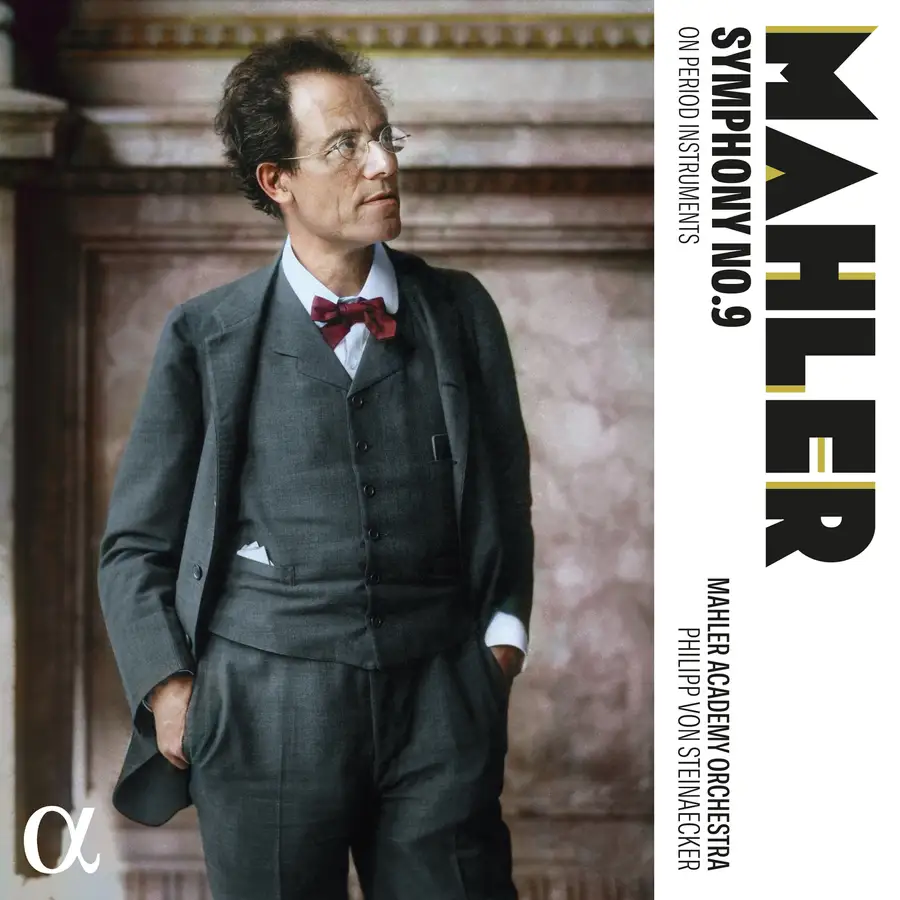
  • ARC SP-11 MkII James' is stock, tubed with mostly Russian tubes. I should mention here that I have always been a fan of older ARC's. In HK, I still have an SP-3, SP-8MkII, SP-10MkI and SP-11MkII, so am familiar with the sound of this hybrid preamp. It was just as I remembered it. The sound had great presence, fast transient speed and a tight, walking bass, but the midrange was not quite as rich as an all-tube preamp. Compared to the Jadis JPS we heard before lunch, on Saxophone Colossus, Rollins' sax was missing a little bowel sound, and Max Roach's drumsticks were not quite woody when slapped together or on the drum edges. However, the rhythmic snap and timing were superior, the Jadis a bit heavy footed in comparison. Mahler's Second (VPO/Mehta, London) also could have used a bit more heft, but it was atmospheric and uplifting. Again, the Jadis was richer, but a bit brutal during fortissimi. I then wanted to try Stephen's MkI power supply on this unit, but a loud hum told us it was not compatible.
    Image result for mahler 2 mehta
  •  SP-11 MkI (Tube Rectified) Compared with the stock SP-11 MkII, the tube rectified and choke filtered MkI was definitely smoother, with less high frequency hash (not that there was a lot before). The midrange was a little richer, but still not quite like an all-tube unit. The gain in fullness and smoothness in both Saxophone Colossus and Mahler Second was met with approval by most of the crowd, but I thought this came at the price of rhythmic vitality and transient speed, a trade I personally would not want to make. I actually think one can hear the FET part of the hybrid, and in my opinion it is not a trait that can be camouflaged in its entirety (in many ways, among hybrid preamps, the very good Counterpoint thousand series does better in this regard, the best in my experience being the Melos 222, though it is a little dark sounding.)
  • ARC SP-11 MkII Redux This time James put in more vintage tubes (I don't know what), and sound sweetened a little. However, the re-tubed unit lacked a little definition in comparison and, like the effect of tube rectification, also lost some rhythmic vitality and transient speed. I myself preferred the first iteration.
  • Tom Tutay Phonoamp At this point, R's Tom Tutay phonoamp was swapped in in lieu of the SP-11's own phono section. A word on Tom Tutay: he apparently is a well regarded DIY person who runs Transition Audio Design (no website). The one R has is actually an early all-tube full function preamp, though R is only using the phono section, which looks very much like the later Tutay phonoamp named Vibrance, which employs both octal and noval tubes. We have heard it in conjunction with the Linn many times before. The sound was definitely a little darker, smoother and warmer than ARC's own phono section. As with designs employing the larger octal tubes, images were larger and fleshier. though a trifle homogenized (as Andy put it). I thought it had sounded better with the Jadis JPS in R's regular rig during the last visit. This synergy thing is unpredictable and has upset many an audio boat! One more thing on this phono design. The octal tubes are prone to microphonics and noise. R's unit works with the Cardas cable, which rolls of the top, but with my considerably more neutral Gotham GAC-2, R reported hearing high frequency noise, likely tube noise, but that shall be investigated.
  • Conrad Johnson Premier 3 R had used its phono section in his previous room before he dismantled it; in contrast, Andy has long been using the similar Premier 2 (tube rectified) as a linestage (preferring the Citation I's phono section). As a full preamp, it put in a performance that was the most puzzling and inconsistent of the lot. It was the warmest and most full-bodied of the lot and was easy to listen to, but in comparison with the others it seemed sluggish and lacking in sparkle and resolution. I wondered if it was out-of-phase but was told that this is one of the rare CJ preamps that is not phase-inverting. From my experience, old CJ is too much of a good thing - big caps likely slow down the sound and make it more earthbound. Used as a full preamp, the problem compounds itself; no wonder both of my friends use only a half of it. The CJ, especially the phono section, is definitely not neutral. This experience also reinforces my view that these slower and darker components work with horns better than with conventional speakers (even the modernist Citation I usually works better with horns than regular stuff; that it works so well with this system and Wilson surprised me a little.)
  • Harman Kardon Citation I Once again, this vintage classic, beloved by me, Andy and others (see Part I), instantly revealed its true mettle. The sound was modernist in tendency and well balanced, very neutral and with excellent resolution, reasonable transient speed and clean bass. Add a good dose of presence and touch of tube warmth and it was quite wonderful. Most approved, and Mark exclaimed that he wanted one. R made the decision to have the Citation stay in the system and he took the Jadis JPS out, that is how much he liked it. But, was it perfect? No, there was just a trace of leaness and coarseness that increased with volume. To me, in a way, it was like the SP-11 with more tube and less FET characteristic, though the Citation I's power supply is by no means comparable, commonly faulted for being marginal for support of the large number of tubes. Nonetheless, a classic. Note that I spoke to R later and he said he found it a little fatiguing after prolonged listening, but I am sure that can be ameliorated by some cable matching; I am sure you will hear more of this later.
  • My Choice Personally, I'd prefer to work around the more neutral Citation I or stock ARC SP-11. The colored CJ is clearly not my cup of tea, but has its adherents. The equally colored Jadis JPS strangely was ousted in this session, but it should have done better (as last time).
Collector vs Glutton Call it what you want, but there is only a thin divide between the collector and the glutton. However, somewhat unfairly, the former has an elevated aura and the latter is usually a denigration. More than the Glutton, the Collector could morph into a Connoisseur, though most don't. Most of the time, we are all of these rolled into one. This certainly applies to Andy, James, Stephen and I, even R! Talking about myself, I hoard both equipment and software. I have over 10,000 LP's and thousands of CDs - there is no way I can listen to each one even once. There is also tremendous duplication. Simon and Leo have not much extraneous equipment, and hence are not audio gluttons, but they collect LPs prized by audiophiles. Leo of course is a reseller; maybe that's the best way, buy what you like, yet have an easy way to unload stuff. In HK, this is why many audiophiles ultimately end up in business (physical and virtual shops) - one would have to when one has amassed way too much and reached critical mass. But then when money comes into it, things get complicated, even with friends - something to think about.

Vinyl Talk: The Western Electric Phenomenon There is a dark side to the US's unparalleled history of innovation, invention and progress - waste. There is another dark side to the US's inborn revolutionary and evolutionary attitude - undervaluation of heritage. Both of these play a very significant role in the current state of audio, particularly vintage audio. I'll expound on this in detail n another article. Here we will only note that nobody much in the US buys classical music LPs, but there are many people like Leo, from especially from HK, China and Korea, who buy these and ship them back to Asia, because they are treasured by audiophiles there. Like the depletion of 300B and other WE tubes and equipment in the US, classical vinyl (the better titles and selected pop titles) is heading the same way.

More photos. From top: Durian (does it not look like a mis-proportioned organ?); Note the VAS Citation I between 2 vertical stacks of VPI 16.5; Tip of the iceberg, note the Quicksilver, McIntosh 240 and Marantz 8B; No eggs, but much more expensive VPI tonearms.



25 February, 2016

Klipsch La Scala Mods, ALK, B&K, Crites

pic shows my hero PWK with the Klipschorn. Note the Brook Amplifier (from itishifi).

Enhancement or Denigration? On Klipsch (La Scala) Crossover Mods, ALK, B & K Sound (Crites)
Talk Horns - Klipsch, the One-Stop Solution, Part V

 
Note: Previous articles in Talk Horns - Klipsch, the One-Stop Solution (Part I, Part II, Part III, Part IV) treat mostly what is now called the Heritage Series; Part I is dedicated to La Scala. All the models I covered there have after-market mods available, which is why I feel I HAVE to write this article. Keep in mind I have only heard those for La Scala and Belle, as described below.


Refuting "Science"? This is a difficult article for me to write. I know simple electrical principles, and can build kits and DIY simple things, but I am not at all technically inclined. I like to read about the technical side of hifi (which is one reason why I like Stereophile more than TAS), but ultimately I use my ears to determine what is good and bad, and I trust mine. In my audio life, I have come across a huge number of audio products by DIYer's (everything from amps to speakers), also far too many after-market mods and "upgrades" - most simply sound AWFUL. This is yet another vast topic that will be treated in a subsequent HiFi Basics article. The people who are behind these mods and upgrades have better technical knowledge than I, but they make me wonder what they are hearing most of the time. Mind you, it is my firm belief that audio is not even close to an exact science, though these people would have you believe so (and them). Suffice to say, I have a huge distrust of DIY mods, especially those with extravagant claims. 

Issue Can or Should you modify the designs of the great Paul Klipsch, one of the giants of audio? My take is, NO, liter for liter (or cubic ft for cubic ft) Paul Klipsch made the best. If they don't sound good for you, look carefully at your own approach rather than modify masterpieces. Do you think all these mod people are better engineers or have more horn experiences than PWK? I bet not.


What's "Wrong" with La Scala? (Much of the following applies also to other Klipsch Heritage Series models.) For me, nothing much - it is a masterpiece, in continuous production for decades. Criticisms stem from various factors, which I shall delineate. First Time Horn Users Some people come from other non-horn designs (say electrostatic or panels) and had difficulty in comprehending, not to mention appreciating, horn virtues, instead focusing on what they perceive as shortcomings. Poor Associated Equipment If you have poor equipment, horns are the first to tell you that! Don't blame the horns! Treble and Midrange Units Some of the after-market people offer tweeters and midrange units. My experience tells me otherwise (see below). Here though, I'd have to say I think the alnico units are more refined (see Talk Horns - Klipsch, the One-Stop Solution Part I). In fact, their refinement surprised my Western Electric friend, who compared them to the WE755 (here). Bass/Room Many users voice dissatisfaction with La Scala's bass performance. I briefly covered this topic in my Talk Horns - Klipsch, the One-Stop Solution Part I. In most instances, equipment and room factors are responsible. Yes, they don't go much below 40 Hz, but if you do not hear 40 Hz, there is something wrong with your setup (or your hearing). If your room is too small, or cannot accommodate optimal placement, please do not blame the La Scala. If you peruse Part I cited above, you will notice my friends and I have all obtained clean and highly satisfying bass from the La Scala, though I'd add here that all our rooms are about 250-300 sq ft. And if you read Part III, you will know La Scala's might in a really good space. Cabinet This is another issue. Some claim the cabinets are colored, that there are resonances, etc. But, as I reported in the links above, given enough room to breathe, that is NOT the case! Impedance Some believe in solid state damping, citing impedance irregularities, but my experience tells me with certain speakers, the more your care about damping factor, the less bass you get (not just Klipsch, also ATC, for which more later in another HiFi Basics Article). Tube vs Solid State I can sympathize with those who don't want to fuss and use a simple setup of solid state amp, but not at all with those who think they need solid state to "tame" the Klipsch. For me, with big horns, not to use tubes borders on the absurd. But there are too many people who have misconceptions of tube gears, or simply have never used superior tube equipment (indeed there are a lot of poor tube gears out there). Barking Up the Wrong Tree In fact, many of the people who complain about the La Scala etc are just barking up the wrong tree. They should instead use the Quartet/Forte (see Talk Horns - Klipsch, the One-Stop Solution, Part IV), which in a smaller/suboptimal space are easier to deal with, and more tolerant of room irregularities. In fact, there are many Klipsch users who regard these as better than the Heritage Series models. To each his own.

After-Market Mods There are many out there. Crossover Mods are the most common, followed by after-market drivers and horn throats. Among these are: expensive Volti Audio, which used to do La Scala upgrades and La Scala restorations, but since they began producing their own speakers, these have been relegated to the back pages; somewhat cheaper ALK Engineering; and even cheaper B & K Enterprises (Bob Crites). It is important to mention here that all these mod people, each claiming scientific proficiency, often do NOT agree with each other. Think, why? Because there is NO exact science, claims to the contrary.

Somewhat different animals are various replica's of Type A/AA crossovers (original designs by Klipsch, though these replicas use whatever is available, from NOS caps to modern caps and of course inductors). Many claim these to work well, but people like ALK desists (of course).

My Encounters

  • First Experience at Opera Audio, Causeway Bay My first experience with a Crossover Mod was almost 20 years ago at the late Stanley Chu's shop. He had a pair of La Scala. I remember the after-market crossover was expensive (at least several hundred USD then) and huge, stuffed with new parts. If I have not remembered incorrectly, it was ALK (if I am wrong, I'd welcome correction). That La Scala never sounded right to me, not nearly as lively as my stock pair, and seemingly not nearly as efficient. BTW, every huge crossover, with huge capacitors and inductors, that I have come across (and there have been many, especially for the DIY "TAD" people) sounded inefficient to me, science notwithstanding.
  • B & K (Bob Crites) Recently, at my friend ama333's place we heard several Crites mods for the Belle Klipsch (non-alnico). ama333's Belle sounded perfectly fine to me; I am actually not sure why he wanted to play with the Crites stuff. We (I am not alone) heard both the Crites Crossover (I think basic version) and new tweeter units. In all instances, we unanimously preferred the stock units. At least the Crites were lively enough, but they were simply too shrill.
  • Type A I also heard this with ama333's Belle's. Smoother than the Crites but still lacking to me.
  • ALK ama333 also bought the ALK (I think a basic model), which he never used and passed on to his cousin Bernard. The same Bernard that I sold my alnico La Scala to, and whose huge living room (pic below) showcased La Scala in all its glory (Talk Horns - Klipsch, the One-Stop Solution, Part III). Well, recently we (me, whlee, captain, Hoi, Tony88, and several others) re-visited Bernard after yumcha, and was surprised to find the sound lifeless. We asked him what he did to it, and the answer was the crossover was changed to ALK. It was a hassle changing back, but bingo, the great sound came back with the stock crossovers! We had a professional violinist among us, and he much preferred the stock units.
My Thoughts
  • My several encounters have completely turned me off these after-market mods.
  • Most damaging of all, they often suck the life out of the Klipsch's.
  • I'd rather trust PWK than anyone else. PERIOD.