Showing posts with label Home Visit - Virtual. Show all posts

04 April, 2022

Western Electric 755, TA 4189A

Click pic to enlarge. right, Vincent's NAD's. Next to WE, beauty and the beast...

Home Visits (22-1): Western Electric
Letter from Hong Kong (22-3): icefox sends goodies

Regular readers know that when I was in Hong Kong, my friend icefox often acted as my taskmaster, making me work hard. This man knows virtually everyone, especially the ones worth knowing (not at all in the majority). He knows almost all the WE players in HK and the greater Guangzhou area and is a constant source of good information. He recently sent me the videos below, which I hope you will enjoy. Much of the music will be unfamiliar but I think that's not so important.

Note: Although I am not in HK, icefox is, and that was where all this info was related to me via wechat.

HK: Vincent's WE 755 We have met Vincent before. Not so long before I left HK in 2018 I chronicled his WE systems and Altec 604 (here). He has changed from the Altec 604 to the WE 755. In this video, however, unlike before, he's not using the WE 133 replica amp (using all genuine parts) but an NAD 3020 (or 3020A). In the video, the NAD is in the back and the WE133 in the front are not used. Bluetooth was source and speaker cable Belden 9497. I of course asked which NAD is better and he said there is not much difference. As for the heart of the matter, most importantly, icefox said "...(this is) the simplest nice sounding WE system I have ever heard...this combo puts a lot of big but poorly executed WE horn systems to shame!" and that's a lot coming from him! icefox said:"... the 133 sounds nice too but when you consider what NAD 3020 could do, it's such a gigantic bargain vs those expensive tubes that one requires to operate the 133..." And now, he even said this!!!!!!!! "when you have a WE speaker, the WE amp is not mandatory!" The Cabinet Now, this is very important. I have heard plenty of 755's, from Alnico WE and early Altec's to later ferrite Altec's. It is still the most iconic fullrange. But, often the sound is sub-par. In my experience, most, if not all, modern cabinets do not sound good (just as in the case of Lowther). If it's MDF, you can just totally forget about it. To avoid the trappings of a bix, some use open baffle, but that has its own can of worms. In this case, Vincent's are housed in original Altec 618 cabinets (literature at bottom), which is a solution adopted by many. But, as icefox says, not all 618 cabinets are created equal (many are DIY's of widely varying qualities). Vincent's apparently are particularly fine specimens.


Taipei: Mr Han's WE TA-4189A 台北韩先生 He is an acquanitance of icefox. I have even less info on this. Suffice to say, this is a pair of fullrange Field Coil WE (power supply at bottom of article), driven with WE 94C amps, fed by Studer A730 directly, no preamp. This is Mr. Han's second system, his main being WE 15A (not available this time).


China: Foshan (Guangdong) 佛山西电镖 This is the WE Replica of the fellow who makes close replicas of WE stuff, including Vincent's 133. Think along the lines of Line Magnetic.


Well, I cannot thank icefox enough for these footages, which I hope you will enjoy!


19 July, 2021

Tannoy Canterbury SE

From Our Readers (21-1): Craig S on Tannoy Canterbury SE (detour Goodmans)
Virtual Home Visits (16): Tannoy Canterbury SE

Editor: (1) Although I seriously restrict my email correspondence, I do have interactions with a few. With their permission, I am going to collate some of these into articles for this new reader driven series. It is a wide (and wild) world out there, and most real world systems don't at all read (and look) like the magazines; (2) As you know, I have been a Tannoy Canterbury user for a long time and have profusely written on them (just search the blog), hence my greatest welcome to this current article from another user. Thanks Craig S!

A bit of the sweet life with the Tannoy Canterbury SE

Maybe I should retitle this piece “Life with Two Tannoys” because this line of loudspeakers, Tannoy Prestige, is one of the very few, if not the sole loudspeaker brand, that prices its speakers each, as in per speaker.  If you would like a stereo pair, please double the price.  That is just the beginning of the unique qualities of this maker.  So now that you know they cost exactly twice what you thought, let’s move on. These things do have personality.

What personality?

The Tannoy Canterbury ownership experience is a little different, I found.  They look different - not an eyebrow would twitch if these speakers were situated in a photoshoot of a madman's seaside villa for October 1955's edition of Esquire magazine.  They are huge and look like fine walnut furniture.  They have curves, vents, brass plates, and unabashed table-tops that extend past the sides, unlike the monkey coffins or overwrought dystopian transformers that many other speakers seem to aspire to.  The simple, single monster 15-inch driver is dark blue and in the centre is a gleaming copper tweeter assembly that looks like it was designed by Jules Verne.

They have different feed and caring needs too.  The new owner is quickly apprised of this distinction when, upon unboxing, he discovers, besides a speaker, which admittedly was rather expected, a proper jar of dark paste wax - and you as owner are expected to apply it.  There is more work too: Canterburys have variable ports - you the owner are expected to vary them, with the special supplied porty stick. The grills, useful if you have feral cats or mothers-in-law, have golden locking skeleton keys that work flawlessly.  Do not lose these!  But you will probably keep the grills off.  Finally, the Canterburys have adjustable crossovers so you can tailor them to diplomatically get along with many more rooms and sources than humanly possible.

Where did these things come from?

Tannoy's have a history.  Founded in 1926 in London, they became the leading brand of public address speakers in the UK by the 1930s.  By then ubiquitous in schools and other factories throughout the UK, a PA speaker was then just called a Tannoy, much like we call a tissue a Kleenex in North America.  In 1947, another Tannoy invention, the dual concentric driver, was debuted at the London Radio Show, marking a new emphasis on fidelity, it wasn’t just about voice anymore.  Fortunately for us, they soon came to dominate theatre, studio, and home hifi loudspeaker markets. In 1973 Pink Floyds' DSOM, which may be familiar to some readers, was recorded at Abby Road Studio 2 and monitored on Tannoy Golds.  In 1987 Tannoy merged with the venerable but much smaller Goodmans, which, if the reader will permit, recalls a fine memory.

My very first purchased speaker was a single Goodmans Axiom 12 in a huge 1950s reflex cabinet bought at a garage sale from a prickly old man in my neighbourhood.  I complained that there was just the one, and he basically said something to the effect “don't be an idiot, boy.” Attempting to prove non-idiot status at the garage sale, and getting the nod from my Dad, my 12 year old self bought that huge Goodmans, wired it up to my grandparents' tube console (mono anyway, so) and heard a sound I have been trying to replicate ever since.  I'm sure that latent memory lead me to the aesthetically similar Canterbury SEs 35 years later.  

In short, whether from someone's childhood experience or enjoying spectacular works mastered  through them in a studio, or just hearing the principal's voice too clearly at school long ago, Tannoy has an intriguing pedigree that has touched millions.  

Is this an audio review?

Oh right, they sound different too.  It is entirely possible, as some commentators have reported, to make them sound like two gigantic transistor AM radios.  It is also possible for your wife to be a completely different person when she is dining with George Clooney than when she is with you.  We can observe, if you will, with Mr. Clooney she is taciturn, indifferent, and maybe chews with her mouth slightly agape.  Posture gets a little slouchy and pounds seem to materialise from nowhere to the midsection. She just doesn’t care.  With you, to state the obvious, it’s completely different.  She is all doe-eyed, gracious, the perfect balance between doting and dependent, and through your eyes (which is all that matters) looks just like the day you met her.  Tannoys are a bit like that.  They care who they are with.  Some sources, it is true, will get the AM radio treatment, so please pair them with suitable company to get the magic in abundance.

So, about the sound.  I am no reviewer, rather I am a normal man with a proper job, so discount or credit my observations as you see fit.  To my ears, the sound is best described as natural, organic, of its own life force.  Like many interesting sound signatures, one best perceives it by comparison.  Compared to minimonitors, for example, the 15”dual concentric drivers step up and command the room.  There is an effortlessness to the whole presentation.  Some people don't like the pepper pot tweeter, but I do.  Late night low volume listening, often while reading, is like noticing shooting stars in a dark sky - little delightful surprises, details, aural caresses if you will, that I have never experienced with other speakers.  Compared with another format I like, 8”single driver horns, I don't perceive any loss of speed or subtlety, but do hear a huge improvement in neutrality, or should I say, no obvious annoying artefacts regardless of what is being played.  And not to be vulgar, but the Canterburys can move air, big time.  Some bass notes are chuckle-and-wow-inducing, even while alone with no one to show off to.

Let's talk more about sound, especially in different conditions and with different music.  The room where my TCSEs sit is small, too small I thought.  I was worried about paying the piano movers to ship them between two houses in different cities only to have them arrive in a 12 by 15 foot room, with 9 and a half foot ceilings.  The materials in this nice old Victorian are lath and plaster and lots of wood.  The room is pretty lively so heavy curtains and a fat Persian changed the balance nicely.  Big plants are natural diffusers, I suppose, but I know nothing about that.  In my experience, carpeting and heavy upholstered furniture make a big improvement in a room like this, so that's what I did.  I'm sure it could be better.

I was surprised to find the room does not seem overwhelmed at higher volumes.  I can get pretty significant SPLs from these large boxes, driven by McIntosh MC601 monoblocks.  I did try a few other amps with these speakers, including some well regarded low watt tube models, but they seem very happy with the 601s.  I like the meters too, what else are you going to look at when worshiping at the the home altar?  I am embarrassed to say that if the meters are correct, many hundreds of watts can go through these Tannoys and they sound completely nonplussed - cone breakup simply does not happen at any level.  

There is a universal diplomat aspect to these speakers as well.  I like small group renaissance and I like AC/DC.  I like Khatia Buniatishvili  and Valentina Lisitsa.  (Do I repeat myself? Just kidding ladies, I love you both equally!)   And I like Byrne. Bowie, Eno, Ferry, and a whole bunch of the usual suspects you have heard of, and maybe a couple you haven't.  Roon helps me expand my horizons, a painful need, and in the end I end up hearing many different sounds and sound types on this stereo.  Risking complete banality, it all sounds good, very good.  Comfortable, I'd call it.  I am never in the position where I think - hmm, wouldn't it be nice if this were a little livelier, or lusher, or more dynamic, or smoother.  It seems to be just the right sound at the right time, but not due to a boring cast, rather it seems due to all-round athleticism of these Tannoys, or as I call it, their diplomatic nature with music and rooms.

How does it feel to have pet Tannoys, after you've settled in?

Loyalty is a rare phenomenon these days.  Could it be because so much is changing, politically, socially, technologically?  Could it be because where we once assigned merit, it has become obvious now that no merit really existed?  There is something to be said for slow steady improvement on an already excellent, time-tested, proven model, and enjoying the art of a fine maker at its peak of refinement.   Cartier in the 30s.  Beretta in the 40s.  In the 50s Rolex made beautiful machines and in the 60s, Hasselblad.  The 70s gave us a special machine named James Brown, and Mercedes made beautiful civilian tanks for us to drive in the 80s, thank God. The 90s? Whatever.  And the 00s are post 9/11 so devoid of  traditional cultural vitality necessary for beautiful works, with the exception of some rare makers, like Tannoy.  With the Canterbury model, we are buying decades of refinement expressed in a beautiful, coherent device of great integrity.

There is a cost to loyalty, borne by the loyalist: commitment.  There is a significant risk that these machines will take a place in your heart and not leave, like a favourite golden retriever.  I have heard many men declare that they will not give up their Tannoys,  Some, quite reasonably, want to be buried in them (owners of the larger horn models, presumably).  Other audio flings may come and go, but there is a rare rightness these beautiful instruments provide to their lucky owner that makes the world seem, at the very least, tolerable, and on a good day, outright glorious.  That's worth hanging on to.

So is it all good news?

No, there is one huge caveat.  The Tannoy Canterbury SEs are exactly the perfect height and size for tipsy women to lean over, and these things attract them like supernatural magnets.  You must be on constant watch during your dinner parties for errant cocktail glasses or other dewy things attempting to alight upon your Canterburys.  

Other than that, they're perfect.


14 October, 2020

Auralic Aries Mini Lite DAC-AH Realistic Loudspeakers


Letter from Hong Kong (20-9): Eric L experiences a setback
Virtual Home Visit (15): Realistic Loudspeakers!

Auralic Aries Mini, Laptop, Naim SBL and Home Visit

Contrary to mrgoodsound's recent post on his HP Laptop's performance, I couldn't have been happier with my current setup with my HP Laptop streaming Tidal and Youtube, which comprise now my main source!

Auralic Aries Mini Recently I acquired an Auralic Aries Mini with a local LPS from 2nd hand market and I immediately hooked it up to my system. Got an old iPhone from my wife for song selection; hooked up the Wifi and I was all set to go!

To my disappointment, at once I observed that the soundstage had collapsed, the airiness had completely disappeared and the overall sound had become uninteresting. I had no choice but to put it aside and go back to my Laptop (with the Auralic Vega DAC) and everything became normal again! Later, based on my poor experience, I suspected the cheap LPS did more evil than good. I switched to the unused cheap stock SMPS. The sound improved but was still inferior to my Laptop!

I was very miserable since I had high hopes that the little streamer can be a giant killer. It turned out it was being killed by another David!! I emailed to Auralic and asked them why the sound though my Laptop was way way better than the Aries Mini, but it seemed they did not grasp what I was trying to get at. You see, the Auralic Driver for the Vega that I had downloaded from their website and use on my laptop, I think it automatically upsamples the music files to 384kps from 44.2 or 48  (you can choose different sampling rate through the pull down menu) and it has sounded extremely well and musical. I suspect this free driver software makes all the magic happen! 

My Aries Mini is still here, and I have not given up hope yet (it does register 88.2kHz on some Tidal music files). I will pair it with a proper LPS to see if that really helps. Also I will be receiving an Innuous Zen Mini MkII for trial. My search for streamer has not ended yet, just that progress is slow...

Lite DAC-AH To report on the Lite DAC-AH, which my friend had snatched from me (I poisoned him in fact by lending it to him for trial). He said, once hooked up, it sounded way way better than the internal DAC of his Audionet ART II (Not V2). This little workhorse runs hot but, like my friend said, it does wonders, and costs only HKD 1200! It seemed all the upgrades he made (Audionet bi-amped, top speaker wires from Audioplan and Gotham cables) only served to strengthen the Lite DAC-AH! Well, can't wait to hear the setup, but he lives just too far away. From what he said, the whole system is very musical, smooth and with solid foundation - very promising indeed. [Ed: see Footnote 1]


Home Visit Went to another friend's place to pay a visit to his setup built around some very unusual equipment. All his equipment is housed in his study room. In the picture is the famous TAD TSM-300, but he chose to showcase his cheapo tiny Realistic desktop speakers (8" tall) made in Canada, BUT the crossover is an aftermarket one that cost a whopping USD 1,000!! DIY silver cables, NAS with hard drives and laptop fed through an unnamed (again)  DAC to his multi-TVC passive line amp (cover sealed with special screws to prevent being opened up by customers...) then to Monarch Audio Monoblocks. Routers and DAC also had dedicated LPS (Monarach Audio is designed and built by the former owner of a Hifi shop in HK, selling first generation Audion Silver night). [Ed: see Footnote 2]

To describe the sound: it has an intensity and density that is rarely found in  many setups. I am not saying that my setup in comparison is thin or pointy in imaging, which it is not. But his is remarkably dense and quite neutral and musical. However, it gets a bit congested when playing complicated passages and can only give you limited bass, which is already very impressive, though limited by its physical size. It is always nice to hear different setups to learn from it.

What's Next While I'm still in the midst of looking for a Streamer, the drive is less since the music streamed through Tidal from my Laptop directly connected to my Vega DAC is so involving. Despite not being be the most hifi, the system is extremely musical, natural sounding with no colorations and highly listenable and enjoyable. I can listen 90% of the time to Tidal's random choice of songs and enjoy the music coming out of the system for hours without the urge to adjust or change. Same for playing You Tube videos, which are also very engaging and analog sounding too~. By the way, I have just upgraded to You Tube Premium and happily bade farewell to the annoying ads!!!! It's so satisfyingly and convenient that I seldom play CDs through my Sparkler S503 CDP. I have to say, sometimes the CD sounds a bit more engaging but the convenience of music streaming is so handy that I can comfortably live with the little trade off!

That said, out of impulse, I fetched a pair of the once well regarded NAIM SBL on the cheap and will be used in my office for music during lunchtime or after office hour!! My friend will lend me his MF A1s, and another friend Audioplan speaker cables; add to it my Bluetooth H10U, I'm all set!! I'm still open to shopping for a cheap used amp like NuForce ST120 (for 250USD) or a Cambridge A75 (Duo Transformer mode; was told it's a poor man's Naim).

Stay tuned for more update.

Editor's Footnotes: 1) Lite makes a vast range of products, from circuit boards (e.g. of famous preamps), DIY and semi-DIY stuff. They are good value, though often clones (which I try not to promote). They make several DACs. The cheap and popular DAC-AH has been around for a long long time (see this enjoythemusic review). It was suggested to Eric L by Dexler Poppe. I am not surprised at all that it was much more musical than German Audionet, not one of my favorites (here is an episode where cheap iPod/Wadia iTransport was preferred to expensive German Acuustic Arts CDP); 2) This Home Visit illustrates the lack of space of a lot of HK audiophiles. The texture should be pretty good as there is not that much distance between the loudspeakers! European and Asian readers may not know about Realistic. It is the brand of the now defunct Radio Shack, which sold drivers and DIY stuff. Certain of their loudspeakers have an underground following. This model looks like the well regarded Minimus 7. Incidentally, the TAD TSM-300 will sound much better if placed horizontally, though he may not have the space.

31 July, 2020

Western Electric 49 124 LS5/1A


Click pics to enlarge. Wow! Western Electric and LS5/1! Green with Envy! Left, WE 49, used as Preamp.

Virtual Home Visits (13): Western Electric and LS5/1A

Your host today is Mila, a member of icefox's entourage. You first met him in 2018, when the icefox crowd came to my place for some bluetooth activity (here). I actually visited him at his home to listen to his LS5/1A. That's right, another pair of this rare gem (see write up on Jules' pair; also Home Visit (8)). Like Jules too, Mila fell under the spell of Western Electric.

Mila operates a Hair Salon in a trendy area. Guess what's special about the place?

Note the couch and single ESL57 are by the window opening to the street. Would be nice to sit there and have a drink! Note too the poster is for what many film critics all over the world have included in their best ever list, Wong Kar Wai's In the Mood for Love (wiki), an authentic remembrance for a bygone Hong Kong (I can swear to its authenticity, especially the conductor's Shanghaiese elements).

The Youtube below is what icefox heard on the ESL. It is Yumeji's Theme, used throughout the film, originally from another Japanese film. Note Maggie Cheung's dress is called the qipao,(wiki), commonly worn by women in those days (including my mother). It is sad that it is almost a relic today, especially since I think they are particularly suited to the physique of Chinese ladies.

 WE124. Garrard 301; SME 3012/Shure M3D; Gray/Mono GE


Above, YS Audio Phono and WE 91A Repeat Coil Transformers

 Rogers JR149, Quad ESL 57


29 July, 2020

DIY Kondo M7

Click pics to enlarge. PS Audio Lambda and Ultralink II. Clone Kondo M7.

Virtual Home Visit (12): DIY Galore

Modified August 7, 2020: The host actually designed ALL his PCBs; none from outside suppliers.

Our yumcha friend Thomasfw is a DIYer of some repute. Like many DIYers, I think he derives more pleasure from making things than listening to them.

If you look at the pics, you shall see work of a high standard. And they are not cheap because they use boutique parts like M-cap and Leader volume control from hificollective. ALL of the boards are designed by our host himself (he is in the industry!)

Clone Kondo M7s
Actually you may have read about its prototype before. It is buried deep in this article (roll down to the David vs Goliath section). I quote:

Surprise! David vs Goliath? As it happened, our yumcha friend davewong had been building a Kondo-clone preamp based on the very simply laid out boards by thomasfw. Since it is said to be a Kondo-clone, I expressed an interest to hear it (a very rare occurrence). Suffice to say, davewong geared up and had the prototype ready that day (click on right pic to enlarge), so we took it along to Jules. The DIY preamp employed 6X4 rectification and MOSFET regulation. For the line section, the two triodes of the 12AX7 were coupled and output was cathode follower. No exotic components were used - Dale resistors and Wima red caps for the line section; Philips caps for the power section. Sound The Kondo clone actually sounded quite decent. It seemed to be modern sounding, with a surprisingly fast leading edge (methinks faster than the Koda). Immediately, there were more air and a deeper soundstage, and the front corners were better illuminated. With the jazz CD, virtues were more split: the percussion had better rhythmic expression and exactitude with the Kondo clone; the saxophone and guitar sounded much fuller with the Koda - a surprise as usually one would expect the reverse. A Little Tube Rolling As there were Europhiles present, Valvo long plate's were swapped in for the RCA (D getter, grey plates). Immediately, the saxophone and guitar sounded much fleshier and much closer to the Koda, but at a cost - the percussion lost almost all of the snap (a price I personally would not pay). The Votes Though still a flawed prototype, some of us preferred the DIY tube preamp, but pluto, a DIY man, admired the Koda. As you see, it was not quite a David vs Goliath scenario. Suffice to say, both the DIY kit and the solid state Koda met with our approval, and (except for pluto and maybe jules) this is a rather hard-core tube crowd! After this, we reconnected the Koda and listened to analogue playback.

Detour: Kondo Clone vs Kondo/Audio Note Japan M7 After I got home, I actually briefly compared it to my own Audio Note Japan M7 (the one in the pic). Both are quite neutral sounding so it is hard to say whether they sound alike, but the challenger was obviously a little on the lean side and rhythmically a little too insistent, without the M7's subtle and articulate nature. Still, a respectable showing!

Kondo M7, Phono section derived from ANUK. ChineseInput and Output Transformers, 
4 for about USD 400. Phono Board Self-drawn.
Dual Mono Power Supply derived from Kondo M1000 
Small Listening Environment
Another Clone M7 next to SE EL84 with Tango Output Transformers
Inside the M7 Line
Inside the SE EL84

22 July, 2020

ATC SCM19 P1 Schiit Gungnir Marantz PM14S1SE


Click pic to enlarge. System is so simple it is self-explanatory.

Caveman
by Audiopro

Editor: If you look at this simple system, it may escape and surprise you that the author had gone through a lot before, including something as different as a fully tubed Audio Note Level 2 System! Sometimes we get more ambitious, sometimes we scale down, sometimes we change trajectory, but whatever we do our ears (and our hearts), not those of others, must guide us. This makes his points even more worthy of heeding. This is also Virtual Home Visits (11).

My quest for a setup began almost 25 years ago. At that time I owned a Sony FH series mini compo and I listened to music that I loved. My foot tapped, my head bobbed. My body swayed. I yelled in joy on some tracks. I clapped my hands on others. My body wanted to dance! I was going by primal instinct, I was a caveman! Then I turned into an audiophile locked lifeless in a chair and began to listen to music that sounded good only on my setup. So what happened?

I moved from the simple Sony system to a set of floorstanders driven by an integrated amplifier and CD player. Suddenly music no longer sounded fun.

I tried cable swaps, power filtering, speaker changes etc. Swapped speakers, swapped amplifiers, CD players, etc. I began buying audiophile CD’s because I firmly believed the garbage in garbage out fallacy. Sounds familiar? Read on!

I call this a fallacy because very often we are told that a high end system will expose a poor recording. It will expose the warts on it but it shouldn’t take away the primal quality of music. The body is sensitive to music. Walk into a store with some music playing and automatically you feel like swaying. Sitting at a pub you suddenly yell out when they play your favorite song. People faint at live concerts. I’d probably faint in fear at a Slipknot [Ed: Heavy Metal Band] concert but that’s different. Why does all this disappear when we sit in front of a multi thousand dollar setup? What happened to that primal emotion that we felt earlier?

Our expectations are set by review articles that said we should look for adjectives like silky highs, airy highs, warm balance, huge soundstage, strong harmonics, etc when judging an audio setup. Jaws should drop. Your wife should drop the cooking and come into the room and say darling what a lovely sound. Unfortunately IMHO those parameters do not matter when it comes to enjoying music.

Musicians are not trained to play a trumpet in a silky manner or to make their guitars sound warm. Imagine telling Ozzy or Freddie to sing with a silky voice. They probably would have popped you on the head for saying that. They train to time right, articulate using different parts of their head, mouth or throat, manage changes in amplitude with their breath (micro dynamics) and to get you to connect with them. Their voice changes depending on their health and age as well. Listen to an older Aretha Franklin and she can move you to tears with her big voice. A good musician connects to your primal instinct that recognizes music and moves you, be it physically or emotionally.

So what matters?

I grew up playing the piano and while I did, music was a function of three things:

1. Timing
– this is what we term as PRAT. Get the timing wrong and no matter what you do the music will not engage you. Timing is everything. This is why sometimes an old mono radio (non digital) sounds good because it gets the timing right. Try clapping in tune with a song in your head. Now clap out of tune and see what happens. Music lives in the space between notes.

2. Micro dynamics – The way one hits a key or plucks a string determines the micro dynamics. We always talk about dynamics but it is micro dynamics that are more important. This is where the soul of music lies. How Louis Armstrong blows puffs of air into his trumpet is what gives him his character. Most powerful amplifiers deliver dynamics but miss out on the delicacy of the notes i.e. micro dynamics. They just shoot through them.

If I hit a key softly and then a little harder randomly, it would go ping, Ping, PING, piNG, and so on. The same is applied for singing. Listen to the song Imagine by John Lennon. When he says Imagine its not said in one amplitude IMAGINE. There is a micro dynamic to it. Listen to Goodbye Yellow Brick Road by Sara Bareilles. You should be able to pick out the micro dynamics when she plays different piano keys. This is why Keith don’t go [Ed: Nils Lofgren] sounds noisy on some systems. They just slam out his guitaring at one amplitude and fail to differentiate between the various notes.

3. Tonality – If the piano needed tuning, no matter what I played it'd sound weird. It would either sound too high or too low. A piano must be centered correctly tonally. The same is true of a system. If the system is centered too high it will sound superb on say audiophile female vocals where they swoon and tzz and whizz with the notes. Play something by Neil Diamond and it will fail to engage you. Play rock and you will run away. Play Ozzy Osbourne and…OK you get it!

These are the three parameters that any system I aspire to must have. If it fails in any of these parameters the system will not engage me at all. These are the primary characteristics. Even background music will sound good if it maintains these.

Then there are some other parameters I would add to complete the setup, especially two channel ones:

4. Image size – I have heard many people aspire for a huge image size, huge soundstage - everything must sound bigger than life. When I listen to a setup, I look at the size of the vocal image. Ideally it should emerge from a space the size of an orange or a small Cantaloupe. This prevents multiple singers and instruments from blurring into each other and creating a smeared soundstage. Smearing tends to affect micro dynamics because you cannot pickup individual instruments. It turns towards a mushy sound. We then end up turning the volume up to try and hear through the mush and it sounds noisy. This is also a function of speaker positioning but position a speaker well and use two different amps and you will pick up the differences in image size.

5. Bass – One can never have enough bass. Bass isn’t about going thump thump. Bass conveys the two things – fun and space. The mid bass adds to the PRAT factor. We enjoy mid bass; we enjoy a kick from the drum. Low bass (which is a function of your room to a great extent) shows you space. It adds a feel to the sound. The size of the recording venue, the space around the music. Bass sets the canvas on which music is painted.

I personally look for bass that is drier rather than wetter. A dry bass tends to attack and then has a short decay like a Mike Tyson punch. A wet bass tends to be soft on the attack and tends to go poooooof on the decay. Some call this a loose bass. While a wetter bass may sound nice on audiophile recordings I feel it affects music negatively overall.

6. Harmonics – Most people place this first in their list. They want a harmonically rich system. Tubes! I want tubes! When done right harmonics will move your soul. When done wrong it will get you to move out of the room. Every instrument, voice, etc has its own harmonic structure known as timbre. When you hit a 400hz key on the piano it isn’t playing just 400hz. It will deliver maximum amplitude at 400hz along with a bunch of other frequencies above and below this note at lower amplitudes.

The mistake is done when we expect the system to add a ton of harmonics, thus seriously altering timbre. The recording has to capture the harmonics while the music system must play it back. If the recording has failed to capture it you will not hear it. All systems add colour to some degree. If the system is balanced right (i.e. not too high or too low) it will sound good on a vast number of songs compared to one that is harmonically over rich modifying the timbre greatly.

7. Tube Coloration I have experienced this with tubes. The Telefunken 12AX7 tube is a neutral tube. It adds just a dash of harmonics (like Goldilocks porridge). On the other hand a Mullard tube is harmonically rich but tends to turn into mush. Alison Krauss may sound sublime on the Mullard tube but something with a little get up and go will sound boring and dull.

8. Listen for the singer. To understand this, have a look at this Beth Roars video on youtube (here, or play the video embedded on the bottom of this article). She is a voice coach and she evaluates how different famous singers sing. See if your system can reveal this. A singer is like an instrument. They all have their own set of timbre, pitch, dynamics, articulation of vowels etc. They cheat at times to hide their limitations by suddenly ending a sentence. You should be able to experience their character in your system. It is difficult to achieve this but it is possible.

How I chose my setup:

A system must sound balanced. We often try to balance a bright speaker with a warm amp etc. This is not called a balanced setup. When you do this you may end up with a reasonably listenable sound, but it almost never sounds right. This is because both products are pulling in opposite directions instead of complementing them. The point I am trying to make is try not to buy a product that is too skewed sound wise because then you are compensating for that skew with other products. The less the skew the easier it is to build a system. In theory you should be able to flavor the system with a single component, be it a wire, source, etc.

My current setup is based on my room size. I have a small 11 x 12 feet room with some basic treatment. I picked the ATC SCM19 speakers because they do not over power my room, are neutral and deliver lovey PRAT courtesy of their sealed box design. I cannot stress this enough – do not pick a speaker that is too large for your room! Or the journey will end the minute you hit play.

The ATC speaker doesn’t try and act smart. It needs current, so I recommend using an amp that delivers high current by using more than two transistors per channel. Most amps above 120W at 8 ohms will use parallel transistors and should work fine in terms of drive.

The ATC speaker delivers what it is fed. So by picking a neutral sealed box speaker that delivers adequate bass for my room I am not left compensating for the speaker's skew in sound signature, nor am I trying to compensate for the room.

My amplification chain consists of the ATC P1 power amplifier, which again to a large extent is neutral with a tad of MOSFET warmth in the bass and upper highs. It has enough drive for this speaker. It times well and is dynamic.

My DAC is from Schiit audio – the MB Gungnir. This dac is pretty neutral and dynamic. It is a dense DAC which means it delivers each note with a certain amount of weight. This prevents the highs or voices sounding thin. It is neither harmonically over rich nor is it lean. It doesn’t get confused by complex music and has a wholesome bass.

I use a Sony Blu Ray as a transport and stream Tidal using Chromecast. I may add an Allo transport for Tidal at a later date.

So with most of my chain being balanced neutrally I am left with the pre stage to take the system whichever way I want. This is where I have flavored it. I use a Marantz PM14S1 SE integrated amplifier as the pre. This amp is a HIDDEN gem and has flown under the radar. It’s pre stage is to die for.

It offers superb PRAT and micro dynamics are stunning; it's fluid; image size is near perfect; just the right amount of harmonic structure and a dry bass. It was as if Ken Ishiwata asked me what I wanted in an amp and voiced it that way! This doesn’t sound like the Marantz of old which was warm and tubey with poor timing. This is a perfect blend of the parameters that I look for. If I had to nitpick I’d say it has a tinge of hardness in the upper mids. This amp needs burn in. Don’t judge it on day 1 or it will sound hard. If you can get hold off a piece I strongly recommend you do so. It is able to drive the ATC speaker by itself in my small room but not as confidently as ATC’s own power amp.

Lastly cables – I use simple plain-Jane 16 guage copper speaker cables from Sommer or Supra. Interconnects are simple copper ones soldered by myself. Power cables are stock. Again the idea is to avoid products that are heavily flavoured. Do the flavouring at one level and let it flow through the rest of the setup.

I’ll sign off by sharing the following tips:

1. Try and understand the house sound of a manufacturer and if you like it and the manufacturer builds the entire chain, try and stick with it as much as possible. Example: Rega CD player with a Rega amplifier. Naim with Naim. ATC speakers with ATC amps. Sim audio amps and dacs. This removes a lot of guess work.

2. Match the speaker to your room and to the amplifier correctly. This will break a system if done wrong and no amount of tinkering can solve this.

3. Position your speakers well. Take time to find the spot in which the bass sounds right. Then focus on the image size. Image size at a macro level is primarily a function of the room though equipment, especially amplifiers, affect it greatly on a micro level as well. Complete speaker positioning is beyond the scope of this article but it is absolutely critical in achieving good sound.

4. Keep the parameters discussed in the beginning in mind. Timing, micro dynamics, well balanced sound, image size, etc.

5. Try different gauges of speaker cables. Sometimes lesser gauge wires offers better balance. Get hold of affordable 12, 14 and 16 gauge wires and try them out. High end cables DO work when you are trying to compensate for system skewness!

6. Try and listen to music at approximately 80db with 95 db peaks. This in my experience allows the singers voice to scale perfectly without hardening or bloating or loosing control. This is a personal choice though.

9. Never ever ever ever listen to an audio salesman telling you garbage in garbage out and that the setup he is demoing sounds bad because your CD’s are poor. If the system delivers on timing, dynamics and is well balanced, majority of poor recordings will get your foot tapping. Listen to a talented homeless man sing or play a cheap guitar on the street and see what happens to your foot.

10. See if your foot taps and head bobs when you listen to a system. If the system is setup well it will connect with your primal instinct and you will enjoy the setup. It will grow on you. Bass, treble soundstage, this parameter or that will no longer matter because the setup connects with your soul.

11. Pay attention to your equipment support. The material the equipment is placed on will shift the tonal balance slightly. This happens at a micro level. Place your amp on the floor, then on a stool, then on a rack and you will notice it sounds RIGHT on one of them. Avoid placing equipment one on top of the other. I consider equipment support as part of my system setup. I do not use expensive racks, but I do have different base materials like wood and granite, which I use as a final balancer for my setup.

12. Lastly, as our friend Prem says (his system the JBL4343 has been featured here too) “Don’t think of sound as warm, big, soundstage, silky treble, tight bass, etc. Think of it as tone, timbre, dynamics and presence.” The former are audiophile parameters, the later primal ones.

Welcome to the Jungle!

18 July, 2020

Quad ESL 2812, DMP, Elite QMP, 50E, Audio Note M8 Micromega Microdac Rel Strata III


Click pics to enlarge.

Virtual Home Visits (10): Quad System, Audio Note, Micromega

Hot on the heels of the vintage ESL 63 comes another current ESL 2812 from our friend Joe L! Joe is a young retiree living in Toronto. Joe is a very experienced audiophile well connected in both Canadian and Hong Kong circles. In fact every year Joe spends quite a bit of time just hanging out in HK. I guess not this year! Joe is a very discerning listener who knows exactly what he wants. And he is handy, makes his own cables and mods.

He has used his current system for quite a while. If the system looks familiar, it is because it is very similar to the current system of our dear mutual friend WSS (more on this later).

CD Transport: Quad DMP CD Player Digital Out
DAC: Micromega Microdac
Preamp: Audio Note M8 Line
Amps: Quad 50E monoblocks and Elite QMP monoblocks
Loudspeakers: Quad 2812
Subwoofer: REL Strata III
Cables: Gotham GAC-1 S/PDIF-Pro digital cable, GAC-2 interconnect; Belden 9497

Quad ESL 2812 This is the same as WSS. More info on the 2812 and an early iteration of WSS' system can be found here. The article also covers the larger 2905 and contains a mini Overview of Quad, which I have just revised.

Quad DMP CD Player This is well reviewed here and in HiFi News. The DMP is likely an updated version of the older 99 CDP that I once had and liked (reported here). Take away the balanced and USB connections and the back is quite similar. The DMP has preamp function but Joe obviously prefers his ANUK M8.

Quad Elite QMP Monoblocks See above HiFi News link for the current version. When WSS acquired his one generation earlier Elite QMP, many went to listen (my report here) and all preferred the Quad to the ANUK amp. If memory serves me, this was all icefox's doing. He was at someone's place where the very reasonably priced Elite QMP massacred the very unreasonably priced Dartzeels's (Fremer, are you reading?) Soon, WSS bought his and Joe followed suit. BTW, I like the looks of the Elite's better.

Quad 50E This has always had a following and is different from other Quad amps in having a transformer input, attesting to its pro origin (including use in BBC). Joe's Canadian version came with a different input transformer and pinout. Being his fastidious self, he found a pair of the original input transformers on Ebay and restored it. In addition, he re-capped and adjusted bias. Joe said: "...to me there is not enough gain without the input trans. With a fixed 1k Hz signal to the 50E, the output voltages were 0.943V and 0.475V with and without the input trans, respectively..." That could account for my reservation of the bass when I heard it at icefox's, as he didn't use the transformer input. Joe obviously prefers the 50E to his QMP's as he is planning to sell the latter. Someone should grab them ASAP, very reasonably priced but excellent amps imho. I also think there may be another factor at play. Using the RCA out of ANUK M8, it goes through an input transformer when he is using the 50E, but it just goes into the Elite QMP RCA input directly. If one inserts a 1:1 input transformer between the M8 and Elite QMP, the result may be a little different. I once had the Manley PSE/PP switchable 300B monoblocks (very good) and I definitely preferred the transformer input. More oomph.

Micromega Microdac (my entry) Joe bought one for very little money. This is a small and beautiful looking DAC with a clear acrylic top. It is a true 1-bit (bitstream) DAC using Philips chips, like the whole line-up in that era (up to the mighty Trio). The other members of the Micro- series are Microdrive, Variodac, Microamp (I still have them all). The sound of the Microdac is very sweet, yet a little more resolving than the Duo BS-1, the lower priced of the 2 Duo DAC's (the other being the Duo Pro, which is sonically superior). I actually had 2 of these - I kept one and sold one to my friend whlee. Obviously Joe prefers this humble DAC! Indeed one of my budget favorites. Given that the Quad DMP is likely delta-sigma, it does not surprise me that Joe prefers a well-executed bitstream.

Subwoofer (REL Strata III) When the subwoofer arrived at WSS, Joe was there with me, as recorded here. I'll just paste it here: "...As you know, the Quad ESL crowd is a special breed. They swear by their ESL and are in general very reluctant to add a subwoofer. So, I am proud to say that after listening to my 47 Labs 4737 augmented by subwoofer (here) both Quad ESL-2812 owners WSS and JL were persuaded to give it a try. They lugged my down-firing REL Strata III from icefox's cavernous place (he used it to augment his Tannoy) to WSS's small den...The REL Strata III was an old product, but one of the more expensive offerings. It was generally very well received at the time and you can find quite a bit of info on the internet...The afternoon I was there, with the low-level input we tried crossing over from 69 Hz to 95Hz. All worked quite well. The volume is indented. We started with 3 small clicks, but eventually went down to just one click. If you touch the woofer unit, it was barely vibrating. This very small bass augmentation however had the eminently audible effect of improving upon the liveliness of the presentation. The ESL has always been too polite for me. It is good for a few instruments, but when the orchestra comes in, it is always underwhelming. The subwoofer improves upon this most important aspect. The effect of the subwoofer here is a bit different from what I get with my own systems - with the ESL one picks up the gain in presence more than bass extension. I am not sure whether that is due to the ESL or this REL. The important thing is, used judiciously, it is definitely a plus for the Quad ESL-2812, though I think other subwoofers may be worth trying too..." Joe also compared the low and high level inputs and said: "Although REL suggests using the Neutrik Speakon High Level Input, I think that masks the high frequency of the ESL and so prefer the Low Level Input." I agree, but one should always compare and trust one's own ears.

Cables Handy Joe has made quite a number of professional cables. His final choice of each of the three above, in his own words, "...was chosen from at least 3 to 7 different ones..."

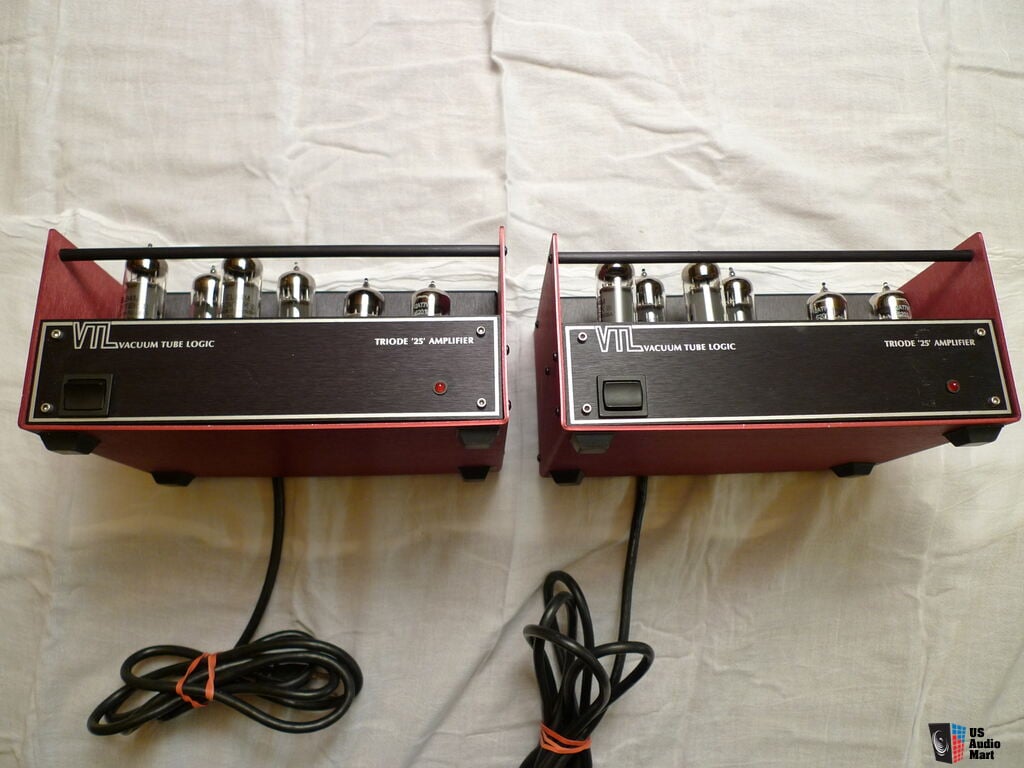
What's next? Joe has expressed his interest in a tube amp for the Quad's. After icefox reminded us that his ESL 57 sang with the Manley Tiny Triode 25 (actually recorded here), he is looking. Actually, the Manley was made by VTL, and the original VTL Tiny Triodes (sassy chassis; later uglier silver faceplate hides the tubes) was nicknamed "dice" 骰仔 (for their small size and cuteness) in Hong Kong. Heard them several times - yes, very good. None of the versions would be a wrong buy but the earliest red ones are the prettiest and cheapest. These are triode connected but I think vintage Pentode PP can be excellent too. Two favorites are Eico HF-86 and Dynaco ST-35.

Top, ANUK M8, Quad DMP; Bottom, Quad 50E flanking Elite QMP, Micromega on top.
REL with low level input
I hope Joe gets a pair of these for Christmas present
VTL Tiny Triode 25 Amp Original Version Red Finish
The transformers that came with Joe's 50E's are smaller than the originals

Surgery (R) and Final Result (L)

16 July, 2020

Graaf GM200 GM20 Modena OTL Quad ESL 63


Click pic to enlarge. Quad ESL-63 on stands; Graaf GM200 on stool, connected with Nordost Speaker Cables; above, pair of GM20 Modena Monoblocks with black coverings, next to which Marantz 10B Tuner; beneath Marantz is Luminous Audio Passive Control.

Virtual Home Visits (9): Quad ESL, Graaf OTL

The Perfect Gentleman
This photo came by accident. When Jules (Visit 8) sent his photo to me, he included this one, which briefly threw me off. It turned out to be a more recent picture of the home of dkyyu, which I had visited a few times before. dkyyu is a perfect gentleman and a generous man (come to think of it, don't you think the majority of audiophiles, of any nationality, are really nice people?). I took the liberty of using this photo, just to say hello to him! dkyyu is also a precious tea collector and an LP collector.

Researching this blog, I was surprised that I had actually recorded a visit to dkyyu more than 10 years ago!!! I forgot about it! It is still a good read, and relevant to this article! :-) That makes me happy. I have visited him after that, but did not write about it, so please say hello to LeeHC and big Lau for me too! I miss you all!

dkyyu's living room can be considered reasonably sized in HK. He is a die-hard vintage Quad ESL fan, owner of the iconic ESL-57 and ESL-63. There is a crazy gang of vintage ESL users in HK; some members even do DIY repairs (HK is very humid, and almost all ESL's go bad). Some of their exploits can be seen here (pics galore).

ESL users naturally gravitate to OTL (the theoretical high impedance matching thing). That is one of the reasons (but no the only one) why I have heard many Graaf's in HK. This Modena (home of the 3 i's of race cars) manufacturer is not well known in the US. This is understandable, as North American homes on the average are much larger and OTL, being a low-powered and impedance matching oddball, is a niche; and the US also has its own Atmasphere and Transcendent Sound. On the other hand, in places like the UK, Europe and Hong Kong, listening quarters are small and Graaf would be more suitable. In the HK market, any Graaf that shows up is lapped up quickly; in NA, I think it'd be like hunting for hen's teeth. Graaf's official websites have not been updated for a few years but can still be read (old one has more info, "new one" less so). If readers know if they are defunct or not, please let me know. Where are you, "Giacomo Bello" (come to think of it, can you email me?)?

OTL in General My own experience with OTL is summarized here in an Overview.

Graaf GM 20
Graaf's most commonly seen OTL amp is the GM20 (this review is probably by Ken Kessler of HiFi News). Employing 4 x 6C33, it puts out 20 watts. It is a great amp, and not just with ESL. Yes, I have heard it with vintage Quad ESL, like at dkyyu's place, to good effect. But, keep in mind, I understand what's good about ESL, but am not an exact fan of vintage ESL, as they image low and have no power envelope to speak of for this classical symphonic listener. In my opinion, for vintage ESL, elevation and addition of subwoofer is a must. I'd actually prefer my lowly low-level Martin Logan Source (here, and there are many after that pilot, just search; second-hand price is probably a few hundred dollars). But I notice that dkyyu now has a subwoofer! If my memory serves me, my previous visits were without, and that is a big step forward by my thinking! In terms of average,based on what I heard in HK, I actually prefer the sound of my friend relax173's Graaf + B and W Nautilus 804. So, OTL can work well with other lower impedance loudspeakers as well.

Graaf Modena Monoblocks 
These are special monoblock editions of the GM20, and highly coveted. The sound is excellent, just like the GM20, with a little more power. Should you be interested, this past sales ad has a lot of great pics.

Graaf GM 200
Judging by the looks and the "magic eye" tubes, dkyyu's ' "newest" acquisition, which I have not heard, is the GM 200, 10x the power of the GM20! This was reviewed by Ken Kessler in HiFi News and Stereophile. A whopping 42 tubes, and in ultra-hot sub-tropical (misnomer; I think the difference between sub- and tropical is disappearing) HK! While I admire the fanaticism, I cannot really take this to heart. I am sure it sounds great, but the energy cost! I'll take the GM20 myself, thank you. What I am saying is, no matter what the power, vintage ESL is highly limited in dynamics - there is a reason why SME's Alistair Richardosn employed stacked pairs! For me, the current Quad offerings (28' and 29' series) are more dynamic and suitable (though I shall still opt for Martin Logan).

Thank you Jules, and dkyyu! You both have enhanced my audio experience so much. I am grateful that I have you as friends.

12 July, 2020

Horns Jensen 302 201 P15LL103 Fountek General Radio 1450TA Altec 808 Fostex T90A


Click pics to enlarge. Tri-amped Altec System. L, from top: TT, Conuterpoint, Electronic Crossover x 2, ASL. R, from top: Passive Pre, Puresound, Adcom, Raphaelite, Adcom.

Virtual Home Visit (7): Dual (Duel) Horn Systems

Editor: BenYC is one of the gentlest souls that I have had the pleasure of knowing. Always willing to lend a hand, Ben has been very kind to me. He is a very experienced audiophile; just a casual look at his equipment will tell you that. Ben also had my ferrite La Scala for a while before he evolved into the Jensen's and Altec's. Although we probably listen in different ways, there is one thing that now we share: we both listen to the low-res streamed music - Ben to his YouTube and I to NML or Spotify. We just love to explore music. For Ben, this comes in the wee hours, after a day of working and cooking (he's an excellent cook) and tending to his three kids; he then is free to listen at low volume or with his desktop system - his private hour. I am sure a lot of readers can relay. Ben plays the violin.

It was more than 10 years ago that I wrote up BenYC in a Home Visit. I had visited him several times after that but didn't report on it. Note that the equipment haven't changed that much. How does BenYC describe the sound of his systems? "...All are old gears that no one wants.  They sound like a mini-hifi that can play a bit louder..." But, don't you believe him...

BenYC's Living and Dining Rooms are conjoined in an L-shape. Top pic shows the Dining Room System, which is kind of his main system.

CD transport - Puremusic MU20
DAC - Adcom 600
Turntable: Nottingham ?
Phono - Counterpoint 5.1 + Raphaelite SUT
CD Passive Pre - General Radio 1450TA (RCA 11713 Transformers in out)
Crossover and input selector - Ashly SP4.8 x 2
Treble - Raphaelite 6L6 SE to Jensen 103 + Fostex T90A
Mid - Sun Audio 45 SE to Altec 808 + 511
Bass - Antique Sound Lab 6L6 PP to Jensen P15LL
Sub - MJ Acoustics Ref 100 x 2

The system below is the second system, located in the Living Room by the Door.


Top Shelf: Ampex,  Raphaelite behind amp on left, Sun Audio behind amp on right, Electronic Crossovers stacked behind Center Speaker. Middle: Parasound and Passive Pre. Lower: PS Audio. See also right pic and pic below.

CD Transport - PS Audio Lambda
DAC - Parasound 1600
Passive Pre - General Radio 1450TA (RCA11713 transformers in out)
Crossover - Ashly SP4.8 x 2
Treble - Raphaelite 6V6 to Jensen 302 + Fountek NeoCD2.0
Mid - Sun Audio 6V6 SE to Jensen 201
Bass - Ampex 6L6 PP to Jensen P15LL
Sub - Sunfire HRS12

BenYC also has a lot of stuff on his desktop, but that is enough for now!

10 July, 2020

TAD 3401 Kondo M7 Ongaku 47 Labs Gaincard


Click pics to enlarge. TAD 3401 flanking Kondo M7 + Ongaku. Seng is a classical music man, and his wife is a bookworm. Even without children, their rooms are filled to the brim. 

Virtual Home Visits (6): TAD 3401, Kondo, 47 Labs revisited by Seng

Editor's Note: Regular readers shall remember my Hong Kong friend Seng, whom I featured in Home Visits many times. Before I left HK I consigned  to him my most treasured stuff, including a pair of the TAD 3401. The initial setup was reported here, and I urge you to read it as you will see the rest of the room as well as even more equipment. The following are his words.

When the speaker first came to the house, it was placed in the adjacent side of the living room (refer to link above) which was really too confined a space for such large speakers. I then moved them to the wider side of the room and the sound stage was much improved.

Before the Ongaku, I was using the 47 Labs Gaincard with the Kondo M7. Daniel [Ed: see Footnote 1] has come and listened to the system. He commented that the system sounded very direct and particularly good in playing jazz, the only weakness being the lack of micro-dynamics.

After switching to the Ongaku (I know it may not be a fair comparison), I understood what he meant. The sound of Teresa Teng became sweet and attractive. Before that, I did not find anything special about her vinyl. Now, I know why people like her so much [Ed: see Footnote 2].

Editor's Footnotes: 1) Daniel, aka Danz, is Seng's brother-in-law. More than 10 years ago he contacted me about Tannoy (I wrote a lot about Tannoy in the HK forum r33) and I have featured him regularly in my Home visits. Those are among the most interesting of my posts, and it chronicled his whole journey; should you be interested you can read everything by entering the word "danz" in the blog search (top left). A few highlights: here for my first visit with Tannoy Canterbury; here for his Wavac; and here for his Tannoy Kingdom. I met Seng through him. 2) I was in my early teens when I first watched a very young Teresa Teng on Hong Kong TV (our TV set was black and white). Due to her popularity in China when the country was opening up, generations of Chinese knew her songs by heart. In the mid-eighties, when there was an intelligentsia of Chinese artists and writers in NYC (most returned to China), I held parties for them sometimes at my home. I only have to play Teresa Tang (on my Dahlquist DQ-10's) and everybody would get up and do ballroom dancing (very popular in China then). For me, Teng is the best Chinese singer ever (I am a native mandarin speaker, whereas most HK people speak Cantonese and tend to gravitate to Cantopop). Her voice is sweet and there is an artlessness in her approach. Many of her songs are covered by female wannabe's, but no one can surpass her. Below I attach the youtube of one of my favorites, "sea tune", which is among the least covered because no one can approach it her way. 

08 July, 2020

Tannoy Canterbury Spendor SP100 EAR 912 509 YS Thorens Zorin


Click Pics to Enlarge. Tannoy Canterbury HE behind Spendor SP-100.

Virtual Home Visit (5):  Tannoy Canterbury HE and Spendor SP100

The name of my HK yumcha friend trazom used to come up quite often in after yumcha activities (dealer or home visits), yet I haven't really written an update for quite a while. Trazom is Mozart backwards, what a moniker! Maybe I should call myself Renkcurb or Hcivokatsohs, Bruckner and Shostakovich in reverse. Almost unique among HK audiophiles, although trazom listens to all kinds of music, his heart belongs to opera.

Early in our acquaintanceship, I wrote in detail about him in 2009 (here and here). He gradually fell under our influence and became a very different kind of audiophile (tube oriented) and took up vinyl again. Two years later, I sold him my Spendor SP-100 and he acquired tubed preamp and monoblocks from  YS Audio (here). Although 2015 was the last time I wrote about him, up till the time I left HK, I have actually listened to his setup several times. In the interim, he had upgraded his YS amps. I then lent him the Leben RS-28CX Preamp, then sold him the EAR 912 Preamp. Before I left HK, I lent him both my Tannoy Canterbury HE's and EAR 509 monoblocks. His current setup:

CDP: Lyngdorf CD-2; Esoteric K-03
Analog: Thorens TD-125/SME 3009; Zorin Setup

Phonoamp: YS Audio Concerto Plus MC
Preamp: EAR 912; Leben RX-28CX
Amp: YS Audio KT-120 monoblocks; EAR 509 monoblocks


From Right, from Top to bottom; Zorin TT, YS Phono; EAR 912, 509; Esoteric, EAR 509; Thorens, Leben, Lyngdorf. 

A word about the analogue setup. Around the time trazom updraded his YS Audio Amps, he bought the Zorin Turntable (YS is distributor in HK). Zorin is a Taiwanese company that now only maintains a Facebook Page. Its products are very beautiful and competitive in price. I was not really enamored of the sound. While very good, it seemed to lack something, soul perhaps. One day, out of the blue, trazom called me and said there was a used Thorens TD-125 with SME 3009 arm for sale for around USD500 and I told him to jump on it without delay, which he did. I heard it later and, yes, that was the kind of sound I like!

Every audiophile is different in his preference and his ways. The Spendor SP-100 and Tannoy Canterbury always sounded a little tighter at trazom's than at my place.

He also put together something in his study. I sold him my pair of the famed Pioneer S-A4SPT-VP (evaluated here), and I see he has paired them with an old Pioneer receiver!

trazom's other hobby is to build toy models (mostly Japanese designs, OEM'ed in China). During the Lockdown, he built many kits, See below: