Showing posts with label Brand-BAT. Show all posts

19 April, 2016

Shure SC35C, BAT P5, ARC PH1, Shindo


Review: Shure SC35C Cartridge, Part II
Letter from NYC (53) 2016 (9)
Review: BAT VK-P5
Vinyl Talk: MM vs MC, Part I
Phonoamp Shootout: BAT P5 vs ARC PH1 vs Musical Surroundings Phonomena II vs Parasound JC3

Note: At first I was perplexed that I got terrible results from the Shure SC35C (see Review: Shure SC35C, Part I), but I now know why. Read on.

Shure SC35C
Puzzling First Impression Almost a year ago, I read a Stereophile article by Herb Reichert, in which he (like others on the net) praises the evergreen $35 DJ Shure SC35C cartridge, used on a Pioneer direct-drive PLX-1000 (his review of the TT here). Now, HR is a seasoned reviewer (though now on the cheap), and the Pioneer he uses is almost the same thing as my AT-PL120 (I suspect they have the same OEM). As he got curious about the Shure, I did too. I bought one from Amazon and enlisted my idling Pioneer PL-10 for the purpose. As stated in my Note and the link above, the result I got was terrible. Frankly, I have never heard a worse sounding setup.

Rejuvenation/Culprit Revealed Still perplexed by the result, this time around I decided to shift the SC35C to my Audio-Technica AT-PL120 for a second chance. As I took off the cartridge leads on the Pioneer headshell, I noticed that they have deteriorated quite a bit, with clip barely hanging on. I installed it on the AT-PL120 and was immediately captivated. Yes, it was a little rough at first, but now I could hear the potential (more sonic notes down below). There! Cartridge Leads are easily damaged with time and during manipulation, and any poor connection adversely affects the sound. The degree of damage the leads did still amazes me.

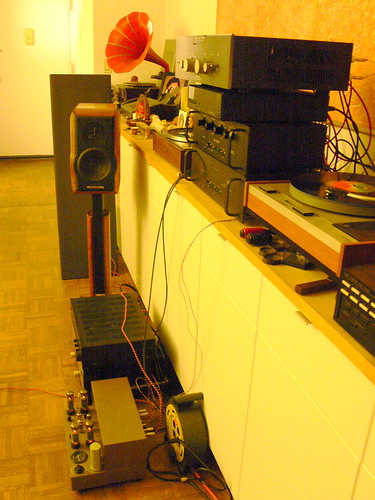
I added the AT-PL120/Shure SC35C to my reference System II. As I have 2 Thorens tables fighting for the Shindo Monbrisson's 2 phono inputs, I needed to add a phono amp anyway, I used the opportunity for a little fitting.

BAT VK-P5
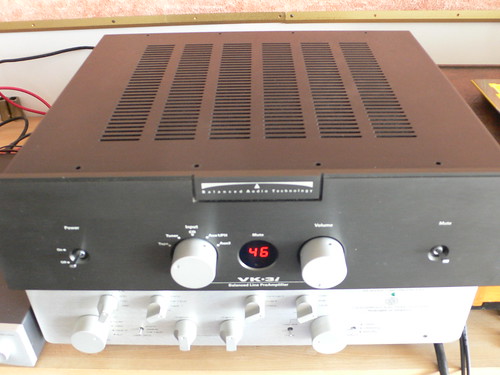
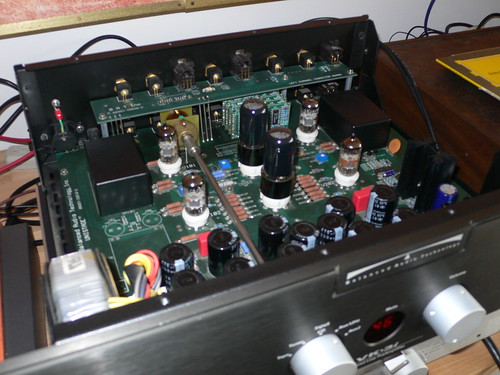
This is an older model, a super-bargain at current second-hand prices. As you can see from the pic, its battleship built and topology bears great resemblance to its current offerings, including the current flagship VK-P12SE (just rave-reviewed in the current May/June 2016 TAS). If you compare, the more expensive offerings differ little in topology, more in component grade and added options, like input transformers (I prefer my own) and output transformers. The P5 uses 8x6DJ8 and 2x6SN7. I have all old stock tubes in them.

The P5 is highly configurable. The maximum (high) gain of 56 db is a little low for very low output cartridges (like my Denon DL-304), but the low gain is a highish 50 db. One can further trim two pots to attenuate another 6 db (44 db). Two dip-switches allow for loading and capacitative adjustments.

For some reason, I have never formally written this up. Perhaps it is because I have previously only used it in balanced mode with the BAT VK-3i preamp, not my usual connection (RCA, as I use SET amps). My previous experience, with Air Tight PC-1 and with Koetsu Black, was very positive, and so is completely at odds with the surprisingly negative review on 10audio (usually this site is OK) and more in keeping with Toneaudio (summary only; more details in its review of the similar P6).

Compared to some other big names, BAT gears are less popular. I think this is due to their insistence on balanced topology. While the preamps have concessions to RCA's, the P5 phono amp does not; there is only a single pair of balanced output, necessitating the use of adaptors when used with non-balanced gears.

Audio Research (ARC) PH1 There is not much info on the net. For an introduction, see my previous experience.

Parasound JC3 Previously reviewed extensively (see here).

Musical Surroundings Phonomena II (see here).

System:
Analog Rig: Audio-Technica AT-PL120/Shure SC35C (and other after-market styli)
Preamp: Shindo Monbrisson (has MM stage)
Amp: Wavac MD-811
Loudspeakers: YL Audio 4-way horns
Phonoamps: Musical Surroundings Phonomena II; Parasound JC3; BAT VK-P5, ARC PH-1
XLR to RCA Cable: Gotham GAC-2/1 and DGS-1

Sonic Impressions
  • Shure SC35C (new stock) Compliance This is a very low compliance cartridge, and my low-medium mass arms are theoretically not optimal (I added a headshell weight). You can press on the stylus and it hardly budges, maybe great for child-proofing? VTF Recommended tracking force is 4-5 gm, and I use 4.5 with no problem. Output As we shall see, the high output of 5mV proved problematic to my system with high efficiency loudspeakers. Initial Sound/Run-In As soon as I mounted the SC35C in the AT-PL120, everything just snapped into focus. Force, colour, everything just exploded. Initially the sound was rather coarse at the top, but it started to smooth out after 20 hours. Likely not fully run in yet even as of this writing.
  • SC35C + Shindo Monbrisson Trying the other phono amps made me realize the presentation of Shindo's MM section - a somewhat softer presentation and narrower stage. But it was perfect for the rather long run-in period. The Shindo tamed the edge of the SC35C (it is important to remember my horns magnify such things) and for the initial period that was what I used. Unusually for me, but highly appropriate for MM, I played many rock and pop records. Even early on, the SC35C took well to rock and the male voices: Willy DeVille's Miracle, Leonard Cohen's Songs of Love and Hate, Dylan's Nashville Skyline and Pink Floyd's The Wall were all rendered with unforced dynamic swing, a fast, clean and powerful bass. On these rock/pop LPs the SC35C outperforms my MC's, and its ease of delivery is just admirable. Only when I played the period instrument Bach Violin Concerti (La Petit Bande; Proarte) or digitally recorded Linda Ronstadt For Sentimental Reasons was some residual upper midrange glare revealed. Of course, with MC's vocals and instrumental details are more nuanced, but the Shure is satisfying enough and rhythmically even more urgent.
  • SC35C + Phonomena II Like before, I had no luck with this one. I tried the various capacitance valued but none was able to change the sterile sound. Nothing offensive and neat, but not inspiring either, and that is a no no for LPs. Abandoned again.
  • SC35C + ARC PH-1 Now, this is more like it. The soundstage expanded in width and depth significantly. Bags of air was accompanied by a little over-the-top treble. To smooth out the sound, I resorted to an old Audioquest Ruby, a solid core cable. That did it perfectly. It shows once again that solid cores can sometimes work when stranded prove unsatisfactory. It also shows that one should consider what the vintage item was paired during its time. For the ARC PH-1, it was likely the era of Monster and MIT, old models that were not so transparent.
  • SC35C + Parasound JC3 or BAT VK-P5 Parasound JC3 Previously I had only availed myself of its excellent high-gain MC stage. I was surprised that the (47 db gain) MM sound was equally impeccably detailed, quiet and smooth. Just like the ARC PH-1, as compared to the Shindo, the soundstage width and depth both expanded. Tonally and dynamically a very even performer. This is a full balanced design. BAT VK-P5 The sound is very detailed and with a wide and deep soundstage. Surprisingly for a tubed unit, the transient attack is very fast and dynamics superlative. The unit also needs an hour to sound its best. As this is tube, there is a little more harmonics, but overall the sound is rather neutral, with just a hint of tube bloom; hence I can see why some tube people may not like this. I tried all of the capacitance options but the basic sound remained the same. As the output of the SC35C is a high 5mV, I used the lowest gain of 44 db by trimming the pots all the way down (see above). Parasound vs BAT Compared to the Parasound (even higher 47 db gain), the BAT subjectively sounds like the gain is too high, and the sound becomes just a little wilder/bright with certain styli. I interpret this to mean the BAT VK-P5 is more dynamic than the Parasound. Part of this is also due to its fast transient attack, again subjectively faster than the Parasound. Put it another way, the solid state Parasound veers towards the warm of tubes, whereas the tubed BAT tends not to be tubey. For BAT, I think it is somewhat unusual to be in the position of having insufficient gain for very low output MC's but seemingly too much gain for high output MM's. Hum Like when I had the Raos mono cartridge (here), both the Parasound and BAT have a grounding issue that I could not get rid of. When the music is playing, it is low enough to be inaudible, but one can just hear it during quiet passages. Maybe the fully balanced phonoamp deos not work well with unbalanced downstream gears?
  • Aftermarket Styli Old Stock 766-D7 (SS35C) I first tried this when the Shindo was used. The sound was somewhat veiled and too smooth. However, with the Parasound and BAT, the sound blossomed with a natural balance. It is a little more refined than the stock, but the stock has a stronger and more projected midrange (particularly evident with male voices). Pfanstiel 4766-D7 The box says Switzerland SS35C, 0.7 mil con., but the seller advertised it as N35X, which was why I bought it. Out of the box I knew something was different. The stylus is much more compliant. Indeed, at 4.5 gm, the belly of the cartridge was almost sweeping the record. I then tried 1.5 gm (like an N35X) and it worked very well, without tracking errors! The stylus looks conical, but it s behaving like an elliptical. Maybe the suspension has deteriorated? I don't know. In any case, the sound is very clear, more airy, extended and refined on top than the stock cartridge. Not withstanding the curious difference in compliance of the Pfanstiel, I have to say all three styli sound more similar than different.
Conclusion The SC35C is wildly good and cheap. It does many things better than even an expensive MC (like effortless bass) and makes one seriously wonder why one should spend more than $40. As a result of this, I have also embarked on a project of rejuvenating my Empire's (2000E/III and 2000Z) and I also took them to listen at Andy's setup. So more later as we delve deeper into MM vs MC.

04 January, 2011

Talk Vinyl: Air Tight PC-1, Ortofon MC-5000 (and MC3000MkII)

Talk Vinyl: Air Tight PC-1, Ortofon MC-5000 (and MC3000MkII)

HiFi Letter from NYC 2010 (9): Magnepan 1.7 Redux
Clearaudio Concept Part IV

Right before I left NYC, I invited newly acquainted AL, a vinyl expert, to listen to my new cartridges (he had expressed interest in the Ortofon MC-5000). He brought a friend and my friends Mark and princetonsound also came. I barely had time to set up 2 systems for them to listen to.

Air Tight PC-1
I first heard the Air Tight PC-1 at ML's place several months ago (report here). I liked it but did not scrutinize it too much as we focused on comparing the Continuum and Clearaudio flagships.

Fortuitously in NYC I acquired a used, but low-hours, sample (not Supreme). I swapped out the Koetsu Black (mentioned previously here) on my Linn LP12 and the sound was instantly captivating through my reference balanced system, similar to that reported before :

Analogue Source: Linn LP12 Lingo/Ittok/PC-1
Phonoamp: BAT P5
Preamp: BAT VK3i (reviewed here)
Amp: Audio Research VT130
Speakers: Magnepan MG1.7
Cables: Fully balanced Gotham GAC-3

The PC-1 has a healthy output of 0.6 mV and did not cause the Phonoamp undue distress. Its internal impedance is 2.5 ohm and I loaded it at 30 ohms on the P5.

It excels in mid-range presence, and with its well-controlled yet full midbass yields a very live and direct sound not unlike horns, or a little reminiscent of Decca cartridge if you will (funny that JV in his TAS review compared it to a Decca). Its bass control is obviously superior to the sometimes rowdy Koetsu Black (the LP12/Ittok may be to blame too), but the treble and high-midrange is a little more clinical than the Koetsu. All in all, all my friends, including Princetonsound and AL, were impressed.

Just a brief word on the Maggies. They sound better in my new room, like all other speakers. Bass is more robust and the top smoother. I am pleased.

Ortofon MC-5000 (and MC-3000MkII)
This time I brought both the Clearaudio Concept TT and Ortofon MC-5000 to NYC. The MC-5000, like the similar MC-3000 MkII, has a ceramic body, uses the replicant stylus (same as in the previous Ortofon statement product, MC Winfield, as well as the current A-90!), an has a very low output of barely over 0.1 mV, mandating the use of step-up transformers. Installation on the Verify arm proved a breeze, and I was immediately rewarded by the sound through the more casual setup:

Source: Clearaudio Concept/Verify arm
Step-up transformers: WE 285L and Langevin 402B (into AN silver cable)
Phonoamp: Linn Kairn (using tape out and Gotham GAC-4 cable)
Preamp: Langevin 102 preamp (vintage cable)
Amp: McIntosh 2200 (Acrotec cables)
Speakers: Magnepan 1.7
As I'd expect the sound was wonderfully detailed, dynamic, and with very wide bandwidth. No frequency called attention to itself. I had actually worried whether the 5000 would be a good match with the crisp sounding Concept. There was no trouble whatsoever. In this different system it did not quite project like the PC-1 did, but in terms of neutrality it was well nigh perfect. By neutrality, please do not think of the clinical kind. Percussion were reproduced with all their sheen, not tinged with whiteness as in lesser analogues (not to mention digitals).

I am also very pleased by the Concept, particularly the arm, which seems to work well with everything, and I still have room to spare in the counterweight for a somewhat heavier cartridge (these now are around 10 gm).
America, in music
Mr AL evidently liked the reproduction of one of his favorite LPs, Varese's Amerique (Vanguard). My copy was an early one, not a re-issue. If you don't have it, I'd urge you to get it for the strangely beautiful music that still sounds modern after all these years.

Words about the 5000 must have spread fast! Despite my protest, my copy was snatched up by AL's buddy, guru TM who merits a separate report all by himself.

A brief note before I stop: In HK previously I had installed the "legendary" MC-3000 MkII on the same TT and if my memory is correct, the 3000 is a little smoother and richer, particularly shining on massed strings. Both are cut from the same beautiful cloth and would be great buys. There are out there a lot more users of the cheaper 3000, and very little info on the later 5000. I hope my little bit helps. You'd be sure to hear more of these beauties in the articles to come.
Addendum on PC-1:
reviews by Ken Kessler; TAS

03 September, 2010

Review: SONUS FABER Electa Amator II

Review: SONUS FABER Electa Amator II

I have long been familiar with this speaker, and with most other models in the family. A good colleague and later a friend both had the EA I, which some preferred as it sported the Esotar tweeter. However, although the I mated better with solid states the more open nature of II can be even more of an asset with II.

My journey with SF started with the Concertino, a marvelous entry model. Later, I had the rather unique Signum, which I regret selling up to this date. Recently I came across this immaculate pair of EA II with original stands, and bit. Not cheap, but worth every penny.

These are even better than I thought. Previously I heard them with ARC LS5/VT70 (very good) and Pathos. Now I mated them with ARC SP9 (or BAT VK5i on loan) and Marantz 8B. Hooked up with no-nonsense cables (which makes all the difference, believe me) the sound is astonishing. Detailed, big, bold, yet refined. Even more impressive than a single violin's tone is the peerless conveyance of massed strings, which most expensive speakers fail to deliver. Even if I switched to an NAD it remains mesmerizing. Overall dynamics and power is awesome, though always delivered naturally. You can put this up next to a stat and not fear.

The best “bookshelf” I have yet heard. This is really a more manageable version of Extrema, quite similar in design.

p.s. I know a lot of people use SF with ss amps. That’s a mistake. SF can do a lot better. As for those who say these are difficult to drive, you just laugh!

Review: BAT AUDIO TECHNOLOGY (BAT) VK-3i/VK5i Preamplifier

Note: After the big job of re-labeling I just performed on this Blog, as part of my re-organization, I'm going to eliminate my other sister audio Blog (Review and Overview), to let everything be archived here. Today I'm duplicating all reviews from my sister Blog here. This may cause inconvenience for a few users who follow some of my items; my apology. In the long run, this shall be a lot more efficient. For regular posts, scroll down to 01, Spetember and below.

Review: BAT AUDIO TECHNOLOGY (BAT) VK-3i/VK5i preamplifier

I have always liked BAT’s products whenever I have heard them. The sound always seemed balanced, dynamic and clean. I think they are not too popular in HK, judging by their paucity in second-hand stores. Maybe that’s because of the workman-like look or the massive blackness. I happen to like the look.

I have never heard BAT in any home visits, not to say in my own home. This was rectified recently when my friend E brought a VK5i line preamplifier for me to examine. One channel had little sound. I tested its 8x 6922 and found a short in the last triode section. Replacement of the tube fully restored normalcy. The VK5i was over-built like a tank and weighs twice the weight of ARC. It has dual mono power supply, with dual transformers and 2x 6L6 for tube power regulation (remember ARC SP10, SP8, Reference 1/2/3, Counterpoint SA5.1, SA-5000 and Lamm flagship?). Despite its putting out heat like a small tube power amp and having to use XLR/RCA adaptors, I liked its dynamic sound and started watching out for BAT, especially since I have always wanted a fully balanced TUBE preamp.

I ended up with the lower model VK-3i, which uses only 4x 6922, has only one power transformer and a more manageable (in terms of heat) 2x 6V6 for regulation. My copy was a late one with RCA’s as well as XLR’s and fitted with remote.

Even though the VK5i is long gone, I can tell the sound of VK-3i is in the same vein, rock-solid. Dynamic prowess is the supreme virtue. We are not talking about brute force here. Bruckner’s 6th symphony (Wand/RCA) not only showcases BATs ability to accurately reproduce the innumerable crescendos and decrescendos and abrupt shift of gear, it tells you how well the musicians are coping. Fortissimos are always naturally arrived at (most preamps fail this), louder than one expects. And so careful adjustment of volume is mandatory, making this not so suitable for those who listen low-level to pop/Chinese vocals with gain-riding and compromised dynamic range (usually those who claim vintage preamps are better).

Tonally there is little to fault. Details are plentiful. Despite its killer dynamics, the preamp does not call attention to itself, a testament to its neutrality. At the same time I have the Counterpoint SA-5000 here, and comparison with the VK3i betrays the Counterpoint’s dynamic limitation, a slight midrange recess and mild emphasis of upper treble.

The 5i is a little darker sounding and possibly a little quieter, while the 3i has better rhythm and pace. Overall I prefer the sound of the livelier 3i to the more Teutonic 5i, though the latter in recollection is even more steady when run loud. This brings the question of whether dual mono power supply is always a benefit in every department. In my experience, a good single power supply frequently has better musicality and coherence than a dual mono supply, which however may have a little better high-level performance.

Even with older ARCs and Counterpoints in mind, I cannot think of a better buy in preamplifier. Now I am hunting for a phono card.

07 July, 2010

Talk Vinyl: Current NYC setup (keywords Denon DL-304, Koetsu Black, Linn LP12, Thorens TD-125, SME 3009, BAT P5, GCPH)

Talk Vinyl: Current NYC setup

As I was about to write about a new "surprise" purchase, I realized I had not written about the extensive changes my vinyl setups underwent towards the latter part of my last stay in NYC.

Enter the Black. Koetsu vs Denon
The arrival of the Koetsu Black (read this Art Dudley review) induced great changes in my setup. The sheer weight of this cartridge precludes installation on any of my other arms except the Ittok on the Linn LP12/Lingo. Fed into the BAT P5 , the sound was not that far off from the Denon DL-304 used previously. After protracted listening I made the decision of not using the WE 285L transformers and just using the high-gain setting of the P5. The gain offered previously was not quite enough for the Denon, but the Koetsu's slightly higher output and somewhat wilder streak made the difference. Here, I shall repeat that, whenever possible, for step-up my preference goes to active devices rather than transformers. Aside from the gain and energy, the Koetsu is also bolder and more romantic, with a lush treble. The Denon DL-304 is quite neutral I'm sure (more so than the 103), but the black veers off from neutrality by a much smaller factor than I'd have thought.

As much as I was enamored of the Koetsu sound, I also gained even more respect for Denon, the DL-103 having long been a personal favorite. Indeed, it's always valid to ask, upon hearing any Denon, "Why pay more"?

Merry-go-round 1. What, 304 on the 3009?
Displaced by the Koetsu, the Deonon DL-304 went on the Thorens TD-125/SME 3009S2Imp. The cartridge is likely too heavy for the arm, and the "resonant structure" may not be perfect, but I didn't want to install it on the Technics SP-1200. The result on the SME 3009 though was surprisingly good. After the initial promising sound, I concentrated on mating it with phonoamp.

PS Audio GCPH
The neutral DL-304 had always taken to the tubed BAT more than the PS Audio GCPH. Previously, on the Linn LP12/Ittok, I had tried it extensively with the GCPH. With the gain setting maxed, the GCPH had enough gain for the DL-304 but the sound was just that tiny bit etched in the treble. While this brought great brilliance to percussion pieces I missed a little heft down below. At that time, the WE285L transformer fed into the BAT P5 outclassed the GCPH decidedly.

On the SME 3009 the DL-304 sounded lighter still. As I ran several TTs at once and with the BAT P5 now bonded to the Koetsu, I decided to try out the WE285L transformer in conjunction with the lower gain setting of the GCPH. Bingo, that did it, with added heft and elimination of the slight whiteness. Comparison with the Koetsu/BAT setup was close and I was immensely satisfied.

Is it the 3009 or the TD-125?
Assuming the TD-125 is similar in sound to the LP-12, the 304 on the 3009 sounded remarkably different from the Ittok. To be expected was a lighter and less dynamic sound, with the bottom lighter in heft and slam. However, it was also immediately apparent that there was a delicacy to the treble that was quite a bit more refined than the LP12/Ittok. Rhythm and pace was superior on the TD-125/3009 too: while pop material was obviously less heavy-footed, it was in certain classical material that the difference was most felt; the phrasings on violin recordings instantly felt more sinewy, the flow more organic. I'd venture to say, if you are a violin aficionado, there would be little reason to own the Linn combo.

As the TTs are more similar than dissimilar, I personally felt the arm to be more responsible for the obvious difference in sound. But is that completely true? Somehow, as in previous observations, I have a nagging suspicion that the TD-125 is also a superior turntable to the LP-12. What is inescapable is that the Linn is over-rated.

Merry-go-round 2. A sliver of Silver
Last, I installed the Benz Micro Silver on my bedroom system's Technics SP-1200. I was very pleased that the sound reached new heights. As a matter of fact, they proved so synergistic into the Linn Majik I integrated amp and Linn Kan I speakers that I may have to up my opinion on this particular cartridge by a notch. It has refinement as well as tremendous rhythm and pace that makes me think about how to further improve the main gig a little in this regard.

27 May, 2010

HiFi Letter from NYC 2010 (6): Magnepan MG 1.7 Listening Tests (2)

HiFi Letter from NYC 2010 (6): Magnepan MG 1.7 Listening Tests (2) (finished in HK)

Marantz 9
Next I fired up an old pair of M9. I decided just for fun to drive them from my Marantz 7. These are all old versions. The M7+9 gave a superbly clean sound, but where's that legendary bass oomph? Feeling something missing, I replaced the M7 with my usual BAT VK-3i. I was shocked by the difference. Even using the non-balanced ouput the BAT delievered a lot more: there is iron-grip control, and dynamics completely trounced the vintage machine. Importantly, the bass now was phenomenal, as it should be.

I have always preferred the better modern preamps to the usual vintage (Marantz, McIntosh, Fisher etc). If you just play simple music, you may find a certain vintage preamp flavorful, but for all-around performance, there's no comparison. This little exercise was just a reminder, as if I need reminding. The other side of the coin is that vintage tube amps in good condition can be formidable.

(click on pics to enlarge): (L) Fisher 80AZ; (R) The wondrous Art-Deco Altec 323, fronted by WE285L, Langevin 402A and 402B step-up transformers.

The Wonderful Flavor of 6L6 amps
A good friend brought over a large variety of 6L6 amps for me to check. At about 20 wpc, these lacked real muscle to drive the Maggie, but for smaller-scaled music, most vocals and acoustic jazz, they performed miraculously. There's a sweetness to the 6L6 that tonally most becomes the more analytical Maggie, more so than the more powerful EL34. The Fisher 80AZ, using 6L6GC in place of the original EL37, delivered clean sound and remarkably quiet background, but it terms of finesse it yields to the wonderful, and under-rated Heath W3M, using Tungsol 5881. In terms of power and control, as well as tonal allure, they all had to yield to the WE 274-equipped WE124 (pictured in last post); its ability to drive belies its nominal 12 wpc rating. Indeed, if you only listen to smaller things this is a great speaker for the WE. Another amp from the WE era, the rare-as-hen's-teeth Altec 323 (pictured pair from the 40's) delivered the same transparency, trailing behind the WE124 just a little in terms of rhythmic savvy.

(click on pics to enlarge) (L) Biasing ARC VT130; (R) Theta+SFD2

Fully Balanced Power!

By chance I ran into some balanced gears and made a new friend. My visit to the seller, who uses Martin Logan SL3, would be the subject of another post. Suffice to say the gears I bought from him enabled me to create a fully balanced system (except for phono inputs) for the first time. A revision of reference system is in order:

Digital: Theta Data Basic II into Sonic Frontier SFD2
Analogue 1: Linn LP12/Ittok/Koetsu Black into BAT P-5 (high gain)
Analogue 2: Thorens 125/SME 3009 S2 Imp/Denon 304 (into WE285L) into PS Audio GCPH (low gain)
Preamp: BAT VK-3i
Amp: Audio Reserach VT130
XLR cables used: Gotham GAC-3

Now, the system, both analogue and digital, are balanced. Of note is that the noise floor of the BAT VK-3i preamp, which is much lower via its balanced outputs than RCA outs. This proved quite beneficial as the 8x matched Amperex Holland Globe 6DJ8 I use are inherently noisier than the the stock Sovtek 6922, but tonally much more alluring. Compared to using RCA connectors, the balanced preamp/amp configuration IMHO offered superior dynamic swings and control. I should re-iterate here that the inexpensive BAT VK-3i is really quite a bargain, a fully balanced TUBE linestage that doesn't cost an arm and a leg.

The ARC VT130 (together with its sibling VT150) is an odd product in the ARC series. Despite the designation, its 4x 6550 per channel yields only 110 wpc, 10 more than the contemporaneous VT-100. Its design is for sure related to some of the D series amps (like the D115) , without extra 6550 as regulation; and to the balanced V-series amps, but not in triode mode. IMHO, it is unnecessarily big, laid out more extravagantly than the D- and V-series amps, with a bulky cover that covers everything. I suspect the bulk is why it has never been popular here in HK. Sonically, it's another matter. Though it still contains solid state components in the signal path, its sound is definitely more tubey than the D-115 MkII, which I have in HK. The D115 betrays its hybrid nature when it is switched on, a little white in tonality, and that does not completely go away even after a full warm-up. Not so the VT130: it sounds quite warm even at power on, and reaches full bloom in about an hour. As for power, I'd say they are about equal, but the balanced connection gives it an more effortless quality.

In all, this is now my reference for the Maggie 1.7. At 110 wpc of balanced tube power, the system is powerful enough to handle everything, from fusion to big symphonic work. It doesn't have the brute power of some ss amps, but it trounces them in almost everything else. Neither does it quite have the tonal allure of a WE system, but its even attributes rewards everyday listening.

In the next and final part of this Magnepan 1.7 Listening Log, there are some loose ends to tie up, and I shall do some summation on what I have learned. Stay tuned.

30 April, 2010

HiFi Letter from NYC 2010 (4): Magnepan MG 1.7

HiFi Letter from NYC 2010 (4): Magnepan MG 1.7

(revised May 6, 2010)
Part I

Ever since Magnepan came out with the all-(quasi) ribbon MG 1.7 I have been following it. The speaker has been sweeping all before it, garnering great praise and Magnepan cannot keep up with production. As my previous letter (a few posts down) mentioned, Jonathan Valin of TAS has spent a huge amount of time listening to it and writing about it on the TAS Blog (no printed review yet), claiming unparalled coherence that is superior to the 1.6, 3.6 and 20.1. Being a full-range driver fan and a Tannoy user, of course this aroused my interest. It's imperative you read JV's account in detail, for he went out on a limb, and this is sure to incite unrest among people in the Maggie clan.

To encapsulate what's so revolutionary about the MG 1.7: the bass panel of this model uses quasi-ribbon, said by the manufacturer to be "...a departure from Magnepan's 40-year history of using planar magnetic drivers for the bass or lower midrange. The use of quasi ribbon technology down into the lower midrange and bass will provide a new level of coherence..." (there's also a "supertweeter" in this model). This is a first for Magnepan; all their "higher" models' bass panels still use the old planar drivers. Although there's no official news from Maggie yet, I'm sure that is set to change.

Audition at Lyric HiFi
Lyric HiFi is the only dealer in NYC (unlike the MMG, you cannot buy direct from Magnepan). I have not visited them in years, but I remember the early days when I auditioned the 4-pole Infinity setup with Goldmund turntable, still one of the best sound I have ever heard in a shop. Well, the demo of the MG 1.7 looked almost like an afterthought. It is in one of the small rooms, more long than wide. The panels are about 6 ft apart and only 2 ft or so from the front wall, so not much of soundstaging. They were driven by old Lector digitals and a current McIntosh integrated (big), hooked up by the cheapest Nordost Flatline. Sound was not great, but not bad either. I was surprised by the smoothness. Certainly, there wasn't the "lean" quality mentioned by some users of older Maggies. I wondered how it would sound more in-room. So as usual you get little from the shop demo. Nevertheless, I eventually gave in to my impulse and decided to give it a try. My pair is with the usual aluminum trim, NOT quite as aesthetically pleasing as the traditional wood trims (now special order and I didn't want to wait).

First Impression
The night before delivery I packed up my MMG. When the 1.7 came I was astonished by how big they were, and the packing was even bigger, several times the volume of that for the MMG. Even given my familiarity with the 1.6, I was a bit unsettled by their actual size. Although I'd estimate only a 50% increase in radiating area compared to that of the MMG, the 1.7 looks a lot larger. I drove it with:

Digital: Meridian 596
Turntable 1: Thorens TD-125/SME 3009 S2 Imp/Denon 304 into PS Audio GCPH
Turntable 2: Linn LP12/Ittok/Koetsu Black into WE285L into BAT P5
Preamp: BAT 3i, later Artemis Lab LA-1
Amp: McIntosh 2200 4-ohm tap

Right off the box, you'd be surprised what I noticed immediately. It's not the speed of the bass, nor the difference in tonal balance. It's the ease. It just seems easier to drive than the smaller MMG. I was quite surprised.

Part II
First a little digression. I am quite familiar with the sound of the 1.6, and indeed Maggie in general. My first experience decades ago was the wonderful Tympani in a Long Island basement, still the best setup in my opinion. Rumor has it that Magnepan is developing a new version - now, THAT would be something to wait for.

Through the years I have heard quite a few Maggies. What got me personally into it in HK was acquiring a pair of SMGa (modified to bi-wire) from my friend jules. It was easy to drive and the sound was refreshing, enough to win praise even from discriminating listeners. Then I got to know quite a few of the HK Maggie clan, and frequently listened to models ranging from the MG 12 to the 20.1. Due to home constraints and personal preference, the setups varied widely, the resulting sound too. As an example, for the 1.6, sound from the homes of jules and Vash differ greatly, though both are enticing.

My own experience in NYC began with the MMG, and that has been amply chronicled in this Blog. Keep in mind my reference in my home here in NYC still remains the Martin Logan Source. The 1.7 though opens a new chapter.

Placement
Although the 1.7 sounded good right out of the box, within the confines of a few square feet I spent time dialling in the best placement. One advantage of this taller pair is that my left speaker now towers over the couch in front of it, hence an improvment in the left channel. Aside from a little booming at first, I found I could place these almost flush against the side walls (more advantageous for maintaining good proportion between speaker distance and listening distance). Unlike the MMG, the 1.7 certainly demanded placing the tweeter in the center (the manual more unequivocally mentions: "In most rooms the speakers will sound better with the tweeters inside".

One interesting thing. In the manual AND in a separate sheet, Magnepan says: "The 1.7 has exceptional phase characteristics that are accomplished without the use of compensation networks. To realize the optimum phasing, the 1.7 should be angled inward to be on-axis with the listener (Do not place parallel to the front wall)". No doubt this is not going to happen with HK users who cling to the superstition of "no toe-in". Well, some people want to show you they know better than the manufacturer. With electronics and modifcations I'd say maybe (but only occasionally), but with loudspeakers of good repute, and in the absence of measuring equipment (not just a microphone to measure room response) it would be foolhardy, not to say arrogant and ignorant, not to consider the manufacturer's suggestions. I experimented quite a bit and did find toeing-in to yield a more focused sound.

The easeful character pervades nearly all music I played. This can only be attributed to better integration. What is eminently clear next is a certain warmth that is missing in many Maggies, dispelling certain old Maggie users report on the net. Watch upcoming Part III for detailed listening report.

05 April, 2010

HiFi Letter from NYC 2010 (2): Magnepan MMG growing-up pains

HiFi Letter from New York 2010 (2): Magnepan MMG growing-up pains

This time I recovered from jetlag surprisingly quickly, and had little use of the second system after a few days. I concentrated on my main system, The first thing I did was to improve its performance. Current main system:

Digital: Linn Karik/Numerik (Linn RCA cable to preamp); Meridian 500/563 (Gotham GAC-3 XLR to preamp)
Turntables: Linn LP12/Ittok/Denon 304, Lingo power supply; AT PL1200/Grado Gold
Phono preamps: PS Audio GCPH; WE 285L (step-up trans) into BAT P5 (Gotham GAC-3 XLR to preamp)
Preamp: BAT VK3i (Filotex RG58 coaxial thru adaptor to amp) Amp: McIntosh 2200 (4-ohm tap)zzd

Placement
The day after I set up my main system, after not such heavy use, the system was already surprisingly in reasonable form. There was not that much I could do in positioning, but within a 2 sq ft area I experimented and obtained a small improvement. My room is ~12.5 ft in width and 20 ft in length (to the kitchen partition; 26 ft counting the corridor on the right). The speakers are placed ~10-11 ft from my listening seats, and are 6 ft apart (inner edge to inner edge). With those measurements, the manual was correct in saying having the panels upright resulted in better sound (but the opposite would be true for shorter listening distances). Here, I must add that I feel the larger Maggies with non-adjustable upright stands are NOT meant to be used in rooms too small, which would result in an over-bright sound. Take in only what you can swallow, that applies to hifi too. Unfortunately, audiophiles in HK most often ignore this, a result of the pitiable general situation of having money but not space. Blame the real estate tycoons, and the government.

Left or right, game of the mirror image
Some say the Maggies MUST have the tweeters inside. This is too dogmatic, and presumptive by not taking individual environments into account. While the Maggie MMG manual advices at one point to place the tweeters inside, somewhere else it encourages the user to switch the 2 panels and experiment, a good attitude that's there for a reason. In my space placing the tweeters on the outside reaped big rewards: a larger and deeper soundstage, more easeful climaxes and better gradation of dynamics, all at little cost. Okay, with solo instruments there is a slight shift in the position of the images, which also softens just perceptively, but I'd regard the gains far outweigh the slight imaging compromise (haven't you ever noticed even the best Maggies tighten up when the going gets rough?). Most importantly, on big pieces there was just more atmosphere. I surmise the improvements are due to 2 reasons: (1) the increase in distance between the tweeters by more than 1 ft yielded a better ratio, although mine is within the rough Maggie ballpark of 60%; and (2) moving the bass panels a little less close to the sidewalls cleans up the bass a little.

Here I must ponder what people mean by "holographic". Most people link it with imaging, and that's not true at all. Sometimes over-emphasis on imaging reduces the sense of holography, snifling out the real hall sound by creating an artificial soundfield (I'd refrain from using the term "soundstage" as it has no bearing to the real "stage" on which the musicians perform). By having the tweeters on the outside, presumably reducing imaging exactitude (though I hardly noticed), my sound definitely became more holographic and provided more ambient information and sptial clues on the performance venue. By the way, that was not the first time I felt like this; it had happened often (but not always) before with mirror image pairs, from vintage JBLs (4312A and Century Gold) to Proac (original Response 2). All I can say is, experiment.

(Click on pics to enlarge)

Cable Talk

Using the records shown I proceeded to determine which of the 3 pairs of speaker cables I had on hand was best suited to the task. I started with the Belden 9497 (twisted 2-conductor; TPC). The sound was, as usual, undeniably right, and transparent, showcasing all the concertante and solo moments. However, due to its relatively small gauge (for driving the current-hungry Maggies) its sound at big clmaxes was held in with a little restraint. This was particularly evident with the opening of Solti's CSO Mahler Sixth (London), which was less threatening than desired. A swtich to an old pair of Cable Talk Model 3 (thick stranded Cu-parallel conductors) immediately brought more gravitas, but then the sound was just slightly dark (not so bad for Maggies) and more importantly the inner details were audibly compromised. The violin and viola of Grumiaux and Pellicia in Mozart's Sinfonia Concertante (Philips) lacked sparkle and rosin and the highlighted viola sounded a little too close to the cello for comfort. I finally settled on Acrotec 6N-1010 Cu, a finely balanced cable that sounded more like the Belden, but with a little more weight due to its moderately heavier guage. This settled, my attention wandered to other perhaps equally important things.

Again, what a difference an inch makes
The MMG is spec'ed at 50-26k Hz +/- 3db. If you guess from the figure that the speakers, without port and enclosure, are prone to sound lean in the bass and with a certain prominence in the treble, you're largely right (otherwise tweeter-attenuation resistors would not have been supplied). In my well-damped living room, and with a tube preamp and the McIntosh, the treble, though a shade pale (like most Maggies), did not however sound over-bright. In an attempt to improve details in the inner spaces I substituted the original tweeter attenuation jumper (a solid block of metal) with a piece of wire (16 AWG vintage silver-plated Cu I have on hand) and I was gratified that opened the sound up a bit while exacting no compromise.

How low, and how much?
I have waited long enough to come to the million dollar question. What about a subwoofer to fill out the bottom? Note that almost all serious Western Maggie users use a subwoofer, and that includes HP of TAS, surely the person who had put Magnepan on the map. Despite this, I have yet to see a Maggie user in HK use a sub, ostensibly for fear of compromising the "purity" of the speakers. Is the fear rational?

Good as the sound of the MMG is, it DOES sound lean in the bass in my 250 sq ft+ room, which could actually accomodate a pair of MG1.7, but that's for later, if ever. As holographic and airy as they are, the MMGs just do not flesh out like the Martin Logan Source, and I don't expect them to. Robbed of the lowest fundamentals, maybe that bass is just not as rhythmic as you'd like, but with vocals and jazz it perhaps would not be so important. But big orchestral music simply demands reinforcement. Enter the subwoofer.

The experiment was conducted with a very modest AR powered subwoofer borrowed from a friend. It cannot have more than an 8" driver inside. From the start I did not expect it to plumb great depths, but to "fill in" a little. This old sub did not have high-level inputs, so I had to use the second pair of my preamp out. Using the same recordings I judged the adjustable crossover was best at or below 65 Hz; further up the band some compromise in mid-bass clarity was audible. The volume took a while to set, but it was just a notch or two above barely audible.

What's the difference? I say, not so subtle. While tonality remained much as it was, the bass fleshed out. It is important you feel it in the atmosphere, not in your pants. Solti's Mahler 6th became more subjectively threatening. The best way to tune the subwoofer I found is by using a well-recorded piano piece that has slow left-hand rumblings. This was more than amply provided by the Jorge Bolet's Liszt album, particularly on Reminiscenes of Don Juan. You want to hear the bass rumbling, but you also want not to lose the articulation, or for the faint bass notes to smear into one. You have to listen hard.

The "subwoofer" I don't think really extended the bass of the MMGs by much, maybe 10 Hz, but I feel it filled out the leaness in the bass without robbing the panel bass of its tunefulness. Unless your Maggies are big enough for your room you should investigate adding a subwoofer. Also, the type of music you listen to makes a difference too. Light vocal and jazz lovers are more likely not mindful of the bass leanness, but lovers of big orchestral works (me) would definitely feel otherwise.

23 November, 2009

HiFi Letter from New York 2009 (3):

HiFi Letter from New York 2009 (3):

Spread them wider! Menage a Trois, ou Quatre!


If you look at the pic in my first letter you shall see the placement of the left speaker left something to be desired. With approval, a week ago I relocated the table to the middle of the front wall and the left speaker further against the sidewall. This enabled me to put the small bookshelves to the lateral side of the Martin Logan Source’s. I am still 10 ft+ from the speakers but the distance between the MLs and between the bookshelves now become a more respectable 7+ ft and 9 ft.


Needless to say, the soundstage became much wider instantly, and after adjusting the toe-in angle, there is no loss of focus. While the benefit to the ML’s are solid, the change made to the sound of the bookshelves, which shall be described in another letter, is nothing short of astonishing.


The Martin Logan Source

These continue to please me to no end. Its ability to run on good SET amps is a great bonus. The real strength is the ability to let the listener into the venue, meaning feeling like you're listening to the real musicians. In this, it is matched by few transducers that I have heard. Right now as I type I am listening to LP, Mahler’s Symphony No. 3 (LPO/Tennstedt), one of his most atmospheric. In III one distinctly feels the hushed atmosphere of the posthorn solo, and so it is the same in IV, where the singing by contralto Ortrund Wenkel is similarly atmospheric. No doubt the engagement I felt can be most appropriately attributed to ML’s exceptional portrayal of the leading edge (fast, but not too fast to stand out) allied to a full sound palette. The ML also makes most of the other speakers touted for imaging sound just that little bit manicured, even artificial. The palpability and real-life size decidedly trump the smaller Quads, which have trouble with tallness of image, not to say a realistic level of playback. I mostly play the LP pile I have just bought, but every time I slot in something familiar, like Van Morrison's Moondance, I am astonished by the experience of hearing something anew. I know it’s a cliché, but that is certainly how it is.


With its rear port and still less than ideal placement surprisingly I have very little bass problem. There isn’t significant bloating and I do not feel much standing wave effects. Perhaps I am just lucky, though I feel the 2 corridors behind the 2 speakers help a bit here.


A second station

After some toying around and running some other components for maintenance sake, the main system (for this visit) has been settled:


-Linn LP-12 (just upgraded from Valhalla to Lingo; report later) with Ittok 2 and Denon DL-304 (yes, changed from the Benz Micro Silver; report later too)

-Audio Technica 1200 turntable with Grado Gold and Denon DL-102 mono cartridges

-Linn Karik/Numerik (Linn cable)

-PS Audio GCPH phonoamp (Mogami)

-BAT VK3i preamp (thin WE interconnect)

-Almarro 6C33 SET amp (Belden 9497)

-Martin Logan Source


What’s the real reason for setting up a second system? Usually and ostensibly it is for practical reasons, like to have something in the bedroom. I suspect the true reason for some people is at least a trace of harbored ill-will for the main system. Avoiding the naked truth staring in one’s face, so as not to upset the weak psyche, one usually savors something different and usually lower in status.Just a thought.


If you believe me, my reason for a second system IS a practical one. I get up really early, like 6 am, and start to listen to music. Of course you can only listen at a very low level, though the system must excel at microdynamics. I could use the main system, but why burn up so many tubes? The second reason is to use it to test new toys. I set up a separate station close to where I sit, placing my gears on 2 coffee tables (see pic). After a bit of work, here it’s now:


-Revox 226 Signature (DIY solid core cable of thin gauge)

-Pioneer PL-10 with cheap AT cartridge (my first TT)

-High Resolution Technology Music Streamer (PC running iTunes/Wav files)(cheap Audioquest)

-Sony XDR-F1HD “digital” tuner, with HD capability (useful in the USA)

-ARC SP-9

-Almarro EL84 SE amp (Acrotec) or NAD 325BEE (used as power amp)

-Linn Kan or Focal Chorus 705V on Sonus Faber adjustable stands.


With the new positions of the bookshelves, the second system is functioning splendidly. I had a hard time with the Focal Chorus before, but they are fine now and deserve a separate report later. The Linn Kan (version I) I just got and it was plug and play. The system now achieves a very good level of transparency even at very low volume. But it is surprisingly dynamic at high volume, with images tall and fleshed out. It took a bit of work and the experience is worth also a separate report.


A bedroom system is also half finished. Stay tuned.