Showing posts with label Brand-Audio Note. Show all posts

18 February, 2024

Counterpoint Overview SA3000 ANUK Kit 4 Marantz CD60 CDA90 Limited

Click pics to enlarge. R, in use the Revox 221 CDP, Counterpoint SA-3000 Preamp, (Rotel 870BX) and the original Bryston 4B.

Letter from Hong Kong (24-7): More days after the Longest Days

Written in Shenzhen

This article picks up after my last article left off and chronicles what I have been doing in my old house in HK.

I'm slowly but hopefully surely rehabilitating some of my gear in HK. I meet with many obstacles, as long periods of disuse do harm to all things electric. When I first got back to the old house last year, all electric outlets near the floor were out, and the electrician had to install a new fuse box! 3 phase for HKD 3,000.

Counterpoint SA-3000 As mentioned in the last article, in Station A I was until recently using the MFA Magus Preamp. I had actually tried the Counterpoint first, but on turning on it'd not come out of relay. All the indicator lights on the board were green. I suspected a tube problem but could not entirely remove the top plate because one of the Philips screws had a worn out slot that no Philips screwdriver could grip. So I put it aside for a long time.

Last week I gave it another try. I found a silver colored sharp tipped tool that looks like companion to the Ortofon screwdriver that comes with its cartridges (not sure what it's for). I hammered it a bit into the center of the defective screw slot and voila! the Philips screwdriver now could grip it and I took out the screw. I first changed the 6DJ8 tubes to no avail. Then I noticed the (latter-day International) 6CA4 tube was barely warm. I dug out a replacement tube (a better old-stock Zaerix, likely Eastern European) and Eureka! it came back to life!

Sound at first was a little grey but over time it improved quite a bit. Compared to the MFA Magus, the sound is more laid back, but still involving. Over a few visits, it worked quite well with my equally old and trusty first-gen Bryston 4B driving B&W 801 Mk II. The lighter character works well with the super full bodied 801. The unit now has a gold-pin Zaerix 6DJ8 in the line section. Two Mullard's sit in the phono section but I've yet to test that section out. For more info, see the Brief Overview below.

Brief Overview: Counterpoint Over the years I've owned a few and heard even more. I don't pretend to be an expert but I'm a fan. This Overview is by no means exhaustive! For years on end, owner and designer Mike Elliot maintained an Altavista Audio site which was chockful of info, and offered upgrades, but then his health forced him to shut it down. It's too bad there's no site like arcdb.com (for ARC) to archive this brand's stuff.

There have always been a sleuth of comments on this brand, two of which I'd like to address here:

"Counterpoint is  poor man's ARC 窮人的 ARC" This saying is at least popular in Hong Kong, but it's nonsense. I think I know why this comment came about. First, ARC had always been held in the highest regard in HK (and I'm a fan of their oldest stuff) so this saying honors contemporaneous Counterpoint, meaning one can aspire to "high-end" on a lesser budget. But I demure. IMHO, Counterpoint has its own sound, and its best is no less than ARC, albeit at lower cost. The other thing is, like ARC, Counterpoint had many hybrid designs, reflective of the era actually (my excellent Melos 222 Preamp used in Station B is hybrid too).

"...Prone to Failure...药煲" Basically no, but...Now, these products happen in an era when ALL tube gear are prone to issues like microphonics and failure because of the unreliable tube supplies at the time. As tube power amps are more demanding of tubes, they fail often during this era, and that includes ARC, CJ and Melos products. Counterpoint had few all tube products but then even the small tubes used in the hybrid amps were prone to failure at the time. Whether Counterpoint, ARC or CJ or Melos, the use of 6DJ8 is always prone to microphonics. Counterpoint is actually better as it can run on cheaper but quality 6DJ8 (like an Amperex) whereas its ARC counterparts, not to mention the then-popular Audible Illusion (which I have never liked) run the tubes harder and demand higher grade and much more expensive 6922.  Another important factor is that Counterpoint was purist and in most amps did not have protection circuit. The accidental and briefest of shorting in the speaker cable connection would result in demise. But if one takes care, it'd be alright. My experience is mostly with preamps which in my opinion are well built and reliable.

SA3/3.1 The 3 is less seen, the 3.1 more often by far. This is an all tube unit, full function with good MM phono stage, with separate PS . I had once owned a 3.1, and heard them at others numerous times. It's a sturdy unit, but subtractive in its virtues. Good, but not the best for me. Riding with the 5/5.1, they are overpriced.

SA5/5.1 Again, mostly the 5.1 heard. Sturdy all tube unit with good full function MM phono stage and  separate PS. I have never owned one but have heard several. They are superior to the 3/3.1 in dynamics and sheer presence for sure. Very decent, but still not close to the last word in resolution, though the 5.1 is Elliot's own favorite (more than the 5000, see below). Currently, they are overpriced imho.

SA7/7.1 This is still all tube, basically an updated SA3/3.1, full function with MM phono, but I personally think it is much better, at least in resolution. I still own a 7.1, which I have to fire up again. Now, by this time, surely to cut cost, the chassis had become much lighter metal. AND, the power supply is incorporated within, no longer separate. So, a much cheaper unit to build. Despite all this, for me the sound is much more transparent than both the 3 and 5 series, although the lighter chassis and onboard PS likely contribute to the more serious issue of microphonics. The SA7 is notorious as Stereophile then gave it a horrible review. The tubes used might have had played a negative role, as I always use good old-stock tubes to best effects. To conclude, for me the 7.1 is better than the 3 and 5's. Perhaps less oomph, but more refinement and resolution. Also better price. My ranking may sound like heresy and there is a factor that one has to keep in mind. Many of the 3s and 5s have had mods that will surely affect the sound (it's a fact that the more expensive the old gear, the more chances that it had been modified; no one will modify a 7.1 or 1000). YMMV.

SA1000 With this series, Counterpoint Preamps entered the big chassis and hybrid preamp era. I had owned one. It's full function with MM phono stage (2x 12AX7 in phono; 1x 6DJ8 in line section). Its sound is subtractive, but very smooth and pleasant, less immediate and upfront than the all tubed 3/5/7 (the observation holds for the entire thousand series) but still musical. Aside from a small degree of greyness, one would be hard put to hear it's hybrid. A bargain and underrated entry preamp in my opinion, at least for those who desire a built-in phono.

SA3000 As above, this one I still have, and listen to! This is a solid cut above. Instead of the ss rectification of the SA1000, this is tube rectified (6CA4). The line still employs 6DJ8, but the phono employs also 2x 6DJ8 and is both MM/MC! Although I've not fired it up this time (I'll soon update), in my recollection the MC Phono section is highly capable (FET based headamp section), even with my Denon DL-103! THIS IS A BEST BUY. SA2000 This is just a line-only SA3000, without Phono.

SA5000 This is the flagship and all-out effort, the only one with separate power supply. It's like a beefed up SA3000, 6CA4 rectified, with 2x 6DJ8 in both Line and Phono stages. Tube regulation is added (2x 6DJ8 and 12AX7)! I have never owned one but did get to spend a long time with a mint sample (Danz' unit which I brought back for him). I was not entirely happy with it, however. In this article on the BAT VK3i I wrote: "...At the same time I have the Counterpoint SA-5000 here, and comparison with the VK3i betrays the Counterpoint’s dynamic limitation, a slight midrange recess and mild emphasis of upper treble..."

The dynamic limitation is a characteristic of the entire 1000 series. As for "hybrid sound", I think only in the 5000 is it particularly evident. Let me say that I'm not against hybrid preamp at all. The ARC SP11, which I own, has the hybrid sound too but the 5000 is even more on the pale side. The best hybrid design to me is my Melos 222 (and likely its predecessor 111 and successor 333), which I still use in my Station B. If I don't tell you it's hybrid, you'd never guess. The very expensive CJ preamps have been hybrid for a long time, and I've heard many models to reasonably good effect. My pick of the Counterpoint 1000 series is the SA3000. For those who wish for a more traditional tube sound, go for the older 3/5/7. The SA5/5.1 is in many ways very similar in sound to my trusty MFA Magus. In my Station A, the Magus produces a more dynamic and upfront sound that most tube die-hards may prefer, but I also like the SA3000 for its lighter hand and more subtle resolution. Both prove to work well with my Bryston 4B (despite use of XLR-RCA convertors).

SA2 This is a legendary headamp. I've heard it once but the demo was not very good in general. A wasted opportunity. One of my dream gear!

SA12 To me, this is the best (hybrid) ss amps I have heard. My unit was an early one with 12BY7 tubes instead of the later 6DJ8s. It's so musical that if I don't tell you you'd never guess it's solid state output. I sold it to a friend who clamored for it. I was told by a tech that, as it has no protection whatsoever, one should be very careful with speaker cables. Even the briefest short will result in the unit's demise. If you come across a good unit (or the SA100) by all means consider purchasing it! Aside from this I have no experience with other amps. Our friend Humphrey has a pair of the legendary SA-4 OTL amps (very rare, so are the 6LF6 tubes) which I hope to hear one day!

The small black box atop the CDA94 Limited is the April Music (Stello) U2 USB convertor. Note the large italic Limited

Marantz CD60 + CDA94 Limited Both of these are 100V, plugged into my 100V line (Chinese Gold Ox Step Down). The Marantz CD60 model number for some reason had been used several times by the company, so it could be confusing. Not to be confused with the current CD60, this much older CD60 was very popular in its days. It has the CDM4 transport and 16-bit TDA1541 DAC. Mine is a "water goods" (or "grey goods" or "parallel import") 100V version, not the ones sold in HK (230V). HK audio lore has it that the Japanese domestic 100V ones have better components than the export versions, and it's true (even if it's just a few parts). Here in Station A it is used as a transport, hooked up with Belden 1694 to the CDA94 Limited (I believe the link has the wrong pic of a regular CDA94, as my specimen has a large Limited logo; see also the many pics in hifido). The CDA94 Limited was never exported (not to HK, nor the West I believe). As I had both the Marantz CD94/CDA94 I can attest that the "Limited" is indeed the best sounding (by a small but significant margin as compared to the regular CDA94; difference not as large as between the internal DAC of the CD94 and CDA94). There are 2 coaxial inputs. On the other one a Stello U2 USB(B) to SPDI/F convertor was connected via also a Belden 1694. During my 2-month stay in HK at the end of 2020 I actually streamed NML and Spotify on my Chromebook. The CDA 94 Limited has XLR outputs (transformer coupled I believe). As my Bryston 4B has only XLR input I'm already thinking of trying out the Douk T8 Pro Preamp (which has both XLR in and out) to create a fully balanced Station A!

vs Revox C221 The Marantz CDA94 Limited belongs in the top echelon of 16-bit, just as the Revox C221 ranks among the top in Bitstream (my write up). So, being an avid student of both 16-bit and bitstream, the matchup was both fun as well as predictable. As my Pioneer T-07A suffers now from an unusual problem (midway it'd sputter, not skip but producing unusual digital noise), I had been using the C221 in Station A, so it was definitely re-run-in.  Unfailingly musical but, true to its studio origin, the C221 renders music in a sunny and explicit manner (Micromega 1-bits have a little more yin, or subtlety). The CDA94 Limited is likely not so re-run-in, but it does put out classic 16-bit sound. For me, that is, a less upfront perspective, better hall sound and ambience, and weightier bass quality. Even though a little darker, the proceedings benefit the big symphonic classical works. Bruckner through the Marantz had more breath and weight, but vocal and jazz fans just might prefer their material though the more explicit Revox. The difference is quite substantial, and that involves both technology and house sound preferences. Suffice to say this is just a start to this project.


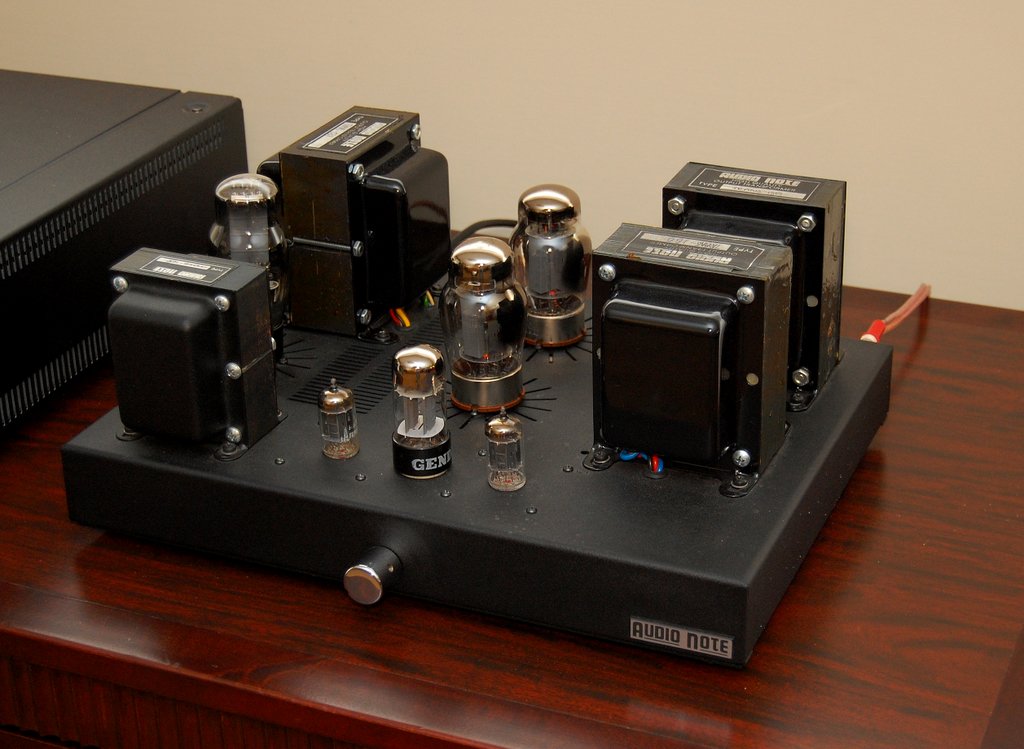
Audio Note UK Kit 4 It took some time to fish out some tubes for the long abandoned ANUK Kit 4 (see here). Finally found 2 pairs of "matched" old-stock 6V6's and installed a pair of UK Brimar 6SN7 (with interesting somewhat curved plate structures) that I didn't even know I had. The 12AX7s were stock Yugo EIs. I was really surprised by the sound. Finally, the amp seemed run-in, or at least out of the initial murky period! In Station B, with the el cheapo Philips AK601 and Melos 222 Preamp driving the Ruark Crusader II, sound was really engaging! More than the ANUK Kit 1, or Preamp and Phonoamp kits, this one immediately showcased its rhythmic elan. Pacey, confident, it certainly made me want to tap my toes. Given that I am a huge 6V6 fan, I'm really gratified. Now, this is a more modern sound that is different from my vintage Bell and Grommes. If you are interested in 6V6, you should read my Overview. No, the Kit 4 does not have the subtleties and sheen of the best vintage samples, but it's worthy on its own. I'm sure it's superior to an old Raphaelite/SinoVT 6V6 PP amp that I had (here). More useful power than my SET amps for the Crusader, it's a highly worthwhile addition to Station B.

I stop here, but there are a lot more coming very soon, on Reisong trannies, Micromega and the mighty WE274B (even used in SZ now!!!) Going back and forth between SZ and HK has galvanized my audio libido. Watch this space.

30 July, 2020

Audio Note Overview Integrated CD Zero AX2 OTO PP SE DAC2 TT1 AN K J E Kit 1 4 Preamp

Review: Two Audio Note Systems (Levels Zero and Two)
Overview: Audio Note (UK)

As I got to know them better, I learned that our Indian Trinity Vivek, Prem and audiopro are all prominent members of the Indian audio community. Given the hurdles Indian audiophiles face (like the difficulty of sourcing less popular brands, and the prohibitive import duties levied at individuals) it continues to amaze me how the community "gets so much done", a showcase of determination and stamina.

Coincidentally, in the not so distant past, Vivek and audiopro had both reviewed full ANUK systems. Full system reviews are rarer and valuable. This article starts with their Reviews and is followed by my Overview of ANUK - about time.

pic from India's HiFi Today. Click to enlarge.

Level Zero System
In 2018, Vivek reviewed the ANUK Level Zero System for India's HiFi Today. This is still top entry if you google ANUK Zero. I must say, very honest review and Kudos to the webzine (which seems to have ceased operation)! Vivek had reservations about the CD Player and called over some of his friends for referencing. Some of our magazines will never say things like that!

It is the current Zero System, which differ in many ways from the original Zero components that I'd go over in the Overview (the AX2 appears to have been d/c'ed by ANUK). The originals were housed in plainer aluminum project boxes and significantly cheaper. The current Zero's obviously are pivoted to a different crowd, the "entry high-end" aspirants rather than the more experienced "bargain hunters and adventurers". The amp is similar in design but the DAC of the current Zero is a NOS design that uses the iconic TDA-1543 whereas the older one was a delta-sigma design.

On the 6111 These sub-minature double-triodes of military origin have to be directly soldered onto the circuit board but they are cheap, space-saving and sonically OK (no tube rolling!). ANUK used them widely in the original Zero and One series. They are very durable that after all these years the units are still in function and failures are rare. Others use them too, like Tim Paravicini in the Quad QC-24 Preamp. The related nuvistor 6112 is used in many high-end Musical Fidelity Products (which are decent sounding).

On the ECL82/6BM8 Tube This tall Noval Tube combines a Beam power tube section with a short Triode section. Space saving, as four of these can make an amp, with the 4 Triode sections used as splitter/driver (even simple phono) and the 4 Beams used as 2 push-pull pairs. There were many lower-end vintage amps that used this (as well as the similar ECL86/6GW8, like in the iconic Rogers Cadet series). ECL82 is also popularly used as a power regulator tube (as in my Shindo Monbrison). The Japanese also love to make an elegant SE amp out of it (as in the older Elekit TU-870R and San Ei). There are even more similar tubes, like the PCL86/14GW8 (higher filament, used in the current Elekit TU-8100).

I actually once owned the AN-K loudspeaker that Vivek wished he had heard, but I will deal with that in the Overview - it'd not be entirely as he expected.


pic shows CDT-2 Transport used with DAC 2.1x. The Turntable is Pro-ject X-tension 9.

Level Two System
Around the same time audiopro published his review in hifivision. audiopro was rather self-effacing, and gave his general impressions of the system. Make sure you read the whole thread for other people's favorable audition impressions (like DAC2 vs Chord 2Qute, and TT1). As audiopro did not give basic info on the stuff, I shall supply it.

OTO has always been in the ANUK lineup. It's original iteration was an integrated amp using EL84 PP. Its preamp and amp sections were separately marketed as M1 and P1. I have heard it in second hand shops but given my understanding of the brilliant vintage EL84 PP amps (the likes of Eico, Dynaco, Pilot, Fisher etc), the OTO (PP) was only fair. I have also once owned the M1, sweet, but its broad-stroke and lack of detail made me sell it after a short possession.

Interestingly, the current OTO PP has switched tubes! It now uses the 6005/6AQ5, which is the 6V6 with a different pin-out and in a smaller envelope. Now, this is a good sounding tube (see my Elekit Tu-8150 post; and NOS are cheap, and one can use adaptors to use 6V6)! And it also uses 1 x 5670, which is a good sounding tube, especially with  WE 2C51/396A. I'd not mind auditioning this one (just for curiosity, not that I have much expectation), particularly since I know the old ANUK Kit 4 (6V6 PP, see Overview).

As for the OTO SE, it is a different animal. It uses 4 x EL84, meaning Parallel SE (PSE) of 2 EL84 per channel. Understandably, that roughly doubles the power of SE and makes it fit (squeeze) into the "real world" (driving loudspeakers), but imho this is also a small compromise. Compared to SE, I think PSE introduces timing errors (as does PP) as no 2 tubes, no matter how "matched" can ever be the same. If this is the case, I'd rather have PP. My experience with the excellent Manley Retro PSE/PP 300B amp is a case in point. After much comparison, I preferred the PP to the PSE. PSE is neither here nor there. Of course, similar doubts can be harbored about most OTL amps, which parallel the tubes for more power. Another point, as a great admirer of the EL84 tube, I am not a fan of the Russian or JJ tube (tighter and more upfront than old-stock) and I'd definitely judge by old-stock tubes, which are more expensive. audiopro's expereince seems to agree with me. He invested a lot in good tubes. He maintains only by using the expenisve Bendix 6094 (with adaptors) and rolling Telefinken and Amperex in input tubes was he able to get the best result.

True SE EL84 Because of its low power (just a little more than SE 6V6), only boutique brands would make SE EL84. Almarro (defunct) made a nice one, the cheap A205(A). I once heard the very expensive Wavelength (generally good but not exceptional, including their 300B), and it was not bad but not as good as the vintage ones and overpriced. Many people do not know, but there are actually some very nice vintage SE EL84 vintage amps which can be had on the cheap (like my overachieving Conar, Heathkit AA-191 and the even earlier EA-1). The vintage transformers are way better, one may safely conclude.

DAC 2 Unless I am mistaken, the one audiopro used is the standard DAC 2.1x, there being also a Signature version (review of Art Dudley). I know ANUK DAC well because I once owned an early DAC 2 (here), which is now with my friend Seng (having passed through one more pair of hands). The earlier version (may not have been NOS) used the 20-bit PCM63 (a great chip), employed the same transformer I/V conversion and used the same 6DJ8 tubes. The current 2.1x uses the 18-bit AD 1865 chip and adds tube rectification (a 6X5).

The pic shows audiopro's older Pro-ject Xtension 9 turntable. He later replaced it with the Audio Note TT1 (as the comment in that thread said) and had tried both the IQ1 and IQ3 (basically modified Goldring's).

For the loudspeaker, audiopro briefly tried the AN-E but felt it was too big for his room.

He also briefly had the Meishu. He said "...it is impossible to get a good 6SN7 tube. The Ken Rads are always noisy and the Sylvania just lack magic. The new sovteks are crappy. At that time AN introduced their own 300B tube which costs USD 2000. I got one pair on demo and it was super coloured. Also the Meishu lacked dyamics - in fact I felt the OTO is a better amp overall..."

*****
Overview: Audio Note UK
This Overview is skewed towards the lower levels, as I think the higher levels are absurdly over-priced. I am most familiar with the discontinued UK Kits and the original Zero series. ANUK is not exactly my taste but, given its popularity, I sure have owned a few and heard a lot!

Who are ANUK? Headman Peter Qvortrup is not even a designer, but he knows what he wants, including the name Audio Note, which he basically wrangled ignominiously from Kondo san. He was a successful salesman turned entrepreneur. On Electronics, his chief designer is Andy Groves, whose designs are rather predictable, rarely inspiring. The other designer (loudspeakers mostly), also tasked with other duties, was Andy Whittle, who hailed from, and is now back with, Rogers.

How Innovative are Their Designs? Overall, ANUK's designs are completely derivative. The one exception is the use of transformers for I/V Conversion in their DACs. This will be dealt with more in Product Categories below. Otherwise, from circuits to parts they are highly derivative.

OEM Audio Note/Andy Grove also designed and manufactured for other companies, like the Rogers E20A amp (to be re-released; I had one), and also Quad II-40. You can say that they have a generic Andy Grove sound. ANUK is also supplier of parts for some small companies, as we shall see later (the case of Audion).

Then and Now Night and Day. Then, ANUK was an interesting company that I kind of rooted for, with its generally well received bargain Kits arm. Up to the time of the highly affordable Zero series, they had simpler offerings. Fast forward to now, it is absurdly over-priced big business, with an opportunistic sales strategy.

Their True Color Make no mistake, ANUK products are mostly highly colored. BUT, to be fair, under a lot of circumstances, given the general pallor of modern products, it can be beneficial, or remedial to have some color. I'd say most ANUK products are used outside of all-ANUK complete systems, because of this MSG. ANUK is all about the FIRST WATT, the Jump Factor, and Presence, not wrong priorities for SE Amps, but in my opinion many Japanese designers (not to mention Kondo) do it a lot better than he does. And, mostly, this kind of sound can be accomplished for a lot less money. That said, a full system of ANUK usually sounds not bad, even in show conditions. But if you listen long, you will find out more.

From DIY Mentality to Marketing Ploy ANUK was probably the first in the world of audio to consistently seize on and deploy this Level and Upgrade business (and there is also the Signature option within a Level). The "genius" is to market the DIY mentality ("better components equals better sound", which I have reservations about) to the general, non-DIY customer. This business model is highly successful and now much emulated, witness the likes ofAN Kit operation, Sophia Electric (I had the misfortune of listening to my friend Karma's 300B amp, stiff and lifeless) etc. Take basically the same circuit, add rectifier, perhaps regulator, add more and more transformers; "upgrade" the caps, change the cables from copper to silver. Does that make the product better? That's exactly what a DIYer would think, but having heard so many terrible DIY products that use the most expensive parts, I can assure you that is not the case.

Quality Parts? ANUK has always touted its own use of quality parts, but how good are they? Whatever Kondo does, ANUK has to prove that they can do it. Kondo had LONG made their own transformers and components and relatively recently ANUK also started to "make" their own components and partnered with others for their "special" tubes. Transformers A tube amplification company stands or falls on the quality of its irons. ANUK in particular, beside the Power and Output Transformers, also use Transformer I/V Conversion and Interstage Transformers (imho the hardest to do right). They must know what they are doing, right? But I have my doubts; at the very least, I don't think they are complete masters of their art. As I shall detail below, I have listened to a lot of their amplifications, and not one will I call great. This is mostly about Preamps and SE amps, where ANUK amps cannot compete with their Japanese Counterparts. Aside from listening impressions, there are some little known (to Westerners) aspects. As I have mentioned, ANUK supplied parts to some smaller operations. Audion is a UK company that has a cult following. Early on, they made SE amps (with ANUK transformers) in small but attractive chassis that were terrible at heat dissipation. Add to this use of components that were almost under-spec'ed relative to output, and breakdowns were inevitable and common. Here, a well known Taiwanese Technician who is versed in winding transformers was SHOCKED at the lousy quality of the transformers (in winding, grounding and isolation). Make sure you look at the many pics. Atrocious, and unconscionable. Caps ANUK started with Jensen PIO and then proceeded to "make" their own. Both Jensen and ANUK caps, at least earlier on, had reliability problems, in particular, leakage. They are also highly colored. A little here and there may sound good, but using those across the board is not a good idea. And now ANUK is "making" resistors...Good luck. Tubes This is a fad. Sophia does it, ANUK does it. All those tubes (including Psvane, 6SN7, "CV181") are at most the same generic Chinese tubes in different envelopes and base, but selling at inflated prices. And they are highly colored. Take the "globed" 300B/4300, I have heard the earlier Sophia 300B and "2A3" and they are absolutely garbage (overly warm and woolly). The sound veers so much off 300B it's not even funny. To be fair, American  reviewers (and others) are largely to blame too. They know so little about tubes that they are easy to fool and they praise all these rip-off's. Yes, current tubes have improved but tube rollers need to hear the old-stock tubes (in proper condition) to know what a tube should sound like. Circuit Board You know how little these cost. Just look at the Chinese offerings on Ebay. What I can hardly accept is even high level products use circuit boards, not hard-wire. What quality is that? Industrial Design None. Big Black project box, all of them. The current aluminum front plate is uglier than the black acrylic of yore. You pay all that money and get a box like that? All you have to do is compare Kondo and ANUK and you will see how crude ANUK is. Wavac, Zanden, Yamamoto, all look much better. Even the bargain Elekits and Sun Valley products look way better! Think about Linear Tube Audio, very unique and great industrial design!

To sum up, today, I actually think, for the money, at any level, ANUK is low in build quality and high in profit. And now to the products.

KITS (UK) I am not talking about the current Canadian Audio Note Kits (ANK), which has taken a similar approach but there are big differences. Even though I have doubts about the ANUK trannies, the ANK's Hammonds are likely even worse. I shall be guarded also because in Hong Kong I have seen all kinds of components and combinations that make one worry about just how officially sanctioned ANK is. ANUK had many kits and I only treat here the ones I am familiar with:
  • Kit 1 This is the most famous one, and the best. It was also the first ANUK I owned, as well as my first SET amp. At that point I hadn't picked up the solder so mine was assembled for me. Brand new, it took quite a while to run in. After the Kit 1, I owned many 300B amps, including the Audion Golden Night, Japanese Advance, Sun Audio, Cary's kit, AES-1 etc. The Kit 1 uses 5U4, 2x300B, 6SN7 and 2x5687, is a good amp, with surprising driving power (and was better than ANUK's finished products) but, in comparison with some of the others, has a trace of brightness that I could not rid of, which was why I sold it. Later, I got the Welborne and ultimately the Verdier and Wavac, and that was really another level. But this is an iconic product, and much emulated. Kit 3 This is the PSE monoblock version of Kit 1 (pic can be seen here) but I have not heard it. Kit 2 is a similar amp on the same chassis but SE 6550 (see here; pic here); It is rare and I've not heard it.
  • Kit 4 I bought one in HK and delayed the building for many years. Finally, I did it but I misplaced the back plate so cosmetically it was not complete. It came with horrible Russian and Chinese tubes; at least 2 6V6s failed so I had to replace them with old-stock. The sound was smeared and not good. On the net there were good user reviews (here and here), so perhaps I had not run it in (my Kit 1 did take quite a while). Somehow I highly doubt it will hold up to my cheap vintage Grommes and Bell.
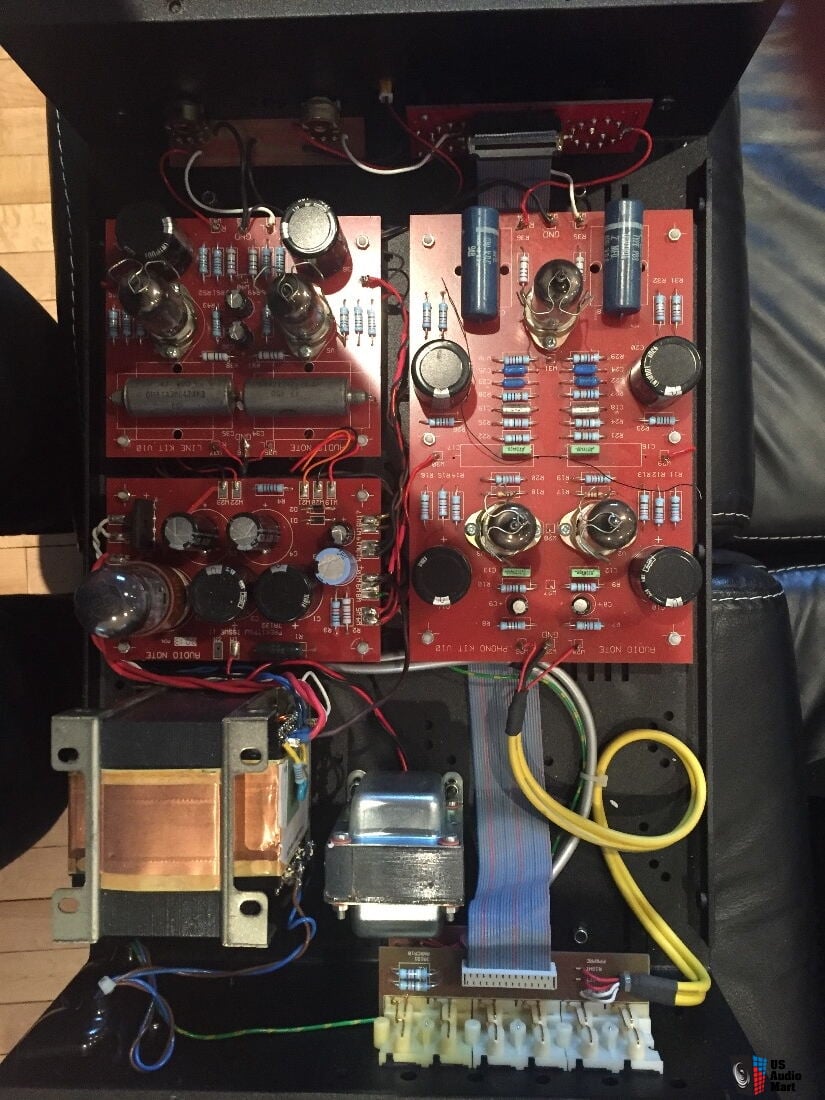
  • Preamp Kit Mine was the original one which I bought used. The net is now dominated by the current ANK so old entries are hard to come by. It looks like this one. Suffice to say sound was a bit veiled, not very extended on both ends. It did not stay with me too long. This is most likely due to weakness of the line stage (see below).
  • Phonoamp Kit Mine was the original one which I bought second hand (details here). Although the phono section looks similar to that in the Preamp Kit, it sounds better, which leads one to think the line section of the preamp kit was not very good (not surprising).
Zero (Original) These were reviewed in Positive Feedback. For the difference between them and the current Zero series, see above. As I have many tube preamps and amps I was not interested in the preamp and amp. They were very reasonably priced (especially in HK), sold pretty well and many second-hand units were available, so I bought used. DAC Zero and CDT Zero These worked well and sounded good. For the price they were bargains. DAC One 1x This is highly confusing. Although it says ONE, it is in a Zero series enclosure, and in this TNT review was regarded as part of the Zero series. It uses the same AD1865 chip ANUK uses now. There is also a Signature version. This was my first NOS DAC and I was able to A/B with the Zero. There is little question the 1x is more fluid. In particular, better bass articulation. A fine little DAC  for the money.

Digitals DAC is where ANUK scores higher with their NOS and proprietary I/V conversion. However, I have always thought their Transports ridiculously overpriced. DAC 2 My original one I have written a lot about (here). As for higher levels I have heard them many times. My good friend WSS used the CDT-4/DAC5 but many times the combo did not perform well (as in here, but it was better after some servicing), so I have my reservations. WSS' friend ML has a constantly evolving system worth tens of thousands. He always has 2 full digital systems (top dCS, Metronome etc). And so I have heard the top of the line CDT-6/Fifth Element. Was it impressive? I can't really say. I was good but I didn't hear the kind of NOS that I like, a more lithe kind.

Amps AN amps are totally derived from experience with Kondo. That they keep using the iconic Ongaku name is really regrettable Cultural Appropriation (more serious offense than the "Kimono" incidence if you ask me). In fact, considering their split from AN Japan, their continued use of Japanese names is just sleazy and vengeful. When I still had the Kit 1, one day there was a 300B amp shootout where some one brought the Conqueror. What a misnomer! The Kit 1 walked all over it. We opened it up and the stacked output trannies were just half the size of the Kit 1. I later heard the much more expensive monoblock Quest, which was more commensurate, but not superior, in performance. Meishu I heard this at the second-hand shop. Not too impressed and I thought my Kit 1 was as good. And that HUGE box was really ugly. Jinro My friend WSS has the Jinro (amp version, here) but we all preferred the Quad amps.

Preamps Again, here ANUK was really derived from Kondo, including use of tubes like 6072 and 5687. M1 I had an early version that used the 12AU7. Sweet but lacking in resolution. Perhaps a little better than the Preamp Kit, but nothing to write home about. Sold it quickly. M8 Again, WSS (and our friend Joe) uses the M8 and we have heard it many times. Not bad, but pricey.

Analog The ANUK turntables are all derived from classics. TT1 The TT1 is basically a Systemdek. It is a good turntable, imho competitive with the Linn LP12, no credit to ANUK. My old version came with a silver wired modified Rega arm (probably Arm 2). The TT2 looks like also an updated Systemdek also. As for the TT3, it is basically a reworked Voyd Triple-Motor with different cosmetics. ANUK's new arms are made in Austria, most probably by Pro-ject. I seriously doubt they are better than the older Rega's. As for Cartridges, the IQ's are basically modified Goldring's. Titanium cantilever? Doesn't sound right to me.

Loudspeakers Except for the budget ones designed by Andy Whittle, all the loudspeakers are basically based on Snell's. And I have heard Snells. They always sound at ease, if a little weak in the bass. AN-K I owned this one. It was very fine and coherent in the treble and midband, but the bass was a loose with tube amps. I sold them to a photographer friend together with the Micromega Tempo (solid state but sweet) amp. I went to his home and set it up. I was astonished at how much better they sounded together. Like many UK (or not) loudspeakers, the Celestion SL6, Spendor SP1/2, Harbeth Compact 7 and HL5, B and W Matrix 805 and many more, it responds to solid state better than tubes. This is ironic for a tube based company! The fallacy in the corner loading is that while it will improve the bass it won't make the woofer respond better when it comes to tube amps. AN-J/E I have heard these many times and because of increased size they have a fulller bass, but they are still cut from the same cloth. All these loudspeakers will work better with a good solid state amp and they are not that efficient and certainly not ideal for SE amps like 300B or 2A3. No matter how you slice it, NOT efficient enough. AX/AZ These are from ANUK's own (Andy Whittle) designs. They look rather DIY. I am not sure which models I heard in people's homes or second-hand stores (heard both bookshelves and floorstanders) but I remember they were cheap and the sound was fairly balanced. ANUK now is so upscale they largely don't bother with these.

Cables Don't get me started. As you all know, I use mostly professional cables and frown upon most audiophile cables. But, I do know some of these ANUK cables. I know some of the older loudspeaker cables, which likely has remained unchanged. The old AN-B was musical but had a hopelessly under-damped bass (I believe this is deliberate to compensate for the loudspeakers' faults). The AN-L was better. In terms of Interconnects, I have 2 vintage AN silver cables from a long time ago, before the schism. The QSSC and the AN-V. These are soft and probably correspond more to the current Kondo cables than the stiffer ANUK silver ones. Both of these are smooth but have a midrange suckout so very common to silver cables. I personally prefer the Kimber KCAG  So, I shall not be enthusiastic about their cables. At WSS' place, the Belden 1694A trounced everything, including a current ANUK Digital Coaxial Cable. My advice, forget it.

I have actually heard a lot more isolated ANUKs in various systems. The point is, I think ANUK's System Approach, touted by themselves as a holistic one, actually comprises many patches not dissimilar to computer operation. They know where the holes are, and they patch them, but a good OS it is NOT.

18 July, 2020

Quad ESL 2812, DMP, Elite QMP, 50E, Audio Note M8 Micromega Microdac Rel Strata III


Click pics to enlarge.

Virtual Home Visits (10): Quad System, Audio Note, Micromega

Hot on the heels of the vintage ESL 63 comes another current ESL 2812 from our friend Joe L! Joe is a young retiree living in Toronto. Joe is a very experienced audiophile well connected in both Canadian and Hong Kong circles. In fact every year Joe spends quite a bit of time just hanging out in HK. I guess not this year! Joe is a very discerning listener who knows exactly what he wants. And he is handy, makes his own cables and mods.

He has used his current system for quite a while. If the system looks familiar, it is because it is very similar to the current system of our dear mutual friend WSS (more on this later).

CD Transport: Quad DMP CD Player Digital Out
DAC: Micromega Microdac
Preamp: Audio Note M8 Line
Amps: Quad 50E monoblocks and Elite QMP monoblocks
Loudspeakers: Quad 2812
Subwoofer: REL Strata III
Cables: Gotham GAC-1 S/PDIF-Pro digital cable, GAC-2 interconnect; Belden 9497

Quad ESL 2812 This is the same as WSS. More info on the 2812 and an early iteration of WSS' system can be found here. The article also covers the larger 2905 and contains a mini Overview of Quad, which I have just revised.

Quad DMP CD Player This is well reviewed here and in HiFi News. The DMP is likely an updated version of the older 99 CDP that I once had and liked (reported here). Take away the balanced and USB connections and the back is quite similar. The DMP has preamp function but Joe obviously prefers his ANUK M8.

Quad Elite QMP Monoblocks See above HiFi News link for the current version. When WSS acquired his one generation earlier Elite QMP, many went to listen (my report here) and all preferred the Quad to the ANUK amp. If memory serves me, this was all icefox's doing. He was at someone's place where the very reasonably priced Elite QMP massacred the very unreasonably priced Dartzeels's (Fremer, are you reading?) Soon, WSS bought his and Joe followed suit. BTW, I like the looks of the Elite's better.

Quad 50E This has always had a following and is different from other Quad amps in having a transformer input, attesting to its pro origin (including use in BBC). Joe's Canadian version came with a different input transformer and pinout. Being his fastidious self, he found a pair of the original input transformers on Ebay and restored it. In addition, he re-capped and adjusted bias. Joe said: "...to me there is not enough gain without the input trans. With a fixed 1k Hz signal to the 50E, the output voltages were 0.943V and 0.475V with and without the input trans, respectively..." That could account for my reservation of the bass when I heard it at icefox's, as he didn't use the transformer input. Joe obviously prefers the 50E to his QMP's as he is planning to sell the latter. Someone should grab them ASAP, very reasonably priced but excellent amps imho. I also think there may be another factor at play. Using the RCA out of ANUK M8, it goes through an input transformer when he is using the 50E, but it just goes into the Elite QMP RCA input directly. If one inserts a 1:1 input transformer between the M8 and Elite QMP, the result may be a little different. I once had the Manley PSE/PP switchable 300B monoblocks (very good) and I definitely preferred the transformer input. More oomph.

Micromega Microdac (my entry) Joe bought one for very little money. This is a small and beautiful looking DAC with a clear acrylic top. It is a true 1-bit (bitstream) DAC using Philips chips, like the whole line-up in that era (up to the mighty Trio). The other members of the Micro- series are Microdrive, Variodac, Microamp (I still have them all). The sound of the Microdac is very sweet, yet a little more resolving than the Duo BS-1, the lower priced of the 2 Duo DAC's (the other being the Duo Pro, which is sonically superior). I actually had 2 of these - I kept one and sold one to my friend whlee. Obviously Joe prefers this humble DAC! Indeed one of my budget favorites. Given that the Quad DMP is likely delta-sigma, it does not surprise me that Joe prefers a well-executed bitstream.

Subwoofer (REL Strata III) When the subwoofer arrived at WSS, Joe was there with me, as recorded here. I'll just paste it here: "...As you know, the Quad ESL crowd is a special breed. They swear by their ESL and are in general very reluctant to add a subwoofer. So, I am proud to say that after listening to my 47 Labs 4737 augmented by subwoofer (here) both Quad ESL-2812 owners WSS and JL were persuaded to give it a try. They lugged my down-firing REL Strata III from icefox's cavernous place (he used it to augment his Tannoy) to WSS's small den...The REL Strata III was an old product, but one of the more expensive offerings. It was generally very well received at the time and you can find quite a bit of info on the internet...The afternoon I was there, with the low-level input we tried crossing over from 69 Hz to 95Hz. All worked quite well. The volume is indented. We started with 3 small clicks, but eventually went down to just one click. If you touch the woofer unit, it was barely vibrating. This very small bass augmentation however had the eminently audible effect of improving upon the liveliness of the presentation. The ESL has always been too polite for me. It is good for a few instruments, but when the orchestra comes in, it is always underwhelming. The subwoofer improves upon this most important aspect. The effect of the subwoofer here is a bit different from what I get with my own systems - with the ESL one picks up the gain in presence more than bass extension. I am not sure whether that is due to the ESL or this REL. The important thing is, used judiciously, it is definitely a plus for the Quad ESL-2812, though I think other subwoofers may be worth trying too..." Joe also compared the low and high level inputs and said: "Although REL suggests using the Neutrik Speakon High Level Input, I think that masks the high frequency of the ESL and so prefer the Low Level Input." I agree, but one should always compare and trust one's own ears.

Cables Handy Joe has made quite a number of professional cables. His final choice of each of the three above, in his own words, "...was chosen from at least 3 to 7 different ones..."

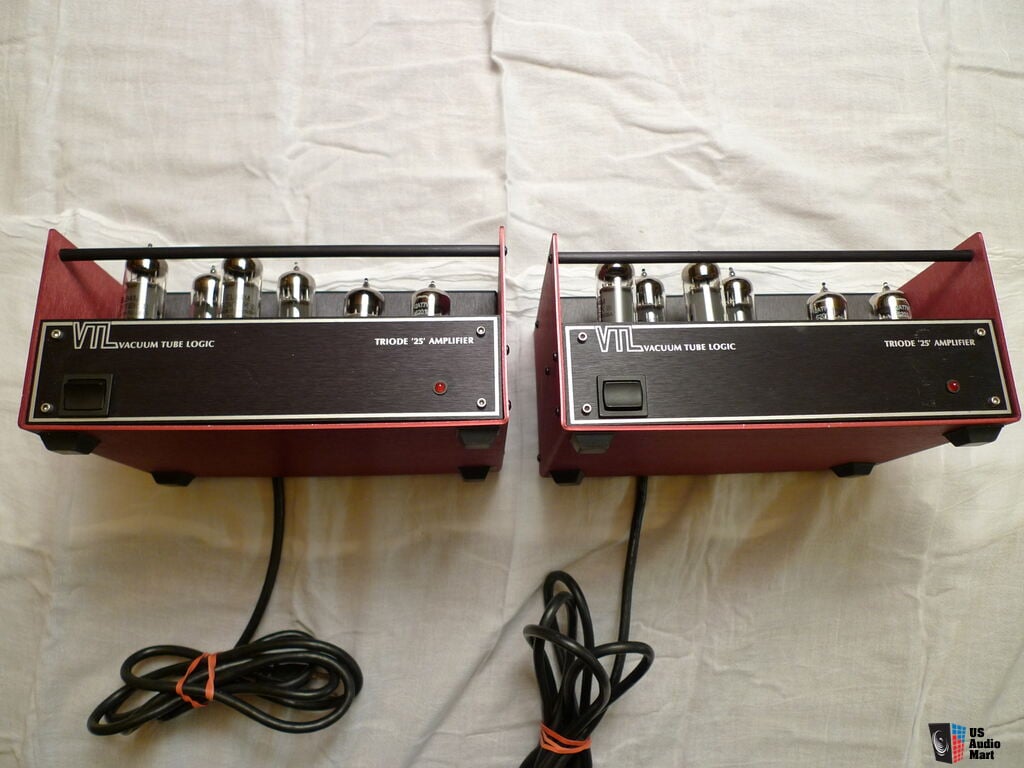
What's next? Joe has expressed his interest in a tube amp for the Quad's. After icefox reminded us that his ESL 57 sang with the Manley Tiny Triode 25 (actually recorded here), he is looking. Actually, the Manley was made by VTL, and the original VTL Tiny Triodes (sassy chassis; later uglier silver faceplate hides the tubes) was nicknamed "dice" 骰仔 (for their small size and cuteness) in Hong Kong. Heard them several times - yes, very good. None of the versions would be a wrong buy but the earliest red ones are the prettiest and cheapest. These are triode connected but I think vintage Pentode PP can be excellent too. Two favorites are Eico HF-86 and Dynaco ST-35.

Top, ANUK M8, Quad DMP; Bottom, Quad 50E flanking Elite QMP, Micromega on top.
REL with low level input
I hope Joe gets a pair of these for Christmas present
VTL Tiny Triode 25 Amp Original Version Red Finish
The transformers that came with Joe's 50E's are smaller than the originals

Surgery (R) and Final Result (L)

11 November, 2015

Quad 2812 revisted, Quad QMP, Ortofon Quintet Mono

AVI AVITAL / BETWEEN WORLDSThis CD is not as easy to replay as you may think.

Quad 2812 revisited
Breif Reviews: Quad Elite QMP monoblocks,  Ortofon Quintet Mono, Ortofon SPU
Yumcha Diary 24-10-2015

Yesterday, between yumcha and a concert in the evening, I spent my (and the host's) precious time at our old friend WSS' cozy den, which I have visited several times since my last report. WSS is a true music lover and in many ways not your typical audiophile (which is why I'd like to hang out with him more than most others). This article describes not just this visit, but also serves to summarize our findings and doings over time. Equipment has undergone quite some changes. Current configuration:

Turntable 1: JC Verdier La Platine/SME3012R-Air Tight PC-1/Ortofon TA210-SPU
Turntable 2: Garrard 301/SME M2-12/Ortofon Quintet Mono
Phonoamp 1: Phase Tech EA-1 IIs (no MC; step-up by EAR MC-4)
Phonoamp 2: ARC Reference 2 Phono
Digital: Sony DVP-PR50P (standing in for his out of commission AN CDT4/DAC5)
Preamp: AN M8
Amp 1: Quad Elite QMP monoblocks
Amp 2: AN Jinro Shochu

ARGERICH - BARENBOIM / PIANO DUOS
Image result for ortofon quintet monoPristine Piano Sound through the Quad ESL.

Sound Notes
  • Analogue Supremacy I'd not belabor this. The 3 analogue sources fed into the 2 phonoamps (some described in last report) still reign supreme in this system.
  • Ortofon Quintet Mono Since my last report, WSS had a Garrard 301/SME M2-12 practically "forced" upon him , on which he installed this cartridge (Output 0.3 mV; info here) . It is a true low-output mono MC cartridge, a very even-handed performer that handily delivers the virile and tactile qualities mono cartridges are known for. Those who favor low-output MC cartridges, who want to experience mono, but who cannot afford more exotic fares like Ortofon's own SPU and the likes of Miyajima should consider it.
  • Digital Woes (or David vs Goliath) Sometime ago I spent quite a bit of time at WSS, and the digital playback nagged at me - substantially slower and less lively than the analogue. In my experience, Audio Note UK digital's usually over-emphasize, not under. I made for WSS a Belden 1694A cable (here) and it trounced his considerably more expensive AN-UK silver cable, as well as Kimber! Things seemed to have improved somewhat, but on a subsequent visit, when I played the Avi Avital CD shown above, the magnitude of the problem revealed itself. This CD is a crossover genre, which usually is geared towards the lively, but at WSS it was utterly un-involving. The epiphany came when I got home, nonplussed, and just to cross-check played it in my very humble Micromega system (here), and everything simply came alive! I then knew something was seriously amiss with his digital system. On a subsequent visit, I joined force with with my infamous taskmaster icefox, who brought his Sony DVP-PR50P (see review here) for stand-in duty. Guess what! The el-cheapo Sony completely trounced the AN UK (this did not surprise us, as it had happened in similar circumstances many times before - an expensive digital system proves inadequate next to much humbler kins, again and again giving lies to "advances" in digital "technology"). One thing though, sometime later WSS told me his DAC went caput. So, maybe its suboptimal performance was (at least partially) due to this. I look forward to a rematch. But I tell you, many "senior" audiophiles, including some who think they are audio experts, have visited WSS, yet completely failed to realize the magnitude of the problem. To me, these people don't even know the HiFi Basics I am about to expound (Watch for next article!)
  • Quad Elite QMP A Quad amp almost always does a decent job anywhere. And with the Quad 2812 it goes without saying. The Elite series just proves Quad has not lost its qualities that stem from the 300/400/600/900 series, all from old current-dumping technology. In this system, it proves every bit the equal of the AN Jinro Sochu, and the larger power reserve at hand was particularly evident in a remarkable rendition of Stravinsky's Rite for 4 hands.
  • Ortofon SPU  Just a brief comment. As usual, the SPU is emotive and involving, though it presents details in a less truthful perspective, but what ultimately nags at me is the lack in resolution by modern standards. Not my fav, but there are fans.

01 August, 2014

Quad 2905, 2812 and Overview Quad

Click pic to enlarge. Quad 2905 behind the Tannoy York.


Home Visits: A Tale of Two Quads
Quad 2905, Tannoy York (Gold 15")
Quad 2812, Audio Note System, Phase Tech EA-1 IIs
Overview: Quad

7/17/20: Overview extensively revised.

A rare occasion: all of a sudden, I found myself with a little time on hand. I first arranged a quick visit to my old friend and occasional taskmaster icefox  (see previous visits, which include audition of Quad ESL57). The object of desire was a pair of Quad 2905. Funny thing, the pair actually belong to another friend, who as yet cannot let them into his own home. This is a common thing in HK, where space is at a premium. A few days later I followed up by visiting another friend, lovingly nicknamed Wo Sir Sir (WSS) by his friends, to audition his Quad 2812. How about that! First, digression...

Hysteresis and Hysteria
Electrostatic loudspeakers have always had a following, and Quad of course is the most well known and loved. But, like many vintage aficionados in HK, vintage Quad ESL lovers in HK are also in my experience among the most exasperating, stubborn and prejudiced. These people overlook all the considerable (and to me unacceptable) deficiencies of older ESL's but nick-pick faults with speakers of any other type. Members of the closely knit group feed off each other, only becoming more and more limited in palette - that is hysteresis. These people regard vintage Quad ESLs as the best ever and frown upon newer Quad's - that is hysteria. More on these people later in the Quad Overview section. For the moment, suffice to say, most of these people get pretty bad sound out of their vintage ESL's.

Mind you, I can appreciate the qualities of ESL, though they are ultimately not for me, a horn lover. Perhaps my friend whlee said it best: "...the only people who should play with ESL's are people like icefox, who has several pairs of speakers of other types..." We recalled one time at icefox's place, where we listened to both Spendor SP100 and ESL57. In icefox's large space, an opera cut was magnificent on the SP100 but hopelessly distorted on the ESL, but the ESL crowd still praised the latter - that is how biased they are.

Perhaps Gordon Holt said it best: "...After all the positive reviews of the Quad system—34 preamp, 405-2 power amp, ESL-63 speakers—that I have read (particularly in the British press, whose views are generally in accord with mine), I must confess to some disappointment now that I have lived with these components for a while...The system sounded smooth! But while there is no denying the musicality and listening ease of this system, the sound is simply not realistic, nor even a reasonable approximation of that. It is too smooth, too rich, too polite, and while certain instruments—fiddles, for example—are reproduced as well as I have ever heard them, most other instrumental sounds are more-or-less tainted with an almost cloying warmth that not even the Quad 34 preamp's Tilt control can cure. Gone is the bite of the trumpet, the thrum of the cellos, the blat of the trombone, the twang of the piano's upper-bass strings...I am not speaking here of preferences in reproduced sound, and there are doubtless many people who will like this kind of reproduction. Indeed, it is exactly the kind of sound that many record collectors, given a choice, will prefer to the hyperdetailed renditions of an audiophile-type system. But to take a $3000 speaker system with the imaging and detail of the ESL-63s, and drown those attributes in a sea of haze strikes me somehow as a moral felony.
I love the richness and fullness of live orchestral sound, but I also love the rough edges that much live musicmaking produces, and it is those that I miss in this system. I still have the feeling that the '63s, mated with the "right" electronics, could deliver that level of fidelity without sacrificing their positive attributes (imaging, balance, detail). But I have not heard that sound from these speakers as yet, and until I do I can only say: Audition them for yourself. You may disagree with me.—J. Gordon Holt

Quad 2905 (Official Brochure)
Forget about the HK vintage ESL crowd. The newer Quad ESL's, the 29 and 28 series, introduced in 05 and updated in 12, have garnered praise everywhere else. For the 2905, the hometheaterreview (which has unannotated but interesting quotes), What HiFi review, and TAS review by Cordesman Part I, Part II all use dependable Quad electronics, which is the way to go. I will forget about reviews by the likes of 6moons.

Chez icefox This time the equipment is almost like a studio. Digital: Studer D730; Preamp: EAR 912; Amp: Quad 50E.

LentoSound was excellent. In HK, icefox got better sound out of the ESL57 than anyone else I have heard (here), but the 2905 is clearly superior, and by a wide margin. As you can see from the pic, the placement is not optimal, very far from the listening seat in this cavernous loft. I am sure in a somewhat smaller space, with better placement, it will be even more awesome. No matter, compared to the 57, the following are clear:
  • Image is tall and full-sized.
  • Much larger sweetspot.
  • There is good bass, and it goes surprisingly deep.
  • Although still limited with big orchestral pieces, it can play a lot louder. Of course, small combo's like jazz are even better. The Youn Sun Nah album is simply magnificent.
  • It is every bit as refined, actually more so to my ears.
For the wide range of music I play, including a good diet of symphonic music, I would never consider ESL57/63's, but the 2905 I can live with.

2905 vs Tannoy Actually , we spent more time listening to icefox's main loudspeakers, the Tannoy York housing Gold 15". In icefox's hand, the sound is surprisingly not too far off from Quad, with a very transparent treble and midrange. The York sounds quite modern, though a tad slower than the Quad. The 2905 is also "blacker" in background. But when it comes to large classical pieces the Tannoy wins hands down.


Displaying 4fab820bcf7a213c1375c22e93ed6904.jpgDisplaying IMG_20140422_012317.jpgClick to enlarge. Note the WE349A in the "Jinro"

Quad 2812 (official brochure)
The 2812 is the updated version of 2805. It is about half the size of its bigger brother, more in keeping with vintage  obviously made to suit smaller rooms. Fewer reviews: HiFi+, What HiFi (and you may want to read Stereophile review on predecessor 2805).


Chez WSS In complete contrast to icefox, Wu Sir Sir's space is very small (maybe 150 sq ft), but exquisitely furnished. Equipment is quite interesting, basically completely high level Audio Note connected with AN XLR cables:

Analog: JC Verdier La Platine/SME3012R-Air Tight PC-1/Ortofon TA210-SPU (not auditioned)
Phonoamp: Phase Tech EA-1 IIs (no MC; step-up by EAR MC-4) and ARC Reference Phono 2 (not auditioned)
Digital: AN CDT4/DAC5
Preamp: AN M8
Amp: AN Jinro Shochu

Sound Notes Basically, the 2812 is cut from the same cloth as its older brother 2905, and most of the comments above are as valid here:
  • Due to the small space, image is inevitably not as tall, but still very good and way superior to ESL57.
  • JC Verdier and Air Tight Inevitably, the analog rig out performed the digital by a considerable margin. This is to be expected, as the Verdier La Platine, father of magnetic suspension, is a triumph of engineering, a class-defining icon as worthy of the term classic as, say, Garrard and Thorens. We only heard the SME3012, which BTW is the arm JCV uses himself (though with Denon DL-103). This also confirms that the Air Tight PC-1, which I use also in NYC, is a very even performer of the highest caliber. Apparently, WSS prefers the SME/Air Tight combo to the Ortofon combo. I'd think so too, as I have always found the SPU to be too slow.
  • Phase Tech Phonoamp I have followed Japanese Phase Tech (best known for cartridges) for a while. Previously I have heard the discontinued solid state EA-3 phonoamp (here), and the company has since changed its name to Phasemation (website). I have always wanted to hear the flagship tubed EA-1 (now discontinued and replaced by EA-1000), and I am glad with the help of the excellent EAR MC-4 steup transformer (see my EAR Overview) this setup did not disappoint. The pic to the right shows the version with input transformers. What a nice dual-mono, tube-rectified design!
  • AN Jinro Shochu Strangely, this power amp version of the Jinro is not listed in in the products section of the AN UK website. However, the EU website lists it, but with the wrong pics. Even more strangely, the UK website has a pdf file of the Jinro Sochu which I found only by searching. WSS has substituted the WE349A for the 6V6. I asked him what is the difference, and he thinks its warmer, but in this setup I did not quite hear the sinuous quality WE often delivers, particularly in terms of PRaT. If you would like to read more about the integrated AN Jinro, here is the detailed review by Art Dudley in Stereophile.
  • Large vs Small In terms of ESL, for me, larger is better simply because of better image fidelity. In terms of room size, I think icefox's is too big and WSS's is too small. You can't have everything in this world! :-)
Overview: Quad (wikipedia concise history of Quad)

Over the years, I have owned and heard a lot of Quad equipment. There are tons of info on the net, so I shall be brief in citation. Here are my 2 cents:

Loudspeakers-ESL
  • So far, the best I have heard is the 2905 and 2812 (would love to hear the 2912 ) [Editor: fulfilled a year later].
  • Then, trailing a good distance behind, I have heard a couple of reasonably good ESL63's (as in here; image taller than 57).
  • Now, the heresy: most of the ESL57's I have heard are terrible. A pair in good condition, raised (like daiwok's pair we heard at icefox's place, cited above) can be good. I am also sure stacked pairs, which would raise the image heights and enlarge the sweet spot, are even better (I am sure SME's Alastair Robertson had his reasons). But the average pair in the HK average room (small) is terrible: pinpoint sweet spot (don't you dare move your head!), dwarf-sized images...come on folks, there is nothing real about this (unless you are Japanese, sitting on the tatami instead of a chair, or perhaps you are a fan of Murakami's IQ84)! Even my humble pair of hybrid Martin Logan Source (report here) is way superior.
  • ESL 57 Caveat-Conundrum-Room Size: I don't know who wrote the wikipedia article, but did you notice this paragraph? "...In 1957, the company made history when they released Quad Electrostatic Loudspeaker (ESL), the world's first production full frequency range electrostatic loudspeaker renowned for sonic transparency and very low distortion. Its sonic neutrality and transparency were offset by its extreme directionality, moderate power handling, the need for a large room, and moderate bass extension...". Now, large room? This coincides with my view. In 2010 I wrote of icefox's ESL57: "...As soon as I was inside, I was surprised by the big and reasonably dynamic sound the Quad ESL57 produced in this large space, firing in the opposite direction as Spendor...I believe icefox was drivng them with a pair of Manley 4xEL84 PP monoblocks. At less than 30 watts, the music was fluently rendered, once again proving that an EL84 amp is one of the best matches for Quad ESLs. The most surprising thing was that images were full and tall, the sound big. Once again this proves a large room sometimes works wonders. I have heard more "refined" Quads, but I prefer this big-hearted performance..." There, I believe most, if not all, of the HK ESL57 is wrongly used in small spaces. No matter how small, the ESL57 is not going to deliver high SPL, but in a larger room, it works better. I rather think that was the original intention.
  • Buyer Beware: unless you are sure someone competent is going to restore it for you, buy ESL's with extreme caution. I have heard too many stories of "restored" ESL's that fail again, yet again. Ultimately, this kind of design is ill-suited to humid Asia.
Loudspeaker-Non-ESL These days Quad makes many non-ESL's. My experience is limited to the excellent 11L which I briefly owned many years ago. The treble purity is extremely impressive (as you'd expect) but the bass unit is not for tube amps, which was why I sold it.

Tube Amplifiers-vintage Basically we are talking about the venerable Quad II, a wonderful amplifier. It doesn't stand out, or shout (the antithesis to many Leak models), and I love its black background (not something that can be said of most Leak's) - perhaps the ESL of tube amps (I still own 3 pairs)! Tip: imho the Quad II sounds best with its matching preamp, be it the stereo Quad 22 or a pair of mono Quad QC/II.  As the preamp draws power from one of the amps, this creates an imbalance. Power transformer failure is not unheard of. But there is a winning wholesomeness to the combo. However, those who want more oophm will have to use an external preamp. Keep in mind the Quad II has low input sensitivity and higher gain (modern) preamp would be more suitable.

Tube Amplifiers-current The current crop  (II-40, QC24 etc) were designed either by Tim Paravicini (EAR) or Andy Grove (AN) and they are very good, but they do not quite sound like the older Quad II's. this partly has to do with the output tube in my opinion. Current KT88 may be more powerful, but it is not a very sweet sounding tube, nothing like old stock KT66.

SS Amplifiers-vintage I still own the 303, 405mkII and 306, and have heard the 50E. They are all very good, stable and confident, in a word, mature! They can all drive my ATC20 well. My battered specimen of 303 is rather dark in tonal color, but a good driver (maybe a service is needed). The 306 on the other hand is my favorite for its looks and crisper sound. The 405-II is somewhere in between, ymmv. As for the 50E I reserve my judgement because of a bass issue I am not sure about. The 606 and 909 are also great and confident amps. All highly competent. These come with Quadlink for connection with Quad preamps, which most users are not using. There are users who say removing the quadlink circuitry results in better sound with RCA input. (Ed: Later we got to hear the current and even more powerful QMP, and they are excellent, here and here).

SS Integrated Amplifiers-current and recent I once tried the 77 integrated, and it was very nice.

SS Preamps I only have experience with the iconic 45 but I don't like to use it with a Quad amp, just way too polite and lacking in dynamics, which is why many people modify it.

CD Players I have high opinion of the 99 CDP (mine has the Philips transport, here). The older CDP-77 was much simpler, less resolved but sweet. I still have the vintage CDP-67, a very musical player that is let down by a slight veil and soft dynamics.

Tuners I own the FM4. Very good.