Showing posts with label Brand-Stax. Show all posts

30 December, 2019

On Headphone Listening Pt. II Sennheiser HD600/650 Stax SRA-12S ZMF Focal Audio-Technica

From mrgoodsound: Follow-up Thoughts On Headphone Listening


This is a Part II post. For Part I, please see here.

For this post, I would like to share some philosophy on what makes headphone listening engaging to me, and provide some context with my own headphone experience.

The X Factor


Before I begin, I'd like to state that I do experience 'goosebumps', 'shivers' or 'frisson' from auditory stimuli, including hearing the right music on a 'good' system. I open with this because from what I understand this physical reaction to sound is unique to each individual and not everyone experiences this, or experiences it the same way.

All audiophiles have individual 'sounds' that they are looking (listening?) for whenever they audition a system or individual component. These 'sounds' are more felt as much as they are heard, and the enthusiast knows if system Y or component Z has 'it', even if they cannot express 'it' in words their colleagues will understand. Often as their colleagues are listening for their own 'sounds'. To simplify, I will just call the presence of these 'sounds' the X factor.


I am not sure if there is any greater audiophile thrill than the discovery of a component or combination of components that contains your personal X factor, or if there is any greater disappointment than substantial investment into a system or component which does not.

I wouldn't be able to effectively communicate in words my personal X factor to the reader for multiple reasons, the biggest of which is the shared vernacular we audiophiles use to discuss sounds has some words so completely diluted by the mainstream press and the un-experienced that they have become meaningless. Instead my goal is to give some ideas of what I am looking for in a good headphone system, in order to achieve goosebumps. I think this is important to discuss, because I spent so much time, money and frustration trying to obtain the correct balance of these traits.

  • Tonality/timbre: Unfortunately there is a disturbing trend in the high-end headphone market to sacrifice even response or natural timbre for lightning fast transient response and shoving macro-detail into your face (literally). Admittedly, it is difficult to begin with to get a driver smaller than your palm firing directly at your ear from millimeters away to produce anything resembling a linear response. In a speaker system, I can actually be more forgiving of vulgarities from metal domes and HF horns in exchange for liveliness and immediacy. With headphones, I do not feel the trade off is as worth it, and avoiding fatigue takes higher priority. Focal comes to mind as an offender, as I cannot listen their Utopia ($4000) or Clear ($1500) models for more than a few tracks without serious fatigue from metallic timbre and overemphasized leading edge transients.

  • Imaging: In my opinion precision imaging is very overrated in all forms of sound reproduction. Of course with headphones the acoustic interaction of a listening room is not part of what reaches your ear-brain system, and we get a presentation similar to near-field monitors, albeit even more intimate. But who wants to focus with laser precision on tiny instruments on a tiny stage inside their head? My favorite headphone systems have generally been a bit diffuse or even 'smeared' with how aural images are spread out.

  • Soundstage: Headphone listening can be described as intimate for a number of reasons. I will say that I dislike headphone systems that sound too 'in-your-head'. We are talking about a few millimeters here, but the best systems I've heard were able to project a sound-field slightly in front of my eyes, with a teeny tiny bit of front-to-back depth. This is in contrast to a flat plane of sound inside my head, behind my eyeballs. The latter is what is typical from even very expensive solid-state headphone amplifiers, the headphone outs of receivers, integrated amps, and CD players.

  • Euphony: It is highly desirable for me to have a headphone system to lean towards 'euphony'. This is a cop-out descriptor I admit, a lot like 'musical', it doesn't mean much by itself. But to achieve a mouth-open-drooling-stupor listening session, I want music to be played through my headphones imbued with a bit of richness or saturation of tone, that I don't necessarily 'need' in a two-channel system to stay interested. So far I have only achieved satisfaction in this area with models from Sennheiser, AudioTechnica, ZMF, and certain vintage Stax (only with un-amplified acoustic material).

Practical Headphone Advice Based On Experience


Over the past few years I have squandered my fair share of money on headphones and headphone amplifiers trying to chase a type of sound I formulated in my head (that I never quite reached). I really don't want to present myself as any sort of expert, and I try in general to avoid dogmatic thought now more than ever. However I have formed very strong opinions after several years and the below encapsulates my thoughts (read: biases) on the various types of headphone gear available on the market, broken down by driver type/manufacturer.

Dynamic Headphones

I am heavily biased to dynamic driver (moving cone) headphones.

Sennheiser: For me, the undisputed king of the hill is the Sennheiser HD600/650 (doesn't matter which, I like them both equally). They win at linearity from the lower mids through the presence region, have above average resolving ability and as such service all genres of music. These models have been around for ages, can be modified to slightly improve performance past stock and are available at prices anyone can afford. Their high-impedance voice coils make them suited to what I believe is the ideal amplifier topology for headphones, output transformer-less valve amplifiers. I do not care at all for the HD800, which is perhaps the most overrated headphone of all time.

ZMF: Relative newcomer, as they have released several models that have become very popular in recent years. Also using high-impedance dynamic drivers, and besting the Sennheiser HD600 in several technical areas such as bass extension and cleanliness of transients. My opinions vary on their models from strong dislike (Eikon) to like (Auteur). Ultimately I find them to be too expensive for what they are and the approach of using wooden enclosures as a tuning mechanism not ideal, but novel. I really understand why they have a strong fan base though, it is deserved for at least having a unique approach which works to taste.

Focal: Strong dislike. All of their models retain irregular, metallic timbre with vulgar overtones on string instruments. Very comfortable and well built.

Audio-Technica: Unfortunately, only their discontinued models are worth the time of day, many of which are fetching collectors prices on the second-hand market now. They frequently have 'Japanese' tuning which is far from neutral but suites certain genres. The best models have emphasis on fast transient response and airy but warm sound. I really like AD-2000.

Headphone bonanza from 2017 Toronto meet-up.


Electrostatic Headphones

These are supposed to be the 'most advanced' headphones, using ultra-thin membranes which are electrically energized to produce sound. I had attended a headphone enthusiast meet-up several years ago in which I heard all the modern Stax models, many vintage units, and several expensive electrostatic amplifiers. Based on this experience, I had written off electrostats as wispy and limp sounding and unable to cope with electric music. This opinion persisted until very recently.

Stax: I dislike the SR-009 and SR-007 mkII based on my listening experiences at the aforementioned meetup and again at a dealer in Toronto with Stax's own recommended energizer units. I recently acquired from a friend three vintage Stax models, the SR-3, New SR-3, and SR-5; as well as the SRA-12S integrated earspeaker amplifier/pre-amplifier, which has changed my opinion. These very early units (1970s) have thicker diaphragms versus the ultra-thin modern models, and trade some transient response for a warmer sound with a bit more heft, a bit more euphony. I still find them largely allergic to electric music, but they impress with jazz and chamber music. I will write more on these models and the SRA-12S (a very interesting unit indeed) in a separate post.

Stax SRA-12S amp + SR-5 headphones. One of the best headphone setups I have heard.

Sennheiser: I had the opportunity to hear the HE-60, with its own drive unit and several electrostatic amplifiers. It is the real deal, too laid back for my taste but again absolutely charming with acoustic music. Unfortunately these are becoming very difficult to find in good condition and fetch collectors prices.

From what I understand speaking with individuals more experienced with owning electrostatic headphones than I, the real issue with building a 'good' electrostatic system is a shortage of 'good' electrostatic amplifiers/energizer units. From what I can tell, Stax themselves have manufactured a grand total of two amplifiers which were all tube-based from input to output. Their modern models are all hybrids, either with FET input and triode output or vice versa. The most popular 'high-end' commercial offerings are solid-state. There are very few all tube-based units, many of which are cost prohibitive and fewer still employing DHTs.

Orthodynamic (Planar) Headphones

To date I am wholly unimpressed with this category of headphones. I feel that orthodynamic headphones have too many compromises in vital areas of sound and tend to homogenize music more than electrodynamics or electrostatic types.

Audeze/Hifiman: These two companies are really two sides of the same terrible coin. They engage in anti-consumer practices such as price creep, product variation, silent revisions, terrible quality control and shoddy customer service. They release new models every few months with minuscule tuning differences, but slowly and surely increasing the prices. Two pairs of the same Audeze model can sound drastically different, with variations of up to a few dB in published, repeated measurements. Hifiman all follow virtually the same tuning, with a depressed presence region and bump in the lower treble that I do not like at all. Their most expensive models don't do much to distinguish from the inexpensive ones.

MrSpeakers: Very well built and very comfortable. Strong dislike. Completely dead, dull, lifeless. Frequently releases new models with minor engineering revisions for higher prices, ruining resale for existing owners who did not even have the latest model for 6 months. Has recently re-branded to Dan Clark Audio.

In terms of sound, I find all of the orthodynamics I have experienced thus far homogenize too much in too many areas of reproduction including dynamic compression, lack of micro-dynamic expressiveness and very colored presence to brilliance regions. Orthodynamics are also traditionally hungry for current and recommended to pair with solid-state amplifiers. They will not respond to output transformer-less valve amps. Their main sonic advantage is deep bass extension with low harmonic distortion, which is on the bottom of my personal priority list. The only plus side I can think of is that these two brands have extensive distribution and dealer networks, so most living in metropolitan areas can audition before buying. Perhaps the tuning or presentation will agree with you, or you primarily listen to electronic music where deep bass is a priority, and the pricing on an open box or 'demo' unit will make sense. I cannot really recommend these though for the reasons stated above.

A visual summary of the above paragraphs.

On Headphone Amplifiers


In the next article of this series on headphone listening, I will discuss my experience with headphone amplifiers and offer some practical advise. I will also discuss in detail the Stax SRA-12S integrated energizer/pre-amplifier which is a very high value for money unit, if you can find one used.

Until then, Happy New Year and thanks for reading!

30 December, 2016

2016 in Review

pic has distortion at the edges - the Pioneer loudspeakers are not trapezoids! Click to enlarge.

2016 in Review
Letter from NYC (58) 2016 (14)

A belated Season's Greetings!

This Blog is now over 8 years old. Due to family matters, my output (in terms of articles written) hit an all-time low in 2012/13. Since then, there has been a small but steady increase. However, since I am buying fewer things and the stuff I do buy in HK tend to be small "gadgets", there is less to report on "serious" current products. However, I now focus more on older products and my own things that I have neglected previously, a valid trade-off. A little more than a year ago, I started the "HiFi Basics" series, but due to my somewhat compulsive nature have managed only 3 articles so far. I hope 2017 shall see more entries under that label.

Most Significant Events
  • Kondo System Re-Make In a coming article I shall detail my efforts at matching loudspeakers to my Kondo Ongaku. Mind you, this is at my present small abode in HK. There were quite a few candidates and the results were, to say the least, quite surprising! After I started this effort I acquired an old Audio Note (Kondo design) M7 with built-in Phono. Its smaller size allowed me to use it in on an IKEA shelf (see pic above). It would be a shame not to use a turntable, so I just managed to squeeze in the smallest that I have, the humble Pro-Ject RPM 1.3. Then I added a subwoofer!!!! I assure you the end-result was quite satisfying, earning the approvals of my music lover friends Seng and wss! Coming soon...
  • Vintage Cartridges Although this started 5 years ago when I re-tested my Empire 2000 cartridges (here), things didn't get serious until recently. Shure SC35C After initial failure, I finally got this "DJ" cartridge right (here)! Although my sample is current production, it is a replica of a vintage creation. I have yet to put this low compliance cartridge on a heavy arm, and it is already darn good. Warning: In some systems the treble could be just a little on the unrefined side. I rather think of it as a "monitor" type product, not the kindest to bad recordings. I just noticed its street price has gone up quite a bit to around $59. Still, quite a bargain! Shure M44-7 The ones currently sold are replicas of this vintage relic, beloved by DJ's. My sample just happened when I spotted a vintage body and NOS Empire replacement on Ebay, and so may not be representative. In any case, I just installed it yesterday as replacement for the SC35C on my cheap AT PL-120 and was absolutely floored - my cartridge of the year! Stanton 380 I heard this at my friend Andy's and took one back home to play. It has a very attractive rich hue and plays anything well. There shall be big article on these cartridges soon. Happy New Year already! Mono Cartridge Finally I got a mono MC, the Taiwanese Raos, and I am very satisfied. Unfortunately, Master Rao has passed away and these are not obtainable. Nagatron Ribbon Cartridge heard at Andy's was very impressive!

Vintage Loudspeakers Although in 2016 I have heard megabuck loudspeakers of the caliber of Magico Q7MkII, top-rated in any magazine, my kudos go to much older designs:
  • Dahlquist DQ20 (reviewed here) was astonishing in how it made the music come alive, unequivocally leaving an expensive and well reviewed modern loudspeaker in the shade.
  • JBL L20T Even this unassuming vintage JBL (reviewed here), which can be had for perhaps $200, is over-achieving. I was thinking of trying out Andrew Jones' new Elac B5/6 just for fun (I have a thing for inexpensive bookshelves), but after I got these JBL's I completely dispelled the idea (after all, I know his designs, as I have his recent Pioneer SP-BS21LR).
Headphone Stax SRS 2170 (my review here) is all I need in a headphone! Although this is a current product, both the design and the sound have been around for a long time. Vintage reproduction again!

Buffer Amp Though a niche product, the iFi iTube is just wonderful. If you need some bloom, give it a serious thought!

Cable The Gotham DGS-1 continues to gain my admiration. Although not the best in hifi parameters, there is definitely something that is very attractive to this simple cable - a fluency that just makes music come alive with great presence and PRaT (the best analogy is non-oversampling in digital conversion). More and more of this cable are finding their way into my systems.

Brief Mentions My 47 Lab 4718 Shigaraki Phonoamp is finally running in and providing solid support for my mono Raos cartridge. My resurrected EAR 509 Mk II dealt a coup de grace to unreasonably priced Conrad-Johnson. I also acquired a Naim Nait I - no surprise as I previously owned and loved a II and still have the III. Sound is in the same mould.

Happy 2017!

20 December, 2016

Stax SRS-2170

Review: Stax SRS-2170 System
Headphone Talk VII: Electrostatic Headphones
Letter from NYC (55) 2016 (11)

My attitude towards Headphone is described in Headphone Talk I

As a long-time audiophile, I am simultaneously amazed, alarmed and sometimes amused or even dismayed by the exponential growth of headphones, headphone amps and so-called "head-fi" sites. The reasons are too numerous, so I shall leave that for a planned "Hi-Fi Basics" article.

Suffice to say, I do have some rather peripheral interest in headphones, and own several respectable headphones (Audio Technica ATH-AD700, Grado SR80e, Sennheiser HD-600 and now Stax SRS-2170) and headphone amps (listening experience of my Meier Audio Corda SwingPro-ject Headbox II and the amazing bargain Micromega Myzic, which I have yet to write about). That is not all: some of my preamps have excellent headphone outputs (certainly not the usual value added feature). Both my Nagra PL-P (listening notes here) and Manley 300B preamp (here) drive headphones in the best way possible, i.e. through dedicated transformers. I doubt most current headphone amps costing into the thousands can beat those two.

This surprises me: only after researching my own blog did I find out I have actually written on quite a few headphone and headphone amps!

The Best Earphones? Best du jour?
These days, new technologies are being used to make earphones of all kinds, and reviews are all over the audio websites and magazines. Planar magnetic earphones (led by HiFiMan, Audeze and now, Oppo) are all the rage. Each is touted to be better than the last, and a breakthrough in sound. Is that truly so? I'd reckon, no.

Even my friend shidi Andrew asked me whether he should get a pair of planars. My answer to him is basically encoded below.

Electrostatic Headphones in General
  • Power Supply Electrostatics, whether loudspeakers or earphones, have the inherent disadvantage of having to be tethered to a power supply. So the usual headphone amps and outputs cannot be used with an ESL headphone. However, as I note there is now self-biasing ESL technology (no power supply needed) used for ESL supertweeters (the Enigmacoustics Sopraninos are currently the darling of the audio press), I harbour hope perhaps this technology can be used in headphones in the near future to free the ESL from its power supply.
  • Adaptors There are adaptors which both provide the connection and power supply for ESL headphones, facilitating use with a regular loudspeaker system. Stax used to make these (SRD-7 Pro) and there are also current offerings (from the like of Woo Sound - the Wee). However, I don't see how the serious audiophile would be willing to insert one of these between their amplifier and loudspeaker. One can also of course wire the loudspeaker input to a phono jack so as the normal headphone output can be used. As for me, I'd just stick to the companion amp.
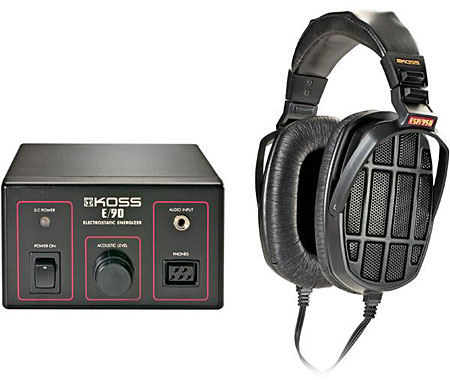
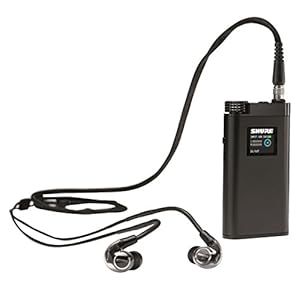
  • Stax and Other Makers Stax is virtually synonymous with the ESL Headphone. There have been others, but they have been few and far in between. In the past, there have been Koss, Beyerdynamics and perhaps others (some are rebranded Stax). Now, paradoxically, there may be renewed interest, as Sonoma and HiFiman have just made their rounds at HiFi shows with their new ESL headphones, which are due for release. Caveat, I think these are likely to be more expensive than Stax. What is more interesting to me is the Shure KSE1500, recently well reviewed by John Atkinson in Stereophile (November 2016), a unique in-ear ESL design with a portable amp, expensive but quite different. Even more interestingly, in the same issue, Herb Reichert wrote of the Koss ESP 950/E90 ESL system (link), still in production but issued in 1990, a full 26 years ago. HR compared them favourably, indeed preferred them to Audeze's magnetic planar LCD-X and LCD-4 (the same article contains links to TJN's 1992 review). Also, another Stereophile reviewer Steve Guttenberg also presents another view in cnet, and the article also interestingly compared the Koss system to the Stax SRS-2107 system. These are all worthwhile reads, highly recommended.   
  • My Stax Experience-Vintage Over the years I have periodically encountered STAX earphones, always to great satisfaction. Just a few years ago, along with his AKG 501 and 701 and Grado RS-1, the same Andrew also lent me his old Stax SR-3 and SR Lambda Pro, with a driver. While I had sampled the AKG's and Grado early on, because of the nuisance of hooking up the dedicated amp, I never listened to the Stax's until I had to return them to him. And boy, what had I missed! For the hallmark sound, see description below.
  • My Stax Experience-Current In NYC my friend Kane owns the current SR-507 with the tubed SRM 007tII amp. As I remember, the sound is luxurious, in the same vein as below.
  • (In)Visibilty of ESL Despite its virtues, ESL technology has always been on the fringe of audio, and this is as true of ESL headphones as ESL loudspeakers. Imagine, a great company like Quad has not had US distribution for a few years until recently. Part of the reason must be the difficulty in servicing Quad ESL's (costly and cumbersome). But Stax headphones are a different story - they are famous for their longevity and many old units are working perfectly. One interesting observation: If you google "electrostatic headphone" you will get Stax among your entries, but if you use "electrostatic earphone" you get pages of Shure only. The vagaries of googling!
SRS-2170 System (SR-207+SRM252S) (Official link with spec's)
SRS-2170 is Stax's entry level system. As it comprises both headphone and matching amp, the package is very reasonably priced in my opinion. It has been well received and even managed to have a few reviews (see cnet and avhub). I agree with those and shall be brief here.
  • Comfort is unsurpassed.
  • Sound Although "entry level", these deliver Stax's hallmark sound that can only be called luxurious, with a large soundstage, plenty of air and warmth. Nothing grating to the ear, yet everything was crystal clear. (the same cannot be said about some of the current, very hifi cans). As expected from ESL, transients are fast (but natural) and bass is tight and tuneful.   I cannot imagine better replay of classical music. Large orchestral music have scale and flow that surpass the usual dynamic headphones. To name just one very important virtue: a very realistic rendition of massed strings (many modern designs fail miserably in this). Chamber music is even more superior - what glorious string tones and tensile interaction! Jazz also benefits from the fast leading edge - pristine percussion and brozen brass, all with superb rhythm and pace. Another difficult feat: a reasonable facsimile of  hall sound, if that can be portrayed by headphones at all. It all adds up to one word: natural.
  • Upgrade? Personally, I don't really think so, or at least not at all in a hurry. Although this is entry-level Stax I don't really hear that much difference between the SRS-2170 system and the more expensive vintage Stax or the current (middle level) SR-507/SRM007tII that my friend has. The SRS-2170 system is an overachiever that has most, if not all, of what Stax has to offer, at an eminently affordable price. I am sure you get more as you go up the ladder, but it is likely a case of diminishing returns.
Conclusion

  • The Best For once, I shall say what is the best: Stax, even entry level, is the best for me, and I am not at all tempted by newer and sexier offerings. If you are into headphones at all, you should try Stax. Stax is durable, and older offerings offer much the same sound and can be obtained at bargain prices. Just get one!
  • vs Planar Magnetics The hottest headphones of today are almost all planars. I have never had one in my own system, but I know the sound. A good analogy is Planar Magnetic loudspeakers (e.g. Magnepan) vs ESL loudspeakers (e.g. Quad and Martin Logan). Now, I know quite a bit about that, as an owner of Maggies and Martin Logan, and interested student of Quad. With large speakers, ESL suffers from dynamic limitations, and in the case of Quad (except the 29xx series) less than full size images, while Maggies tend to grate a little in the treble, not as refined and luxurious as the ESL's. However, with the cans over our head, the situation is totally different. Unless one listens to heavy metal and a steady diet of rock (which is not the average audiophile), I personally have not heard better than Stax, and shall remain an ardent fan.

04 May, 2016

Rare Cartridges: Nagatron Ribbon, Stax Electrostatic

Smorgasbord: Versa Dynamics 1.0 under Walker Proscenium Gold Signature; Foreground: Technics SP-10/Stax/Electrostatic. Middle, right: Garrard 301/Ikeda 407/Nagatron ribbon; center, amp for Stax; left, Garrard 401/SME3012/Nagatron Induced Magnet. Click pics to enlarge.

Letter from NYC (54) 2016 (10): Heroic Analogue Efforts
Rare Cartridges: Nagatron, Stax

(Article finished in HK). For me, this is a special article. Not many are privileged to get to hear even one rare analogue legend, not to mention several in one morning. But my friend Andy basically did a "presentation" for me, and I am damn impressed! Thanks to the old souls who keep the flame alive! In an era of hyperbole's (generously applied to each new generation of "super" cartridges), re-visits to an older era should be mandatory.
 
I had first arranged to take my Empire and Shure cartridges to Andy's place for a listen. As it would be a lot easier to have an arm with a removable headshell, I asked Andy to make one available. Imagine my surprise when I walked in to see so many turntables, armed with RARE cartridges. Pics here are indeed worth a thousand words...

We did not listen to the Versa Dynamics 1.0 under the Walker Proscenium Gold Signature (with Stanton 380, reported previously). For associated equipment, see the link.

Garrard 301/Ikeda 407/Nagatron (Jeweltone) HV-9100 Ribbon
Nagatron Ribbon (0.04 mv output) was connected through a dedicated 1:100 transformer (Nagatron Z Coupler).


Garrard 401/SME3012/Nagatron 360CE Induced Magnet
 SME 3012 (converted from SME 3009) with damping trough


About Nagatron I found some of Andy's postings in vinylengine. Attached below.

"...Nagatronics was active in the heydays of the vinyl era. They marketed in America a full line of phono cartridges made in Japan by Nagaoka during the 70s and 80s. Nagatron as a brand is now mainly remembered by their induced magnet cartridges which, imho, can still hold their own sonically against many high-price phono cartridges currently available.

Nagatron's flagship cartridge was not an induced magnet type but was of an "exotic" ribbon design. Instead of a magnet, a piece of iron, or a coil in the magnetic field, there is a strip of ribbon. According to Nagatron, the ribbon design offers the highest degree in linearity of all the magnetic phono cartridges. The penalty, however, is in the output level. It is around 0.04mv, a magnitude lower than the current low-output MCs, therefore, requiring a high-gain transformer or head amp to work properly into a normal preamplifier.

There is also this lencoheaven thread (where the pics of the HV9100 below come from)


Sonic Notes HV-9100 I absolutely adored the Ribbon HV-9100! Although working in a different way, its sound did remind one of the ribbon planar's clear, pristine presentation, but sans the undesirable peakiness. An open window; marvelous! 360CE As for the Induced Magnet 360CE, the sound was softer, but eminently enjoyable. Part of this may be attributable to the more mellow damped SME arm (as compared to the Ikeda). In any case, the sound was still excellent and hard to fault!

Andy told me Nagatron lost its shirt developing the amplification/transformer for the ultra-low output cartridges. Admirable heroes of hifi! I am sure there will be more Nagatron in  my analogue future!

Technics SP-10/Stax UA-7 and CPX Electrostatic Cartridge
Stax CPX electrostatic cartridge is connected to the Stax UA-7 arm via a dedicated arm tube.Stax Electrostatic is fed through the Stax POD-Xe, a tubed oscillator/de-modulator unit with a bypassable 10db solid state booster amp.


More on Stax Here is a vinylengine gallery that has a lot more pics for the Stax (and Nagatron) stuff covered in this article. Enjoy! Personally I am a huge Stax fan. Their earphones are still unrivaled imho. Hence I was very eager to hear this setup. Sound The sound was still very respectable, but the midrange and lower treble were not quite fully fleshed out and not quite as good as the Nagatron ribbon. We even tried bypassing the booster amp with my iFi iTube buffer (6 db gain setting) but there was not much difference. I suspect the more "direct" direct-drive may be a culprit here. But I'd love to hear this cartridge in another setting.