Showing posts with label Brand-Artemis Lab. Show all posts

30 May, 2020

Artemis Labs LA-1


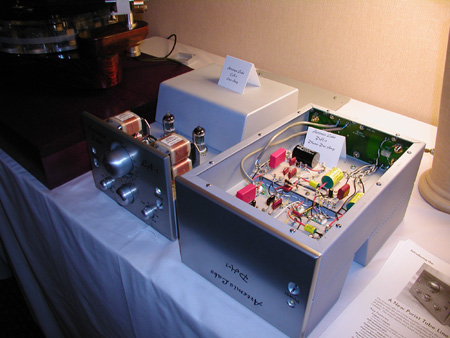
Click pics to Enlarge. Note the Kondo-like Split-Level chassis with holes for cables to go through.

Review: Artemis Labs LA-1 Preamp, Part II
7119 vs 5687

LA-1, Part I

Artemis Labs, now long defunct, was headed by John Atwood, former Technical Editor of the much missed Vacuum Tube Valley publication of Charles Kittelson. Its first products in 2004 were this Preamp and the companion PH-1 Phonoamp. It was much later that I saw and heard them at the AV show in HK, though as usual, given show conditions, the sound did not register with me.

In HK, their products, though receiving wide praise, never sold well. I suspect that had something to do with the aesthetics. These products have the form of a bulky brick with a V(or U)-shaped trough in the top center, where the tubes are seated. The aluminum face plate looks rather Gothic to me. I actually don't quite like the look, but some reviewers seem to like it. Unusual shapes usually is not a good idea in the conservative world of audio consumerism. Second hand prices are low, even when I got it in 2010 (even lower now).

Construction This preamp is definitely not run of the mill, and is intriguingly constructed. There is a lot of technical information in the 2006 positive-feedback and belated 2010 dagogo reviews.

My interest in the LA-1 lies in its use of a single 5687 for amplification. The use of this tube in a preamp was initially developed by Kondo (I have yet to see one of these as he then moved away and used other tubes) and later much emulated in DIY circles. The split level construction of the LA-1 is also Kondo-like, but on a less luxurious level. Parts quality is superb. The coupling cap is Auricap (personally I harbor doubts about Teflon caps). The potentiometer is stepped Goldpoint and Chokes are used for Loading (somehow I was not able to get the front cover off but at the bottom there is a pic from the net). I popped open the back cover though and that overbuilt power supply is fit for an amp! BTW, see that black wire used for the signal (lower right corner)? It is Belden 8450, the solid core version of the 8451 that I use!

Ergonomics Excellent. Stepped volume can sometimes be trouble, but it is well designed here. I always get the exact volume I need. The two level knobs also come in handy in balancing the stage. And the Mono switch is a luxury.

Sound There is something very direct about the sound, and a presence that some of the reviewers had alluded to, but I find it difficult to exactly pin down the sound. What I find significant are:
  • Simplicity Despite its realization, this is as simple as a preamp can be. Just a triode section capacitor coupled to the output, with very little feedback. One can hear this simplicity.
  • Dynamics and Headroom There is definitely something outstanding about the headroom of this unit. It is never fazed. It is not ultra-dynamic in the usual sense. Its gain is modest at 13db. It doesn't immediately impress one as punchy as, say, a preamp based on the SRPP circuit. But the way it follows the dynamic is exceptional. No stress, no matter what. It is not reticent, it just gets out of the way. It is good with all manners of music.
  • 5687 vs 7119 The 5687 was made famous by Kondo. Since then it has been used widely in DIY circuits, as well as in some mass products such as the iconic Audio Note (UK) Kit 1, which I used to own. It is a very good amp, and better than its then much more expensive commercial brethens Conqueror and Conquest. But still, I could not get over its trace of brightness. I rolled 5687 and 7119 but thought the 7119 sounded quite off. Fast forward to now. The LA-1 is completely different, and highly amenable to both tubes. The 5687 has a more airy sound, but the 7119 is definitely more corporeal sounding, and that is my preference. 
  • A Steal At current price, this is a steal. If your system is kind of laid back, this may not provide you with the jump factor you need. But, if your system is in ship shape, the Artemis can be a big surprise and make you re-evaluate what you think you know about dynamics.

Beefy Power Supply!

Bottom pic from here. LA-1 to the Left. See the Chokes (there is better pic here)

rm7dc

06 May, 2010

HiFi Letter from NYC 2010 (5): Magnepan 1.7 listening tests

HiFi Letter from NYC 2010 (5): Magnepan 1.7 Listening tests (I)

I got really busy with the 1.7's. A chance to try all kinds of tube power amps. In recent years I have spent most of my time with SET amps and completely neglected my medium- and high-powered amps. The 1.7 provides me with an excuse to fire them up. Firing these up took a lot of work. Digging out the proper tubes for them, test and match the tubes and carefully bias them.

Listening began with the same gears I used to listen to the MMG (see last letter). As alluded to previously, immediately the sound struck me as more at ease, but also more extended at both ends. This implies more liquidity, a more fluent musical flow as well as tonal richness. I used this setup for quite a while to run-in the speakers. Truth be told, they really did not need much run-in; a few days was all it needed to remove the tiny bit of grain in the treble.

McIntosh MC2200
Praise must be given to the McIntosh MC2200 amp, basically a cheaper and more industrial looking 2205 (no meters either). Like all McIntosh ss amps of yore, it uses output transformers (now used only in higher models). This is a 200 wpc amp that is VERY heavy and built like a tank. It even has a 1-ohm tap. I wish I had a pair of Apogee to try this amp on. The even load of Maggie surely stressed it not one bit. Sound was superbly controlled, liquid and smooth even in the loudest moments. My WE tube friend marvelled at the synergy between this amp and the 1.7. Note that Lyric HiFi also uses McIntosh to demonstrate its 1.7. There is neither transistor hash nor dark colorations of some vintage gears. I'd say this amp is definitely a best buy for a Maggie. Given the chance I'd like to buy another one to use the pair in bridged mono mode. Now, THAT's cost-effective! This is the only ss amp I used this time (although my NAD 325BEE drove my MMG quite well, I have too little time to test it out on the 1.7 and it likely will be marginal; so be it).

Artemis Lab LA-1
At this time I got a new toy. I have previously heard Artemis Lab only at shows and, despite the looks, my impressions were generally positive. My interest in the LA-1 line preamp revolves around its use of 5687, a tube I like and popularized by AN and Kondo. If you know the layout of the Kondo M7 you should find the chassis here eerily familiar: 2-level, with only small holes to let the wiring go between the compartments. In this "poor-man" version, there is no expensive silver, and the design is also different and notable for its use of plate choke and constant current source. Perhaps later I shall write a more detailed review.

The Artemis LA-1 immediately proved itself a winner. As noted in some web reviews (avguide; positive-feedback), it is eerily quiet (more than my BAT VK3i, though that may be the problem of my particular unit, as my BAT P5 phonostage is dead-quiet) and goes loud with great ease, perfect for this classical listener. The BAT VK3i is a little tight in comparison. It's very revealing, making tube-rolling not only fun but essential for system synergy. The Tungsol is smoother and generally suitable, but with certain amps that are slightly dark, Philips/Sylvania is preferable. So the system changed to:

Analogue: Linn LP12/Ittok/Koetsu Black; Thorens TD-125/SME 3009 S2 Imp/Denon 304
Digital: Meridian 596V
Preamp: Artemis Lab LA-1 (mostly using Tungsol)

pic: Marantz 8B, Dynaco ST70 and, waiting in the wings, WE124 (click to enlarge)

Marantz
8B and Dynaco ST-70

Perviously, I had used the Marantz 8B quite satisfactorily with the MMG. And in HK, another Marantz 8B had satisfactorily driven a host of "difficult" speakers, including Magnepan MG-12, Thiel 2.3. Even ATC 20 performed miraculously well with it. Don't under-estimate its 35 wpc, it's a power-house in disguise. And best value. One in good condition (mine is) should sound quite transparent and be quiet in operation.

I am glad to report that the Marantz 8B had no difficulty whatsoever handling the MG 1.7. This amplifier must also be rated a best-buy Maggie amp. Compared to the ss McIntosh, there is a little more bloom on vocals, a little more rosin on the violin, and a slightly bigger soundstage. But in some ways the MC2200 is a little smoother (perhaps because I was using the leaner Siemens EL34 on the 8B). Overall, there is rather little to choose between the two and I could live happily ever-after with either, both big bang-for-the-buck.

Moving down the food chain, I tried out the humble Dynaco ST-70 (mine is bone-stock). A little sweeter in the treble (this amp has the best treble imho), open, but looser at the bottom and not quite as powerful, though control was good enough in my large LR. This is THE best-buy in the budget sector. If you don't listen to the big orchestral stuff like I do, it will do nicely. This attests to the drivability of the 1.7.

Throughout, sound of the MG 1.7 was just wonderful and never gave me the tight feeling I get with a lot of Maggies. My WE friend again marvelled and completely agreed that it is a best buy.

That concludes Part I of the listening report. There are quite some surprises coming. Stay tuned for Part II and more.