Showing posts with label Brand-Quad. Show all posts

26 September, 2022

Nagra VPA MSA Quad 77 909 Pass F5 Pamphonic 3000 Tektron

Click pics to enlarge. Top, One of the Author's many setups. Nagra PP 300B amp in center; VPA monoblocks flanking it, all driving the Tannoy Yorkminster.

Letter from Italy (22-3): M Surdi on What Make His Tannoys Tango

Editor: There is so much I agree with and want to comment on, but I want to preserve the densely textured wholesomeness of M Surdi's writing that I shall refrain and perhaps later write a companion article. Keep in mind his room is fairly big.

Previously, M Surdi wrote on his long Tannoy journey, an article not to be missed (here). The current article discusses the electronics matching during the long period.

We may take it as a given that all audiophiles are OCD afflicted. However, even terminal maniacs must balk at a blow by blow description of the decades long pairing of the four sets of Tannoys I have described in my previous post - some 25 different power amps and integrateds (and that’s keeping preamplifiers out of the mix).
Any credit accorded to my musings should also take into account the fact that musical proclivities may change with time. As an archetypal Sixties survivor, I’ve travelled the usual boomer arc from rock to baroque, Animals to Allegri, ZZ Top to Zelenka, and most alliterations in between. The Tannoys caught me in mid-journey, when punch and drive (represented by Tina Turner belting out Acid Queen, on AR-LST’s no less) were gradually giving way to midrange, proportion and all-around tone. This obviously had an impact on amplifier choice and preferences (though Biber’s Missa Salisburgensis is no chocolate box affair).

That being said, in order to cut through product clutter, I’ll be passing my judgments by amplifier categories: transistor, class AB to A; tube, push pull to SET; and class D; with some final comments on bi-amplification. With the intent of keeping things from getting even drier I’ll also be throwing in some gratuitous comments on mismatches and quirky combinations. Not, however, before raising Two Useful Signposts: best amp ever heard on Tannoy’s are the Nagra VPA monoblocs, hardly a surprise since these are the best amps I’ve ever owned (and sold off because of serious mental issues). Worst amp, and by a long chalk, is the noxious Meridian 551, a high powered sand amp which in conjunction with the equally toxic 501 all digital pre was so bad that even patriotic British reviewers could only hang their heads in shame.

Now, to Sand Amps and Current Capability. It is a well known fact that dualcons are current friendly, paper sensitivity figures notwithstanding.This is due to the unavoidably exacting 2nd order crossover, which is not the easiest of electrical loads. Trading quantity for quality however is a generally unwise gambit and dualcons are not shy about revealing grit and glare. Worst case scenario is represented by the previously denounced class AB 150+ watt Meridian (on the DMTs), which exhibited glassiness to rival the entire window surface of the Burj al Khalifa. On the other hand the most memorable sandamp pairing was obtained with the equally class AB 50 watt Nagra MSA, (on Yorks and Cants), a combo so good that it beat out my reference, 20 watt class A Pass Labs First Watt F5. It may also be noted that the Yorkminster-Quad 909 pairing was unimpeachably endearing, to the point of setting something of a record in the price-value sweepstakes. Quirkiest solid state combination (with the DMTs) was the obscure Ariston Amplifier, a Scottish OEM Nait wannabe, which substituted the cheap Naim volume pot with an even cheaper and nastier integrated chip. Not too bad really but inferior to Stan Curtis’ equally IC kneecapped Quad 77 integrated. Not recommended finally would be pairing the otherwise patient DMTs with the dependable Mission Cyrus 2. This supposedly safe combo produced bass mooing which would have done a herd of Angus cows proud. Even Tannoys get the blues sometimes.

R. Pamphonic 3000.

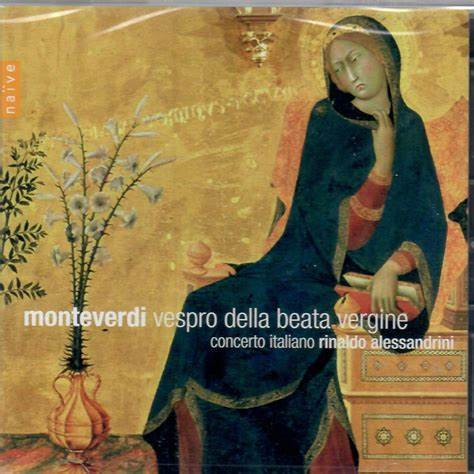
In my experience Tube Push Pull is the default configuration for dualcons. I’ve had this architecture in anything from giant 845 transmitting triodes to midget ECL 82s, along with pentode, beam tetrode and strapped triode combinations, with results that have consistently achieved both current delivery and tone quality - with one noteworthy exception: I really do not recommend the extremely popular Leben 300 with the Cants. I own the 300XS version, expensively retubed with Blackburn Philips EL 84s, Blackburn Mullard ECC 83 and JAN 5751 drivers. The Leben is expressly designed to accommodate both the high gain ECC 83 and lower gain 5751 twin triodes, but exhibits notable transformer induced hum with both of them. This is due to a defective layout which I would ordinarily consider a deal breaker, were it not at least partially redeemed by an excellent build and a singularly captivating sound. The mains derived hum is nonetheless unbearable using the high gain Mullards and weaker, but still obnoxious, with the 5751. A pity really, but there it is. Quirkiest tube configuration was with my father’s late Fifties Pamphonic 3000 integrated (on DMTs, Edinburghs and Yorks). Not the last word in cone control but well provided with musical as well as sentimental value. Single Ended Triode setups are where the rubber meets the road when evaluating dualcon compatibility. Somewhat contradictorily, SET amps are designed for simplicity but discussion of their performance quickly gets complicated, so I’ll give you the short version first. Can you, should you use SETs on Cants? The answer is yes, but. And it’s the but part that needs some delving into. The issue here is performance vs.power. To put it bluntly, the lower the power the more immediate the result, but what you gain in sheer musical communication you lose on dynamic swings. My SETs are custom made to my specs by Tektron of Italy (disclosure: yes, I am friendly with them). I pigheadedly favored 2A3 and 45 DHTs driven by 6J5 single triodes (look Ma, no 300Bs). This means that on a good day I can get a whole watt out of the 45s, almost, and a whopping 2 watts out of the 2A3s. Leaving aside preamplifier and tube options, which could be extensively discussed elsewhere, this means that ideal results are content dependent on music played. Turning to boomer alliterations again, both acoustic Dylan classics and De Rore quintets easily approach perfection. Janis Joplin’s Pearl on the other hand, or my favorite Alessandrini version of Monteverdi’s Vespro are tremendously enjoyable, but while Janis’ voice is truly heartrending and the baroque violin passages almost unsettlingly moving, the rhythm section behind the voice has no propulsive strength, and the violin vaulted spaces are merely alluded to. You want those, you need my 20 watt 300B push pull Nagra amp. Volume is not the issue here - I can easily fill my 50+ sqm listening room with the 45s, nor are microdynamics, but macrodynamic contrasts are muted, and tube rolling is not that helpful. And the Missa Salisburgensis is really not a thing. This also begs any technical discussion of the ever varying effects of cetacean output impedances, even with dedicated 8 ohm tap only trannies. Listening to SETs is an (educated) ear‘s first proposition, and as such gladly accepted by the Canterburys. As to quirks I fondly remember my first elephant driving flea, a Tektron ultra minimalist 6EM7s desk amp which sold me on the whole custom SET concept (reported on 6moons). 

L. Tektron 2A3 amp.

Class D, or chip, amps are easily disposed of. I’ve used Trends Audio and Amazon ordered 60 bucks SMSL thingies to excellent effect, thus faithfully replicating Dr. John’s impressions (here). As far as I’m concerned, when budget considerations intrude, go for the Cants and click the SMSL 36 Pro for an apparently lopsided but actually very well reasoned allocation of funds. Always assuming audiophiles have any familiarity with reason, of course.

About Biamping now. Dualcons are excellently suited to this and I‘ve rigged twin Quad 909s horizontally on the Yorks and tried out an extreme horizontal setup on the Cants using 45 SET monoblocs on the highs and a SET 2A3 two chassis stereo on the lows. Also quite recently, to purge myself of this excess I’ve vertically amplified the 15 inchers with two SMSL 36 matchboxes. In all instances the effects were as expected, expanded soundstage and different, though not necessarily superior, bass articulation. A possible improvement then, but to my ear not worth the hassle and the danger of 16 plus cables lying around. Also, the larger soundstage may, or may not, have been paid for with a minute loss of immediacy.

All in all, less is more to my fusty 20th century taste. Lastly and leastly, the obligatory mention of cables. Though I generally biwire lately I have fallen into the habit of single wiring my antiquarian SETs with Belden 9497 as a philological tweak, this despite my having penned a few years ago (here) some pricelessly witty, if ever so tolerant, remarks on Dr. John’s predilection for the very same cable.  Must be a lesson for us all there. (Editor: LOL. It's so wonderful that because of that we actually became friends!).

18 July, 2020

Quad ESL 2812, DMP, Elite QMP, 50E, Audio Note M8 Micromega Microdac Rel Strata III


Click pics to enlarge.

Virtual Home Visits (10): Quad System, Audio Note, Micromega

Hot on the heels of the vintage ESL 63 comes another current ESL 2812 from our friend Joe L! Joe is a young retiree living in Toronto. Joe is a very experienced audiophile well connected in both Canadian and Hong Kong circles. In fact every year Joe spends quite a bit of time just hanging out in HK. I guess not this year! Joe is a very discerning listener who knows exactly what he wants. And he is handy, makes his own cables and mods.

He has used his current system for quite a while. If the system looks familiar, it is because it is very similar to the current system of our dear mutual friend WSS (more on this later).

CD Transport: Quad DMP CD Player Digital Out
DAC: Micromega Microdac
Preamp: Audio Note M8 Line
Amps: Quad 50E monoblocks and Elite QMP monoblocks
Loudspeakers: Quad 2812
Subwoofer: REL Strata III
Cables: Gotham GAC-1 S/PDIF-Pro digital cable, GAC-2 interconnect; Belden 9497

Quad ESL 2812 This is the same as WSS. More info on the 2812 and an early iteration of WSS' system can be found here. The article also covers the larger 2905 and contains a mini Overview of Quad, which I have just revised.

Quad DMP CD Player This is well reviewed here and in HiFi News. The DMP is likely an updated version of the older 99 CDP that I once had and liked (reported here). Take away the balanced and USB connections and the back is quite similar. The DMP has preamp function but Joe obviously prefers his ANUK M8.

Quad Elite QMP Monoblocks See above HiFi News link for the current version. When WSS acquired his one generation earlier Elite QMP, many went to listen (my report here) and all preferred the Quad to the ANUK amp. If memory serves me, this was all icefox's doing. He was at someone's place where the very reasonably priced Elite QMP massacred the very unreasonably priced Dartzeels's (Fremer, are you reading?) Soon, WSS bought his and Joe followed suit. BTW, I like the looks of the Elite's better.

Quad 50E This has always had a following and is different from other Quad amps in having a transformer input, attesting to its pro origin (including use in BBC). Joe's Canadian version came with a different input transformer and pinout. Being his fastidious self, he found a pair of the original input transformers on Ebay and restored it. In addition, he re-capped and adjusted bias. Joe said: "...to me there is not enough gain without the input trans. With a fixed 1k Hz signal to the 50E, the output voltages were 0.943V and 0.475V with and without the input trans, respectively..." That could account for my reservation of the bass when I heard it at icefox's, as he didn't use the transformer input. Joe obviously prefers the 50E to his QMP's as he is planning to sell the latter. Someone should grab them ASAP, very reasonably priced but excellent amps imho. I also think there may be another factor at play. Using the RCA out of ANUK M8, it goes through an input transformer when he is using the 50E, but it just goes into the Elite QMP RCA input directly. If one inserts a 1:1 input transformer between the M8 and Elite QMP, the result may be a little different. I once had the Manley PSE/PP switchable 300B monoblocks (very good) and I definitely preferred the transformer input. More oomph.

Micromega Microdac (my entry) Joe bought one for very little money. This is a small and beautiful looking DAC with a clear acrylic top. It is a true 1-bit (bitstream) DAC using Philips chips, like the whole line-up in that era (up to the mighty Trio). The other members of the Micro- series are Microdrive, Variodac, Microamp (I still have them all). The sound of the Microdac is very sweet, yet a little more resolving than the Duo BS-1, the lower priced of the 2 Duo DAC's (the other being the Duo Pro, which is sonically superior). I actually had 2 of these - I kept one and sold one to my friend whlee. Obviously Joe prefers this humble DAC! Indeed one of my budget favorites. Given that the Quad DMP is likely delta-sigma, it does not surprise me that Joe prefers a well-executed bitstream.

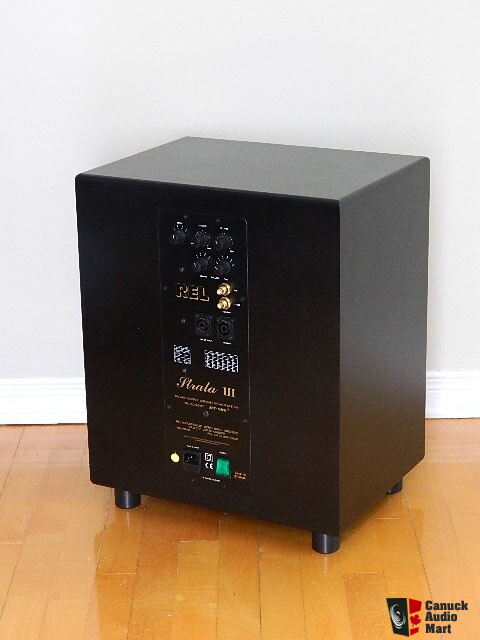
Subwoofer (REL Strata III) When the subwoofer arrived at WSS, Joe was there with me, as recorded here. I'll just paste it here: "...As you know, the Quad ESL crowd is a special breed. They swear by their ESL and are in general very reluctant to add a subwoofer. So, I am proud to say that after listening to my 47 Labs 4737 augmented by subwoofer (here) both Quad ESL-2812 owners WSS and JL were persuaded to give it a try. They lugged my down-firing REL Strata III from icefox's cavernous place (he used it to augment his Tannoy) to WSS's small den...The REL Strata III was an old product, but one of the more expensive offerings. It was generally very well received at the time and you can find quite a bit of info on the internet...The afternoon I was there, with the low-level input we tried crossing over from 69 Hz to 95Hz. All worked quite well. The volume is indented. We started with 3 small clicks, but eventually went down to just one click. If you touch the woofer unit, it was barely vibrating. This very small bass augmentation however had the eminently audible effect of improving upon the liveliness of the presentation. The ESL has always been too polite for me. It is good for a few instruments, but when the orchestra comes in, it is always underwhelming. The subwoofer improves upon this most important aspect. The effect of the subwoofer here is a bit different from what I get with my own systems - with the ESL one picks up the gain in presence more than bass extension. I am not sure whether that is due to the ESL or this REL. The important thing is, used judiciously, it is definitely a plus for the Quad ESL-2812, though I think other subwoofers may be worth trying too..." Joe also compared the low and high level inputs and said: "Although REL suggests using the Neutrik Speakon High Level Input, I think that masks the high frequency of the ESL and so prefer the Low Level Input." I agree, but one should always compare and trust one's own ears.

Cables Handy Joe has made quite a number of professional cables. His final choice of each of the three above, in his own words, "...was chosen from at least 3 to 7 different ones..."

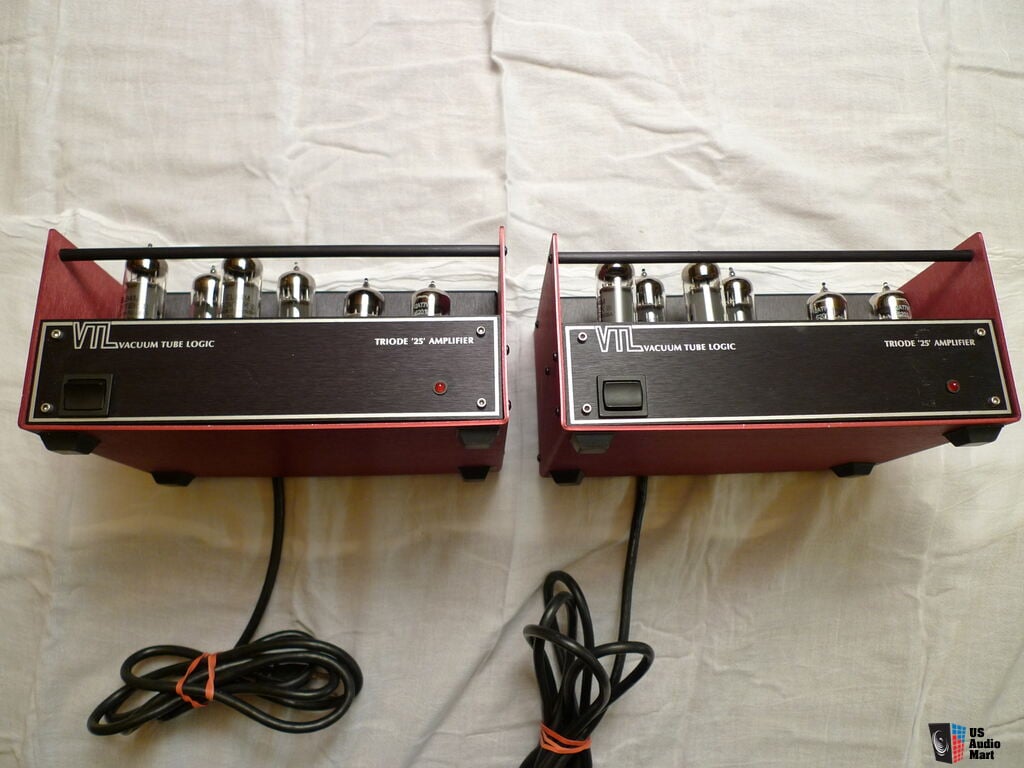
What's next? Joe has expressed his interest in a tube amp for the Quad's. After icefox reminded us that his ESL 57 sang with the Manley Tiny Triode 25 (actually recorded here), he is looking. Actually, the Manley was made by VTL, and the original VTL Tiny Triodes (sassy chassis; later uglier silver faceplate hides the tubes) was nicknamed "dice" 骰仔 (for their small size and cuteness) in Hong Kong. Heard them several times - yes, very good. None of the versions would be a wrong buy but the earliest red ones are the prettiest and cheapest. These are triode connected but I think vintage Pentode PP can be excellent too. Two favorites are Eico HF-86 and Dynaco ST-35.

Top, ANUK M8, Quad DMP; Bottom, Quad 50E flanking Elite QMP, Micromega on top.
REL with low level input
I hope Joe gets a pair of these for Christmas present
VTL Tiny Triode 25 Amp Original Version Red Finish
The transformers that came with Joe's 50E's are smaller than the originals

Surgery (R) and Final Result (L)

16 July, 2020

Graaf GM200 GM20 Modena OTL Quad ESL 63


Click pic to enlarge. Quad ESL-63 on stands; Graaf GM200 on stool, connected with Nordost Speaker Cables; above, pair of GM20 Modena Monoblocks with black coverings, next to which Marantz 10B Tuner; beneath Marantz is Luminous Audio Passive Control.

Virtual Home Visits (9): Quad ESL, Graaf OTL

The Perfect Gentleman
This photo came by accident. When Jules (Visit 8) sent his photo to me, he included this one, which briefly threw me off. It turned out to be a more recent picture of the home of dkyyu, which I had visited a few times before. dkyyu is a perfect gentleman and a generous man (come to think of it, don't you think the majority of audiophiles, of any nationality, are really nice people?). I took the liberty of using this photo, just to say hello to him! dkyyu is also a precious tea collector and an LP collector.

Researching this blog, I was surprised that I had actually recorded a visit to dkyyu more than 10 years ago!!! I forgot about it! It is still a good read, and relevant to this article! :-) That makes me happy. I have visited him after that, but did not write about it, so please say hello to LeeHC and big Lau for me too! I miss you all!

dkyyu's living room can be considered reasonably sized in HK. He is a die-hard vintage Quad ESL fan, owner of the iconic ESL-57 and ESL-63. There is a crazy gang of vintage ESL users in HK; some members even do DIY repairs (HK is very humid, and almost all ESL's go bad). Some of their exploits can be seen here (pics galore).

ESL users naturally gravitate to OTL (the theoretical high impedance matching thing). That is one of the reasons (but no the only one) why I have heard many Graaf's in HK. This Modena (home of the 3 i's of race cars) manufacturer is not well known in the US. This is understandable, as North American homes on the average are much larger and OTL, being a low-powered and impedance matching oddball, is a niche; and the US also has its own Atmasphere and Transcendent Sound. On the other hand, in places like the UK, Europe and Hong Kong, listening quarters are small and Graaf would be more suitable. In the HK market, any Graaf that shows up is lapped up quickly; in NA, I think it'd be like hunting for hen's teeth. Graaf's official websites have not been updated for a few years but can still be read (old one has more info, "new one" less so). If readers know if they are defunct or not, please let me know. Where are you, "Giacomo Bello" (come to think of it, can you email me?)?

OTL in General My own experience with OTL is summarized here in an Overview.

Graaf GM 20
Graaf's most commonly seen OTL amp is the GM20 (this review is probably by Ken Kessler of HiFi News). Employing 4 x 6C33, it puts out 20 watts. It is a great amp, and not just with ESL. Yes, I have heard it with vintage Quad ESL, like at dkyyu's place, to good effect. But, keep in mind, I understand what's good about ESL, but am not an exact fan of vintage ESL, as they image low and have no power envelope to speak of for this classical symphonic listener. In my opinion, for vintage ESL, elevation and addition of subwoofer is a must. I'd actually prefer my lowly low-level Martin Logan Source (here, and there are many after that pilot, just search; second-hand price is probably a few hundred dollars). But I notice that dkyyu now has a subwoofer! If my memory serves me, my previous visits were without, and that is a big step forward by my thinking! In terms of average,based on what I heard in HK, I actually prefer the sound of my friend relax173's Graaf + B and W Nautilus 804. So, OTL can work well with other lower impedance loudspeakers as well.

Graaf Modena Monoblocks 
These are special monoblock editions of the GM20, and highly coveted. The sound is excellent, just like the GM20, with a little more power. Should you be interested, this past sales ad has a lot of great pics.

Graaf GM 200
Judging by the looks and the "magic eye" tubes, dkyyu's ' "newest" acquisition, which I have not heard, is the GM 200, 10x the power of the GM20! This was reviewed by Ken Kessler in HiFi News and Stereophile. A whopping 42 tubes, and in ultra-hot sub-tropical (misnomer; I think the difference between sub- and tropical is disappearing) HK! While I admire the fanaticism, I cannot really take this to heart. I am sure it sounds great, but the energy cost! I'll take the GM20 myself, thank you. What I am saying is, no matter what the power, vintage ESL is highly limited in dynamics - there is a reason why SME's Alistair Richardosn employed stacked pairs! For me, the current Quad offerings (28' and 29' series) are more dynamic and suitable (though I shall still opt for Martin Logan).

Thank you Jules, and dkyyu! You both have enhanced my audio experience so much. I am grateful that I have you as friends.

20 June, 2018

Sparkler S306 DAC, RELStrata III for Quad ESL-2812, TAD TD-3401

TAD TD-3401, Part III: with Full Wavac System
The Amazing Sparkler S306 DAC, Part III: 
Sparkler S306 vs 47 Labs Shigaraki
Subwoofer for Quad 2812
Talk CAS: Cheapo Bluetooth Device vs. Meridian Explorer
Talk CAS: Tidal, Youtube, Radio Garden

The better half of this article comprise further reports on TAD TD-3401 and Sparkler S306 DAC. However, I also tie up some loose ends here.

TAD TD-3401, Part III: with Full Wavac System
On Sunday I re-visited Sang to spend more time with the TAD-TD-3401. This is basically a brief report that is the continuation of the last report (Part II) below (or here). On this day we tested out the full Wavac system by using the Wavac PR-X2 preamp in lieu of the Verdier Control B. The sound, as expected, was crisper than using the Control B. The piano sound was just awesome.

On this day (after much begging and cajoling) my taskmaster icefox finally agreed to come to listen again to my current systems. I was just about to leave Sang's place when icefox arrived in Yuen Long earlier than expected, and I asked him to join us at Sang's place. icefox was impressed by the performance, and harbored the same opinion that the 3401 is superior to the 2401/2402.

Regarding the Wavac, icefox still wished that it could be a tad cooler and thought the piano a little too clanging. For me, it was the opposite. More than most audiophiles, I am very particular about the leading edge, and have always thought the Wavac to be better on this front. However, since the TAD TD-3401 is a faster and more precise transducer than the Tannoy Canterbury, the resultant sound could sometimes be a little sharp. It is a small price I am willing to pay (especially since we get more details with the Wavac) but I can totally understand the other camp. So we were all consistent in our preferences.

Very soon, To Sir and then Mila joined us too. To Sir has a self-assembled big TAD System (which I have never heard) and is obviously a TAD expert. Both he and Mila were delighted with the 3401.

Now we go back a day or two...

Top Shelf: Note Sparkler S306 under 47 Labs Shigaraki DAC, behind Shigaraki Transport.

This is my third write-up of the Sparkler S306 DAC. For basic info please read Part I, where the Weiss Minerva proved utterly inept in its face. In Part II, the S306 went head to head with NOS AMC without shaming itself.

Sparkler S306 DAC
As mentioned in the links, ever since I bought it, I have used my S306 (serial Number 2) exclusively in my Yamaha NS-1000 system. Just could not bear removing it. Yesterday, however, with a little extra time on my hand, I decided to implement it in my Kondo system (pic above):

Transport: 47 Labs Shigaraki (Belden 1694)
DACs: 47 Labs Shigaraki vs Sparkler S306 (Gotham DGS-1 and 2111)
Preamp: Audio Note (original; Japan) M7
Amp: Kondo Ongaku
Loudspeakers: TAD TSM-2201
Subwoofer: JBL 12" paper cone 

Just one recording for illustration shall suffice. In the EMI (Warner) Oistrakh box is a performance of Schubert's Piano Trio No. 1 (with his long-term partners Oborin and Knushsevitsky). This 1958 recording is good but not exceptional in sound. In fact, with the 47 Labs Shigaraki DAC, in this Kondo system there was some harshness in the upper midrange, particularly with the Gotham 2111.

I was dumbfounded when I swapped in the Sparkler. It is very hard to describe the tonal differences, but the bit of hardness is gone with the S306, despite its being obviously more airy in the treble and elsewhere a little leaner than the Shigaraki. What is easier to describe is the utterly sinuous quality of the Sparkler. While the 47 Labs delivered a musical performance, with the Sparkler it is at another level: there is more resolution; the leading edge is sharper; the three instruments are more separated and easier heard; Oistrakh's playing is more sinuous and the cellist more mellifluous. The whole performance sparkled (pun intended) with an utterly disarming rhythm and pace.

This is not the first time Sparkler astounded me in its grab of musical intent. I have not reported this before, but in my Yamaha system, I once played the Andris Nelsons recording of Shostakovich 10th (DG) and felt something amiss: there was a brooding and threatening atmosphere that went missing (compared to my first hearing the CD in the same system). I checked and, lo and behold, the DAC was not connected and it was the Sony Blu-ray player's analogue section I was hearing. Now, as I reported in Part I, the Sony is no slouch, but it just did not deliver the charged atmosphere the way Sparkler could.

And so, despite the use of its matching transport, the 47 Labs Shigaraki DAC was displaced by the Sparkler S306 in the Kondo system.

The 47 Labs Shigaraki continues to serve in the system below as the DAC for the Sony DVP-PR50P, and it improved upon the Arcam rDAC and Sony's own analogue output.

Time Out: World Cup
After playing the imitable Celibidache's Brahms Symphonies, it was time for some food. Once again I opted for 肥姐 蠔餅 (Fat Lady's Oyster Omelette) which I wrote about last time. This time a plain red went well too with the dish.

On this day it was Germany vs Mexico; the latter's quick and precise counter-strikes were really impressive. In a way, Germany played like a bad DAC - no finesse; whereas Mexico was like the Sparkler, microdynamically alert,with tensile strength, exceptional leading edge, PRaT.

Time Out: Subwoofer (REL Strata III) for the Quad ESL-2812
As you know, the Quad ESL crowd is a special breed. They swear by their ESL and are in general very reluctant to add a subwoofer. So, I am proud to say that after listening to my 47 Labs 4737 augmented by subwoofer (here) both Quad ESL-2812 owners WSS (whose system was last reported here) and JL were persuaded to give it a try. They lugged my down-firing REL Strata III from icefox's cavernous place (he used it to augment his Tannoy) to WSS's small den.

REL STRATA III Subwoofer, Black, Mint Condition!The REL Strata III was an old product, but one of the more expensive offerings. It was generally very well received at the time and you can find quite a bit of info on the internet (pic borrowed from canuckaudiomart).

The afternoon I was there, with the low-level input we tried crossing over from 69 Hz to 95Hz. All worked quite well. The volume is indented. We started with 3 small clicks, but eventually went down to just one click. If you touch the woofer unit, it was barely vibrating. This very small bass augmentation however had the eminently audible effect of improving upon the liveliness of the presentation. The ESL always been too polite for me. It is good for a few instruments, but when the orchestra comes in, it is always underwhelming. The subwoofer improves upon this most important aspect. The effect of the subwoofer here is a bit different from what I get with my own systems - with the ESL one picks up the gain in presence more than bass extension. I am not sure whether that is due to the ESL or this REL. The important thing is, used judiciously, it is definitely a plus for the Quad ESL-2812, though I think other subwoofers may be worth trying too.

Back to the icefox crowd.


Click pic to enlarge. The black Bluetooth Device next to the Meridian Explorer.


The Bluetooth Crowd and the Generic Cable
Back to the icefox crowd. They spent a few hours in Yuen Long, but the program didn't exactly unfold the way I had wanted it to. After two hours with 15" woofers, I am sure anything else is an anti-climax. It would have been better the other way around. :-) Nonetheless, I don't think the sound at my place disappointed them unduly.

This is also the Bluetooth Crowd. Many of them use Tidal Streaming through their Cellphones. Arranged in advance, icefox brought his el cheapo Bluetooth device (from Taobao, less than USD 50; the black thing). Despite its small size, I think it has the latest technology. We connected it to the Kondo M7 with icefox's generic RCA cable, and the sound was quite acceptable, better with some cuts than others. icefox also played some youtube, which to my ear sounds even better. We then did some brief comparisons.

Tidal (Cellphone) vs Macbook Pro My Macbook Pro is very basic, unadulterated iTunes (no "mandatory" Amarra) playing lossless AIFF files. Through Bluetooth, the Macbook has a warmer and more detailed sound.

Meridian Explorer (USB) vs Bluetooth We then played my Macbook AIFF files through Bluetooth and also through USB (my favorite Unitek) connected to the Meridian Explorer. The USB connection is again warmer and more detailed. It better be, as I actually hold the Meridian Explorer in high regard (here). Actually, from memory I also think the sound through the wireless dongle of my Arcam rDAC is better than the Bluetooth.

Image result for Radio gardenInternet Radio Through my Macbook icefox also played his favorite Italian Radio Emiglio Romagna, but not through the official site, instead using Radio Garden. I can attest it was very good and the programming of much baroque music was to my liking. I also like the fun way one navigates in Radio Garden. Give it a try!

Belden 8451 vs Generic Cable We then compared the two 1/4" to RCA cables. My go-to 1/4" to RCA cable, which I use with my Meridian Explorer and Fiio X-1, is a DIY one is made from Belden 8451 (info) with Amphenol connectors. The sound was at once more controlled and detailed, but the crowd pointed out correctly that it was also a little tighter than the generic one.

For a while, there has been a little bit of a phenomenon going on with those around icefox (that means a lot of people). People give generic cables (some from Apliu Street) serious tries and devote much time to comparison, just like, e.g., one would compare Audioquest with Kimber. In general, these are pragmatic people who rightly eschew expensive cables. Many also use cables of vintage origins (WE or not). Many of these people own expensive systems (such as the two WE systems recently featured).

I don't have any problems with this. However, from the vantage point of a professional cable user, I do think one can achieve just as much, and more, playing around with professional cables and other things. Take an example, at our WE/Altec 604 friend Vincent's home, I didn't report it, but we did compare my DGS-1 with his favorite generic cable. To me, the DGS-1 was just more nuanced and had more finesse (I gave him a pair). Similarly, while the generic cable that came with my Thorens TD-309 was surprisingly good, it was surpassed by Gotham cable. Note too these about generic cables: 1) they vary greatly in quality; the ones that come with your USB devices, TVs, TV boxes etc are usually not too good; 2) they are usually smoother, less dynamic and extended at the frequency extremes, which I'd venture is why some audiophiles use them, but imho this is more of like patch-up works on flawed systems.

Nonetheless, the exercise with the Bluetooth device was highly entertaining and downright fun! How often can you say that about audio? As CAS is just peripheral to me, I can entirely see the point of doing things on the cheap, and the quality was pretty good! BTW, like me, icefox thinks usually the expensive, complicated, technical and "serious" CAS systems sound terrible. YMMV.

11 November, 2015

Quad 2812 revisted, Quad QMP, Ortofon Quintet Mono

AVI AVITAL / BETWEEN WORLDSThis CD is not as easy to replay as you may think.

Quad 2812 revisited
Breif Reviews: Quad Elite QMP monoblocks,  Ortofon Quintet Mono, Ortofon SPU
Yumcha Diary 24-10-2015

Yesterday, between yumcha and a concert in the evening, I spent my (and the host's) precious time at our old friend WSS' cozy den, which I have visited several times since my last report. WSS is a true music lover and in many ways not your typical audiophile (which is why I'd like to hang out with him more than most others). This article describes not just this visit, but also serves to summarize our findings and doings over time. Equipment has undergone quite some changes. Current configuration:

Turntable 1: JC Verdier La Platine/SME3012R-Air Tight PC-1/Ortofon TA210-SPU
Turntable 2: Garrard 301/SME M2-12/Ortofon Quintet Mono
Phonoamp 1: Phase Tech EA-1 IIs (no MC; step-up by EAR MC-4)
Phonoamp 2: ARC Reference 2 Phono
Digital: Sony DVP-PR50P (standing in for his out of commission AN CDT4/DAC5)
Preamp: AN M8
Amp 1: Quad Elite QMP monoblocks
Amp 2: AN Jinro Shochu

ARGERICH - BARENBOIM / PIANO DUOS
Image result for ortofon quintet monoPristine Piano Sound through the Quad ESL.

Sound Notes
  • Analogue Supremacy I'd not belabor this. The 3 analogue sources fed into the 2 phonoamps (some described in last report) still reign supreme in this system.
  • Ortofon Quintet Mono Since my last report, WSS had a Garrard 301/SME M2-12 practically "forced" upon him , on which he installed this cartridge (Output 0.3 mV; info here) . It is a true low-output mono MC cartridge, a very even-handed performer that handily delivers the virile and tactile qualities mono cartridges are known for. Those who favor low-output MC cartridges, who want to experience mono, but who cannot afford more exotic fares like Ortofon's own SPU and the likes of Miyajima should consider it.
  • Digital Woes (or David vs Goliath) Sometime ago I spent quite a bit of time at WSS, and the digital playback nagged at me - substantially slower and less lively than the analogue. In my experience, Audio Note UK digital's usually over-emphasize, not under. I made for WSS a Belden 1694A cable (here) and it trounced his considerably more expensive AN-UK silver cable, as well as Kimber! Things seemed to have improved somewhat, but on a subsequent visit, when I played the Avi Avital CD shown above, the magnitude of the problem revealed itself. This CD is a crossover genre, which usually is geared towards the lively, but at WSS it was utterly un-involving. The epiphany came when I got home, nonplussed, and just to cross-check played it in my very humble Micromega system (here), and everything simply came alive! I then knew something was seriously amiss with his digital system. On a subsequent visit, I joined force with with my infamous taskmaster icefox, who brought his Sony DVP-PR50P (see review here) for stand-in duty. Guess what! The el-cheapo Sony completely trounced the AN UK (this did not surprise us, as it had happened in similar circumstances many times before - an expensive digital system proves inadequate next to much humbler kins, again and again giving lies to "advances" in digital "technology"). One thing though, sometime later WSS told me his DAC went caput. So, maybe its suboptimal performance was (at least partially) due to this. I look forward to a rematch. But I tell you, many "senior" audiophiles, including some who think they are audio experts, have visited WSS, yet completely failed to realize the magnitude of the problem. To me, these people don't even know the HiFi Basics I am about to expound (Watch for next article!)
  • Quad Elite QMP A Quad amp almost always does a decent job anywhere. And with the Quad 2812 it goes without saying. The Elite series just proves Quad has not lost its qualities that stem from the 300/400/600/900 series, all from old current-dumping technology. In this system, it proves every bit the equal of the AN Jinro Sochu, and the larger power reserve at hand was particularly evident in a remarkable rendition of Stravinsky's Rite for 4 hands.
  • Ortofon SPU  Just a brief comment. As usual, the SPU is emotive and involving, though it presents details in a less truthful perspective, but what ultimately nags at me is the lack in resolution by modern standards. Not my fav, but there are fans.

02 March, 2015

Yumcha Diary: Quad ESL-2912

Yumcha Diary 28-02-2015: Quad ESL-2912
CD Recommendation: Sokolov Salzburg Recital

Last Saturday, after yumcha, I met up with friends WSS and icefox, users of Quad ESL-2812 and ESL-2905 (my visits here). WSS had told me how much he liked the Quad ESL-2912 of 盧華煇, aka ML, whom we re-visited (for me, after more than 3 years; link to last visit.)

As usual for our host, his mega-system has changed much. Since my last visit, top-end Raidho, JBL 66000 and Magico M7 had come and go, among others. One of the reasons for my visit is because he is soon to renovate his audio room, a gargantuan effort to gain some height. Update on his gears (I cannot guarantee accuracy):


Vinyl 1 - Clearaudio Statement-Goldfinger Statement
Vinyl 2 - Continuum Caliburn-Cobra arm-VdH ?Colibri
Vinyl 3 - Linn LP-12 Lingo, with Akiva cartridge and built-in Urika phonostage.
Phonopreamp - Clearaudio Statement Phono
Digital System 1 - dCS 4-piece Vivaldi
Digital System 2 - Audio Note UK  CDT-6/ Sixth Element
Preamp/amps - Soulution 725/701 monoblocks
Speakers - Quad ESL-2912

Brief Impressions and Comments
  • It was easily the best sound I have heard at ML's. The sound had a coherence that escaped many of the larger speakers he had before (see my previous visits).
  • Sound was smooth and refined (but not overly so.) imho, although I am not an ss user, Soulution is a brand that I have usually liked. The ambience and beautifully recorded piano sound of the Sokolov recital was faithfully rendered (this disc is a must-buy, also available in vinyl).
  • I only heard the Audio Note Digital System 1, priced at double that of the dCS Vivaldi! Surely an overkill? The 3-box Sixth Element cannot even be found on the net, but if you are curious, you can read Martin Collom's Review of CDT6/Fifth Element.
  • For me, the 2912 is by far the best ESL I have heard. It has addressed most of the problems that bothered me about earlier ESL's. Its tall and fleshy image and good dynamics earn my praise, and would be the ESL I would own should I go that way.