Overview: Lowther
Ruark Crusader II Revisited
This Blog is sort of a real time audio diary. For the moment, this is even more so.
Extra! Closing Up Shop
My friends know, due to family circumstances, I am soon to (more or less) wrap up things in Hong Kong, and spend more time in New York. Now, you all know.
This is why I am transferring some of my prized possessions to my friends. In the last two articles, you have read about my prized TAD TD-3401 in its new home. You shall soon read the same about the Tannoy Canterbury. The departure of those two loudspeakers signifies the closing of an era for me.
As anyone who has re-located, not to mention with way excessive baggage, knows, it is pandemonium. I don't know how I am going to survive it. But friends help, and writing, again, is a catharsis. The recent articles, more of a potpourri, reflect this reality.

Drunken Goose Palm!
Audio Comaraderie
In the last entry, I reported on the visit by icefox and company to my place. What I did not report on was that I scrambled to offer them something to snack on, very humble offerings (like 759 Spanish ham, sardines, Taiwanese crackers and udon; with some privately sourced organic peanuts, fried) with some equally humble generic wines.
The next day, I was really surprised to have received an email from To Sir. He had just prepared some Goose Palms 醉鵝掌 marinated in rice wine, Hence the name Drunken - this classic method has long been used by the Shanghainese to prepare chicken and other small birds. He insisted on delivering some to me, as he knows I am a drinker and this dish is supposed to go well.
I must say To Sir's take on this classic recipe is excellent! But I am even more grateful for the warm-heartedness, from a man I have met only once! In some ways, he reminds me of our NYC friend Kevin (here). No "thank you" is enough!
Removal
How do you sell a "warehouse" full of possessions? You don't; I don't really try very hard, but friends have helped me to unload a bit. And also, re-hooking some of these up have been a very pleasant reminder on why I owned them in the first place. Aside from the major events of TAD and Tannoy, here are some recent activities, and I'll take this opportunity to re-evaluate some of these and write a few words. In order of occurrence:
- NAD 3020A I sold to someone I didn't know. As usual for such low-priced items, there was no testing and the transaction was in the MTR station. The next day, I received a call; the new owner breathlessly told me how wonderful the NAD was - it completely outclassed his vintage Conrad-Johnson preamp (no news to me) + 6A3 SET amp through his University loudspeakers (sounds like the basis for a pretty good system - too bad I have no time to visit). To recap, I have written extensively in this blog on the 3020 (click here) and as of this writing still employ it for my Yamaha NS-1000 (which the icefox crowd auditioned). I suspect there shall always be a 3020 in my possession and use; after all, it is a benchmark. Immortal!
- Lowther TP-1 Complete Loudspeaker Names and Iterations Lowther model names for their loudspeakers and cabinets are highly confusing (like the many subtypes of Acousta), and this particular model even more so. Mine is the classic version with beautiful "Queen Anne" legs (TP-1B), which was/is more expensive than its plainer straight legs counterpart (TP-1A). A good guide is the Lowther Voigt Museum, which however I think is not complete. There were other later TP-1's, including "London" (not the current repro) an perhaps others. Currently, Lowther UK also offers the "TP-1 Imperator", which seems very different as it is front firing, though back loaded. My Pair My pair can be seen in the pic at the bottom of the article (similar to the units well documented with pictures here and here). I have had mine for almost twenty years, but haven't used them in the last fifteen. For a little info on how I got my pair and some old listening notes, click here. This Time Around After the removal of my Tannoy Canterbury and TAD TD-3401, I was finally able to access them. It was serendipitous that my friend wher called me up around this time, saying a friend of his is interested. One day, we dragged these out. One has an intact PM3A with rubber surround (its mate has a short); the other a PM2A Silver with disintegrated surrounds (even worse is its mate). Despite this, the TP1 made mellifluous music when directly driven by my Sun Audio 2A3 (even with Russian tubes; source was Sony transport, YBA WD202 DAC). The driver with bad surround naturally had not much bass, but the intact PM3 was simple divine. The house was filled with rich, good music, so airy that we did not feel any need for supertweeters. Amazing! My Observations Based on my own wonderful experience with the TP-1's, and also the many Lowther's and as many DIY/repro cabinets I have heard, here are my views which I know is going to grate on many people: 1) Front firing Lowthers must have good bass horn loading to sound good; 2) Original cabinets sound much better than most DIY and Repro cabinets (no matter how touted or even "official"); 3) If DIY is necessary, avoid MDF and other rigid material; 4) As the repro cabinets all originate from China, we get to hear them in Hong Kong. Suffice to say I have heard my share and I am sorry to say I am singularly unimpressed - they usually sound so tight, the antithesis of a good pair of vintage Lowther's; 5) The Cabinet is much more important than the Driver used (even the cheapest PM6A produces excellent sound, IF housed right); 6) I am not impressed by the many Lowther-like drivers (like AER) that are said to be improvements. Overview Aside from the incomparable TP-1 I have heard excellent sound from a model with doors (likely the "Ambassador"). Possibly other large Lowther's like the Audiovector should sound good. I have also heard very good sound from some Acousta's, the most amazing being the "Dual-Position" firing into the corners (a bargain). I am sorry I cannot be more enthusiastic about modern cabinets or DIY efforts.
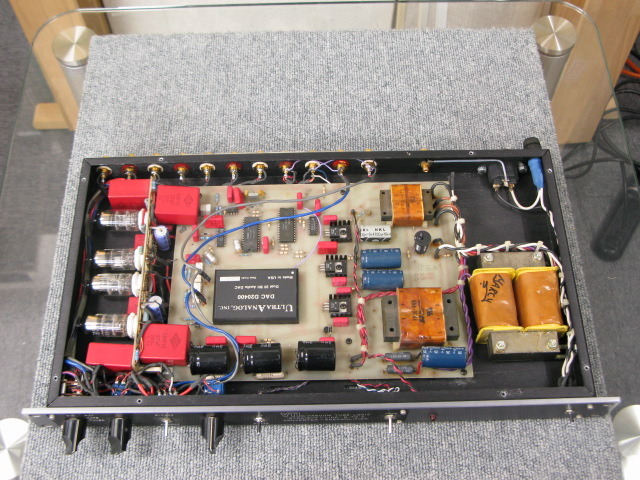

- VTL Straightline DAC/Preamp (pics from hifido.jp; click to enlarge) Some days after the Lowther event, my friends Captain and Romo came in with "Garage" Charles and jules. Each had a different agenda, and Romo's was to get a DAC. He was very lucky that I sold this to him. This is one of my favorite DAC's. Compared to its more famous contemporaries which employed the same marvelous UltraAnalog 20-bit chip (Sonic Frontier SFD-II and PS Audio Ultralink, to name just two), it lives in undeserved obscurity. Basically, it is a DAC with a tubed output stage (with gain). It is both an excellent DAC and excellent preamp, but there is a quirk. As DAC Switch the Selector to Bypass and it works as a DAC. The sound is classic UltraAnalog, rich and detailed. Compared to the darker SFD-II, it is a little lighter on its feet (a plus) but perhaps a little less steady with big orchestral's. Absolutely first-rate, that is for sure. As Preamp Here lies the quirk. If one uses the Digital input, the sound lacks beef. However, if fed a line level signal (like we did on this occasion with the YBA WD202 DAC) the sound explodes with color. Indeed, as a preamp, I think it is as good as most that have come my way! That is accolade indeed. You get Two in One, but you cannot use both at the same time, funny, no?
- SinoVT TP-215AI This cute 6V6 PP amp (reported here) seems to have been discontinued, and in any case this brand is a little difficult to source in the West. Charles heard this some years ago at my place. Subsequently, he bought two. On this day, Charles came to buy mine. The SinoVT did a reasonable job driving my Ruark Crusader II, and even the "Big Fat Lady" B&W Matrix 801 MkII, amazing considering it is just 7 wpc (pentode operation). More below.
- Ruark Crusader II These were covered in a previous article. Using the VTL DAC into the SinoVT, the sound was very good, and everyone nodded in approval. I am puzzled as to why these three-way's with diminutive footprints are not more sought after in HK.
- B&W Matrix 801 MkII For my assessment of B&W, especially the Matrix series, of which I am fond, read my Overview. For the longest time, together with the Spendor SP-100, the Matrix 801 was a perennial on Stereophile's list of Class A components (indeed, read its most amazingly detailed review, written by a musician). I have had mine for a long time, but rarely used them, as I had my horns, which could use SET amps. But the Matrix 801 had retained my loyalty otherwise. Driven by the 7 wpc SinoVT, sound was surprisingly big-boned and decent - that should completely dispel the myth that the 801 is difficult to drive. We then switched to the Bryston 3B, which immediately firmed up the sound and put things into scale. Splendid loudspeakers of reference caliber!





 Posts
Posts