Showing posts with label Brand-Genesis. Show all posts

04 November, 2020

Genesis Digital Lens Theta Data Basic II Meridian 200 Gotham 10601

Brief Review: Genesis Digital Lens
Two DAC's: Ensemble Dichrono Hi-Dac vs Sparkler S-306
Two Swing Arm Transports: Theta Data Basic II vs Meridian 200


Calling this a "review" is an overstatement. Rather, just brief notes. I am trying to finish off my stash of articles. Today is the last day of quarantine. Tomorrow I shall return to my old house, which is in the "countryside", where the signal is poor. Wifi is likely poor. So my communications will be fewer and farther in between.

Genesis Digital Lens In HK, I have long used de-jitter devices. Early on, I briefly used the Sonic Frontier Ultra Jitterbug, but I preferred the Monarchy Audio DIP. But when I got my hands on the Genesis, all others fell by the wayside and it became central to my digital setups. With 5 inputs and 3 outputs it acts as a great switchboard that allows one to run multiple combinations. For detailed description of what was then quite revolutionary, see Stereophile. The Genesis was probably the first device to use 500Kb of RAM as buffer. Is it obsolete 20+ years later? I think not, and this 2018 article agreed with me.

Two months ago I chanced upon one at US Audiomart, at a very good price, and the seller delivered it to me! I first tried it in the LR streaming system. It did its usual good job with my Micromega Stage 2 and MyDac. However, it would not work well with bluetooth. There was no jitter figure, music got through, but there were not infrequent stutters, sign of the poor quality of the digital signal. I then took it to the audio room, where I connected it in System II with 2 transports and 2 DAC's.

Theta Data Basic II This is a hell of a transport. Stereophile has a detailed review on the I, but the II is even better, with addition of balanced output, addition of one more transformer and an updated anti-jitter circuit (info from an excellent Taiwanese page). Basically a modified PS Audio Lambda, it nonetheless is better sounding, and it has that trademark killer bass that its forerunner Data had. I still have the legendary original Data (Stereophile; the one converted from a Pioneer LD player), which I have always regarded as the best transport. However, previously I did compare the 2 and the sound was shockingly similar. My Data Basic II reads discs very fast and I think there is a lot of life left in the Philips CD9 Pro; unfortunately the same cannot be said about the Data. I used the balanced output.

Gotham10601 This is the Gotham AES cable, very slim and flexible. I regard it as the best digital cable. In HK I still have the old Kimber (Illuminati) DX-50, and the Gotham has a lot more detail and is also more pacey.

Meridian 200 This is a classic Meridian transport employing the CDM-4. Stereophile reviewed it together with the 263 DAC, whereas Gramophone had the earlier bitstream 200/203 combo (the DACs can be ignored). I used the coaxial output with the Belden 1694A.

Sparkler S306 needs no introduction in this blog. NOS TDA-1543 conversion. This was after I reversed the input wires. Hooked up with the Belden 1694A.

Ensemble Dichrono HiDac This is a very expensive DAC, but I got it with the Dirondo transport for a very good price. Critical reception was mixed (see 6moons and positive feedback). Hooked up with either Ensemble Gigaflux BNC or coaxial Belden 1694A.

Brief Comparisons 
  • Theta vs Meridian There is little question that the Theta excels in more areas: resolution, drive, dynamics and bass. This could also partly be due to the AES connection. Error displayed is very low on the Genesis. But the Meridian is no slouch. It is a little more diffuse and less resolved but it is still eminently musical. Error displayed is just slightly higher than the Theta. Both are highly recommendable if one can find an honest seller or test thoroughly. The CDM4 though shall likely last longer.
  • Ensemble vs Sparkler Similarly, there is little question the Ensemble excelled in all the things the Theta did. However, in my highly resolved system (using Yamamoto CA-04 preamp) the Ensemble proved to be on the yang side. The Sparkler had less resolution but was subtly articulate and more listenable over time. I still have work to do on the Ensemble in the future.

01 December, 2018

Genesis V, EAR G-88, 549


Not anyone's idea of fun: Jumping the car at night and in the rain.

Audiophilia: Rain or Shine, Dead or Alive
Home Visit: Genesis V, EAR G88, 549
Return Visit to VAS

The weather forecast was not promising, but under our great leader's guidance we soldiered on. Andy had organized the New Jersey trip with a visit to composer Han Yong's home in central Jersey as an opener.

With Kevin chauffeuring Andy and I, we started early and made good time but just short of target we were derailed by the GPS. We ended up on the wrong side of a river and the road across was closed due to flooding. It took us quite a while, with the help of Google map and considerable detour, to finally reach destination. By that time, the raining had started. We were met there by James, who had had no trouble driving from Philadelphia.


Home Visit: Genesis V, EAR G88, 549
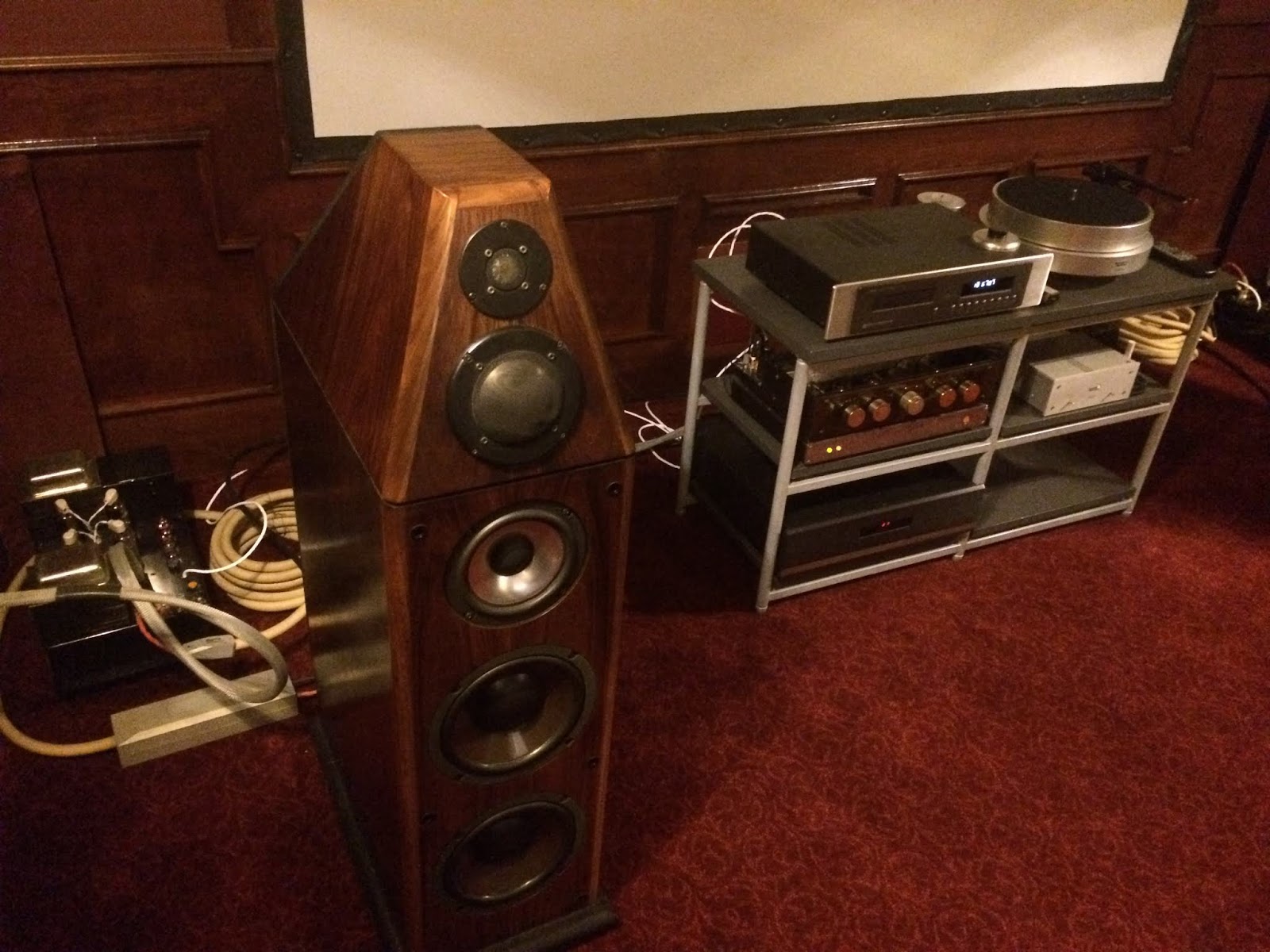
HY has just recently moved into this very handsome, and cavernous new home. The listening room is not the largest, longer than wide, and with a somewhat low ceiling.

Han proclaimed that he just want a good system to listen to music, but from his compulsive tweaking it seems to us he is also every inch an audiophile.

Analog Rig: Acoustic Signature Final Tool/Benz Micro ACE (temporary)
CDP: Sonic Frontier SFCD
Preamp (with MM/MC phono): EAR G88
Amp: EAR 549 monoblocks
Loudspeakers: Genesis V

Nothing is what it seems. There is quite a bit of studied cabling around. HY likes a particular kind of teflon-coated silver-plated cable and not only his power cords are made of it, he has replaced most of the wiring in his EAR preamp and amps with it too.

Image result for reiner kijeThe sound was very good, clean and with good perspective. Orchestral details were impressively layered and revealing (as on Reiner's Lt Kije), though I found solo piano and violin to be a trifle lean for my taste. Also, I am very particular about the bass - good as it was, it was not the last word in tactile quality, as I'd expect from managed and powered bass (this from a 15" paper cone horn aficionado).

Image result for han yong cantandoWe only heard one CD, and that was HY's own composition. It is a rich and nicely crafted amalgamation of Eastern and Western elements. Importantly, the tonal balance of the digital sound was commensurate with the analog, as I believe is the way it should be. Of course, analog is more involving, and coming from a composer one could hardly argue! Nothing argues the case more than the fairly large collection of LP's in the basement. I love the pics of the composers!

We did not get to hear HY's other rig, said to be very good for CD:

CD Transport: MBL CDP used as such
DAC and (Re-clocker): dCS
Preamp: CAT SL-1
Amp: Canary 300B

I was also intrigued by the disc washing setups. Aside from a VPI 17, HY has a cheap Ultrasound setup, comprising a professional Vevor Cleaner and a Vinyl Stack Record Spinner.

When we left it was raining hard, but we proceeded to Princeton, where we had lunch and visited Princeton Record Exchange, which has a lot less interesting things than before. Although slim picking, I still bought 2 CD sets and 2 LP's.

Return Visit to VAS
In the rain, it took quite a while to reach Steven at VAS (next to VPI; earlier visit here).

The sound was the best we have heard at his place, also the best I have heard from the 802, not a model that I like usually.

Analog: VPI TT (rim drive)/VAS MC cartridge/VAS MC SUT
Preamp: ARC SP-11, heavily modded, with tube PS.
Amps: VAS "Citation II" monoblocks (tube swaps of 5R4, 5755 and 12SX7)
Loudspeakers: B&W Nautilus 802

A very fine day!

11 February, 2012

Review: Kondo Ongaku + KSL-M7 System Part III

Kondo M7 in company with JC Verdier, Leben and Brooks; Ongaku in the background; click to enlarge.

Review: My Kondo System Part III
Kondo Ongaku + M7 System Part III - Digital Playback
Review: Sony CDP-R1/DAS-R1
Review: Audio Note DAC-2

Review: Genesis Digital Lens
Review: Gotham 10070 Coaxial Digital Cable


My Kondo System, Part I (background info on Kondo and Ongaku); Part II (all about M7); Part IV (largely phono related, skip if you are digital only)Part V (on old Audio Note M7 and use of Kondo with small bookshelves).

(Last revision Jan 23, 2015 - addition to the AN DAC-2)
(Extensively revised Feb 16, 2012)

Editor's Note:
I'd like to also refer you to a six-year old discussion thread dedicated to Kondo in the most well-known and worthwhile Hong Kong hifi forum called review33; the thread is humorously named AudioNote Ongaku - I'm in pain!, you get the idea! Although the webpage is in Chinese, most write in English, and there are useful information on Kondo buried there. I don't write much there but I do know (of) some of the regulars, all Kondo old-hands. Note there are two arrows on the upper right hand corner which usefully let you reverse the chronological order.

Recently, a part-Kondo user from Scandinavia found the review33 thread and asked about the use of Ongaku as amplifier and matching with preamp. It is a worthwhile question which has not been addressed comprehensively on the internet. The question coincided with my recently re-initiated effort to tune-up my Kondo system. So I have decided to explore his question while tuning up my system. This article is the first of my experience, and more would be forthcoming. First, I'd like to introduce my Associated Equipment for this Round.


Two Digital Systems
Personally, particularly when exploring something serious, I like to play with different sources, be it digital or analog. Contrary to popular belief, digital is still more complex than theoreticians/CAS/Perfect-bit people make it out to be. While digital replay standards have improved in general, all the theories and latest "advances" are often (like digital itself) merely number crunching games that get you nowhere. It still holds true that a good digital playback medium depends heavily on the ears of the designer. There are good sonic reasons why the best of the older products are still being cherished and sought after by connoisseurs (which the head-fi crowd shall never be).
There is a reason why some designers like Thorsten Loesch (now of AMR) still see greatness in the 16-bit TDA-1541 chip! Of course, "perfect-bit" or not, digital has yet to hold up to analog!

Aside from WE, perhaps nothing is more serious than Kondo, and a proper evaluation should be multifaceted. Mine uses older equipment that to me have retained their allure, in many aspects trumping their much more modern yet soul-less counterparts. And the two different sources differ markedly in gain, which proves to have relevance.

Digital System 1 This utilizes the superb Sony CDP-R1 as transport, and its matching DAS-R1
(16-bit TDA1541A; normal output level ~2V) as DAC (full pic at bottom of article). Connection is by the proprietary Sony Twin Link. I have previously written about this venerable system here. I'd like to add that subsequent evaluation has confirmed the greater, indeed exceptional, dynamic prowess of the Twin Link, and the connection is used as one of my references, particularly in replay of big complex music. Of course, the 16-bit TDA 1541A still reigns supreme in reproduction of the hall sound, and subtlety in integrating the whole sonic fabric. If there is a fault, it is that the Sony is a little too smooth, rounding out the edges of rhythmic figures.

L, AN DAC-2; R, Genesis Digital Lens.

Digital System 2 This system is more complex. It still utilizes the same superb Sony CDP-R1 as transport, but is more complex downstream. It uses the more conventional RCA digital output of the CDP-R1, which is connected to:

Genesis Digital Lens Over the years, the Genesis Digital Lens, an old anti-jitter system if you will, has stayed in my system. Its 5 inputs and 3 outputs offer infinite connectivity, and more often than not, even with modern DACs with supposedly top-class jitter-reduction, it improves the sound by firming out the contours. In some combinations, a mild deleterious effect of a little dryness can be detected. In this system it is connected via the same Gotham 10070 to the:

Audio Note UK DAC-2 My DAC2 is an older version, which employs the great-sounding 20-bit Burr-Brown PCM63P; it uses minimal digital filtering and I/V conversion unusually deploys interstage transformers; output via 2x 6DJ8 is fully tube-based, run in SRPP configuration. The output is significantly higher than normal, much higher than the standard 2V; see below). Here is Peter Qvotrup's philosophy and I quote some official descriptions on AN DAC's of the time:


L pic: inside the DAC-2; note the PCM63 and tranformer I/V; click to enlarge.


"...Audio Note waited until 1993 to introduce their first DAC because we felt there were serious problems with the digital format. Only after years of research did we feel we had developed significant enough insight to create a converter that moved the design goalposts forward. We wanted a DAC that would remain state of the art and retain its value for many years. To this end, Audio Note digital products now represent the most original and effective solutions to the design of digital circuitry and to the digital to analogue interface. In digital our approach is the same as it is in analogue; keep it simple and gentle and employ the highest quality components. The digital signal should also be handled with great care. Less processing; treat the original bitstream as fundamental truth.

Our goal is to create a line of classic D/A converters. We started by reducing the digital circuitry to its absolute minimum level and selecting the highest quality (and highest cost) digital chips (i.e.. the Burr-Brown PCM-63, K-type). Then we developed a battery of tests that allow us to further select higher quality chipsets. We do five separate tests to grade our D/A chips and reserve the very finest chips for the DAC-4 Signature, DAC-4, DAC-3 Signature and DAC-3.

In front of the D/A chip most companies use a high-order, "brick-wall" filter to "erase" frequencies above 20KHz. These high-order filters create resonant back waves (ringing) that result in energy reflections that add mechanical artifacts and hardness to the musical signal. This filter is the most critical juncture in a digital based system and how the signal is handled, how the energy is transferred, at this point will make or break a high quality system. Multi-pole filters are subject to ripple in their passband and poor transient response. Additionally, the high-Q ringing causes irregular and uneven dynamic and transient behavior, resulting in hardness, opaqueness, diffusion, exaggerated high frequencies and a false sense of detail. Additionally, the brick-wall filter is one of the primary causes of listening fatigue. Brick wall filters make music sound canned and artificial. Audio Note's solution to this problem was to use the only filter that does not ring or suffer transient or phase problems; a first-order, single pole. This simple filter employs a very high quality 1:1 interstage transformer. This original (patented) strategy gives our digital to analogue converters a very real musical advantage. This unique interface strategy allows the best type of energy transfer. Again, Audio Note has worked to preserve the original proportions and energy distribution of the music signal. Audio Note believes the signal must not be manhandled or subjected to unnecessary manipulations. The simple 'transient-perfect' single-pole filter/interstage transformer combination is the gentlest way to bandpass limit the output of a digital/analogue chipset.

The sonic benefits? Audio Note DACs have an uncanny sense of musical continuity; the listener's awareness of tempo and musical flow are distinctly enhanced. Their retrieval of small scale detail and timing information is second to none. These DACs can only be compared to the best analogue not other DACs.

All Audio Note DACs use the 6DJ8/6922 dual triode, except the DAC-4 Signature which uses the 7119/7044/E182CC. As you move up from the lowest priced DAC-1 to the higher priced DAC-4 Signature the parts quality improves with the DAC-3 and above using AN silver wire. The DAC-1 uses Audio Note Aluminum foil, paper in oil capacitors and copper wired interstage transformers. The DAC-2 is similar to the DAC-1 except that it uses either a 1:1 or a 1:2 interstage transformer for higher output and is designed to drive the Audio Note power amplifiers directly. Maximum output on the DAC-2 is 10VAC. The DAC-2 also has a higher quality component selection. The DAC-3 takes the parts quality to the next level with the introduction of a higher quality interface transformer, a higher grade of PCM63P chip and a more careful component selection. The DAC-3 uses AN-V Silver interconnect between the digital and analogue sections and between the analogue board and the output jacks. The DAC-3 Signature would be the best DAC in the world, were it not for the DAC-4 and DAC-4 Signature The DAC-3 Signature has even more and higher quality Black Gate caps, silver interface transformers, and a individually adjusted silver filter coil. The PCM-63s (K-type) are critically selected and auditioned especially for the DAC-3 Signature. The 4-Series DACs push that critical selection a step further with regard to the PCM-63s. In the DAC-4 Signature these chips are further selected by audition with musical program. The DAC-4 Signature uses the highest grade Black Gate caps, AN-Vx silver wire, and selected copper foil paper in oil coupling capacitors. The Production of the DAC-4 Sig. is generally VERY LIMITED due to lack of suitable chip sets, so delivery time can and should be expected.


The DAC-4 uses separate power supplies for the digital and analogue sections. The DAC-4 and DAC-4 Sigs. both are built on heavy, pure copper chassis. The DAC-4 employs still further power supply and parts upgrades over the DAC-3s. The DAC-4 Silver Signature is our current 'statement' DAC. It has a very improved, tube rectified, choke filtered power supply, the very best Black Gate Caps and Audio Note silver-foil, paper in oil, coupling capacitors. The exotic, E182CC/7044/7119 tube, used in the DAC-4 Signature, brings a greater sense of transparency and power to music reproduction. These DACs are designed to give at least a decade of analogue-like musical enjoyment. Jonathan Valin described the DAC-4 Signature in Fi magazine as "the best there is at any price"...".


Audio Note UK uses the exact same circuit for all of their DAC's, but the higher grade ones have "better parts" and tube rectification. As you can see from the pic, the DAC-2 is very well built. I agree (see descriptions below) the sound is much as the official literature described. Its great sound has as much to do with tube output and the excellent PCM63 chip (imho one of the best chips ever; its 20-bit sounds superior to most of the 192 stuff now) as the use of interstage transformers.

Audio Note UK later moved on to non-oversampling (so-called 1x) but, while I like the sound and simplicity of non-oversampling, imho latter-day chips are inferior. Maybe I am biased; I have heard their very expensive ones many times in other systems, but none impressed me like my old DAC-2. I have also owned the admittedly much cheaper and non-oversampling DAC One 1x (6111 tube). While it was certainly cheerful and bettered the more conventional Zero of the time, it was not at all a match for the DAC-2.


Gotham 10070
2 runs of this cheap but reference-grade coaxial digital cables are used. This utterly transparent and musical S/PDIF cable has outperformed everything else in my system. While here, I shall tell you Gotham's XLR digital cable is equally distinguished (as are the entire line).


Analog interconnect cable from either digital system to the preamp is Gotham GAC-4, one of my references.

System Used
For those who don't know my Blog well, please go to the right hand column of the Blog; scroll down to see the equipment I use in both Hong Kong and NYC. This will give you an inclination on my preferences. For this round, I used:

Preamp: Kondo KSL-M7 (stock Sylvania 6X4; 2x Mullard ECC82)
Cable from Preamp to Amp: Gotham GAC-2
Amp: Kondo Ongaku (stock GE VT4C and 4x JJGZ34; triple-mica black-plate 6072; Tung Sol 5687)
Speaker Cables: Gotham 50150 (another marvelous Gotham)
Loudspeakers: Tannoy Canterbury HE

Notes on the Tannoy Canterbury For the past years, since I received them in very dark-sounding condition, I have run these in with increased treble energy and rollover. While these setting still work marvelously well with the WE setups, with the Kondo setup I have found restoring close-to-default settings reaped greater benefits, while extracting no cost from the WEs!
Although Kondo is not bright or harsh, its strong presence and unrivaled airy presentation demand partnering with the right loudspeakers. Those with overly strong or grainy treble just would not do, particularly with digital sources.

R pic of Ongaku front; click to enlarge.

Ongaku as Integrated Amp (Digital)
To facilitate comparison, I used the Direct In exclusively. Unlike some erroneous reports, this bypasses only the selector and renders the other inputs (except tape) useless. The source/tape selector, balance and volume all remain functional. Note that the balance function desirably operates over a usefully narrowed range. In my system, the volume knob ranges from 9 to 11 o'clock depending on the digital system used and material.

With such a "monumental" project, I opted to use one CD as my main test material, and the MANGER Test CD (tracks here) it was to be.
I am happy to report that both digital systems, though different in their presentations, yielded excellent sound.

Digital Systems 1 vs 2 In general, System 1 is more composed, always finely layered and cultured, never making an ugly sound; whereas system 2 has more rhythmic incisiveness and a more "vocally" declamatory nature, more "hifi" too if you will.

  • -Track 1 With System 1, the bells are more telling in their tolls, their tones more varied and differentiated.
  • -Track 2 The cinematic effects and timbers of the various personae are better differentiated by System 2.
  • -Tracks 3-7 These classical tracks are overall better rendered by System 1, no-less by more accurate portrait of strings timber, but in terms of rhythmic accuracy (tracks 6-7) System 2 has the upper hand (Sony is weakest in this area). System 2 also portrays the piano (track 3) with more body and realism.
  • -Tracks 8-10 and 12-13 These Jazz/Pop-influenced tracks undoubtedly has more emphatic and audible rhythmic variations with System 2.
With classical and complex material System 1 scores a little higher, whereas in smaller pop/jazz combos I'd give the edge to System 2. Overall, I'd narrowly give the edge to System 2 for its superior PRaT. Please note that System 2 has the much higher output, and I believe that is an advantage when using the Ongaku as integrated amp.

Ongaku + M7 (Digital)
Direct-in was used throughout. After hours of going back and forth, I have to conclude that, with digital playback, adding the M7 is not really that superior to direct-in:

  • With the M7 , the position of the volume knob of the Ongaku is somewhat arbitrary, up to the preference of the user as well as the nature of the music played. I am not certain what is the optimal, but I resist having it much over 12 o'clock, as I think past 1 o'clock or so the sound coarsens significantly.
  • Addition of The M7 immediately brings about a more panoramic soundstage that is greater in both width and depth.
  • With the M7, Digital System 1 gains perhaps a little speed in the leading edge and a firmer rhythm, though it shall never be the equal of System 2 in this regard. More, this comes at the cost of loss of a little subtlety in certain areas, like massed string timber. I also notice that the hall sound is reduced somewhat.
  • With the M7, Digital System 2 displays an even more upfront rhythmic signature, but the depth of attack and PRaT are not necessarily superior to direct-in. In other words, what benefits System 1 a little is less obviously useful here. Note also that the high output of System 2 can be attenuated with the level control of the M7, but it'd take time to arrive at the optimum; I used the 1 O'clock position.
  • Overall, with significant reservations, I'd say addition of the M7 brings about a somewhat more even quality, but digital direct-into the Ongaku can be a success (higher source input level desirable). So there is much room for tuning the sound.
Analog experience to come in Part IV. Suffice to say I also think the higher the cartridge's output the better...

07 July, 2011

Review: Musical Fidelity M1 DAC

Review: Musical Fidelity M1 DAC

Revised and expanded July 16, 2011

While I am quite settled into my SET world and don't look much beyond in terms of amplification, I have retained quite an interest in digital products. One of the heartening things these days is that good digital products can be had quite on the cheap, and there is no better example than the Musical Fidelity M1 DAC.

This very reasonably priced (even more so in HK) and well-equipped DAC has been widely and glowingly reviewed (a good one from HiFi World; see also HiFi News, TAS). Of course, that alone does not arouse my curiosity. Think of the rave-reviewed Benchmark DAC1, which has always left me cold (non-involving sound), and it costs quite a bit more than the MF. More extravagantly, I think of dCS, which always seem to sound "good" but fail to draw me into the performance (interestingly, the HiFi World review compared the M1 to a dCS, albeit subtly).

Neither does the name MF previously mean much to me in digital products. Many years ago I had their Tubalog DAC for a while, but soon sold it because of its lack of details-the tubes were just buffers in the worst sense, ones that robbed details (much like their gimmicky X-10). Since then, I have heard quite a few of their CDPs, like X-Ray and A3, and none of them impressed me too much.

Neither am I necessarily a convert of upsampling, having heard just too many clinical sounding and expensive products. But I am not against it either, as I know if well implemented the result can be very good (an example is the Quad CDP-2, which is a very good sounding unit that like the M1 upsamples to 192kHz).

So what exactly drew me to the M1? I'd guess it was a combination of the following: (1) the wordings used in some of the reviews, much more detailed and "sincere" than the generic "rave" review; (2) The features, including balanced input and output; (3) great measurements across the board.

I bought a second-hand sample and was delighted from the start. I used it in the following system:

CD: Audio Research CD2 as transport-Gotham XLR digital cable
Digital Switching Station: Genesis Digital Lens.
DAC1: Audio Note DAC-2 (old version; PCM-63) connected with Gotham coaxial digital cable
DAC2: Musical Fidelity M1 connected by Gotham XLR digital cable
SACD: Marantz DV-6001 analogue out
Preamp: Kondo M7
Amp: Elekit 2300 or Wavac MD-300B (Ongaku is too hot in the summer)
Loudspeakers: Tannoy Canterbury

Since many of the cited reviews were very well written, and in great details, I'd not write much except to note a few of my impressions.

Most of all, I was impressed by the superbly clean, well-delineated and coherent sound, which does not highlight anything and impressively maintains composure even at loud level. Perhaps since I use tubed equipment, I found nothing etching or over-bright at all.

Comparison with the analogue out of the ARC CD2 (older Delta-Sigma unit using CDM12) reveals the ARC to be very slightly fuller in the midrange, but less well delineated (though it is no slouch in this area). Hence the M1 may not be for those who wants a very rich midrange or upfront sound in the vocals, although it is by no means recessed. With the M1, instruments, including vocals, have excellent presence, but always in a natural way. Aside from the XLR input, I also tested the RCA input, which worked equally well with the Marantz multi-player, raising the CD playback to a level almost comparable to the ARC as transport. Although the M1 has excellent measured performance, I still marginally prefer feeding it indirectly through my Genesis Digital Lens, which theoretically removes jitter originating from the transport, and which I use as a versatile switchboard. Last, but not the least, (unlike things like Benchmark) the M1 has a very good sense of the music's flow, good PRAT if you will.

In very big pieces perhaps the M1 loses a little ground to the AN DAC2 (as well as my Sony CDP/DAC R1) but its performance is still way above average, remarkable for something at this price. And all this with the RCA analogue out, as I have not even tested its XLR out! Neither have I used its USB in (may not be as great; see TAS review cited above). Maybe that's for another day.

The M1 is a wonderful product. Use it with a good transport, or even with a DVD player (which usually serves quite well in this regard) and the sound will beat many, if not most, of those way over-priced, so-called high-end CD players (particularly those from Germany). A bargain.

Addendum (July 16, 2100): M1 DAC vs V-DAC
There is a question on the internet regarding how different the M1 DAC is from the same company's much cheaper and compact V-DAC, which similarly has garnered much praise and did well against rivals costing much more in group tests.

The best info is from a Japanese site, where you can see the internals of both. Aside from the obvious difference of power supply (the V-DAC uses a wall-mart), as the author noted (Babelfish translation), the DAC section is very similar (pics of the DAC section are 180 degrees from each other) but I think the analogue output seems better in the M1.

31 March, 2011

Letter from NYC 2011 (13): Genesis V, MBL, EAR, Michaelson & Austin

L: Note the M&A preamp up front; R: DIY table for EMT 930 using pipes! (click to enlarge)

Letter from NYC 2011 (13): Genesis V, MBL, EAR, Michaelson & Austin


Among my hifi friends MW in LI must count as one of the craziest; perhaps even insane. I have previously reported on his Western Electric setup. It has been barely 2 years and yet his system (including the room) has undergone so many upheavals that it'd be hard to chronicle. Yes, you read it right, it's upheavals, not mere changes like what happen to you and me. I shall be brief, as I really cannot second-guess why MW made his moves.

L: HMV's; R: KEF'ed Genesis

After Mark's excellent Vandersteen 2CE period came what I had to come to think of as his mid-life crisis (don't we all experience that!). He pawned the WE combo to me but later acquired a full MBL set (the wrong path in my opinion, and you'll see why). Also, he divided his basement into two halves, presumably to give more space to his children (no, an electronic warehouse is not quite suitable really). The resultant small square room was not kind to his hifi. At this point he acquired a pair of Genesis V (early version). Not happy with its performance, he swapped out the mid range units for LS3/5A's KEF's!!!!!!!! Surprisingly, the sound was not THAT bad. Also, a pair of ancient HMV loudspeakers made a brief appearance (they sound very good).

Last time I was in NYC, he heard my horns (as yet unannounced) and was smitten. A 180 degree turn took him to build a horn system, which went through several iterations with JBL pro and Altec drivers in a custom JBL pro enclosure. With such disparate elements, electronic crossover was employed and after a bit of experiment sound was surprisingly robust.

So I was surprised this time that he had gone back to the Genesis V. Happily the stock mid range units were restored. AND he had knocked down the partition and regained use of the full room. The first time we went, we pulled the speaker up front about 2 ft, adjusted the bass servo as well as the knobs on the back before we got good sound. This is a complicated speaker!!

Over 2 days we heard the Genesis V driven by 2 sets of electronics:

Analogue: Nottingham Spacedeck/Spacearm/Denon 103D
Digital: MBL Transport+DAC
Preamp+Amp A: MBL 6010+amp
Preamp+Amp B: Michaelson & Austin TVP-X preamp/EAR 509

I shall be brief. While the MBL set sounded reasonably well on its own, upon switching to the M&A/EAR all-tube combo the system took a huge leap forward. So much for the under-achieving MBLs. That is hardly surprising. Like the EAR, the M&A preamp was designed by Tim de Paravicini, hence "Tim's Valve Preamp". This is an all-out effort, almost dual mono, with 4 tubes in the phono section and another 4 in the linestage, per channel. It is also rare as hen's teeth now. The sound was excellent with vinyl.

Back to the Genesis V. I think we had it in the sonic ballpark but, with the bass still a bit tight and not deep enough, had not quite hit the bull's eye. It was close though. Even then, the sound showcased the speaker's rich and solid sound. There is a marvelous texture to the mid range and treble that should still put most current hi-end speakers to shame for their etched sound. The basement I think is a little small for the speakers too. I have heard them in much larger rooms to different, if not better, effect.

M&A TVP-X
This early all-out effort uses 6x 12AX7 and 6x 12AT7 and constant current source design. The separate power supply is transistor.