Showing posts with label Column-mrgoodsound. Show all posts

20 March, 2022

Audio road trips & the Metzner Starlight

By mrgoodsound

Since I began collecting vintage audio equipment 3 years ago, my favourite weekend pastime has been driving to far-off places to pick up rare gear. It's an opportunity I take up at least twice a month to clear my head from a heavy week of my day job by cruising the Ontario countryside, meeting new people, and coming home with a new audio toy (or several). This weekend was one of the most interesting excursions yet, taking me to Acton, a small town with a population of under 10,000. 

First, a little backstory. I have been collecting vintage turntables in some sort of misguided quest to find 'the one'. Two years ago I made an offer on a Metzner Starlight that popped on eBay. It was grossly overpriced so I did not think my lowball offer (which was still overpaying) would be accepted, but of course it did. I was naive about these sort of things back then and expected things to kind of just work. When it arrived it had a number of issues that I realized would not be easily solved and I put it aside in frustration for a long time. I recently pulled it out of storage to disassemble and clean it, determined to get it working, but disaster struck: I foolishly polished the printing straight off the fascia of the unit.

I was disheartened a second time by this Metzner, and put it aside again. Sure enough another one popped up on eBay, this time the seller was local. I immediately considered bidding, stopped myself, paced back and forth, then decided to only bid at the last second. Of course I won. The seller reached out to me offering local pickup, and that is how I met Pat from Acton, Ontario. More on the Metzner later.

Pat lives on a beautiful 120 acre plot of farmland. The quality of the air in the countryside is different. It allows for calmness and clarity of thought, the benefits of which I immediately lose when driving back to the city. Probably why I make so many stupid audio purchases. I met Pat in his yard and he welcomed me into his garage to look at the turntable. I immediately recognized that I was dealing with another serious enthusiast. His garage had it all: Altec, Ampex, Electrovoice, McCurdy, McIntosh, Northern Electric, Presto, and so on. Classic American and Canadian audio equipment everywhere you looked, much of it professional or studio equipment. Cutting amplifiers, tape machines, an Altec 604 RWB in its original cabinet, multi-cell horns, oh my. 

There was a lot of equipment I had only read about or seen photos of, and now here it was in the flesh. I asked Pat for a tour to which he obliged. He would point at things and start talking about them only for me to interrupt and name it. 'Yeah, I know, that's a Presto cutting amp.' This was ignored the first few times until he finally turned to me and exclaimed; 'How do you know what that is?'. I could only grin in reply.

Eventually I came out of my daze and entered scavenger mode, asking if he was selling anything else. 'Sure, what are you looking for?'. I mentioned I was looking for a small amplifier, and he pointed to a diminutive tube amplifier sitting on the shelf. At first glance it looked like any Magnavox, RCA or Zenith console amplifier I had seen before. A 12AX7 drove a pair of EL84s for single-ended output. Upon closer inspection, a cool English-made Plessey electrolytic capacitor was spotted, and the output transformers were distinctly un-American. My best guess is the amplifier came from a Canadian console. 

I asked Pat to hook it up to make sure it was all working, and then noticed a distinct lack of any turntable set up anywhere. 'Oh yeah, I mostly listen to tapes in here'. No kidding, the walls were lined with tapes, pre-recorded and home-made. A Sony reel-to-reel in the corner was connected to the mystery console amp with some cursing. Pat pulled out a tape for our impromptu listening session. 'Do you like Joan Baez?'. Are you kidding? Do you even have to ask?

In a few moments, Baez was singing Dylan out of two enormous wall-mounted Electrovoice speakers. Her voice was clear, warm and larger than life. I guess if you ever want to audition equipment for someone to purchase, cheat and use a tape source. 'I'll take it'. We spent a while longer talking tonearms and speakers before I thanked Pat for his time and took the Metzner and amplifier home.

The mystery console amplifier does indeed sound quite good. I can't say I've ever heard an EL84 amp I didn't like. Single-ended ones with vintage iron are especially sweet. Like almost all console amps, this one needs a pre-amp. Its voice is a little too naked and the playback speed a little too quick without one.

Back to the 'star' of our show, the Starlight turntable. It's a rather unique machine, manufactured in the early 1950s in Japan for Robert Metzner of California. Metzner is probably more well known for his other venture of importing Akai reel-to-reel machines to the US and his company Califone who sold tape machines and record players to the educational market. The Starlight uses a direct drive system, in which a motor-driven worm gear interfaces with a series of two discs. The second disc is mounted on the platter shaft and its position may be altered for variable speed control a la Lenco. It's an incredibly simple and effective drive train, similar to the earliest electric gramophones, and unfortunately largely vanished from the marketplace after the 50s. There are a few different revisions of the Starlight with a different top plate and controls, but the basic motor system is the same.

The Starlight has two major problems which make restoration a pain. First, the worm gear has a rubber coating which wears over time and becomes noisy. Voice of Music in the US sells refurbished worm gears. Second, the platter sleeve was made from quite cheap stamped aluminum and is prone to wear, resulting in platter wobble. There is no easy solution here, if the platter sleeve is worn you must have a machinist make you a new one, preferably from bronze or brass. This was the case for my first Starlight, thankfully this new one is much better in that regard and I think the original sleeve can be left.

Other annoying tidbits include a glued-on cork mat which must be scraped off, an integral 45 RPM adapter which must be popped off, and rubber motor grommets which have hardened and must be replaced. I may write a follow-up article on the results when the restoration is done. I am determined to get this player working. Thank you to Pat! See some more of his collection below.


20 February, 2022

Vanatoo Transparent Zeros Part II

Vanatoo Transparent Zeros Part II


By mrgoodsound 


In January of 2020 I wrote an article about my Vanatoo Transparent Zero desktop speakers. At the time, I had considered them to be my best audio investment to date. Over the past two years, a series of progressively sillier tweaks has elevated that opinion even further. This article will detail those tweaks for the readers entertainment. 

Step 1: clubwood mpingo feet (~$350)

It has honestly been so long I don't remember where I stumbled upon the clubwood products, a South Korean firm offering wood accessories for audiophiles and espresso machine enthusiasts. Most of their products are made out of mpingo, a species of African Blackwood (in)famous in audio circles thanks to Shun Mook. Clubwood is operated by Mr. Song, who is an extremely friendly individual, and has seemingly been in the audio tweaks business for many years. His wares are sold on eBay and the clubwood website. The prices are actually reasonable, when you consider the raw material costs of real mpingo wood and the difficulties associated with working with it.

In June of 2021 I placed a large order for mpingo discs, cone feet, volume knob and cable damper; intending to test the efficacy of these products across a variety of applications. When I received them, my first instinct was to stick the cone feet and discs under my Vanatoo speakers for fun, meaning to move them to more 'serious' components later. I put three cones and three discs under each speaker, and they have been there ever since.

To say the effect was 'transformative' would be simultaneously hyperbolic and an understatement. By this point I had been living with the Transparent Zeros for many years, listening to them daily, and becoming very familiar with their sound. Vanatoo includes a pair of foam pads to place under the speakers for isolation and I had been using them on my desk since the beginning. I knew that they caused a decrease in clarity but the alternative was the uncontrolled transmission of vibration to and from my desk, which was unacceptable. 

Replacing these foam pads with the mpingo cones and discs, every aspect of the sound improved for the better. Tone, timbre, intelligibility, separation, dynamics, extension, etcetera. The magnitude of the effect was actually dumbfounding, until it occurred to me that the Transparent Zeros are a self-contained system with an integral DAC and amplifier, and I had just witnessed the effect of the simple wooden feet on a single component as if it were an entire system. 

I meant to write a more detailed review of the other clubwood products including the volume knob and cable damper but there is no point. They pretty much all have the same effect described above, just in varying degrees depending on the application.

Step 2: Adding a subwoofer (after all, $0)

This was actually a misstep. Even with the foam pads, which muddied the low frequencies quite a bit, I had never felt the bass of the Transparent Zeros was lacking. I still wondered if I was leaving something on the table and purchased a small subwoofer to place under my desk. The Vanatoos have a single sub out in the form of an RCA jack on the rear of the master speaker, and the manual states they automatically set the crossover point between the speakers and the subs when this output is utilized.

Unfortunately, I could never get the subwoofer to blend properly with the Vanatoos and gave up. This wasn't a big loss though as the bass of the Transparent Zeros with the mpingo feet is actually hilariously satisfying, rattling loose objects on my desk when playing modern recording with deep bass. The volume and depth of the bass is actually unbelievable for a speaker this size.

Step 3: Disabling the volume limiter and shelved DSP ($0)

From the factory the Transparent Zeros have a digital volume limiter and 'shelved' DSP mode, intended for the most common use case of desk placement near boundaries. Many owners have reported an increase in clarity and dynamics by disabling these two features, and instructions on how to do so are provided in the user manual. For several years I was too lazy to do this until I was messing around trying to get the subwoofer to work right. Indeed the 'flat' DSP mode seems to give an additional octave of LF content, and disabling the volume limiter provides slightly better dynamics. This is a 5 minute change every owner should try to get the most out of their speakers.

Step 4: USB cable (~$160)

Art USB Cable
I use the Transparent Zeros with a desktop computer through the USB input. They sound best when used with their digital inputs as they are a fully active speaker, and USB is the most convenient option for computer connection. I was not a stranger to the sensitivity of the speakers to the USB cable used. Several years ago I purchased an Acoustic BBQ USB cable made using stranded Duelund wire and hooked it up to the Transparent Zeros to accelerate the break-in process. The cable sounded better than the generic black USB cable included with the speakers, but not so much so that I missed it when it was removed to be used in the 'big rig'. Ironically, swapping in a $20 Schiit PYST USB cable (OEM by Straightwire) resulted in a big decrease in sound quality over the generic stock USB cable. Side note: the PYST cable is one of the worst sounding USB cables I have encountered, for any price.

Recently I tried some other audiophile cables on the Vanatoos for fun. The first was the Supra Excalibur USB cable. It initially seemed like an improvement, improving clarity and dynamics substantially, but unfortunately has too much of a 'hi-fi' characteristic, lacking body and having an overly insistent sense of timing. After two weeks of usage, I returned to the generic stock cable and felt relief at how much more relaxed the sound became.

The most successful pairing thus far has been from Art Cables in Moscow. Their USB cable uses stranded Telefunken wire from the 1960s. It had all of the improvements of the Supra without the downsides, for about the same price. Highly recommended!

Step 5: Power supply (~$35)

I thought this would be the largest improvement to date but it turned out to be another misstep. The stock power supply for the Transparent Zeros comes in the form of a 24VDC @ 2.5A switch-mode brick. I decided to replace it with a cheap linear power supply as an experiment. I purchased a SOLA HD LPS off eBay for around $25. These are cheap linear supplies meant for powering lab equipment (I think), and some audiophiles have had success using them as replacements for stock SMPS of phono stages among other devices.

I carefully wired up the SOLA with a DC barrel plug and hooked it up to the Transparent Zeros (be careful, loss of power to the speaker seems to reset the volume to 100!). The results were a mixed bag. On one hand, there was more relaxed timing and ease of dynamics, rhythm. On the other hand, the sound clearly became veiled with gray overtones. In a linear supply, the voice of every capacitor, resistor and inductor is clearly heard. It turns out that the very inexpensive passive components on the SOLA PSU were not really up to snuff for audio applications. Going back to the stock SMPS took some getting used to as the sound now appeared to be lean and insistent, but the most important attributes of liveliness and color returned.

I considered modifying the SOLA PSU with some audio-grade parts, but decided it would ultimately be a waste of time and I would be better off building a new supply from scratch. Haven't gotten around to it yet.

Step 6: Schumann Resonator (~$200)

This isn't actually a modification of the Vanatoos, but I mention it here as it continues the theme of taking things too far and the funny effects of tweaks on modest desktop speakers. 

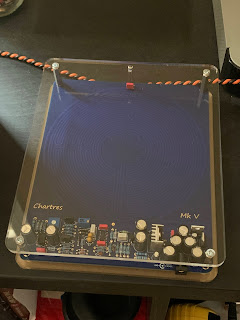
People have been talking about the effects of the so-called Schumann wave, or rather its suppression, on our auditory perception for a long time. I won't really get into it, a quick internet search will find a million such discussions. Several firms including the Japanese Acoustic Revive have been engaged in producing Schumann resonators as audiophile tweaks for many years. Out of sheer curiosity, I purchased such a resonator on eBay that seemed well built from a reputable seller for a reasonable cost. 

These devices promise a variety of effects ranging from a clearer audio message and less confused soundstage to improved mood stability and sleep. I can say that the device I purchased actually works, and all of these effects were noticed by me in the first few days of its operation. The problem is that the body seems to become accustomed to them, and through habituation the positive effects or at least the active perception of them seems to fade. Perhaps with more expensive devices this is less of an issue, but I cannot say I am curious enough to find out at this time.

Twenty minutes after installing the resonator in my room, I noticed the soundstage of the Vanatoos became wider, low frequencies seemed to extend a full octave lower, and the overall intelligibility of music increased significantly. The same effects were later confirmed on a different system using headphones.

Step 7: Replacing the grills with Shamwow towels ($10)

When I first got the Transparent Zeros, I tried them with and without their grills which are of very high quality and attached magnetically to the front panel of the speaker. The sound without the grills was clearer but also a bit rude and fatiguing at higher volumes. Conversely, the sound with the grills was more comfortable despite being more muffled. I left the grills on and didn't think anything further of it.

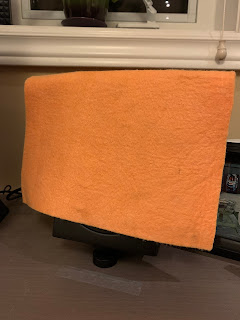
Recently I came across an old post by the Russian audio engineer Anatoly Likhnitsky who described the wonderful effect of placing orange cloth towels over his computer speakers. Realizing I had very similar cleaning towels in the closet, I took them out and draped them over the speakers in place of the grills. 
Likhnitsky computer speakers

I have long since learned to not doubt the influence of seemingly innocuous things on the sound of a system. I have especially learned to not doubt any ideas proposed by Likhnitsky, whom I consider to be something of a genius in the field of audio. I have to still admit I was skeptical of what I would hear by placing these silly orange towels over my speakers. Well, again, I was dumbfounded. If the sound without grills was too rude, and the sound with grills too comfortable, then the sound with the towels was the Goldilocks zone, that is to say just right. There was a sharp increase in the clarity and intonation of music, and yet no fatigue was experienced even at high volumes. I listened to the speakers that night for 6 hours straight with a stupid grin on my face.

If you are curious why such silly looking grills would serve such an improvement, it is because they act as an acoustic phase randomizer. In Likhnitsky's articles, he espouses that phase randomization is a necessary thing in any audio path, and especially in a short one, as an increase in sound clarity offered by a short audio path is also accompanied by an increase in what he calls musical 'garbage' or 'debris'. This 'garbage' or 'debris' are manifested non-linear distortions which are inseparable from (or glued to)  the musical signal. He claims this debris is generated mainly from the decline in sound recording equipment and techniques over the last century, and it is necessary to wash the system of this 'debris' by implementing phase randomization in the sound path. The implementation of phase randomizers can be acoustic, mechanical, electrical and even digital. Grills on a speaker act as an acoustic phase randomizer.

I would also like to draw attention to the notice of the British loudspeaker manufacturer Harbeth, who advises their speakers must be used with the grills in place for appropriate response. They point to frequency response graphs which show a +/- 1dB change in the presence region when grills are employed versus not. Of course, they are correct that their speakers sound better with the grills (I think almost anyone who has experience with Harbeth's can attest to this), but their reasoning for why is absolutely silly. Studies have long shown that listeners will barely perceive, or rather rapidly adapt to, a 1-3 dB change in the frequency response employed through another means, such as digital equalization, but the effects of acoustic phase randomization from the grills is undeniable and goes beyond such simple explanations.

Conclusion

I realize I have spent more than what the Transparent Zeros cost on miscellaneous tweaks, but I emphasize it is not really a matter of linear value. 
Shamwow grills in situ

Firstly, the enjoyment I get out of the tweaked system is massive. If I were to give away or sell all of my other audio equipment, I would be perfectly content listening to music solely through the tweaked Vanatoo system. 

Secondly, because the Vanatoos are a self-contained system consisting of speakers, amplifier and DAC, the effects of any tweak on them are amplified. They have become something of a test bed for experiments, and the amount of time I spend listening to them daily has made me extremely sensitive to any changes in their sound.

Lastly, it is unfortunate that the term 'tweak' has become a dirty word in the audiophile lexicon. I prefer to think of it as sound tuning. If I may be honest, the tuning of any system no matter how large or small is a difficult but important task for satisfaction. It may be true that 20% of the work (stringing together a set of speakers, an amplifier, a source) gives 80% of the result. In the field of audio however, we are often chasing the final 20%, and this is what requires 80% of our time and effort. It is simple for many to scoff at this and swear off 'tweaking' as a waste of time and money. 

I don't blame anyone for doing this, we all have to draw our individual lines in the sand. However if that same individual then spends the rest of their days swapping this amplifier or that DAC for many thousands of dollars in the search of audio nirvana without being cognizant of environmental factors which can have a very real and tangible effect on the final sound, then they are simply engaging in a different but in my opinion more depraved activity.

26 December, 2020

mrgoodsound's Alternative Audio Wisdom for 2021

By mrgoodsound

I am not sure if I am old enough yet to be considered wise but if we treat years spent towards the pursuit of good sound as dog years then I should be about 35 in audiophile years - married with children and chipping away at a mortgage.

My Christmas night was spent listening to spiritual jazz from the greats - Sun Ra, Mingus, Coleman, Don Cherry and of course Coltrane. Having just shaved my head (I avoid the barber due to COVID), I was feeling especially monk-like and engaged in a year-end reflection. I know this has not been a great year for many people, I am very fortunate to say it has not been that bad for me, but in terms of audio and music it was in many ways a great one.

Here are just a few audio milestones for 2020, in no particular order:

1. Acquisition of Klipsch La Scala loudspeakers

I acquired a 1970s pair of La Scala's early in the year, by chance not so long after this home visit where I heard them for the first time. I love these speakers, to do better I would have to DIY a horn system using higher quality drivers at great expense - and even then I am not sure I could match the greatness of the folded bass horn in a DIY endeavor. 

A turnkey, fully horn-loaded speaker system, available at used prices well below the retail cost of modern bookshelf speakers. If you have the space to support these speakers you will be rewarded with high-efficiency (in the true sense of the term) sound, where amplifier choice becomes a matter of taste, not requirement.

2. Converting 1s and 0s using NOS (non-oversampling) multibit DACs

Technically, I had already started becoming interested in NOS DACs in 2019, but it was not until this year that I realized their full potential. Having spent the better part of the last 3 years churning through over 20 digital audio converters priced from $100 to $2500, I actively avoided NOS DACs due to sonic descriptions from others indicating these DACs were overly warm, rolled-off, soft, etc. The irony was that these same people were recommending the 20 or so other DACs I tried and found unsatisfactory. 

After some encouraging experiments with NOS, I went out on a limb and purchased the DAC2.2SE from Ukranian manufacturer abbasaudio. I have not done a formal review of this DAC anywhere and don't plan to. I will just say this is the DAC that has made me stop thinking about DACs. It's renders music from digital sources well enough to make me cry. That's good enough for me.

3. Mono mia! (Telefunken Opus 6 Röhrenradio)

This year I gained an exponential interest in monophonic (single channel) playback, spurred on by an ever-involving interest in historical monophonic recordings. Articles such as "Mono Mia" by Vincent Gallo (pub. Sound Practices Issue #1, 1992) and "Стерео или моно" by Anatoly Likhnitsky (pub. 2001) got me thinking about home sound reproduction in a completely different way. 

I began experimenting with listening to a single speaker (for appropriate recordings), and eventually purchased a Telefunken Opus 6 radio receiver. This fine mono radio from 1956 has 6 speaker units and was carefully engineered to completely fill a room with glowing, glorious music like I have never experienced before. 

There is nothing quite like listening to a late-night classical or jazz FM broadcast on a set like this - it has opened my eyes and inspired me to attempt to achieve the same quality of sound in a full-range high-fidelity system, though I believe I am still quite a ways off from accomplishing that.

4. An expanded musical consciousness

Victories in other audio departments such as the 3 listed above have afforded me the ability to expand my musical consciousness and taste at an exponential rate. In 2019, I listened mainly to rock music, with only a cursory and surface level interest in jazz and classical. Just a year later, I can truly say I am 'into' jazz, classical, oldies, folk and even foreign artists. The discovery of new music has become something as natural and effortless as breathing, enabled by an audio system that not only satisfies but allows me to relish the aesthetics of different genres, recording eras and musical consciousnesses. 

Most of my digital listening is done now on YouTube, where Google's extremely powerful algorithm has a never-ending hole of increasingly obscure recommendations to make. I have subscriptions to many small-time channels whose owners take time to upload rare recordings and performances, including the delicate digitization's of LP and shellac records. The ability to sample a lifetimes worth of music before purchasing a physical copy is a true modern-day blessing.

5. Letting go of audio pretenses & pretentiousness

I use the term 'pretense' here as a polite way of saying bullsh**. 

Bullsh** like:

  • caring what anyone else thinks about your system
  • the audio tribalism and groupthink present consciously and unconsciously in so many aspects of this hobby
  • the meandering and meaningless arguments that take place in so many audio discussion groups and forums
  • what dogmas the 'audio scientists' have to proclaim as false shepherds about what is and is not possible in sound reproduction
  • most of all what those who do not even understand or appreciate music (though they are often the loudest to proclaim that they do) have to say about anything audio-related.

Forget them all. The ability to see through such noise and remained focus with acute perception on what matters most to you will be the most useful tool in achieving aural nirvana and good sound. I say this as someone who is now achieving one audio success after another, only after completely discarding such pretenses and pretentiousness. 

I suggest to ignore anyone who provides you advice without asking and understanding first: what music do you enjoy? what sounds do you like to hear? what sacrifices are you willing to make? These questions form the basis of your aural matrix, and let you pick and choose system components that fit inside of it.

I suggest to not ask even a wise master for advice if you do not have the answers to these questions. It will only lead to disappointment and a sure path to audio hell. 

I suggest to keep around some form of inexpensive system which is capable of providing musical satisfaction: equipment which allows you to enjoy the music you have while finding more, equipment in which your engagement with it remains utterly non-cerebral. It may be a cheap receiver you inherited from a family member, a $20 CD player you found at a thrift store, and speakers you rescued from a dumpster. The less pretentious, the better. 

Assembled, these components will become your sanity control, something to fall back on if you take too many steps on the wrong path in the pursuit of aural nirvana. The one time this pursuit becomes truly dangerous is if the soul & spirit are denied the nourishment of music for an extended period of time, generally from having an expensive system you don't feel like listening to. This is what causes burn-out and audio depression. You have been warned!

Sources of alternative audio wisdom

If you are ready to or are already in the process of rejecting mainstream audio ideology, here are some sites which may provide nice reading material during the holiday break.

The Triode Guild - this website contains articles and publications of the late Dr. Harvey 'Gizmo' Rosenberg. As the name suggests, most of the articles are about vacuum tube amplification, but Rosenberg was a truly hilarious and entertaining writer regarding any subject. I burst out laughing more than once reading articles such as Sex, Music, and Pentodes.

Arthur Salvatore's Audio Critique - this website contains articles and essays of Arthur Salvatore, a lifelong audiophile who shares information on audio philosophy, audio components and the high-end audio industry. I do not expressly agree with all of the opinions on this website, but I would especially implore readers to carefully review the sections of the website detailing the escapades of the audio press and review magazines. The insight is invaluable.

Sound Practices - a magazine published in the 1990s as part of the underground American audio scene, consider it a sort of counter-culture to Stereophile and TAS. Many articles have been republished online though I recommend paying for the entire archive here. The fact that information in articles which are nearly three decades old are still so relevant today show how little forwards progress there is in the audio industry.

Nutshell High Fidelity - the home page of Lynn Olson, containing many well-written and insightful articles on tube amplifiers, loudspeaker design and DIY. Especially recommended is A Tiny History of High Fidelity.

AML - the home page of the late Russian audio engineer Anatoly Likhnitsky. Only a few articles were translated to English but the site can be easily understood using Google Translate. Likhnitsky thinks more deeply and clearly about audio reproduction than anyone else I have ever encountered. He has a cult following of sorts in the East, and some Western admirers as well, including Peter Qvortup of Audio Note UK. Especially recommended to read his article on the death of high-end audio.

With all that said, I leave you with a beautiful tune to relax to as we close out this year. I wish all readers a happy holiday break and much audio success in 2021!


08 November, 2020

Grundig Mystery Amp, abbasaudio Hybrid Pre-amplifier, Gotham DGS-1

By mrgoodsound 

Earlier this year I had quite the eBay addiction, a terrible thing. It has subsided a bit, but I acquired quite a few pieces of equipment on a whim that I had no preset plan for. 

One of these pieces I am calling the 'Grundig Mystery Amp', a mystery because I do not have much information behind its creation or creator, and Grundig because it proudly displays a matched set of vintage Grundig transformers.

Grundig Mystery Amp

This amplifier came from a kind German seller, who claims his retired engineer friend built it and sold it to him. It is a single ended amplifier using the German EL12 pentode as an output tube and EF12 pentode as a driver tube. The chokes, output and mains transformers are all vintage Grundig units, presumably pulled from a high-end console or radio of the early 60s or late 50s. If you know anything more about these transformers, please leave a comment! Other high quality parts include Siemens capacitors and bridge rectifier. 

The greatest attraction of this unit for me was the fact that the single-chassis construction was entirely dual mono, down to separate power switches for the left and right channels. As a budding monophile, it was nice to know I could use this amplifier in a stereo or mono system without hassle. Finally, the mains transformers had secondaries for the 120 volt AC network we use in North America. Multiple secondaries on power transformers seems to be a common theme for vintage German units, and thanks to the foresight of those engineers we can continue to enjoy German tube audio around the world! I simply had to remove the Euro power plugs and replace them with US ones. 

My initial evaluation of the Grundig amp was driving my Klipsch La Scala's, using the Truth line stage and a Philips CD650 CD player. Unfortunately the EF12>EL12 combo was of moderate to low gain, and the Truth could not provide a satisfactory volume level with the output of my CD player. Though what I heard was extremely promising, I had to put the Grundig amp aside for a few months until I got another pre-amplifier. 


abbasaudio Hybrid Transistor pre-amp/head-amp

A few months ago I placed another order with Abbas from abbasaudio, this time for a hybrid headphone amplifier using germanium transistors, a 7119/ECC182 input stage, and an EZ35 rectifier. The primary motivation was to have a secondary headamp to evaluate low-impedance headphones that my OTL amplifier could not cope with. Thankfully, I had the foresight to ask Abbas to install a pre-out on this unit as well, which proved fortuitous when I realized the Grundig would not play with the Truth. 


Firstly, a brief evaluation of the Hybrid as a headphone amplifier. It is simply excellent. There is nothing for me to say that was not already said in my review of the OTL amplifier (linked above), the two are extremely similar in character, and the Hybrid gives up very little, despite residing in a chassis less than half the size. The Siemens germanium transistors used must be competitive with real triodes in their naturalness and ability to convey emotion! For tubes, I am using Amperex 7119 (made in the USA, I hope to try the Dutch-made variant soon), and a US-made 6ZY5G (an inexpensive, uncommon full-wave rectifier that Abbas suggested as a substitute). 

Next, it was time to try the combination of the Hybrid pre-amp and Grundig amp, a most unique and unlikely pairing if there ever was one. Did I mention I am unsatisfied with mainstream audio? But first I needed a rather long set of interconnects to reach from my headphone station to where the Grundig amp lay. 

Gotham DGS-1 coaxial cable

Doctorjohn was very kind to send me a care package of several wires and tubes (including the aforementioned Amperex 7119, thank you very much!), including a long spool of Gotham DGS-1 coaxial cable. My previous encounter with Gotham was only with their headphone wire, which I used to make a cable for my Sennheiser HD600s. Unfortunately I was not too happy with the result, the wire was immediately impressive with a bright, zippy character and loads of macro-detail; but the overall balance was upset to the detriment of music. The LF and lower middle lacked the proper body and weight, leading to a lean and frantic sound. 

Thankfully the DGS-1 is not like this, though it has some character of its own. I made up some long and short pairs using my favourite Switchcraft RCA connectors and evaluated them first using my headphone system to pick apart the sound character. Again, there is not much I can say that doctorjohn has not already said here, he describes the character of this wire very well. The hue is a bit dark, one might go so far as to think certain HF overtones which would ordinarily cause goosebumps are being lost, but the tone in the MF is simply enchanting. Subtle timing stuff is done well, though the wire is still a little lighter on the LF than I would like. Low piano notes did not have the full resonant weight I would expect.

I recommend this inexpensive cable in a slightly brighter or unruly system, it provides something I would describe as a 'natural dampening' or taming of high frequencies, while preserving or perhaps even enhancing emotion in the middle frequencies. It works rather well for me with the La Scala's. 

All Together

With the pre-amplifier and interconnects ready, I was able to evaluate the Grundig amp proper in the chain below.

DAC: 2008 Mac Pro + abbasaudio DAC2.2SE
Preamp: abbasaudio Hybrid Transistor
Amps: Grundig Mystery Amp
Loudspeakers: Klipsch La Scala

The Grundig mystery amp sounds fantastic! It is thus far the best single-ended amplifier I have heard or owned. I must attribute this in large to the use of vintage transformers, which have a special sound character. I do believe the Germans had already figured out the secrets of making the best sounding transformers long ago, and these arts have been mostly lost to modern manufacturers, at least in the West. 

I have come to realize the best sounding amplifiers seem to be remarkably unremarkable, in that they transmit and convey music and the emotion within intact, without adding too much flair. It seems the high end today, even within the ultra-fi circles concerned with triodes and single-ended amplifiers, are too focused on the delivery of sonic special effects, and the use of increasingly exotic and pricey passive components to achieve this. 

With the Grundig mystery amplifier, I am addicted to listening to historical recordings of famous 20th century performers, as music flows from the speakers in a way that shuts down the brain, with subtle intonations and tone all the listener can really stand to focus on. If I am in a mood to play only monophonic recordings, I simply shut off one channel of the amp and let one speaker sing. The single EL12 per channel is capable of somewhere between 4~5 watts, and has no problem with the La Scala's. These results are being obtained with more common late production 'short bottle' EL12s which I assume are manufactured by RFT, I hope to obtain some early 'tall' EL12 from the firm Telefunken soon. 

I leave some examples of delightful recordings and performances enjoyed from this setup below:

06 October, 2020

From mrgoodsound: Music from the computer!

By mrgoodsound


Hello! I apologize for the lack of articles from my end, there has not been enough time to listen to gear let alone write about it. 

Today's article is about a very advanced subject; one that many people on the internet, in forums, think that they have all figured out. Unfortunately, like many things in audio, it's complicated.

I am talking about how to listen to music using a computer as a digital source. Streamers are the latest craze in high-end audio, and manufacturers were quick to launch products which are essentially closed-system computers in fancy cases for obscene prices. More tech savvy users have already figured out how to copy the efficacy of these products for a fraction of the cost using an inexpensive Raspberry Pi mini computer and some specific add-ons. 

The oldest and most successful computer for music playback is the CD player! Its technical weak point is the optical conversion, reading a disc via a laser system and generating an electrical data stream. But besides this, it has many advantages the modern computer does not: a short signal path, absence of interference, construction using fine vintage components designed for audio, a bare minimum of software, etc. 

As much as I like to play CDs, I have the need to listen to rare recordings which were never issued on CD, or have become impossible to obtain on factory discs. As much as the streamer and networked audio fad has taken off, I have other specific requirements which preclude me from such a solution.

For my digital source, I require:

  • The ability to stream Tidal, for modern recordings
  • The ability to stream web-based content, such as YouTube, NML, internet radio, sites containing archived rips of 78 rpm records
  • The ability to view music videos and concert films while listening
  • The ability to rip and burn CDs
  • The ability to play local files without an internet connection
  • The ability to output sound via USB (more on this later)
So basically, I need a regular computer with a monitor, mouse and keyboard. I do not fit into the headless (controlled remotely) streamer crowd but at the same time want the best sound quality possible. What to do?
For the past year, I have been using a modern HP laptop running Windows 10. It has been connected to a USB-to-S/PDIF converter which in turn feeds my DAC. Why a converter? My DAC only has S/PDIF input and the number of ways to get a clean S/PDIF signal out of a computer are very limited. This solution worked OK, but the sound was far from inspiring. I felt for a long time that my digital transport was the weak link in my chain, and I have also felt historically that at least as much attention should be provided to the transport as is to the DAC.
Generally, laptops are not good for audio. They need a switch-mode power supply to charge the battery and all of the components are tightly packed together increasing potential for electronic interference. Generally, Windows is terrible for audio. As an operating system, it already has a reputation for being unnecessarily bloated, and the way it manages the interface between audio hardware such as a USB DAC and the software responsible for audio playback is no exception. There was a strong desire to move to a silent desktop computer using a non-Windows OS.
a simplified view of the Windows audio stack

Shiny new hardware
Luckily, I had an opportunity to purchase an early 2008 Mac Pro from a close friend for a very reasonable sum. This machine had seen service inside a recording studio, alongside a fleet of similar machines used for production and file backup. They specifically used this model of Mac Pro not because they were too cheap to upgrade but because there was no point, the newer machines from Apple had seen serious design flaws and reliability issues due to cost cutting.
I took the machine home along with an original Apple display and installed it in place of my Windows laptop. After an hour of messing around with playback software and settings, I started to listen. I expected results, but what I experienced was transformative. The sound was much improved in terms of dynamics, clarity, intelligibility and timing from both internet and local sources! How can this be?
The answer is a mix of hardware and software. On the hardware side, the 2008 machine is simply something to behold. Aside from an all-metal construction and very thick PCBs, even the quality of capacitors on the motherboard and inside the power supply were more like what you would see in a modern audio component than a computer. I was told the power supply in this particular unit was a special part number from Apple designed for low-noise professional applications. I haven't verified if that's actually true, but it would help. 
OSX playback software
On the software side, Mac OSX is simply very far ahead in terms of audio optimization when compared to Windows. There are no competing APIs such as WASAPI, ASIO, etc. but instead just the Apple-maintained low latency CoreAudio system. There is no myriad of hidden settings and optimizations to make scattered around the operating system, no alternative USB drivers to deploy, everything kind of just works. There is not as great a choice in playback software, but this is fine as I was able to find an honest one relatively quickly. 
I first tried Audirvana, which seems to be the go-to 'audiophile' playback for Mac. Supposedly it bypasses the system audio mixer and performs some other optimizations. Unfortunately, it does not sound very good to my ears. The low end is fairly boosted, leaving not much clarity in the lower mids, and the overall sound presentation is very 'hi-fi'. I can see how it would impress others, but I quickly moved on.
I next tried SoundByte, which is actually a sound clip carting software made for DJs and radio operators. You load up sound files and then have a bunch of options to play them back, fade them into each other, etc. Of course I didn't use any of these tools and simply create a playlist of the files I want. For whatever reason, SoundByte is the most honest player: all frequencies have the correct level, the sound gains in depth and more subtle intonations are revealed. 
Older is better?
I should've probably stopped here, already extremely satisfied with the quality of playback I was getting along with the absolute convenience of a computer connected to the internet, but curiosity got the better of me. I read more than once that older versions of Mac OSX sound better, and I decided to try one. My machine came pre-loaded with OSX 10.11 El Capitan. This is basically the oldest version of OSX (2015) which still has wide compatibility with modern software such as web browsers and media players. It ran reasonably well on my 2008 Mac, but there was still an occasional slowdown and freeze.
I decided to go way back and settled on OSX 10.6 Snow Leopard (2009), for several reasons. First, it would've been a period correct OS to be running on my particular machine. Second, it was the first release of OSX where Apple abandoned PowerPC compatibility and thus had a general reputation for being stable and lightweight. Third, I read a few anecdotal impressions praising the sound of this release over subsequent OSX versions. 
Since the Mac Pro has multiple hot-swappable hard drive bays, it was very easy to install an alternative version of OSX without interrupting my current installation. Two hours later and I had a fresh install of Snow Leopard, ready to test with music. To my surprise, my USB audio device was detected instantly and playback worked right away without additional configuration. Not yet internet connected and not wanting to use iTunes, I simply pressed play on the first file I found through the system default 'Quick Look' media player. 
Well, I was rather stunned at the results. There was another leap in sound quality, perhaps even to the same magnitude of jumping ship from Windows to Mac in the first place. I immediately heard greater articulation, finer detail, less aggressive and glassy sound, better rhythm and timing, and a more correct volume between instruments in the mix. How can this be? I don't really know. All I know is that at this point preconceptions about computers and digital audio should be left at the door, and the only solution for good sound is through tinkering and exploration. I went back to the Windows laptop for a reality check and was disgusted at what I heard, a sound that was simultaneously dull and aggressive. Go figure.
Trouble in paradise
My victory celebration ended when I tried to go online. The old version of Safari that came standard with the installation was simply unusable, it couldn't even load the Apple website. I had to download an old, unsupported build of Google Chrome using another computer and transfer it over. Next, I realized that the TIDAL web player wouldn't work. Well, this was to be expected. Lastly I tried YouTube and while it did play audio just fine, going full screen caused the video to become choppy and lag the entire system. Such is the fate of old operating systems, but at least I can still listen to rare and historical recordings online.
Like Icarus, I ended up flying too close to the sun. My installation disc for Snow Leopard was version 10.6.3, and the version recommended to me by a foreign acquaintance for best sound was 10.6.6. I went to Apple's website, downloaded the appropriate patch, and let it install. Upon rebooting the computer, it just hangs and will not start. I suspect a display driver error as the original video card in the system was replaced with a better one. Oh woe is me, as I became greedy and could not settle for one large jump in sound quality for a day. I will have to erase the drive later and reinstall 10.6.3. Thankfully, I can go back to using my original El Capitan installation at any time just by holding down a key during system restart.
Next steps
The results of these experiments have convinced me the old Macintosh computer is a very suitable digital transport. I would not recommend the Mac Pro, it is very large and rather expensive, but a Mac Mini of a certain vintage is an excellent choice and will fit into an audio rack. In fact, there was a period of time in audiophilia before the popularity of networked audio and streaming that Mac Mini's ruled the roost for music servers. I would not recommend the modern ones however.
For me, I am curious at just how farther this can go. I plan to acquire a PowerMac G4 from 1999 to see how it sounds for playback of local files. I am doubtful it will support my USB device but there are other ways to extract an audio signal from it. If this all sounds quite insane, it probably is, but it's also fun. I got quite a kick out of using an 11 year old operating system to play music, and messing around with software is free. The best advice I can give for computer audio is to dedicate the computer system to the task of playing audio, and ditch Windows entirely.

19 May, 2020

Linear Tube Audio MicroZOTL MZ 2.0: A second opinion

By mrgoodsound


Editor: This is indeed a Milestone for this Blog! Readers should examine the two distinct views and think philosophically! Perhaps Leave a Comment? Have Fun!

Today's article will be very unique, in some ways a first for the blog, and my most ambitious yet since doctorjohn invited me to start writing a column some months ago.

For context, over two months ago I exited my loudspeaker purgatory by acquiring a pair of 1978 La Scala's. I absolutely love these speakers and mean to provide something of a write-up on them, but several adjustments to my listening room need to be completed first. In the interim, I was searching for a low power (<10 watt) amplifier I could replace my Lance Cochrane 6550 amplifier (50 watts) with to fully exploit the La Scala's efficiency. I was very intrigued by doctorjohn's praise of the microZOTL2 and after some deliberation placed an order for my own unit, with the intention of using it as an integrated amplifier.

I will spoil the conclusion of the article now: the sound did not work for me and I made arrangements to return my unit to the manufacturer. What follows below is hopefully a coherent analysis of why that is and how I reached my conclusion. Please note I do not really consider it a 'review', nor do I consider myself an 'audio reviewer'. The term makes me cringe, as it has been bastardized by the mainstream audio press and their casual relationships with industry manufacturers. However, it will be a unique opportunity to provide a second opinion to my colleague doctorjohn's on the microZOTL, something which we rarely (read: never) see from the 'professional' audio reviewers. And why not? Multiple perspectives are necessary to reach critical consensus, and infinitely more useful than just one. Sadly, you will not see this from the advertiser-relationship driven audio press. It would not make much sense having two writers tell you how great one component from one manufacturer is when they could each be busy telling you how great two different components from two different manufacturers are.

In recent memory, I can think of only one mainstream review which offered a second follow-up opinion, and that was the BorderPatrol DAC in Stereophile. Unfortunately, it was offered for entirely the wrong reasons: disingenuous journalism to push a predefined agenda, at great cost to the integrity of Stereophile's staff. The original review and follow-up are linked above, though you can read more about the context of the situation in this article from Part-Time Audiophile.

My System


I have never really described my playback chain in detail for the reader, as it has been in a state of constant flux for the last 6 months. I will lay it out now for the context. I currently only use a digital source as my 6 (six!) turntables are all in various states of disarray. This front-end consists of a HP laptop running Windows 10, feeding USB to a USB/SPDIF converter, which feeds S/PDIF to my abbasaudio DAC. The DAC is TDA1541 based and has a low-impedance triode output stage capable of a healthy 4.0V RMS. It can drive an integrated amp directly. My pre-amplifier is The Truth which provides volume control and source switching for the Lance Cochrane 6550 amp. I would like to state I am not really dissatisfied with any aspect of the Cochrane amp's performance. In fact, I am surprised time and time again at just how good it is. However, I did want to see what was possible with lower power, fewer active stages, etc. to really bring out everything my source has to offer. Call it the audiophile's curse. The La Scala's are placed in the corner of the room, angled in 45 degrees to the center, in accordance with Paul Klipsch's placement instructions. Once I tried this placement I stopped considering in-room placement, despite having a good amount of space. Belden 9497 speaker wire is used, my interconnects are all random, nothing fancy, only copper or tinned copper wire.

Options Power supply I ordered the Switch Mode PSU. This is because I really wanted to see if the unit worked in my system before investing in upgrades (in hindsight, a very wise choice) and doctorjohn's praise was sans LPS. Besides, I could always upgrade later. Tubes I requested the NOS upgrade tubes. While I agree with doctorjohn that current production tubes have gotten better, I still avoid them any which way. They always sound coarse and lacking in refinement to old production. I also avoid tube rolling, I prefer when the manufacturer can just supply me with 'the good stuff', like they did in the old days! Remote Yes for me. Remote control for volume adjustment is so important for me. I do not want to be enraptured in a performance and glued to my seat only to feel the volume is one tick too quiet or too loud. I do not want to get up between recordings of varying gain levels. Most importantly, I tend to stand up and pace around the room when listening. This is a weird trait of mine, I don't really know anyone else who does this, but I like to have the remote in hand and be able to adjust the levels as I walk around.

Day One


Impressions of build quality, finish, pride of ownership are all very high. It feels like a premium unit and I love the see-through top cover. I had already waited three weeks for the unit to ship, so when it arrived I immediately finished work and set it up, connecting my DAC to its RCA input. I did not listen to my system as it was (generally, this is an evaluation mistake) and fired up the MZ2. There was no background even with my ear against the tweeter, which cannot be said for every other amp I have tried with the La Scala so far. The manufacturer had advised no burn-in required, so I began listening right away with a live recording of Glenn Gould live in Moscow Conservatory (1957), streamed from YouTube. (I think another article detailing my obsession with Gould is soon due).

I was taken with what I heard right away! The benefits of removing active stages and output transformer were evident in increased immediacy and physicality. The notes were sharper, each individually more distinct, lending to an impression of increased intelligibility and drive. I recall cheering internally, that the microZOTL was a success and that this was the best piano playback I had yet heard. I listened enraptured to the rest of the recording, which unfortunately is incomplete and ends abruptly in the middle of Fugue #4. Desiring more Gould, I put on Haydn Sonata no. 3 from Columbia ML 5274 (the YouTube link I provided is unfortunately 'remastered' and neutered compared to the local file I have). This was just as exhilarating as the live Moscow recording and I felt rather confident after just two recordings that the microZOTL was the bee's knees.

Unfortunately this confidence would be short lived. I began to explore pop/rock favorites and grew rather concerned about what I was hearing. First was Joan Baez's cover of Fountain Of Sorrow. This is a very typical mid-70s pop production from A&M on early transistors. Very clear and distinct vocals with some light overdubbing and snappy accompaniment. What stuck out with the microZOTL was not pleasing, the snappy accompaniment became annoying and sharp; Joan's voice was thinner than expected and a bit detached, despite piercing clarity and forwardness. Technically, the sound was impressive, all the stereo pop record tricks were highlighted like fireworks, the bass was 'tight', but the sound had an unnatural insistence to it not unlike servo-controlled direct drive turntables. I was disappointed and put on a few other pop records, wondering if it was a fluke, but unfortunately heard more of the same. I decided the unit needed break-in and left it to run signal overnight.

Day Two


I returned after the unit had 24 hours of play time and ran through the same recordings as yesterday as well as new ones. I cannot say the sound character changed at all, and I heard the same traits. The playback was too damped; similar to what I would expect listening to the raw multi-tracks of a pop record in a studio on an analytical monitoring system. There was a lack of weight or gravitas around the middle frequencies, voices in general seemed shifted a pitch up. I played all sorts of 60s pop/rock such as Hendrix, The Mamas & The Papas, Jefferson Airplane, etc. hoping to hear a baggier or fuller sound, but it did not come. I did not have a strong desire to listen and decided to return after the 100 hour mark had passed.

Day Five


I returned after the unit had 100 hours of play time and ran a loop again through all the same recordings, listening acutely for improvement in my areas of concern. One thing is for sure, the sound character did not change at all with break-in! I had watched the Johnny Cash biopic Walk The Line (2005) the previous night and decided to run through some of his catalog with the microZOTL. This was the final straw, Cash's voice was lacking its smokey Southern chestiness and I found the rockabilly tunes repetitive and fatiguing, despite impeccable 'timing'. This was especially shocking considering I had just been enjoying them on my Vanatoo desktop speakers the night before.

At this point, I shut off the microZOTL and switched back to the Truth + Cochrane combo. After 15 minutes of warm-up I played the same Johnny Cash tunes. Instant relief! The body returned to his voice, the accompaniment was certainly a little more smeared and not as lithe but certainly played with more warmth and communication of musical intent. If anything, the little bit of smearing contributed to a greater sense of 'human' playback. An analogy can be drawn to the 'quantization' of modern pop/rock records which removes all human elements in favor of perfect transients and timing. The effect here is not so drastic but easily felt when switching back and forth.

I went in a complete backwards cycle, playing through every record from the past week and with each felt more relief, less annoyance, more enjoyment and relaxation. I came full circle to the same 1957 Gould recording from day one and realized that I preferred that too on the Truth + Cochrane. The recording was actually transformed, as if I was hearing an entirely different interpretation of the same piece. Gould's playing was less frantic, the individual notes stood out less but their relationships and melodies a hundred times easier to absorb. Intonation especially in the low-end came through clearer. Despite having four cascades (6SN7 input, 12AU7 voltage gain, 6CG7 phase inverter, 6550 output) and an overkill power rating for my speakers, the Lance Cochrane amp scored higher where it mattered.

At this point, my thoughts on the MZ2 must read as very critical and fairly negative. I want to be fair to it as a component and provide a description of its sound, in my system, absent from the feelings experienced or recordings played in the past week. To do so I will use the framework for all aspects of sound provided by Anatoly Likhnitsky's 7 Words About Audio Examination Errors (2001) to dissect the MZ2's sound character.

  • Sound proportions (include tonal balance, spatial impression, clarity of sound and dynamics).
Tonal balance is linear, although slightly devoid of euphony or saturation. Spatial impression is distinct with regards to stereo effects as aural objects are thinner, sharper, less stuck together. Clarity of sound as it relates to absence of veil and electronic masking is very high. Dynamics are sharp but the sound is lacking in satisfactory fullness in the LF which in turn affects the dynamics.
  • Soundness of sound (includes vividness, saturation, brightness and naturalness of sounding of music tones).
Saturation is lacking. Voices, wood instruments have a slight pallor, lack of rosiness. Many musical tones take on a frantic, insistent characteristic that can be distracting. Brightness and vividness are present in that the sound is forward and un-obscured, but is more like monitoring a direct mic feed than playback of a finished record.
  • The emotional content of the “sound” (energy, emotional mobility, emotional diversity of the sound of music).
At first confusing and paradoxical, why the emotional content of sound is absent despite the presence of technical excellence as it relates to timing, rhythm and articulation. Ultimately, the sound is stripped of emotional content for the above reasons. 
  • The spiritual content of the “sound” (a sense of the appropriateness of the distribution of musical sounds, the nature of their sound production, intonation, dynamics, rhythm, etc.).
The highest level of perception, which is inaccessible due to the shortcomings listed above. The greater sense of intelligibility from the microZOTL is false, as it is technical and not spiritual or emotional in nature. I really wish this wasn't the case, as for me it is the ultimate damnation of any audio component.

Conclusion

So, you can tell by now the microZOTL is not for me. The technical reasons behind this I can only hypothesize about. You will probably notice that I have not referenced anything from doctorjohn's initial post about the MZ2. This is because I don't actually disagree with anything he said, though obviously our conclusions on it diverge. I could have read his post 100 times and still not have been prepared for what my experience was, but this does not make his review a bad one. Just the same, you may read my impressions and be largely discouraged from trying this amplifier, but you might really like it! When I get curious about something, I try it for myself and form my own conclusion, that's that. Victory or Defeat? I know a lot of people get discouraged when they get a new component and it is not 'the one', and treat the experience as a defeat to recover from. I do not regret at all trying the microZOTL. I have eliminated a curiosity, gained experience, and perspective on where to go next.

Output Impedance The ZOTL amps all have very low output impedance specifications. For the MZ2 it is 2ohms. I have a hunch this is largely to blame for the 'over-damped' character, stripping the sound of its emotional mobility and diversity. I know that when it comes to headphone amplifiers, there is a trend towards a very low OI (<1 ohm) being the most desirable and 'accurate'. This is horseshit, and in my experience these amps sound the worst of them all. Perhaps this issue is only exacerbated by the 16 ohm La Scala's. The Circuit In Sound Practices issue #15, editor Joe Roberts slips in this paraphrased quote: "Sure the Loftin-White was a great amp but if it was that great why isn't everyone listening to Loftin-Whites?". I believe the same can be said of the ZOTL circuit. The transformer is being replaced in the circuit by an impedance matching network of surface-mounted resistors, which will bring its own sound compromises like everything else. For me this was not preferable to transformer coupling. The Evil Output Transformer Actually, the entire basis of ZOTL is that output transformers are a source of distortion which should be eliminated. I will not try to argue with what the scopes say. I will say that there are schools of thought which view the output transformer as a necessary randomizer of sound. The curious and intellectual reader may learn more from Anatoly Likhnitsky's Formula of Sound. With Pre-amp Something that I am not able to try, which doctorjohn did, is use the MZ2 with an active line stage before it that would have a complimentary sound character. I only have The Truth, which does not have much character to speak of, and didn't help the situation when placed before the MZ2. I will say that I never felt the MZ2 was running out of steam or drive with the La Scala's, output power and gain were definitely not concerns.

doctorjohn also asked me to assess the MZ2 as a pre-amp and headphone amplifier. The two components I have for these categories, The Truth line stage and the abbasaudio OTL headamp, I already consider to be 'best in class', and the odds are stacked highly against the little ZOTL amp. I did try it as a pre-amp in front of my Lance Cochrane 6550 and as a headphone amplifier driving my modified HD600s. My conclusions are in-line with what I wrote about it as an integrated amplifier, although its primary shortcomings (lack of euphony, damped sound character) were more apparent listening with headphones as I am particularly sensitive to these aspects there. I will note that the MZ2 performs all three functions and costs the about same as just one of the dedicated units it battled against.

Lastly, a bit of an easter egg in the film Walk The Line (2005). In one scene Johnny Cash (Joaquin Phoenix) is in a radio station ready to debut his first single, when the operator asks him to flip the record. Given that this scene was supposed to take place in the mid-50s, the broadcast equipment is very accurate! You can see a Gray Research 106SP tonearm in action, mounted to what must be a Gates or Rek-O-Kut 16" transcription table. Good attention to detail from the Hollywood set designers!


11 May, 2020

Amp Builder Spotlight: Lance Cochrane, Oliver Sayes, Radu Tarta

By mrgoodsound


Time for some cheap tube audio! I would like to share about some independent amplifier builders I have worked with in the past. Although 'cheap' is subjective, the builders I discuss here put out amplifiers that could be considered affordable by most!

I have little to no interest in commercial or mass manufactured tube electronics (this does not apply to vintage electronics). This is because even if you cannot DIY (my skills are limited) or have no interest in building electronics yourself, there are a number of talented craftsmen in the audio community who put out products that out perform anything from the brand names.

Working with an amplifier builder has its pros:
  • Great deal of flexibility and customization, you may get a unit specifically tailored to your system, speakers or taste. This includes aesthetic and functional considerations too. 
  • Free from overhead manufacturing, marketing and distribution costs; the hobbyist or semi-pro builder may pass those savings onto the consumer when he or she buys direct. 
  • Potential for higher performance. Most brand names are re-hashing the same 3-4 circuits for a given power rating, with minor differences in parts quality. This assures a certain 'safe' performance and sales. The hobbyist or semi-pro has more freedom to explore designs and think outside of the box
And some cons:
  • Limited opportunity to demo their wares beforehand. Usually a purchase decision must be made based on direct conversation and the recommendations of others, which is not an ideal position, especially for a big purchase.
  • Limited resale value. You can only sell to someone who is familiar with the builder's work, and even then at a rather steep discount to what you paid, considering additional costs for customization the potential buyer may not care for
  • Potential for lower performance. Freedom of design means that you may end up paying big bucks for someone else's prototype or design that seemed good on paper but did not sound well on execution. 
  • Potential to go 'overboard'. Given the opportunity to specify what they would like in their amplifier, it turns out that most audiophiles don't have a clue; and are usually too focused on the tubes and parts used, or making their dream amplifier that is not really the right fit for their system. The conversation usually goes something like this:
Prospective customer: "Hello, I saw on your website that you build custom amplifiers. I have always wanted to try a 45 amplifier. I listen to loud rock music with 92db/w efficient speakers. Please help!"
Amp builder: "Yes, I can build you an amplifier, but have you considered a simple 6L6 push-pull circuit for your speakers instead? A single-ended 45 amplifier may not satisfy your listening requirements. I can build a number of push-pull amps with good sounding iron from Hammond or One Electron. Check out my projects page and let me know what you think."
Inside the Sun 2A3 clone - so neat!
Prospective customer: "No, push-pull doesn't sound good, I don't have any experience with it myself but the people on forums say so. I want a single-ended 45 amp. I heard one at my friend's house and now I have to have one. BTW can you source Tribute transformers for me with nano-crystalline cores? And please only use Mundorf film capacitors in the power supply."
Amp builder: *facepalm*

Oliver Sayes

Oliver Sayes aka sonic_oli is based in New York and is really talented! His main offering seems to be Yamamoto/Korneff 45 clones using old stock Tamradio output transformers. It's really amazing that in this day and age one can get such a high quality single-ended amplifier for under $1000 USD from a talented builder. I always see his 'plain jane' amps sell in under a week when listed, though I know he is open to custom orders and I have seen some crazy two-chassis creations from him.

I owned a simple Sun Audio 2A3 clone he did with bargain basement parts - Hammond OPTs, Russian PIO caps and an ALPs pot. Nothing fancy, but it sounded sweet! I would like to try one of his amps based on the 45, 46 or 42 tubes sometime.

Radu Tarta

Radu is based in Connecticut can be found on his blog simplepleasuretubeamps. I would consider him a 'modern' amp builder - he uses very fine modern OPTs, DC heating, filament regulation and overbuilt external power supplies for his amps. As a result his creations are a little more elaborate and definitely not 'cheap', but seriously beautiful.

Radu Tarta 4P1L line stage
I owned a line stage from him using the Russian 4P1L direct-heated pentode, triode-connected and plate loaded into a Lundahl line transformer. It sounded really good, competitive in terms of neutrality and rightness of tone with The Truth line stage, with some 'direct-heating' and transformer flavor. In the end, I sold it on because it did not have remote volume adjustment, which was more important to me.

Lance Cochrane

The next builder I would like to highlight is Lance Cochrane from California. Lance has been building 'scratch amps' for several years and selling his one-off creations on Audiogon. He no longer takes custom/individual orders but if you are lucky you may find one of his amplifiers floating around for sale. They usually go quickly. 
I like the scrappy style of Lance's creations. He reuses the chassis' and transformers from old console, organ and jukebox amplifiers; cleans out the inside and puts in a variation of his favorite circuit he has been working with for years. I have seen his amps feature 6L6, 6V6, 6550, 6BQ5, 6AQ5 and more, typically in a push-pull configuration for somewhere between 10-30 watts.

I currently own an amp of his called the 'Leviathan' which I think is rebuilt on a Conn organ amplifier chassis. It is 6550-based and features a whopping 11 tubes, 3 of which are rectifiers! When I was young and naive, as opposed to now where I am just young, I was anti push-pull for no rational reason. Yes, in general, they sound a little more restrained and a little less free than their single-ended counterparts, but I do not feel this way about Lance's amp. It is capable of sounding psychedelic and graceful, despite having enough current on tap to drive just about any conventional loudspeaker. The best part is that Lance builds for trouble-free operation, automatic bias on everything, no adjustments to make, output tubes run softly.

Finally, I will share an excerpt of an email from Lance where he describes the signature of his amps:

"What makes the power number? The higher the plate voltage, the higher the power. KT88/6550 for instance will be run at 600v on the plates commonly while 6V6 can't take over say 325. That's a starting point. How much the output tubes take and what you give them are separate things.
I tend to not give output tubes anywhere near their maximum ratings. The harder you run them, the harder the sound and the sooner that they wear out. All in the pursuit of more watts.
Looking a little deeper, the voltage difference between the plates and screens determines the class the unit runs in. If you have a big difference in voltage there, like Audio Research tends to do, you get more power. As always, more power comes at a cost.
I like to run the plates and screens with some difference, say 50 volts, but not a lot. That cuts effective power but adds depth. Having the plates and screens at the same voltage would give Class A operation. I've always found that on the bland side.
Mode of operation gives an amp a signature. Voltage on the first tube in the chain gives an amp a signature. Triode versus tetrode versus ultralinear gives an amp a signature. Biasing level gives an amp a signature.
My amps are all tetrode, all run at a soft level of plate voltage, all run at a discrete level of voltage on the first tube in the chain, and all are biased at roughly the same level on the tube curve.
They also are all cathode biased, have low global feedback, and have the same phase inverter.
There are a number of reasons my amps all sound more alike than different. It's all in optimizing the various factors of each unit so that everything falls into the same picture."

Lance Cochrane 6550 'Leviathan'
Conclusion - So, here is my advice if you want to pursue a custom amp. Find an experienced builder who has a portfolio building the type of amplifier you want, discuss your system with them, get their recommendations, provide a budget for the construction, and let them do the rest. If you are scared, wait for one of their creations to come up used at a reasonable price and try that first before commissioning something. The most important thing is that final product satisfies, and no amount of obsession, changing your mind or investing in more boutique audiophile-approved parts will guarantee that. Trust your builder!