Showing posts with label Brand-Musical Surroundings. Show all posts

19 April, 2016

Shure SC35C, BAT P5, ARC PH1, Shindo


Review: Shure SC35C Cartridge, Part II
Letter from NYC (53) 2016 (9)
Review: BAT VK-P5
Vinyl Talk: MM vs MC, Part I
Phonoamp Shootout: BAT P5 vs ARC PH1 vs Musical Surroundings Phonomena II vs Parasound JC3

Note: At first I was perplexed that I got terrible results from the Shure SC35C (see Review: Shure SC35C, Part I), but I now know why. Read on.

Shure SC35C
Puzzling First Impression Almost a year ago, I read a Stereophile article by Herb Reichert, in which he (like others on the net) praises the evergreen $35 DJ Shure SC35C cartridge, used on a Pioneer direct-drive PLX-1000 (his review of the TT here). Now, HR is a seasoned reviewer (though now on the cheap), and the Pioneer he uses is almost the same thing as my AT-PL120 (I suspect they have the same OEM). As he got curious about the Shure, I did too. I bought one from Amazon and enlisted my idling Pioneer PL-10 for the purpose. As stated in my Note and the link above, the result I got was terrible. Frankly, I have never heard a worse sounding setup.

Rejuvenation/Culprit Revealed Still perplexed by the result, this time around I decided to shift the SC35C to my Audio-Technica AT-PL120 for a second chance. As I took off the cartridge leads on the Pioneer headshell, I noticed that they have deteriorated quite a bit, with clip barely hanging on. I installed it on the AT-PL120 and was immediately captivated. Yes, it was a little rough at first, but now I could hear the potential (more sonic notes down below). There! Cartridge Leads are easily damaged with time and during manipulation, and any poor connection adversely affects the sound. The degree of damage the leads did still amazes me.

I added the AT-PL120/Shure SC35C to my reference System II. As I have 2 Thorens tables fighting for the Shindo Monbrisson's 2 phono inputs, I needed to add a phono amp anyway, I used the opportunity for a little fitting.

BAT VK-P5
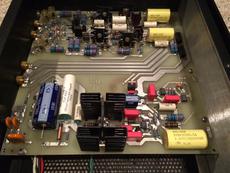
This is an older model, a super-bargain at current second-hand prices. As you can see from the pic, its battleship built and topology bears great resemblance to its current offerings, including the current flagship VK-P12SE (just rave-reviewed in the current May/June 2016 TAS). If you compare, the more expensive offerings differ little in topology, more in component grade and added options, like input transformers (I prefer my own) and output transformers. The P5 uses 8x6DJ8 and 2x6SN7. I have all old stock tubes in them.

The P5 is highly configurable. The maximum (high) gain of 56 db is a little low for very low output cartridges (like my Denon DL-304), but the low gain is a highish 50 db. One can further trim two pots to attenuate another 6 db (44 db). Two dip-switches allow for loading and capacitative adjustments.

For some reason, I have never formally written this up. Perhaps it is because I have previously only used it in balanced mode with the BAT VK-3i preamp, not my usual connection (RCA, as I use SET amps). My previous experience, with Air Tight PC-1 and with Koetsu Black, was very positive, and so is completely at odds with the surprisingly negative review on 10audio (usually this site is OK) and more in keeping with Toneaudio (summary only; more details in its review of the similar P6).

Compared to some other big names, BAT gears are less popular. I think this is due to their insistence on balanced topology. While the preamps have concessions to RCA's, the P5 phono amp does not; there is only a single pair of balanced output, necessitating the use of adaptors when used with non-balanced gears.

Audio Research (ARC) PH1 There is not much info on the net. For an introduction, see my previous experience.

Parasound JC3 Previously reviewed extensively (see here).

Musical Surroundings Phonomena II (see here).

System:
Analog Rig: Audio-Technica AT-PL120/Shure SC35C (and other after-market styli)
Preamp: Shindo Monbrisson (has MM stage)
Amp: Wavac MD-811
Loudspeakers: YL Audio 4-way horns
Phonoamps: Musical Surroundings Phonomena II; Parasound JC3; BAT VK-P5, ARC PH-1
XLR to RCA Cable: Gotham GAC-2/1 and DGS-1

Sonic Impressions
  • Shure SC35C (new stock) Compliance This is a very low compliance cartridge, and my low-medium mass arms are theoretically not optimal (I added a headshell weight). You can press on the stylus and it hardly budges, maybe great for child-proofing? VTF Recommended tracking force is 4-5 gm, and I use 4.5 with no problem. Output As we shall see, the high output of 5mV proved problematic to my system with high efficiency loudspeakers. Initial Sound/Run-In As soon as I mounted the SC35C in the AT-PL120, everything just snapped into focus. Force, colour, everything just exploded. Initially the sound was rather coarse at the top, but it started to smooth out after 20 hours. Likely not fully run in yet even as of this writing.
  • SC35C + Shindo Monbrisson Trying the other phono amps made me realize the presentation of Shindo's MM section - a somewhat softer presentation and narrower stage. But it was perfect for the rather long run-in period. The Shindo tamed the edge of the SC35C (it is important to remember my horns magnify such things) and for the initial period that was what I used. Unusually for me, but highly appropriate for MM, I played many rock and pop records. Even early on, the SC35C took well to rock and the male voices: Willy DeVille's Miracle, Leonard Cohen's Songs of Love and Hate, Dylan's Nashville Skyline and Pink Floyd's The Wall were all rendered with unforced dynamic swing, a fast, clean and powerful bass. On these rock/pop LPs the SC35C outperforms my MC's, and its ease of delivery is just admirable. Only when I played the period instrument Bach Violin Concerti (La Petit Bande; Proarte) or digitally recorded Linda Ronstadt For Sentimental Reasons was some residual upper midrange glare revealed. Of course, with MC's vocals and instrumental details are more nuanced, but the Shure is satisfying enough and rhythmically even more urgent.
  • SC35C + Phonomena II Like before, I had no luck with this one. I tried the various capacitance valued but none was able to change the sterile sound. Nothing offensive and neat, but not inspiring either, and that is a no no for LPs. Abandoned again.
  • SC35C + ARC PH-1 Now, this is more like it. The soundstage expanded in width and depth significantly. Bags of air was accompanied by a little over-the-top treble. To smooth out the sound, I resorted to an old Audioquest Ruby, a solid core cable. That did it perfectly. It shows once again that solid cores can sometimes work when stranded prove unsatisfactory. It also shows that one should consider what the vintage item was paired during its time. For the ARC PH-1, it was likely the era of Monster and MIT, old models that were not so transparent.
  • SC35C + Parasound JC3 or BAT VK-P5 Parasound JC3 Previously I had only availed myself of its excellent high-gain MC stage. I was surprised that the (47 db gain) MM sound was equally impeccably detailed, quiet and smooth. Just like the ARC PH-1, as compared to the Shindo, the soundstage width and depth both expanded. Tonally and dynamically a very even performer. This is a full balanced design. BAT VK-P5 The sound is very detailed and with a wide and deep soundstage. Surprisingly for a tubed unit, the transient attack is very fast and dynamics superlative. The unit also needs an hour to sound its best. As this is tube, there is a little more harmonics, but overall the sound is rather neutral, with just a hint of tube bloom; hence I can see why some tube people may not like this. I tried all of the capacitance options but the basic sound remained the same. As the output of the SC35C is a high 5mV, I used the lowest gain of 44 db by trimming the pots all the way down (see above). Parasound vs BAT Compared to the Parasound (even higher 47 db gain), the BAT subjectively sounds like the gain is too high, and the sound becomes just a little wilder/bright with certain styli. I interpret this to mean the BAT VK-P5 is more dynamic than the Parasound. Part of this is also due to its fast transient attack, again subjectively faster than the Parasound. Put it another way, the solid state Parasound veers towards the warm of tubes, whereas the tubed BAT tends not to be tubey. For BAT, I think it is somewhat unusual to be in the position of having insufficient gain for very low output MC's but seemingly too much gain for high output MM's. Hum Like when I had the Raos mono cartridge (here), both the Parasound and BAT have a grounding issue that I could not get rid of. When the music is playing, it is low enough to be inaudible, but one can just hear it during quiet passages. Maybe the fully balanced phonoamp deos not work well with unbalanced downstream gears?
  • Aftermarket Styli Old Stock 766-D7 (SS35C) I first tried this when the Shindo was used. The sound was somewhat veiled and too smooth. However, with the Parasound and BAT, the sound blossomed with a natural balance. It is a little more refined than the stock, but the stock has a stronger and more projected midrange (particularly evident with male voices). Pfanstiel 4766-D7 The box says Switzerland SS35C, 0.7 mil con., but the seller advertised it as N35X, which was why I bought it. Out of the box I knew something was different. The stylus is much more compliant. Indeed, at 4.5 gm, the belly of the cartridge was almost sweeping the record. I then tried 1.5 gm (like an N35X) and it worked very well, without tracking errors! The stylus looks conical, but it s behaving like an elliptical. Maybe the suspension has deteriorated? I don't know. In any case, the sound is very clear, more airy, extended and refined on top than the stock cartridge. Not withstanding the curious difference in compliance of the Pfanstiel, I have to say all three styli sound more similar than different.
Conclusion The SC35C is wildly good and cheap. It does many things better than even an expensive MC (like effortless bass) and makes one seriously wonder why one should spend more than $40. As a result of this, I have also embarked on a project of rejuvenating my Empire's (2000E/III and 2000Z) and I also took them to listen at Andy's setup. So more later as we delve deeper into MM vs MC.

16 October, 2013

Review: iFi iPhono, Nagra BPS


Review: iFi iPhono, Nagra BPS

Talk Vinyl: iFi iPhono vs Musical Surroundings Phonomena II (also Nagra BPS, Audio Technica AT-PEQ3, AQVOX 2CI and Fosgate Signature)
Talk Vinyl: Naim Nait I vs Jolida JD-9 vs MFA Magus B vs iFi iPhono

ifi Audio Micro iPhono MM/MC PhonostagePart I: iPhono
Prologue When I first wrote about the iFi iPhono (here) almost a year ago, I could not find any reviews. Subsequently, a few appeared, and here are some links:

Reviews: AnalogPlanet; EnjoytheMusic; MonoandStereo
Interview: Designer Thorsten Loesch Interview in MonoandStereo

First, A Long Digression 好事多折磨
In case you wonder why the real review of the iPhono took so long, it was because it was to be months before I actually heard it in my own system! It went through several guest systems before joining mine. I would like to spend a little time describing the journey as some of the results add to my understanding of this unit, and I'd also detour a little to write up briefly on some other phonoamps I have encountered. In case you cannot wait, you can jump to the real review below. I'll give you the conclusion on iPhono first: the iPhono is a wonderful phonoamp, but it may take time and care to reveal its considerable strengths.

Detour: First Impression of iPhono (by others) My unit finally arrived about one month later. As I usually do not have time to spin vinyl these days, and as my usual abode has no vinyl set-up, I asked friend A (vinyl and tube fanatic who uses Quad ESL-57) to pick it up for me and test it out. After a short try he told me the sound was not bad but a little too thin for his taste and I completely understood because I know he likes vintage equipment and a fatter sound. Then I asked him to pass it to friend B (vinyl and jazz fanatic who uses Mark Levinson to drive big MBL speakers) who likes his music big and upfront.The iPhono did nothing for him in this system either. So far, things did not look too good...

Detour: My Second Impression of iPhono (first was at the dealer) actually took place on foreign turf! Friend B decided to renovate his apartment. He had to move temporarily into a smaller place where he listened to a pair of Quad ESL-57 placed side-by-side with reinforcement by corner placement (see pic). This actually sounds a lot better (fuller bass) than many "normally" placed ones! The little Nait I amplifier did a good job driving them. On the day I went to pick up my iPhono we actually did a small session of phonoamp shootout (MM only). The turntable used was a Linn LP12 (Valhalla) fitted with a Decca arm and Decca Maroon cartridge. Loading was at the standard 47k, so some may argue about that.

The result was not surprising. The iPhono easily bettered the Nait. The ultra high-gain hybrid Jolida JD-9 (a unit bought in Shanghai) was more overtly exciting than the iPhono but less refined. The owner had also borrowed my MFA Magus B, and on this occasion it was used as a phonoamp via its Tape Out. The MFA was decidedly the best, and that did not surprise me as its phono section is amongst the best I have heard, very quiet for a tubed unit as well. 

Mahler Symphonie 3 Jascha Horenstein Mahler Symphonie 3 - Norma Procter, Jascha HorensteinReview: iFi iPhono

Shortly after I reclaimed my unit I took it to New York (thanks to its universal PS, one reason I bought it) where I finally had the chance to really test it out during the nearly 3-month stay. I knew that it was probably not run-in, so it was one of the first things I plugged in! In NYC I spin vinyl almost exclusively. Equipment used this round:

Analog 1: Linn LP-12 Lingo/Ittok LV-II/Airtight PC-1
Analog 2: Clearaudio Concept/Koetsu Black
Analog 3 (mono): Thorens TD-309/Denon DL-102
Other Phonoamps used: Fosgate Signature (my experience here); AQVOX 2CI MkII used only for MC (here); Musical Surroundings Phonomena II (here); Nagra BPS; Audio Technica AT-PEQ3 (only MM)
Digital: Ensemble
Preamp: Manley Neo-Classic 300B
Loudspeaker/Amp 1: Magnepan MG 1.7 (used with Sunfire 300 amp)
Loudspeaker/Amp 2:-YL Acoustics 4-way Horn Speakers (used with Wavac MD-811 SET amp)

My previous phonoamp group review covers some of the units on hand for comparison, so it is relevant for this article. I dare you to find a more detailed or useful iPhono review! :-) I must have played more than 100 LPs during my stay, but I will single out 2 of them. The Unicorn Horenstein Mahler 3rd (in the US also on noisier Nonesuch) is a magnificent recording of a magnificent performance, with a huge orchestra and more than one chorus! Note that this famous recording is now on HDTT reel-to-reel tape!The Miles Davis Tutu is of course classic and one of my favorites, still Marcus Miller's best effort. There are many passages of complex instrumental interplay that tests the phonoamp's savvy. Another reason I use this LP is because I have the CD and I use them to make sure both the digital and analog rigs are balanced. Vinyl enthusiasts should do this often; too often they tweak so much that the sound is way off.


Observations I am not going to give a blow-by-blow description of how various LPs sound with the iPhono. It is not necessary, because (thankfully for all the right reasons) its sound really does not stand out. But over the few months I made some observations that I think are interesting:

  • Note 1: My impressions are almost exclusively based on the MC setting (I do not listen to MM much, though the mono Denon DL-102 uses the MM setting). For MM, usually I'd prefer tubed amplification.
  • Note 2: I got so caught up by my listening that I did not spend any time evaluating the equalization curves (though I have many mono LPs). After all I do believe the basic aspects of the phonoamp are much more important.
  • Run-in I suspect the unit needs quite a bit of run-in. I am sure it had a lot less than 20-30 hours on it when I got it back. Initially the sound was a little uninspiring, but I just played on. Read on.
  • Vibrations I have said before that my racks in NYC leave something to be desired (placed on stone slabs on thick carpeted wood floor). Certainly, it made my preamp prone to microphonics. I found out the light and slim iPhono was quite susceptible to vibrations! I could hear a trace of smearing much like microphonics in nature. Putting two Vibrapods (here) underneath immediately cleaned up the sound and gave the impression of more solidity. I also noted that the susceptibility to vibration decreased with time and run-in; I wonder why? I also tried Tony's trick of putting some books on top but in my setting that did not reap extra benefits, so for the entire duration in NYC only the Vibrapods were used.
  • Background Noise (lack of) You should note that among the battery of phonoamps here iFi is one of the few that fearlessly publish various specifications (AQVOX and Nagra do; Fosgate and Phonomena don't). One listen and you know why: one is immediately impressed by the extremely low noise floor (Signal to Noise Ratio 82dB). This is black background unusual for a budget phonoamp, indeed unusual for any phonoamp! In comparison, it is as quiet as (or quieter than) the more expensive AQVOX and battery operated Nagra (no mean feat!) and certainly quieter than the (pretty quiet) Phonomena II and Fosgate Signature (which is excellent for a tubed unit). This low level of noise, especially in MC, is quite an accomplishment. Now, that brings up the next question/observation.
  • Dynamics, or Is there Life in Low Noise? This is a little hard to describe. Experienced listeners know that with lowered noise and darkened background often comes a degree of "reticence" in the music making, as if the baby has been thrown out with the bathwater. It is often debated whether the "diminished dynamics" is just erroneous human perception. In such cases, often the music only comes to life when you crank up the volume. Now, personally, especially as a tube and vinyl person, the debates aside, I am not obsessed by noise level but I do think any component/system that cannot be enjoyed at a low volume, that does not have good microdynamics, is bad, period. Not so the iPhono - in my reference systems it performs just as well (and sounds just as as well and quiet) at all volume settings, with all kinds of music (unlike the Phonomena II). Its dynamics are properly scaled. In the grand opening of the Mahler, the iPhono puts you in a mid-hall perspective. In contrast, the Phonomena II is upfront. While the latter may have more overtly exciting bass and slam, overall its presentation is falsely highlighted dynamically. As the movement goes on, with the iPhono one is aware of natural progression, of unfolding drama, whereas the Phonomena II increasingly seemed to be a pastiche of highlights. I do think the composure demonstrated by the iPhono means that while it will work best in a balanced system, in less ideal circumstances I rather think it should work better in an over-energized system than one more sedate. The corollary is that the iPhono, unlike much modern hifi, does not set out to "impress" - it rather demands you to listen carefully (and you can do that at low volume!)
  • Hall Sound Experienced listeners listen for the hall sound, or that of the recording venue. In digital, a good example of the faithful rendering of hall sound would be the 16-bit TDA1541 chip; nothing else since has really come close (all you have to do is compare a 16-bit Revox B226 with a later delta-sigma Revox C221 and you will know what I mean, though the latter is a very fine machine otherwise). The iPhono is exceptional in this regard. The Mahler just heaved and sighed, bathed in the hall acoustics. I am not surprised, given that designer Thorsten Loesch is a fan of the 16-bit chip! In contrast, the upfront Phonomena II gave no clues to the hall, a serious failing to my ears.
  • Rhythm and Pace The iPhono is excellent in this regard. The flow of music is always natural, yet not without a spring in the step. Take Tutu as an example, the various instruments were not unduly highlighted but the delicate interplay came over as part of a whole fabric. The Phonomena II on the other hand seemed to be more visceral initially, but soon I got worn down by a certain uneasiness - the music just did not flow as the phonoamp imposes its own insistent quality.
  • Gain The gain of the iPhono is pretty standard. Since my favorites are big orchestral music I use the +6 db setting. At high volume, I do find it a little more dynamic and not much noisier. The gain is sufficient for my Koetsu Black, Air Tight PC-1 and Denon DL-304.
  • vs Fosgate Signature In some ways the iPhono breathes in a way not unlike the Fosgate. The tubed unit has more bloom (as it should) and dynamics, though comparison gives credit to the iPhono for running it close in its fine grain, details and smoothness, an achievement for a solid-state unit.
  • vs AQVOX 2CI MkII The AQVOX is quite a different beast in its design. Used in balanced mode it has higher gain (though reduced by my use of an adaptor I am sure). The AQVOX is more overtly exciting and dynamic than the iPhono, though the latter runs it close in details and S/N ratio. I love the AQVOX and it shall remain one of my references, but comparison certainly made me respect the iPhono!
  • vs Audio Technica AT-PEQ3 (only MM) Michael Fremer (Stereophile, Vol. 32 No.12 December 2009) had this to say abount the AT: "How about a sweet sounding starter phono preamp that lists for $119...? It's the Audio-Technica AT-PEQ3, a little plug'n'play box with a wall-wart power supply that's quiet, sounds clean and surprisingly dynamic, and get's the job done remarkably well.". Using the mono DL-102 I did compare this against the MM section of the iPhono and Phonomena II. The AT-PEQ3 is more like the iPhono in reduction, a unit that lets the music flow naturally, unlike the upfront and unnatural Phonomena II. Of course, it has appreciably less details and dynamics. I also briefly added a step-up transformer for MC use - not bad! A fine unit at the price!
  • vs Musical Surrounding Phonomena II If you have read this far you know that I do not much like the Phonomena II. Yes, I much prefer the iPhono! To me, all the praise heaped upon the Phonomena II just shows how wrong hifi has become.
Conclusions

  • The iPhono is unusually fine-grained and quiet (not just at its price, but comparable to most products regardless of price). It makes the music flow naturally, and has excellent rendition of hall sound. It doesn't play to the gallery, instead rewards in the long term.
  • The iPhono compares well to more expensive phonostages (even to the Nagra BPS reviewed below), and so is surely a BEST BUY. I think mid-priced phonoamps, not to mention budget ones, will have a hard time going up against the iPhono.
  • In the company of all the phonoamps I have,  for three months I listened mostly to the iPhono (save for comparison purposes); that should tell you more than this review how satisfying the iPhono is!
  • Take time to run-in and check for isolation.

page_BPSPart II: Nagra BPS
I have always been a fan of Nagra and have owned its tubed full-function preamp, the wonderful Nagra PL-P (my reviews here and here) for a number of years, so I am quite familiar with its phono sound. Recently I acquired a BPS and took it to NYC, where I tested it by the side of the iPhono.

Whereas the phono section of the PL-P preamp and the newer VPS phonoamp are tube-based units, the BPS is a solid-state device. Although tube-based, the VPS uses solid-state devices for its last 16 db of gain (unlike the PL-P, which I think is all-tube). Like its more expensive brothers, the BPS employs transformers (wound in-house) for MC step-up function. Like the PL-P, the BPS is battery-operated, though in a simpler manner by using a simpler 9V cell. Thus, you can infer that the BPS is no cheap compromise, as borne out by its sound.

The BPS (official literature) has been well reviewed (using multiple high-end cartridges) by TAS and Stereophile. 6moons has a review too but it is limited to use of the Denon DL-103.

After spending so much time writing on the iPhono, I am going to be a lot briefer when it comes to the BPS: simplement fantastique!

Observations
  • Much of what I wrote about the PL-P (links above) can be applied to the BPS! Indeed, comparing the BPS to the PL-P (from memory, though I did have the PL-P on hand but did not fire it up) is not unlike comparing the iPhono to the Fosgate (see above).
  • The battery-operated BPS is very quiet. But the iPhono is subjectively equally (perhaps even more) so. In this regard, the achievement of the iPhono is outstanding. If blind-folded and asked to tell which is battery operated, I just may say iPhono!
  • The BPS is fast and  has a leading edge that is just right in speed and sharpness. Its superb microdynamics make music easily come alive. In these respects I do prefer it to the much cheaper iPhono. Here, for the same reasons that I detailed in the section on background noise in the preceding iPhono review, I should say I am not usually a fan of batter-powered equipment, but the BPS does not suffer any of the shortcomings of battery operation. In terms of macrodynamics, it is certainly not wanting. In some regards, sonically it resembles AQVOX the most.
  • Like the iPhono, if you don't use care in cabling tonally the BPS may be a wee tad towards the lean side, but still far from lean (think Phonomena II). It has just a tad more bloom than the iPhono. In both my systems, it rendered everything faithfully and, importantly, delightfully. I am not sure what the 6moons reviewer was talking about when he mentions the mid-bass/bass. My opinions are closer to the TAS and Stereophile.
Conclusion
  • The BPS, though not cheap, is actually a Best Buy!  It is now one of my references.

02 June, 2011

Group Review: 8 Phonoamps (ARC, AQVOX, PS Audio, Musical Surroundings, YS Audio, Linn, Elekit)

Group Review: 8 Phonoamps
ARC PH-1 and SP-9, AQVOX 2CI mkII, PS Audio GCPH, Musical Surroundings Phonomena II, YS Audio Solo 2, Linn Kairn, Elekit TU-875
Vinyl Talk: Phono pre-preamplifiers
Vinyl Talk: How good are outboard phonoamps?

In this age of the line preamplifier, many people actually prefer outboard phono units. For people like me though, who have held on to vinyl through the birth, middle age and old age of CD, full-function preamplifiers with built-in phono stages are still de rigeur.

It can be said many of my reference (tube) preamplifiers (Nagra PL-P, EAR 912, Verdier Control B, Shindo Monbrison, not to mention older units like ARC SP-10/11, Melos 222, Counterpoint SA-3000 nor truly classics like Marantz 7C) have built-in phono sections of exemplary quality that cannot easily be outclassed by even expensive outboard units. That said, occasionally I do play with some, and recently I tried or (re-) tested quite a few while setting up my various setups in NYC.

For the record, I prefer at least some tubes in the phono section (even with my efficient 100 db horns). I used mainly 3 turntables with my SET setup (see also sidebar) and this rambling review is in no particular order:

--Thorens TD-124/SME 3009 S2 imp/Denon DL-304
--Clearaudio Concept/Koetsu Black
--Audio Technica AT-PL120/Denon DL-102 (mono)

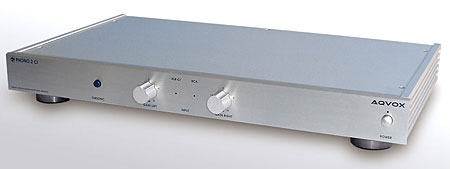
AQVOX 2CI MkII
This one intrigued me the most. Ever since I read Fremer's review in Stereophile I have wanted one, not because of Fremer, but because of the design. Not because of its fully balanced nature, but because of its innovation. My experience with this phonoamp tuned out to be exactly in line with the very thorough report in Stereophile, as well as reviews in tnt-audio and 6moonspositive feedback and particularly from 10 AudioSalute!

The seller of my unit had balanced tonearm cables whereas I do not, and was not about to re-terminate. So I started with the RCA inputs. It performed well but not quite distinctively. So I moved onto the XLR input. Not about to buy their own adapters, I decided to use my cheap Chinese XLR to RCA adapters. I knew this would not work as is, and certainly no sound was obtained by plugging them in directly.

I opened up the adaptors and saw that pin 3 is tied to pin 1, and that is the connection you have to break (pin 1 should not be used). Some quick de-soldering action later, voila! And what great sound! One play of Kondrashin's Philips LP of Shostakovich Symphony No. 15 and I decided it is going to be a long-term relationship. If you know this symphony, you will know that the equipment's main job is to (1) portray accurately the battery of percussion; (2) to convey a certain quality of life ticking away, an enigmatic quality. You may think (1) is not so difficult, and certainly the AQVOX performed miraculously in this aspect. Certainly, I tried the same LP on various phono setups, including tubed ones, and AQVOX's performance remained unrivalled. Even more importantly, it conveyed (2), proving it is not just merely an analytical machine, but a master communicator! A winner!

Audio Research PH-1(PH1)
It is interesting to study how ARC makes phono equipment. Indeed ARC played the most important role in keeping tube preamps and tube phono equipment alive during the transistor years. All the older tubed SP series (which they in recent years revived a little) preamps have built-in phono sections (seriously speaking, they are only MM stage) of superb quality. I have owned and am quite familiar with the SP-3, 6, 8, 9, 10 and 11. In HK, until a few years ago I used the SP-11 MkII as my reference (still with me). With my sensitive horns, the lowish phono gain of the SP-11 (higher than the others) was enough even with my MC, the Denon 103. During these years, ARC made the mostly solid-state MCP series of phono pre-preamplifiers to satisfy the requirements of increasingly low output MC cartridges.

In 1989, ARC abandoned the SP series and introduced the LS series linestages. Of course, they needed to make outboard phonoamps to go with these, and the PH series was born with the introduction of the solid-state PH-1. Since I have always had ARC SP preamps around and they have superb phonostages I did not really need to try these out.

When ARC introduced the tubed (actually hybrid) PH-3 I did try it out. The sound was not quite like the phonostages of the SP series: less full bodied even after tube-rolling, a lighter sound. But its Achilles heel was a lack of dynamics. The nominal 54 db gain was a bit over-rated IMHO. I sold it after a while.

Fast forward to now. Recently I got a PH-1 (full info here) in excellent condition, and I was surprised by its performance. At 48 db, the gain was low and I could not use it with my MC's even with my horns. But partnered with step-up transformers the sound was crisp and full, dynamic and lively, in the best of the ARC tradition.

There is an interesting review of PH-1 by Stereophile-Robert Harley. There is also an interesting comparison of PH-1 vs PH-3 in Audiogon. For me, the PH-1 is a keeper, a better phonoamp than the later, popular and rave-reviewed PH-3. For one as dedicated to tubed phonostages as I, that says a lot. YMMV.

Musical Surroundings Phonomena II can be quickly dismissed. Although it has enough gain for my MC cartridges, and loaded with features, I found the sound curiously lacking in finesse. It has good bass and reasonable dynamics but, most annoyingly, strings lacked sheen. I played several Heifetz mono LPs through the Denon DL-102 mono cartridge and the violin sound was so lackluster it was not better than the AT's built-in phono!!) A switch to the ARC PH-1 immediately restored normalcy. So much for all the rave reviews; it turns out the small prints are much more important than the rest of the reviews.

PS Audio GCPH (Stereophile, What HiFi?) fared much better (see also my previous experience). You can frequently find this phonoamp discounted and so it costs just a little more than the Phonomena, but its performance is in another league. There is just more music, and it performed evenhandedly with all set-ups. MM and MC alike. Heifetz? Yes, I recognize the sound, though I still give the edge to the PH-1. For a cheap full-function phonoamp, the GCPH is well worth considering.

YS Audio Solo 2 Phono pre-preamplifier
And now for something different, but what exactly is a pre-pre? Well, if a phono preamp is like foreplay (which is after all something before amplification), a pre-pre must be what happens before, I guess perhaps seduction, or whatever it takes to get to foreplay.

The active phono pre-pre is now a rare bird and no longer fashionable. In this high-noise age, it is no wonder stressed out audiophiles demand low-noise, and for additional gain when using low to ultra-low MC's usually opt for the even older but quieter technology of Step-Up transformers. An additional powered unit and an extra set of cables certainly can be cumbersome. But I have always thought the active pre-preamplifier has a valid reason for existence, as transformers can be colored and bandwidth-limited, and I still own the wonderful Klyne SK-1 as well as the Mark Levinson JC-1DC (one day I hope to acquire a Counterpoint SA-2). For myself, and perhaps I belong to a minority, if gain, noise or tonality are not issues, I prefer the potentially greater dynamics of fully active amplification rather than having a transformer in the signal path, but as always experimentation is the key here.

YS Audio Solo 2 is that rare bird. As a matter of fact, I cannot think of another CURRENTLY produced phono pre-preamplifier!! And it is one with a twist too. It is basically a solid-state device, but with a tube regulator (solid state rectification >> solid state regulator >> 6N3 regulator >> to gain stage)! I got it in HK but took it to NYC, where I proceeded to try it out in august company. Using the Chinese stock tube it proved immediately a winner. I set all my MC/MM full function preamps to MM and connected the Solo 2 with Kimber KCAG. As expected, it immediately proved its superiority over the JFET section of the Elekit TU-875. More importantly, it was not shamed by the step-up transformers inside the Verdier Control B as well as the EAR 912. Noise is acceptable for use with my Tannoy Canterbury HE, Gain is very good and sounds like more than its spec of 20 db. In NYC, it proved quiet enough to use with my 100 db YL horns. I also tube rolled a bit. The WE 396a proved superior, though a little noisier than the stock 6N3. Unfortunately, my Bendix 2C51 on hand proved too noisy in this circuit. But it is amazing the tube regulator has such effect on sound.

Why not get a free line preamp with your phonoamp?
Outboard phonoamps come in all sizes and prices, but I can tell you one thing: it will take quite an expensive phonoamp to outperform the phono section of (usually older) full-function preamp. And so it makes sense to buy an older full function preamp and just use its phono section via the tape loop. In such case, you would not want a bulky or hot tubed unit, but there are ample choices.

An example is Linn Kairn with Brilliant power supply. Used in MC mode, it has high gain, is quiet enough, and tolerant of loading (works equally well with my Denon DL-304, Koetsu Black and Ortofon MC-5000). Some say it is as good as the Linn Linto. I don't think so, but the performance is certainly very good. For the same price as an outboard phonoamp, you get a full preamp and remote facilities (the preamp ain't bad, but I am a tube man)!

Of course, it would be even better to go tube. Here, you'd want a unit that is not too bulky or hot. I highly recommend the hybrid ARC SP-9's phono section, which offers 46 db of gain. The vinyl replay is pristine, quiet and nuanced, and if I am forced I'd think perhaps even better than the PH-1 . The whole preamp uses only 2 tubes and is only warm to touch. I bet its line section will outperform almost all solid-state preamps in overall strength. Considering its price is only a little more than the PH-1, I think the SP-9 is as good a place to start with tube phono as any. As a matter of fact, the SP-9 is really hard to beat in overall performance, even with much more expensive equipment. It serves as a benchmark for me (see here).

If you're willing to build it yourself, the Elekit TU-875 full-function preamp is a no-brainer. Its MM stage is fully tube, liquid and airy, the MC is more than useable and quiet (though as noted not as good as the YS Audio Solo 2). It is small and simply wonderful as a phono unit, and you get an excellent line section. More on this preamp later.