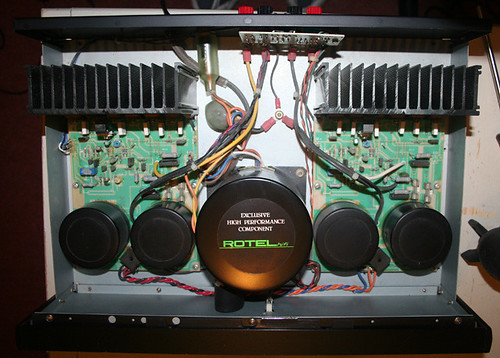
pic: click to enlarge. Note stacked 4312A as well as back of 2 bridged Rotel amps.
Review: JBL 4312A, Century Gold
The day before last, in anticipation of removal, I took out my borrowed pair of
JBL 4312A and tested it with the
LFD integrated amp. I haven't used it in 6 years, yet it sounded simply wonderful. Before I write my
LFD review, I'd like to tell you about my previous experience with this wonderful and under-rated loudspeaker.
JBL 4312A (Official literature
here, and
here)
The evergreen in the JBL stable and probably the most popular JBL of all time, the 4312 went through several generations, the current revival being the 4312D (mostly for the Japanese and Asian market). The second-generation 4312A sold in huge quantities and could easily be found; many are probably still in active use in studios. It differs from its predecessor in its
titanium tweeter. It is precisely this tweeter that caused many to dislike the 4312A. True, if the ancillary equipment is not good, these may "shout"; but with proper care taken these actually produce an open sound.
The other 2 stars in this long tale are 1) the
Rotel RB-870BX amp (which I just wrote up
here); 2) the
Melos 222 full-function preamp, which needs a full article by itself, and which I hope to write up in the near future.
And now, here it is for those who haven't read it, what I wrote several years ago in review33.
JBL 4312A Diary (06/12/05)
I) As you know, I've long been a Klipsch (La Scala) and Tannoy (Gold/Lancaster + Canterbury) user. But I have always wanted to try out Altec and JBL. As a classical devotee, conquering these speakers well known (or well misunderstood) to be tough on classical music would be a good challenge. Of course, one has to sense the potential there. It would indeed be a total waste of time if JBL turns out to be like what one of my friends said, and I quote: "...not designed for reproducing classical music, therefore senseless to force it to do something it is not able to...". As a person who listens to more classicals than most people I'd respectfully disagree.
Sometimes it's a case of contagious disease too. Aside from some hopeless examples around, a few recent outings with the GMC crowd aroused further my interest in JBL and showed JBL is not really a one-dimensional speaker, There is a huge divide between geo024's relaxed and certainly not R&R L300 and loman69's powerfully upfront and definitely R&R 4344. This is partly due to the difference between the speakers themselves, but also partly due to the owner's own preferences and hence matching gears.
 The first opportunity came when tubediyer lent me "indefinitely" his father's Century Gold (left pic). They arrived at my house with less than 50 hrs logged. It took quite a while to run in the tweeters a bit, though I'd say they cannot have more than 300 hrs on them now. The 4312A came by fortuitously. When listening to the L300 at geo024's place I had casually mentioned to him that I'd queue up for them should he decided to sell them. Well, it happened and I took it up as I did not know how long the CG would be at my house and I'm into them now.
The widely different sound people achieve means JBL is ultra-sentitive to the way it is used. In real terms, it means it is unforgiving and in general JBLs have an upfront presentation and strings on CDs would usually be the first thing that needs a little taming. This is completely different from Tannoy. It's not easy to make a Tannoy offend (but it surprisingly happens in some hands), but a JBL complains easily.
I personally find playing with both these pairs illuminating. What works with the older 4312A does not necessarily work with the newer CG. What works for Tannoy may not work for JBL. You can say the JBL's are fussy, but they are fun.
II) I now listen to both JBLs alternately.
The tentative choice for CDP right now is the venerable Revox B225. This CDP takes quite a while to warm up. I'm not sure if this professional CDP has the laser on once the power is on, hence I keep the power off, unlike my other CDP, which I keep on indefinitely.
The tube preamp for the moment is still the Melos 222 with built-in 4-tube phono stage.
The TT is changed. My mellow AN TT-1/silver-RB300/Denon 103 is on loan to sobilly, so right now it is Clearaudio Champion/OL-RB250/Ortophon MC-15-II, of QUITE a different character than before.
When people come, it had to be the CG, as it can play louder with more ease. I just picked up the nearest tube amp, and it is the Copland 501, EL34x2 per channel, hence 35-40 wpc.
I had NEVER previously associated my gears with the word "fast", not to say "extremely fast". But the combo DOES prove to be very fast with JBL CG, and this with 15 ft of interconnect between the preamp and amp!
Another thing I had never really previously regarded as too important is warm-up time. With the Tannoy, this is almost a non-issue. Not so with the CG. Even discounting the source and front end, with the modern Copland, it takes at least half an hour for the sound to settle down. And so a reasonably long visit would get more of the sound than an unduly short one. The owner of the CG, tubediyer and 風鳴 and Wesley+wife are the only ones who have listened for a long stretch of time. With 風鳴 and especially with Wesley and wife we played a large amount of classical music and I believe they were not displeased. With Wesley and wife we actually listened to almost 4-5 hours of classical music. At the very start they DID find it slightly sharp, but by the middle of the period, Wesley commented that any trace of sharpness was gone and we just continued to play LP after LP.
When I am by myself, I continue to listen to the 4312A. The same amp does not quite work nearly as well as the ICL 300B amp. The 300B gives a good degree of cleanliness and is just sufficient for personal listening. Last night I played a Mozart symphony, a Martinu quartet, a Kogan Beethoven, and only in Mahler's 4th did I encounter outright clipping and had to turn down the volume one notch. The 300B does not give that much bass but it does give a high quality bass, ans so the bass passages had surprising speed and depth for 8 watts. No, I did not find any of the stuff too lean.
III) The most important thing is not to please everyone immediately. That is impossible.
What I'd like to do is to set some immediate goals, come up with an agenda for the immediate future and envision the next step. Through the journey I hope some people will be surprised.
As a serious Tannoy user, for me to do this is actually sort of a funny thing, sort of 以茅攻盾。But I think that's the fun. I could not care less for which one is better for what.
I think I have achieved already my immediate goals. To actually make the JBL sound reasonably balanced and coherent in that it can show its strong points and yet cope with more demanding classicals.
The second step is to further refine the system. As I've said before, getting my vintage amps back in action would be beneficial I'd think. Slowing down the sound a tad would inch it towards even more balanced classical playback. But it would never be the Tannoy presentation, not that I'd want it to be.
The important thing with the new experience here is to really probe for new insights. I must say here JBL has already made me look at classical playback with a different eye. And that is all to the good.
IV) My friend BenYC asked: "...Many people say I like JBL sound, I like planar sound, I like horn sound.... Ultimately, we choose equipment based on our own preference. However, the ultimate goal is to make the sound closest to the live music...If the above is true, should we pursue the tasteless direction? If I can hear planar sound or dome sound or horn sound, does this indeed means the system is not being faithful? (Many people do relate tasteless to sterile or even unmuscial. This I cannot agree..."
Interesting question, but only for those more objective, like you, and I'd say myself.
Personally, I think there is NOT AT ALL anything that comes close to the perfect transducer. BUT I think there are many approaches that reveal a substantial part of the truth.
The important thing is to recognize what each approach does right. If each approach does not have some success it would long be obsolete, no? Failing to do that is not to learn, and I'm profoundly disturbed by the fact that this is the case with a lot of people.
Let's say, if you REALLY know what's the real horn sound, it'd paradoxically let you appreciate planars, electrostatics and other competent designs. On the contrary, if you appreciate planars and electrostatics, maybe you'd not be resistant to horn sound.
The word "horn" arouses the most primitive of sentiments. Every person who comments on "horn sound", even those who possess horn speakers, think they know what it s, but is that true? I'd say not.
For me, horns, when done properly, deliver a true allusion to a live event as no other speaker can. Anyone who says otherwise is suspect in my book.
The real question is, can other approaches SOMETIMES do that? The answer is yes. The ESL has this ability with certain things. JBL's too, when done right.
I think the important thing is to let the system reproduce the "LIVE" atmosphere (not the same as hifi parameters like imaging) appropriate to the recording.
I do believe in neutrality. What gives the "live" feel is neutrality. What most people refer to as neutrality is just gibberish. If you do not know music, you do not know neutrality.
An analogy can be made to my recent change of TT/cartridge. Having used the Denon DL-103 for a LONG time, it was a REAL shock to change to the Ortofon MC-15-II. It was almost like changing from comfortable Tannoy overnight to forward JBL! That was initially a thoroughly disheartening experience. But running in the cartridge and experimenting with the input impedance gradually paid dividend. The Ortofon will NEVER sound like the Denon, but if you ask me now, I am no longer sure at all which one is better. I like them both.
At this point, I am pretty sure that JBL's classical playback had been severely distorted and sabotaged by audiophiles, and I personally see great potential, even with my humble models.
My goal is precisely to TRY to show to those objective enough that JBL CAN play classicals like Tannoy and Klipsch and maybe Altec too. Not everyone will agree, but that's a clear goal. Mind you, I want to do this without sacrificing too much of the traditionally strong points of the JBL.
What's up next besides vintage amps deserves scrutiny. On the one hand I'm thinking of upgrading, but my space limitations (no, I'm not going to get rid of the Tannoys) cannot tolerate anything bigger than 4425. I can also get a SECOND pair of 4312A and play them together. This would be very interesting as there would be many permutations. Of course, if tubediyer leaves the CG in my home indefinitely I'd put all those plans on hold. But he says he has BBSM-6 and TAD's coming to my place.......did I hear right?
TUNING UP - Enter the Subwoofer
Before reporting on the event yesterday, let me linger a bit on the background and prequels.
After tubediyer cruelly took away his father's Century Gold, I felt bereavement. In mourning and in memoriam, the JBL 4312A came down from perching horizontally on top of its cousin to sit straight on a a pair of low stands (~14", spikeless on tile floor). They are roughly in the middle of the room, approximately 6' apart and 7.5 ft from my ears, which are about 1' from the rear balcony door/curtains. The tweeters are on the outside and quite a bit below ear level. A small degree of toe-in was employed.
At first sound was somewhat lackluster, but with average day-to-day listening they just opened up more. I listened mostly to classicals. For late night listening alone I used my Japanese ICL 300B SETA. When I wanted more volume or when people came over, I used my Copland 501 (6CA7 PP, amp) which just happened to be around. For the last few years the majority of my listening was done using SE triode amps and my vintage PP amps, no doubt suitable for JBL, are collecting dust. The only vintage one that I tried was the lowly Fisher X-101-C (7591 PP integrated amp) which once performed beautifully with the K2-9800 and which works superbly well with my own Tannoy Canterbury. However, in the case of 4312A it seemed to offer no real advantage. In all of these cases, the sound was a little sluggish.
Recently my two Rotel 870BX came back and I gave it a listen with the 4312A. I liked what I heard, mainly the evenness and the good speed, so I ran it in. I also tried bridging but did not quite like the little bit of coarsening, so I stayed with just one. Supposedly this vintage ss amp has a lot of Black Gate caps inside! Built in Japan.
Bit by bit, I felt the sound has improved to the point that I'd invite some other close hifi 惡客 friends to come listen. Last Saturday, they came over and and I thank them for helping to deliver a cheap JBL subwoofer, curiously named Digital 12, to my place. A list of gears used:
Digital 1-Revox B225 (CDM0-TDA1540-14bit)/Gotham GAC-2
Digital 2-Revox C221 (CDM4-Delta-Sigma)/balanced adaptor/Gotham GAC-2
Analogue-Clearaudio Champion/Origin Live RB250 basic mod/Ortofon MC15-II
Preamp-Melos 222 MC/MM 2-chassis hybrid preamp/Gotham GAC-2
Amp-Rotel 870BX (100 wpc)/MIT Terminator 4 , used singly or bridged
Amp 2-Copland 501
Speaker Cable-Gotham 50025
A Fostex 900A was used with a 0.22 generic cap and a resistor. The tweeter level was turned quite down.
When I listened to the 4312A alone this setup more or less sounded balanced, with just a hint of aggressiveness in the notorious Titanium tweeter at high levels. I like to play at concert hall level, so when the big guys came and the balcony door were opened and the curtains pulled, the fault of the tweeter was magnified.
I forgot to mention that we played with the cheap subwoofer too. Due to lack of space, it was placed in mid-room and fired towards the right. Via the line input (preamp out into MIT Terminator 5) I thought the preamp lost something due to the added load. But the little bit of added bass on the bottom added a little weight and helped clarify and smooth out the treble a little. Matching was surprisingly OK and X'over point appeared to be the higher the better (50-150Hz)!
TUNING UP - Further Tweaks
As I knew
limage was going to pay a visit, I spent a few hours the next day tweaking for an even larger crowd. I made a few changes:
-the interconnect between the preamp and amp was changed from Gotham to a DIY WE-era tin-plated thin cable, which was most effective in eliminating some treble harshness.
-some blue-tack was applied to the metal grill of the tweeter, an outer circle and a "nipple".
-the cap of the supertweeter was changed from generic to vintage Russian. The difference, not profound with the La Scala, was instantly audible as a little more suppleness. Then I switched to the Aurum Cantus G3, which was only recently returned to me. the change was instantly noticeable too and I favored the G3.
-Another digital system was put into service: Theta Basic/AMP AT&T cable/Genesis Digital Lens/Gotham digital cable/Audio Note DAC-2 old version (PCM63-6922 buffer)/DIY-Sumitomo. The DAC is high-output and previously was not at all suitable for the 4312A.
-Bridged Rotels were tried again, and this time with great success. Yes, a little coarsening, but not unacceptably so.
-the subwoofer connection was changed to high level, which meant connection with a generic speaker cable.
After all of that, I thought the sound improved quite a bit more and that was the system I used for the next day.
THE STACKING EVENT - 1+1>2
All this is preface to the main event. My friend Gingers, now a 3/5A user, has a pair of 4312A stacked away forlornly in a corner, neglected for years on end; I asked to borrow them.
Monday morning Gingers, rcwy and limage came with the delivery. Last minute additions were sokps and my Chinese-in-heart gweilo and fellow 4312A user friend Mark, aka "Sparky" in the pre-R33 days of "Audioboard". They arrived at 11 am! Military precision and superb organization!
We fiddled with said system, driving single 4312A + G3 super + little bit of sub, till 1 pm. The high-frequency stress was much reduced but I am sure a little remained, but my very crazy and funny guests survived. All agreed the little bit of sub was an enhancement.
We broke for lunch, a welcome respite for endless replays of Mahler Symphony #5! We had used "Night on Bald Mountain", Nils Lofgren, Manger Test CD, Pat Metheny, etc etc, and a bit of silence was more than welcome.
After lunch, we stacked them. The height meant we left the "supertweeter" disconnected. As soon as we hit the play button, we were stunned. There was just so much more body to the thing and everything acquired a new gravitas. It was judged the subwoofer was redundant. The treble might not have been perfect, but their inadequacies were much camouflaged. I wondered whether things became a tad slower, but there was no going back.
The speakers did behave like big speakers. An amazing experience way beyond my/our imagination.
I'm sure there's more to be done and learned. I am also sure there's no one way to play with things. I am a classically oriented person, and JBL never came as a first thought, but there are always things to learn and it has been great fun.
Now, what I really would like to talk about. First, the JBLs.
-The arrangement is almost like a D'Appolito array, some people's favorite design used in quite a number of hi-end speakers, including the image-capable Proac response 3, 4 etc. I believe the array not only adds height but the upper woofer's proximity to the ceiling enhances greatly bass dynamics.
-An observation. Many times hung speakers like those in CD shops give very good and full sound. My single-pair 4312A actually sounded a bit better in some ways when perched (horizontally) on top of the Century Golds just a while back.
-The 4312A's have been designed to be smaller monitors and free from colorations acquired from placement as they also had to be used in near-field situation. This makes them, unlike some others, a good candidate for this kind of placement.
-The single-pair 4312A's singular fault is stress at high volume. The stacked ones augmented most noticeably the lower midrange and midbass, which of course also made the treble less prominent. The corollary is, the single-pair 4312A needs additional bass weight. And I believe this is also the problem with "G-spotting" older Tannoys. The Tannoys are not designed to be near-field. Shall we stack the Golds one day?
-This way of speaker placement actually minimizes the difference in speakers. The "pinpoint imaging" takes over and the Maggies, JBLs and even Golds (though less successful in bass) begin to sound alike. Some would call this neutrality but there's a bit of the artificial in that.
For the Future I'd like to try:
-Take out the tweeters, somehow fix them right in the middle of the stack and make a true D'Appolito out of them.
-Stacked but HORIZONTAL. I believe these would sound different but just as good.
-"Dipole" them. One firing backwards. May have to move them a bit along the axis.
A little praise from limage:
"...The JBL 4312A was indeed astonishing for the volume it actually managed to pump out from the 3 drivers that are as moderate as their enclosure. The sound was crisp and fast, with surprising presence that was most appropriate with pop and jazz work. But the biggest surprise did not come until we had Gingers’ pair stacked inversely on top of the existing pair. It was instantly transformed into a mammoth of considerable potency and authority, emulous of all rivals of the most exotic and expensive species. And the amp driving this column of JBL was nothing more than a cheap old solid state Rotel !
The stacked 4312 must be ranked among the best of the best JBLs I have ever heard until today..."
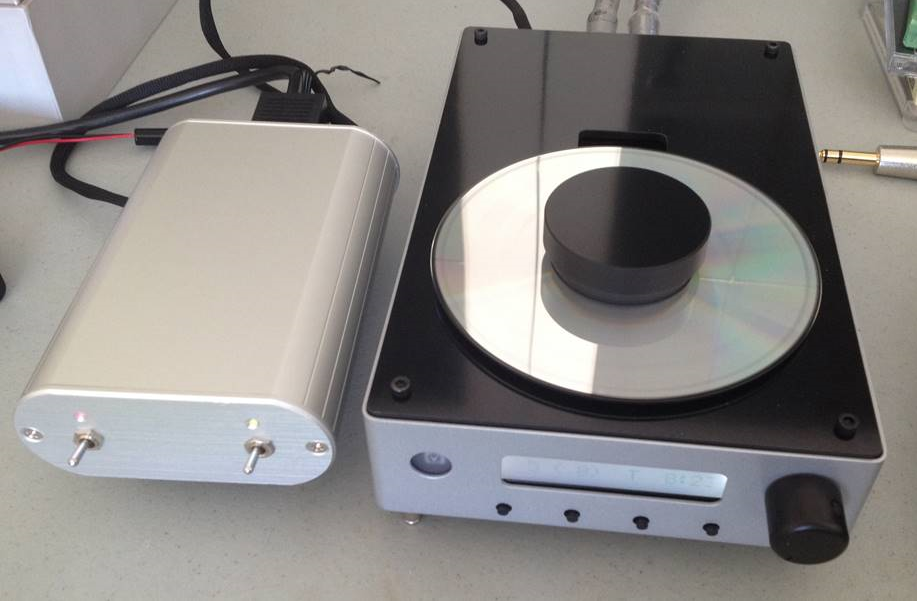
 Year-End Crusade
 pic of Dynaudio D76AF dome midrange (from www.stereo.net.au)
 pic of Thorens TD-124/SME 3009 II/Denon DL-103.




 Posts
Posts