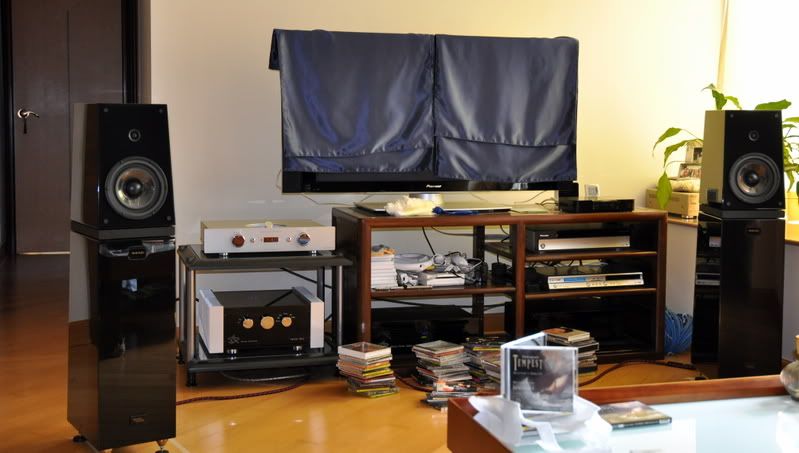
Click pics to enlarge. System View + accompanying popcorn (Note the ASI resonators in the center above the amplifier and the small barely visible Stein dot above the mid woofer).
The Sistine Chapel by audiopro
(no, this isn’t a John Wick movie)
I recently reviewed a system that I have seen grow over the last 4-5 years in India. It
started when Mr. Michael acquired the big Ascendo speakers and has grown
ever since. It was built using the one component that most of us lack i.e.
patience. Slowly but surely the owner acquired each component and has now
achieved what I call synergy.
It is always difficult to review a system as a whole because one doesn’t know
what each component can do. When I review a system, I have always felt that a
system (not a component as much) may be categorised into two broad categories:
– A photograph or a painting....mostly a system lies somewhere in between but then it is neither here or there...
A system that I classify as a photograph is neutral, transparent, clean, well
centered tonally; attack and decay are well balanced, PRAT, dynamic; may lack hues and shades but it connects with your primal side and heads bob and feet tap. Think of a photograph
taken using a really nice lens in perfect lighting.
A system that I classify as a painting is about the brushstrokes and the
colour choices. How they blend in with each other, the emotion portrayed on
the painting, etc. You can get lost in this bath, flavours swirling around your senses. It can draw you in, caress you and so on...
Both are easy to enter but very difficult to get right. Setup one (photograph)
can easily become bright and analytical, robbing the music of its soul, like
the Topping D50 DAC. It is well reviewed based on its measurements, yet when
I bought it, it sounded sterile - it was like a punishment that I received in
primary school: having to kneel down on the cold floor for talking; I
vehemently defended my innocence. (Yes we were punished like this in those days –
talk about a whack to the head or a remark in your diary that your folks had
to sign. I’d pick the kneel and/or whack combo any day than the puppy eyed guilt trip the remark set you on).
System two can easily become dull, warm, uninvolving, slow or too harmonically dense, killing attack and PRAT.
System two can easily become dull, warm, uninvolving, slow or too harmonically dense, killing attack and PRAT.
Michael’s system consists of some flagship components like the Ascendo MS-Sew speaker, the Metrum Pavane DAC, Audience cabling or the ASR
Emitter II Exclusive amplifier. It also consists of some room treatment tweaks
like the Steinmusic Harmonizers, ASI resonators and Stein Blue Suns.

(not shown are the dual power supplies and individual battery pack, this is a 4 box amplifier)

There is something to learn from this system setup. I very so often get asked,
“I have a bright speaker so if I use a smooth cable or dac will it balance it
out?” The answer is yes, it will tame the brightness but I can almost
guarantee you that the system will not sound fun. This is because there are components pulling opposite ways.
Michael’s system has components that are similar in tonality, yet are so
well flavoured or balanced that they do not tip over into the boring territory.
All of his components are warm, harmonically rich, dark sounding but they come
together as a whole and the end result is something as beautiful as the Sistine Chapel.
We played music using Roon and Tidal. Michael has an Intel NUC with a SOTM PSU hosting the Roon software. Music is streamed to a Metrum Roon endpoint which ends at the Pavane DAC. All component to component network cabling was SOTM’s CAT 7.
We played music using Roon and Tidal. Michael has an Intel NUC with a SOTM PSU hosting the Roon software. Music is streamed to a Metrum Roon endpoint which ends at the Pavane DAC. All component to component network cabling was SOTM’s CAT 7.
I usually listen for the following:
- Timing
- Micro dynamics
- Tonality
- Image size
- Bass
- Harmonics
- Listen for the singer to see if you can catch how he’s moving his voice i.e. head voice, throat, mouth etc.
First lets get what this system doesn’t do. It isn’t neutral tonally, it's
coloured. Harmonics don’t jump out at you like a tube amp or some accuphase
amps. It isn't a high sensitivity low powered setup which sometimes has that JUMP factor. It isn't a Ferrari or Tesla. This is a Bentley flying wing or a Rolls Royce. More than enough power when called for and you travel first class.
Being coloured it may not suit every genre, say rock, but I don’t think
the owner listens to rock or heavy metal. Primal raw gritty it is not.
Warm, textured, fleshed out, musical, golden, sexy, a work of art it is.
Well this system struck 5/7 of these parameters. Four to me were near
perfect, whereas one parameter (tonality) was superb but in an artistic type of
way. Harmonics, though extremely well done, were a little dark on the top and I will write about the bass below. Image size was executed perfectly, probably the best I’ve heard in a long
time.
2. Micro dynamics was beautiful too. It was faaaaasst without sounding thin or bright. The sound remained fleshed out but was yet fast. Think of it as a brush stroke where the initial stroke looks darker and the later ones lighten up. Think of seeing paint that appears textured not overtly smooth. Think of a movie in which the Samurai sword swishes fast and you are left seeing the blades trail.
It was beautiful. It was as if the system was painting the song rather than mechanically producing it. It sacrificed the jump factor you get from a low powered amp high sensitivity speaker combo but I really didn't care this time around. The siren was enthralling me with her song.
3. Tonality - Warm, richly fleshed out golden mid range. This "fleshing out" of the midrange is what adds texture and prevents a warm sound from becoming too smooth or dull and boring. I kept coming back to this textured mid range and mid bass every time a song is played. The texture was the transient. I have experienced something similar with Audio Note products where the sound depends heavily on the texture to deliver the transient bite, like moving your palm over a textured surface instead of on a needle tip.
It's almost like taking the best of a really nice Amperex (harmonics and golden glow) + RCA 12AU7 (darkness and chocolate) tubes, sprinkling in a little of Telefunken magic (sparkle) and adding some of the good solid state properties like speed and fast decay. If I had to fault it I would say that the highs were dark sounding (something almost every ASR review has talked about) but dark it maybe, lacking in information it was not (now I sound like Yoda).
4. Image Size – This was perfect. Perfect, perfecto, perfect. The image size was like a small musk melon, yet it could expand and contract instantly as and when the singer raised his voice. Think of it like a light bulb with a dimmer. The size of the bulb stays the same, yet when you increase the brightness the glow grows and can contract immediately if you reduce the same.
I was listening to Seal's both sides now and the young James Morrison and the way they energized that space was perfect. Never did the voice grow too loud and overshoot or smear. It just expanded and contracted like the glow of a bulb in milliseconds, offering probably the best contrast of vocal micro dynamics that I have heard.
This micro dynamic aspect of the vocals and the warm golden texture made the voice so involving, it just kept drawing me in to the music. The micro dynamics and texture served as the attack or brush stroke whereas the warm golden hue served as the paint. Even when instruments came in they were sized perfectly and expanded and contracted without smearing each other in any way. I would attribute these characteristics to the ASR amplifier and the room treatments. I have heard this speaker in the same room with other components but it was only when the ASR came in did it develop this personality.
5. Bass – The Ascendo uses a bandpass design. I am not too fond of bandpass designs as I feel they are one notish and always leave a hole where they integrate with the mids. In the past I always felt this systems Achilles' heel was the bass but this time around it was fast, textured and didn’t drag as much (drier than before). I did feel it to be slightly lacking at the crossover to the mid region but then I guess a bandbass will always do that. The Ascendo uses a large 8ish inch mid driver so I guess it is better suited to handling this transition that other bandpass coupled speakers. The kick drum was superb. You could hear the texture of the drum skin decay vis a vis a simple dry thuck. But there was some darkness between the mid bass and lower mid region. It was well concealed but something appeared dark or amiss there.
6. Harmonics – I have already spoken about the tonality. I would just add that harmonically it was not suited for rock. I tried some rock music but I don’t think rockstars would like a dark, warm, golden hue, cuddly, chocolate, complex whiskey malt system. They are better suited to a raw gritty, Russian vodka mixed with absinthe kind (if you mix vodka and absinthe, you never read this here – editor please make note, actually please never try this ever, leave it to the short lived rockstars). [Ed: I think the stigma surrounding absinthe is a myth. I am actually a big fan of anisette flavored drinks, from pernod to ouzo to raki. Drank plenty on my trips to Greece and Syria. I am sure India has its own]
As mentioned before this was - Amperex + RCA 12AU7 tubes, sprinkling in a little of Telefunken magic which I again strongly feel is the ASR voicing followed by the Pavane and Audience cabling.
7. Listen for the singer – again superb, more so on male vocals. You could hear the singer moving the voice around, the voice changing weight and tone depending on if it was a head or chest voice (for those who don't get this look up vocal coach Beth Roars videos on Youtube in my last post), then changing micro dynamics as the singer increased or decreased air pressure. The system did not pressurize the room as I have seen some systems do. Instead the singer was left by himself on the soundstage just singing his heart out. I did not get the same feeling using female tracks. It was there but not as well done as the male ones.
All in all I thank Michael for hosting me over and kudos to him for pulling off
a superb sounding system. It isn't meant to have that jump and presence factor that
you get with high sensitivity speakers and small simple amplification circuits. It may not suit aggressive genres that sound good on raw systems but, what it did well, was beautiful, just beautiful, which made me
think of the Sistine Chapel. Well done, Michael, you pulled off a Michaelangelo!

Vintage Marantz RC programmed and controlling the system
"we can send a man to Mars and maybe even grow a tree on it but we cannot remake a classic remote like this. Why? Oh why!!!! Just look at the print and buttons..."
- audiopro
System components in the above setup:
Lector Digidrive cd Transport
Metrum PavaneLinn LP12/ IttokLVii/ Lyra Delos
Jeff Rowland Cadence Phono stage with BPS1 supply
Intel NUC / SOtM SPS500, Metrum
Ambre , Melco N1A
ASR Emitter II Exclusive
Ascendo MS- SEW
Audience Au24SX Speaker Cables , Front Row Digital, Line Level XLR , Audience and Furutech Power Cables, SOtM Purist Audio Cat7 cables.
Audience power conditioning, Steinmusic Harmonizers, Blue Suns, Supernatural feet, ASI Resonators.
Kemp Electroniks QA and Schumann Resonator plugs
Vintage Marantz RC
Editor: My friend Sang in HK used to have an ASR Emitter I (2 box) which I have heard a lot (here). Indeed all these battery driven equipment would not be the last word in macrodynamics, but that's not what they are for. Part of the polite character may be due to the Metrum too. Eric L's lower level Metrum was deemed too polite by him. Just a guess. As for this flagship Ascendo, I have heard it twice: the first time was terrible (driven by Audionet); the second time pretty good at a show (here). A great write-up. Indeed it's not easy to hear a thoroughly musical system on home visits.




 Posts
Posts