31 March, 2011

Letter from NYC 2011 (13): Genesis V, MBL, EAR, Michaelson & Austin

L: Note the M&A preamp up front; R: DIY table for EMT 930 using pipes! (click to enlarge)

Letter from NYC 2011 (13): Genesis V, MBL, EAR, Michaelson & Austin


Among my hifi friends MW in LI must count as one of the craziest; perhaps even insane. I have previously reported on his Western Electric setup. It has been barely 2 years and yet his system (including the room) has undergone so many upheavals that it'd be hard to chronicle. Yes, you read it right, it's upheavals, not mere changes like what happen to you and me. I shall be brief, as I really cannot second-guess why MW made his moves.

L: HMV's; R: KEF'ed Genesis

After Mark's excellent Vandersteen 2CE period came what I had to come to think of as his mid-life crisis (don't we all experience that!). He pawned the WE combo to me but later acquired a full MBL set (the wrong path in my opinion, and you'll see why). Also, he divided his basement into two halves, presumably to give more space to his children (no, an electronic warehouse is not quite suitable really). The resultant small square room was not kind to his hifi. At this point he acquired a pair of Genesis V (early version). Not happy with its performance, he swapped out the mid range units for LS3/5A's KEF's!!!!!!!! Surprisingly, the sound was not THAT bad. Also, a pair of ancient HMV loudspeakers made a brief appearance (they sound very good).

Last time I was in NYC, he heard my horns (as yet unannounced) and was smitten. A 180 degree turn took him to build a horn system, which went through several iterations with JBL pro and Altec drivers in a custom JBL pro enclosure. With such disparate elements, electronic crossover was employed and after a bit of experiment sound was surprisingly robust.

So I was surprised this time that he had gone back to the Genesis V. Happily the stock mid range units were restored. AND he had knocked down the partition and regained use of the full room. The first time we went, we pulled the speaker up front about 2 ft, adjusted the bass servo as well as the knobs on the back before we got good sound. This is a complicated speaker!!

Over 2 days we heard the Genesis V driven by 2 sets of electronics:

Analogue: Nottingham Spacedeck/Spacearm/Denon 103D
Digital: MBL Transport+DAC
Preamp+Amp A: MBL 6010+amp
Preamp+Amp B: Michaelson & Austin TVP-X preamp/EAR 509

I shall be brief. While the MBL set sounded reasonably well on its own, upon switching to the M&A/EAR all-tube combo the system took a huge leap forward. So much for the under-achieving MBLs. That is hardly surprising. Like the EAR, the M&A preamp was designed by Tim de Paravicini, hence "Tim's Valve Preamp". This is an all-out effort, almost dual mono, with 4 tubes in the phono section and another 4 in the linestage, per channel. It is also rare as hen's teeth now. The sound was excellent with vinyl.

Back to the Genesis V. I think we had it in the sonic ballpark but, with the bass still a bit tight and not deep enough, had not quite hit the bull's eye. It was close though. Even then, the sound showcased the speaker's rich and solid sound. There is a marvelous texture to the mid range and treble that should still put most current hi-end speakers to shame for their etched sound. The basement I think is a little small for the speakers too. I have heard them in much larger rooms to different, if not better, effect.

M&A TVP-X
This early all-out effort uses 6x 12AX7 and 6x 12AT7 and constant current source design. The separate power supply is transistor.

26 March, 2011

Q and A:AES, Sonus faber, Clearaudio, VPI, Chinese made products

Q and A: AES, Sonus faber, Clearaudio, VPI, Chinese made products

Periodically I receive emails from readers on various topics. A few I answer right away because the questions are simple and easy. A few requests, like the circuit diagram on the extinct AES SE-1, took some time to satisfy. But there are many on which I procratinate; I hesitate not because I don't want to, but because I don't know the readers well. Many ask whether I'd prefer A to B, and these are not too easy to answer without knowing a lot about the reader. For myself, I simultaneouly enjoy many different things, though in the bottom of my heart I know my ultimate preferences. After some thought I have decided to periodically publish Q and A, of which this is the first. This is to let you know I hate to not answer mail, but sometimes it is not easy to give a conscientious answer based on the little I know of you. Now, from the newest first.

Q. on AES SE-1 (gwoods100) "...have you, by any chance, heard the standard SE-1 against the 'Signature' version? I'm contemplating doing the upgrade...do you know where I might locate a schematic for the Signature version? If there's not much involved, I might consider the upgrade and take a chance that it'll sound better.Incidentally, I have tried to contact Cary about this, but so far they've failed to respond to my emails (three so far, across ten days). Again, many thanks for the SE-1 schematic - and for other fascinating reading..."

A. No, I have never seen, let alone heard the 'Signature' version. What I have heard though, is the difference between the stock version I have now and the decked-out one (Kimber caps; upmarket diodes; better wiring etc) I previously owned. I'd say heavily modified the sound is clearer, but not necessarily musically better all-around. From my perspective, one's money would be better spent in another amp that has a completely different design, say the wonderful Elekit 2300 or 3200. Boutique parts are expensive and don't always pay dividends. YMMV. Some people build a tube recitified power supply for the thing, and I think THAT would be worthwhile, though drastic surgery.

Q. Sonus faber EAII (gysbertwillem)
"...I have had my Sonus Faber: Electa Amator 2 for years, very happy. Nad 330 to "feed" them...
I was not going to use the Nad that long anyway, however here I am now ( years later) and one speaker stopped in the low frequency! I have worked out that it is not my amp , could it be the xover, or is it the woofer it self. I have tried all the sonus faber people to advise me in this one ,simply no reply of none of them. Desperate as i am got me on to you when I found out about your web site. I know that you don't want to get back to the people who approach you, but could you please make an exception in this case of mine so I can listen to my music again. It is nearly 2months since this shit happened! Also I would like to hear your opinion about the Almarro 318 b in combo with Electa amator 2..."

I am really sorry that the second question is a lot easier to answer than the first. It depends on the music played. I think classical solo and chamber music and jazz would be OK for the Almarro 318, but big works or rock would not do for lack of power.

I have actually tried to contact also the SF HK dealer but got little. You have to make sure it's the woofer that's bad. In HK we have repairmen who can make it work, though how much up to spec's is not clear. It's too bad SF does not back up.

Q. Clearaudio and VPI (Babar)
"...I noticed your commentary on Clearaudio Concept. I just listened to this today and it sounded great even with the stock cartridge. I am considering to purchase this table, maybe with a better cartridge like Virtuoso or Maestro. I guess you still own this table so you must like it! I see you are very particular about your tables and the musicality is important to you as it is to me. I also considered Clearaudio Emotion CMB table which I have a line on for a very good price, with the Virtuoso cart. I was wondering what you thought of this table in comparison to Concept. Personally, I found it to be very present with great soundstage, but also overly bright and fatiguing (maybe was setup?). Also many people recommend me to stay away this table and instead consider Concept or others. There was something appealing about the sound but also maybe it was analytical or something bothered me as well which stopped me from buying this, as dealer was pushing me, insisting it was best value for the price ($2000.00 approx) The last one I think about is VPI Classic and would be interested to hear more what you think about this table. It is a little bit outside of my budget for purchase, however, so I am leaning towards Clearaudio (Concept most likely). How would you compare these two tables - i.e., will I be satisfied with the Concept!..."

A. Probably too little too late. Yes, I love the Concept and consider it one of Clearaudio's better efforts. To be fair, they do put effort in their lower end products, though the upgrade path is more of a pandora's box. As I alluded to in answer to another question, many times I'd prefer just playing with something else rather than upgrade. I suspect the Emotion itself, without the CMB, is probably a lesser turntable than the Concept. I am curious about the CMB myself, but the magnetic arm on the Concept is probably just as good as the one on the Emotion, and rare to boot. As for cartridges, Clearaudio would not be my first picks. Denon, Benz-Micro, not to say Ortofon, would be hard competitors. In any case I think all of them are OK. As for the VPI Classic, I think it is a bigger sounding beast, quite different and worth an audition. It too has too many upgrade paths. Too much temptation. Do let me know what you finally settled on and whether you liked it.

One thing though on the Concept: the price in HK is a bargain!

Q. China Made (Dana)
"...since you have strong Asia connections, how come you don't review more China components. It's my understanding that China high end audio components have improved dramatically in both audio and build quality. It would be most helpful to review some of these products like the DOGE 8, and maybe identify those vendors who turn out really good stuff..."

I thank reader Dana for his kind words elsewhere. As to why I don't review too many China gears, it's actually a complex question that merits an article on its own, and I am way behind. While I agree the audio and built quality have improved greatly, based on what I hear I still often have serious reservations about most of the stuff. As a rule, I generally frown on copy-cat stuff (especially cloning), and that eliminates many products (well western products too). The looks too of many of the gears put me off, neither here nor there. Most importantly, I think in general it can safely be said the Chinese designer is likely not quite mature in his MUSICAL TASTE, which makes or breaks a product. Many products do reasonably well on vocals but fail when it comes to full-bandwidth music. This is especially true of Chinese (including HK) tube audio products, of which I am not a fan. Despite claims, many of the transformers and designs just sacrifice both ends of the spectrum, to list just one of their sins. In contrast, I do think the Chinese solid state products are better than the tubes ones. As for speakers, well, they are few good ones, and most are just clones of existing big-names.

There are good manufacturers. Like YS-Audio from HK, which I plan to report more on. I also would like to write a full length reply, but no time yet.

Talk Vinyl: Garrard 301 Reborn Part I

Return of the prodigal son. Click on pic to enlarge.

Talk Vinyl: Garrard 301 Reborn Part I

Talk Vinyl: Technics SP-10 MkII Part II
The Yumcha Diaries: 12-03-11

It was always a delight to have the company of feikeung, who is one of the rare people who has a view of the Internet that is close to mine. After yumcha, he and davwong (a fellow Garrard user) went with me to Robin's place to pick up my Garrard.

After I removed the platter i put it in my tote bag, we packed up the TT and it was actually not heavy, just bulky. I managed to get it home safely, horizontally. Here thanks davwong for his help in packing.

The Second Advent, or Return of the Prodigal Son

The return of the Garrard heralds the beginning of a Second Age for me. Remember previously I had the oil-bearing cream-colored Garrard as a reference? It is now with my friend whlee. To make room for all my new turntables I recently sold my Clearaudio Champion as well as, regrettably, my Audio Note TT1/Arm 2, which I had used in the interim. As I have always thought the Systemdek-based TT1 to be better sounding and balanced than the LP12, I regret I never got a chance to compare the two. That may yet happen as the person I sold it to planned to do that! :-)

This was just a test-drive before even starting to ponder about the final form the 301 should take. As it is one of my reference TT's and shall always be so, I am sure we'll grow together. And the current plinth is certainly not the last word on isolation (it is rather light in mass). When I say return of the prodigal son, I mean ME, not Garrard. :-)

I decided to install the very arm that I used with the previous Garrard, the RB250 with Origin Live structural mod (only) that has served me so well for so long, so as to connect with past aural memory. It is strange audiophiles so distrust their impressions, on which everything cognitive is based. While one must be objective, even ready to re-evaluate old presumptions, one must also not do so lightly without serious trials, for the present is nothing without a past.

For a cartridge I finally decided on the humble Ortofon Kontrapunkt H. One of the reasons I chose the Ortofon is for its neutrality, perhaps even its tendency towards starkness. Also, on this very arm I had spent years with my old and trusty Ortofon MC-15 MkII, which is recently sadly defunct.

Grease Bearing or just Greasy?
To be honest, the first few tracks I played had me a little non-plussed. After coming off a period of listening to the crisp and take-no-prisoner approach of the SP-10 (even with the Benz-Micro!), the smooth Garrard inevitably seemed just a little slow on the transients, and image also seemed not as focused. Dylan's record lost a bit of its bite.

However, after a while I started to get used to the sound and heard things differently. While the rhythms were not as superficially sharp, the Garrard delivered more subtle rhythmic felicities. The players in the band seemed to have their own takes on the rhythm (while keeping time). The bass was also more elastic and fulsome, more tuneful. The violin also seems to be more sinuous with the 301, and massed strings more full-bodied.

In comparison, the admittedly exciting SP-10 seemed to be have a pervasive insistent quality that likely does not belong to the musicians, sort of like a controlling master clock at work (but less than the lesser, but still over-achieving SP-1200). This makes me ponder. In digitals, can all the hooplahs in jitter and clock be at least just a bit overblown? I think so, and I am being kind. While I am convinced keeping jitter low is generally good, I am not convinced all these "state-of-the-art" clocking and jitter-reduction has brought forth more music. In having masters and slaves (as in clocking), are we sure the mysterious minutiae (not details) in music (which vinyl conveys so well) have not been smoothed out too much? It would not be the first time babies have been thrown out with the bath water. Have you ever have your doubts about dCS and the likes? Do you like the way these supercomputers make music? Do they give you more of the illusion of live music? Truth be told, I am not impressed.

I am not at all knocking the SP-10. It has its own enticing features and shall likely remain as one of my references. Like the Garrard, I doubt most of today's megadollar TTs can beat it in any all-around way. When I'd like a little more excitement I shall reach for it.

Preview: Arm Swaps and the Bottlehead Eros Tube Tape Head Preamp
Next step would be to swap arms, to have the presumably better max'ed out RB250 on the Technics transplanted to the Garrard. Later would be the Ortofon AS-212S 9" arm. Stay tuned.

Let me digress. Robin spent the last weekend building this Tape Head preamp for his R2R. He just hooked it up. We didn't listen to it. Robin said sound was a little too bass-heavy. We'll let it run-in and tube-roll a little later, but that has to wait till May I think.

24 March, 2011

Letter from NYC 2011 (12): The Wonder of Nagra PLP

click on pic to enlarge

Letter from NYC 2011 (12): The Wonder of Nagra PLP

On the second day (should I say middle of the night) I hooked up a system for a little music:

Digital: Rega Apollo
Preamp: Nagra PLP
Amp: McIntosh 2200
Speakers: Magnepan MG 1.7
Earphones: Audio Technica ATH-AD700

Read my other articles on the Nagra PL-P

Nuance Aplenty
Even at very low volume through the Maggies, playing a Mozart sonata (see previous post) I found the combination, which I have not tried before, highly special. The Rega CDP's all-around excellence was taken for granted, but the combination of Nagra and McIntosh seemed especially luminous. I waited till much later to try out the big stuff. In my experience, all the older McIntosh amps, whether tube or solid-state, benefit from modern preamps that are high in resolution and have fast transients. The Nagra PLP certainly fits the bill.

Given its small size, the PLP does not perhaps quite possess the wide macrodynamics of much larger and heavily regulated preamps (though it is no slouch here), but its transient speed is unusually fast for a tubed unit. In fact, many traditional tube fans (who prefer murk I sometimes think) regard the PLP to sound rather like solid-state.

Together with its excellent resolution the preamp excels in microdynamics and has fine rhythm and timing. The violin also always showcases the strength of the Nagra, the portrayal so complete and seamless that one actually hears the the music as phrases merging into each other, rather than one note after another. One easily senses the bow's return, something few preamps manage to do (the Wavac does).

Harmonia Mundi, indeed
I was even more enticed when later I played much more complex music. The Herreweghe Beethoven 9th (HM) was performed on original instruments. One heard the gut strings but not too much grit, and that was just about right for anyone who has actually heard this refined period band (one of my favorites). Crispy, rhythmically sophisticated but fluid and richly multi-layered. The whole was holographically laid out by the Maggies. Oh, did I mention the skin-effect of the tympani was immaculately rendered?

Even more impressively "hifi" was the Biber Missa Christi Resurgentis (HM). Separation of the choir and voices and layering of the orchestra were uncanny. The system also conveyed the joy in the performance, surprisingly for an Easter piece.

Later, a misteriosso performance of Bruckner's granitic 8th under Giulini. The fair BBC Live recording still managed to convey a sense of occasion. Whether it was the strings in cantilena, or a solo woodwind in the wild, or brass blazing foward, all gave the illusion of a live performance, and a great one it was! There's no higher praise for equipment that can convey this sense. Throughout, the Nagra PLP kept every strand of the music intact and the fabric whole.

Balm for the Ears
The next day, or rather middle of the night, I all of a sudden remembered the Nagra's earphone output. I plugged the AT 700 into it and was immediately rewarded by detailed and fulsome sound. I managed 2 CD's worth of Beethoven Late Quartets, as performed by the Vermeer Quartet (Warner). When I finished at 6 am, I felt well. What a wonderful headphone amp! And nice cans!

Yes, good sound reproduction puts you in touch with the world and achieve harmony with nature. Harmonia Mundi!

HiFi Letter from NYC 2011 (11): Through a Glass, Darkly

HiFi Letter from NYC 2011 (11): Through a Glass, Darkly
CD Recommendation: Classical

Waking up in the middle of the night, it was dark all around me. I stole into the kitchen to make some coffee. A while later, sipping it in my hifi room I started to come around the jet lag - not physically, but spiritually.

4:00 am, too early to play music. By 5:30 I felt the urgent need and turned on the system and listened at extremely low level through the Maggies.

I played these CDs, and did they uplift me! I played the Mozart sonatas recorded by Richter with violinist Oleg Kagan. My copy is the original EMI issue, but I think it's now available only in the budget box set, a fine value. Richter's Mozart can be idiosyncratic, and Kagan can be grating sometimes, but in K378 they gave a timeless performance.

Later I played Annie Fischer's Mozart concerti. Again, my copy was an earlier Seraphim. The playing is rather muscular, as is wont with this great artist. What's also priceless was the detailed and dramatic accompaniment by the Philharmonia under Sawallisch. Probing accounts that are among the best.

These performances are not the smooth Mozart one so often hears. They are highly intelligent accounts that reflect great study and musicianship. As listener, we also never get to the bottom of the works. That's what WONDER is all about.

13 March, 2011

Talk Vinyl: Technics SP10MkII, Benz-Micro Gold and PP1

Full Metal Jacket. Click on pic to enlarge.

Talk Vinyl: Technics SP10MkII, Benz Micro Gold, T-9 Lukaschek PP1


Mellow Gold and Bright Silver
Before proceeding with my Garrad, let me tell you I had just come off a period of listening to my recently acquired Technics SP-10 MkII. This legendary direct-drive turntable is equipped with an all decked-out RB250 (Michell mod and Incognito sliver wiring). It came with the Benz-Micro Gold. Surely you, like me, shall find the cartridge oddly installed so far up front. That is because the armboard that came with it has the center-to-pivot distance to be 3-4 mm more than the official 222 mm. Given the fait accompli, using 2-point alignment, the cartridge seems to be properly installed. Listening revealed no problem with all my LPs, and I just let it be. Until I change to another arm, that is, which is likely.

Interesting how things have come around. My first MC setup was the Benz-Micro Gold installed on my Rega RB-250 ( origin Live structural mod)(read more here), which later developed a problem with the suspension and became unusable. So I am familiar with the sound of this cartridge. Also, I still use its higher-output sibling, the Silver, in NYC (more here). I haven't directly compared the two, but I am pretty certain the Gold tends to be mellower than the snappy Silver. Both were good buys, but at current prices they have quite a bit of competition.

Direct or Indirect? That is The Question
This is the fourth direct-drive turntable I own. The Audio Technica AT-PL120 and Revox B791 were covered before. I had not really covered the Technics SL-1200 MkII I acquired from my friend. Let me just say this legendary DJ turntable is truly a superior turntable that belies its modest price. It is obviously better than the clone AT in terms of musicality. The Revox is a comparable but its sound too tends towards the lean and mean, more so than the Technics. All these direct drives have excellent resolution of detail that IMHO is superior to belt-drive TTs of similar price. However, it does take some work on matching to smooth out the edges in them. If that were not a challenge, there would not be so many people in the belt-drive camp.

Let me just say this outright. From the first play, it was obvious the Technics SP-10 MkII possesses better musicality. The sound, while detailed and excitingly fast, does not impart a feeling of breathlessness, as lesser direct-drives are prone to do. However, this is NOT to say it does not have the hallmarks of a direct-drive. It does, with the wrong phonoamp there is often still a lingering feeling of insistence in the rhythm. More on that when I cover the Garrard. Suffice to say the SP-10 deserves its reputation as one of the best turntables of all times, and certainly likely one of the best of the direct-drives.

Make sure you visit:
Soundfountain's wonderful SP-10 page

When Beauty is not Skin-Deep
I used several phono setups during audition. The TT sounded equally wonderful through the Elekit TU-875, EAR912 and Verdier Control B, all tubed in their phonostage.

The real surprise took place just before I got the Garrard back home. On impulse I got a Benz-Micro Lukaschek T9 PP-1 MC phonoamp to match with the lowly Gold. I had encountered this phonoamp many times before, often with the Glider. It always gave decent sound, but also frequently gave the impression of being on the lean side. Its lack of loading options, indeed any adjustment, is not appealing to many.

Since the arm used Incognito silver wiring, I decided to use the silver Kimber KCAG for connection to the preamp. I used the Elekit TU-875 and the result surprised me a little.

I have not yet written up the Elekit combo. The TU875 has a tubed MM phono stage, while the MC section is solid state, one main reason why I chose this preamp for comparison purposes rather than my other all-tubed units that use transformers for the MC section. Now I use 2x stock Philips 5963 for the phono section and 1x Amperex 12AU7 for the linestage.

There is just a rightness to the all Benz-Micro setup that is difficult to describe. The PP1 is a little more detailed than the Elekit, but not overwhelmingly so to swing the result in its favor. The PP1 is cleaner sounding than the Elekit while avoiding leanness; indeed it is its effortless quality that surprises. In comparison, the imaging of the Elekit is larger and more smeared (shall do more tube-rolling later). Overall the musicality is impressive.

The input impedance of the PP-1 is an unusually high 22k, "...in order to eliminate interconnect cable and phono connector influence on the sound quality..." This is a marked deviation from the norm of 100 ohm, and certain to raise eyebrows, but keep in mind that Benz-Micro cartridges were designed to be loaded at a higher impedance than most others. It is the final sound that counts.

To test whether the high impedance would be a downright mismatch with other cartridges, I later tried it with the Ortofon Kontrapunkt H (mounted on the Garrard/RB250). Again the PP-1 dealt me a surprise. I detected no great frequency aberrations nor diminished musicality, and the "neutral" sound of the Ortofon emerged with great clarity. Note that usually Ortofon's like to be loaded into rather low impedances, hence the big surprise. Maybe there is something to Benz-Micro's cable and phono connector theory (these certainly add their own impedance to the signal path).

Although very small, the PP-1 is an extremely well made device. Once again, it proves SM components and short signal path can be great pluses in a good design (Linn Linto also comes to mind). It is beautiful though the chrome is hard to keep clean and the prints will eventually come off. At its current second-hand price it is good value, but a new unit costs rather more now due to exchange rates. With a Benz-Micro cartridge it is a very good choice, but its sterling qualities should still be apparent with many other cartridges.

23 February, 2011

HiFi 天碟 Golden Discs (4): Pop II

HiFi 天碟 Golden Discs (4): Pop II


Is this Pop? Well, it certainly WAS.

Every hifi enthusiast in the 60's-70's probably owns an LP or two of Command Classics' Persuasive Percussion (info on wikipedia). There were several volumes but 1 and 2 were the best known. These LPs, and even the original CD issues now command good money on the second-hand market. Watch my word, one day the LP will likely be re-issued.

The CD has been out of print for a long time. Now, Sepia Records has reissued a CD that combines volume 1 and 2, making it a good buy. Those with sharp eyes shall note that the cover art is an amalgamation of volumes 1 and 2. Of course, the mark-up by HK dealer is a little too much. I don't recommend the music really, but for the right occasion and audition this CD can be fun. The early stereo is very good but layout is simple. I have the original LPs. I think the remasters are good but fall shy of the dynamics of the analogue LP.

The label Command Classics is also known to older classical music collectors for artists like the Pittsburgh SO recordings with William Steinberg, all quite good in performance and sound. Like many recordings on this label, these were recorded on magnetic tapes, much like Everest and Mercury, probably by Robert Fine, later of Mercury fame. For more on this, read the Everest Records link.

Another CD recommended to those who like simple ballroom dance music is this issue of Tea for Two Cha Cha Cha. The orchestra is a very good one, the music is fun and the sound is OK (but I think not as good as the Persuasive Percussion).

I have fondness for this issue because many years ago when I learned to dance this was one of the albums we used. I still have the cassette tape!

Info on: Tea for Two Cha Cha, Persuasive Percussion (previous CD issue)

Both are issued by Sepia Records, browse their fun catalogue! Note that many are not sonically spectacular, and some are mono's.

Finally, a more recent favorite and recommended for its music (as well as sound). This CD that pits ageless Taj Mahal's blues guitar against Toumani Diabate's Malian Kora is spellbinding from the first note. Putting two greats together doesn't always guarantee results, but this one is a masterpiece. Frankly speaking, I think the string playing is much more interesting here than audiophile favorites Nils Lofgren, Friday Night in San Francisco, Pat Metheny etc.

11 February, 2011

Overview: JC Verdier

Overview: JC Verdier
JC Verdier Control B, 220 MkII, 2300B Luxe

This article is unusual for me in its coverage of mostly my own equipment! This leads me to reflect a little. While my blog covers all sorts of things encountered in my hifi "life", I really have neglected coverage of most of my gears, particularly those which remain central to my experience. In truth, aside from occasional audition of really worthwhile nature (such as Robin's R2R recently), most auditions barely deserve a word or two, no more hifi event than social function.

My friend icefox visits me once in a while when he comes back from China via 福田口岸. This picky man often asks me why I don't fire-up this instead of that, questions of that sort. But that has positive ramifications (sometimes). His last visit resulted in my digging out my Garrad, which is now restored! This time he came when I had just finished assembly of my Elekit preamp. But let me start with my recent journey of Verdier.


Overview - Verdier
France has had its share in analogue replay history. Two eminent figures are Pierre Lurne of Audiomeca, and JC Verdier, the latter famed for his invention/implementation of magnetic levitation, now in vogue.

The flagship magnetically levitated TT, called simply "La Platine", has been in production for decades and has spawned many imitators. Monsieur Verdier obviously finds this amusing, and since he thinks most of his imitators has got things wrong, on his website he gently but certainly sarcastically derides them (here)!!!

We have heard several Verdier TTs, not just the La Platine, but also the Nouvelle Platine. They always gave pleasure. In case you wonder, JCV himself uses an SME 3012 with Denon 103.

Control B - True to its name (cached official page)
My experience with Verdier started more than a decade ago, when I spotted a used Control B in a shop. My friend Captain soon bought it and we did much listening to it, even fought over it, imagine! But I know the sound of the Control B quite well. It is an enigmatic preamp, often capable of stunning performance, but sometimes also a little disappointment. At least two more friends bought the preamp later. It was not until recently that I acquired a used one from a really nice gentleman, who delivered it to me in a Benz. Verdier deserves as much! :-)

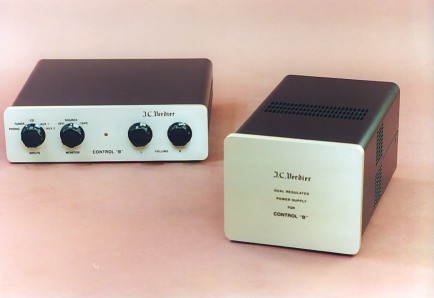
Pictured is the old version with the Gothic looking black plastic knobs, replaced later by champagne-colored metal ones (as in my own; pic below); I am not sure which is more aesthetically pleasing, perhaps neither. In HK, all Control B's I have seen have the DRPS (Dual-Regulated Power Supply, a big unit with 3 tubes).

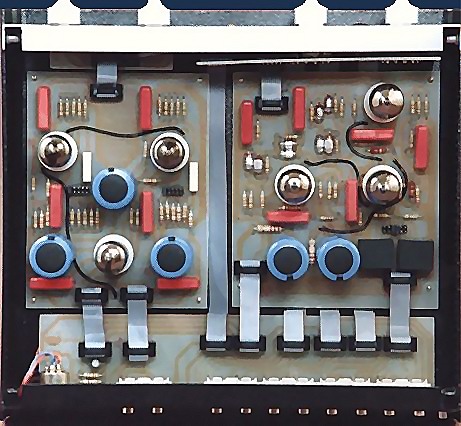
Although many think the look of the Control B is a joke, I rather think it is very well built. The chassis is solid metal and the champagne colored anodized aluminum front plates look better than most. The parts inside look humble, including the use of computer cables (which I actually think, like CAT wires, sound good), but that's part of the beauty. The Control B is a good lesson for those who judge components by their prices and looks! If you think about it, this is a 9-tube tube-rectified and regulated full-function preamp on 2 chassis, and you will begin to think of it as a bargain.

Sonically, the phonostage is a real beauty. It is quietly confident, yet dynamically expressive. You will be surprised by the music it unearths. Take one example, on violin replay, the Control B consistently captures the feeling of the bow's return, something the Elekit preamp doesn't quite manage. Options are limited - you are confined to moving a set of jumpers for MM or MC operation. No loading options nor dip-switches here, but we know MC loading is not important or at least not so critical with transformers. The MC input transformers are small (mine is not potted as in the pic) but they do an excellent job with low-output cartridges such as the Denon DL-103 (0.25 V).

The linestage also has 5 sets of jumpers for various gain settings, ranging from 0 db to 20 db. Since I use low-output MC's, I'd not recommend the 0 db setting. I used the middle one, 10 db; the even higher gain setting proved too noisy for my SET amps, which usually have high input sensitivities. It should be mentioned that if you do not spin vinyl, the linestage gain setting may be a different story.

In the past, in contrast to the excellent performance of the phonostage, the linestage of Control B sometimes sounded a bit rolled off and sedate, leading many to roll in the brightest 12AT7. For some reason, my specimen, a later one, has less of such a problem, and I was able to achieve balance between the phonostage and the line section without too much tube rolling and gain re-setting. Still, I think if you do not spin vinyl, this preamp may NOT be for you.

For the moment I retained the 3x stock Sovtek 12AX7 of the phono section and 2/3 RFT (East German) 12AT7 of the line section, rolling in only 1 Telefunken 12AT7 for what is presumably the cathode follower. Inside the DRPS there are 3 tubes. I did not change the EF184 (Valvo) nor 6Y6 (RCA black plate), but I did substitute the Chinese 5AR4 for a Raytheon military 5Y3 to great effect (more open and agile).

When set up optimally, and it is a little finicky, the Control B's considerable strengths, many subtle, will gradually engage you more and more.

left, 2A3; right, 6550

Pentode or Triode, push-pull or SE? Tale of 4 Verdier Amplifiers

The first Verdier amp I became familiar with was the Triode Spirit 2A3 amp, which my friend jules bought many moons ago. I was instantly smitten by the sound it produced with the Pioneer/TAD 300. It seemed more powerful than any 2A3 amp I have come across. This amp later went to my friend Danz, with a little soujourn at my place. The next Verdier amp I heard was the Triode Spirit 45, which is basically the 2A3 amp adapted, and the sound it produced with the Lowther Acousta at my friend Wher's place was delightful too!

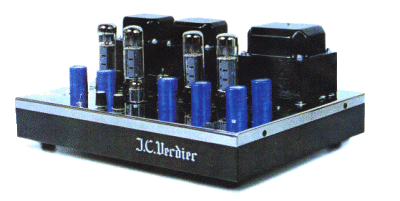
The next two Verdier amps I came across were not SET amps, but push-pull pentode amps. First was the older L'Amplificateur 6550, sold to Danz by seamonster, (and now with Patrick). I always thought this amp was a little too warm for my taste, but recently I heard it at Patrick's place and it was not so when driven by Counterpoint SA-2000E! Ah, matching!

Only just before I acquired the Control B I Came across the 220 MkII (official material here; Control version, with selector and volume knobs), generously loaned to me by my friend relax173. The original 220 actually had many configurations (not to be confused with the later 220DE, which was "double-end"). The one pictured here uses EL34 but the one I heard used 4x EH 6L6/5881, outputting a grand 20 wpc in push-pull configuration! :-) But don't under-estimate this amp! Its 20 wpc was powerful enough to drive my ATC20 to satisfying level, if not plumbing its ultimate depth. Paired with easier speakers, like the Vienna Acoustic Haydn Grand SE, the 220 made great music, superbly transparent, rhythmically savvy and musically wholesome. A great amp, I was sorry to see it go!

J.C. Verdier 220C MKⅡ
曾在 2001 年獲音響論壇年度最佳器材大獎:"...很難想像,一家生產百萬元級磁浮LP唱盤、六十萬元級單聲道電源分體式唱頭放大器的公司,竟然會推出五萬多元的真空管擴大機?而且,這款採用四支6L6/5881真空管推挽輸出20瓦的後級,還可以當作綜合擴大機?...自然呈現的音質,清新暢快的音樂性,晶體機重現能力的透明感,都是它在聲音表現上的特點。「毫無保留,最佳推薦」的試聽評語為220C MKⅡ作下了最佳註解..."

Click here for some of my previous encounters with JC Verdier.

Let me use a classical symphony to describe the layout of this article. The introduction of the turntables was like a Haydnesque slow opening. The full treatment of Control B is the first movement (allegro), the briefer descriptions of the 4 amplifiers are like the two inner movements, two in pentode mode (scherzo), two in SET mode (andante). You guessed it, we have arrived at the grand finale...

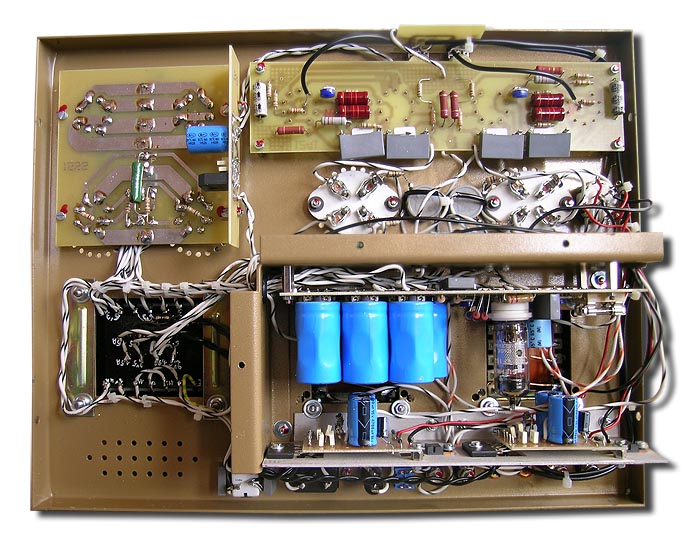
left pic: internals of 2300B Luxe. right pic: bottom, Control B and Elekit TU-875; top, Verdier 2300B Luxe (click on pics to enlarge)

Luxe, Luxury, in every sense of the word
Just one week after I bought the Control B, the nice seller, who had also previously owned the 275DE, decided to sell me his 300B Luxe. One big caveat, his amplifier is not stock. JCV's Triode Spirit series, whether plain Jane or Luxe versions, all have similar topology and use similar components. Below is a pic of the 45 amp downloaded from the net (6moons review of 45). Compare with my pic you should see the 2300B Luxe has more tubes (EF184) inside due to the hum-hunting circuit. You should also notice various can type caps have been changed (to Black gates and Jensens of the same values). This did not concern me as much as replacement of the 4 coupling caps on the input board (from gray "AV"; can someone tell me what they are?) to bright yellow Auricaps. The modification had been done by 凱韻, and that worried me greatly. In the past I have heard too many mods by this shop that sounded terrible. Basically this shop doesn't care for original design, and since they sell the expensive caps they routinely do wholesale cap replacements without regard to sound. It is my experience using too many expensive boutique caps usually result in bad sound. But it is rare to encounter this amp on the second-hand market, so I bought it, thinking if necessary I should just restore it to stock form (all original caps retained). Interestingly I asked the seller what was the sound difference after the mod, and he said very little!

Initial listening had me worried. There was a curious lack of body to things, a sort of vacuity that just couldn't be JC Verdier! And this was matched with the Control B! I began to mentally get myself ready to do some solder work. But then things started to improve with a little tube rolling. Substituting 2 old RCA 5U4 for the stock Sovteks was not as effective as swapping out the stock KR VV300B for generic Shuguang 300B. I much prefer the Chinese 300B to the sterile VV300B for balance and musical involvement. I did not have 6AS7/6080 on hand. Be Careful NOT to swap the 4x EF184, as these have to be matched and internally adjusted!

After a few days, the combo miraculously snapped into focus. On the day icefox came we auditioned this system:

-Digital: Sony CDP R1/DAS R1
-Analogue: Technics SP10/Rega with Michell counterweight and Incognito wiring/Benz Micro Gold
-Preamp/Amp: JC Verdier Control B + 2300B Luxe
-Loudspeakers: Tannoy Canterbury HE

On the beautifully recorded Berlin recital CD Argerich's piano had a bloom that was not there just days before. Perhaps the amplifier had not been used for a while? Kremer's violin was silky and not at all acerbic even in this music. With the JCV combo, I was fully aware of Kremer's bowing, and able to feel the back-and-forth action of his bow, which eludes the Elekit preamp, good as that was. With the Verve LP (re-issue) one just felt the synergy between the musicians, which included Oscar Peterson and Ray Brown on this date. You could feel them tossing things at each other. That is not a feeling one often gets. JCV may not be the most analytical or most detailed, but the combo distinguishes itself in the capture of the musical event, the microdynamics and rhythm that constitute the atmosphere, if you will.

icefox I think really took to the combo. He is one of the few person who has heard my equally distinguished Wavac PR-X2/MD-300B combo (which I really should write up). We agree that the JCV imparts a richer and more soulful character 幸福指數高點, while the Wavac tends to be etched in more details and perhaps more alert (I'd not say more "hifi").

More useful links:
220DE MkII 音響論壇
6moons review of 45
JC Verdier Museum

09 February, 2011

Talk R2R: How to Describe the Sound of R2R?

Talk R2R: How to Describe the Sound of R2R?

As I had struggled to describe the sound of R2R, I was astonished by what Robin wrote in an email to me. More than waxing lyrics, its eloquence is so heart-felt! It encapsulates the perfect listening experience:

"...I was so happy to read your Yumcha Diary entry on our get-together last Saturday! I feel awed, but delighted of course, that you liked the new system so much. Since then, it's been getting noticeably better each day, as the new capacitors settle down and start singing their little hearts out whenever I put on a really good quality tape. Sadly, there are fewer of these than I thought: now that everything is so clear and well-defined, I can hear major tape dropout on quite a few of the tapes I'd previously felt were OK. (They've gone straight onto the "B" pile, for future recycling as empty reels.) Overall, I must revise my estimate of the wastage rate among the tapes I've bought so far, to at least 35 percent. Still, I'm gradually learning which ebay sellers are reliable and which aren't, so hopefully I'll be able to make wiser purchase choices in future. I've probably wasted around US $400 in all so far with bad tapes, but I'm just going to see it as my "tape culture 101 tuition fees"... No pain, no gain, etc...

As I have more and more of those special listening moments that you eloquently described in the case of the Shostakovich s.q. #8 on Saturday (isn't that tape something!), I'm starting to experience music in ways I never have before. I can only describe it as a kind of "synaesthesia": a merging of one's separate physical senses into one, single continuum of sensation. As Oliver Sacks writes, people who "suffer" from synaesthesia can see sounds, smell colours and hear paintings, etc. (In certain practical ways, this must be a problem; but on other levels it greatly enrich their lives.)...

What I've found lately, listening to music via magnetic tape - and as you point out, the big Yams also deserve a lot of the credit here - is that (for example) a particularly expressive line on the cello gets converted -- in some very basic part of my brain -- into a kind of "analog" of the sensation of brown/wood/earth. Or rather, the lines separating what I'm hearing, per se, and the numerous other sensations - visual and/or tactile - that the sound directly conjures up in my field of awareness, begin to blur, and it all becomes a delicious sensory amalgam...

Similarly, when Paolien and I went to the Botanical Gardens on Sunday afternoon, just after I'd been listening to a Bohm/Berlin Philharmonic tape of Mozart's symphony #33, and the sun was pouring down, I sat on a bench and looked at the trees / skies / flowers all around -- and I almost saw (or began to see) a symphony taking shape before my eyes! The tall trees were the cello section, the red flowers were the oboes, the green shrubs and bushes all around were the first and second violins --- sorry, I should stop all these fanciful ramblings!...

The time dimension is another area where I find magnetic tape brings very unexpected results. The special clarity and directness of the sound one gets can be attributed, perhaps, to four key factors: better dynamics, linearity, coherence, and texture. Subjectively, one outcome is that a piece of music seems to last much longer, on tape, than the same piece heard from a CD or LP. Or maybe it would be more accurate to say that one simply stops paying attention to time while the tape is playing. The relentless ticking of clock time, which governs our lives in so many ways, known and unknown, these days, becomes irrelevant -- and instead one is simply "there", in the continuous moment as the music organically unfolds..."

Isn't that something!